ADICHUNCHANAGIRI INSTITUTE OF TECHNOLOGY, CHIKMAGALUR
(Affiliated to VTU, Belagavi-590018)
DEPARTMENT OF
ELECTRONICS AND COMMUNICATION
GPS BASED SPACE DEBRIS
REMOVAL SYSTEM
By: DILSHAD BANU
USN: 4AI12EC025
CONTENTS
1. Abstract
2. Introduction
3. Types of Orbits
4. Tracking and Measurement of Debris
5. Clearance of space debris
6. Implementation
7. Advantages
8. Disadvantages
9. Conclusion
10. Reference
ABSTRACT
There are various methods in which the space debris issue can be
handled. The implementation of debris removal techniques will give
a bright future. Satellite communication would develop faster as
there will be no obstacles. Every corner of earth, even the poles
could be linked via satellites. So, A portion of the International
Space Station should be allocated for space debris removal and
control called as Debris removal system.
INTRODUCTION
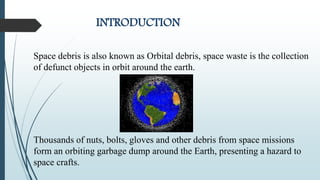
Space debris is also known as Orbital debris, space waste is the collection
of defunct objects in orbit around the earth.
Thousands of nuts, bolts, gloves and other debris from space missions
form an orbiting garbage dump around the Earth, presenting a hazard to
space crafts.
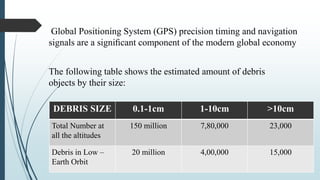
Global Positioning System (GPS) precision timing and navigation
signals are a significant component of the modern global economy
The following table shows the estimated amount of debris
objects by their size:
DEBRIS SIZE 0.1-1cm 1-10cm >10cm
Total Number at
all the altitudes
150 million 7,80,000 23,000
Debris in Low –
Earth Orbit
20 million 4,00,000 15,000
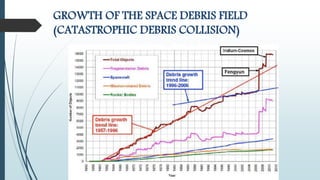
GROWTH OF THE SPACE DEBRIS FIELD
(CATASTROPHIC DEBRIS COLLISION)
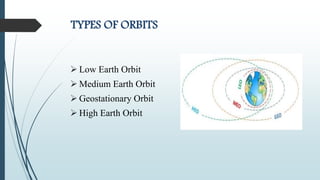
TYPES OF ORBITS
 Low Earth Orbit
 Medium Earth Orbit
 Geostationary Orbit
 High Earth Orbit
TRACKING OF DEBRIS
 RADAR and optical detectors such as LIDAR are the main tools used
for tracking space debris.
 Some of the modules used were:
 LDEF(Long Duration Exposure Facility) satellite
 EURECA(European Retrievable Carrier)
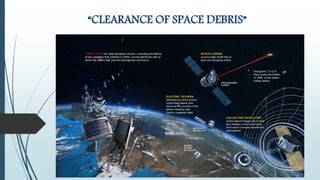
“CLEARANCE OF SPACE DEBRIS”
DIFFERENT METHODS
 Electro dynamic tethers
 LASER beam
 Solar Sail
 Collectors
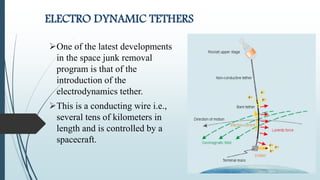
ELECTRO DYNAMIC TETHERS
One of the latest developments
in the space junk removal
program is that of the
introduction of the
electrodynamics tether.
This is a conducting wire i.e.,
several tens of kilometers in
length and is controlled by a
spacecraft.
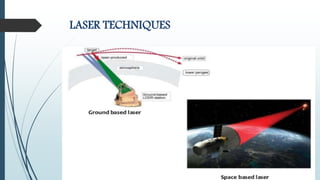
LASER BEAM
By using a highly intense laser beam we can slow down the debris
thereby allowing it to reenter earth’s atmosphere.
With continued application the debris will eventually decrease their
altitude enough to become subject to atmospheric drag.
Mainly the LASER based techniques are two types.
1. Ground based LASER technique.
2. Space based LASER technique.
LASER TECHNIQUES
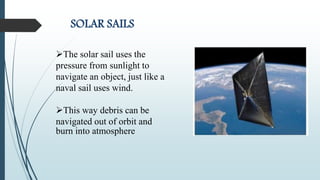
SOLAR SAILS
The solar sail uses the
pressure from sunlight to
navigate an object, just like a
naval sail uses wind.
This way debris can be
navigated out of orbit and
burn into atmosphere
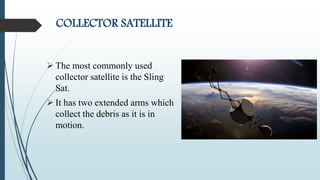
COLLECTOR SATELLITE
 The most commonly used
collector satellite is the Sling
Sat.
 It has two extended arms which
collect the debris as it is in
motion.
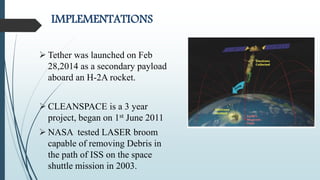
IMPLEMENTATIONS
 Tether was launched on Feb
28,2014 as a secondary payload
aboard an H-2A rocket.
 CLEANSPACE is a 3 year
project, began on 1st June 2011
 NASA tested LASER broom
capable of removing Debris in
the path of ISS on the space
shuttle mission in 2003.
Contd…
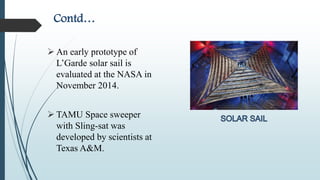
 An early prototype of
L’Garde solar sail is
evaluated at the NASA in
November 2014.
 TAMU Space sweeper
with Sling-sat was
developed by scientists at
Texas A&M.
ADVANTAGES
It provides efficient Satellite Communication
It is feasible way to remove 1 to 10 cm debris from LEO
 It can track and target debris with a much larger field of
view.
It can act as a space –based weapon system. Unlike other
debris removal methods it will not provide any negative
atmospheric effects.
DISADVANTAGES
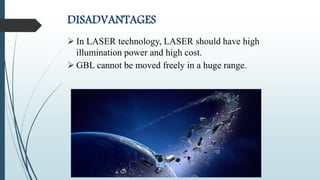
 In LASER technology, LASER should have high
illumination power and high cost.
 GBL cannot be moved freely in a huge range.
CONCLUSION
We know that “prevention is better than cure”. The efficiency and time
period of satellite can increase by the use of debris removal system, i.e.,
we can prevent the destruction of the satellites. “The beginning is always
today” should be our approach; otherwise the future will be a in dark.
REFERENCES
[1] NASA Orbital Debris Quarterly News, January 2010
[2] Anderson, R.E., interviewed by Jacob Abolafia, Dudley Observatory,
Schenectady, New York, 26 May 2008
[3] Wheeler, “The Current Legal Framework Associated with Debris
Mitigation” Proc IMechE, Part G 221 6 (2007), pp 911-14
[4] Easton, R.L., Global Navigation Flies High, Physics World, Vol. 20,
No. 10, 2007, pp. 34-38.
[5] Easton, R.Timation and the Invention of the Global Positioning System:
1964-1973, Quest: The History of Spaceflight Quarterly, Vol. 14, No. 3,
2007, pp. 12-17.
 GPS BASED DEBRIS REMOVAL SYSTEM

GPS BASED DEBRIS REMOVAL SYSTEM

  • 1.
    ADICHUNCHANAGIRI INSTITUTE OFTECHNOLOGY, CHIKMAGALUR (Affiliated to VTU, Belagavi-590018) DEPARTMENT OF ELECTRONICS AND COMMUNICATION GPS BASED SPACE DEBRIS REMOVAL SYSTEM By: DILSHAD BANU USN: 4AI12EC025
  • 2.
    CONTENTS 1. Abstract 2. Introduction 3.Types of Orbits 4. Tracking and Measurement of Debris 5. Clearance of space debris 6. Implementation 7. Advantages 8. Disadvantages 9. Conclusion 10. Reference
  • 3.
    ABSTRACT There are variousmethods in which the space debris issue can be handled. The implementation of debris removal techniques will give a bright future. Satellite communication would develop faster as there will be no obstacles. Every corner of earth, even the poles could be linked via satellites. So, A portion of the International Space Station should be allocated for space debris removal and control called as Debris removal system.
  • 4.
    INTRODUCTION Space debris isalso known as Orbital debris, space waste is the collection of defunct objects in orbit around the earth. Thousands of nuts, bolts, gloves and other debris from space missions form an orbiting garbage dump around the Earth, presenting a hazard to space crafts.
  • 5.
    Global Positioning System(GPS) precision timing and navigation signals are a significant component of the modern global economy The following table shows the estimated amount of debris objects by their size: DEBRIS SIZE 0.1-1cm 1-10cm >10cm Total Number at all the altitudes 150 million 7,80,000 23,000 Debris in Low – Earth Orbit 20 million 4,00,000 15,000
  • 6.
    GROWTH OF THESPACE DEBRIS FIELD (CATASTROPHIC DEBRIS COLLISION)
  • 7.
    TYPES OF ORBITS Low Earth Orbit  Medium Earth Orbit  Geostationary Orbit  High Earth Orbit
  • 8.
    TRACKING OF DEBRIS RADAR and optical detectors such as LIDAR are the main tools used for tracking space debris.  Some of the modules used were:  LDEF(Long Duration Exposure Facility) satellite  EURECA(European Retrievable Carrier)
  • 9.
  • 10.
    DIFFERENT METHODS  Electrodynamic tethers  LASER beam  Solar Sail  Collectors
  • 11.
    ELECTRO DYNAMIC TETHERS Oneof the latest developments in the space junk removal program is that of the introduction of the electrodynamics tether. This is a conducting wire i.e., several tens of kilometers in length and is controlled by a spacecraft.
  • 12.
    LASER BEAM By usinga highly intense laser beam we can slow down the debris thereby allowing it to reenter earth’s atmosphere. With continued application the debris will eventually decrease their altitude enough to become subject to atmospheric drag. Mainly the LASER based techniques are two types. 1. Ground based LASER technique. 2. Space based LASER technique.
  • 13.
  • 14.
    SOLAR SAILS The solarsail uses the pressure from sunlight to navigate an object, just like a naval sail uses wind. This way debris can be navigated out of orbit and burn into atmosphere
  • 15.
    COLLECTOR SATELLITE  Themost commonly used collector satellite is the Sling Sat.  It has two extended arms which collect the debris as it is in motion.
  • 16.
    IMPLEMENTATIONS  Tether waslaunched on Feb 28,2014 as a secondary payload aboard an H-2A rocket.  CLEANSPACE is a 3 year project, began on 1st June 2011  NASA tested LASER broom capable of removing Debris in the path of ISS on the space shuttle mission in 2003.
  • 17.
    Contd…  An earlyprototype of L’Garde solar sail is evaluated at the NASA in November 2014.  TAMU Space sweeper with Sling-sat was developed by scientists at Texas A&M.
  • 18.
    ADVANTAGES It provides efficientSatellite Communication It is feasible way to remove 1 to 10 cm debris from LEO  It can track and target debris with a much larger field of view. It can act as a space –based weapon system. Unlike other debris removal methods it will not provide any negative atmospheric effects.
  • 19.
    DISADVANTAGES  In LASERtechnology, LASER should have high illumination power and high cost.  GBL cannot be moved freely in a huge range.
  • 20.
    CONCLUSION We know that“prevention is better than cure”. The efficiency and time period of satellite can increase by the use of debris removal system, i.e., we can prevent the destruction of the satellites. “The beginning is always today” should be our approach; otherwise the future will be a in dark.
  • 21.
    REFERENCES [1] NASA OrbitalDebris Quarterly News, January 2010 [2] Anderson, R.E., interviewed by Jacob Abolafia, Dudley Observatory, Schenectady, New York, 26 May 2008 [3] Wheeler, “The Current Legal Framework Associated with Debris Mitigation” Proc IMechE, Part G 221 6 (2007), pp 911-14 [4] Easton, R.L., Global Navigation Flies High, Physics World, Vol. 20, No. 10, 2007, pp. 34-38. [5] Easton, R.Timation and the Invention of the Global Positioning System: 1964-1973, Quest: The History of Spaceflight Quarterly, Vol. 14, No. 3, 2007, pp. 12-17.