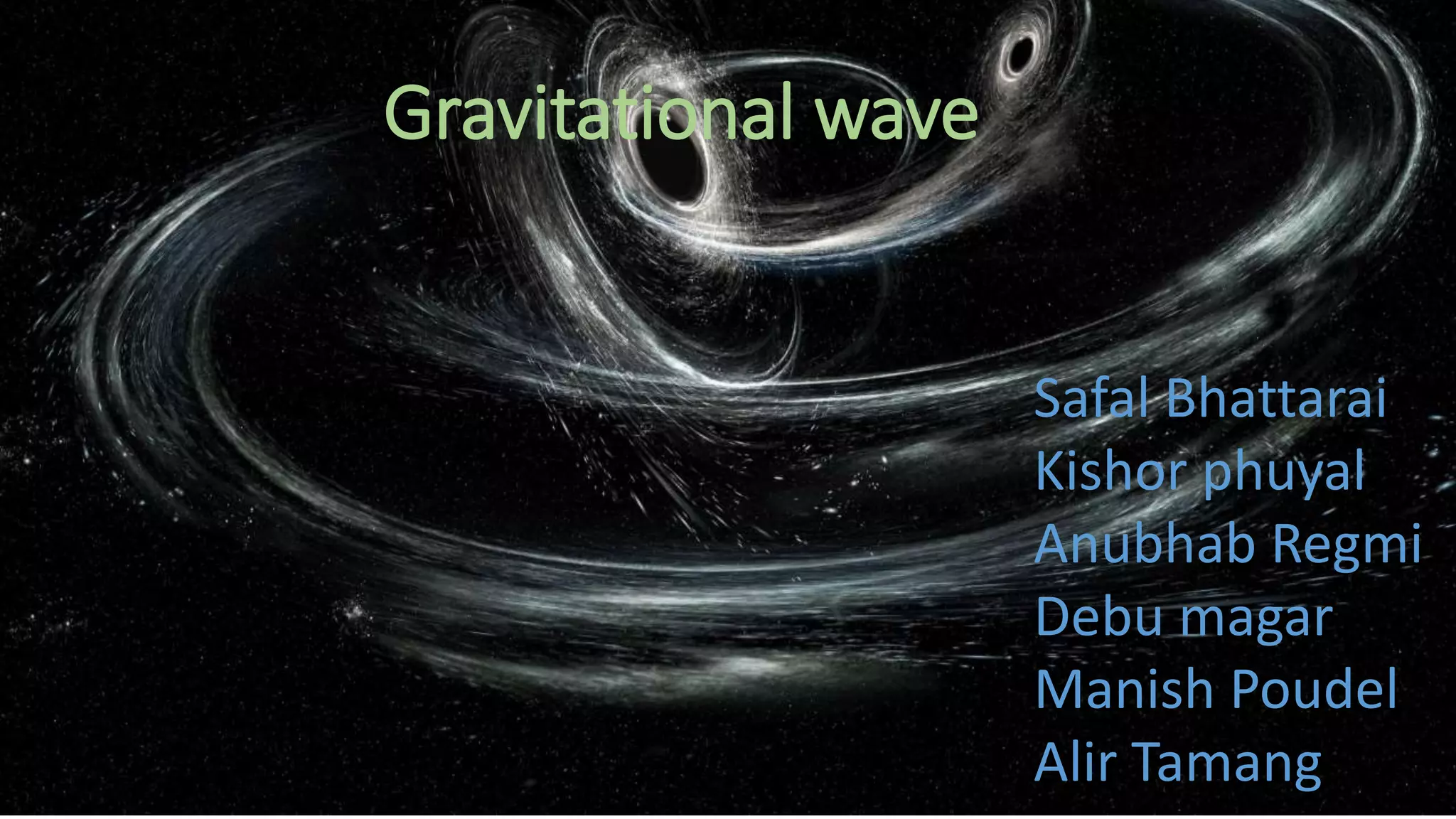
Gravitational wave
Safal Bhattarai
Kishor phuyal
Anubhab Regmi
Debu magar
Manish Poudel
Alir Tamang
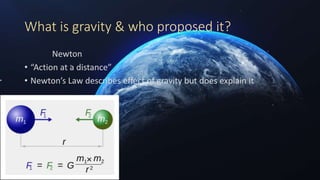
What is gravity & who proposed it?
Newton
• “Action at a distance”
• Newton’s Law describes effect of gravity but does explain it
Who explained Gravity?
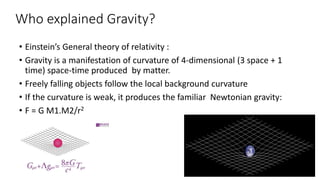
• Einstein’s General theory of relativity :
• Gravity is a manifestation of curvature of 4-dimensional (3 space + 1
time) space-time produced by matter.
• Freely falling objects follow the local background curvature
• If the curvature is weak, it produces the familiar Newtonian gravity:
• F = G M1.M2/r2
Gravitational-waves
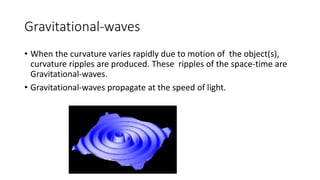
• When the curvature varies rapidly due to motion of the object(s),
curvature ripples are produced. These ripples of the space-time are
Gravitational-waves.
• Gravitational-waves propagate at the speed of light.
General Relativity
• Einstein predicted that objects cause the fabric of space-time around
them to curve.
• Moving objects should therefore create ripples in space-time
• Einstein predicted that the more massive the object the larger the
gracitatioal waves it ould create.
Tests of General Relativity
• Einstein’s formulas explained Mercury’s perihelion changes.
• Observations of starlight passing the sun during a solar eclipse in
1919 confirmed that light is bent by the curved space-time
surrounding the sun.
Electromagnetic (versus) Gravitational-
waves
• EM waves are produced by accelerated charges, whereas
GWs are produced by accelerated “masses”.
• EM waves propogate through space-time, GWs are
oscillations of space-time itself.
• Typical frequencies of EM waves range from (107 Hz –
1020 Hz) whereas GW frequencies range from ~ (10-9 Hz
– 104 Hz). They are more like sound waves.
Cassini Test
• Test took place in September 2002, when the sun was between the
cassini spacecraft and Earth
• Cassini confirmed the theory with 50x greater precision than previous
tests.
• Researchers observed a frequescy shift of radio waves traveling to
and from Cassisn when passed near the sun.
• The extra distance that the radio waves traveled was measured bu th
time were delayed in reaching Earth.
What exactly are gravitational waves?
• Ripples pr ascillations I space-time itself, unlike
electromagnetic radiation, which passes through space-time
• They travel at the speed of light.
• Their strength weakens proportionally to the distance
travelled from the source.
• By the time the waves reach Earth, they are weak and difficult
to detect – comparable to detectiong a change the size of an
atom in the distance between the sun and the earth.
• Neutrons star : an extermly dense burnt-out core left behind
after a star explodes.
• Can have as much mass as the sun in a smaller space ( a few
miles wide).
• Imagine two neutron stars orbiting each other. Their motion couses
space time to be ‘stirred’ and gravitational waves are generated and
send outward from the stars.
• In 1974, Joseph Taylor and Russel Hulse found a pair of neutron stars,
one of the starts was found to be a pulsar.
• After 20 years of measuring these pulses, the shift in their timing
indicated that the pulsar’s orbital period decreased by 75µ per year
• Taylor and Hulse won the Nobel prize in 1993 for their work.
• More binary pulsar systems have since been detected.
What else causes gravitational waves?
• Supernovae and star’s collapse into neutron stars
• Two black holes colliding or orbiting each other
• Neutron star orbitind a black hole
• Rotating neutron star- continuous sources of waves
• Collinging galaxies
• Stochastis background of gravitational waves emitted in the early
stages of the universe- comparable to microwave background.
• Other new and exciting objects.
Detection of Gravitational-waves
• Ground based detectors:
• LIGO (U.S.A), VIRGO (Italy), GEO (Germany), TAMA (Japan),
AURIGA (Australia)
• (Proposed) Space-based detectors:
• LISA (NASA-ESA)
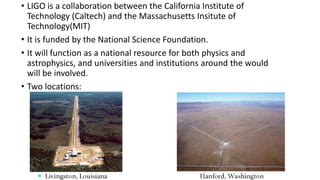
• LIGO is a collaboration between the California Institute of
Technology (Caltech) and the Massachusetts Insitute of
Technology(MIT)
• It is funded by the National Science Foundation.
• It will function as a national resource for both physics and
astrophysics, and universities and institutions around the would
will be involved.
• Two locations:
Goals of LIGO
• Prove the existence of gravitational waves by direct measurements
• Confirm that gravitational waves travel at the speed of light
• Verify that gravitational waves cause disturbances of predicted
amounts in the matter thay pass through.
• Learn more about black hles by provig their existence and study their
behavior.
• Gain other knowledge about the universe, including more information
about supernovae and the big bang.
Other Detectors
• Allegro (Us)
• Auriga (Italy)
• Explorer (Italy)
• Niobe(Australia)
• MiniGrail(Denmark)
• Graviton
Properties of Gravitational waves
• They do not shows reflection or refraction.
• The gravitational waves are tranverse waves
• They show polarization like electromagnetic waves( For eg. Light)
• A powerful properties of gravitational wave is that the universe is
essentially transparent to them. This maked gravitational wwaves a
unique messenger with which to observe the universe, there is
nothing that can block the observation of gravitational wave.
Why should we care about gravitational
waves?
• Learning about gravitational wave will expand our knowledge of the
universe.
• They are thought to remain unchanged bu passing through material –
can carry unaltered information about their source.
• Could gain insight into wy the universe is the way it is and its fate will
be.
• Can accurately determine cosmological distances.
• Searching for existence of gravitational waves may uncover new
phenomena.
• Scientists can detect a black hole using gravitational wave – and how
big and how the black hole is spinning.
• The gravitational waves emitted from each binary system – inspiral
waves – have characteristic frequencies and amplitutde.
• There characteristics depend on properties of the system ( mass,
orbital period, etc).
• When waves emitted during the merging of two neutron stars are
detected, we will be able to learn more about their structure and
equation of state.
• Eventually, we will be able to use the information from inspiral waves
to perform more precise tests of general relativity, measure the
Hubble constant, and understand the geometry of the space-time
black holes and other objects.
Conclusion
• Gravitational waves are one of the most interesting predictions of
general relativity, and provide an unprecedented probe of extreme
gravity environments in the universe.
• There are many potential sources of gravitational wave for out
dectectors, ranging from binary star system to supermassive black hole
mergers to cosmic string cusps.
• We are on the verge of making our first derect gravitational wave
detection. This should happen within 5-10 years, probablt using
Advance LIGO.
• Once gravitational wave dections become routine, we stand to learn a
great deal about systm that are inaccessible to electromagnetic
telescopes.

Gravitational wave.pptx

  • 1.
    Gravitational wave Safal Bhattarai Kishorphuyal Anubhab Regmi Debu magar Manish Poudel Alir Tamang
  • 2.
    What is gravity& who proposed it? Newton • “Action at a distance” • Newton’s Law describes effect of gravity but does explain it
  • 3.
    Who explained Gravity? •Einstein’s General theory of relativity : • Gravity is a manifestation of curvature of 4-dimensional (3 space + 1 time) space-time produced by matter. • Freely falling objects follow the local background curvature • If the curvature is weak, it produces the familiar Newtonian gravity: • F = G M1.M2/r2
  • 4.
    Gravitational-waves • When thecurvature varies rapidly due to motion of the object(s), curvature ripples are produced. These ripples of the space-time are Gravitational-waves. • Gravitational-waves propagate at the speed of light.
  • 5.
    General Relativity • Einsteinpredicted that objects cause the fabric of space-time around them to curve. • Moving objects should therefore create ripples in space-time • Einstein predicted that the more massive the object the larger the gracitatioal waves it ould create.
  • 6.
    Tests of GeneralRelativity • Einstein’s formulas explained Mercury’s perihelion changes. • Observations of starlight passing the sun during a solar eclipse in 1919 confirmed that light is bent by the curved space-time surrounding the sun.
  • 7.
    Electromagnetic (versus) Gravitational- waves •EM waves are produced by accelerated charges, whereas GWs are produced by accelerated “masses”. • EM waves propogate through space-time, GWs are oscillations of space-time itself. • Typical frequencies of EM waves range from (107 Hz – 1020 Hz) whereas GW frequencies range from ~ (10-9 Hz – 104 Hz). They are more like sound waves.
  • 8.
    Cassini Test • Testtook place in September 2002, when the sun was between the cassini spacecraft and Earth • Cassini confirmed the theory with 50x greater precision than previous tests. • Researchers observed a frequescy shift of radio waves traveling to and from Cassisn when passed near the sun. • The extra distance that the radio waves traveled was measured bu th time were delayed in reaching Earth.
  • 9.
    What exactly aregravitational waves? • Ripples pr ascillations I space-time itself, unlike electromagnetic radiation, which passes through space-time • They travel at the speed of light. • Their strength weakens proportionally to the distance travelled from the source. • By the time the waves reach Earth, they are weak and difficult to detect – comparable to detectiong a change the size of an atom in the distance between the sun and the earth. • Neutrons star : an extermly dense burnt-out core left behind after a star explodes. • Can have as much mass as the sun in a smaller space ( a few miles wide).
  • 10.
    • Imagine twoneutron stars orbiting each other. Their motion couses space time to be ‘stirred’ and gravitational waves are generated and send outward from the stars. • In 1974, Joseph Taylor and Russel Hulse found a pair of neutron stars, one of the starts was found to be a pulsar. • After 20 years of measuring these pulses, the shift in their timing indicated that the pulsar’s orbital period decreased by 75µ per year • Taylor and Hulse won the Nobel prize in 1993 for their work. • More binary pulsar systems have since been detected.
  • 11.
    What else causesgravitational waves? • Supernovae and star’s collapse into neutron stars • Two black holes colliding or orbiting each other • Neutron star orbitind a black hole • Rotating neutron star- continuous sources of waves • Collinging galaxies • Stochastis background of gravitational waves emitted in the early stages of the universe- comparable to microwave background. • Other new and exciting objects.
  • 12.
    Detection of Gravitational-waves •Ground based detectors: • LIGO (U.S.A), VIRGO (Italy), GEO (Germany), TAMA (Japan), AURIGA (Australia) • (Proposed) Space-based detectors: • LISA (NASA-ESA)
  • 13.
    • LIGO isa collaboration between the California Institute of Technology (Caltech) and the Massachusetts Insitute of Technology(MIT) • It is funded by the National Science Foundation. • It will function as a national resource for both physics and astrophysics, and universities and institutions around the would will be involved. • Two locations:
  • 14.
    Goals of LIGO •Prove the existence of gravitational waves by direct measurements • Confirm that gravitational waves travel at the speed of light • Verify that gravitational waves cause disturbances of predicted amounts in the matter thay pass through. • Learn more about black hles by provig their existence and study their behavior. • Gain other knowledge about the universe, including more information about supernovae and the big bang.
  • 15.
    Other Detectors • Allegro(Us) • Auriga (Italy) • Explorer (Italy) • Niobe(Australia) • MiniGrail(Denmark) • Graviton
  • 16.
    Properties of Gravitationalwaves • They do not shows reflection or refraction. • The gravitational waves are tranverse waves • They show polarization like electromagnetic waves( For eg. Light) • A powerful properties of gravitational wave is that the universe is essentially transparent to them. This maked gravitational wwaves a unique messenger with which to observe the universe, there is nothing that can block the observation of gravitational wave.
  • 17.
    Why should wecare about gravitational waves? • Learning about gravitational wave will expand our knowledge of the universe. • They are thought to remain unchanged bu passing through material – can carry unaltered information about their source. • Could gain insight into wy the universe is the way it is and its fate will be. • Can accurately determine cosmological distances. • Searching for existence of gravitational waves may uncover new phenomena.
  • 18.
    • Scientists candetect a black hole using gravitational wave – and how big and how the black hole is spinning. • The gravitational waves emitted from each binary system – inspiral waves – have characteristic frequencies and amplitutde. • There characteristics depend on properties of the system ( mass, orbital period, etc). • When waves emitted during the merging of two neutron stars are detected, we will be able to learn more about their structure and equation of state. • Eventually, we will be able to use the information from inspiral waves to perform more precise tests of general relativity, measure the Hubble constant, and understand the geometry of the space-time black holes and other objects.
  • 19.
    Conclusion • Gravitational wavesare one of the most interesting predictions of general relativity, and provide an unprecedented probe of extreme gravity environments in the universe. • There are many potential sources of gravitational wave for out dectectors, ranging from binary star system to supermassive black hole mergers to cosmic string cusps. • We are on the verge of making our first derect gravitational wave detection. This should happen within 5-10 years, probablt using Advance LIGO. • Once gravitational wave dections become routine, we stand to learn a great deal about systm that are inaccessible to electromagnetic telescopes.