DeepSPACE COMMUNICATION
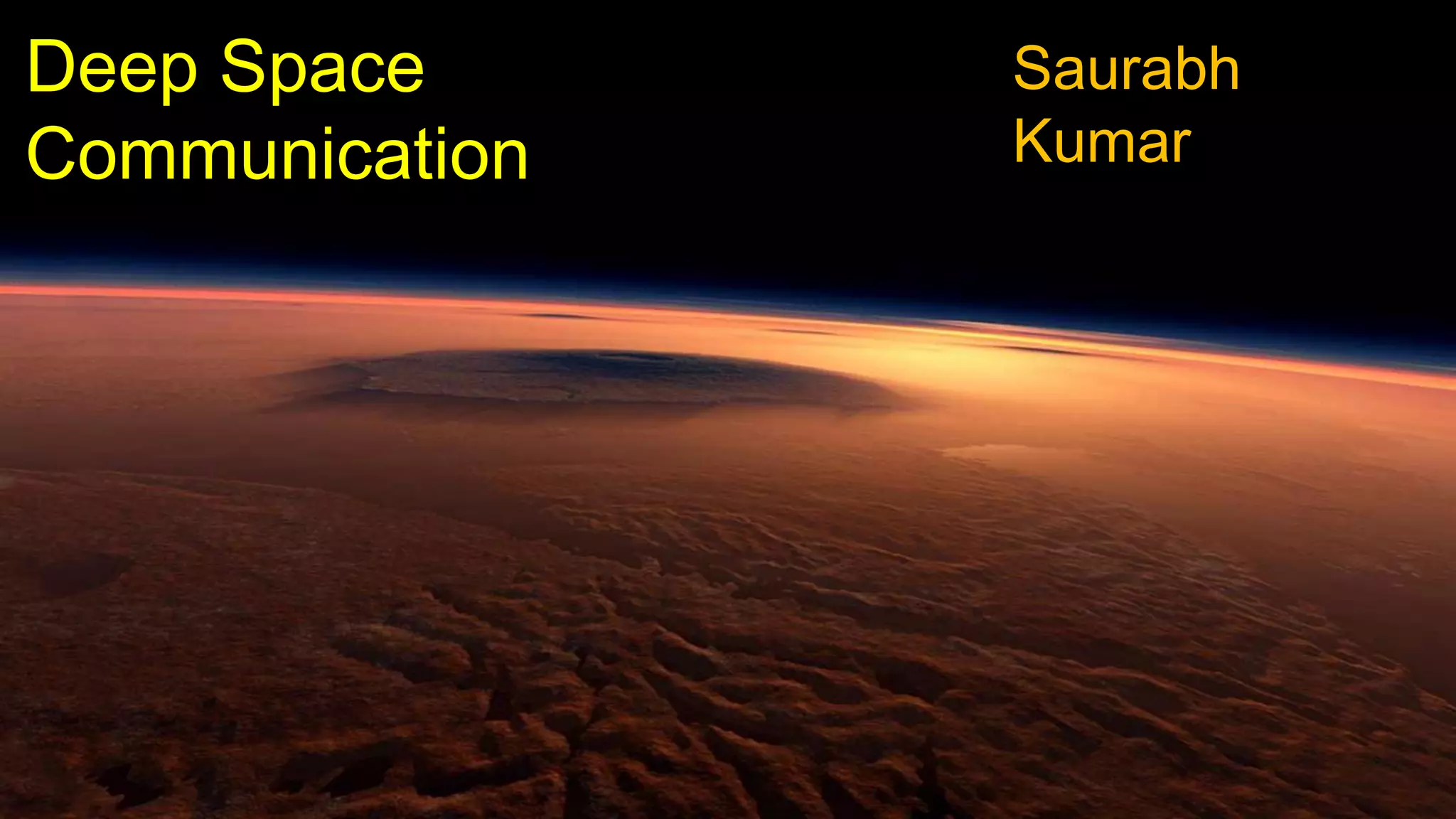
DEEP Space
Communication

Saurabh
Saurabh Kumar
Kumar
What is “Deep Space Communication” ?
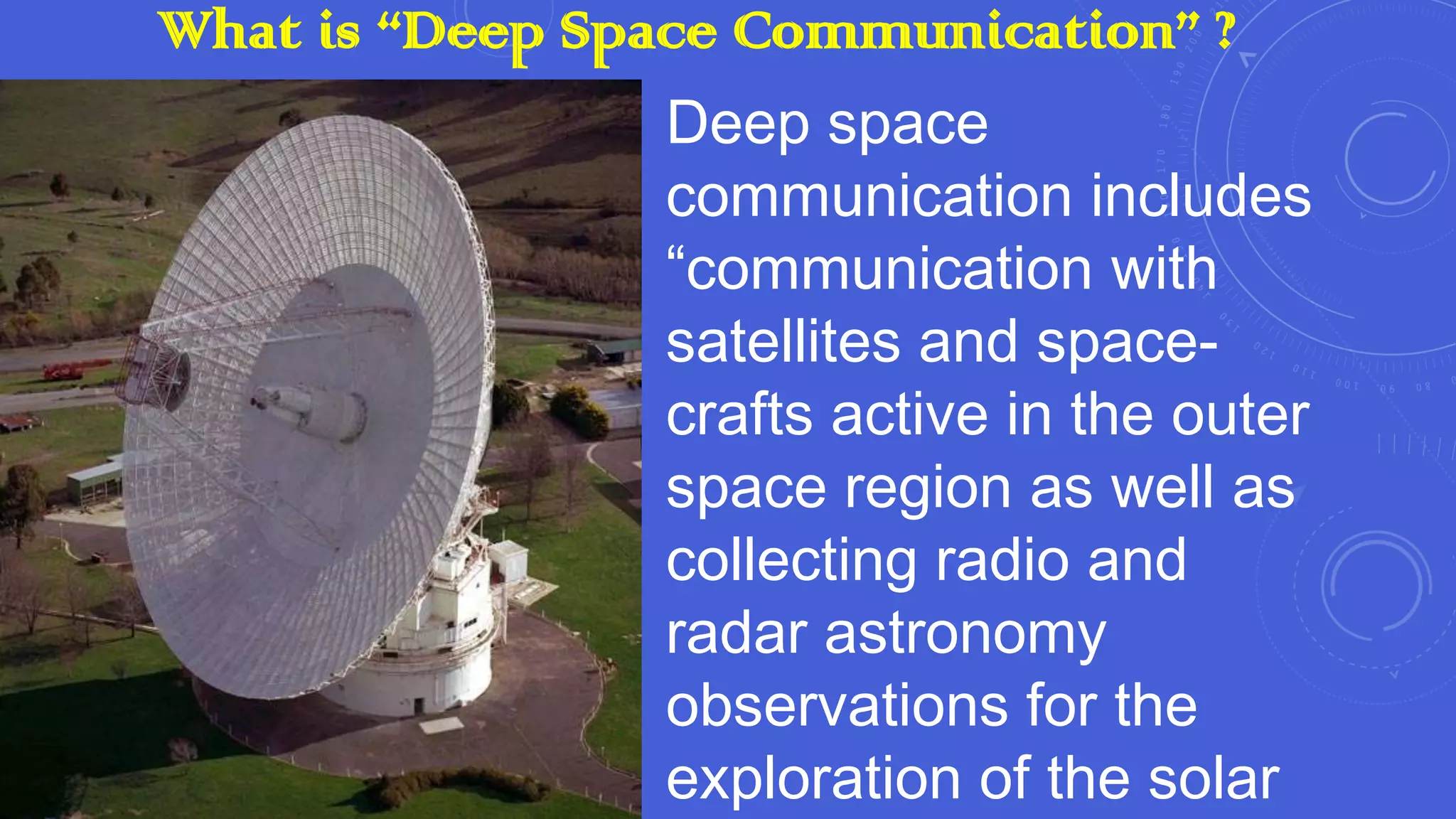
Deep space
communication includes
“communication with
satellites and spacecrafts active in the outer
space region as well as
collecting radio and
radar astronomy
observations for the
exploration of the solar
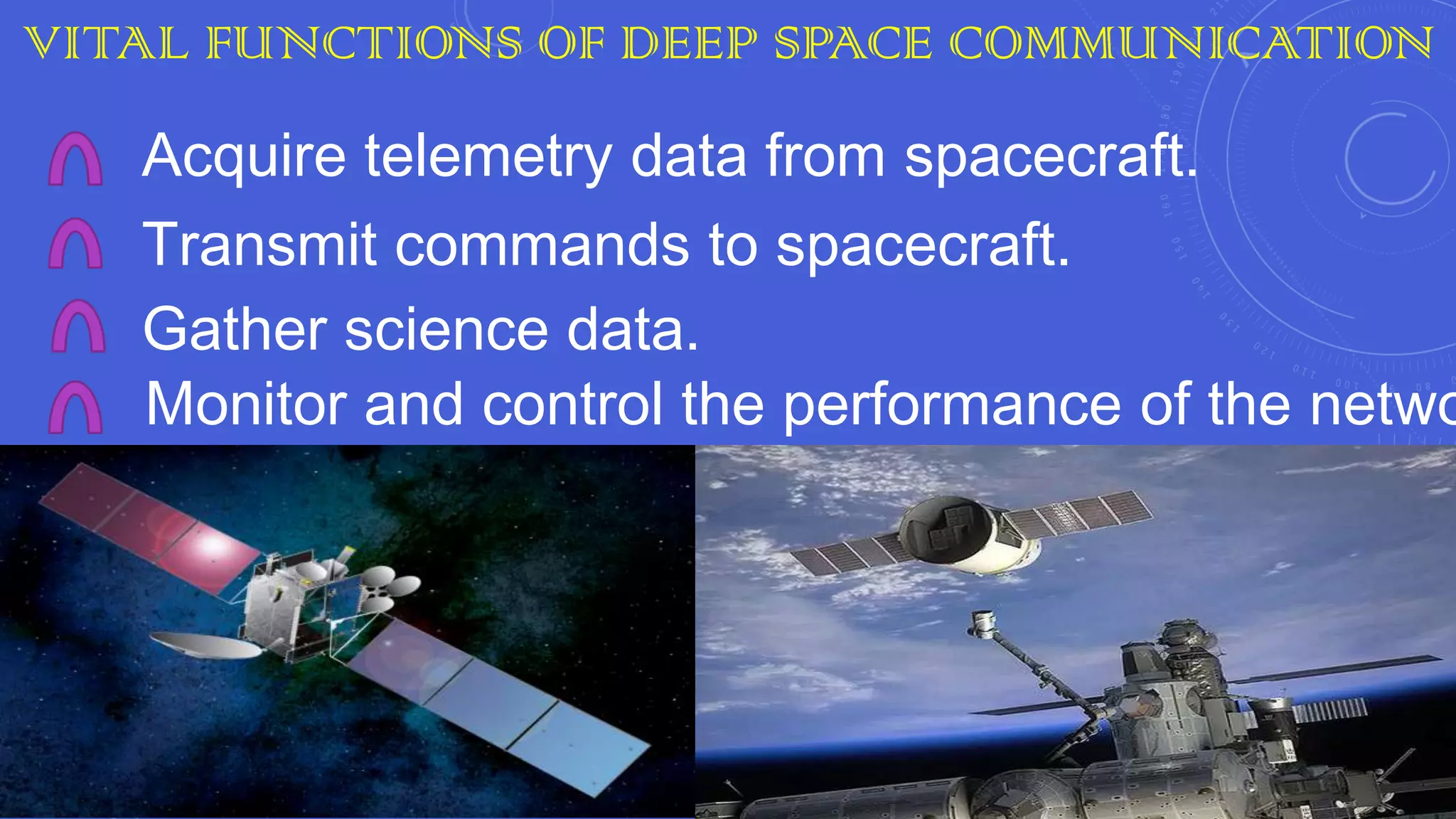
VITAL FUNCTIONS OF DEEP SPACE COMMUNICATION

Acquire telemetry data from spacecraft.
Transmit commands to spacecraft.
Gather science data.
Monitor and control the performance of the netwo
DEEP SPACE NETWORK~BEGINNING

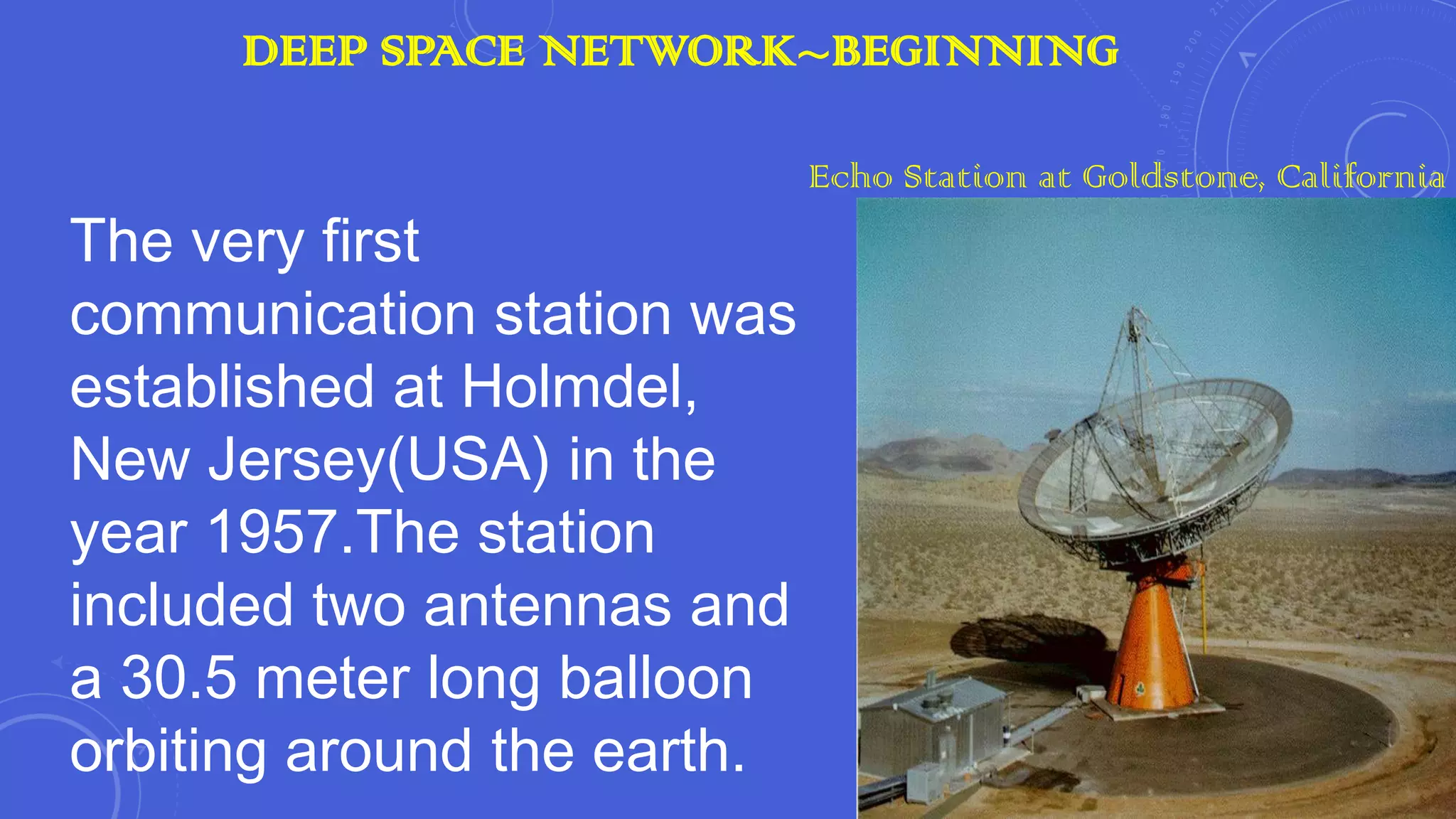
The very first
communication station was
established at Holmdel,
New Jersey(USA) in the
year 1957.The station
included two antennas and
a 30.5 meter long balloon
orbiting around the earth.

Echo Station at Goldstone, California
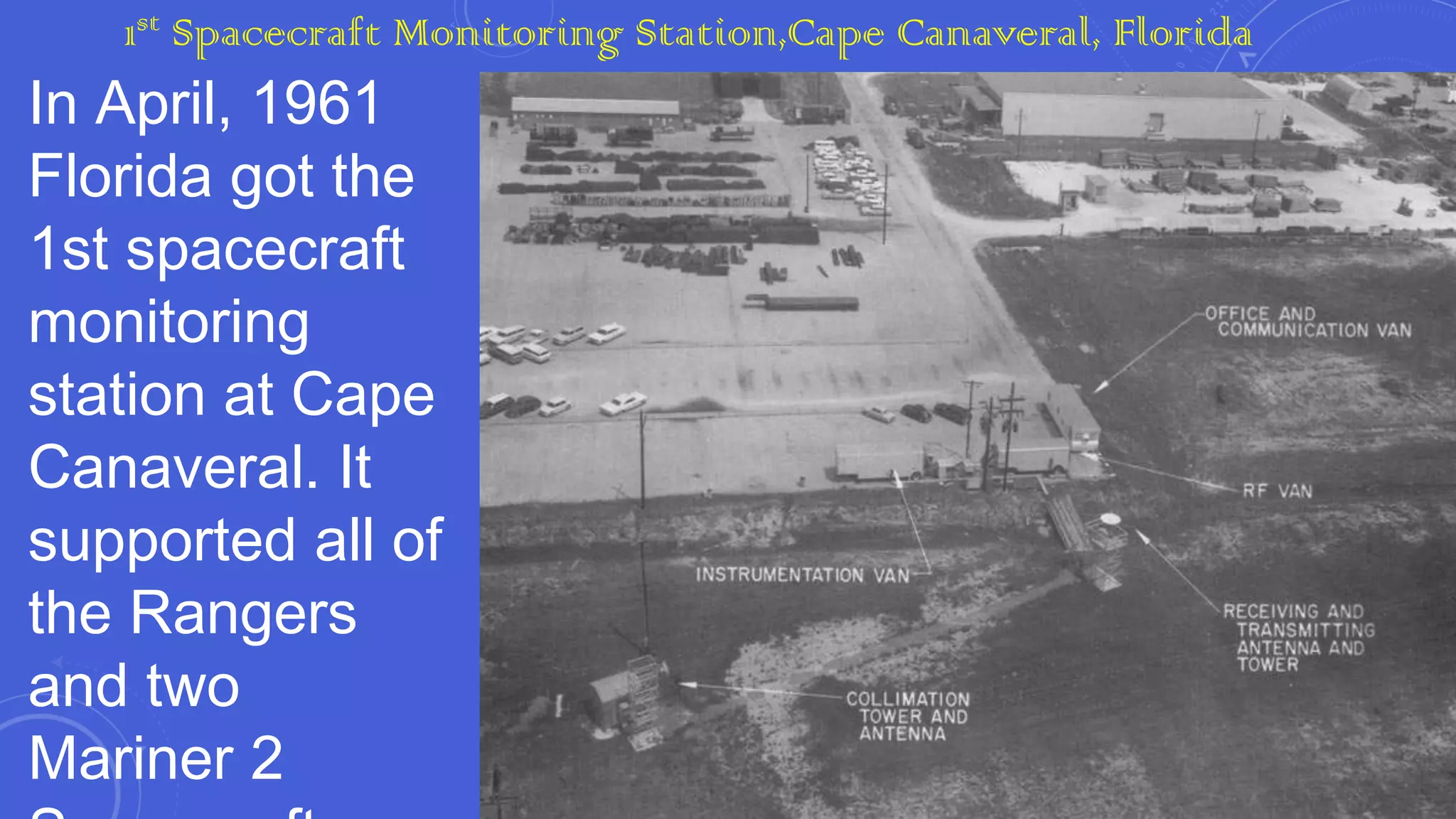
1st Spacecraft Monitoring Station,Cape Canaveral, Florida

In April, 1961
Florida got the
1st spacecraft
monitoring
station at Cape
Canaveral. It
supported all of
the Rangers
and two
Mariner 2
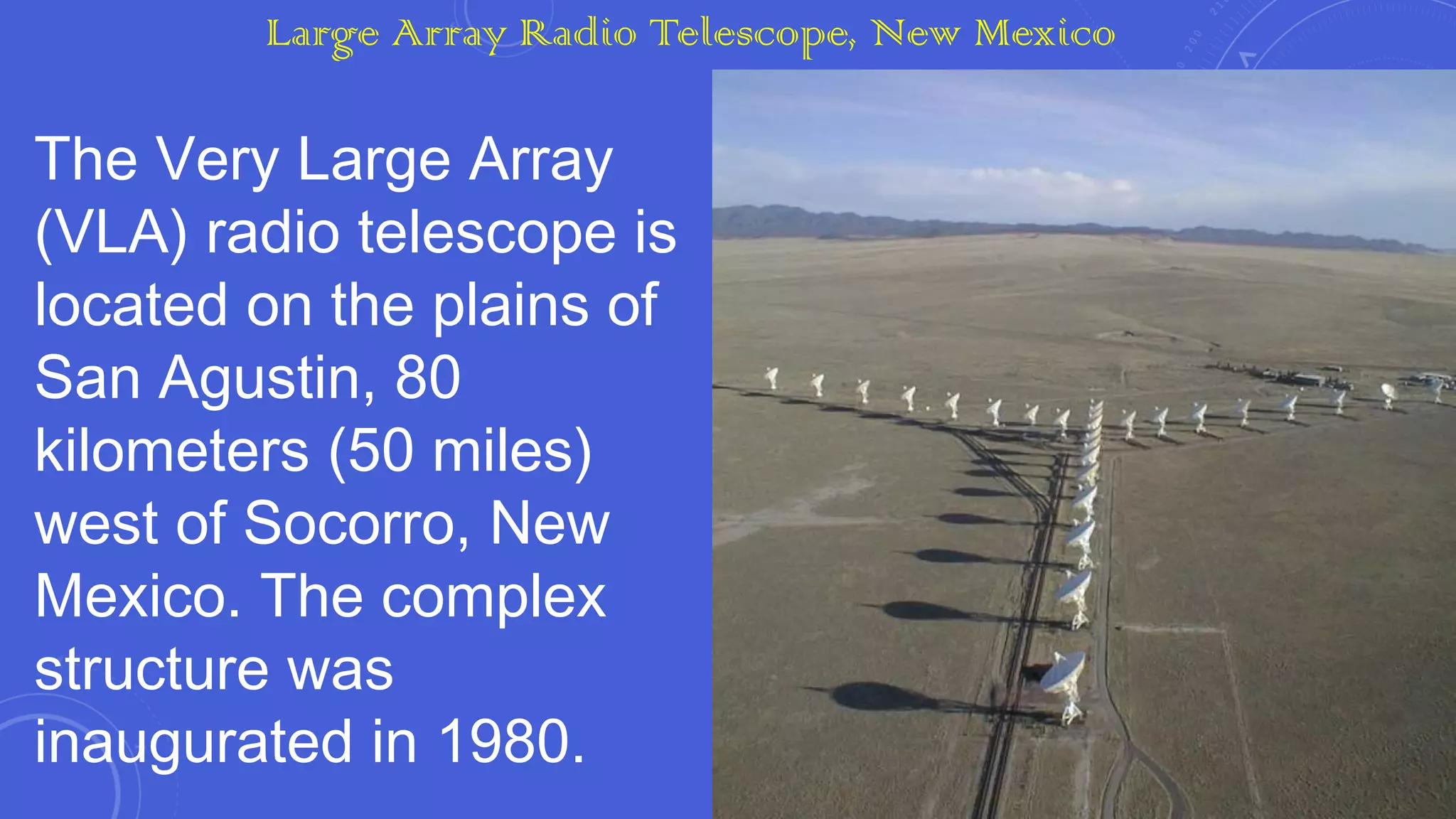
Large Array Radio Telescope, New Mexico

The Very Large Array
(VLA) radio telescope is
located on the plains of
San Agustin, 80
kilometers (50 miles)
west of Socorro, New
Mexico. The complex
structure was
inaugurated in 1980.
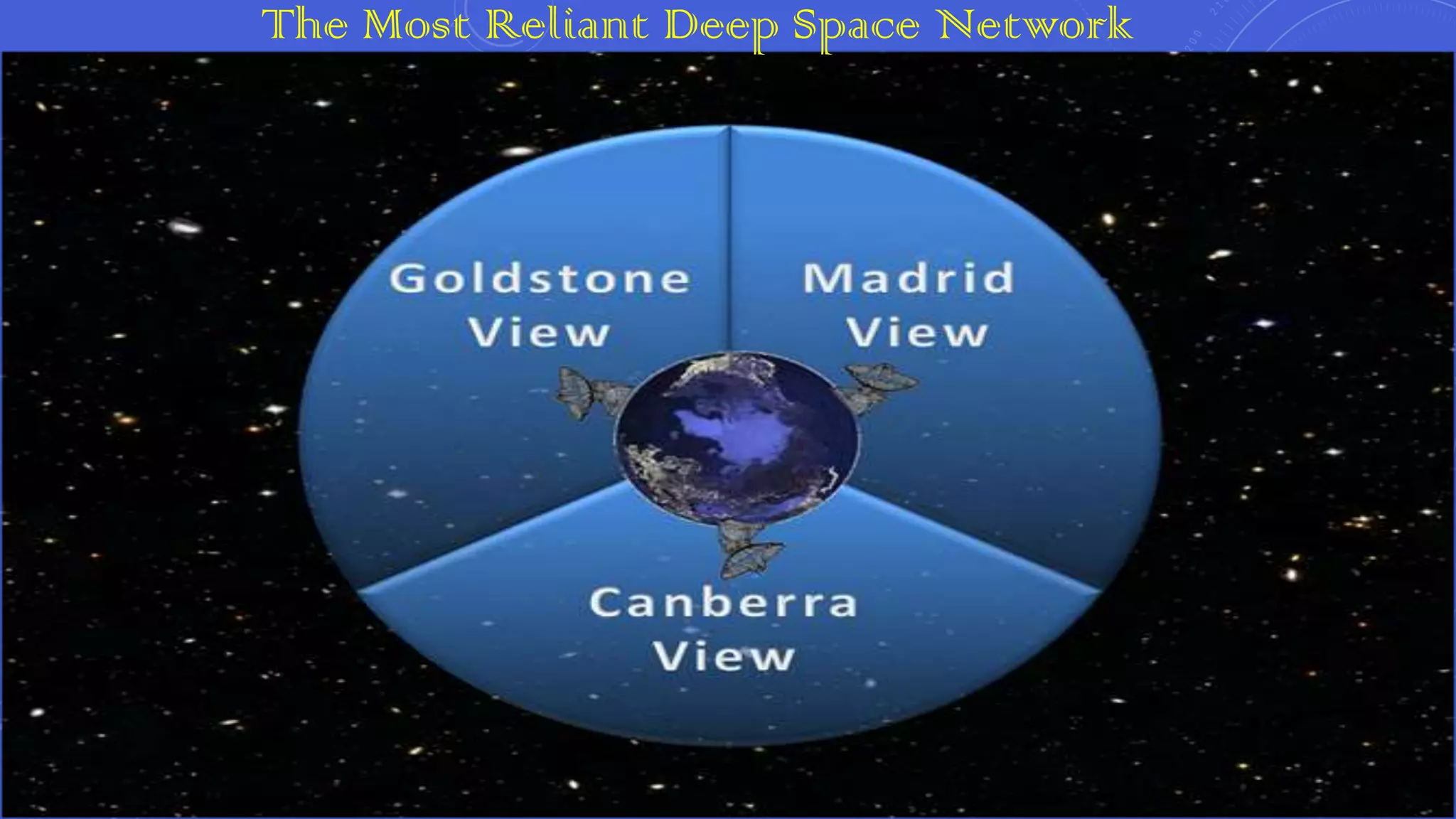
The Most Reliant Deep Space Network
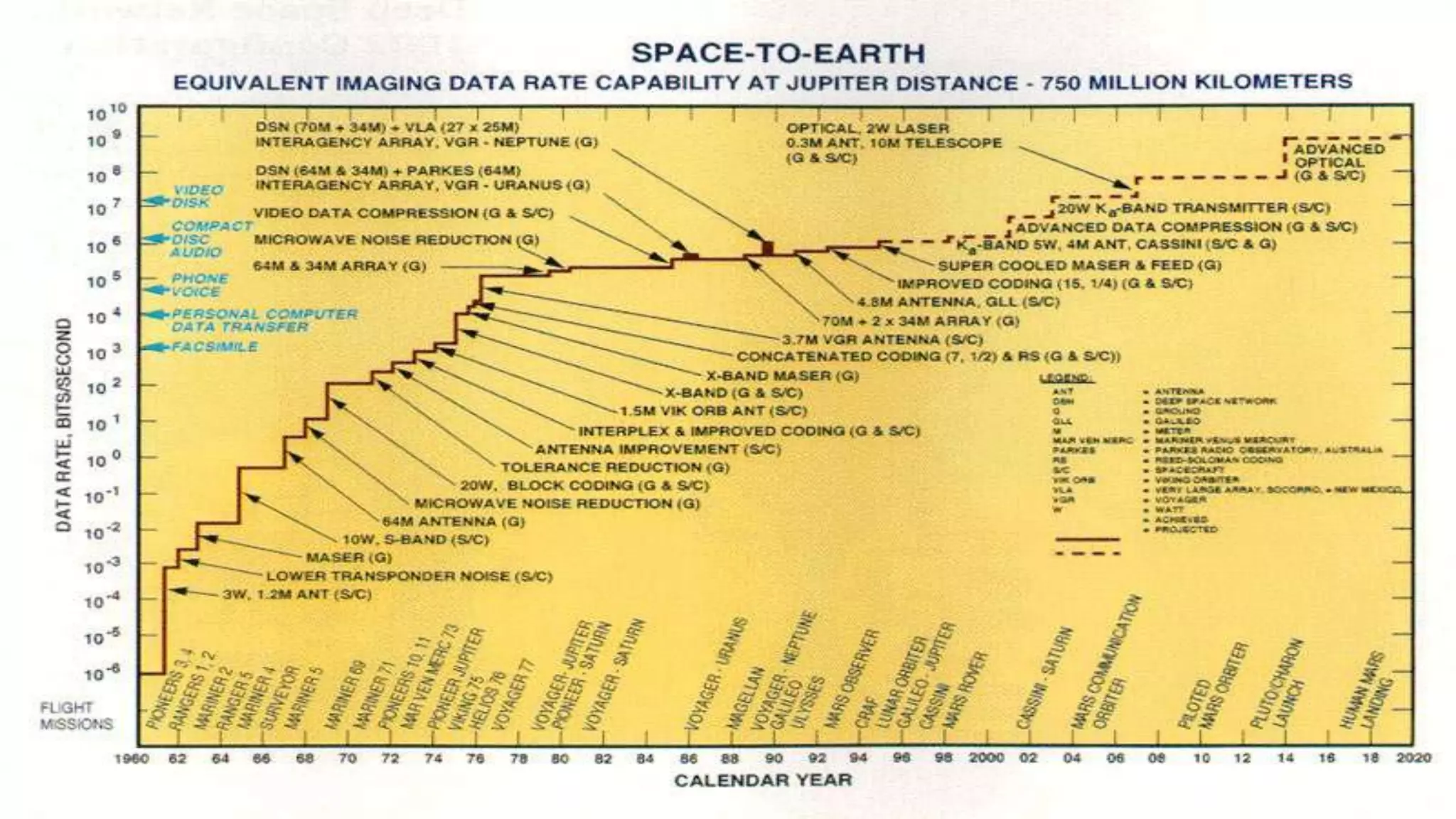
This chart illustrates the real growth of deepspace communications capability from 1960 to
1994 and projected growth to the year 2020.
Real growth has improved by 12 orders of
magnitude, while another three orders of
magnitude are forecast for the future.
The increase in performance is due to a series
of innovative cooperative improvements in both
spacecraft and ground systems.
Challenges of deep-space communications
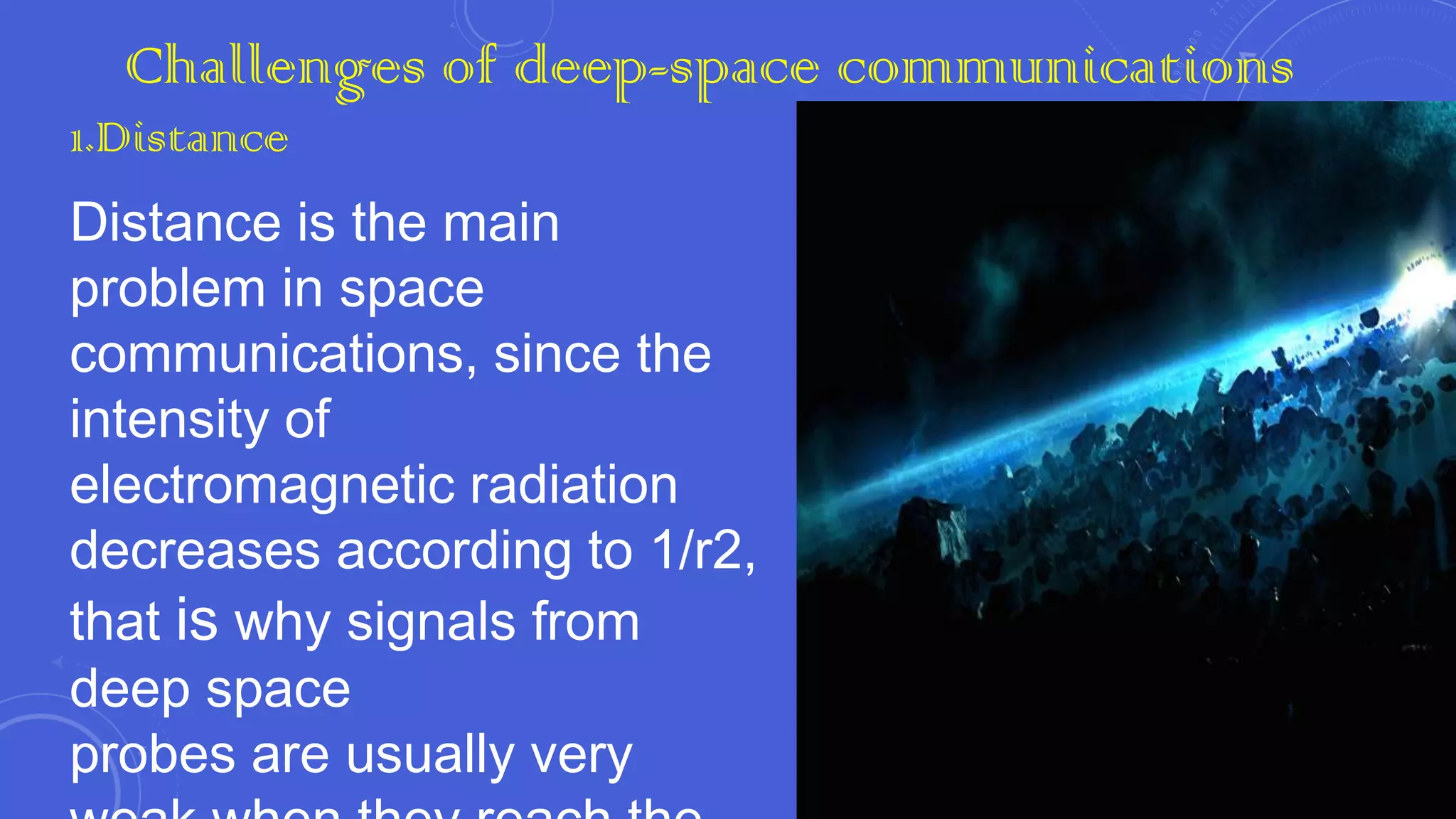
1.Distance

Distance is the main
problem in space
communications, since the
intensity of
electromagnetic radiation
decreases according to 1/r2,
that is why signals from
deep space
probes are usually very
2.Speed Of Light
Electromagnetic
radiation can’t move faster than the
speed of light there are considerable
time lag
introduced in the communications
making real time communications
impossible. It
takes over 5 hours for a signal from
earth to reach the orbit of Pluto in the
outer part of
the solar system.
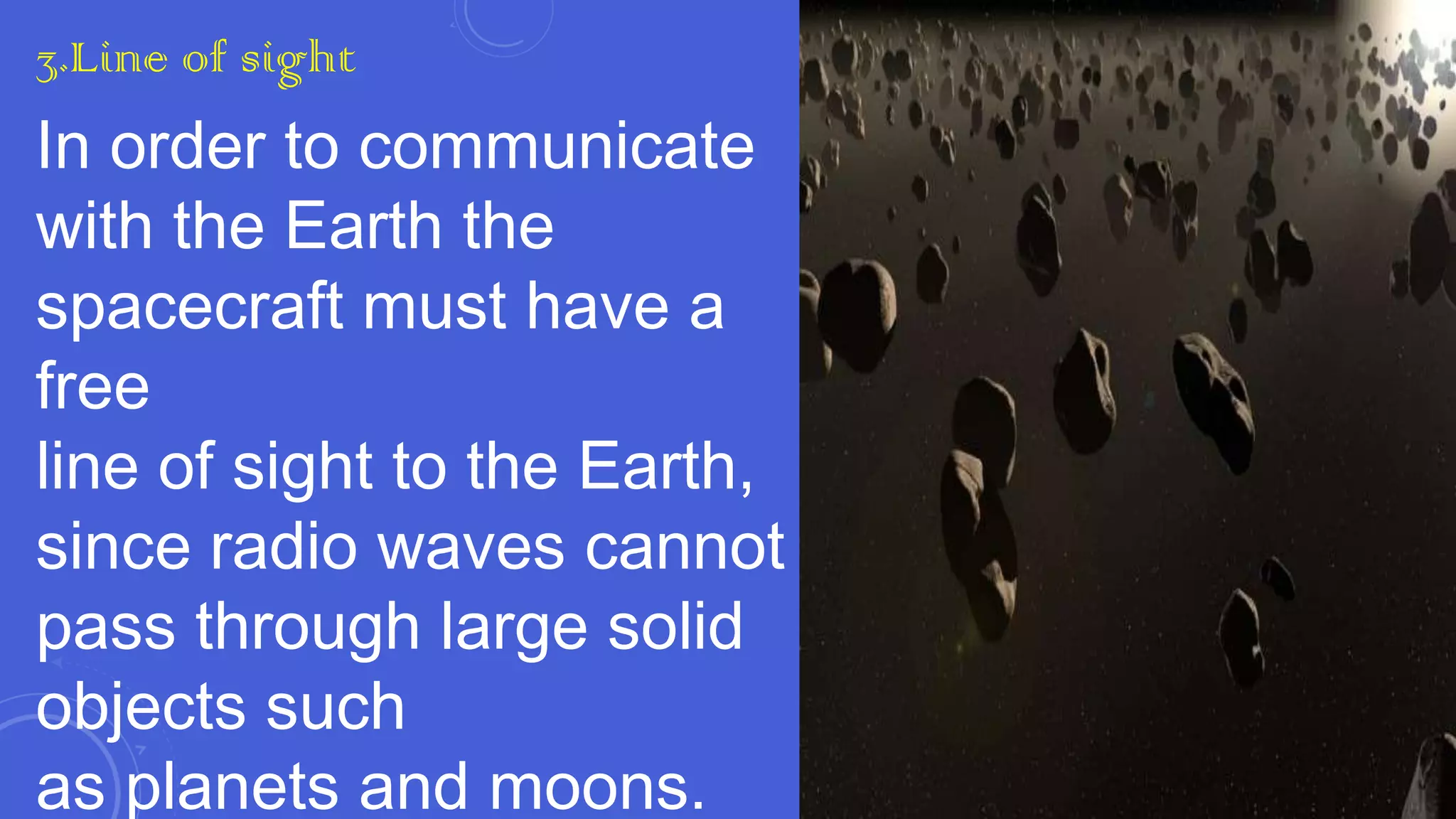
3.Line of sight

In order to communicate
with the Earth the
spacecraft must have a
free
line of sight to the Earth,
since radio waves cannot
pass through large solid
objects such
as planets and moons.
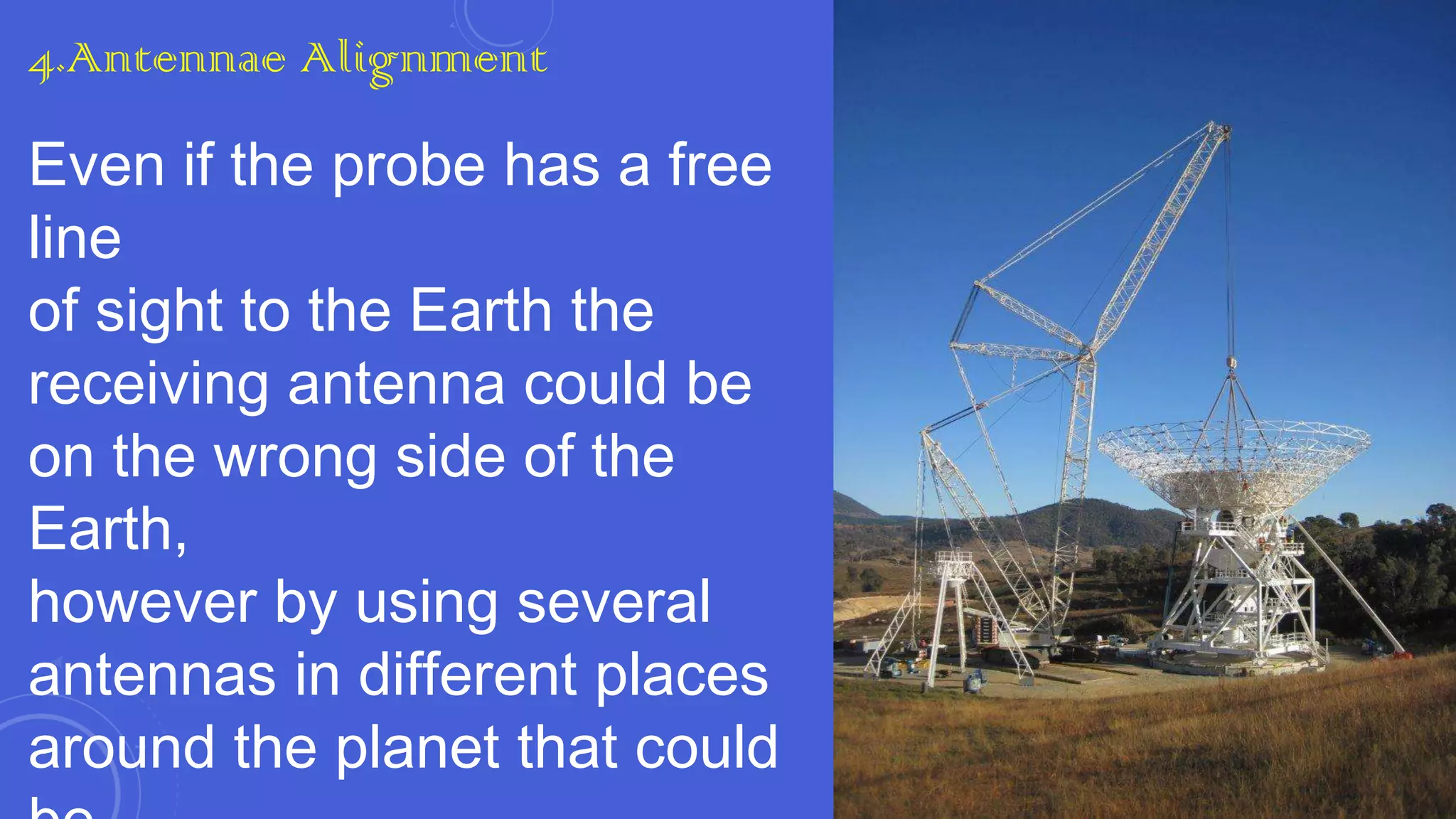
4.Antennae Alignment

Even if the probe has a free
line
of sight to the Earth the
receiving antenna could be
on the wrong side of the
Earth,
however by using several
antennas in different places
around the planet that could
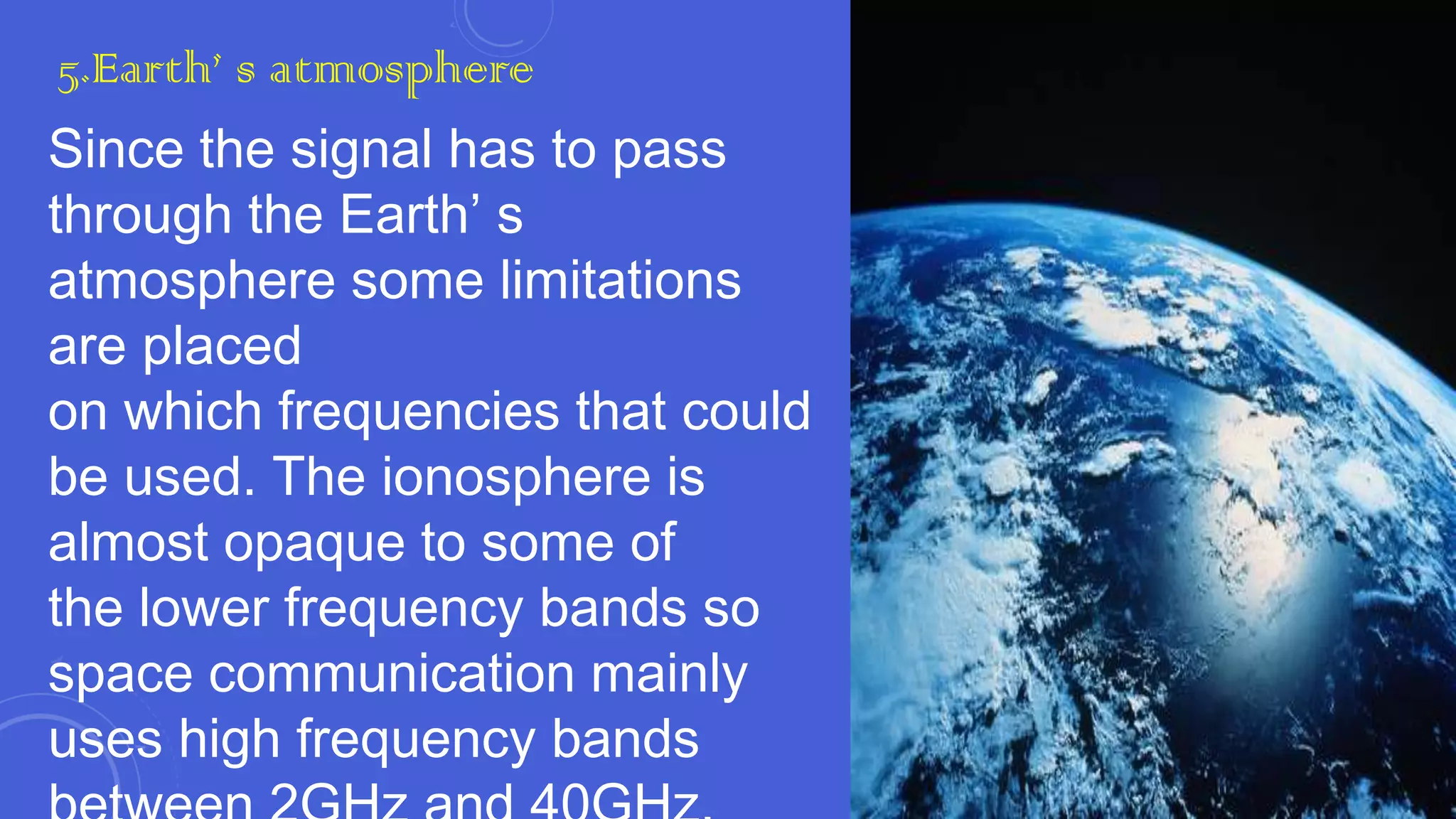
5.Earth’ s atmosphere

Since the signal has to pass
through the Earth’ s
atmosphere some limitations
are placed
on which frequencies that could
be used. The ionosphere is
almost opaque to some of
the lower frequency bands so
space communication mainly
uses high frequency bands
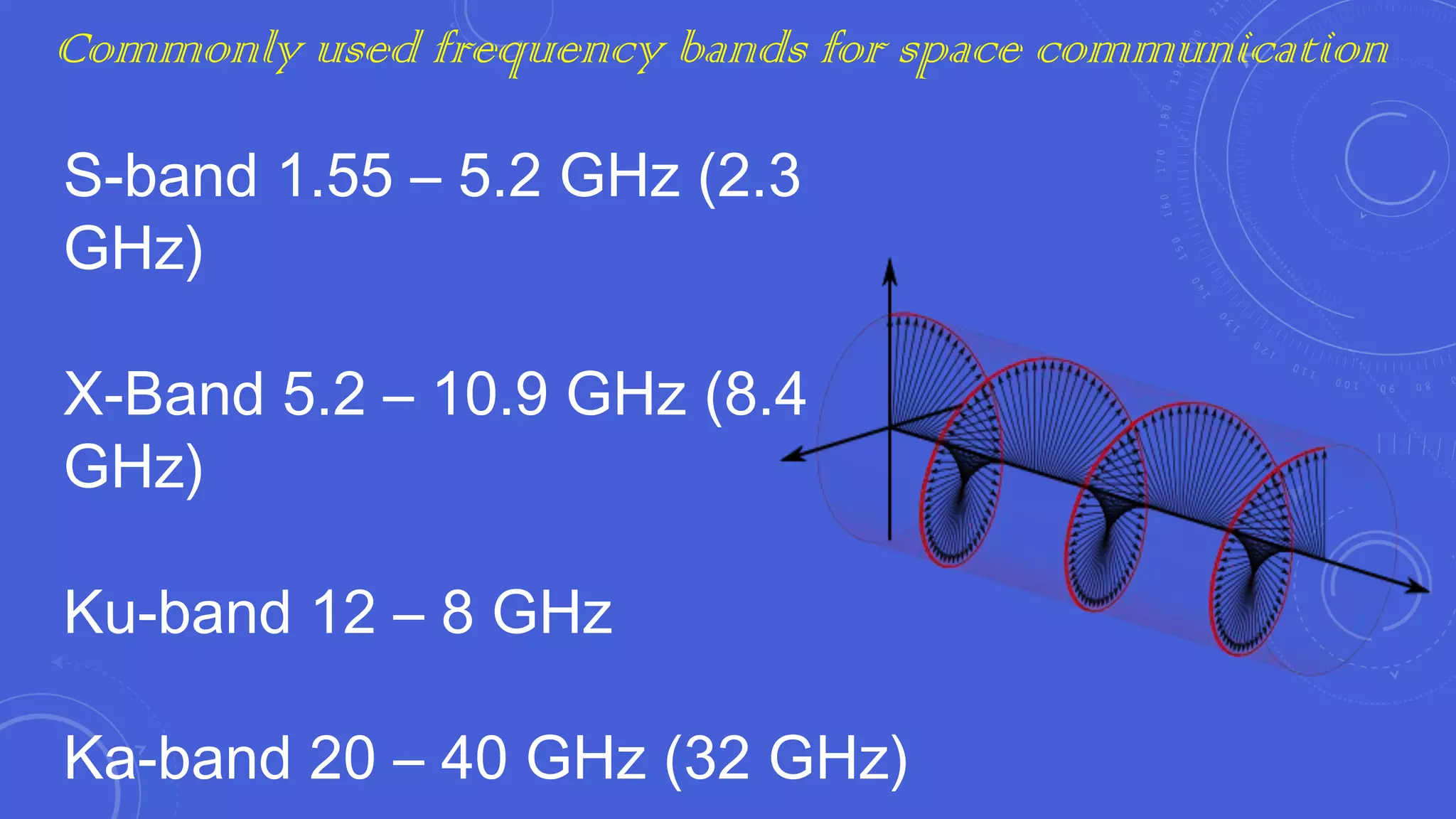
Commonly used frequency bands for space communication

S-band 1.55 – 5.2 GHz (2.3
GHz)
X-Band 5.2 – 10.9 GHz (8.4
GHz)
Ku-band 12 – 8 GHz
Ka-band 20 – 40 GHz (32 GHz)
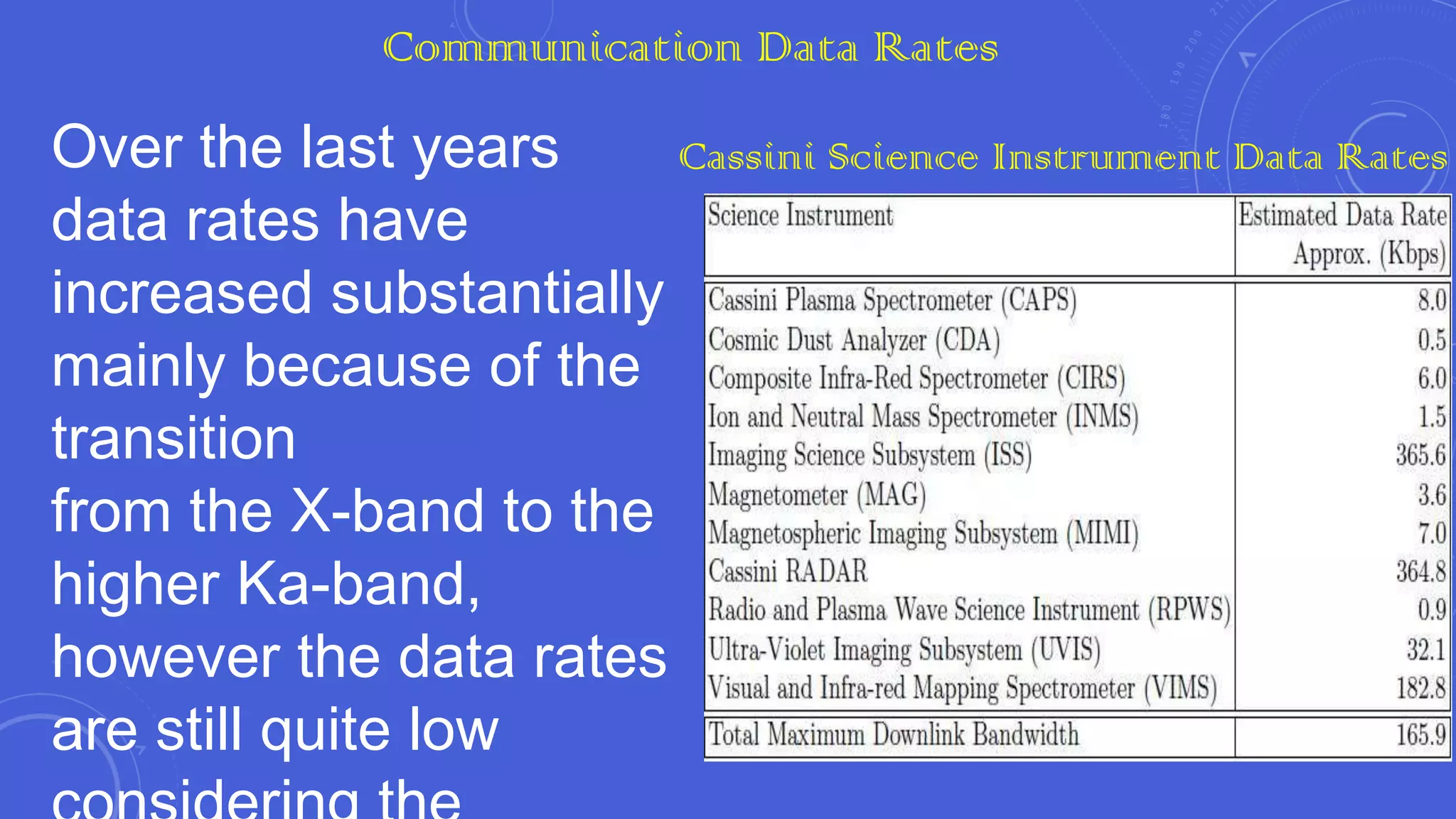
Communication Data Rates

Over the last years
Cassini Science Instrument Data Rates
data rates have
increased substantially
mainly because of the
transition
from the X-band to the
higher Ka-band,
however the data rates
are still quite low
Near Earth Space Communication
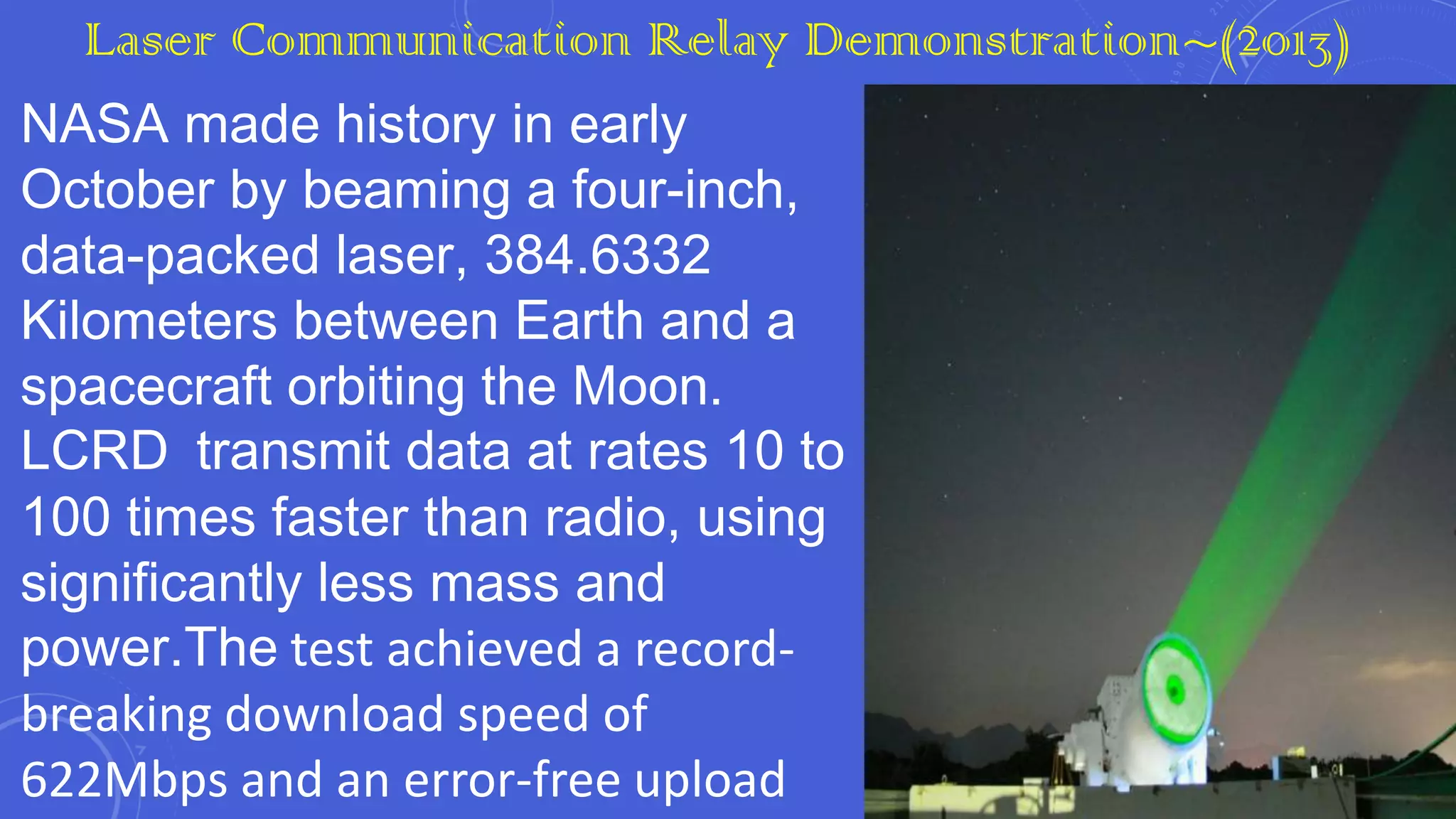
Laser Communication Relay Demonstration~(2013)
NASA made history in early
October by beaming a four-inch,
data-packed laser, 384.6332
Kilometers between Earth and a
spacecraft orbiting the Moon.
LCRD transmit data at rates 10 to
100 times faster than radio, using
significantly less mass and
power.The test achieved a recordbreaking download speed of
622Mbps and an error-free upload
Laser Communication~A revolution in Space Technology
Greatest Achievements of Deep Space Communication
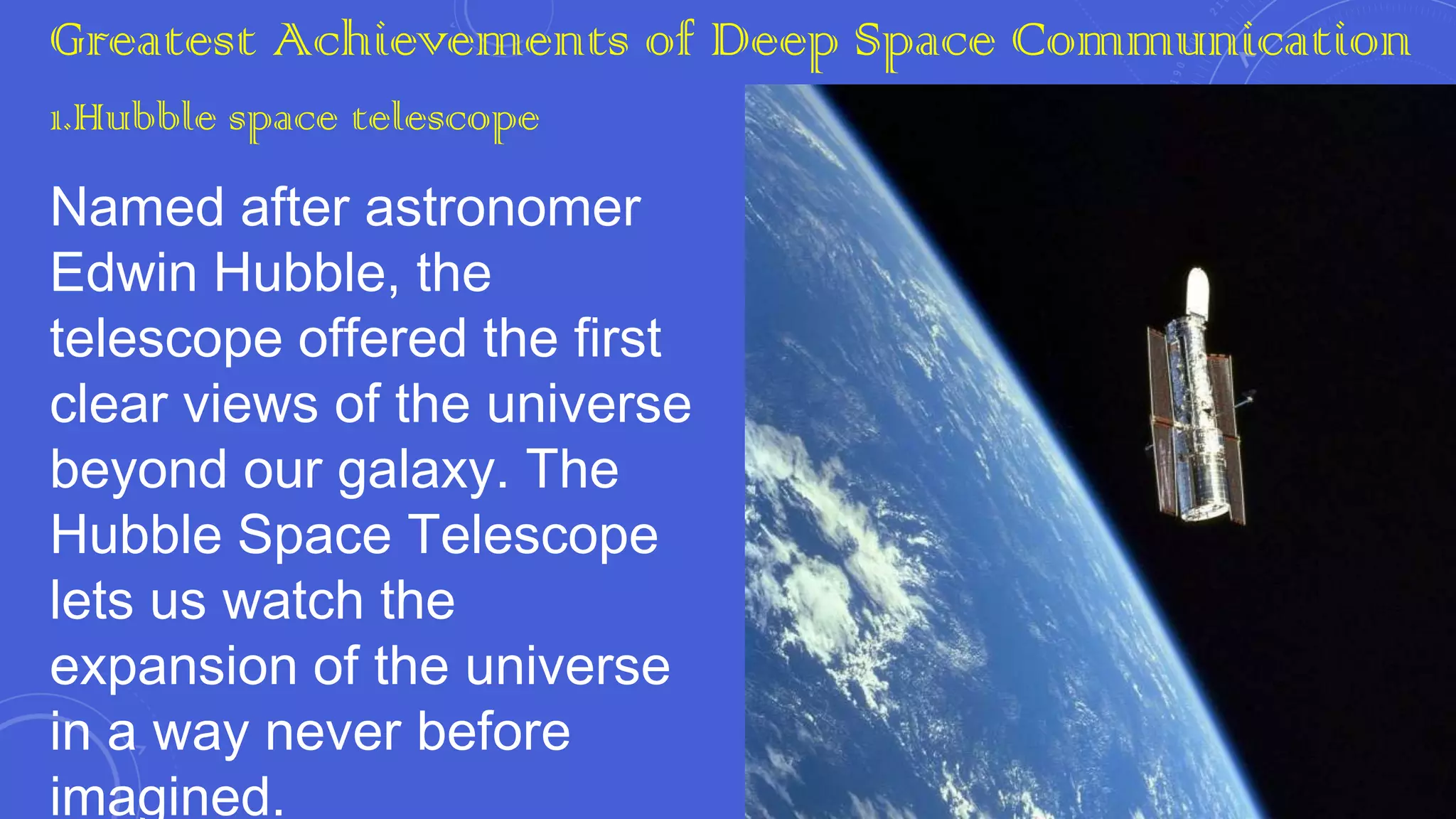
1.Hubble space telescope

Named after astronomer
Edwin Hubble, the
telescope offered the first
clear views of the universe
beyond our galaxy. The
Hubble Space Telescope
lets us watch the
expansion of the universe
in a way never before
imagined.
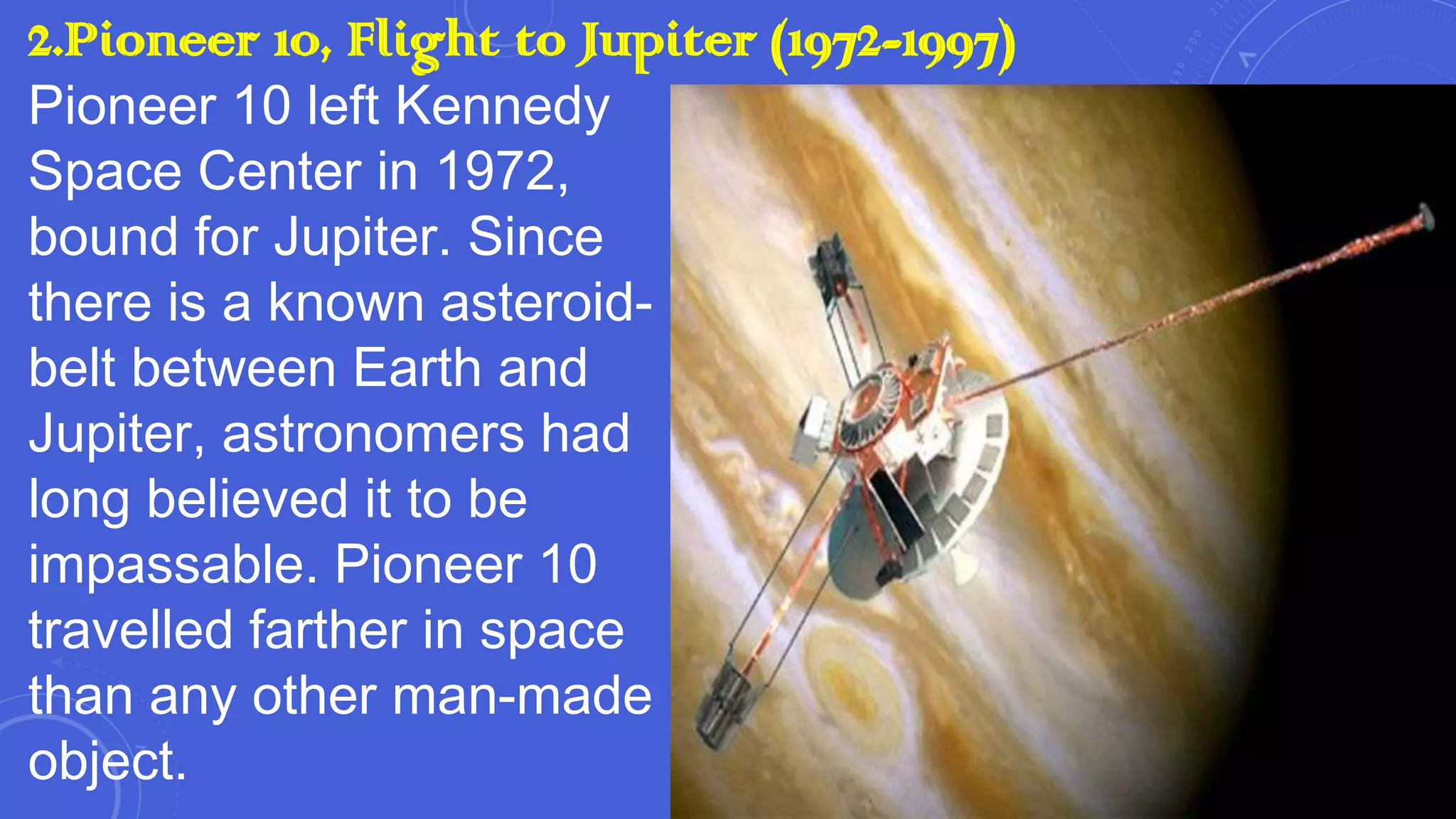
2.Pioneer 10, Flight to Jupiter (1972-1997)
Pioneer 10 left Kennedy
Space Center in 1972,
bound for Jupiter. Since
there is a known asteroidbelt between Earth and
Jupiter, astronomers had
long believed it to be
impassable. Pioneer 10
travelled farther in space
than any other man-made
object.
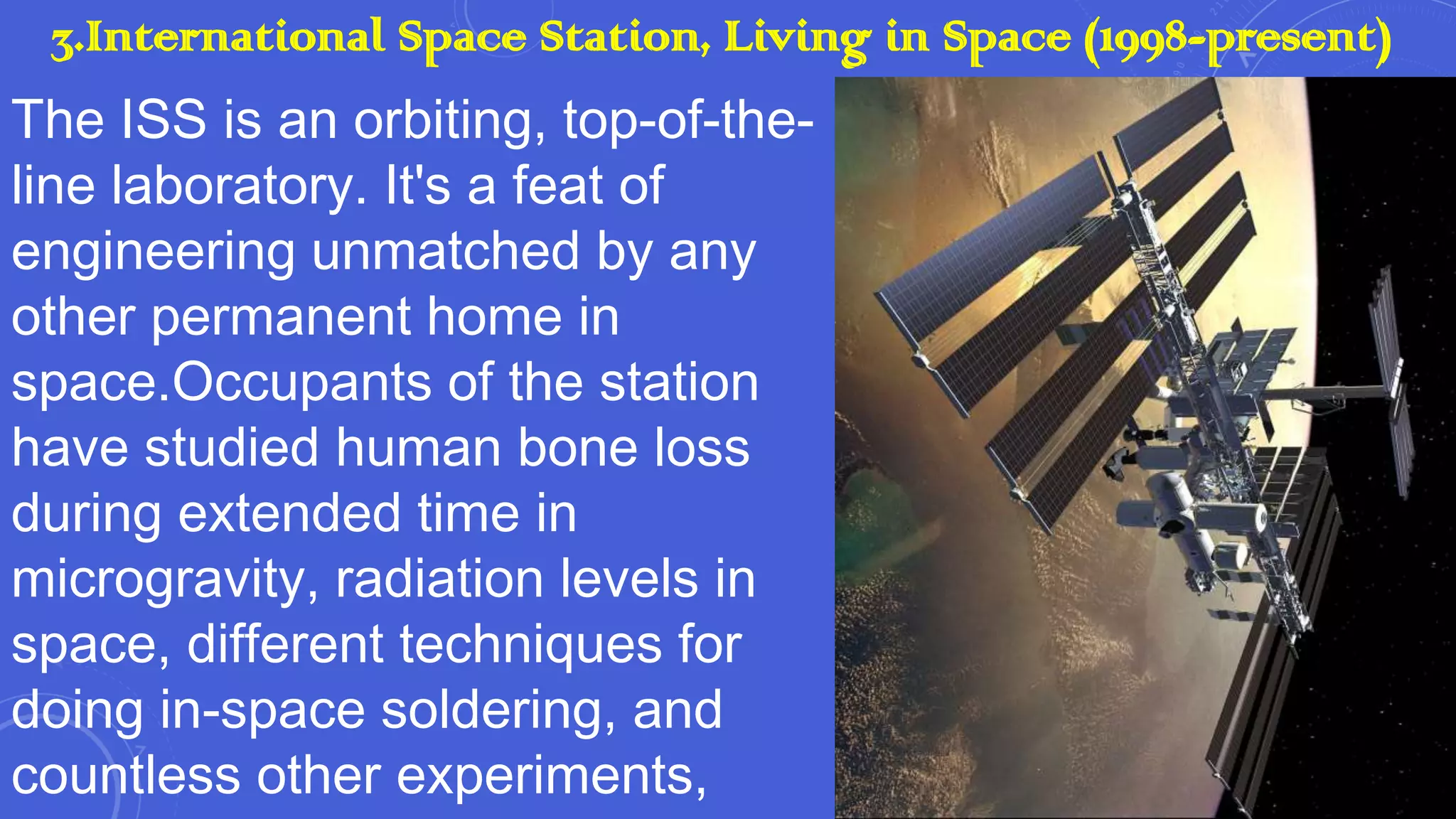
3.International Space Station, Living in Space (1998-present)
The ISS is an orbiting, top-of-theline laboratory. It's a feat of
engineering unmatched by any
other permanent home in
space.Occupants of the station
have studied human bone loss
during extended time in
microgravity, radiation levels in
space, different techniques for
doing in-space soldering, and
countless other experiments,
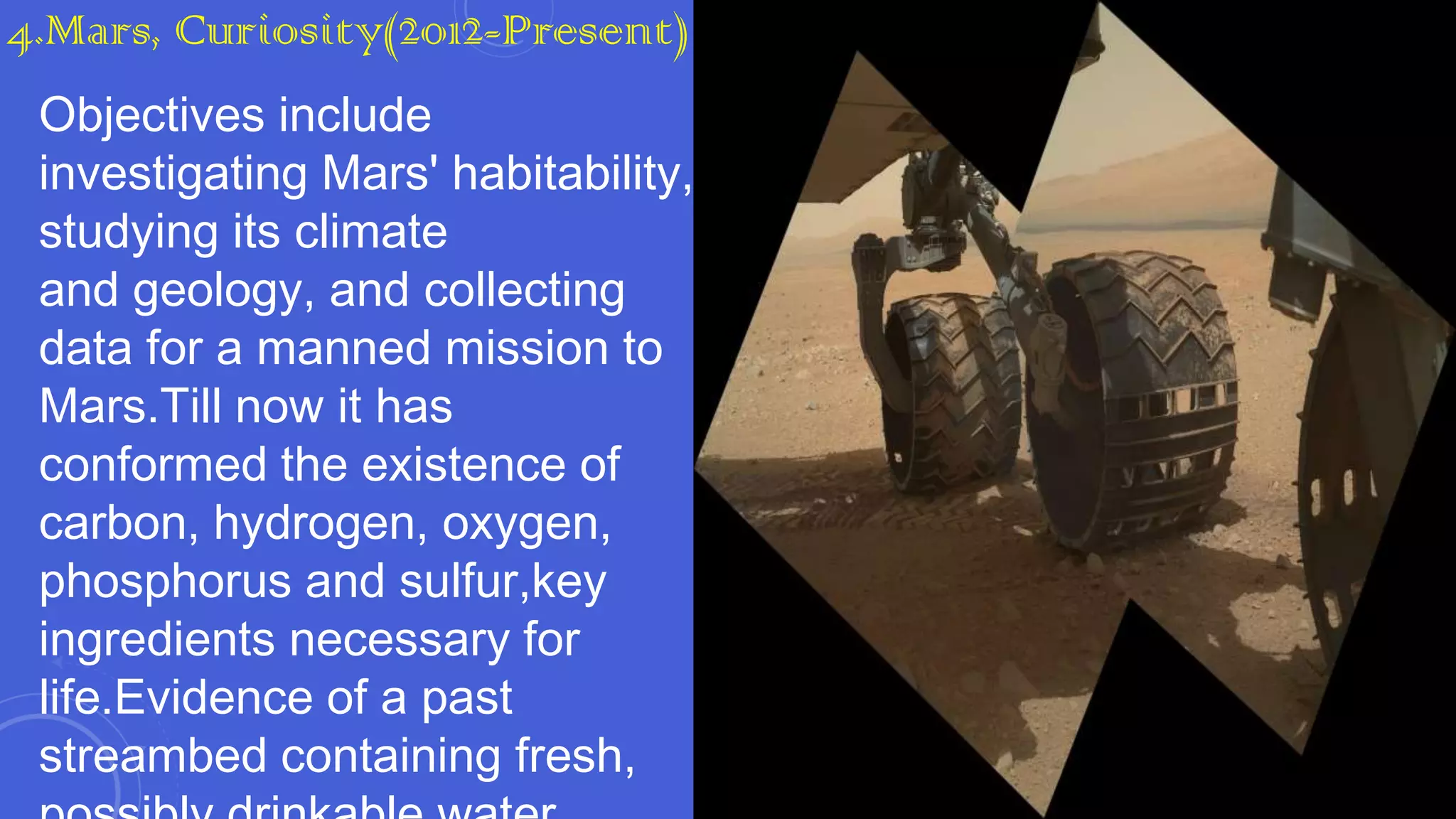
4.Mars, Curiosity(2012-Present)
Objectives include
investigating Mars' habitability,
studying its climate
and geology, and collecting
data for a manned mission to
Mars.Till now it has
conformed the existence of
carbon, hydrogen, oxygen,
phosphorus and sulfur,key
ingredients necessary for
life.Evidence of a past
streambed containing fresh,
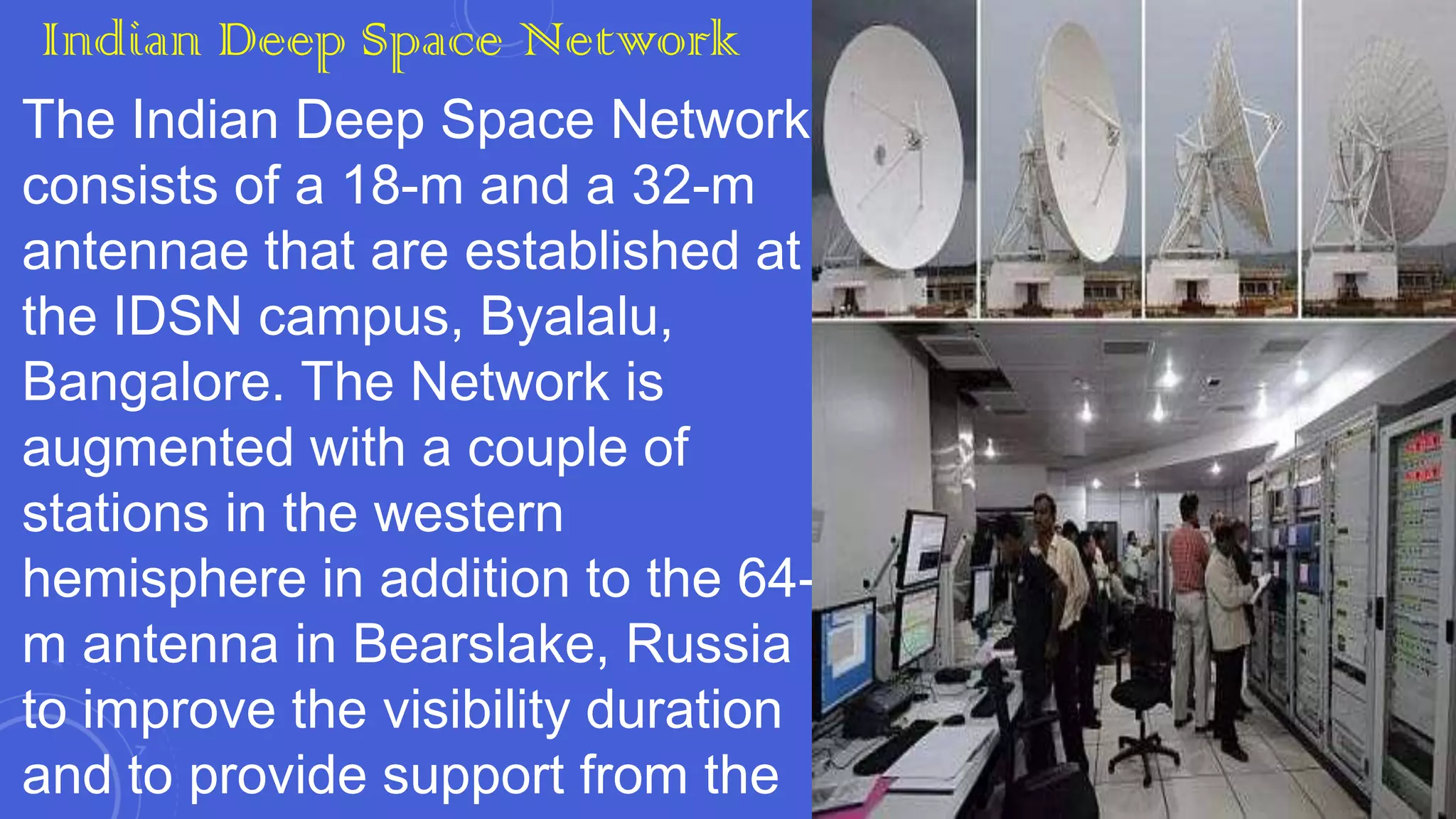
Indian Deep Space Network
The Indian Deep Space Network
consists of a 18-m and a 32-m
antennae that are established at
the IDSN campus, Byalalu,
Bangalore. The Network is
augmented with a couple of
stations in the western
hemisphere in addition to the 64m antenna in Bearslake, Russia
to improve the visibility duration
and to provide support from the
Achievements of Indian Deep Space Network

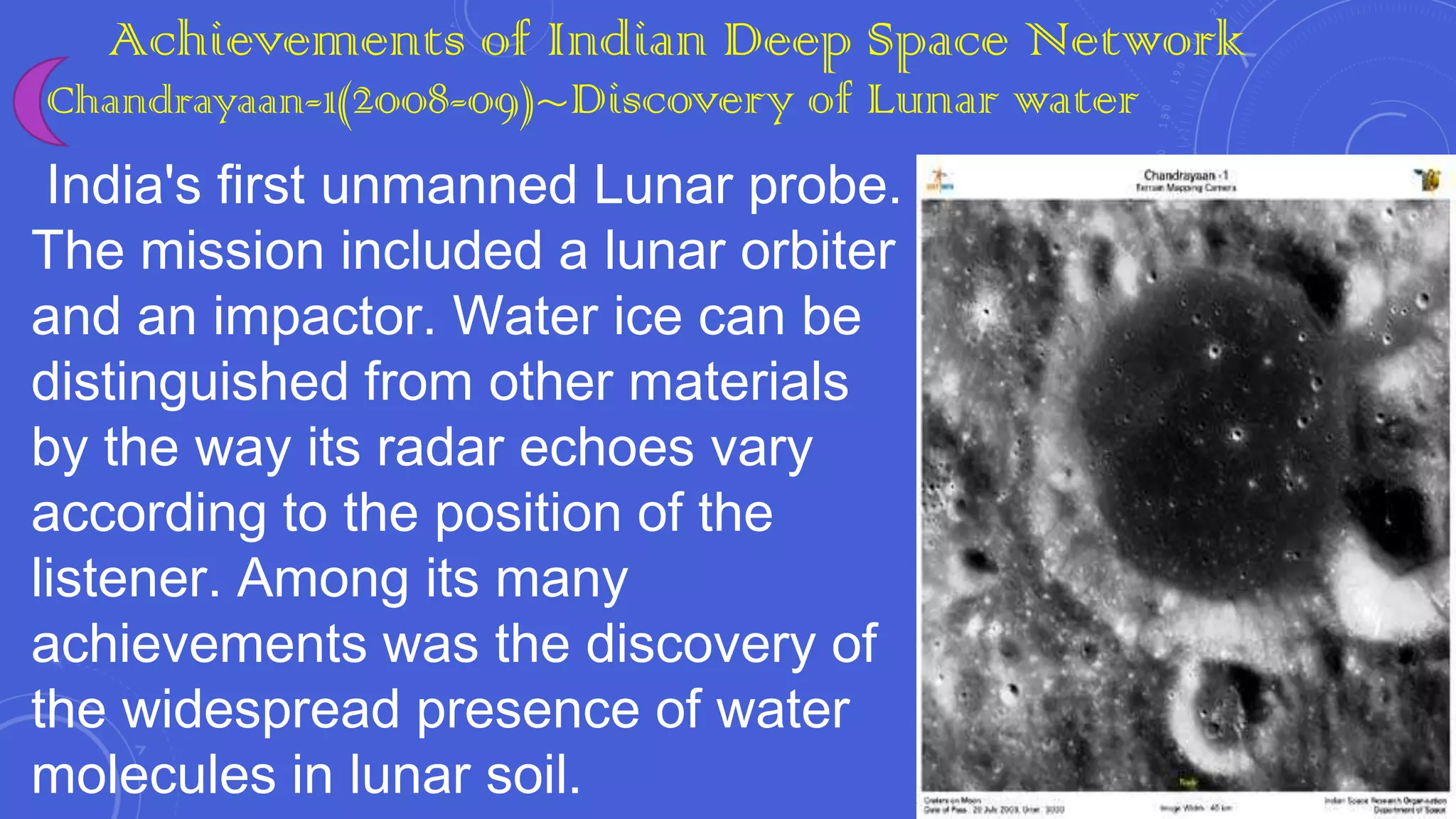
Chandrayaan-1(2008-09)~Discovery of Lunar water

India's first unmanned Lunar probe.
The mission included a lunar orbiter
and an impactor. Water ice can be
distinguished from other materials
by the way its radar echoes vary
according to the position of the
listener. Among its many
achievements was the discovery of
the widespread presence of water
molecules in lunar soil.
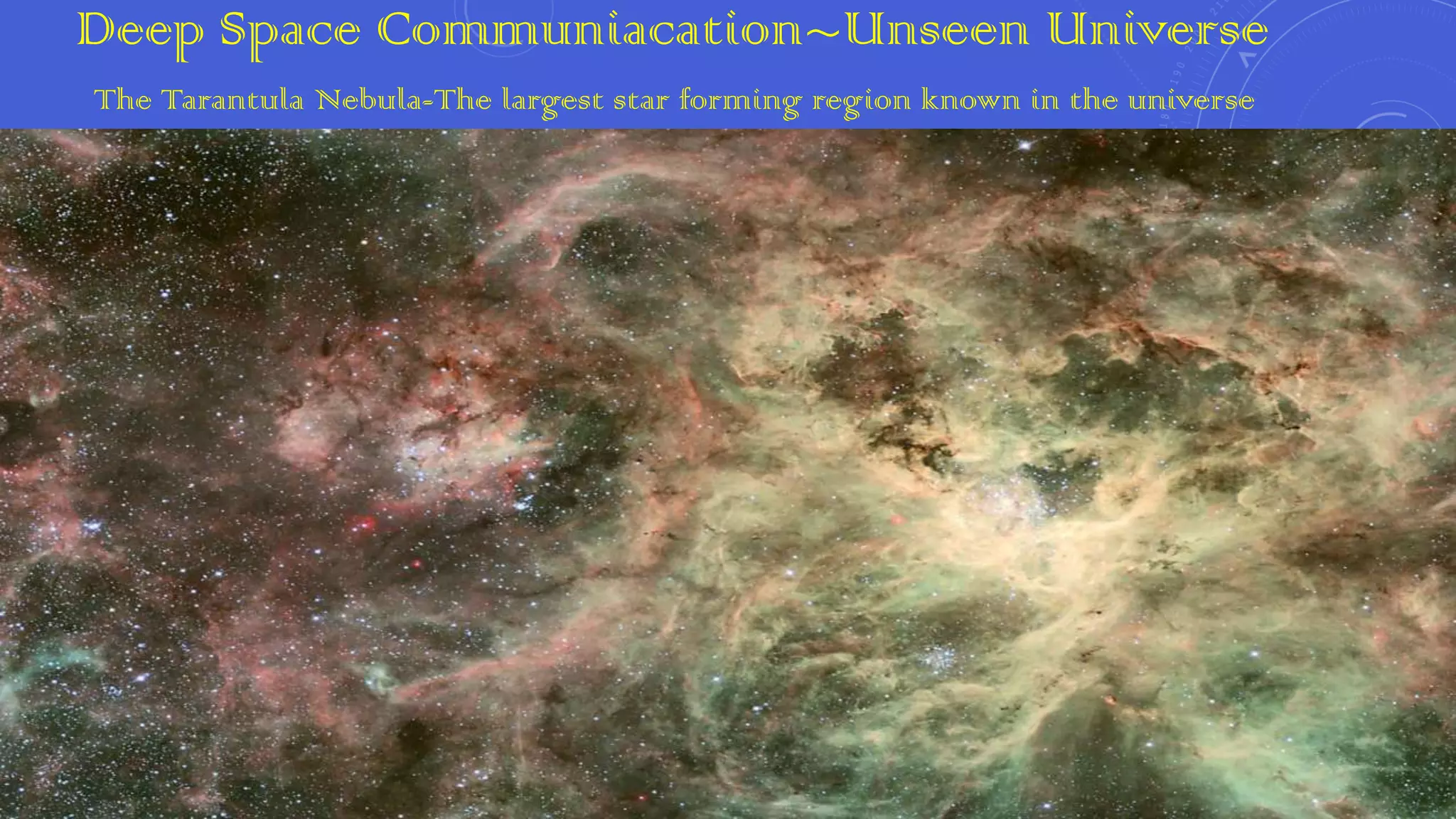
Deep Space Communiacation~Unseen Universe
The Tarantula Nebula-The largest star forming region known in the universe
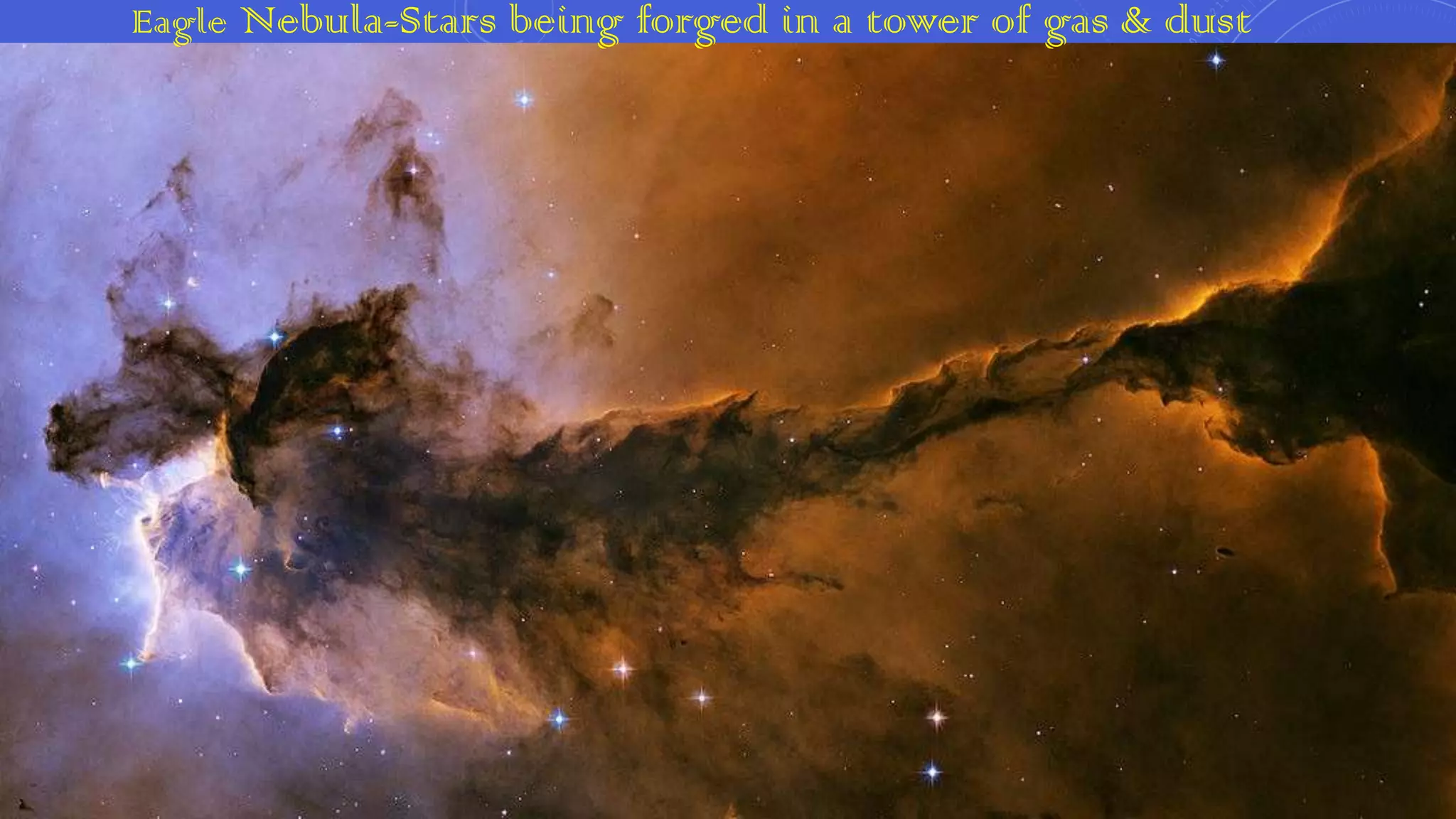
Eagle Nebula-Stars being forged in a tower of gas & dust
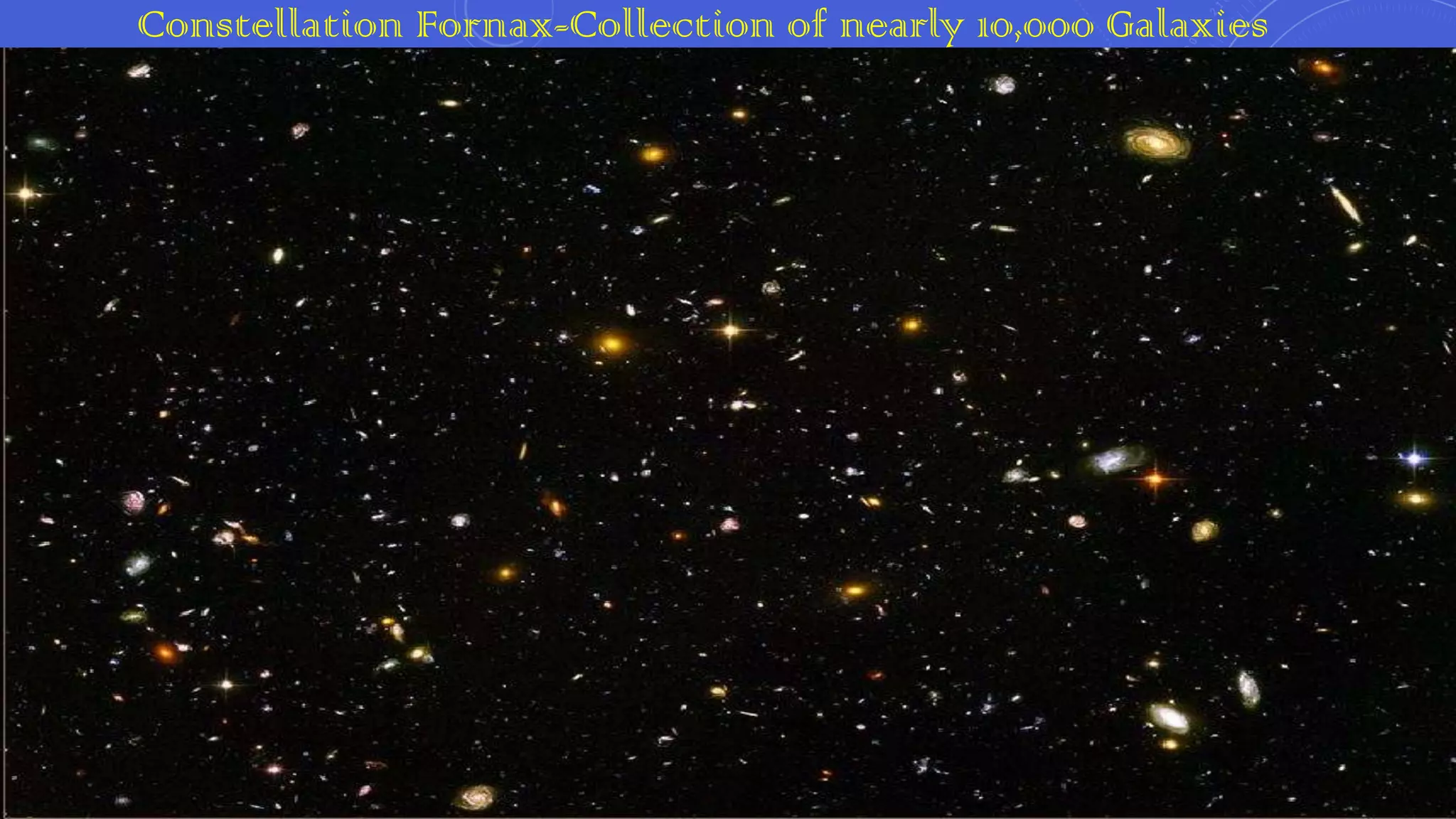
Constellation Fornax-Collection of nearly 10,000 Galaxies
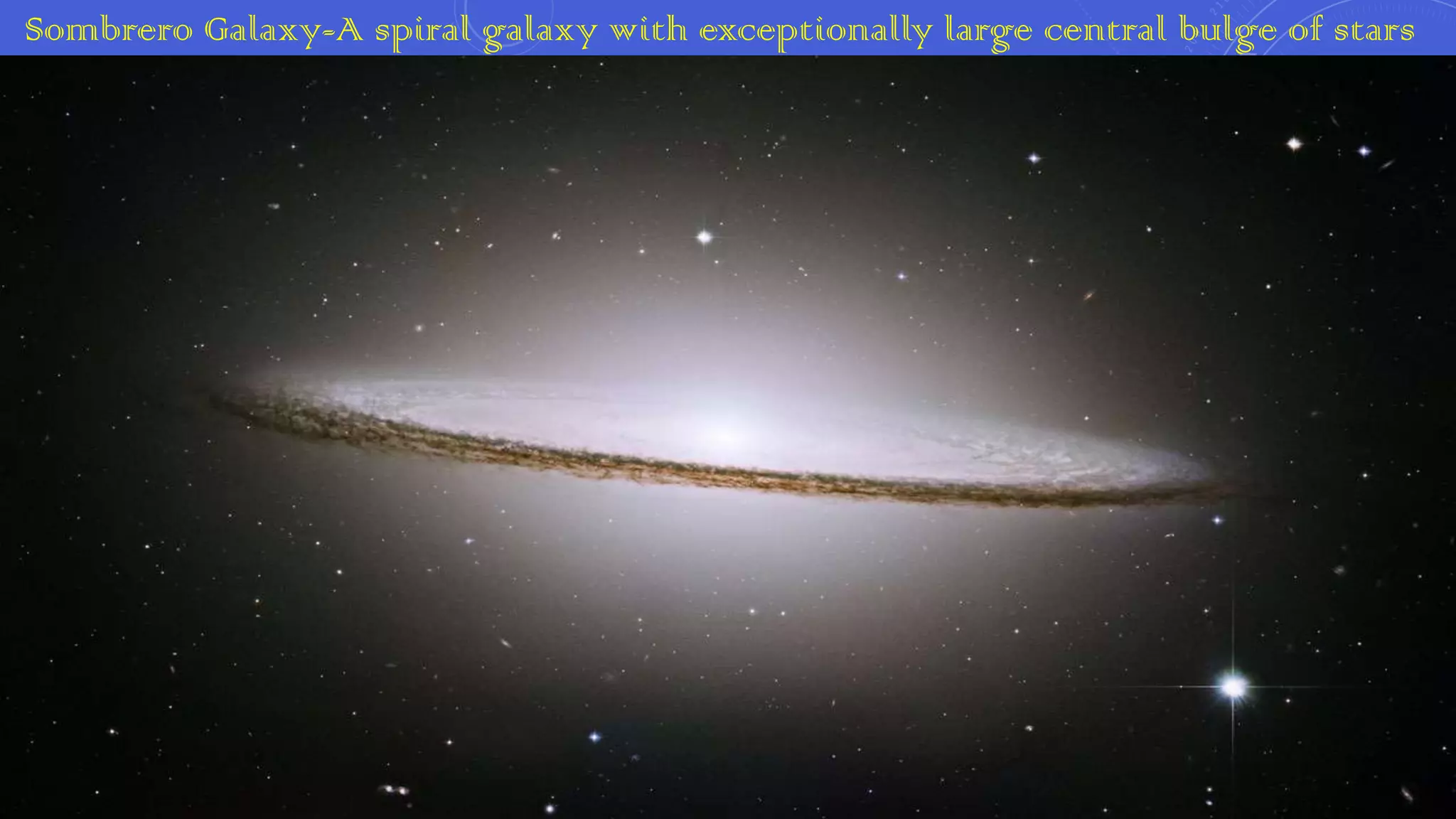
Sombrero Galaxy-A spiral galaxy with exceptionally large central bulge of stars
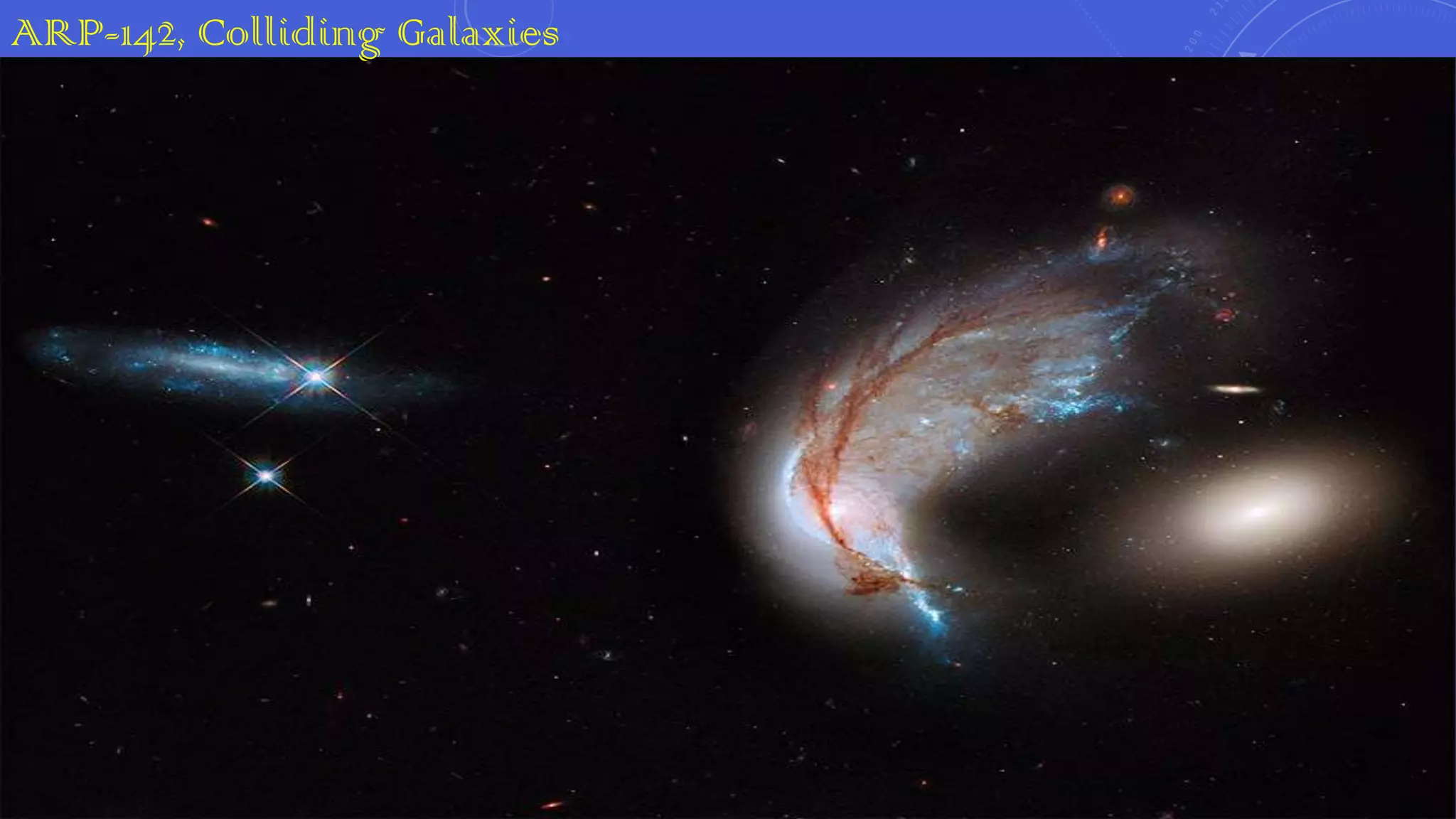
ARP-142, Colliding Galaxies
Astronomy compels the soul to look
upwards and leads us from this world to
another.
Plato

Thank You

Deep space communication

  • 1.
  • 2.
    What is “DeepSpace Communication” ? Deep space communication includes “communication with satellites and spacecrafts active in the outer space region as well as collecting radio and radar astronomy observations for the exploration of the solar
  • 3.
    VITAL FUNCTIONS OFDEEP SPACE COMMUNICATION Acquire telemetry data from spacecraft. Transmit commands to spacecraft. Gather science data. Monitor and control the performance of the netwo
  • 4.
    DEEP SPACE NETWORK~BEGINNING Thevery first communication station was established at Holmdel, New Jersey(USA) in the year 1957.The station included two antennas and a 30.5 meter long balloon orbiting around the earth. Echo Station at Goldstone, California
  • 5.
    1st Spacecraft MonitoringStation,Cape Canaveral, Florida In April, 1961 Florida got the 1st spacecraft monitoring station at Cape Canaveral. It supported all of the Rangers and two Mariner 2
  • 6.
    Large Array RadioTelescope, New Mexico The Very Large Array (VLA) radio telescope is located on the plains of San Agustin, 80 kilometers (50 miles) west of Socorro, New Mexico. The complex structure was inaugurated in 1980.
  • 7.
    The Most ReliantDeep Space Network
  • 9.
    This chart illustratesthe real growth of deepspace communications capability from 1960 to 1994 and projected growth to the year 2020. Real growth has improved by 12 orders of magnitude, while another three orders of magnitude are forecast for the future. The increase in performance is due to a series of innovative cooperative improvements in both spacecraft and ground systems.
  • 10.
    Challenges of deep-spacecommunications 1.Distance Distance is the main problem in space communications, since the intensity of electromagnetic radiation decreases according to 1/r2, that is why signals from deep space probes are usually very
  • 11.
    2.Speed Of Light Electromagnetic radiationcan’t move faster than the speed of light there are considerable time lag introduced in the communications making real time communications impossible. It takes over 5 hours for a signal from earth to reach the orbit of Pluto in the outer part of the solar system.
  • 12.
    3.Line of sight Inorder to communicate with the Earth the spacecraft must have a free line of sight to the Earth, since radio waves cannot pass through large solid objects such as planets and moons.
  • 13.
    4.Antennae Alignment Even ifthe probe has a free line of sight to the Earth the receiving antenna could be on the wrong side of the Earth, however by using several antennas in different places around the planet that could
  • 14.
    5.Earth’ s atmosphere Sincethe signal has to pass through the Earth’ s atmosphere some limitations are placed on which frequencies that could be used. The ionosphere is almost opaque to some of the lower frequency bands so space communication mainly uses high frequency bands
  • 15.
    Commonly used frequencybands for space communication S-band 1.55 – 5.2 GHz (2.3 GHz) X-Band 5.2 – 10.9 GHz (8.4 GHz) Ku-band 12 – 8 GHz Ka-band 20 – 40 GHz (32 GHz)
  • 16.
    Communication Data Rates Overthe last years Cassini Science Instrument Data Rates data rates have increased substantially mainly because of the transition from the X-band to the higher Ka-band, however the data rates are still quite low
  • 17.
    Near Earth SpaceCommunication
  • 18.
    Laser Communication RelayDemonstration~(2013) NASA made history in early October by beaming a four-inch, data-packed laser, 384.6332 Kilometers between Earth and a spacecraft orbiting the Moon. LCRD transmit data at rates 10 to 100 times faster than radio, using significantly less mass and power.The test achieved a recordbreaking download speed of 622Mbps and an error-free upload
  • 19.
  • 20.
    Greatest Achievements ofDeep Space Communication 1.Hubble space telescope Named after astronomer Edwin Hubble, the telescope offered the first clear views of the universe beyond our galaxy. The Hubble Space Telescope lets us watch the expansion of the universe in a way never before imagined.
  • 21.
    2.Pioneer 10, Flightto Jupiter (1972-1997) Pioneer 10 left Kennedy Space Center in 1972, bound for Jupiter. Since there is a known asteroidbelt between Earth and Jupiter, astronomers had long believed it to be impassable. Pioneer 10 travelled farther in space than any other man-made object.
  • 22.
    3.International Space Station,Living in Space (1998-present) The ISS is an orbiting, top-of-theline laboratory. It's a feat of engineering unmatched by any other permanent home in space.Occupants of the station have studied human bone loss during extended time in microgravity, radiation levels in space, different techniques for doing in-space soldering, and countless other experiments,
  • 23.
    4.Mars, Curiosity(2012-Present) Objectives include investigatingMars' habitability, studying its climate and geology, and collecting data for a manned mission to Mars.Till now it has conformed the existence of carbon, hydrogen, oxygen, phosphorus and sulfur,key ingredients necessary for life.Evidence of a past streambed containing fresh,
  • 24.
    Indian Deep SpaceNetwork The Indian Deep Space Network consists of a 18-m and a 32-m antennae that are established at the IDSN campus, Byalalu, Bangalore. The Network is augmented with a couple of stations in the western hemisphere in addition to the 64m antenna in Bearslake, Russia to improve the visibility duration and to provide support from the
  • 25.
    Achievements of IndianDeep Space Network Chandrayaan-1(2008-09)~Discovery of Lunar water India's first unmanned Lunar probe. The mission included a lunar orbiter and an impactor. Water ice can be distinguished from other materials by the way its radar echoes vary according to the position of the listener. Among its many achievements was the discovery of the widespread presence of water molecules in lunar soil.
  • 26.
    Deep Space Communiacation~UnseenUniverse The Tarantula Nebula-The largest star forming region known in the universe
  • 27.
    Eagle Nebula-Stars beingforged in a tower of gas & dust
  • 28.
    Constellation Fornax-Collection ofnearly 10,000 Galaxies
  • 29.
    Sombrero Galaxy-A spiralgalaxy with exceptionally large central bulge of stars
  • 30.
  • 31.
    Astronomy compels thesoul to look upwards and leads us from this world to another. Plato Thank You