 RADIO WAVE
 MICRO WAVE
 INFRARED WAVE
 ULTRA VIOLET WAVE
 X-RAY WAVE
 GAMMA RAY are other electromanetic
waves
 And here comes “THE GRAVITATIONAL
WAVE”
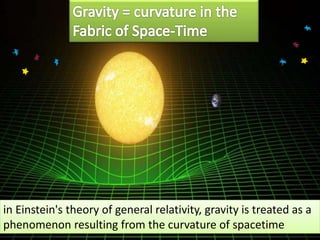
in Einstein's theory of general relativity, gravity is treated as a
phenomenon resulting from the curvature of spacetime
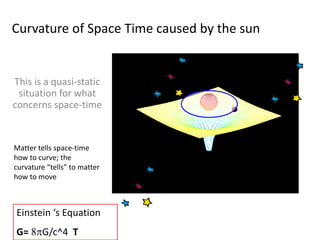
Curvature of Space Time caused by the sun
This is a quasi-static
situation for what
concerns space-time
Matter tells space-time
how to curve; the
curvature “tells” to matter
how to move
Einstein ‘s Equation
G= 8pG/c^4 T
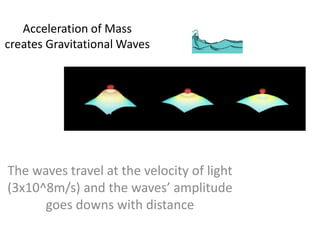
Acceleration of Mass
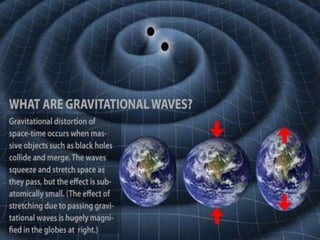
creates Gravitational Waves
The waves travel at the velocity of light
(3x10^8m/s) and the waves’ amplitude
goes downs with distance
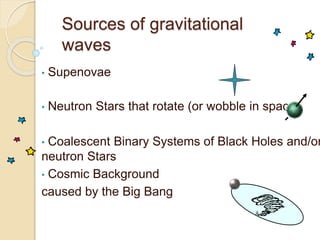
Sources of gravitational
waves
• Supenovae
• Neutron Stars that rotate (or wobble in space)
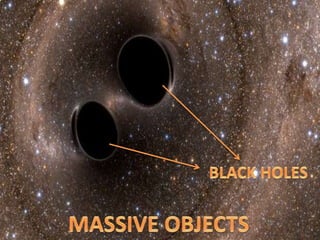
• Coalescent Binary Systems of Black Holes and/or
neutron Stars
• Cosmic Background
caused by the Big Bang
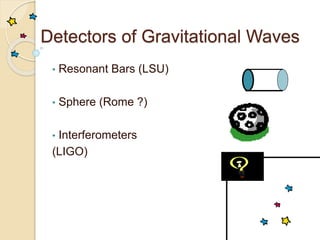
Detectors of Gravitational Waves
• Resonant Bars (LSU)
• Sphere (Rome ?)
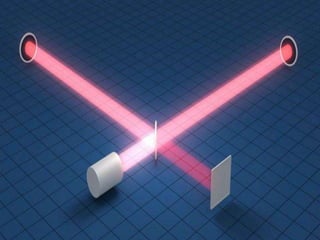
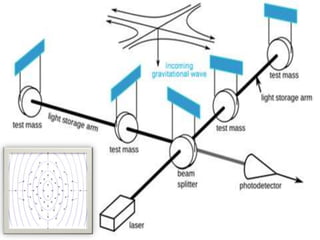
• Interferometers
(LIGO)
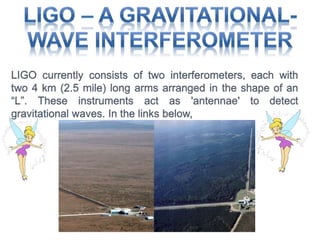
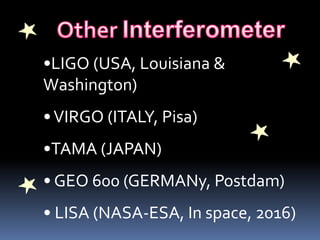
•LIGO (USA, Louisiana &
Washington)
•VIRGO (ITALY, Pisa)
•TAMA (JAPAN)
• GEO 600 (GERMANy, Postdam)
• LISA (NASA-ESA, In space, 2016)
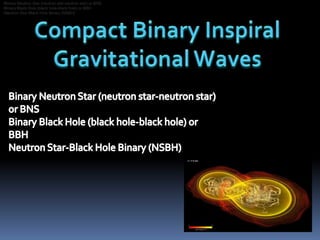
•Binary Neutron Star (neutron star-neutron star) or BNS
•Binary Black Hole (black hole-black hole) or BBH
•Neutron Star-Black Hole Binary (NSBH)
•Binary Neutron Star (neutron star-neutron star) or BNS
•Binary Black Hole (black hole-black hole) or BBH
•Neutron Star-Black Hole Binary (NSBH)
Burst Gravitational Waves
Conclusion: What can we learn
from Gravitational Waves?
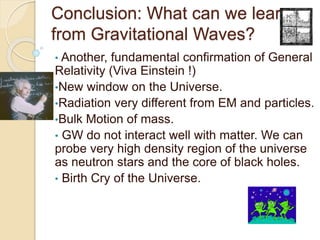
• Another, fundamental confirmation of General
Relativity (Viva Einstein !)
•New window on the Universe.
•Radiation very different from EM and particles.
•Bulk Motion of mass.
• GW do not interact well with matter. We can
probe very high density region of the universe
as neutron stars and the core of black holes.
• Birth Cry of the Universe.
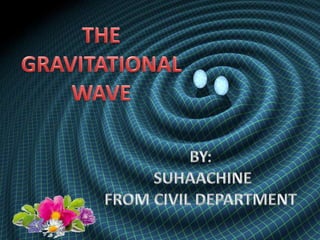
Gravitational wave

Gravitational wave

  • 2.
     RADIO WAVE MICRO WAVE  INFRARED WAVE  ULTRA VIOLET WAVE  X-RAY WAVE  GAMMA RAY are other electromanetic waves  And here comes “THE GRAVITATIONAL WAVE”
  • 5.
    in Einstein's theoryof general relativity, gravity is treated as a phenomenon resulting from the curvature of spacetime
  • 6.
    Curvature of SpaceTime caused by the sun This is a quasi-static situation for what concerns space-time Matter tells space-time how to curve; the curvature “tells” to matter how to move Einstein ‘s Equation G= 8pG/c^4 T
  • 7.
    Acceleration of Mass createsGravitational Waves The waves travel at the velocity of light (3x10^8m/s) and the waves’ amplitude goes downs with distance
  • 8.
    Sources of gravitational waves •Supenovae • Neutron Stars that rotate (or wobble in space) • Coalescent Binary Systems of Black Holes and/or neutron Stars • Cosmic Background caused by the Big Bang
  • 9.
    Detectors of GravitationalWaves • Resonant Bars (LSU) • Sphere (Rome ?) • Interferometers (LIGO)
  • 15.
    •LIGO (USA, Louisiana& Washington) •VIRGO (ITALY, Pisa) •TAMA (JAPAN) • GEO 600 (GERMANy, Postdam) • LISA (NASA-ESA, In space, 2016)
  • 17.
    •Binary Neutron Star(neutron star-neutron star) or BNS •Binary Black Hole (black hole-black hole) or BBH •Neutron Star-Black Hole Binary (NSBH) •Binary Neutron Star (neutron star-neutron star) or BNS •Binary Black Hole (black hole-black hole) or BBH •Neutron Star-Black Hole Binary (NSBH)
  • 18.
  • 19.
    Conclusion: What canwe learn from Gravitational Waves? • Another, fundamental confirmation of General Relativity (Viva Einstein !) •New window on the Universe. •Radiation very different from EM and particles. •Bulk Motion of mass. • GW do not interact well with matter. We can probe very high density region of the universe as neutron stars and the core of black holes. • Birth Cry of the Universe.

Editor's Notes

  • #6 in Einstein's theory of general relativity, gravity is treated as a phenomenon resulting from the curvature of spacetime. This curvature is caused by the presence of mass. Generally, the more mass that is contained within a given volume of space, the greater the curvature of spacetime will be at the boundary of its volume.[15] As objects with mass move around in spacetime, the curvature changes to reflect the changed locations of those objects. In certain circumstances, accelerating objects generate changes in this curvature, which propagate outwards at the speed of light in a wave-like manner. These propagating phenomena are known as gravitational waves.