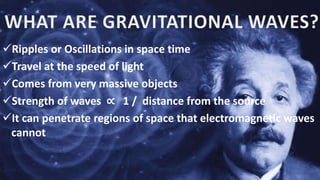
Ripples or Oscillations in space time
Travel at the speed of light
Comes from very massive objects
Strength of waves ∝ 1 / distance from the source
It can penetrate regions of space that electromagnetic waves
cannot
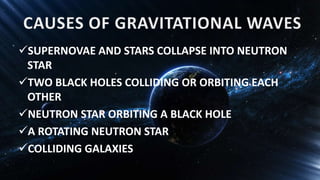
SUPERNOVAE AND STARS COLLAPSE INTO NEUTRON
STAR
TWO BLACK HOLES COLLIDING OR ORBITING EACH
OTHER
NEUTRON STAR ORBITING A BLACK HOLE
A ROTATING NEUTRON STAR
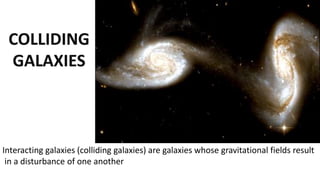
COLLIDING GALAXIES
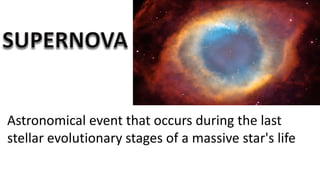
Astronomical event that occurs during the last
stellar evolutionary stages of a massive star's life
Interacting galaxies (colliding galaxies) are galaxies whose gravitational fields result
in a disturbance of one another
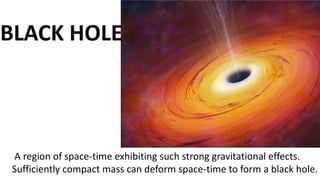
BLACK HOLE
A region of space-time exhibiting such strong gravitational effects.
Sufficiently compact mass can deform space-time to form a black hole.
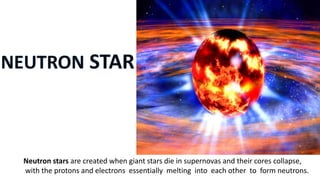
Neutron stars are created when giant stars die in supernovas and their cores collapse,
with the protons and electrons essentially melting into each other to form neutrons.
How will we detect gravitational
waves?
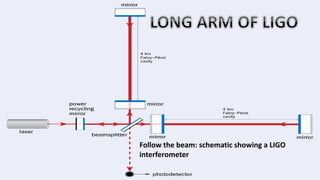
Follow the beam: schematic showing a LIGO
interferometer
• prove the existence of the gravitational waves by
direct measurements
• Confirm that Gravitational waves travel at the speed of
light
• Verify that gravitational waves cause disturbances of
predicted amounts in the matter they pass through
• Learn more about black holes
• Expand knowledge about universe
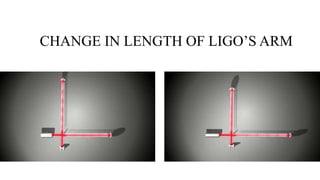
CHANGE IN LENGTH OF LIGO’S ARM
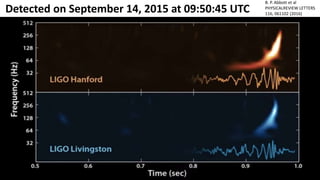
Detected on September 14, 2015 at 09:50:45 UTC
−
B. P. Abbott et al
PHYSICALREVIEW LETTERS
116, 061102 (2016)
WHY STUDY GRAVITATIONAL WAVES
Can accurately determine cosmological distances.
Instrument made for gravitational wave detection is the most
precise measuring system ever.
Gravitational-wave astronomy is an emerging branch of
observational astronomy which aims to use gravitational waves to
collect observational data Such as neutron stars and black holes
COMPARISON
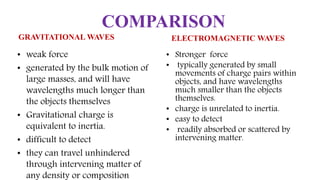
GRAVITATIONAL WAVES
• weak force
• generated by the bulk motion of
large masses, and will have
wavelengths much longer than
the objects themselves
• Gravitational charge is
equivalent to inertia.
• difficult to detect
• they can travel unhindered
through intervening matter of
any density or composition
ELECTROMAGNETIC WAVES
• Stronger force
• typically generated by small
movements of charge pairs within
objects, and have wavelengths
much smaller than the objects
themselves.
• charge is unrelated to inertia.
• easy to detect
• readily absorbed or scattered by
intervening matter.
• To prove the existence of the gravitational waves by
direct measurements
• Confirm that Gravitational waves travel at the speed of
light
• Verify that gravitational waves cause disturbances of
predicted amounts in the matter they pass through
• Learn more about black holes
• Expand knowledge about universe
1. Observation of Gravitational Waves from a Binary Black Hole Merger
PHYSICAL REVIEW LETTERS
B. P. Abbott et al.*
(LIGO Scientific Collaboration and Virgo Collaboration)
https://physics.aps.org/featured-article-pdf/10.1103/PhysRevLett.116.061102
2.LIGO lab Caltech MIThttps://www.ligo.caltech.edu/
3. Gravitational waves-wikipedia
https://en.wikipedia.org/wiki/Gravitational_wave
4. J. Abadie et al. (LIGO Scientific Collaboration, Virgo Collaboration)
Phys. Rev. D 85, 082002 – Published 19 April 2012
http://journals.aps.org/prd/abstract/10.1103/PhysRevD.85.082002
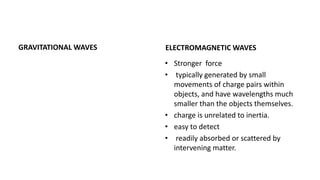
GRAVITATIONAL WAVES ELECTROMAGNETIC WAVES
• Stronger force
• typically generated by small
movements of charge pairs within
objects, and have wavelengths much
smaller than the objects themselves.
• charge is unrelated to inertia.
• easy to detect
• readily absorbed or scattered by
intervening matter.
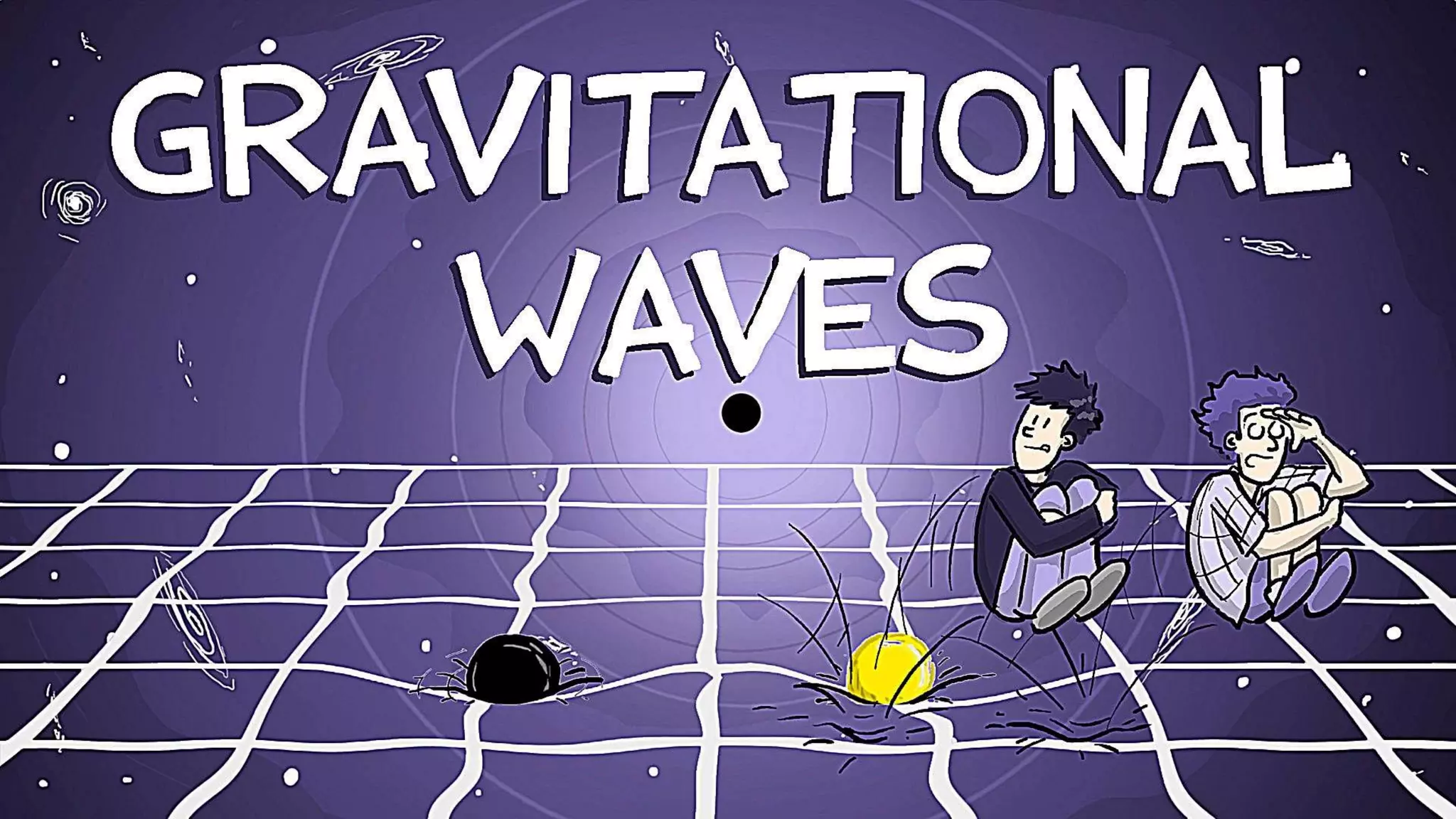
Gravitational waves and their detection

Gravitational waves and their detection

  • 2.
    Ripples or Oscillationsin space time Travel at the speed of light Comes from very massive objects Strength of waves ∝ 1 / distance from the source It can penetrate regions of space that electromagnetic waves cannot
  • 3.
    SUPERNOVAE AND STARSCOLLAPSE INTO NEUTRON STAR TWO BLACK HOLES COLLIDING OR ORBITING EACH OTHER NEUTRON STAR ORBITING A BLACK HOLE A ROTATING NEUTRON STAR COLLIDING GALAXIES
  • 4.
    Astronomical event thatoccurs during the last stellar evolutionary stages of a massive star's life
  • 5.
    Interacting galaxies (collidinggalaxies) are galaxies whose gravitational fields result in a disturbance of one another
  • 6.
    BLACK HOLE A regionof space-time exhibiting such strong gravitational effects. Sufficiently compact mass can deform space-time to form a black hole.
  • 7.
    Neutron stars arecreated when giant stars die in supernovas and their cores collapse, with the protons and electrons essentially melting into each other to form neutrons.
  • 8.
    How will wedetect gravitational waves?
  • 9.
    Follow the beam:schematic showing a LIGO interferometer
  • 11.
    • prove theexistence of the gravitational waves by direct measurements • Confirm that Gravitational waves travel at the speed of light • Verify that gravitational waves cause disturbances of predicted amounts in the matter they pass through • Learn more about black holes • Expand knowledge about universe
  • 12.
    CHANGE IN LENGTHOF LIGO’S ARM
  • 13.
    Detected on September14, 2015 at 09:50:45 UTC − B. P. Abbott et al PHYSICALREVIEW LETTERS 116, 061102 (2016)
  • 14.
    WHY STUDY GRAVITATIONALWAVES Can accurately determine cosmological distances. Instrument made for gravitational wave detection is the most precise measuring system ever. Gravitational-wave astronomy is an emerging branch of observational astronomy which aims to use gravitational waves to collect observational data Such as neutron stars and black holes
  • 15.
    COMPARISON GRAVITATIONAL WAVES • weakforce • generated by the bulk motion of large masses, and will have wavelengths much longer than the objects themselves • Gravitational charge is equivalent to inertia. • difficult to detect • they can travel unhindered through intervening matter of any density or composition ELECTROMAGNETIC WAVES • Stronger force • typically generated by small movements of charge pairs within objects, and have wavelengths much smaller than the objects themselves. • charge is unrelated to inertia. • easy to detect • readily absorbed or scattered by intervening matter.
  • 16.
    • To provethe existence of the gravitational waves by direct measurements • Confirm that Gravitational waves travel at the speed of light • Verify that gravitational waves cause disturbances of predicted amounts in the matter they pass through • Learn more about black holes • Expand knowledge about universe
  • 17.
    1. Observation ofGravitational Waves from a Binary Black Hole Merger PHYSICAL REVIEW LETTERS B. P. Abbott et al.* (LIGO Scientific Collaboration and Virgo Collaboration) https://physics.aps.org/featured-article-pdf/10.1103/PhysRevLett.116.061102 2.LIGO lab Caltech MIThttps://www.ligo.caltech.edu/ 3. Gravitational waves-wikipedia https://en.wikipedia.org/wiki/Gravitational_wave 4. J. Abadie et al. (LIGO Scientific Collaboration, Virgo Collaboration) Phys. Rev. D 85, 082002 – Published 19 April 2012 http://journals.aps.org/prd/abstract/10.1103/PhysRevD.85.082002
  • 18.
    GRAVITATIONAL WAVES ELECTROMAGNETICWAVES • Stronger force • typically generated by small movements of charge pairs within objects, and have wavelengths much smaller than the objects themselves. • charge is unrelated to inertia. • easy to detect • readily absorbed or scattered by intervening matter.