Gravitation

                      Physics 1425 Lecture 11


Michael Fowler, UVa
The Inverse Square Law
• Newton’s idea: the centripetal force keeping the
  Moon circling the Earth is the same gravitational
  force that pulls us to the ground.
• BUT: the Moon’s centripetal acceleration is only
  1/3600 of g!
• The Moon is 60 times further from the Earth’s
  center than we are.
• SO: this suggests the gravitational pull from the
  Earth decreases with distance from the Earth’s
  center as 1/r2.
Gravitational Attraction is Proportional to Mass

 • The gravitational force causes everything to
   fall with the same acceleration:
 • For downward motion Fgrav = ma = mg
 • That is, Fgrav/m has the same value for all
   masses.
 • Conclusion: F ∝ m: the gravitational force on
   a mass is proportional to the mass.
Clicker Question

Does the Moon attract the Earth gravitationally?


  A. No
  B. Yes, but with a much weaker force than the
     Earth attracts the Moon.
  C. Yes, with the same force the Earth attracts
     the Moon.
So why doesn’t the Earth go round the
               Moon?

 • The moon’s mass is about 1% of the Earth’s
   mass.
 • In fact, the Moon’s attraction does cause the
   Earth to go in a circle—both Earth and Moon
   circle their common center of mass (which is
   inside the Earth!) We’ll discuss this more
   later.
Gravitational Attraction is Proportional
           to Both Masses
• We’ve already seen, from Galileo’s
  observation of equal downward acceleration
  and Newton’s Second Law, that the Earth
  attracts an object with a force proportional to
  the object’s mass.
• But from Newton’s Third Law, the attractions
  are equal and opposite—symmetric.
• Therefore, the attraction is also proportional
  to the Earth’s mass.
Law of Universal Gravitation
• The story so far:
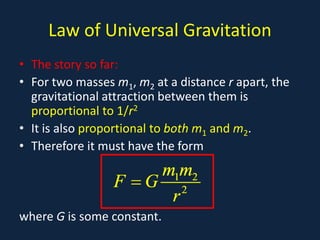
• For two masses m1, m2 at a distance r apart, the
  gravitational attraction between them is
  proportional to 1/r2
• It is also proportional to both m1 and m2.
• Therefore it must have the form
                     m1m2
                 F =G 2
                      r
where G is some constant.
Clicker Question:
    How could G be determined?

A. By accurately measuring the fall of a carefully
   weighed object
B. By observing the satellites of Jupiter
C. From calculations based on measuring relative
   planetary motions in the Solar System
D. It can’t be determined in any of these ways
   without some further information
Measuring G
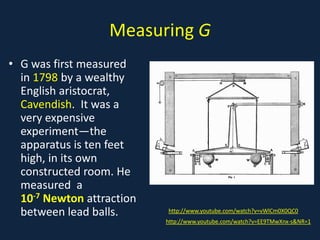
• G was first measured
  in 1798 by a wealthy
  English aristocrat,
  Cavendish. It was a
  very expensive
  experiment—the
  apparatus is ten feet
  high, in its own
  constructed room. He
  measured a
  10-7 Newton attraction
  between lead balls.      http://www.youtube.com/watch?v=vWlCm0X0QC0
                           http://www.youtube.com/watch?v=EE9TMwXnx-s&NR=1
Weighing the Earth
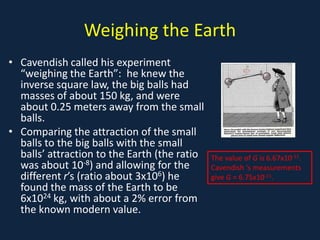
• Cavendish called his experiment
  “weighing the Earth”: he knew the
  inverse square law, the big balls had
  masses of about 150 kg, and were
  about 0.25 meters away from the small
  balls.
• Comparing the attraction of the small
  balls to the big balls with the small
  balls’ attraction to the Earth (the ratio   The value of G is 6.67x10⁻¹¹.
  was about 10-8) and allowing for the        Cavendish ‘s measurements
  different r’s (ratio about 3x10⁶) he        give G = 6.75x10⁻¹¹.
  found the mass of the Earth to be
  6x1024 kg, with about a 2% error from
  the known modern value.
Weighing the Sun…
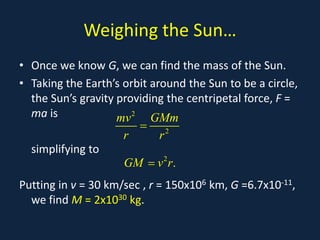
• Once we know G, we can find the mass of the Sun.
• Taking the Earth’s orbit around the Sun to be a circle,
  the Sun’s gravity providing the centripetal force, F =
  ma is             mv 2 GMm
                        = 2
                     r       r
  simplifying to
                     GM = v 2 r.
Putting in v = 30 km/sec , r = 150x106 km, G =6.7x10⁻¹¹,
  we find M = 2x1030 kg.
Weighing a Galaxy…
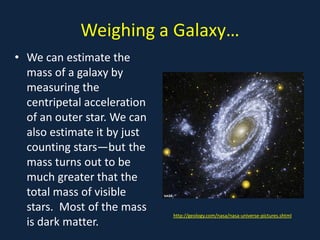
• We can estimate the
  mass of a galaxy by
  measuring the
  centripetal acceleration
  of an outer star. We can
  also estimate it by just
  counting stars—but the
  mass turns out to be
  much greater that the
  total mass of visible
  stars. Most of the mass
                             http://geology.com/nasa/nasa-universe-pictures.shtml
  is dark matter.
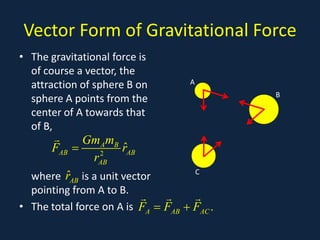
Vector Form of Gravitational Force
• The gravitational force is
                               • A
  of course a vector, the
  attraction of sphere B on          A
                                             B
  sphere A points from the
  center of A towards that
  of B,
           GmAmB
     FAB =       2
                      ˆ
                      rAB
               rAB
                                         C
  where rAB is a unit vector
        ˆ
  pointing from A to B.
                                
• The total force on A is = FAB + FAC .
                          FA
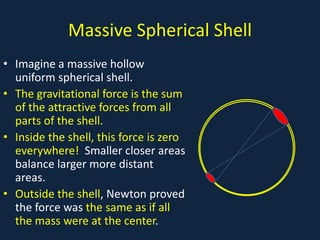
Massive Spherical Shell
• Imagine a massive hollow               • A
  uniform spherical shell.
• The gravitational force is the sum
  of the attractive forces from all
  parts of the shell.
• Inside the shell, this force is zero
  everywhere! Smaller closer areas
  balance larger more distant
  areas.
• Outside the shell, Newton proved
  the force was the same as if all
  the mass were at the center.
Clicker Question
How will g change (if at all) on going from
the Earth’s surface to the bottom of a deep
mine?


A. g will be a bit stronger at the bottom of the
   mine
B. It will be weaker
C. It will be the same as at the surface
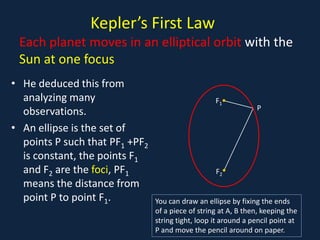
Kepler’s First Law
 Each planet moves in an elliptical orbit with the
 Sun at one focus
• He deduced this from             • A
  analyzing many                                   F1
                                                                P
  observations.
• An ellipse is the set of
  points P such that PF1 +PF2
  is constant, the points F1
  and F2 are the foci, PF1                         F2
  means the distance from
  point P to point F1.          You can draw an ellipse by fixing the ends
                                of a piece of string at A, B then, keeping the
                                string tight, loop it around a pencil point at
                                P and move the pencil around on paper.
About Ellipses…
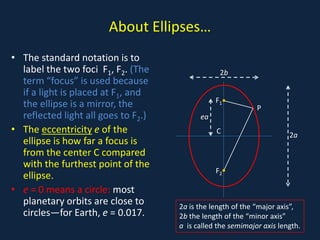
• The standard notation is to
  label the two foci F1, F2. (The                  2b
  term “focus” is used because       • A
  if a light is placed at F1, and
                                                  F1
  the ellipse is a mirror, the                                 P
  reflected light all goes to F2.)           ea
• The eccentricity e of the                       C
                                                                         2a
  ellipse is how far a focus is
  from the center C compared
  with the furthest point of the
                                                  F2
  ellipse.
• e = 0 means a circle: most
  planetary orbits are close to        2a is the length of the “major axis”,
  circles—for Earth, e = 0.017.        2b the length of the “minor axis”
                                       a is called the semimajor axis length.
Kepler’s Second Law
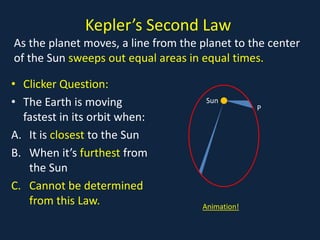
As the planet moves, a line from the planet to the center
of the Sun sweeps out equal areas in equal times.

• Clicker Question:            • A
• The Earth is moving                 Sun
                                                  P
  fastest in its orbit when:
A. It is closest to the Sun
B. When it’s furthest from
   the Sun
C. Cannot be determined
   from this Law.                    Animation!
Clicker Question
 When is Earth closest to the Sun?

A.   January
B.   June
C.   July
D.   August
Kepler’s Third Law
• Calling the average distance of a planet from the Sun
  r, and the time for one complete orbit T, then
• T2/r3 is the same number for all the Sun’s planets.
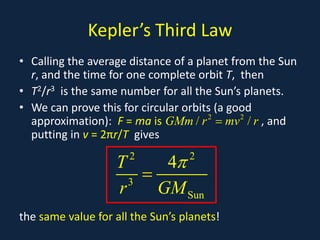
• We can prove this for circular orbits (a good
  approximation): F = ma is GMm / r 2 = mv 2 / r , and
  putting in v = 2πr/T gives

                   T  2
                          4π      2

                     3
                       =
                   r     GM Sun
the same value for all the Sun’s planets!
Trip to Mars
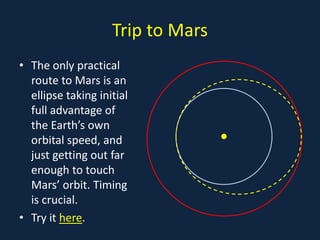
• The only practical       • a
  route to Mars is an
  ellipse taking initial
  full advantage of
  the Earth’s own
  orbital speed, and
  just getting out far
  enough to touch
  Mars’ orbit. Timing
  is crucial.
• Try it here.
The Slingshot

• The only way to really get out there is to use
  the planets themselves to bump you up to
  higher speed … well, pull you up.

• To see how Jupiter is used to get spacecraft
  further out, check the slingshot animation.
Clicker Question: dropping an iPod!

An iPod has a built-in accelerometer, which gives a
continuous reading of gravity. Just resting on a table,
it reads g.

If I drop it, what does it read while falling?

A.   Zero.
B.   g.
C.   Less than g, but not zero.
D.   More than g.
Weightlessness in Orbit
• We don’t directly feel gravity, we feel the
  compression of parts of our bodies, perhaps
  stretching of other parts, supporting us.
• The gravitational force on a body is just as
  strong in a freely falling elevator—but we
  don’t feel it.
• An orbiting spacecraft is in freefall, just like
  the elevator, so things in it are “weightless” in
  the same way.
Footnote: Galileo already knew this…
• He was asked: if a large stone is falling with a small stone
  on top of it, does the small stone press on the large one?

• His reply: One always feels the pressure upon his shoulders
  when he prevents the motion of a load resting upon him; but
  if one descends just as rapidly as the load would fall how can
  it press upon him? Do you not see that this would be the
  same as trying to strike a man with a lance when he is running
  away from you with a speed which is equal to, or even
  greater, than that with which you are following him?
• You must therefore conclude that, during free and natural fall,
  the small stone does not press upon the larger and
  consequently does not increase its weight as it does when at
  rest.

10 1425 web_lec_11_gravitation

  • 1.
    Gravitation Physics 1425 Lecture 11 Michael Fowler, UVa
  • 2.
    The Inverse SquareLaw • Newton’s idea: the centripetal force keeping the Moon circling the Earth is the same gravitational force that pulls us to the ground. • BUT: the Moon’s centripetal acceleration is only 1/3600 of g! • The Moon is 60 times further from the Earth’s center than we are. • SO: this suggests the gravitational pull from the Earth decreases with distance from the Earth’s center as 1/r2.
  • 3.
    Gravitational Attraction isProportional to Mass • The gravitational force causes everything to fall with the same acceleration: • For downward motion Fgrav = ma = mg • That is, Fgrav/m has the same value for all masses. • Conclusion: F ∝ m: the gravitational force on a mass is proportional to the mass.
  • 4.
    Clicker Question Does theMoon attract the Earth gravitationally? A. No B. Yes, but with a much weaker force than the Earth attracts the Moon. C. Yes, with the same force the Earth attracts the Moon.
  • 5.
    So why doesn’tthe Earth go round the Moon? • The moon’s mass is about 1% of the Earth’s mass. • In fact, the Moon’s attraction does cause the Earth to go in a circle—both Earth and Moon circle their common center of mass (which is inside the Earth!) We’ll discuss this more later.
  • 6.
    Gravitational Attraction isProportional to Both Masses • We’ve already seen, from Galileo’s observation of equal downward acceleration and Newton’s Second Law, that the Earth attracts an object with a force proportional to the object’s mass. • But from Newton’s Third Law, the attractions are equal and opposite—symmetric. • Therefore, the attraction is also proportional to the Earth’s mass.
  • 7.
    Law of UniversalGravitation • The story so far: • For two masses m1, m2 at a distance r apart, the gravitational attraction between them is proportional to 1/r2 • It is also proportional to both m1 and m2. • Therefore it must have the form m1m2 F =G 2 r where G is some constant.
  • 8.
    Clicker Question: How could G be determined? A. By accurately measuring the fall of a carefully weighed object B. By observing the satellites of Jupiter C. From calculations based on measuring relative planetary motions in the Solar System D. It can’t be determined in any of these ways without some further information
  • 9.
    Measuring G • Gwas first measured in 1798 by a wealthy English aristocrat, Cavendish. It was a very expensive experiment—the apparatus is ten feet high, in its own constructed room. He measured a 10-7 Newton attraction between lead balls. http://www.youtube.com/watch?v=vWlCm0X0QC0 http://www.youtube.com/watch?v=EE9TMwXnx-s&NR=1
  • 10.
    Weighing the Earth •Cavendish called his experiment “weighing the Earth”: he knew the inverse square law, the big balls had masses of about 150 kg, and were about 0.25 meters away from the small balls. • Comparing the attraction of the small balls to the big balls with the small balls’ attraction to the Earth (the ratio The value of G is 6.67x10⁻¹¹. was about 10-8) and allowing for the Cavendish ‘s measurements different r’s (ratio about 3x10⁶) he give G = 6.75x10⁻¹¹. found the mass of the Earth to be 6x1024 kg, with about a 2% error from the known modern value.
  • 11.
    Weighing the Sun… •Once we know G, we can find the mass of the Sun. • Taking the Earth’s orbit around the Sun to be a circle, the Sun’s gravity providing the centripetal force, F = ma is mv 2 GMm = 2 r r simplifying to GM = v 2 r. Putting in v = 30 km/sec , r = 150x106 km, G =6.7x10⁻¹¹, we find M = 2x1030 kg.
  • 12.
    Weighing a Galaxy… •We can estimate the mass of a galaxy by measuring the centripetal acceleration of an outer star. We can also estimate it by just counting stars—but the mass turns out to be much greater that the total mass of visible stars. Most of the mass http://geology.com/nasa/nasa-universe-pictures.shtml is dark matter.
  • 13.
    Vector Form ofGravitational Force • The gravitational force is • A of course a vector, the attraction of sphere B on A B sphere A points from the center of A towards that of B,  GmAmB FAB = 2 ˆ rAB rAB C where rAB is a unit vector ˆ pointing from A to B.    • The total force on A is = FAB + FAC . FA
  • 14.
    Massive Spherical Shell •Imagine a massive hollow • A uniform spherical shell. • The gravitational force is the sum of the attractive forces from all parts of the shell. • Inside the shell, this force is zero everywhere! Smaller closer areas balance larger more distant areas. • Outside the shell, Newton proved the force was the same as if all the mass were at the center.
  • 15.
    Clicker Question How willg change (if at all) on going from the Earth’s surface to the bottom of a deep mine? A. g will be a bit stronger at the bottom of the mine B. It will be weaker C. It will be the same as at the surface
  • 16.
    Kepler’s First Law Each planet moves in an elliptical orbit with the Sun at one focus • He deduced this from • A analyzing many F1 P observations. • An ellipse is the set of points P such that PF1 +PF2 is constant, the points F1 and F2 are the foci, PF1 F2 means the distance from point P to point F1. You can draw an ellipse by fixing the ends of a piece of string at A, B then, keeping the string tight, loop it around a pencil point at P and move the pencil around on paper.
  • 17.
    About Ellipses… • Thestandard notation is to label the two foci F1, F2. (The 2b term “focus” is used because • A if a light is placed at F1, and F1 the ellipse is a mirror, the P reflected light all goes to F2.) ea • The eccentricity e of the C 2a ellipse is how far a focus is from the center C compared with the furthest point of the F2 ellipse. • e = 0 means a circle: most planetary orbits are close to 2a is the length of the “major axis”, circles—for Earth, e = 0.017. 2b the length of the “minor axis” a is called the semimajor axis length.
  • 18.
    Kepler’s Second Law Asthe planet moves, a line from the planet to the center of the Sun sweeps out equal areas in equal times. • Clicker Question: • A • The Earth is moving Sun P fastest in its orbit when: A. It is closest to the Sun B. When it’s furthest from the Sun C. Cannot be determined from this Law. Animation!
  • 19.
    Clicker Question Whenis Earth closest to the Sun? A. January B. June C. July D. August
  • 20.
    Kepler’s Third Law •Calling the average distance of a planet from the Sun r, and the time for one complete orbit T, then • T2/r3 is the same number for all the Sun’s planets. • We can prove this for circular orbits (a good approximation): F = ma is GMm / r 2 = mv 2 / r , and putting in v = 2πr/T gives T 2 4π 2 3 = r GM Sun the same value for all the Sun’s planets!
  • 21.
    Trip to Mars •The only practical • a route to Mars is an ellipse taking initial full advantage of the Earth’s own orbital speed, and just getting out far enough to touch Mars’ orbit. Timing is crucial. • Try it here.
  • 22.
    The Slingshot • Theonly way to really get out there is to use the planets themselves to bump you up to higher speed … well, pull you up. • To see how Jupiter is used to get spacecraft further out, check the slingshot animation.
  • 23.
    Clicker Question: droppingan iPod! An iPod has a built-in accelerometer, which gives a continuous reading of gravity. Just resting on a table, it reads g. If I drop it, what does it read while falling? A. Zero. B. g. C. Less than g, but not zero. D. More than g.
  • 24.
    Weightlessness in Orbit •We don’t directly feel gravity, we feel the compression of parts of our bodies, perhaps stretching of other parts, supporting us. • The gravitational force on a body is just as strong in a freely falling elevator—but we don’t feel it. • An orbiting spacecraft is in freefall, just like the elevator, so things in it are “weightless” in the same way.
  • 25.
    Footnote: Galileo alreadyknew this… • He was asked: if a large stone is falling with a small stone on top of it, does the small stone press on the large one? • His reply: One always feels the pressure upon his shoulders when he prevents the motion of a load resting upon him; but if one descends just as rapidly as the load would fall how can it press upon him? Do you not see that this would be the same as trying to strike a man with a lance when he is running away from you with a speed which is equal to, or even greater, than that with which you are following him? • You must therefore conclude that, during free and natural fall, the small stone does not press upon the larger and consequently does not increase its weight as it does when at rest.