Chapter 7.3 and 8 Circular and Planetary Motion
Rotational Inertia The resistance of an object to changes in its rotational motion. Question:  Which way is easier to balance? Question:  Which easier to rotate? Rotational Inertia increases as you move the mass away from the axis of rotation Example is a Baseball bat.  Long Bat held near the end has more rotational motion than one that is “choked up”  Players are told to choke up in order to get the speed of the bat going.
Rotational Inertia An ice skater can spin around really fast by decreasing their rotational axis. How do they do it? By pulling their arms in and thus increasing their rotational speed. Here is our example:  One of you will do this. This is exactly how you do flips in gymnastics and cheerleading. Question:  Why is the rotational inertia greater for a gymnast when she’s swinging at full length or executing a somersault? Question:  Why do you hold your arms out to balance on a tight rope? Question:  Which can will roll down the incline faster?  Beans or Juice?
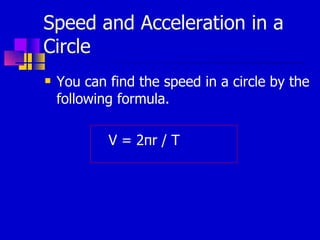
Speed and Acceleration in a Circle You can find the speed in a circle by the following formula. V = 2 π r / T
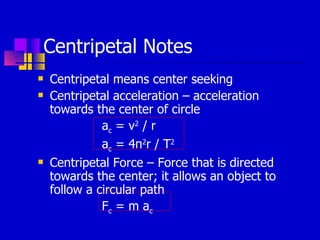
Centripetal Notes Centripetal means center seeking Centripetal acceleration – acceleration towards the center of circle a c  = v 2  / r a c  = 4 π 2 r / T 2 Centripetal Force – Force that is directed towards the center; it allows an object to follow a circular path F c  = m a c
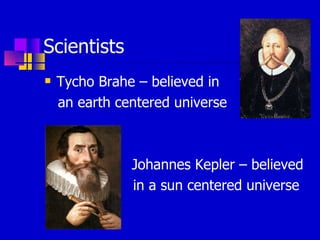
Scientists Tycho Brahe – believed in an earth centered universe Johannes Kepler – believed  in a sun centered universe
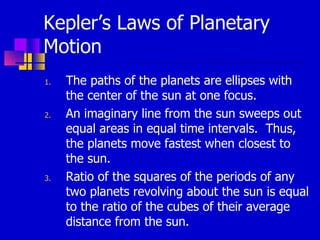
Kepler’s Laws of Planetary Motion The paths of the planets are ellipses with the center of the sun at one focus. An imaginary line from the sun sweeps out equal areas in equal time intervals.  Thus, the planets move fastest when closest to the sun. Ratio of the squares of the periods of any two planets revolving about the sun is equal to the ratio of the cubes of their average distance from the sun.
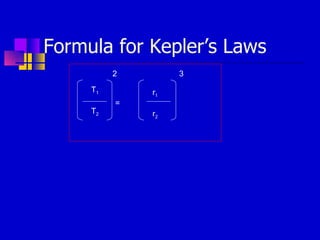
Formula for Kepler’s Laws T 2 T 1 = 2 r 1 r 2 3
Newton’s Universal Law of Gravitation States that the attractive force between two objects is directly proportional to the product of the masses and inversely proportional to the square of the distance between the objects centers.
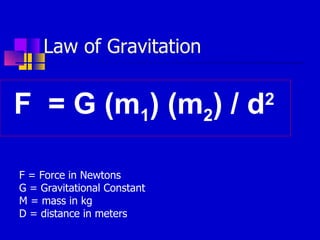
Law of Gravitation F  = G (m 1 ) (m 2 ) / d 2 F = Force in Newtons G = Gravitational Constant M = mass in kg D = distance in meters
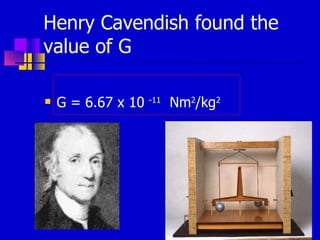
Henry Cavendish found the value of G G = 6.67 x 10  -11   Nm 2 /kg 2
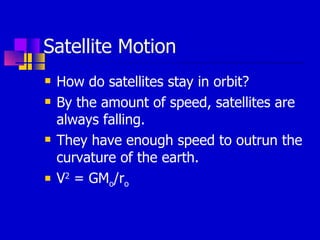
Satellite Motion How do satellites stay in orbit? By the amount of speed, satellites are always falling. They have enough speed to outrun the curvature of the earth. V 2  = GM o /r o
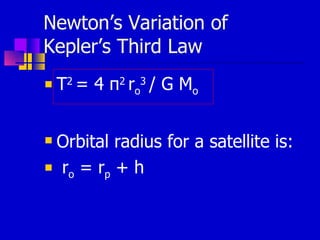
Newton’s Variation of  Kepler’s Third Law T 2  =  4  π 2  r o 3   / G M o Orbital radius for a satellite is:  r o  = r p  + h
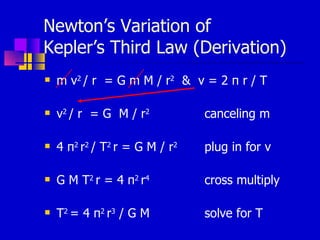
Newton’s Variation of  Kepler’s Third Law (Derivation) m v 2  / r  = G m M / r 2   &  v = 2  π   r / T v 2  / r  = G  M / r 2  canceling m 4  π 2  r 2  / T 2  r  = G M / r 2  plug in for v G M  T 2  r =  4  π 2  r 4   cross multiply T 2  =  4  π 2  r 3  / G M solve for T
Satellite orbits http://science.nasa.gov/Realtime/jtrack/3d/JTrack3D.html
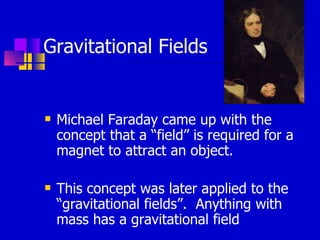
Gravitational Fields Michael Faraday came up with the concept that a “field” is required for a magnet to attract an object. This concept was later applied to the “gravitational fields”.  Anything with mass has a gravitational field
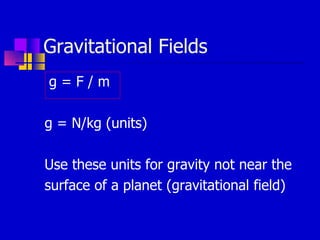
Gravitational Fields g = F / m g = N/kg (units) Use these units for gravity not near the surface of a planet (gravitational field)
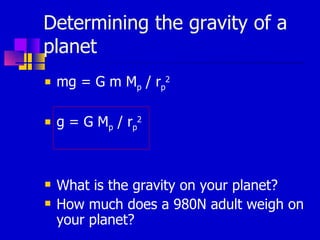
Determining the gravity of a planet mg = G m M p  / r p 2 g = G M p  / r p 2 What is the gravity on your planet? How much does a 980N adult weigh on your planet?
Weightlessness Caused when an object is in freefall
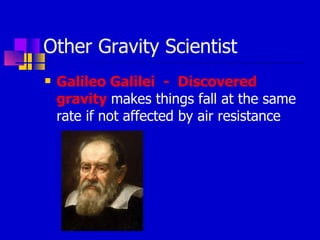
Other Gravity Scientist Galileo Galilei  -  Discovered gravity   makes things fall at the same rate if not affected by air resistance
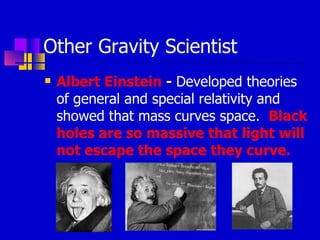
Other Gravity Scientist  Albert Einstein  -  Developed theories of general and special relativity and showed that mass curves space.  Black holes are so massive that light will not escape the space they curve.

Physics chapter 7.3 and 8

  • 1.
    Chapter 7.3 and8 Circular and Planetary Motion
  • 2.
    Rotational Inertia Theresistance of an object to changes in its rotational motion. Question: Which way is easier to balance? Question: Which easier to rotate? Rotational Inertia increases as you move the mass away from the axis of rotation Example is a Baseball bat. Long Bat held near the end has more rotational motion than one that is “choked up” Players are told to choke up in order to get the speed of the bat going.
  • 3.
    Rotational Inertia Anice skater can spin around really fast by decreasing their rotational axis. How do they do it? By pulling their arms in and thus increasing their rotational speed. Here is our example: One of you will do this. This is exactly how you do flips in gymnastics and cheerleading. Question: Why is the rotational inertia greater for a gymnast when she’s swinging at full length or executing a somersault? Question: Why do you hold your arms out to balance on a tight rope? Question: Which can will roll down the incline faster? Beans or Juice?
  • 4.
    Speed and Accelerationin a Circle You can find the speed in a circle by the following formula. V = 2 π r / T
  • 5.
    Centripetal Notes Centripetalmeans center seeking Centripetal acceleration – acceleration towards the center of circle a c = v 2 / r a c = 4 π 2 r / T 2 Centripetal Force – Force that is directed towards the center; it allows an object to follow a circular path F c = m a c
  • 6.
    Scientists Tycho Brahe– believed in an earth centered universe Johannes Kepler – believed in a sun centered universe
  • 7.
    Kepler’s Laws ofPlanetary Motion The paths of the planets are ellipses with the center of the sun at one focus. An imaginary line from the sun sweeps out equal areas in equal time intervals. Thus, the planets move fastest when closest to the sun. Ratio of the squares of the periods of any two planets revolving about the sun is equal to the ratio of the cubes of their average distance from the sun.
  • 8.
    Formula for Kepler’sLaws T 2 T 1 = 2 r 1 r 2 3
  • 9.
    Newton’s Universal Lawof Gravitation States that the attractive force between two objects is directly proportional to the product of the masses and inversely proportional to the square of the distance between the objects centers.
  • 10.
    Law of GravitationF = G (m 1 ) (m 2 ) / d 2 F = Force in Newtons G = Gravitational Constant M = mass in kg D = distance in meters
  • 11.
    Henry Cavendish foundthe value of G G = 6.67 x 10 -11 Nm 2 /kg 2
  • 12.
    Satellite Motion Howdo satellites stay in orbit? By the amount of speed, satellites are always falling. They have enough speed to outrun the curvature of the earth. V 2 = GM o /r o
  • 13.
    Newton’s Variation of Kepler’s Third Law T 2 = 4 π 2 r o 3 / G M o Orbital radius for a satellite is: r o = r p + h
  • 14.
    Newton’s Variation of Kepler’s Third Law (Derivation) m v 2 / r = G m M / r 2 & v = 2 π r / T v 2 / r = G M / r 2 canceling m 4 π 2 r 2 / T 2 r = G M / r 2 plug in for v G M T 2 r = 4 π 2 r 4 cross multiply T 2 = 4 π 2 r 3 / G M solve for T
  • 15.
  • 16.
    Gravitational Fields MichaelFaraday came up with the concept that a “field” is required for a magnet to attract an object. This concept was later applied to the “gravitational fields”. Anything with mass has a gravitational field
  • 17.
    Gravitational Fields g= F / m g = N/kg (units) Use these units for gravity not near the surface of a planet (gravitational field)
  • 18.
    Determining the gravityof a planet mg = G m M p / r p 2 g = G M p / r p 2 What is the gravity on your planet? How much does a 980N adult weigh on your planet?
  • 19.
    Weightlessness Caused whenan object is in freefall
  • 20.
    Other Gravity ScientistGalileo Galilei - Discovered gravity makes things fall at the same rate if not affected by air resistance
  • 21.
    Other Gravity Scientist Albert Einstein - Developed theories of general and special relativity and showed that mass curves space. Black holes are so massive that light will not escape the space they curve.