CALCULUS & NUMERICAL
METHODS
Your lecturer:
 Name :
 Email:
 No Phone:
PART ONE: CALCULUS
 FUNCTIONS AND GRAPHS (2 weeks)
 LIMITS AND CONTINUITY (1 week)
 DIFFERENTIATION (1 week)
 INTEGRATION (2 weeks)
 DIFFERENTIAL EQUATIONS (1 week)
 Total : 7 weeks
PART TWO: NUMERICAL METHODS
 ERRORS (1 week)
 ROOT FINDING (1 week)
 INTERPOLATION (1 week)
 NUMERICAL DIFFERENTIATION (1 week)

 NUMERICAL INTEGRATION (1 week)
 SOLUTION OF ORDINARY DIFFERENTIAL

EQUATIONS (1 week)
Learning Outcomes
 LO1: {C2}: Apply knowledge and fundamental

concepts of Calculus and Numerical Methods.
 LO3:{ C3,P3,CTPS}:Solve problems particularly in

computer science with appropriate and high-level
programming language or tools.
 LO3:{C3, LL}:Solve real-life application problems using

suitable techniques in Calculus or Numerical Methods
Assessment Methods
LO 1
Assessment Methods
Test(2)
= 20%
Assignments(2) = 20%
Mid Term (1) = 30%
Final (1)
= 30%
Total
= 100%

LO 2

T1 (10%)

T2 (10%)
A2 (10%)

MT1 (15%)
F1 (15%)
40%
20%

LO 3

A1 (10%)
MT2(15%)
F3 (15%)
40%
FUNCTIONS AND GRAPHS
Subtopics
1. Relations and Functions
2. Representation of Functions
3. New Function form Old Function
4. Inverse of Functions

5. Exponential Functions
6. Logarithm Functions, log x
1.Relations and Functions
2.Representation of Functions
Relations and Functions
 Definition-A function is defined as a relation in

which every element in the domain has a unique
image in the range. In other words, a function is one
to one relation and many to one relation
Representation of Functions
1. Verbally ( by a description in words)
P(t) is the human population of the world of time

2. Numerically (by a table of values)
Year

1900

1920

1940

1960

1980

2000

Population

1650

1860

2300

3040

4450

6080

(millions)
Representation of Functions
3. Visually ( by a graph)
Population (millions)

8000

6000
4000
2000

0
1900 1920 1940 1960 1980 2000
Year

4. Algebraically ( by an explicit formula)
Example 1:
 Let A = {1, 2, 3, 4} and B = {set of integers}. Illustrate
x 3.
the function f : x
Example 2:
 Draw the graph of the function

,

f :x

2

x ,x

R

where R is the set of real numbers.

Solution
Assume the domain is x = -3, -2, -1, 0, 1, 2, 3.
A table of values is constructed as follows:

x
f(x)

-3
9

-2
4

-1
1

0
0

1
1

2
4

3
9
Example 2: Graph
Type of Function and Their Graph
Linear Function
f ( x)

 Where

are constant called the
coefficients of the linear
equation

x

;x

R
Type of Function and Their Graph
Polynomial

 Where n is a

nonnegative integer
and the number are
constant
called the coefficients
of the polynomial.

 Quadratic

f ( x)

2

x ;x

R
Type of Function and Their Graph
Power Function
f ( x)

Where a is constant.

3

x ;x

R
,

Type of Function and Their Graph
Exponential Function
f ( x)

Where a is a positive constant.

x

e ;x

R
,

Type of Function and Their Graph
Logarithm Function

Where a is a positive constant.

f ( x)

ln x ; x

(0,

)
Example 10:
Consider for what value of x are the following
function defined?

1

f ( x)
x

2
3. New Functions from Old
Function
1. TRANSFORMATIONS OF FUNCTIONS
2. COMBINATION OF FUNCTIONS
3. COMPOSITE FUNCTIONS
New Functions from Old Function
 TRANSFORMATIONS OF FUNCTIONS
 The graph of one function can be transform into the graph of a

different function rely on a function’s equation.
Vertical and horizontal shift
TRANSFORMATIONS OF FUNCTIONS
 Vertical and horizontal shift
Example 3:
Use the graph of

f ( x)

x

g ( x)

x

to obtain the graph of
4
Example 4:
Use the graph of f ( x )
g ( x)

x

(x

2

to obtain the graph of
2)

2
TRANSFORMATIONS OF FUNCTIONS
 Vertical and horizontal shift
TRANSFORMATIONS OF FUNCTIONS
Vertical and Horizontal Reflecting and Stretching
Example 5:
Use the graph of f ( x )
g(x)

h( x)

x

x

x

to obtain the graph of
Example 5:
Use the graph of f ( x )
g ( x)

h(x)

2x
1
2

2

x

2

x

2

to obtain the graph of
COMBINATION OF FUNCTIONS

 Functions can be added, subtracted, multiplied and

divided in a many ways.
For example consider
a) f(x)+g(x)
b) f(x)-g(x)

c) f(x)/g(x)
d) f(x).g(x)

and
and
and
and

f ( x)

x

2

and
g(x)+f(x)
g(x)-f(x)
g(x)/f(x)
g(x).f(x)
COMPOSITE FUNCTIONS

 DefinitionWe define f  g

Consider two functions f(x) and g(x).
fg ( x ) f [ g ( x )] meaning that the output
values of the function g are used as the input values for
the function f.
Example 6:
 If

f (x)=3x +1

of x
(a)

f ° g

(b)

g° f

and

g(x)=2-x , find as a function
COMPOSITE FUNCTIONS
 Determine the

Domain of the
Composite
Functions
Example 7:
 If

f (x)=3x +1

and

g(x)=2-x , find as a function

of x
(a)

Find f ° g and determine its domain and range

(b)

Find g ° f and determine its domain and range
Properties for Graph of Functions
 All forms of relations can be represented on
coordinates
 To test if a graph displayed is a function, vertical lines
are drawn parallel to the y – axis.
 The graph is a function if each vertical line drawn
through the domain cuts the graph at only one point.
Example 8:
 Consider the graphs shown below and state whether

they represent functions:
4. Inverse Function
The Inverse of Functions
 If f is a function, the inverse is denoted by
 Suppose y=f (x) then x
y
y

y

32

1

1

( y)

f (x)
9
5
9

x

32

5
9

f

1

( y)

5

(y

32 )

9
Since y could be any variable, we can rewrite

x

5
x

f

f

as a function of x as

(y

32 )

f

1

(x)

5
9

(x

f

32 )

1
Find the inverse of

Example 11:
 Find the inverse of :
f (x)

x

3
2
Graphical Illustration of an Inverse Function
Verify that the inverse of f (x)=2x-3 is

f

1

(x)

x

3
2

Figure above shows the graph of these two functions on the same pair axes.
The dotted line is the graph y=x. These graphs illustrate a general
relationship between the graph of a function and that of its inverse, namely
that one graph is the reflection of the other in the line y = x.
Example 12:
 Find the inverse of :
1

f ( x)
1

2, x
x

 State the domain of the inverse

1.
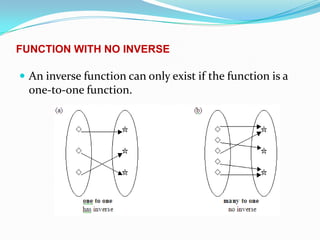
FUNCTION WITH NO INVERSE

 An inverse function can only exist if the function is a

one-to-one function.
Subtopics
1. Relations and Functions
2. Representation of Functions
3. New Function form Old Function
4. Inverse of Functions

Next week lecture:
1. Exponential Functions
2. Logarithm Functions, log x
Calculus and Numerical Method =_=

Calculus and Numerical Method =_=

  • 1.
  • 2.
    Your lecturer:  Name:  Email:  No Phone:
  • 3.
    PART ONE: CALCULUS FUNCTIONS AND GRAPHS (2 weeks)  LIMITS AND CONTINUITY (1 week)  DIFFERENTIATION (1 week)  INTEGRATION (2 weeks)  DIFFERENTIAL EQUATIONS (1 week)  Total : 7 weeks
  • 4.
    PART TWO: NUMERICALMETHODS  ERRORS (1 week)  ROOT FINDING (1 week)  INTERPOLATION (1 week)  NUMERICAL DIFFERENTIATION (1 week)  NUMERICAL INTEGRATION (1 week)  SOLUTION OF ORDINARY DIFFERENTIAL EQUATIONS (1 week)
  • 5.
    Learning Outcomes  LO1:{C2}: Apply knowledge and fundamental concepts of Calculus and Numerical Methods.  LO3:{ C3,P3,CTPS}:Solve problems particularly in computer science with appropriate and high-level programming language or tools.  LO3:{C3, LL}:Solve real-life application problems using suitable techniques in Calculus or Numerical Methods
  • 6.
    Assessment Methods LO 1 AssessmentMethods Test(2) = 20% Assignments(2) = 20% Mid Term (1) = 30% Final (1) = 30% Total = 100% LO 2 T1 (10%) T2 (10%) A2 (10%) MT1 (15%) F1 (15%) 40% 20% LO 3 A1 (10%) MT2(15%) F3 (15%) 40%
  • 7.
  • 9.
    Subtopics 1. Relations andFunctions 2. Representation of Functions 3. New Function form Old Function 4. Inverse of Functions 5. Exponential Functions 6. Logarithm Functions, log x
  • 10.
  • 11.
    Relations and Functions Definition-A function is defined as a relation in which every element in the domain has a unique image in the range. In other words, a function is one to one relation and many to one relation
  • 12.
    Representation of Functions 1.Verbally ( by a description in words) P(t) is the human population of the world of time 2. Numerically (by a table of values) Year 1900 1920 1940 1960 1980 2000 Population 1650 1860 2300 3040 4450 6080 (millions)
  • 13.
    Representation of Functions 3.Visually ( by a graph) Population (millions) 8000 6000 4000 2000 0 1900 1920 1940 1960 1980 2000 Year 4. Algebraically ( by an explicit formula)
  • 14.
    Example 1:  LetA = {1, 2, 3, 4} and B = {set of integers}. Illustrate x 3. the function f : x
  • 15.
    Example 2:  Drawthe graph of the function , f :x 2 x ,x R where R is the set of real numbers. Solution Assume the domain is x = -3, -2, -1, 0, 1, 2, 3. A table of values is constructed as follows: x f(x) -3 9 -2 4 -1 1 0 0 1 1 2 4 3 9
  • 16.
  • 17.
    Type of Functionand Their Graph Linear Function f ( x)  Where are constant called the coefficients of the linear equation x ;x R
  • 18.
    Type of Functionand Their Graph Polynomial  Where n is a nonnegative integer and the number are constant called the coefficients of the polynomial.  Quadratic f ( x) 2 x ;x R
  • 19.
    Type of Functionand Their Graph Power Function f ( x) Where a is constant. 3 x ;x R
  • 20.
    , Type of Functionand Their Graph Exponential Function f ( x) Where a is a positive constant. x e ;x R
  • 21.
    , Type of Functionand Their Graph Logarithm Function Where a is a positive constant. f ( x) ln x ; x (0, )
  • 22.
    Example 10: Consider forwhat value of x are the following function defined? 1 f ( x) x 2
  • 23.
    3. New Functionsfrom Old Function 1. TRANSFORMATIONS OF FUNCTIONS 2. COMBINATION OF FUNCTIONS 3. COMPOSITE FUNCTIONS
  • 24.
    New Functions fromOld Function  TRANSFORMATIONS OF FUNCTIONS  The graph of one function can be transform into the graph of a different function rely on a function’s equation. Vertical and horizontal shift
  • 25.
    TRANSFORMATIONS OF FUNCTIONS Vertical and horizontal shift
  • 26.
    Example 3: Use thegraph of f ( x) x g ( x) x to obtain the graph of 4
  • 27.
    Example 4: Use thegraph of f ( x ) g ( x) x (x 2 to obtain the graph of 2) 2
  • 28.
    TRANSFORMATIONS OF FUNCTIONS Vertical and horizontal shift
  • 29.
    TRANSFORMATIONS OF FUNCTIONS Verticaland Horizontal Reflecting and Stretching
  • 30.
    Example 5: Use thegraph of f ( x ) g(x) h( x) x x x to obtain the graph of
  • 31.
    Example 5: Use thegraph of f ( x ) g ( x) h(x) 2x 1 2 2 x 2 x 2 to obtain the graph of
  • 32.
    COMBINATION OF FUNCTIONS Functions can be added, subtracted, multiplied and divided in a many ways. For example consider a) f(x)+g(x) b) f(x)-g(x) c) f(x)/g(x) d) f(x).g(x) and and and and f ( x) x 2 and g(x)+f(x) g(x)-f(x) g(x)/f(x) g(x).f(x)
  • 33.
    COMPOSITE FUNCTIONS  DefinitionWedefine f  g Consider two functions f(x) and g(x). fg ( x ) f [ g ( x )] meaning that the output values of the function g are used as the input values for the function f.
  • 34.
    Example 6:  If f(x)=3x +1 of x (a) f ° g (b) g° f and g(x)=2-x , find as a function
  • 35.
    COMPOSITE FUNCTIONS  Determinethe Domain of the Composite Functions
  • 36.
    Example 7:  If f(x)=3x +1 and g(x)=2-x , find as a function of x (a) Find f ° g and determine its domain and range (b) Find g ° f and determine its domain and range
  • 37.
    Properties for Graphof Functions  All forms of relations can be represented on coordinates  To test if a graph displayed is a function, vertical lines are drawn parallel to the y – axis.  The graph is a function if each vertical line drawn through the domain cuts the graph at only one point.
  • 38.
    Example 8:  Considerthe graphs shown below and state whether they represent functions:
  • 39.
  • 40.
    The Inverse ofFunctions  If f is a function, the inverse is denoted by  Suppose y=f (x) then x y y y 32 1 1 ( y) f (x) 9 5 9 x 32 5 9 f 1 ( y) 5 (y 32 ) 9 Since y could be any variable, we can rewrite x 5 x f f as a function of x as (y 32 ) f 1 (x) 5 9 (x f 32 ) 1
  • 41.
    Find the inverseof Example 11:  Find the inverse of : f (x) x 3 2
  • 42.
    Graphical Illustration ofan Inverse Function Verify that the inverse of f (x)=2x-3 is f 1 (x) x 3 2 Figure above shows the graph of these two functions on the same pair axes. The dotted line is the graph y=x. These graphs illustrate a general relationship between the graph of a function and that of its inverse, namely that one graph is the reflection of the other in the line y = x.
  • 44.
    Example 12:  Findthe inverse of : 1 f ( x) 1 2, x x  State the domain of the inverse 1.
  • 45.
    FUNCTION WITH NOINVERSE  An inverse function can only exist if the function is a one-to-one function.
  • 46.
    Subtopics 1. Relations andFunctions 2. Representation of Functions 3. New Function form Old Function 4. Inverse of Functions Next week lecture: 1. Exponential Functions 2. Logarithm Functions, log x