Assortativity and 
Dissortativity 
Complex Networks 
Jaqueline Passos do Nascimento
Definitions 
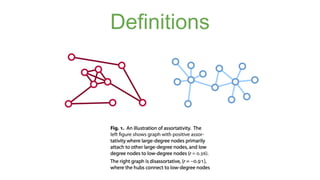
“nodes with similar degree connect preferably” 
(assortative mixing) 
“nodes with low degree try to connect with 
highly connected nodes” 
(dissortativity) 
Xulvi-Brunet, R., & Sokolov, I. (2005). Changing Correlations In Networks: Assortativity And Dissortativity.
Definitions 
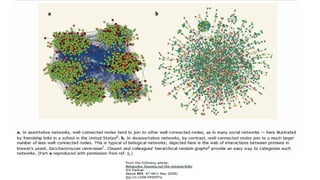
ASSORTATIVITY OR ASSORTATIVE MIXING 
Social networks show the property that nodes having many 
connections tend to be connected with other highly 
connected nodes. 
DISSORTATIVITY 
Technological and biological networks show the property 
that nodes having high degrees are preferably connected 
with nodes having low degrees. 
Xulvi-Brunet, R., & Sokolov, I. (2005). Changing Correlations In Networks: Assortativity And Dissortativity.
Definitions
Definitions 
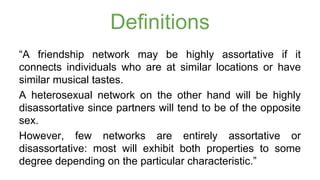
“A friendship network may be highly assortative if it 
connects individuals who are at similar locations or have 
similar musical tastes. 
A heterosexual network on the other hand will be highly 
disassortative since partners will tend to be of the opposite 
sex. 
However, few networks are entirely assortative or 
disassortative: most will exhibit both properties to some 
degree depending on the particular characteristic.”
How to calculate metrics? 
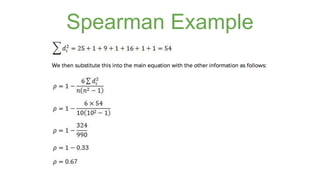
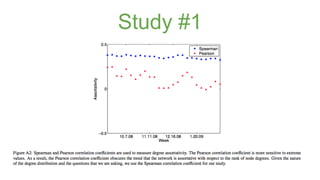
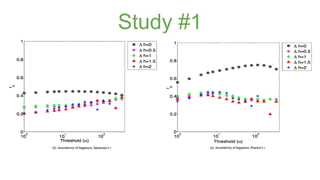
Spearman x Pearson 
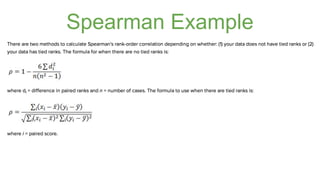
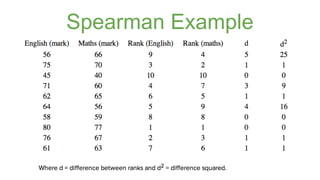
The Spearman correlation coefficient is the Pearson correlation coefficient applied to the ranks of the 
degrees at each end of links in the network, is a non-parametric test that does not rely on normally 
distributed data and is much less sensitive to outliers.
How to calculate metrics? 
Newman 
where ji,ki are the degrees of the vertices at the ends of the ith edge, with i = 1...M 
M edges
Spearman Example
Spearman Example
Spearman Example
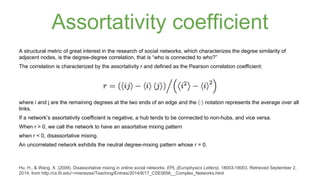
Assortativity coefficient 
A structural metric of great interest in the research of social networks, which characterizes the degree similarity of 
adjacent nodes, is the degree-degree correlation, that is “who is connected to who?” 
The correlation is characterized by the assortativity r and defined as the Pearson correlation coefficient: 
where i and j are the remaining degrees at the two ends of an edge and the ⟨·⟩ notation represents the average over all 
links. 
If a network’s assortativity coefficient is negative, a hub tends to be connected to non-hubs, and vice versa. 
When r > 0, we call the network to have an assortative mixing pattern 
when r < 0, disassortative mixing. 
An uncorrelated network exhibits the neutral degree-mixing pattern whose r = 0. 
Hu, H., & Wang, X. (2009). Disassortative mixing in online social networks. EPL (Europhysics Letters), 18003-18003. Retrieved September 2, 
2014, from http://cs.fit.edu/~rmenezes/Teaching/Entries/2014/8/17_CSE5656__Complex_Networks.html
Relation to Homophily in Social 
Sciences 
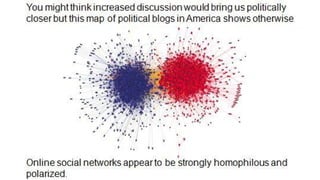
similarity breeds connection
Relation to Homophily in Social 
Sciences
Relation to Homophily in Social 
Sciences 
From the perspective of sociology and psychology, in real life everyone would 
like to have intercourse with elites in a society; however the elites would rather 
communicate with the people with the same social status as theirs, which may 
lead to the assortative mixing pattern in the real-world social networks.
Relation to Homophily in Social 
Sciences 
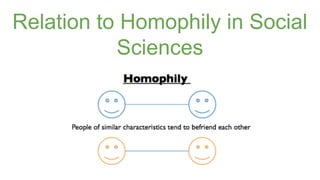
Patterns of friendship between individuals for example are strongly affected by 
the language, race, and age of the individuals in question, among other things. 
Friendship is usually found to be assortative by most characteristics. 
Assortative mixing can have a profound effect on the structural properties of a 
network. For example, assortative mixing of a network by a discrete 
characteristic will tend to break the network up into separate communities. If 
people prefer to be friends with others who speak their own language, for 
example, then one might expect countries with more than one language to 
separate into communities by language.
Applications 
A viral marketer attempting to advertise a new product could benefit from 
considering specific sets of users on a social space who are homophilous with 
respect to their interest in similar products or features. 
Understanding the impact of homophily on diffusion is likely to have potential in 
addressing the propagation of medical and technological innovations, cultural 
bias, in understanding social roles and in distributed social search.
Study #1 
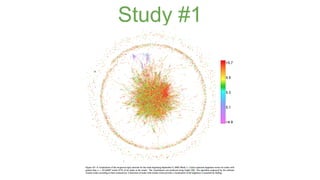
Twitter reciprocal reply networks exhibit assortativity 
with respect to happiness. 
Bliss, C. A., Kloumann, I. M., Harris, K. D., Danforth, C. M. & Dodds, P. S. Twitter reciprocal reply networks exhibit assortativity with respect to happiness. Journal of Computational Science 3(5), 388–397 (2012).
Study #1 
Method 
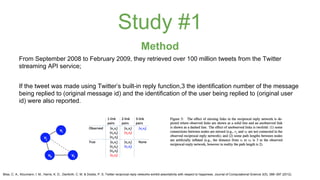
From September 2008 to February 2009, they retrieved over 100 million tweets from the Twitter 
streaming API service; 
If the tweet was made using Twitter’s built-in reply function,3 the identification number of the message 
being replied to (original message id) and the identification of the user being replied to (original user 
id) were also reported. 
Bliss, C. A., Kloumann, I. M., Harris, K. D., Danforth, C. M. & Dodds, P. S. Twitter reciprocal reply networks exhibit assortativity with respect to happiness. Journal of Computational Science 3(5), 388–397 (2012).
Study #1
Study #1 
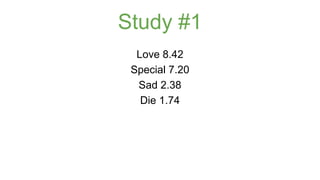
Love 8.42 
Special 7.20 
Sad 2.38 
Die 1.74
Study #1
Study #1
Study #1 
Bliss, C. A., Kloumann, I. M., Harris, K. D., Danforth, C. M. & Dodds, P. S. Twitter reciprocal reply networks exhibit assortativity with respect to happiness. Journal of Computational Science 3(5), 388–397 (2012).
Study #1
Study #1 
In a study of over 6 million users, Cha et al. [10] found that users with the 
highest follower counts were not the users whose messages were most 
frequently retweeted. This suggests that such popular users (as measured by 
follower count) may not be the most influential in terms of spreading 
information, and this calls into question the extent to which users are influenced 
by those that they follow. 
Large degree nodes use words such as “you,” “thanks,” and “lol” more 
frequently than small degree nodes, while the latter group uses words such as 
“damn,” “hate,” and “tired” more frequently. 
Bliss, C. A., Kloumann, I. M., Harris, K. D., Danforth, C. M. & Dodds, P. S. Twitter reciprocal reply networks exhibit assortativity with respect to happiness. Journal of Computational Science 3(5), 388–397 (2012).
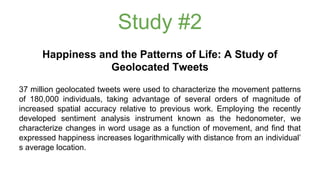
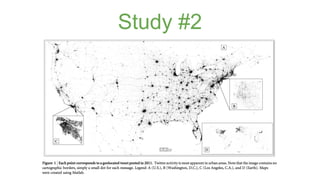
Study #2 
Happiness and the Patterns of Life: A Study of 
Geolocated Tweets 
37 million geolocated tweets were used to characterize the movement patterns 
of 180,000 individuals, taking advantage of several orders of magnitude of 
increased spatial accuracy relative to previous work. Employing the recently 
developed sentiment analysis instrument known as the hedonometer, we 
characterize changes in word usage as a function of movement, and find that 
expressed happiness increases logarithmically with distance from an individual’ 
s average location.
Study #2
Study #2
Study #2 
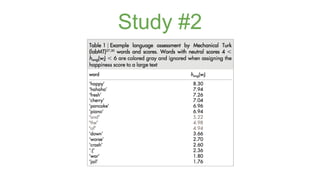
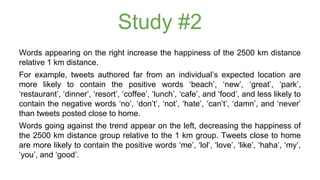
Words appearing on the right increase the happiness of the 2500 km distance 
relative 1 km distance. 
For example, tweets authored far from an individual’s expected location are 
more likely to contain the positive words ‘beach’, ‘new’, ‘great’, ‘park’, 
‘restaurant’, ‘dinner’, ‘resort’, ‘coffee’, ‘lunch’, ‘cafe’, and ‘food’, and less likely to 
contain the negative words ‘no’, ‘don’t’, ‘not’, ‘hate’, ‘can’t’, ‘damn’, and ‘never’ 
than tweets posted close to home. 
Words going against the trend appear on the left, decreasing the happiness of 
the 2500 km distance group relative to the 1 km group. Tweets close to home 
are more likely to contain the positive words ‘me’, ‘lol’, ‘love’, ‘like’, ‘haha’, ‘my’, 
‘you’, and ‘good’.
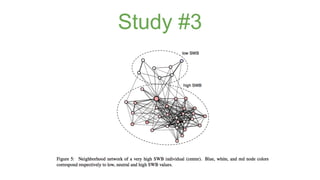
Study #3 
Happiness is assortative in online social networks 
“General happiness or Subjective Well-Being (SWB) of Twitter users, as 
measured from a 6 month record of their individual tweets, is indeed assortative 
across the Twitter social network. To our knowledge this is the first result that 
shows assortative mixing in online networks at the level of SWB.”
Study #3
Study #3
Resilience 
“social networks that spread disease, appear to be assortative, and therefore 
are resilient, at least against simple targeted attacks such as attacks on the 
highest degree vertices. And yet at the same time the networks that we would 
wish to protect, including technological networks such as the Internet, appear to 
be disassortative, and are hence particularly vulnerable.” 
“assortative networks percolate more easily and that they are also more robust 
to removal of their highest degree vertices, while disassortative networks 
percolate less easily and are more vulnerable. This suggests that social 
networks may be robust to intervention and attack while technological networks 
are not.” 
Newman, M. (2002). Assortative Mixing in Networks. Physical Review Letters. Retrieved September 2, 2014, from http://arxiv.org/pdf/cond-mat/0205405.pdf
Resilience 
Assuming that the goal of a vaccination program is to destroy network 
connectivity so that the disease in question cannot spread, our findings suggest 
that even targeted vaccination strategies would be less effective in assortative 
networks than in disassortative or neutral ones because of the resilience of the 
network to this type of attack.
Spreading 
For the spreading phenomena in online communities, such as diffusion of 
opinions, technical innovations or gossip, one can expect the things to be 
spread to a larger segment of the population in disassortative networks than in 
assortative ones.
Thank you

Complex networks - Assortativity

  • 1.
    Assortativity and Dissortativity Complex Networks Jaqueline Passos do Nascimento
  • 2.
    Definitions “nodes withsimilar degree connect preferably” (assortative mixing) “nodes with low degree try to connect with highly connected nodes” (dissortativity) Xulvi-Brunet, R., & Sokolov, I. (2005). Changing Correlations In Networks: Assortativity And Dissortativity.
  • 3.
    Definitions ASSORTATIVITY ORASSORTATIVE MIXING Social networks show the property that nodes having many connections tend to be connected with other highly connected nodes. DISSORTATIVITY Technological and biological networks show the property that nodes having high degrees are preferably connected with nodes having low degrees. Xulvi-Brunet, R., & Sokolov, I. (2005). Changing Correlations In Networks: Assortativity And Dissortativity.
  • 4.
  • 6.
    Definitions “A friendshipnetwork may be highly assortative if it connects individuals who are at similar locations or have similar musical tastes. A heterosexual network on the other hand will be highly disassortative since partners will tend to be of the opposite sex. However, few networks are entirely assortative or disassortative: most will exhibit both properties to some degree depending on the particular characteristic.”
  • 7.
    How to calculatemetrics? Spearman x Pearson The Spearman correlation coefficient is the Pearson correlation coefficient applied to the ranks of the degrees at each end of links in the network, is a non-parametric test that does not rely on normally distributed data and is much less sensitive to outliers.
  • 8.
    How to calculatemetrics? Newman where ji,ki are the degrees of the vertices at the ends of the ith edge, with i = 1...M M edges
  • 9.
  • 10.
  • 11.
  • 12.
    Assortativity coefficient Astructural metric of great interest in the research of social networks, which characterizes the degree similarity of adjacent nodes, is the degree-degree correlation, that is “who is connected to who?” The correlation is characterized by the assortativity r and defined as the Pearson correlation coefficient: where i and j are the remaining degrees at the two ends of an edge and the ⟨·⟩ notation represents the average over all links. If a network’s assortativity coefficient is negative, a hub tends to be connected to non-hubs, and vice versa. When r > 0, we call the network to have an assortative mixing pattern when r < 0, disassortative mixing. An uncorrelated network exhibits the neutral degree-mixing pattern whose r = 0. Hu, H., & Wang, X. (2009). Disassortative mixing in online social networks. EPL (Europhysics Letters), 18003-18003. Retrieved September 2, 2014, from http://cs.fit.edu/~rmenezes/Teaching/Entries/2014/8/17_CSE5656__Complex_Networks.html
  • 13.
    Relation to Homophilyin Social Sciences similarity breeds connection
  • 14.
    Relation to Homophilyin Social Sciences
  • 15.
    Relation to Homophilyin Social Sciences From the perspective of sociology and psychology, in real life everyone would like to have intercourse with elites in a society; however the elites would rather communicate with the people with the same social status as theirs, which may lead to the assortative mixing pattern in the real-world social networks.
  • 17.
    Relation to Homophilyin Social Sciences Patterns of friendship between individuals for example are strongly affected by the language, race, and age of the individuals in question, among other things. Friendship is usually found to be assortative by most characteristics. Assortative mixing can have a profound effect on the structural properties of a network. For example, assortative mixing of a network by a discrete characteristic will tend to break the network up into separate communities. If people prefer to be friends with others who speak their own language, for example, then one might expect countries with more than one language to separate into communities by language.
  • 18.
    Applications A viralmarketer attempting to advertise a new product could benefit from considering specific sets of users on a social space who are homophilous with respect to their interest in similar products or features. Understanding the impact of homophily on diffusion is likely to have potential in addressing the propagation of medical and technological innovations, cultural bias, in understanding social roles and in distributed social search.
  • 19.
    Study #1 Twitterreciprocal reply networks exhibit assortativity with respect to happiness. Bliss, C. A., Kloumann, I. M., Harris, K. D., Danforth, C. M. & Dodds, P. S. Twitter reciprocal reply networks exhibit assortativity with respect to happiness. Journal of Computational Science 3(5), 388–397 (2012).
  • 20.
    Study #1 Method From September 2008 to February 2009, they retrieved over 100 million tweets from the Twitter streaming API service; If the tweet was made using Twitter’s built-in reply function,3 the identification number of the message being replied to (original message id) and the identification of the user being replied to (original user id) were also reported. Bliss, C. A., Kloumann, I. M., Harris, K. D., Danforth, C. M. & Dodds, P. S. Twitter reciprocal reply networks exhibit assortativity with respect to happiness. Journal of Computational Science 3(5), 388–397 (2012).
  • 21.
  • 22.
    Study #1 Love8.42 Special 7.20 Sad 2.38 Die 1.74
  • 23.
  • 24.
  • 25.
    Study #1 Bliss,C. A., Kloumann, I. M., Harris, K. D., Danforth, C. M. & Dodds, P. S. Twitter reciprocal reply networks exhibit assortativity with respect to happiness. Journal of Computational Science 3(5), 388–397 (2012).
  • 26.
  • 27.
    Study #1 Ina study of over 6 million users, Cha et al. [10] found that users with the highest follower counts were not the users whose messages were most frequently retweeted. This suggests that such popular users (as measured by follower count) may not be the most influential in terms of spreading information, and this calls into question the extent to which users are influenced by those that they follow. Large degree nodes use words such as “you,” “thanks,” and “lol” more frequently than small degree nodes, while the latter group uses words such as “damn,” “hate,” and “tired” more frequently. Bliss, C. A., Kloumann, I. M., Harris, K. D., Danforth, C. M. & Dodds, P. S. Twitter reciprocal reply networks exhibit assortativity with respect to happiness. Journal of Computational Science 3(5), 388–397 (2012).
  • 28.
    Study #2 Happinessand the Patterns of Life: A Study of Geolocated Tweets 37 million geolocated tweets were used to characterize the movement patterns of 180,000 individuals, taking advantage of several orders of magnitude of increased spatial accuracy relative to previous work. Employing the recently developed sentiment analysis instrument known as the hedonometer, we characterize changes in word usage as a function of movement, and find that expressed happiness increases logarithmically with distance from an individual’ s average location.
  • 29.
  • 30.
  • 31.
    Study #2 Wordsappearing on the right increase the happiness of the 2500 km distance relative 1 km distance. For example, tweets authored far from an individual’s expected location are more likely to contain the positive words ‘beach’, ‘new’, ‘great’, ‘park’, ‘restaurant’, ‘dinner’, ‘resort’, ‘coffee’, ‘lunch’, ‘cafe’, and ‘food’, and less likely to contain the negative words ‘no’, ‘don’t’, ‘not’, ‘hate’, ‘can’t’, ‘damn’, and ‘never’ than tweets posted close to home. Words going against the trend appear on the left, decreasing the happiness of the 2500 km distance group relative to the 1 km group. Tweets close to home are more likely to contain the positive words ‘me’, ‘lol’, ‘love’, ‘like’, ‘haha’, ‘my’, ‘you’, and ‘good’.
  • 32.
    Study #3 Happinessis assortative in online social networks “General happiness or Subjective Well-Being (SWB) of Twitter users, as measured from a 6 month record of their individual tweets, is indeed assortative across the Twitter social network. To our knowledge this is the first result that shows assortative mixing in online networks at the level of SWB.”
  • 33.
  • 34.
  • 35.
    Resilience “social networksthat spread disease, appear to be assortative, and therefore are resilient, at least against simple targeted attacks such as attacks on the highest degree vertices. And yet at the same time the networks that we would wish to protect, including technological networks such as the Internet, appear to be disassortative, and are hence particularly vulnerable.” “assortative networks percolate more easily and that they are also more robust to removal of their highest degree vertices, while disassortative networks percolate less easily and are more vulnerable. This suggests that social networks may be robust to intervention and attack while technological networks are not.” Newman, M. (2002). Assortative Mixing in Networks. Physical Review Letters. Retrieved September 2, 2014, from http://arxiv.org/pdf/cond-mat/0205405.pdf
  • 36.
    Resilience Assuming thatthe goal of a vaccination program is to destroy network connectivity so that the disease in question cannot spread, our findings suggest that even targeted vaccination strategies would be less effective in assortative networks than in disassortative or neutral ones because of the resilience of the network to this type of attack.
  • 37.
    Spreading For thespreading phenomena in online communities, such as diffusion of opinions, technical innovations or gossip, one can expect the things to be spread to a larger segment of the population in disassortative networks than in assortative ones.
  • 38.