GRAPH
Graph
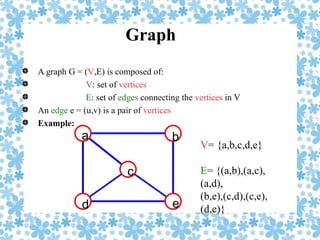
A graph G = (V,E) is composed of:
             V: set of vertices
             E: set of edges connecting the vertices in V
An edge e = (u,v) is a pair of vertices
Example:
            a                        b
                                             V= {a,b,c,d,e}

                         c                   E= {(a,b),(a,c),
                                             (a,d),
                                             (b,e),(c,d),(c,e),
            d                        e       (d,e)}
Types
• Graphs are generally classified as,

     Directed graph
     Undirected graph
Directed graph
• A graphs G is called directed graph if each edge
  has a direction.
Un Directed graph
• A graphs G is called directed graph if each edge
  has no direction.
Graph Terminology:
 Node

 Each element of a graph is called node of a graph

 Edge

 Line joining two nodes is called an edge. It is denoted by
 e=[u,v] where u and v are adjacent vertices.
                             V1


                 e1
                      edge


                                       node
          V2           e2         V2
Adjacent and Incident
 If (v0, v1) is an edge in an undirected graph,
   v0 and v1 are adjacent
   The edge (v0, v1) is incident on vertices v0 and v1

 If <v0, v1> is an edge in a directed graph
   v0 is adjacent to v1, and v1 is adjacent from v0
   The edge <v0, v1> is incident on v0 and v1
Degree of a Vertex
• The degree of a vertex is the number of edges incident to that vertex

• For directed graph,
    •   the in-degree of a vertex v is the number of edges
        that have v as the head
    •   the out-degree of a vertex v is the number of edges
        that have v as the tail
    •   if di is the degree of a vertex i in a graph G with n vertices and e
        edges, the number of edges is
Examples                                     0
          3                                  2
          0                          1               2
                                     3               3
  3 1             2 3            3       4       5       6
          31
          G                      1      1 G2 1           1
              3
                        0    in:1, out: 1
 directed graph
 in-degree
 out-degree             1    in: 1, out: 2


                        2    in: 1, out: 0
                        G3
Path
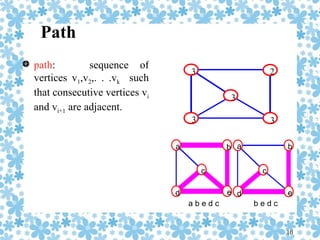
path:         sequence of
                                   3                  2
vertices v1,v2,. . .vk such
that consecutive vertices vi               3
and vi+1 are adjacent.
                                   3                  3

                               a           b a            b


                                       c          c

                               d           e d            e
                                   abedc         bedc


                                                          10
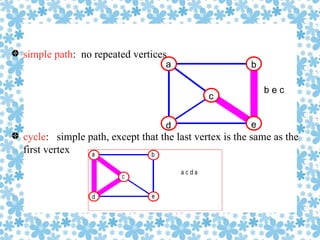
simple path: no repeated vertices
                                  a                   b

                                                          bec
                                            c


                                  d                   e
cycle: simple path, except that the last vertex is the same as the
first vertex
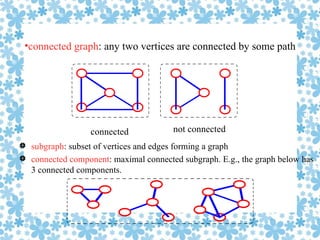
•connected graph: any two vertices are connected by some path


                connected             not connected
 subgraph: subset of vertices and edges forming a graph
 connected component: maximal connected subgraph. E.g., the graph below has
 3 connected components.
Completed graph
• A graph G is called complete, if every nodes are adjacent
  with other nodes.

                v1                   v3


                v2                   v4
Graph Representations

• Set representation

• Sequential representation

   • Adjacency Matrix

   • Path Matrix

• Linked list representation
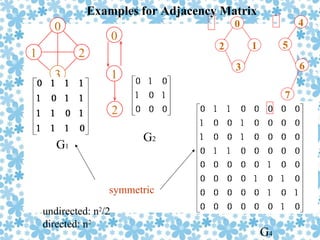
Adjacency Matrix
• Let G=(V,E) be a graph with n vertices.

• The adjacency matrix of G is a two-dimensional
   n by n array, say adj_mat
• If the edge (vi, vj) is in E(G), adj_mat[i][j]=1

• If there is no such edge in E(G), adj_mat[i][j]=0

• The adjacency matrix for an undirected graph is symmetric; the
   adjacency matrix for a digraph
   need not be symmetric
Examples for Adjacency Matrix
      0                                   0                4
                       0
                                      2       1        5
1           2
                                          3                6
      3                1
                                                       7
                       2

                           G2
       G1


                   symmetric

    undirected: n2/2
    directed: n2
                                                  G4
Merits of Adjacency Matrix
• From the adjacency matrix, to determine the connection of
  vertices is easy
• The degree of a vertex is

• For a digraph (= directed graph), the row sum is the
  out_degree, while the column sum is the in_degree
The End..


            THANK YOU

Graph

  • 1.
  • 2.
    Graph A graph G= (V,E) is composed of: V: set of vertices E: set of edges connecting the vertices in V An edge e = (u,v) is a pair of vertices Example: a b V= {a,b,c,d,e} c E= {(a,b),(a,c), (a,d), (b,e),(c,d),(c,e), d e (d,e)}
  • 3.
    Types • Graphs aregenerally classified as, Directed graph Undirected graph
  • 4.
    Directed graph • Agraphs G is called directed graph if each edge has a direction.
  • 5.
    Un Directed graph •A graphs G is called directed graph if each edge has no direction.
  • 6.
    Graph Terminology: Node Each element of a graph is called node of a graph Edge Line joining two nodes is called an edge. It is denoted by e=[u,v] where u and v are adjacent vertices. V1 e1 edge node V2 e2 V2
  • 7.
    Adjacent and Incident If (v0, v1) is an edge in an undirected graph, v0 and v1 are adjacent The edge (v0, v1) is incident on vertices v0 and v1 If <v0, v1> is an edge in a directed graph v0 is adjacent to v1, and v1 is adjacent from v0 The edge <v0, v1> is incident on v0 and v1
  • 8.
    Degree of aVertex • The degree of a vertex is the number of edges incident to that vertex • For directed graph, • the in-degree of a vertex v is the number of edges that have v as the head • the out-degree of a vertex v is the number of edges that have v as the tail • if di is the degree of a vertex i in a graph G with n vertices and e edges, the number of edges is
  • 9.
    Examples 0 3 2 0 1 2 3 3 3 1 2 3 3 4 5 6 31 G 1 1 G2 1 1 3 0 in:1, out: 1 directed graph in-degree out-degree 1 in: 1, out: 2 2 in: 1, out: 0 G3
  • 10.
    Path path: sequence of 3 2 vertices v1,v2,. . .vk such that consecutive vertices vi 3 and vi+1 are adjacent. 3 3 a b a b c c d e d e abedc bedc 10
  • 11.
    simple path: norepeated vertices a b bec c d e cycle: simple path, except that the last vertex is the same as the first vertex
  • 12.
    •connected graph: anytwo vertices are connected by some path connected not connected subgraph: subset of vertices and edges forming a graph connected component: maximal connected subgraph. E.g., the graph below has 3 connected components.
  • 13.
    Completed graph • Agraph G is called complete, if every nodes are adjacent with other nodes. v1 v3 v2 v4
  • 14.
    Graph Representations • Setrepresentation • Sequential representation • Adjacency Matrix • Path Matrix • Linked list representation
  • 15.
    Adjacency Matrix • LetG=(V,E) be a graph with n vertices. • The adjacency matrix of G is a two-dimensional n by n array, say adj_mat • If the edge (vi, vj) is in E(G), adj_mat[i][j]=1 • If there is no such edge in E(G), adj_mat[i][j]=0 • The adjacency matrix for an undirected graph is symmetric; the adjacency matrix for a digraph need not be symmetric
  • 16.
    Examples for AdjacencyMatrix 0 0 4 0 2 1 5 1 2 3 6 3 1 7 2 G2 G1 symmetric undirected: n2/2 directed: n2 G4
  • 17.
    Merits of AdjacencyMatrix • From the adjacency matrix, to determine the connection of vertices is easy • The degree of a vertex is • For a digraph (= directed graph), the row sum is the out_degree, while the column sum is the in_degree
  • 18.
    The End.. THANK YOU