Maximum Matching in General Graphs

                                          Ahmad Khayyat
                            Department of Electrical & Computer Engineering
                                   ahmad.khayyat@ece.queensu.ca

                                            Course Project
                                 CISC 879 — Algorithms and Applications
                                           Queen’s University


                                        November 19, 2008


ECE @ Queen’s • Fall 2008                     Ahmad Khayyat        Maximum Matching in General Graphs • 1
Introduction       Paths, Trees and Flowers   Efficient Implementation   Reachability Approach      Conclusion


 Outline


        1       Introduction

        2       Paths, Trees and Flowers

        3       Efficient Implementation of Edmonds’ Algorithm

        4       Reachability Problem Approach

        5       Conclusion


ECE @ Queen’s • Fall 2008                       Ahmad Khayyat           Maximum Matching in General Graphs • 2
Introduction       Paths, Trees and Flowers   Efficient Implementation   Reachability Approach      Conclusion


 Outline

        1       Introduction
                   Terminology
                   Berge’s Theorem
                   Bipartite Matching

        2       Paths, Trees and Flowers

        3       Efficient Implementation of Edmonds’ Algorithm

        4       Reachability Problem Approach

        5       Conclusion

ECE @ Queen’s • Fall 2008                       Ahmad Khayyat           Maximum Matching in General Graphs • 3
Introduction       Paths, Trees and Flowers   Efficient Implementation   Reachability Approach      Conclusion

 Terminology


 Maximum Matching

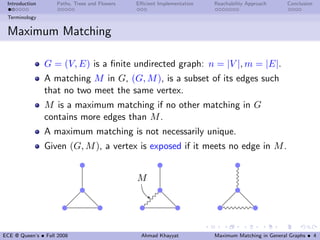
                G = (V, E) is a finite undirected graph: n = |V |, m = |E|.
                A matching M in G, (G, M ), is a subset of its edges such
                that no two meet the same vertex.
                M is a maximum matching if no other matching in G
                contains more edges than M .
                A maximum matching is not necessarily unique.
                Given (G, M ), a vertex is exposed if it meets no edge in M .


                                               M


ECE @ Queen’s • Fall 2008                       Ahmad Khayyat           Maximum Matching in General Graphs • 4
Introduction         Paths, Trees and Flowers        Efficient Implementation    Reachability Approach      Conclusion

 Terminology


 Augmenting Paths


                An alternating path in (G, M ) is a simple path whose edges
                are alternately in M and not in M .
                An augmenting path is an alternating path whose ends are
                distinct exposed vertices.

                         v1            v2             v3                  v1        v2            v3


                 v6             v5               v4                 v6         v5          v4


ECE @ Queen’s • Fall 2008                              Ahmad Khayyat            Maximum Matching in General Graphs • 5
Introduction       Paths, Trees and Flowers        Efficient Implementation      Reachability Approach      Conclusion

 Berge’s Theorem


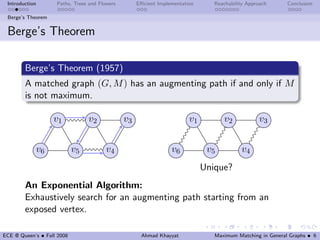
 Berge’s Theorem

        Berge’s Theorem (1957)
        A matched graph (G, M ) has an augmenting path if and only if M
        is not maximum.

                   v1            v2            v3                       v1         v2            v3


            v6              v5          v4                       v6           v5          v4
                                                                             Unique?
        An Exponential Algorithm:
        Exhaustively search for an augmenting path starting from an
        exposed vertex.

ECE @ Queen’s • Fall 2008                            Ahmad Khayyat              Maximum Matching in General Graphs • 6
Introduction         Paths, Trees and Flowers   Efficient Implementation       Reachability Approach      Conclusion

 Bipartite Matching


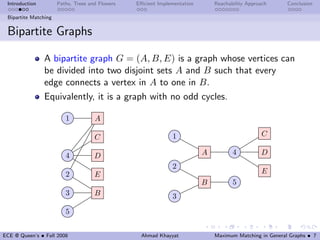
 Bipartite Graphs

                A bipartite graph G = (A, B, E) is a graph whose vertices can
                be divided into two disjoint sets A and B such that every
                edge connects a vertex in A to one in B.
                Equivalently, it is a graph with no odd cycles.

                         1           A

                                     C                        1                                 C

                         4           D                                    A          4          D
                                                              2
                         2           E                                                          E
                                                                          B          5
                         3           B                        3
                         5


ECE @ Queen’s • Fall 2008                         Ahmad Khayyat               Maximum Matching in General Graphs • 7
Introduction         Paths, Trees and Flowers       Efficient Implementation   Reachability Approach      Conclusion

 Bipartite Matching


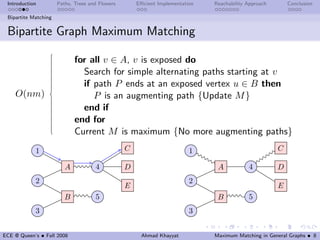
 Bipartite Graph Maximum Matching

                             for all v ∈ A, v is exposed do
                               Search for simple alternating paths starting at v
                               if path P ends at an exposed vertex u ∈ B then
    O(nm)                         P is an augmenting path {Update M }
                               end if
                             end for
                             Current M is maximum {No more augmenting paths}
            1                                    C

                         A           4           D
            2
                                                 E
                         B           5
            3


ECE @ Queen’s • Fall 2008                             Ahmad Khayyat           Maximum Matching in General Graphs • 8
Introduction         Paths, Trees and Flowers       Efficient Implementation   Reachability Approach       Conclusion

 Bipartite Matching


 Bipartite Graph Maximum Matching

                             for all v ∈ A, v is exposed do
                               Search for simple alternating paths starting at v
                               if path P ends at an exposed vertex u ∈ B then
    O(nm)                         P is an augmenting path {Update M }
                               end if
                             end for
                             Current M is maximum {No more augmenting paths}
            1                                    C                       1                            C

                         A           4           D                             A           4          D
            2                                                            2
                                                 E                                                    E
                         B           5                                         B           5
            3                                                            3


ECE @ Queen’s • Fall 2008                             Ahmad Khayyat           Maximum Matching in General Graphs • 8
Introduction         Paths, Trees and Flowers       Efficient Implementation          Reachability Approach      Conclusion

 Bipartite Matching


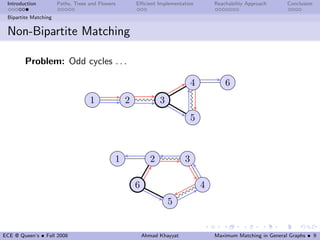
 Non-Bipartite Matching

        Problem: Odd cycles . . .

                                                                             4           6
                                   1             2              3
                                                                             5


                                             1              2            3

                                                     6                           4
                                                                    5


ECE @ Queen’s • Fall 2008                                Ahmad Khayyat               Maximum Matching in General Graphs • 9
Introduction       Paths, Trees and Flowers   Efficient Implementation   Reachability Approach      Conclusion


 Outline


        1       Introduction

        2       Paths, Trees and Flowers
                  Blossoms
                  The Algorithm

        3       Efficient Implementation of Edmonds’ Algorithm

        4       Reachability Problem Approach

        5       Conclusion


ECE @ Queen’s • Fall 2008                       Ahmad Khayyat           Maximum Matching in General Graphs • 10
Introduction       Paths, Trees and Flowers       Efficient Implementation          Reachability Approach      Conclusion

 Blossoms


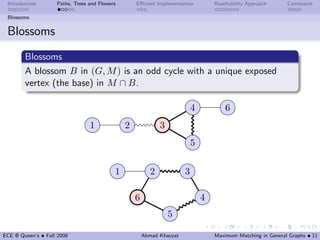
 Blossoms
        Blossoms
        A blossom B in (G, M ) is an odd cycle with a unique exposed
        vertex (the base) in M ∩ B.

                                                                           4           6
                                 1             2              3
                                                                           5

                                           1              2            3

                                                   6                           4
                                                                  5

ECE @ Queen’s • Fall 2008                              Ahmad Khayyat               Maximum Matching in General Graphs • 11
Introduction       Paths, Trees and Flowers       Efficient Implementation   Reachability Approach      Conclusion

 Blossoms


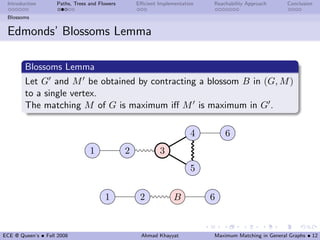
 Edmonds’ Blossoms Lemma

        Blossoms Lemma
        Let G and M be obtained by contracting a blossom B in (G, M )
        to a single vertex.
        The matching M of G is maximum iff M is maximum in G .

                                                                       4        6
                                 1             2            3
                                                                       5

                                       1            2            B          6


ECE @ Queen’s • Fall 2008                           Ahmad Khayyat           Maximum Matching in General Graphs • 12
Introduction       Paths, Trees and Flowers       Efficient Implementation   Reachability Approach      Conclusion

 Blossoms


 Detecting Blossoms

                Performing the alternating path search of the bipartite
                matching algorithm (starting from an exposed vertex):
                   ´   Label vertices at even distance from the root as “outer”;
                   ´   Label vertices at odd distance from the root as “inner”.
                If two outer vertices are found adjacent, we have a blossom.

                                                                        I

                                 O             I            O
                                                                       4        6
                                 1             2            3
                                                                       5
                                                                       O


ECE @ Queen’s • Fall 2008                           Ahmad Khayyat           Maximum Matching in General Graphs • 13
Introduction       Paths, Trees and Flowers      Efficient Implementation   Reachability Approach      Conclusion

 The Algorithm


 Edmonds’ Algorithm (1965)

                    for all v ∈ V , v is exposed do
                      Search for simple alternating paths starting at v
      O(n3 ) O(n2 )
                          Shrink any found blossoms
                      if path P ends at an exposed vertex then
                         P is an augmenting path {Update M }
                      else if no augmenting paths found then
                         Ignore v in future searches
                      end if
                    end for
                    Current M is maximum {No more augmenting paths}


                                               Complexity: O(n4 )

ECE @ Queen’s • Fall 2008                          Ahmad Khayyat           Maximum Matching in General Graphs • 14
Introduction       Paths, Trees and Flowers        Efficient Implementation   Reachability Approach      Conclusion

 The Algorithm


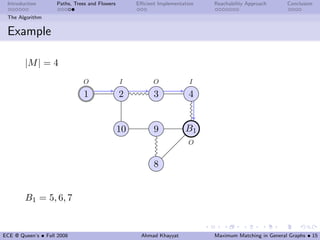
 Example

        |M | = 4


                              1                2          3             4


                                               10         9             5       6


                                                          8             7


ECE @ Queen’s • Fall 2008                            Ahmad Khayyat           Maximum Matching in General Graphs • 15
Introduction       Paths, Trees and Flowers        Efficient Implementation       Reachability Approach      Conclusion

 The Algorithm


 Example

        |M | = 4
                              O                I          O             I
                              1                2          3             4

                                                                             O
                                               10         9             5           6    I


                                                          8             7
                                                                        O


ECE @ Queen’s • Fall 2008                            Ahmad Khayyat               Maximum Matching in General Graphs • 15
Introduction       Paths, Trees and Flowers        Efficient Implementation   Reachability Approach      Conclusion

 The Algorithm


 Example

        |M | = 4
                              O                I          O             I
                              1                2          3             4


                                               10         9           B1
                                                                        O


                                                          8


        B1 = 5, 6, 7


ECE @ Queen’s • Fall 2008                            Ahmad Khayyat           Maximum Matching in General Graphs • 15
Introduction       Paths, Trees and Flowers        Efficient Implementation   Reachability Approach      Conclusion

 The Algorithm


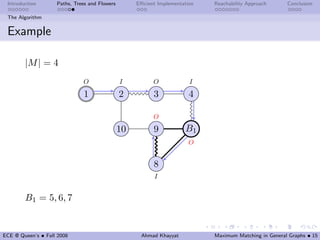
 Example

        |M | = 4
                              O                I          O             I
                              1                2          3             4

                                                          O
                                               10         9           B1
                                                                        O


                                                          8
                                                          I


        B1 = 5, 6, 7


ECE @ Queen’s • Fall 2008                            Ahmad Khayyat           Maximum Matching in General Graphs • 15
Introduction       Paths, Trees and Flowers        Efficient Implementation   Reachability Approach      Conclusion

 The Algorithm


 Example

        |M | = 4
                              O                I          O             I
                              1                2          3             4


                                               10        B2
                                               I          O


        B1 = 5, 6, 7
        B2 = B1 , 8, 9 = 5, 6, 7, 8, 9

ECE @ Queen’s • Fall 2008                            Ahmad Khayyat           Maximum Matching in General Graphs • 15
Introduction       Paths, Trees and Flowers        Efficient Implementation   Reachability Approach      Conclusion

 The Algorithm


 Example

        |M | = 4


                              1                2          3             4


                                               10        B2


        B1 = 5, 6, 7
        B2 = B1 , 8, 9 = 5, 6, 7, 8, 9

ECE @ Queen’s • Fall 2008                            Ahmad Khayyat           Maximum Matching in General Graphs • 15
Introduction       Paths, Trees and Flowers        Efficient Implementation   Reachability Approach      Conclusion

 The Algorithm


 Example

        |M | = 4


                              1                2          3             4


                                               10         9           B1


                                                          8


        B1 = 5, 6, 7
        B2 = B1 , 8, 9 = 5, 6, 7, 8, 9

ECE @ Queen’s • Fall 2008                            Ahmad Khayyat           Maximum Matching in General Graphs • 15
Introduction       Paths, Trees and Flowers        Efficient Implementation   Reachability Approach      Conclusion

 The Algorithm


 Example

        |M | = 4                                                                                |M | = 5


                              1                2          3             4


                                               10         9             5       6


                                                          8             7


        B1 = 5, 6, 7
        B2 = B1 , 8, 9 = 5, 6, 7, 8, 9

ECE @ Queen’s • Fall 2008                            Ahmad Khayyat           Maximum Matching in General Graphs • 15
Introduction       Paths, Trees and Flowers   Efficient Implementation   Reachability Approach      Conclusion


 Outline

        1       Introduction

        2       Paths, Trees and Flowers

        3       Efficient Implementation of Edmonds’ Algorithm
                 Data Structures
                 The Algorithm
                 Performance

        4       Reachability Problem Approach

        5       Conclusion

ECE @ Queen’s • Fall 2008                       Ahmad Khayyat           Maximum Matching in General Graphs • 16
Introduction       Paths, Trees and Flowers   Efficient Implementation   Reachability Approach      Conclusion

 Data Structures


 Three Arrays
                u is an exposed vertex.
                A vertex v is outer if there is a path P (v) = (v, v1 , . . . , u),
                where vv1 ∈ M .

           1    MATE: Specifies a matching. An entry for each vertex:
                   ´   vw ∈ M ⇒ MATE (v) = w and MATE (w) = v.
           2    LABEL: Provides a type and a value:
                                LABEL(v) ≥ 0                    → v is outer
                                LABEL(u)                        → start label, P (u) = (u)
                            1 ≤ LABEL(v) ≤ n                    → vertex label
                   n + 1 ≤ LABEL(v) ≤ n + 2m → edge label

           3    START (v) = the first non-outer vertex in P (v).

ECE @ Queen’s • Fall 2008                       Ahmad Khayyat           Maximum Matching in General Graphs • 17
Introduction       Paths, Trees and Flowers   Efficient Implementation   Reachability Approach      Conclusion

 The Algorithm


 Gabow’s Algorithm (1976)
                            for all u ∈ V, u is exposed do
                              while ∃ an edge xy, x is outer AND
                                      no augmenting path found do
                                 if y is exposed, y = u then
                                    (y, x, . . . , u) is an augmenting path
                                 else if y is outer then
                                    Assign edge labels to P (x) and P (y)
                                 else if MATE (y) is non-outer then
                                    Assign a vertex label to MATE (y)
                                 end if
                              end while
                            end for


ECE @ Queen’s • Fall 2008                       Ahmad Khayyat           Maximum Matching in General Graphs • 18
Introduction       Paths, Trees and Flowers      Efficient Implementation   Reachability Approach      Conclusion

 The Algorithm


 Gabow’s Algorithm (1976)
         O(n)          for all u ∈ V, u is exposed do
                         while ∃ an edge xy, x is outer AND
                                 no augmenting path found do
                 O(1)       if y is exposed, y = u then
                    O(n)       (y, x, . . . , u) is an augmenting path
                 O(n)       else if y is outer then
                    O(n)       Assign edge labels to P (x) and P (y)
                 O(n)       else if MATE (y) is non-outer then
                     O(1)      Assign a vertex label to MATE (y)
                            end if
                         end while
                       end for

                                               Complexity: O(n3 )

ECE @ Queen’s • Fall 2008                          Ahmad Khayyat           Maximum Matching in General Graphs • 18
Introduction       Paths, Trees and Flowers   Efficient Implementation   Reachability Approach      Conclusion

 Performance


 Experimental Performance


        Using an implementation in Algol W on the IBM 360/165
            Worst-case graphs:
                   ´   Efficient Implementation: run times proportional to n2.8 .
                   ´   Edmond: run times proportional to n3.5 .
                Random graphs: times one order of magnitude faster than
                worst-case graphs.
                Space used is 5n + 4m.


ECE @ Queen’s • Fall 2008                       Ahmad Khayyat           Maximum Matching in General Graphs • 19
Introduction       Paths, Trees and Flowers   Efficient Implementation   Reachability Approach      Conclusion


 Outline


        1       Introduction

        2       Paths, Trees and Flowers

        3       Efficient Implementation of Edmonds’ Algorithm

        4       Reachability Problem Approach
                  Reachability and Graphs
                  The Algorithm

        5       Conclusion


ECE @ Queen’s • Fall 2008                       Ahmad Khayyat           Maximum Matching in General Graphs • 20
Introduction        Paths, Trees and Flowers    Efficient Implementation        Reachability Approach       Conclusion

 Reachability and Graphs


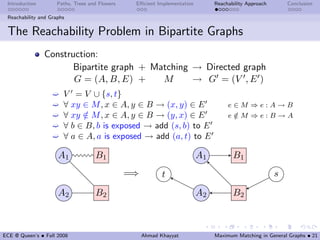
 The Reachability Problem in Bipartite Graphs
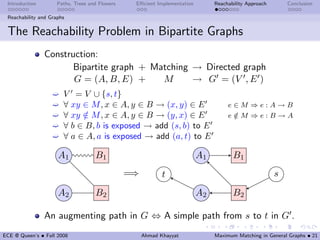
                Construction:
                       Bipartite graph + Matching → Directed graph
                       G = (A, B, E) +     M      → G = (V , E )
                   ´   V = V ∪ {s, t}
                   ´   ∀ xy ∈ M , x ∈ A, y ∈ B → (x, y) ∈ E                         e∈M ⇒e:A→B
                   ´   ∀ xy ∈ M , x ∈ A, y ∈ B → (y, x) ∈ E
                            /                                                       e∈M ⇒e:B→A
                                                                                     /
                   ´   ∀ b ∈ B, b is exposed → add (s, b) to E
                   ´   ∀ a ∈ A, a is exposed → add (a, t) to E

                     A1             B1                                    A1          B1
                                                =⇒          t                                          s

                     A2             B2                                    A2          B2


ECE @ Queen’s • Fall 2008                            Ahmad Khayyat             Maximum Matching in General Graphs • 21
Introduction        Paths, Trees and Flowers    Efficient Implementation        Reachability Approach       Conclusion

 Reachability and Graphs


 The Reachability Problem in Bipartite Graphs
                Construction:
                       Bipartite graph + Matching → Directed graph
                       G = (A, B, E) +     M      → G = (V , E )
                   ´   V = V ∪ {s, t}
                   ´   ∀ xy ∈ M , x ∈ A, y ∈ B → (x, y) ∈ E                         e∈M ⇒e:A→B
                   ´   ∀ xy ∈ M , x ∈ A, y ∈ B → (y, x) ∈ E
                            /                                                       e∈M ⇒e:B→A
                                                                                     /
                   ´   ∀ b ∈ B, b is exposed → add (s, b) to E
                   ´   ∀ a ∈ A, a is exposed → add (a, t) to E

                     A1             B1                                    A1          B1
                                                =⇒          t                                          s

                     A2             B2                                    A2          B2

                An augmenting path in G ⇔ A simple path from s to t in G .
ECE @ Queen’s • Fall 2008                            Ahmad Khayyat             Maximum Matching in General Graphs • 21
Introduction        Paths, Trees and Flowers        Efficient Implementation       Reachability Approach       Conclusion

 Reachability and Graphs

 The Reachability Problem in General Graphs
 Construction

                For each v ∈ V , we introduce two nodes vA and vB
                            V = {vA , vB |v ∈ V } ∪ {s, t}                        s, t ∈ V, s = t
                                                                                       /
                e ∈ M ⇒ e : A → B,                        e∈M ⇒e:B→A
                                                           /
                    E =          {(xA , yB ), (yA , xB ) | (x, y) ∈ M }
                              ∪ {(xB , yA ), (yB , xA ) | (x, y) ∈ M }
                                                                 /
                              ∪ {(s, xB ) | x is exposed} ∪ {(xA , t) | x is exposed}
                                                                              t
                   1               2                     1A            2A            3A             4A
                                                =⇒
                                                        1B             2B            3B            4B
                   4               3
                                                                              s

ECE @ Queen’s • Fall 2008                             Ahmad Khayyat                Maximum Matching in General Graphs • 22
Introduction        Paths, Trees and Flowers        Efficient Implementation       Reachability Approach      Conclusion

 Reachability and Graphs

 The Reachability Problem in General Graphs
 Strongly Simple Paths

        A path P in G is strongly simple if:
            P is simple.
            vA ∈ P ⇒ vB ∈ P .
                          /
        Theorem
        There is an augmenting path in G if and only if there is a strongly
        simple path from s to t in G .

                                                                              t
                   1               2                     1A            2A           3A              4A
                                                =⇒
                                                        1B             2B           3B             4B
                   4               3
                                                                              s

ECE @ Queen’s • Fall 2008                             Ahmad Khayyat               Maximum Matching in General Graphs • 23
Introduction        Paths, Trees and Flowers        Efficient Implementation       Reachability Approach      Conclusion

 Reachability and Graphs


 Solving the Reachability Problem
        Solution: A strongly simple path from s to t in G :
            Depth-First Search (DFS) for t starting at s.
            DFS finds simple paths.
            We need to find strongly simple paths only.
            We use a Modified Depth-First Search (MDFS) algorithm.
        Example:

                                                                              t
                   1               2                     1A            2A           3A              4A
                                                =⇒
                                                        1B             2B           3B             4B
                   4               3
                                                                              s


ECE @ Queen’s • Fall 2008                             Ahmad Khayyat               Maximum Matching in General Graphs • 24
Introduction        Paths, Trees and Flowers        Efficient Implementation       Reachability Approach      Conclusion

 Reachability and Graphs


 Solving the Reachability Problem
        Solution: A strongly simple path from s to t in G :
            Depth-First Search (DFS) for t starting at s.
            DFS finds simple paths.
            We need to find strongly simple paths only.
            We use a Modified Depth-First Search (MDFS) algorithm.
        Example:

                                                                              t
                   1               2                     1A            2A           3A              4A
                                                =⇒
                                                        1B             2B           3B             4B
                   4               3
                                                                              s


ECE @ Queen’s • Fall 2008                             Ahmad Khayyat               Maximum Matching in General Graphs • 24
Introduction       Paths, Trees and Flowers   Efficient Implementation   Reachability Approach      Conclusion

 The Algorithm


 Data Structures


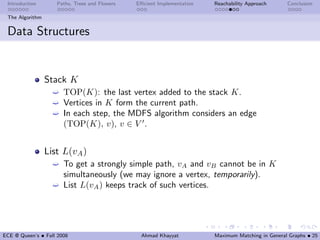
                 Stack K
                   ´   TOP(K): the last vertex added to the stack K.
                   ´   Vertices in K form the current path.
                   ´   In each step, the MDFS algorithm considers an edge
                       (TOP(K), v), v ∈ V .


                 List L(vA )
                   ´ To get a strongly simple path, vA and vB cannot be in K
                     simultaneously (we may ignore a vertex, temporarily).
                   ´ List L(vA ) keeps track of such vertices.


ECE @ Queen’s • Fall 2008                       Ahmad Khayyat           Maximum Matching in General Graphs • 25
Introduction       Paths, Trees and Flowers   Efficient Implementation   Reachability Approach      Conclusion

 The Algorithm


 Hopcroft and Karp Algorithm for Bipartite Graphs (1973)
        Step 1:    M ←φ
        Step 2:    Let l(M ) be the length of a shortest augmenting path of M
                   Find a maximal set of paths {Q1 , Q2 , . . . , Qt } such that:
                    2.1 For each i, Qi is an augmenting path of M , |Qi | = l(M ),
                        Qi are vertex-disjoint.
                    2.2 Halt if no such paths exists.
        Step 3:    M ← M ⊕ Q1 ⊕ Q2 ⊕ · · · ⊕ Qt ; Go to 1.

        Hopcroft and Karp Theorem
        If the cardinality of a maximum matching is s, then this algorithm
                                                 √
        constructs a maximum matching within 2 s + 2 executions of
        Step 2.

                                                                 √
                 Step 2 complexity: O(m) ⇒ Overall complexity: O( nm)

ECE @ Queen’s • Fall 2008                       Ahmad Khayyat           Maximum Matching in General Graphs • 26
Introduction       Paths, Trees and Flowers   Efficient Implementation   Reachability Approach      Conclusion

 The Algorithm
      √
 An O( nm) Algorithm for General Graphs


                 Blum describes an O(m) implementation of Step 2 for general
                 graphs, using a Modified Breadth-First Search (MBFS).
                 Blum’s Step 2 Algorithm:
            Step 1: Using MBFS, compute G
            Step 2: Using MDFS, compute a maximal set of strongly simple paths
                       from s to t in G .

        Blum’s Theorm
        A maximum matching in a general graph can be found in time
           √
        O( nm) and space O(m + n).


ECE @ Queen’s • Fall 2008                       Ahmad Khayyat           Maximum Matching in General Graphs • 27
Introduction       Paths, Trees and Flowers   Efficient Implementation   Reachability Approach      Conclusion


 Outline


        1       Introduction

        2       Paths, Trees and Flowers

        3       Efficient Implementation of Edmonds’ Algorithm

        4       Reachability Problem Approach

        5       Conclusion
                  Summary
                  Questions


ECE @ Queen’s • Fall 2008                       Ahmad Khayyat           Maximum Matching in General Graphs • 28
Introduction            Paths, Trees and Flowers   Efficient Implementation               Reachability Approach        Conclusion

 Summary


 Summary


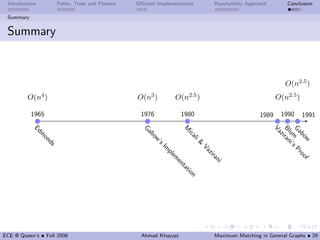
                                                                                                                      O(n2.5 )
         O(n4 )                                     O(n3 )           O(n2.5 )                                     O(n2.5 )

           1965                                      1976              1980                                1989     1990     1991
           Ed


                                                      Ga


                                                                       M


                                                                                                                 Va
                                                                                                                 Bl iran
                                                                                                                 Ga
                                                                            ica


                                                                                                                   um i’s
                m


                                                                                                                    z
                                                        bo


                                                                                                                    bo
                on


                                                                             li
                                                          w’


                                                                                                                      w
                                                                                  &
                    ds


                                                            s
                                                             Im


                                                                                  Va


                                                                                                                          Pr
                                                                pl


                                                                                     z


                                                                                                                             oo
                                                                                      ira
                                                                  em


                                                                                                                               f
                                                                                         ni
                                                                     en
                                                                        t
                                                                       at
                                                                        io
                                                                          n


ECE @ Queen’s • Fall 2008                            Ahmad Khayyat                       Maximum Matching in General Graphs • 29
Introduction       Paths, Trees and Flowers   Efficient Implementation   Reachability Approach      Conclusion

 Summary


 References

                Jack Edmonds
                Paths, Trees, and Flowers
                Canadian Journal of Mathematics, 17:449–467, 1965.
                http://www.cs.berkeley.edu/~christos/classics/edmonds.ps

                Harold N. Gabow
                An Efficient Implementation of Edmonds’ Algorithm for
                Maximum Matching on Graphs
                Journal of the ACM (JACM), 23(2):221–234, 1976.

                Norbert Blum
                A New Approach to Maximum Matching in General Graphs
                Lecture Notes in Computer Science: Automata, Languages and Programming,
                443::586–597, Springer Berlin / Heidelberg, 1990.


ECE @ Queen’s • Fall 2008                       Ahmad Khayyat           Maximum Matching in General Graphs • 30
Introduction       Paths, Trees and Flowers   Efficient Implementation   Reachability Approach      Conclusion

 Summary


 Thank You


                                      Thank You!


ECE @ Queen’s • Fall 2008                       Ahmad Khayyat           Maximum Matching in General Graphs • 31
Introduction       Paths, Trees and Flowers   Efficient Implementation   Reachability Approach      Conclusion

 Questions


 Questions


                                                 ???


ECE @ Queen’s • Fall 2008                       Ahmad Khayyat           Maximum Matching in General Graphs • 32

Maximum Matching in General Graphs

  • 1.
    Maximum Matching inGeneral Graphs Ahmad Khayyat Department of Electrical & Computer Engineering ahmad.khayyat@ece.queensu.ca Course Project CISC 879 — Algorithms and Applications Queen’s University November 19, 2008 ECE @ Queen’s • Fall 2008 Ahmad Khayyat Maximum Matching in General Graphs • 1
  • 2.
    Introduction Paths, Trees and Flowers Efficient Implementation Reachability Approach Conclusion Outline 1 Introduction 2 Paths, Trees and Flowers 3 Efficient Implementation of Edmonds’ Algorithm 4 Reachability Problem Approach 5 Conclusion ECE @ Queen’s • Fall 2008 Ahmad Khayyat Maximum Matching in General Graphs • 2
  • 3.
    Introduction Paths, Trees and Flowers Efficient Implementation Reachability Approach Conclusion Outline 1 Introduction Terminology Berge’s Theorem Bipartite Matching 2 Paths, Trees and Flowers 3 Efficient Implementation of Edmonds’ Algorithm 4 Reachability Problem Approach 5 Conclusion ECE @ Queen’s • Fall 2008 Ahmad Khayyat Maximum Matching in General Graphs • 3
  • 4.
    Introduction Paths, Trees and Flowers Efficient Implementation Reachability Approach Conclusion Terminology Maximum Matching G = (V, E) is a finite undirected graph: n = |V |, m = |E|. A matching M in G, (G, M ), is a subset of its edges such that no two meet the same vertex. M is a maximum matching if no other matching in G contains more edges than M . A maximum matching is not necessarily unique. Given (G, M ), a vertex is exposed if it meets no edge in M . M ECE @ Queen’s • Fall 2008 Ahmad Khayyat Maximum Matching in General Graphs • 4
  • 5.
    Introduction Paths, Trees and Flowers Efficient Implementation Reachability Approach Conclusion Terminology Augmenting Paths An alternating path in (G, M ) is a simple path whose edges are alternately in M and not in M . An augmenting path is an alternating path whose ends are distinct exposed vertices. v1 v2 v3 v1 v2 v3 v6 v5 v4 v6 v5 v4 ECE @ Queen’s • Fall 2008 Ahmad Khayyat Maximum Matching in General Graphs • 5
  • 6.
    Introduction Paths, Trees and Flowers Efficient Implementation Reachability Approach Conclusion Berge’s Theorem Berge’s Theorem Berge’s Theorem (1957) A matched graph (G, M ) has an augmenting path if and only if M is not maximum. v1 v2 v3 v1 v2 v3 v6 v5 v4 v6 v5 v4 Unique? An Exponential Algorithm: Exhaustively search for an augmenting path starting from an exposed vertex. ECE @ Queen’s • Fall 2008 Ahmad Khayyat Maximum Matching in General Graphs • 6
  • 7.
    Introduction Paths, Trees and Flowers Efficient Implementation Reachability Approach Conclusion Bipartite Matching Bipartite Graphs A bipartite graph G = (A, B, E) is a graph whose vertices can be divided into two disjoint sets A and B such that every edge connects a vertex in A to one in B. Equivalently, it is a graph with no odd cycles. 1 A C 1 C 4 D A 4 D 2 2 E E B 5 3 B 3 5 ECE @ Queen’s • Fall 2008 Ahmad Khayyat Maximum Matching in General Graphs • 7
  • 8.
    Introduction Paths, Trees and Flowers Efficient Implementation Reachability Approach Conclusion Bipartite Matching Bipartite Graph Maximum Matching for all v ∈ A, v is exposed do Search for simple alternating paths starting at v if path P ends at an exposed vertex u ∈ B then O(nm) P is an augmenting path {Update M } end if end for Current M is maximum {No more augmenting paths} 1 C A 4 D 2 E B 5 3 ECE @ Queen’s • Fall 2008 Ahmad Khayyat Maximum Matching in General Graphs • 8
  • 9.
    Introduction Paths, Trees and Flowers Efficient Implementation Reachability Approach Conclusion Bipartite Matching Bipartite Graph Maximum Matching for all v ∈ A, v is exposed do Search for simple alternating paths starting at v if path P ends at an exposed vertex u ∈ B then O(nm) P is an augmenting path {Update M } end if end for Current M is maximum {No more augmenting paths} 1 C 1 C A 4 D A 4 D 2 2 E E B 5 B 5 3 3 ECE @ Queen’s • Fall 2008 Ahmad Khayyat Maximum Matching in General Graphs • 8
  • 10.
    Introduction Paths, Trees and Flowers Efficient Implementation Reachability Approach Conclusion Bipartite Matching Non-Bipartite Matching Problem: Odd cycles . . . 4 6 1 2 3 5 1 2 3 6 4 5 ECE @ Queen’s • Fall 2008 Ahmad Khayyat Maximum Matching in General Graphs • 9
  • 11.
    Introduction Paths, Trees and Flowers Efficient Implementation Reachability Approach Conclusion Outline 1 Introduction 2 Paths, Trees and Flowers Blossoms The Algorithm 3 Efficient Implementation of Edmonds’ Algorithm 4 Reachability Problem Approach 5 Conclusion ECE @ Queen’s • Fall 2008 Ahmad Khayyat Maximum Matching in General Graphs • 10
  • 12.
    Introduction Paths, Trees and Flowers Efficient Implementation Reachability Approach Conclusion Blossoms Blossoms Blossoms A blossom B in (G, M ) is an odd cycle with a unique exposed vertex (the base) in M ∩ B. 4 6 1 2 3 5 1 2 3 6 4 5 ECE @ Queen’s • Fall 2008 Ahmad Khayyat Maximum Matching in General Graphs • 11
  • 13.
    Introduction Paths, Trees and Flowers Efficient Implementation Reachability Approach Conclusion Blossoms Edmonds’ Blossoms Lemma Blossoms Lemma Let G and M be obtained by contracting a blossom B in (G, M ) to a single vertex. The matching M of G is maximum iff M is maximum in G . 4 6 1 2 3 5 1 2 B 6 ECE @ Queen’s • Fall 2008 Ahmad Khayyat Maximum Matching in General Graphs • 12
  • 14.
    Introduction Paths, Trees and Flowers Efficient Implementation Reachability Approach Conclusion Blossoms Detecting Blossoms Performing the alternating path search of the bipartite matching algorithm (starting from an exposed vertex): ´ Label vertices at even distance from the root as “outer”; ´ Label vertices at odd distance from the root as “inner”. If two outer vertices are found adjacent, we have a blossom. I O I O 4 6 1 2 3 5 O ECE @ Queen’s • Fall 2008 Ahmad Khayyat Maximum Matching in General Graphs • 13
  • 15.
    Introduction Paths, Trees and Flowers Efficient Implementation Reachability Approach Conclusion The Algorithm Edmonds’ Algorithm (1965) for all v ∈ V , v is exposed do Search for simple alternating paths starting at v O(n3 ) O(n2 ) Shrink any found blossoms if path P ends at an exposed vertex then P is an augmenting path {Update M } else if no augmenting paths found then Ignore v in future searches end if end for Current M is maximum {No more augmenting paths} Complexity: O(n4 ) ECE @ Queen’s • Fall 2008 Ahmad Khayyat Maximum Matching in General Graphs • 14
  • 16.
    Introduction Paths, Trees and Flowers Efficient Implementation Reachability Approach Conclusion The Algorithm Example |M | = 4 1 2 3 4 10 9 5 6 8 7 ECE @ Queen’s • Fall 2008 Ahmad Khayyat Maximum Matching in General Graphs • 15
  • 17.
    Introduction Paths, Trees and Flowers Efficient Implementation Reachability Approach Conclusion The Algorithm Example |M | = 4 O I O I 1 2 3 4 O 10 9 5 6 I 8 7 O ECE @ Queen’s • Fall 2008 Ahmad Khayyat Maximum Matching in General Graphs • 15
  • 18.
    Introduction Paths, Trees and Flowers Efficient Implementation Reachability Approach Conclusion The Algorithm Example |M | = 4 O I O I 1 2 3 4 10 9 B1 O 8 B1 = 5, 6, 7 ECE @ Queen’s • Fall 2008 Ahmad Khayyat Maximum Matching in General Graphs • 15
  • 19.
    Introduction Paths, Trees and Flowers Efficient Implementation Reachability Approach Conclusion The Algorithm Example |M | = 4 O I O I 1 2 3 4 O 10 9 B1 O 8 I B1 = 5, 6, 7 ECE @ Queen’s • Fall 2008 Ahmad Khayyat Maximum Matching in General Graphs • 15
  • 20.
    Introduction Paths, Trees and Flowers Efficient Implementation Reachability Approach Conclusion The Algorithm Example |M | = 4 O I O I 1 2 3 4 10 B2 I O B1 = 5, 6, 7 B2 = B1 , 8, 9 = 5, 6, 7, 8, 9 ECE @ Queen’s • Fall 2008 Ahmad Khayyat Maximum Matching in General Graphs • 15
  • 21.
    Introduction Paths, Trees and Flowers Efficient Implementation Reachability Approach Conclusion The Algorithm Example |M | = 4 1 2 3 4 10 B2 B1 = 5, 6, 7 B2 = B1 , 8, 9 = 5, 6, 7, 8, 9 ECE @ Queen’s • Fall 2008 Ahmad Khayyat Maximum Matching in General Graphs • 15
  • 22.
    Introduction Paths, Trees and Flowers Efficient Implementation Reachability Approach Conclusion The Algorithm Example |M | = 4 1 2 3 4 10 9 B1 8 B1 = 5, 6, 7 B2 = B1 , 8, 9 = 5, 6, 7, 8, 9 ECE @ Queen’s • Fall 2008 Ahmad Khayyat Maximum Matching in General Graphs • 15
  • 23.
    Introduction Paths, Trees and Flowers Efficient Implementation Reachability Approach Conclusion The Algorithm Example |M | = 4 |M | = 5 1 2 3 4 10 9 5 6 8 7 B1 = 5, 6, 7 B2 = B1 , 8, 9 = 5, 6, 7, 8, 9 ECE @ Queen’s • Fall 2008 Ahmad Khayyat Maximum Matching in General Graphs • 15
  • 24.
    Introduction Paths, Trees and Flowers Efficient Implementation Reachability Approach Conclusion Outline 1 Introduction 2 Paths, Trees and Flowers 3 Efficient Implementation of Edmonds’ Algorithm Data Structures The Algorithm Performance 4 Reachability Problem Approach 5 Conclusion ECE @ Queen’s • Fall 2008 Ahmad Khayyat Maximum Matching in General Graphs • 16
  • 25.
    Introduction Paths, Trees and Flowers Efficient Implementation Reachability Approach Conclusion Data Structures Three Arrays u is an exposed vertex. A vertex v is outer if there is a path P (v) = (v, v1 , . . . , u), where vv1 ∈ M . 1 MATE: Specifies a matching. An entry for each vertex: ´ vw ∈ M ⇒ MATE (v) = w and MATE (w) = v. 2 LABEL: Provides a type and a value: LABEL(v) ≥ 0 → v is outer LABEL(u) → start label, P (u) = (u) 1 ≤ LABEL(v) ≤ n → vertex label n + 1 ≤ LABEL(v) ≤ n + 2m → edge label 3 START (v) = the first non-outer vertex in P (v). ECE @ Queen’s • Fall 2008 Ahmad Khayyat Maximum Matching in General Graphs • 17
  • 26.
    Introduction Paths, Trees and Flowers Efficient Implementation Reachability Approach Conclusion The Algorithm Gabow’s Algorithm (1976) for all u ∈ V, u is exposed do while ∃ an edge xy, x is outer AND no augmenting path found do if y is exposed, y = u then (y, x, . . . , u) is an augmenting path else if y is outer then Assign edge labels to P (x) and P (y) else if MATE (y) is non-outer then Assign a vertex label to MATE (y) end if end while end for ECE @ Queen’s • Fall 2008 Ahmad Khayyat Maximum Matching in General Graphs • 18
  • 27.
    Introduction Paths, Trees and Flowers Efficient Implementation Reachability Approach Conclusion The Algorithm Gabow’s Algorithm (1976) O(n) for all u ∈ V, u is exposed do while ∃ an edge xy, x is outer AND no augmenting path found do O(1) if y is exposed, y = u then O(n) (y, x, . . . , u) is an augmenting path O(n) else if y is outer then O(n) Assign edge labels to P (x) and P (y) O(n) else if MATE (y) is non-outer then O(1) Assign a vertex label to MATE (y) end if end while end for Complexity: O(n3 ) ECE @ Queen’s • Fall 2008 Ahmad Khayyat Maximum Matching in General Graphs • 18
  • 28.
    Introduction Paths, Trees and Flowers Efficient Implementation Reachability Approach Conclusion Performance Experimental Performance Using an implementation in Algol W on the IBM 360/165 Worst-case graphs: ´ Efficient Implementation: run times proportional to n2.8 . ´ Edmond: run times proportional to n3.5 . Random graphs: times one order of magnitude faster than worst-case graphs. Space used is 5n + 4m. ECE @ Queen’s • Fall 2008 Ahmad Khayyat Maximum Matching in General Graphs • 19
  • 29.
    Introduction Paths, Trees and Flowers Efficient Implementation Reachability Approach Conclusion Outline 1 Introduction 2 Paths, Trees and Flowers 3 Efficient Implementation of Edmonds’ Algorithm 4 Reachability Problem Approach Reachability and Graphs The Algorithm 5 Conclusion ECE @ Queen’s • Fall 2008 Ahmad Khayyat Maximum Matching in General Graphs • 20
  • 30.
    Introduction Paths, Trees and Flowers Efficient Implementation Reachability Approach Conclusion Reachability and Graphs The Reachability Problem in Bipartite Graphs Construction: Bipartite graph + Matching → Directed graph G = (A, B, E) + M → G = (V , E ) ´ V = V ∪ {s, t} ´ ∀ xy ∈ M , x ∈ A, y ∈ B → (x, y) ∈ E e∈M ⇒e:A→B ´ ∀ xy ∈ M , x ∈ A, y ∈ B → (y, x) ∈ E / e∈M ⇒e:B→A / ´ ∀ b ∈ B, b is exposed → add (s, b) to E ´ ∀ a ∈ A, a is exposed → add (a, t) to E A1 B1 A1 B1 =⇒ t s A2 B2 A2 B2 ECE @ Queen’s • Fall 2008 Ahmad Khayyat Maximum Matching in General Graphs • 21
  • 31.
    Introduction Paths, Trees and Flowers Efficient Implementation Reachability Approach Conclusion Reachability and Graphs The Reachability Problem in Bipartite Graphs Construction: Bipartite graph + Matching → Directed graph G = (A, B, E) + M → G = (V , E ) ´ V = V ∪ {s, t} ´ ∀ xy ∈ M , x ∈ A, y ∈ B → (x, y) ∈ E e∈M ⇒e:A→B ´ ∀ xy ∈ M , x ∈ A, y ∈ B → (y, x) ∈ E / e∈M ⇒e:B→A / ´ ∀ b ∈ B, b is exposed → add (s, b) to E ´ ∀ a ∈ A, a is exposed → add (a, t) to E A1 B1 A1 B1 =⇒ t s A2 B2 A2 B2 An augmenting path in G ⇔ A simple path from s to t in G . ECE @ Queen’s • Fall 2008 Ahmad Khayyat Maximum Matching in General Graphs • 21
  • 32.
    Introduction Paths, Trees and Flowers Efficient Implementation Reachability Approach Conclusion Reachability and Graphs The Reachability Problem in General Graphs Construction For each v ∈ V , we introduce two nodes vA and vB V = {vA , vB |v ∈ V } ∪ {s, t} s, t ∈ V, s = t / e ∈ M ⇒ e : A → B, e∈M ⇒e:B→A / E = {(xA , yB ), (yA , xB ) | (x, y) ∈ M } ∪ {(xB , yA ), (yB , xA ) | (x, y) ∈ M } / ∪ {(s, xB ) | x is exposed} ∪ {(xA , t) | x is exposed} t 1 2 1A 2A 3A 4A =⇒ 1B 2B 3B 4B 4 3 s ECE @ Queen’s • Fall 2008 Ahmad Khayyat Maximum Matching in General Graphs • 22
  • 33.
    Introduction Paths, Trees and Flowers Efficient Implementation Reachability Approach Conclusion Reachability and Graphs The Reachability Problem in General Graphs Strongly Simple Paths A path P in G is strongly simple if: P is simple. vA ∈ P ⇒ vB ∈ P . / Theorem There is an augmenting path in G if and only if there is a strongly simple path from s to t in G . t 1 2 1A 2A 3A 4A =⇒ 1B 2B 3B 4B 4 3 s ECE @ Queen’s • Fall 2008 Ahmad Khayyat Maximum Matching in General Graphs • 23
  • 34.
    Introduction Paths, Trees and Flowers Efficient Implementation Reachability Approach Conclusion Reachability and Graphs Solving the Reachability Problem Solution: A strongly simple path from s to t in G : Depth-First Search (DFS) for t starting at s. DFS finds simple paths. We need to find strongly simple paths only. We use a Modified Depth-First Search (MDFS) algorithm. Example: t 1 2 1A 2A 3A 4A =⇒ 1B 2B 3B 4B 4 3 s ECE @ Queen’s • Fall 2008 Ahmad Khayyat Maximum Matching in General Graphs • 24
  • 35.
    Introduction Paths, Trees and Flowers Efficient Implementation Reachability Approach Conclusion Reachability and Graphs Solving the Reachability Problem Solution: A strongly simple path from s to t in G : Depth-First Search (DFS) for t starting at s. DFS finds simple paths. We need to find strongly simple paths only. We use a Modified Depth-First Search (MDFS) algorithm. Example: t 1 2 1A 2A 3A 4A =⇒ 1B 2B 3B 4B 4 3 s ECE @ Queen’s • Fall 2008 Ahmad Khayyat Maximum Matching in General Graphs • 24
  • 36.
    Introduction Paths, Trees and Flowers Efficient Implementation Reachability Approach Conclusion The Algorithm Data Structures Stack K ´ TOP(K): the last vertex added to the stack K. ´ Vertices in K form the current path. ´ In each step, the MDFS algorithm considers an edge (TOP(K), v), v ∈ V . List L(vA ) ´ To get a strongly simple path, vA and vB cannot be in K simultaneously (we may ignore a vertex, temporarily). ´ List L(vA ) keeps track of such vertices. ECE @ Queen’s • Fall 2008 Ahmad Khayyat Maximum Matching in General Graphs • 25
  • 37.
    Introduction Paths, Trees and Flowers Efficient Implementation Reachability Approach Conclusion The Algorithm Hopcroft and Karp Algorithm for Bipartite Graphs (1973) Step 1: M ←φ Step 2: Let l(M ) be the length of a shortest augmenting path of M Find a maximal set of paths {Q1 , Q2 , . . . , Qt } such that: 2.1 For each i, Qi is an augmenting path of M , |Qi | = l(M ), Qi are vertex-disjoint. 2.2 Halt if no such paths exists. Step 3: M ← M ⊕ Q1 ⊕ Q2 ⊕ · · · ⊕ Qt ; Go to 1. Hopcroft and Karp Theorem If the cardinality of a maximum matching is s, then this algorithm √ constructs a maximum matching within 2 s + 2 executions of Step 2. √ Step 2 complexity: O(m) ⇒ Overall complexity: O( nm) ECE @ Queen’s • Fall 2008 Ahmad Khayyat Maximum Matching in General Graphs • 26
  • 38.
    Introduction Paths, Trees and Flowers Efficient Implementation Reachability Approach Conclusion The Algorithm √ An O( nm) Algorithm for General Graphs Blum describes an O(m) implementation of Step 2 for general graphs, using a Modified Breadth-First Search (MBFS). Blum’s Step 2 Algorithm: Step 1: Using MBFS, compute G Step 2: Using MDFS, compute a maximal set of strongly simple paths from s to t in G . Blum’s Theorm A maximum matching in a general graph can be found in time √ O( nm) and space O(m + n). ECE @ Queen’s • Fall 2008 Ahmad Khayyat Maximum Matching in General Graphs • 27
  • 39.
    Introduction Paths, Trees and Flowers Efficient Implementation Reachability Approach Conclusion Outline 1 Introduction 2 Paths, Trees and Flowers 3 Efficient Implementation of Edmonds’ Algorithm 4 Reachability Problem Approach 5 Conclusion Summary Questions ECE @ Queen’s • Fall 2008 Ahmad Khayyat Maximum Matching in General Graphs • 28
  • 40.
    Introduction Paths, Trees and Flowers Efficient Implementation Reachability Approach Conclusion Summary Summary O(n2.5 ) O(n4 ) O(n3 ) O(n2.5 ) O(n2.5 ) 1965 1976 1980 1989 1990 1991 Ed Ga M Va Bl iran Ga ica um i’s m z bo bo on li w’ w & ds s Im Va Pr pl z oo ira em f ni en t at io n ECE @ Queen’s • Fall 2008 Ahmad Khayyat Maximum Matching in General Graphs • 29
  • 41.
    Introduction Paths, Trees and Flowers Efficient Implementation Reachability Approach Conclusion Summary References Jack Edmonds Paths, Trees, and Flowers Canadian Journal of Mathematics, 17:449–467, 1965. http://www.cs.berkeley.edu/~christos/classics/edmonds.ps Harold N. Gabow An Efficient Implementation of Edmonds’ Algorithm for Maximum Matching on Graphs Journal of the ACM (JACM), 23(2):221–234, 1976. Norbert Blum A New Approach to Maximum Matching in General Graphs Lecture Notes in Computer Science: Automata, Languages and Programming, 443::586–597, Springer Berlin / Heidelberg, 1990. ECE @ Queen’s • Fall 2008 Ahmad Khayyat Maximum Matching in General Graphs • 30
  • 42.
    Introduction Paths, Trees and Flowers Efficient Implementation Reachability Approach Conclusion Summary Thank You Thank You! ECE @ Queen’s • Fall 2008 Ahmad Khayyat Maximum Matching in General Graphs • 31
  • 43.
    Introduction Paths, Trees and Flowers Efficient Implementation Reachability Approach Conclusion Questions Questions ??? ECE @ Queen’s • Fall 2008 Ahmad Khayyat Maximum Matching in General Graphs • 32