Lecture 8


                                  Graph
                             Data Structure (CS221)


                       Abdisalam Issa-Salwe

                        Taibah University
           College of Computer Science & Engineering
                 Computer Science Department


Outline

 Graph Data Type
 Graph Concepts
 Graph Data Structure
 Directed/undirected Graph
 Graph Relationship
 Graph implementation


                                                       2


                                                           1
Learning Outcomes

 Describe a Graph ADT
 Understand how to implement a Graph
 ADT
 Describe algorithms to traverse a graph


                                                             3


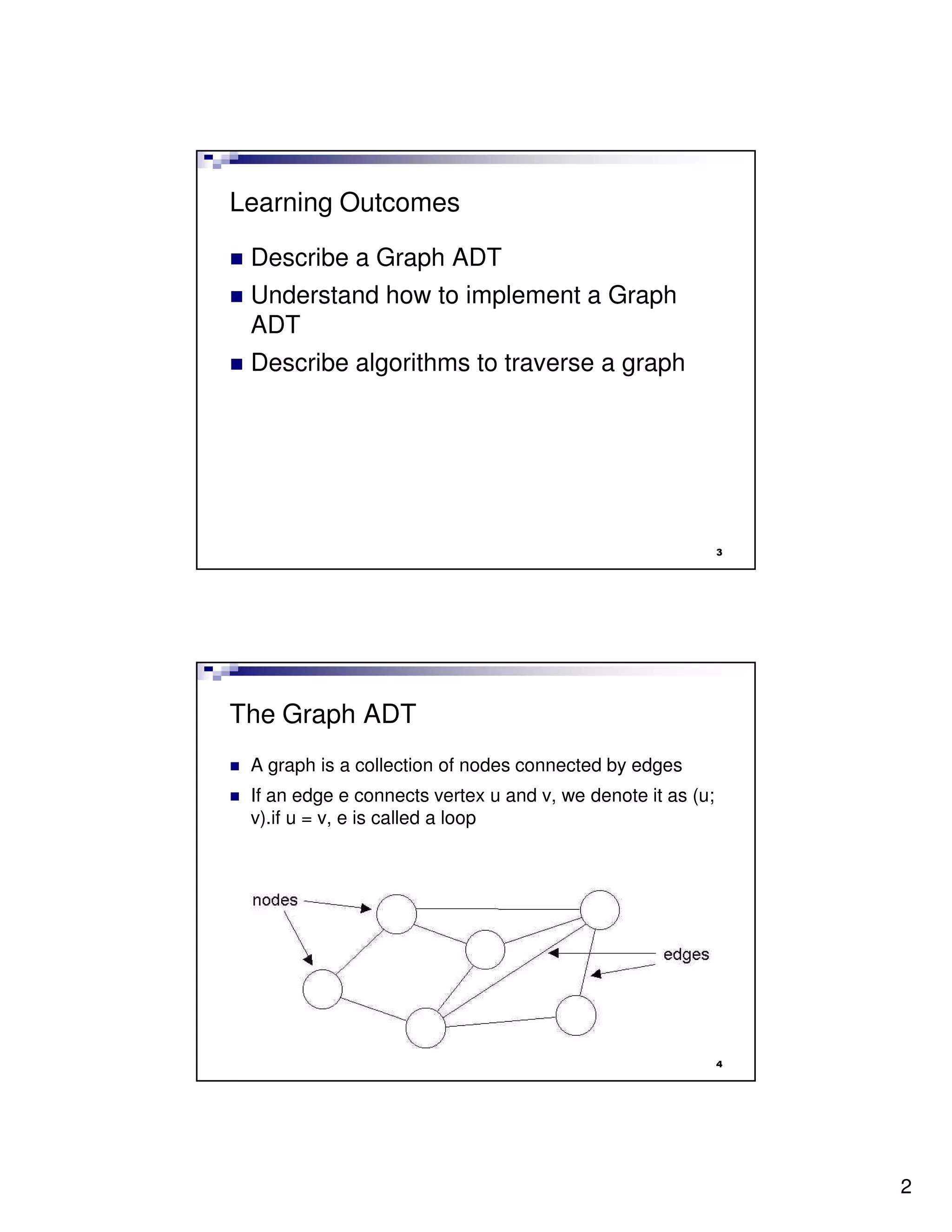
The Graph ADT
 A graph is a collection of nodes connected by edges
 If an edge e connects vertex u and v, we denote it as (u;
 v).if u = v, e is called a loop


                                                             4


                                                                 2
Graph Concepts

 A tree is an example of a graph
 In a graph a node may be it’s own
 ancestor
 In general a graph has no root node
 Formally, a graph is an ordered pair of
 sets (N,E)
 Both nodes and edges may have data
 values associated

                                                   5


Graph Data Structure (cont…)
 Graph is a data structure that consists of a set of
 nodes and a set of edges that relate the nodes
 to one another
 It is made up of a set of nodes called vertices
 and a set of lines called edges (or arcs) that
 connect the nodes.
 If the edges in the graph have no direction it is
 called an undirected graph.
 A graph whose edges are directed from one
 vertex to another is called a directed graph, or
 digraph

                                                   6


                                                       3
Graphs Data Structure (cont…)
More definition:
• Like a tree, is a NON-Linear structure
 consisting of nodes and links between
  the nodes
 Types:    Undirected graph

              Directed graph

Graphs are often used to solve problems

                                                   7


Undirected Graph


 • An undirected graph is a set of nodes
   and a set of links between the nodes.
 • Each NODE is called a VERTEX
                                      V0      V1
 • Each LINK is called an EDGE             E0
 • The order of the two connected vertices
   is unimportant
 ex: whether        “V0 connects V1” or
                    “V1 connects V0”
        means the same thing
                                                   8


                                                       4
Undirected Graph examples
                        5 vertices
                         6 edges


                   V0
           E0            E1             V2        E5

      V1                        E4
           E2                      V4
                 V3      E3


                                                            9


Undirected Graph examples
                5 vertices    6 edges
 V3                           E4
                   V2

       E2               E1                   E0   V0
                        V1


            E3                               V4        E5


  In drawing, the placement of the vertices
 is UNIMPORTANT same as previous graph
                                                            10


                                                                 5
Directed Graph

A directed graph is a finite set of vertices
together with a finite set of edges. If both
are empty then we have an empty graph


V1 SOURCE                      V0
                                                V2
                   V1
                                           V4
V3   TARGET                V3

                                                     11


  Directed Graph

• Loops: a loop connects a vertex to itself
                               LOOP
                Vertex

• Path: is a sequence of vertices
    P0, P1, P2,… Pn , each adjacent pairs of
    vertices Pi and Pi+1 are connected by an edge

                        path
              V1                      V3
          SOURCE                    TARGET
                                                     12


                                                          6
Directed Graph

• Multiple edges:
    a graph may have two or more edges
    connecting the same two vertices in the same
    direction
                                       Directed
           Undirected
                                       V0
     V0
                                              V2
                 V2         V1
V1
                                             V4
                                  V3
      V3        V4                                 13


 Directed Graph
• Simple graph:

  • No loops
  • No multiple edges
  • Directed
  • Undirected
• Directed graph representation:

     • Using a 2-Dim array
     • Using a Linked List for each vertex
     • Using the set class from the C++
       Standard Library ( edge sets )
                                                   14


                                                        7
Graph Relationship

 Adjacent vertices: Two vertices in a
 graph that are connected by an edge
 Path: A sequence of vertices that
 connects two nodes in a graph
 Complete graph: A graph in which every
 vertex is directly connected to every other
 vertex
 Weighted graph: A graph in which each
 edge carries a value
                                                 15


Graph Relationship (cont…)

 In a complete graph, every vertex is
 adjacent to every other vertex.
 If there are N vertices, there will be N * (N
 - 1) edges in a complete directed graph
 and N * (N - 1) / 2 edges in a complete
 undirected graph.


                                                 16


                                                      8
Weighted graphs can be used to represent
Weighted graph   applications in which the value of the
                 connection between the vertices is important,
                 not just the existence of a connection.


                                                                 17


Complete graph


                                                                 18


                                                                      9
Degree
 In an undirected graph, the degree of a
 vertex u is the number of edges connected
 to u.
 In a directed graph, the out-degree of a
 vertex u is the number edges leaving u,
 and its in-degree is the number of edges
 ending at u
 Each vertex is associated with a linked list
 that enumerates all the vertices that are
 connected to u
                                            19


Graph Traversals (cont…)


In general:
•Both traversal algorithms
     1. Start at one vertex of a graph
     2. Process the information contained
         at that vertex
     3. Move along an edge to process a
         neighbor


                                            20


                                                 10
Graph Traversals (cont…)

• The traversal algorithm should be
   careful that it doesn’t enter a “Repetitive
   Cycle”. Therefore we will mark each vertex as
   it is processed..
• When the traversal finishes, all of the vertices
  that can be reached from the start vertex have
  been processed.
• Some of the vertices may not be processed
  because there is NO PATH from the START
  VERTEX                                             21


 Solving a simple problem using a graph


A network of computers can be represented
By a graph, with
• each vertex representing One of the
      machines in the network, and
• an Edge representing a communication wire
      Between the two machines.
The question of whether one machine can send
a message to another machine boils down to
whether the corresponding vertices are
Connected by a path
                                                     22


                                                          11
Solving a simple problem using a graph

                  V0      6
             1                     V0 to V3 = 1
                      3       V1
    V3
                                   V3 to V1 = 3

                          2        V1 to V2 = 2
         7
                 V2                     Total 6
                  6
• Each edge has a NON-Negative Integer value
attached to it called the weight or cost of the edge
The path with the lowest cost is called the
Shortest path
                                                       23


 Node ADT

   Essential Operations
      create: Element → Node
      changeElement: Node´Element → Node
      getElement: Node → Element


                                                       24


                                                            12
Edge ADT

 Essential Operations
  •   create: Node´Node´Attribute → Edge
  •   changeAttribute: Edge´Attribute → Edge
  •   getAttribute: Edge → Attribute
  •   getNodes: Edge → Node´Node
  •   getEdge: Node´Node → Edge


                                               25


Digraph ADT

create: → Graph
addNode: Node´Graph → Graph
addEdge: Edge´Graph → Graph
containsNode: Node´Graph → Boolean
containsEdge: Node´Node´Graph → Boolean
removeNode: Node´Graph → Graph
removeEdge: Node´Node´Graph → Graph
numNodes: Graph → Integer
numEdges: Graph → Integer


                                               26


                                                    13
Digraph ADT

 Other helpful operations
   an iterator over all nodes in the graph;
   an iterator over all edges in the graph;
   for each node, an iterator over all nodes to
   which it has an edge.


                                              27


Digraph Implementations

 Edge Set implementation
   Set of Nodes
   Set of Edges - (node, node, attribute)
 Standard method of representing sets
   e.g. hash table, BSTree


                                              28


                                                   14
Digraph Implementations (cont…)

 Adjacency Set (or Adjacency List)
 implementation
   Set of Nodes
   Data at each node includes list of adjacent
   nodes and edge attributes
 Standard method of representing sets
   e.g. hash table, BSTree


                                                 29


                                                      15

Lecture8 data structure(graph)

  • 1.
    Lecture 8 Graph Data Structure (CS221) Abdisalam Issa-Salwe Taibah University College of Computer Science & Engineering Computer Science Department Outline Graph Data Type Graph Concepts Graph Data Structure Directed/undirected Graph Graph Relationship Graph implementation 2 1
  • 2.
    Learning Outcomes Describea Graph ADT Understand how to implement a Graph ADT Describe algorithms to traverse a graph 3 The Graph ADT A graph is a collection of nodes connected by edges If an edge e connects vertex u and v, we denote it as (u; v).if u = v, e is called a loop 4 2
  • 3.
    Graph Concepts Atree is an example of a graph In a graph a node may be it’s own ancestor In general a graph has no root node Formally, a graph is an ordered pair of sets (N,E) Both nodes and edges may have data values associated 5 Graph Data Structure (cont…) Graph is a data structure that consists of a set of nodes and a set of edges that relate the nodes to one another It is made up of a set of nodes called vertices and a set of lines called edges (or arcs) that connect the nodes. If the edges in the graph have no direction it is called an undirected graph. A graph whose edges are directed from one vertex to another is called a directed graph, or digraph 6 3
  • 4.
    Graphs Data Structure(cont…) More definition: • Like a tree, is a NON-Linear structure consisting of nodes and links between the nodes Types: Undirected graph Directed graph Graphs are often used to solve problems 7 Undirected Graph • An undirected graph is a set of nodes and a set of links between the nodes. • Each NODE is called a VERTEX V0 V1 • Each LINK is called an EDGE E0 • The order of the two connected vertices is unimportant ex: whether “V0 connects V1” or “V1 connects V0” means the same thing 8 4
  • 5.
    Undirected Graph examples 5 vertices 6 edges V0 E0 E1 V2 E5 V1 E4 E2 V4 V3 E3 9 Undirected Graph examples 5 vertices 6 edges V3 E4 V2 E2 E1 E0 V0 V1 E3 V4 E5 In drawing, the placement of the vertices is UNIMPORTANT same as previous graph 10 5
  • 6.
    Directed Graph A directedgraph is a finite set of vertices together with a finite set of edges. If both are empty then we have an empty graph V1 SOURCE V0 V2 V1 V4 V3 TARGET V3 11 Directed Graph • Loops: a loop connects a vertex to itself LOOP Vertex • Path: is a sequence of vertices P0, P1, P2,… Pn , each adjacent pairs of vertices Pi and Pi+1 are connected by an edge path V1 V3 SOURCE TARGET 12 6
  • 7.
    Directed Graph • Multipleedges: a graph may have two or more edges connecting the same two vertices in the same direction Directed Undirected V0 V0 V2 V2 V1 V1 V4 V3 V3 V4 13 Directed Graph • Simple graph: • No loops • No multiple edges • Directed • Undirected • Directed graph representation: • Using a 2-Dim array • Using a Linked List for each vertex • Using the set class from the C++ Standard Library ( edge sets ) 14 7
  • 8.
    Graph Relationship Adjacentvertices: Two vertices in a graph that are connected by an edge Path: A sequence of vertices that connects two nodes in a graph Complete graph: A graph in which every vertex is directly connected to every other vertex Weighted graph: A graph in which each edge carries a value 15 Graph Relationship (cont…) In a complete graph, every vertex is adjacent to every other vertex. If there are N vertices, there will be N * (N - 1) edges in a complete directed graph and N * (N - 1) / 2 edges in a complete undirected graph. 16 8
  • 9.
    Weighted graphs canbe used to represent Weighted graph applications in which the value of the connection between the vertices is important, not just the existence of a connection. 17 Complete graph 18 9
  • 10.
    Degree In anundirected graph, the degree of a vertex u is the number of edges connected to u. In a directed graph, the out-degree of a vertex u is the number edges leaving u, and its in-degree is the number of edges ending at u Each vertex is associated with a linked list that enumerates all the vertices that are connected to u 19 Graph Traversals (cont…) In general: •Both traversal algorithms 1. Start at one vertex of a graph 2. Process the information contained at that vertex 3. Move along an edge to process a neighbor 20 10
  • 11.
    Graph Traversals (cont…) •The traversal algorithm should be careful that it doesn’t enter a “Repetitive Cycle”. Therefore we will mark each vertex as it is processed.. • When the traversal finishes, all of the vertices that can be reached from the start vertex have been processed. • Some of the vertices may not be processed because there is NO PATH from the START VERTEX 21 Solving a simple problem using a graph A network of computers can be represented By a graph, with • each vertex representing One of the machines in the network, and • an Edge representing a communication wire Between the two machines. The question of whether one machine can send a message to another machine boils down to whether the corresponding vertices are Connected by a path 22 11
  • 12.
    Solving a simpleproblem using a graph V0 6 1 V0 to V3 = 1 3 V1 V3 V3 to V1 = 3 2 V1 to V2 = 2 7 V2 Total 6 6 • Each edge has a NON-Negative Integer value attached to it called the weight or cost of the edge The path with the lowest cost is called the Shortest path 23 Node ADT Essential Operations create: Element → Node changeElement: Node´Element → Node getElement: Node → Element 24 12
  • 13.
    Edge ADT EssentialOperations • create: Node´Node´Attribute → Edge • changeAttribute: Edge´Attribute → Edge • getAttribute: Edge → Attribute • getNodes: Edge → Node´Node • getEdge: Node´Node → Edge 25 Digraph ADT create: → Graph addNode: Node´Graph → Graph addEdge: Edge´Graph → Graph containsNode: Node´Graph → Boolean containsEdge: Node´Node´Graph → Boolean removeNode: Node´Graph → Graph removeEdge: Node´Node´Graph → Graph numNodes: Graph → Integer numEdges: Graph → Integer 26 13
  • 14.
    Digraph ADT Otherhelpful operations an iterator over all nodes in the graph; an iterator over all edges in the graph; for each node, an iterator over all nodes to which it has an edge. 27 Digraph Implementations Edge Set implementation Set of Nodes Set of Edges - (node, node, attribute) Standard method of representing sets e.g. hash table, BSTree 28 14
  • 15.
    Digraph Implementations (cont…) Adjacency Set (or Adjacency List) implementation Set of Nodes Data at each node includes list of adjacent nodes and edge attributes Standard method of representing sets e.g. hash table, BSTree 29 15