UNIT 1.
CONCEPTS OF TEACHING ENGLISH
By Tamara Oorts
INTRODUCTION TO ENGLISH
LANGUAGE TEACHING
LEARNING STYLES
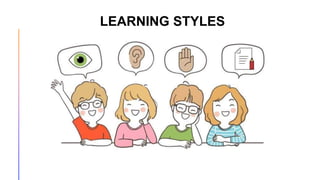
LEARNING STYLES
UNDERSTANDING VARK
3
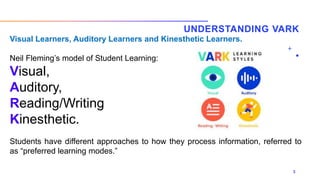
Visual Learners, Auditory Learners and Kinesthetic Learners.
Neil Fleming’s model of Student Learning:
Visual,
Auditory,
Reading/Writing
Kinesthetic.
Students have different approaches to how they process information, referred to
as “preferred learning modes.”
UNDERSTANDING VARK
4
Individual learning styles depend on cognitive, emotional
and environmental factors, as well as one’s prior experience.
In other words: everyone’s different.
It is important for educators to understand the differences in
their students’ learning styles, so that they can implement
best practice strategies into their daily activities, curriculum
and assessments.
UNDERSTANDING VARK
5
Technically, an individual’s learning style refers to
the preferential way in which the student absorbs,
processes, comprehends and retains information.
Any example you can
think of?
UNDERSTANDING VARK
6
1. Students’ preferred learning modes have significant influence on their behavior
and learning.
2. Students’ preferred learning modes should be matched with appropriate
learning strategies.
3. Information that is accessed through students’ use of their modality
preferences shows an increase in their levels of comprehension, motivation,
and metacognition.
MAIN ELEMENTS
UNDERSTANDING VARK
7
1. Identify visual, auditory, reading/writing, kinesthetic,
learners.
2. Align your overall curriculum.
3. Keep in mind, sometimes you may find that it’s a
combination of all three sensory modalities that may
be the best option.
4. Allow students to access information in terms they
are comfortable with will increase their academic
confidence.
UNDERSTANDING VARK
8
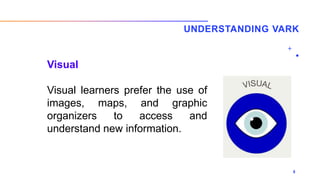
Visual
Visual learners prefer the use of
images, maps, and graphic
organizers to access and
understand new information.
UNDERSTANDING VARK
9
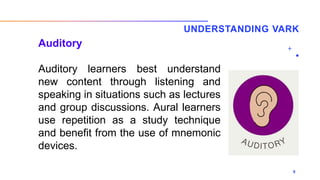
Auditory
Auditory learners best understand
new content through listening and
speaking in situations such as lectures
and group discussions. Aural learners
use repetition as a study technique
and benefit from the use of mnemonic
devices.
UNDERSTANDING VARK
10
Read & Write
Students with a strong reading/writing
preference learn best through words.
These students may present
themselves as copious note takers or
avid readers, and are able to translate
abstract concepts into words and
essays.
UNDERSTANDING VARK
11
UNDERSTANDING VARK
12
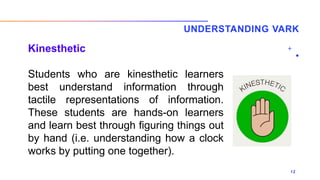
Kinesthetic
Students who are kinesthetic learners
best understand information through
tactile representations of information.
These students are hands-on learners
and learn best through figuring things out
by hand (i.e. understanding how a clock
works by putting one together).
UNDERSTANDING VARK
13
14
/
REFERENCES
BOOK:
VARKing up the right tree! (Fleming & Baume, 2006)
https://teach.com/what/teachers-know/learning-styles
https://vark-learn.com/the-vark-questionnaire/
https://teach.com/what/teachers-know/teaching-methods/
15
THANK YOU!
https://teach.com/what/teachers-
know/learning-styles/

VARK LEARNING STYLES.pptx

  • 1.
    UNIT 1. CONCEPTS OFTEACHING ENGLISH By Tamara Oorts INTRODUCTION TO ENGLISH LANGUAGE TEACHING LEARNING STYLES
  • 2.
  • 3.
    UNDERSTANDING VARK 3 Visual Learners,Auditory Learners and Kinesthetic Learners. Neil Fleming’s model of Student Learning: Visual, Auditory, Reading/Writing Kinesthetic. Students have different approaches to how they process information, referred to as “preferred learning modes.”
  • 4.
    UNDERSTANDING VARK 4 Individual learningstyles depend on cognitive, emotional and environmental factors, as well as one’s prior experience. In other words: everyone’s different. It is important for educators to understand the differences in their students’ learning styles, so that they can implement best practice strategies into their daily activities, curriculum and assessments.
  • 5.
    UNDERSTANDING VARK 5 Technically, anindividual’s learning style refers to the preferential way in which the student absorbs, processes, comprehends and retains information. Any example you can think of?
  • 6.
    UNDERSTANDING VARK 6 1. Students’preferred learning modes have significant influence on their behavior and learning. 2. Students’ preferred learning modes should be matched with appropriate learning strategies. 3. Information that is accessed through students’ use of their modality preferences shows an increase in their levels of comprehension, motivation, and metacognition. MAIN ELEMENTS
  • 7.
    UNDERSTANDING VARK 7 1. Identifyvisual, auditory, reading/writing, kinesthetic, learners. 2. Align your overall curriculum. 3. Keep in mind, sometimes you may find that it’s a combination of all three sensory modalities that may be the best option. 4. Allow students to access information in terms they are comfortable with will increase their academic confidence.
  • 8.
    UNDERSTANDING VARK 8 Visual Visual learnersprefer the use of images, maps, and graphic organizers to access and understand new information.
  • 9.
    UNDERSTANDING VARK 9 Auditory Auditory learnersbest understand new content through listening and speaking in situations such as lectures and group discussions. Aural learners use repetition as a study technique and benefit from the use of mnemonic devices.
  • 10.
    UNDERSTANDING VARK 10 Read &Write Students with a strong reading/writing preference learn best through words. These students may present themselves as copious note takers or avid readers, and are able to translate abstract concepts into words and essays.
  • 11.
  • 12.
    UNDERSTANDING VARK 12 Kinesthetic Students whoare kinesthetic learners best understand information through tactile representations of information. These students are hands-on learners and learn best through figuring things out by hand (i.e. understanding how a clock works by putting one together).
  • 13.
  • 14.
    14 / REFERENCES BOOK: VARKing up theright tree! (Fleming & Baume, 2006) https://teach.com/what/teachers-know/learning-styles https://vark-learn.com/the-vark-questionnaire/ https://teach.com/what/teachers-know/teaching-methods/
  • 15.