LIFESTYLES 
UNIT 10
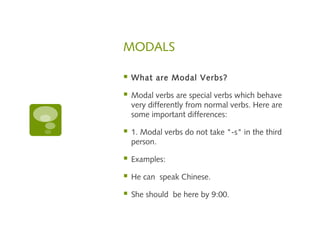
MODALS 
 What are Modal Verbs? 
 Modal verbs are special verbs which behave 
very differently from normal verbs. Here are 
some important differences: 
 1. Modal verbs do not take "-s" in the third 
person. 
 Examples: 
 He can speak Chinese. 
 She should be here by 9:00.
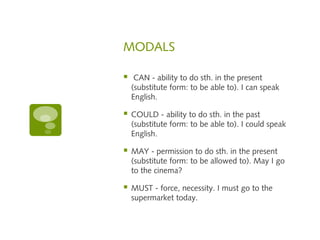
MODALS 
 CAN - ability to do sth. in the present 
(substitute form: to be able to). I can speak 
English. 
 COULD - ability to do sth. in the past 
(substitute form: to be able to). I could speak 
English. 
 MAY - permission to do sth. in the present 
(substitute form: to be allowed to). May I go 
to the cinema? 
 MUST - force, necessity. I must go to the 
supermarket today.
… 
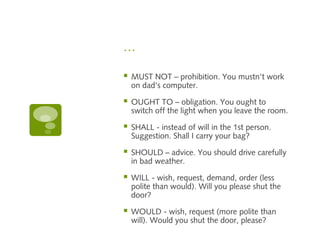
 MUST NOT – prohibition. You mustn't work 
on dad's computer. 
 OUGHT TO – obligation. You ought to 
switch off the light when you leave the room. 
 SHALL - instead of will in the 1st person. 
Suggestion. Shall I carry your bag? 
 SHOULD – advice. You should drive carefully 
in bad weather. 
 WILL - wish, request, demand, order (less 
polite than would). Will you please shut the 
door? 
 WOULD - wish, request (more polite than 
will). Would you shut the door, please?
2. You use "not" to make modal verbs negative, 
even in Simple Present and Simple Past. 
 Examples: 
 He should not be late. 
 They might not come to the party.
3. Many modal verbs cannot 
be used in the past tenses or 
the future tenses. 
 Examples: 
 He will can go with us. Not Correct 
 She musted study very hard. Not Correct 
 Common Modal Verbs 
 Can 
Could 
May 
Might 
Must 
 Ought to 
Shall 
Should 
Will 
Would
EXERCISES 
 http://www.englishpage.com/modals/interactivemodal1. 
htm
QUESTIONS WITH HOW 
 HOW MUCH - We useHow much with uncountable 
nouns (nouns that you cannot count such as money, 
wine, oil etc)...You cannot make them plural . You can't 
say one money, or three oils. 
 HOW MANY - We useHow many with countable nouns 
(nouns that you can count such as books, countries etc). 
We can make these nouns plural. You also use how 
many with a plural verb. 
 HOW OLD – to ask about age! How old are you Kate? 
 HOW LONG – to ask about length or a period of time. 
How long did your grandfather live? 
 HOW OFTEN – to ask about frequency. How often do 
you go to the gym?
EXERCISES 
 http://www.tolearnenglish.com/exercises/exe 
rcise-english-2/exercise-english-24600.php
10 sem 2

10 sem 2

  • 1.
  • 2.
    MODALS  Whatare Modal Verbs?  Modal verbs are special verbs which behave very differently from normal verbs. Here are some important differences:  1. Modal verbs do not take "-s" in the third person.  Examples:  He can speak Chinese.  She should be here by 9:00.
  • 3.
    MODALS  CAN- ability to do sth. in the present (substitute form: to be able to). I can speak English.  COULD - ability to do sth. in the past (substitute form: to be able to). I could speak English.  MAY - permission to do sth. in the present (substitute form: to be allowed to). May I go to the cinema?  MUST - force, necessity. I must go to the supermarket today.
  • 4.
    …  MUSTNOT – prohibition. You mustn't work on dad's computer.  OUGHT TO – obligation. You ought to switch off the light when you leave the room.  SHALL - instead of will in the 1st person. Suggestion. Shall I carry your bag?  SHOULD – advice. You should drive carefully in bad weather.  WILL - wish, request, demand, order (less polite than would). Will you please shut the door?  WOULD - wish, request (more polite than will). Would you shut the door, please?
  • 5.
    2. You use"not" to make modal verbs negative, even in Simple Present and Simple Past.  Examples:  He should not be late.  They might not come to the party.
  • 6.
    3. Many modalverbs cannot be used in the past tenses or the future tenses.  Examples:  He will can go with us. Not Correct  She musted study very hard. Not Correct  Common Modal Verbs  Can Could May Might Must  Ought to Shall Should Will Would
  • 7.
  • 8.
    QUESTIONS WITH HOW  HOW MUCH - We useHow much with uncountable nouns (nouns that you cannot count such as money, wine, oil etc)...You cannot make them plural . You can't say one money, or three oils.  HOW MANY - We useHow many with countable nouns (nouns that you can count such as books, countries etc). We can make these nouns plural. You also use how many with a plural verb.  HOW OLD – to ask about age! How old are you Kate?  HOW LONG – to ask about length or a period of time. How long did your grandfather live?  HOW OFTEN – to ask about frequency. How often do you go to the gym?
  • 9.
    EXERCISES  http://www.tolearnenglish.com/exercises/exe rcise-english-2/exercise-english-24600.php