Raul Templet
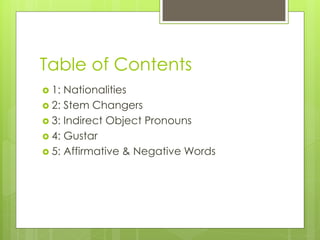
Table of Contents
 1: Nationalities
 2: Stem Changers
 3: Indirect Object Pronouns
 4: Gustar
 5: Affirmative & Negative Words
Nationalities
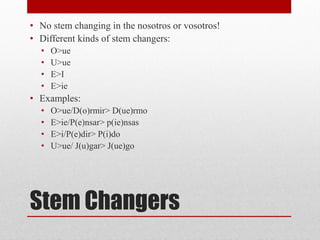
• No stem changing in the nosotros or vosotros!
• Different kinds of stem changers:
  •   O>ue
  •   U>ue
  •   E>I
  •   E>ie
• Examples:
  •   O>ue/D(o)rmir> D(ue)rmo
  •   E>ie/P(e)nsar> p(ie)nsas
  •   E>i/P(e)dir> P(i)do
  •   U>ue/ J(u)gar> J(ue)go


Stem Changers
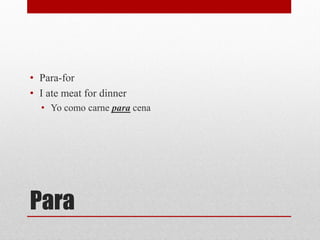
• Para-for
• I ate meat for dinner
  • Yo como carne para cena


Para
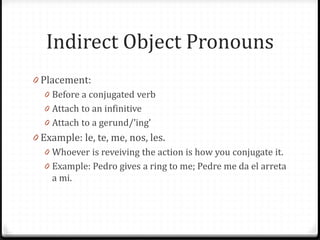
Indirect Object Pronouns
0 Placement:
   0 Before a conjugated verb
   0 Attach to an infinitive
   0 Attach to a gerund/’ing’
0 Example: le, te, me, nos, les.
   0 Whoever is reveiving the action is how you conjugate it.
   0 Example: Pedro gives a ring to me; Pedre me da el arreta
     a mi.
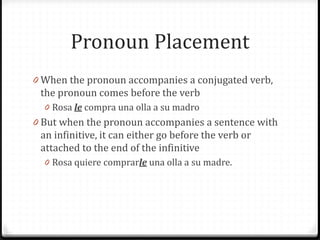
Pronoun Placement
0 When the pronoun accompanies a conjugated verb,
 the pronoun comes before the verb
  0 Rosa le compra una olla a su madro
0 But when the pronoun accompanies a sentence with
 an infinitive, it can either go before the verb or
 attached to the end of the infinitive
  0 Rosa quiere comprarle una olla a su madre.
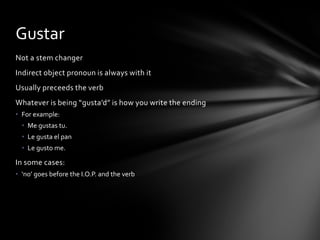
Gustar
Not a stem changer
Indirect object pronoun is always with it
Usually preceeds the verb
Whatever is being “gusta’d” is how you write the ending
• For example:
  • Me gustas tu.
  • Le gusta el pan
  • Le gusto me.

In some cases:
• ‘no’ goes before the I.O.P. and the verb
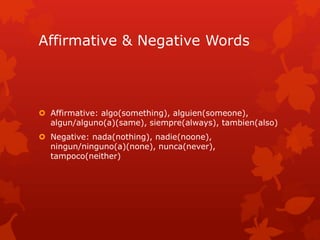
Affirmative & Negative Words


 Affirmative: algo(something), alguien(someone),
  algun/alguno(a)(same), siempre(always), tambien(also)
 Negative: nada(nothing), nadie(noone),
  ningun/ninguno(a)(none), nunca(never),
  tampoco(neither)
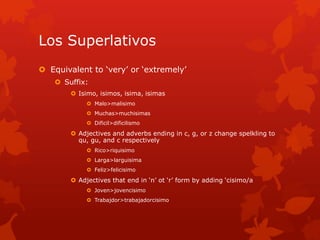
Los Superlativos
 Equivalent to ‘very’ or ‘extremely’
     Suffix:
         Isimo, isimos, isima, isimas
              Malo>malisimo
              Muchas>muchisimas
              Dificil>dificilismo

         Adjectives and adverbs ending in c, g, or z change spelkling to
          qu, gu, and c respectively
              Rico>riquisimo
              Larga>larguisima
              Feliz>felicisimo

         Adjectives that end in ‘n’ ot ‘r’ form by adding ‘cisimo/a
              Joven>jovencisimo
              Trabajdor>trabajadorcisimo
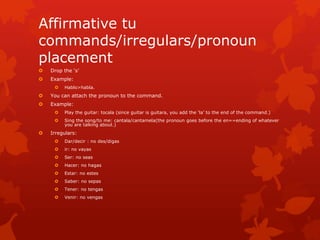
Affirmative tu
commands/irregulars/pronoun
placement
   Drop the ‘s’
   Example:
        Hablo>habla.
   You can attach the pronoun to the command.
   Example:
        Play the guitar: tocala (since guitar is guitara, you add the ‘la’ to the end of the command.)
        Sing the song/to me: cantala/cantamela(the pronoun goes before the en==ending of whatever
         you are talking about.)
   Irregulars:
        Dar/decir : no des/digas
        ir: no vayas
        Ser: no seas
        Hacer: no hagas
        Estar: no estes
        Saber: no sepas
        Tener: no tengas
        Venir: no vengas
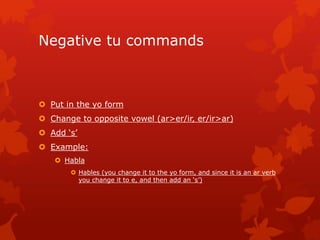
Negative tu commands


 Put in the yo form
 Change to opposite vowel (ar>er/ir, er/ir>ar)
 Add ‘s’
 Example:
    Habla
        Hables (you change it to the yo form, and since it is an ar verb
         you change it to e, and then add an ‘s’)
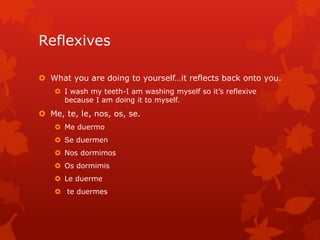
Reflexives

 What you are doing to yourself…it reflects back onto you.
     I wash my teeth-I am washing myself so it’s reflexive
      because I am doing it to myself.
 Me, te, le, nos, os, se.
     Me duermo
     Se duermen
     Nos dormimos
     Os dormimis
     Le duerme
     te duermes
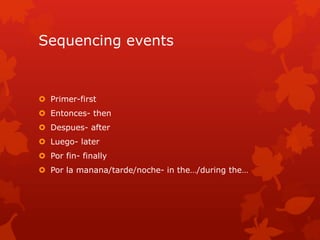
Sequencing events


 Primer-first
 Entonces- then
 Despues- after
 Luego- later
 Por fin- finally
 Por la manana/tarde/noche- in the…/during the…

Grammar book

  • 1.
  • 2.
    Table of Contents 1: Nationalities  2: Stem Changers  3: Indirect Object Pronouns  4: Gustar  5: Affirmative & Negative Words
  • 3.
  • 4.
    • No stemchanging in the nosotros or vosotros! • Different kinds of stem changers: • O>ue • U>ue • E>I • E>ie • Examples: • O>ue/D(o)rmir> D(ue)rmo • E>ie/P(e)nsar> p(ie)nsas • E>i/P(e)dir> P(i)do • U>ue/ J(u)gar> J(ue)go Stem Changers
  • 5.
    • Para-for • Iate meat for dinner • Yo como carne para cena Para
  • 6.
    Indirect Object Pronouns 0Placement: 0 Before a conjugated verb 0 Attach to an infinitive 0 Attach to a gerund/’ing’ 0 Example: le, te, me, nos, les. 0 Whoever is reveiving the action is how you conjugate it. 0 Example: Pedro gives a ring to me; Pedre me da el arreta a mi.
  • 7.
    Pronoun Placement 0 Whenthe pronoun accompanies a conjugated verb, the pronoun comes before the verb 0 Rosa le compra una olla a su madro 0 But when the pronoun accompanies a sentence with an infinitive, it can either go before the verb or attached to the end of the infinitive 0 Rosa quiere comprarle una olla a su madre.
  • 8.
    Gustar Not a stemchanger Indirect object pronoun is always with it Usually preceeds the verb Whatever is being “gusta’d” is how you write the ending • For example: • Me gustas tu. • Le gusta el pan • Le gusto me. In some cases: • ‘no’ goes before the I.O.P. and the verb
  • 9.
    Affirmative & NegativeWords  Affirmative: algo(something), alguien(someone), algun/alguno(a)(same), siempre(always), tambien(also)  Negative: nada(nothing), nadie(noone), ningun/ninguno(a)(none), nunca(never), tampoco(neither)
  • 10.
    Los Superlativos  Equivalentto ‘very’ or ‘extremely’  Suffix:  Isimo, isimos, isima, isimas  Malo>malisimo  Muchas>muchisimas  Dificil>dificilismo  Adjectives and adverbs ending in c, g, or z change spelkling to qu, gu, and c respectively  Rico>riquisimo  Larga>larguisima  Feliz>felicisimo  Adjectives that end in ‘n’ ot ‘r’ form by adding ‘cisimo/a  Joven>jovencisimo  Trabajdor>trabajadorcisimo
  • 11.
    Affirmative tu commands/irregulars/pronoun placement  Drop the ‘s’  Example:  Hablo>habla.  You can attach the pronoun to the command.  Example:  Play the guitar: tocala (since guitar is guitara, you add the ‘la’ to the end of the command.)  Sing the song/to me: cantala/cantamela(the pronoun goes before the en==ending of whatever you are talking about.)  Irregulars:  Dar/decir : no des/digas  ir: no vayas  Ser: no seas  Hacer: no hagas  Estar: no estes  Saber: no sepas  Tener: no tengas  Venir: no vengas
  • 12.
    Negative tu commands Put in the yo form  Change to opposite vowel (ar>er/ir, er/ir>ar)  Add ‘s’  Example:  Habla  Hables (you change it to the yo form, and since it is an ar verb you change it to e, and then add an ‘s’)
  • 13.
    Reflexives  What youare doing to yourself…it reflects back onto you.  I wash my teeth-I am washing myself so it’s reflexive because I am doing it to myself.  Me, te, le, nos, os, se.  Me duermo  Se duermen  Nos dormimos  Os dormimis  Le duerme  te duermes
  • 14.
    Sequencing events  Primer-first Entonces- then  Despues- after  Luego- later  Por fin- finally  Por la manana/tarde/noche- in the…/during the…