


Presented By:-
Ramesh Upadhaya
MCA 4th SEM
CIME,BBSR
CONTENTS
 Introduction.
 Definition.
 History & Evolution.
 Categories of cyber crime.
 Types of cyber crime.
 Prevention.
 Conclusion.
 References.
INTRODUCTION
o The Internet in India is growing rapidly. It
has given rise to new opportunities in every
field we can think of like entertainment,
business, sports & education.
o There’re two sides to a coin. Internet also
has it’s own disadvantage,
i.e. Cyber crime
What is CYBER CRIME ?
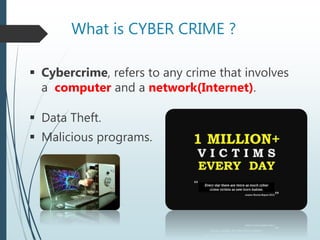
 Cybercrime, refers to any crime that involves
a computer and a network(Internet).
 Data Theft.
 Malicious programs.
HISTORY & EVOLUTION
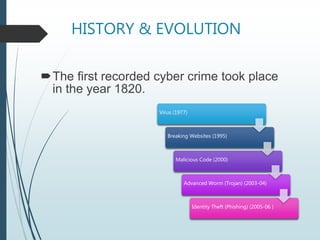
The first recorded cyber crime took place
in the year 1820.
Virus (1977)
Breaking Websites (1995)
Malicious Code (2000)
Advanced Worm (Trojan) (2003-04)
Identity Theft (Phishing) (2005-06 )
CATEGORIZATION OF CYBER CRIME
Cyber Crime Against Individual
Email-spoofing, spamming, Phishing etc.
Cyber Crime Against Property
Credit card fraud, internet time theft etc.
Cyber Crime Against Organization
Denial of service, Virus attack etc.
Cyber Crime Against Society
Forgery, terrorism, web jacking etc.
TYPES OF CYBER CRIME
Hacking
Virus Dissemination
Denial of Service
Computer Vandalism
Cyber Terrorism
Software Piracy
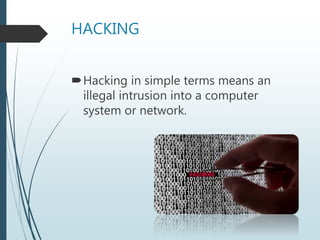
HACKING
Hacking in simple terms means an
illegal intrusion into a computer
system or network.
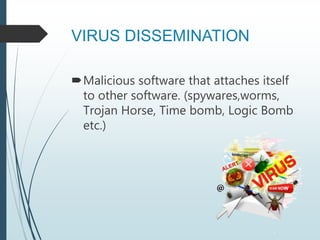
VIRUS DISSEMINATION
Malicious software that attaches itself
to other software. (spywares,worms,
Trojan Horse, Time bomb, Logic Bomb
etc.)
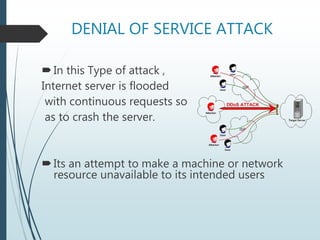
DENIAL OF SERVICE ATTACK
In this Type of attack ,
Internet server is flooded
with continuous requests so
as to crash the server.
Its an attempt to make a machine or network
resource unavailable to its intended users
COMPUTER VANDALISM
Damaging or destroying data rather
than stealing or misusing them is called
Computer Vandalism.
E.g. Transmitting Virus To destroy
system files.
CYBER TERRORISM
Use of Internet based attacks
in terrorist activities.
Technology savvy terrorists are using 512-
bit encryption, which is likely impossible to
decrypt.
SOFTWARE PIRACY
 Theft of software through the illegal copying of
genuine programs.
 Distribution of products intended to pass for
the original.
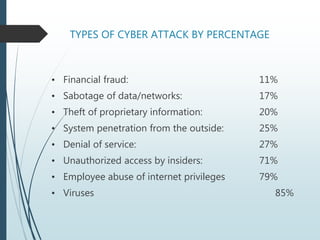
TYPES OF CYBER ATTACK BY PERCENTAGE
• Financial fraud: 11%
• Sabotage of data/networks: 17%
• Theft of proprietary information: 20%
• System penetration from the outside: 25%
• Denial of service: 27%
• Unauthorized access by insiders: 71%
• Employee abuse of internet privileges 79%
• Viruses 85%
SAFETY TIPS FOR CYBER CRIME
 Use antivirus software’s.
 Insert firewalls.
 Uninstall unnecessary software
 Maintain backup.
 Check security settings.
 Stay anonymous - choose a genderless screen name.
 Never give your full name or address to strangers.
 Learn more about Internet privacy.
CONCLUSION
Technology is destructive only in the hands of
people who do not know or care about the
outcomes .
References
 Google
 Wikipedia
 www.cybercellmumbai.com
 www.Interpol.int
 www.webopedia.com
Any Questions ?
Cyber Crime

Cyber Crime

  • 1.
  • 2.
    CONTENTS  Introduction.  Definition. History & Evolution.  Categories of cyber crime.  Types of cyber crime.  Prevention.  Conclusion.  References.
  • 3.
    INTRODUCTION o The Internetin India is growing rapidly. It has given rise to new opportunities in every field we can think of like entertainment, business, sports & education. o There’re two sides to a coin. Internet also has it’s own disadvantage, i.e. Cyber crime
  • 4.
    What is CYBERCRIME ?  Cybercrime, refers to any crime that involves a computer and a network(Internet).  Data Theft.  Malicious programs.
  • 5.
    HISTORY & EVOLUTION Thefirst recorded cyber crime took place in the year 1820. Virus (1977) Breaking Websites (1995) Malicious Code (2000) Advanced Worm (Trojan) (2003-04) Identity Theft (Phishing) (2005-06 )
  • 6.
    CATEGORIZATION OF CYBERCRIME Cyber Crime Against Individual Email-spoofing, spamming, Phishing etc. Cyber Crime Against Property Credit card fraud, internet time theft etc. Cyber Crime Against Organization Denial of service, Virus attack etc. Cyber Crime Against Society Forgery, terrorism, web jacking etc.
  • 7.
    TYPES OF CYBERCRIME Hacking Virus Dissemination Denial of Service Computer Vandalism Cyber Terrorism Software Piracy
  • 8.
    HACKING Hacking in simpleterms means an illegal intrusion into a computer system or network.
  • 9.
    VIRUS DISSEMINATION Malicious softwarethat attaches itself to other software. (spywares,worms, Trojan Horse, Time bomb, Logic Bomb etc.)
  • 10.
    DENIAL OF SERVICEATTACK In this Type of attack , Internet server is flooded with continuous requests so as to crash the server. Its an attempt to make a machine or network resource unavailable to its intended users
  • 11.
    COMPUTER VANDALISM Damaging ordestroying data rather than stealing or misusing them is called Computer Vandalism. E.g. Transmitting Virus To destroy system files.
  • 12.
    CYBER TERRORISM Use ofInternet based attacks in terrorist activities. Technology savvy terrorists are using 512- bit encryption, which is likely impossible to decrypt.
  • 13.
    SOFTWARE PIRACY  Theftof software through the illegal copying of genuine programs.  Distribution of products intended to pass for the original.
  • 14.
    TYPES OF CYBERATTACK BY PERCENTAGE • Financial fraud: 11% • Sabotage of data/networks: 17% • Theft of proprietary information: 20% • System penetration from the outside: 25% • Denial of service: 27% • Unauthorized access by insiders: 71% • Employee abuse of internet privileges 79% • Viruses 85%
  • 15.
    SAFETY TIPS FORCYBER CRIME  Use antivirus software’s.  Insert firewalls.  Uninstall unnecessary software  Maintain backup.  Check security settings.  Stay anonymous - choose a genderless screen name.  Never give your full name or address to strangers.  Learn more about Internet privacy.
  • 16.
    CONCLUSION Technology is destructiveonly in the hands of people who do not know or care about the outcomes .
  • 17.
    References  Google  Wikipedia www.cybercellmumbai.com  www.Interpol.int  www.webopedia.com
  • 18.