







Martin Peniak, Davide Marocco, Angelo Cangelosi
GPU Computing for Cognitive Robotics
GPU Technology Conference, San Jose, California, 25 March, 2014
This study was financed by:
EU Integrating Projects - ITALK and Poeticon++ within the FP7 ICT programme
Cognitive Systems and Robotics
ARIADNA scheme of The European Space Agency
Thanks to my supervisors Prof Angelo Cangelosi, Dr. Davide Marocco
and Prof Tony Belpaeme for their support
Thanks to Calisa Cole and Chandra Cheij from NVIDIA for their help
Acknowledgements
New position at Cortexica
Imperial College London
• Leading provider of visual
search and image recognition
technology for mobile device
• Creators of a bio-inspired
vision system enabling
intelligent image recognition
using principles derived from
the human sight
www.cortexica.com
Action and language acquisition in humanoid robots
Biologically-inspired Active Vision system
Software development
4
Overview
Action and Language Acquisition in Humanoid Robots
6
Humans are good at learning complex actions
Constant repetition of movements with certain components
segmented as reusable elements
Motor primitives are flexibly combined into novel sequences of actions
Human motor control system known to have motor primitives
implemented as low as at the spinal cord and hi-level planning and
execution takes place in primary motor cortex
7
Learning Actions
8
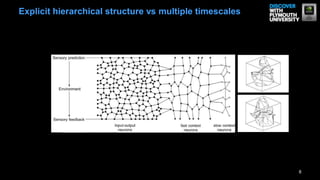
Explicit hierarchical structure vs multiple timescales
9
10
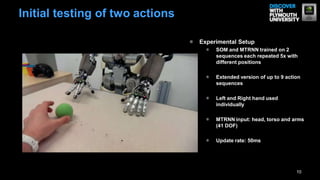
Initial testing of two actions
Experimental Setup
SOM and MTRNN trained on 2
sequences each repeated 5x with
different positions
Extended version of up to 9 action
sequences
Left and Right hand used
individually
MTRNN input: head, torso and arms
(41 DOF)
Update rate: 50ms
11
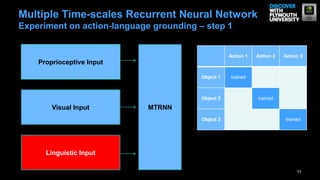
Multiple Time-scales Recurrent Neural Network
Experiment on action-language grounding – step 1
Proprioceptive Input
MTRNNVisual Input
Linguistic Input
Action 1 Action 2 Action 3
Object 1 trained
Object 2 trained
Object 3 trained
12
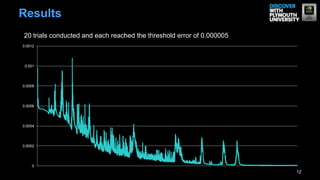
Results
0
0.0002
0.0004
0.0006
0.0008
0.001
0.0012
20 trials conducted and each reached the threshold error of 0.000005
13
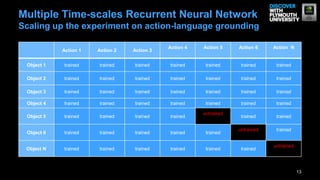
Multiple Time-scales Recurrent Neural Network
Scaling up the experiment on action-language grounding
Action 1 Action 2 Action 3
Action 4 Action 5 Action 6 Action N
Object 1 trained trained trained trained trained trained trained
Object 2 trained trained trained trained trained trained trained
Object 3 trained trained trained trained trained trained trained
Object 4 trained trained trained trained trained trained trained
Object 5 trained trained trained trained
untrained
trained trained
Object 6 trained trained trained trained trained
untrained trained
Object N trained trained trained trained trained trained
untrained
14
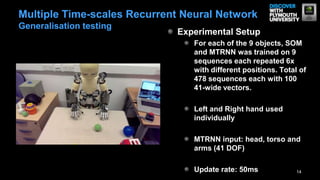
Multiple Time-scales Recurrent Neural Network
Generalisation testing
Experimental Setup
For each of the 9 objects, SOM
and MTRNN was trained on 9
sequences each repeated 6x
with different positions. Total of
478 sequences each with 100
41-wide vectors.
Left and Right hand used
individually
MTRNN input: head, torso and
arms (41 DOF)
Update rate: 50ms
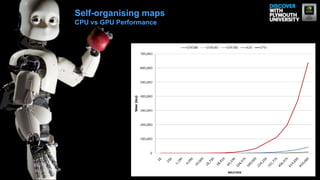
Self-organising maps
CPU vs GPU Performance
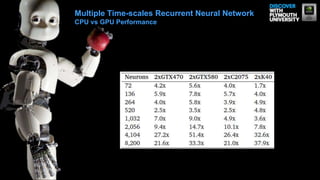
Multiple Time-scales Recurrent Neural Network
CPU vs GPU Performance
Biologically-inspired Active Vision system
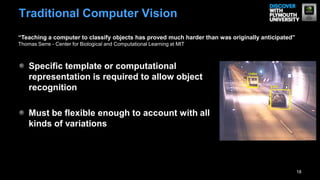
Specific template or computational
representation is required to allow object
recognition
Must be flexible enough to account with all
kinds of variations
18
Traditional Computer Vision
“Teaching a computer to classify objects has proved much harder than was originally anticipated”
Thomas Serre - Center for Biological and Computational Learning at MIT
19
Biological Vision
“Researchers have been interested for years in trying to copy biological vision
systems, simply because they are so good” ~ David Hogg - computer vision expert at Leeds
University, UK
Highly optimized over millions of years of
evolution, developing complex neural structures
to represent and process stimuli
Superiority of biological vision systems is only
partially understood
Hardware architecture and the style of
computation in nervous systems are
fundamentally different
20
Biological Vision
Seeing is a way of acting
21
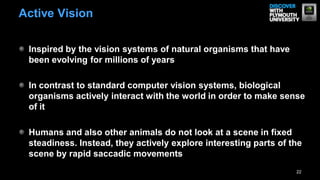
Inspired by the vision systems of natural organisms that have
been evolving for millions of years
In contrast to standard computer vision systems, biological
organisms actively interact with the world in order to make sense
of it
Humans and also other animals do not look at a scene in fixed
steadiness. Instead, they actively explore interesting parts of the
scene by rapid saccadic movements
22
Active Vision
Evolutionary Robotics Approach
Creating Active Vision Systems
23
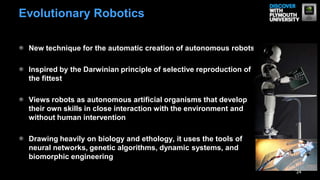
New technique for the automatic creation of autonomous robots
Inspired by the Darwinian principle of selective reproduction of
the fittest
Views robots as autonomous artificial organisms that develop
their own skills in close interaction with the environment and
without human intervention
Drawing heavily on biology and ethology, it uses the tools of
neural networks, genetic algorithms, dynamic systems, and
biomorphic engineering
24
Evolutionary Robotics
25
...
...
...
Population
(Chromosomes)
Evaluation
(Fitness)
Selection
(Mating Pool)
Genetic
operators
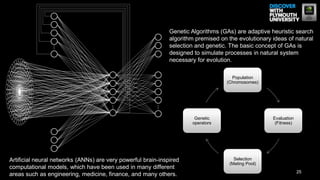
Artificial neural networks (ANNs) are very powerful brain-inspired
computational models, which have been used in many different
areas such as engineering, medicine, finance, and many others.
Genetic Algorithms (GAs) are adaptive heuristic search
algorithm premised on the evolutionary ideas of natural
selection and genetic. The basic concept of GAs is
designed to simulate processes in natural system
necessary for evolution.
26
Related Research
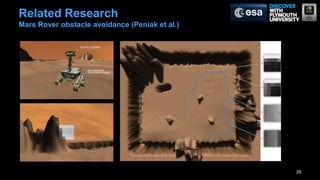
Mars Rover obstacle avoidance (Peniak et al.)
27
Method
Evolution of the active vision system for real-world object recognition
training the system in a parallel manner on multiple objects viewed from many different angles and under different lighting conditions
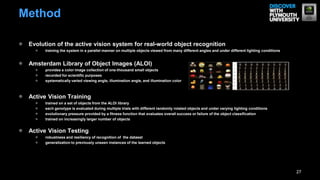
Amsterdam Library of Object Images (ALOI)
provides a color image collection of one-thousand small objects
recorded for scientific purposes
systematically varied viewing angle, illumination angle, and illumination color
Active Vision Training
trained on a set of objects from the ALOI library
each genotype is evaluated during multiple trials with different randomly rotated objects and under varying lighting conditions
evolutionary pressure provided by a fitness function that evaluates overall success or failure of the object classification
trained on increasingly larger number of objects
Active Vision Testing
robustness and resiliency of recognition of the dataset
generalization to previously unseen instances of the learned objects
28
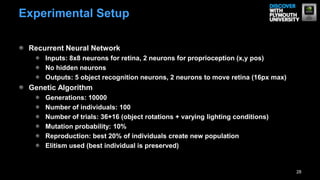
Experimental Setup
Recurrent Neural Network
Inputs: 8x8 neurons for retina, 2 neurons for proprioception (x,y pos)
No hidden neurons
Outputs: 5 object recognition neurons, 2 neurons to move retina (16px max)
Genetic Algorithm
Generations: 10000
Number of individuals: 100
Number of trials: 36+16 (object rotations + varying lighting conditions)
Mutation probability: 10%
Reproduction: best 20% of individuals create new population
Elitism used (best individual is preserved)
29
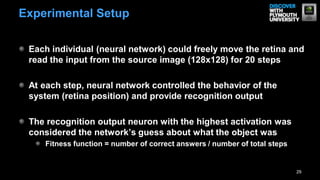
Experimental Setup
Each individual (neural network) could freely move the retina and
read the input from the source image (128x128) for 20 steps
At each step, neural network controlled the behavior of the
system (retina position) and provide recognition output
The recognition output neuron with the highest activation was
considered the network’s guess about what the object was
Fitness function = number of correct answers / number of total steps
GPUs were used to accelerate:
Evolutionary process – parallel execution of trials
Neural Network – parallel calculation of neural activities
30
GPU Accelerating GA and ANN
31
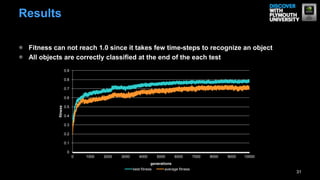
Results
Fitness can not reach 1.0 since it takes few time-steps to recognize an object
All objects are correctly classified at the end of the each test
0
0.1
0.2
0.3
0.4
0.5
0.6
0.7
0.8
0.9
0 1000 2000 3000 4000 5000 6000 7000 8000 9000 10000
fitness
generations
best fitness average fitness
32
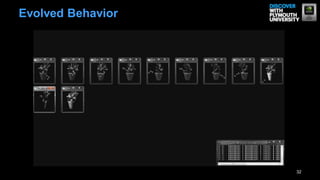
Evolved Behavior
Software development
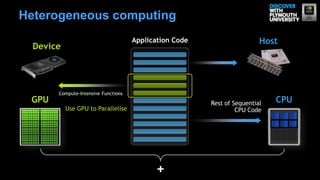
Application Code
+
GPU CPU
Use GPU to Parallelise
Compute-Intensive Functions
Rest of Sequential
CPU Code
Heterogeneous computing
Host
Device
Heterogeneous software architecture for the development of
modules loosely coupled to their graphical user interfaces
Provides simple and user friendly GUI client
Distribute, control and visualise existing modules
Generate new modules
Monitor connected server
Tools
Modules
Run heterogeneous CPU-GPU code doing the actual work
What is Aquila?
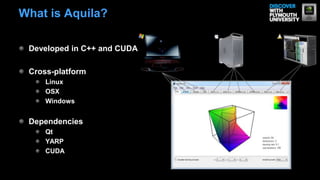
Developed in C++ and CUDA
Cross-platform
Linux
OSX
Windows
Dependencies
Qt
YARP
CUDA
What is Aquila?
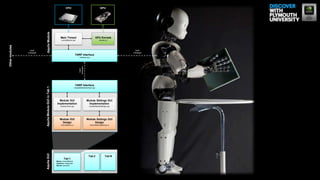
YARP
messages
YARP Interface
Interface.cpp
GPU Kernels
kernels.cu
Main Thread
moduleName.cpp
GPUCPU
YARP Interface
moduleNameInterface.cpp
Module Settings GUI
Implementation
moduleNameSettings.cpp
Module GUI
Implementation
modulename.cpp
Module GUI
Design
moduleName.ui
Module Settings GUI
Design
moduleNameSettings.ui
Tab 1
Name: moduleName
Instance: instanceID
Server: serverID
Tab 2 Tab N
AquilaGUIAquilaModuleGUIinTab1AquilaModule
YARP
messages
YARP
messages
Othermodules
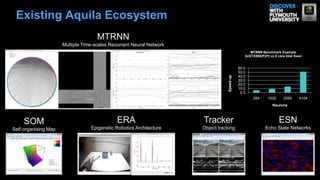
Existing Aquila Ecosystem
SOM
Self-organising Map
ERA
Epigenetic Robotics Architecture
Tracker
Object tracking
MTRNN
Multiple Time-scales Recurrent Neural Network
0.0
10.0
20.0
30.0
40.0
50.0
60.0
264 1032 2056 4104
Speed-up
Neurons
MTRNN Benchmark Example
2xGTX580(P2P) vs 8 core Intel Xeon
ESN
Echo State Networks
Thank you!
39
"Imagination is the highest form of research"
Albert Einstein

GPU Computing for Cognitive Robotics

  • 1.
    Martin Peniak, DavideMarocco, Angelo Cangelosi GPU Computing for Cognitive Robotics GPU Technology Conference, San Jose, California, 25 March, 2014
  • 2.
    This study wasfinanced by: EU Integrating Projects - ITALK and Poeticon++ within the FP7 ICT programme Cognitive Systems and Robotics ARIADNA scheme of The European Space Agency Thanks to my supervisors Prof Angelo Cangelosi, Dr. Davide Marocco and Prof Tony Belpaeme for their support Thanks to Calisa Cole and Chandra Cheij from NVIDIA for their help Acknowledgements
  • 3.
    New position atCortexica Imperial College London • Leading provider of visual search and image recognition technology for mobile device • Creators of a bio-inspired vision system enabling intelligent image recognition using principles derived from the human sight www.cortexica.com
  • 4.
    Action and languageacquisition in humanoid robots Biologically-inspired Active Vision system Software development 4 Overview
  • 6.
    Action and LanguageAcquisition in Humanoid Robots 6
  • 7.
    Humans are goodat learning complex actions Constant repetition of movements with certain components segmented as reusable elements Motor primitives are flexibly combined into novel sequences of actions Human motor control system known to have motor primitives implemented as low as at the spinal cord and hi-level planning and execution takes place in primary motor cortex 7 Learning Actions
  • 8.
    8 Explicit hierarchical structurevs multiple timescales
  • 9.
  • 10.
    10 Initial testing oftwo actions Experimental Setup SOM and MTRNN trained on 2 sequences each repeated 5x with different positions Extended version of up to 9 action sequences Left and Right hand used individually MTRNN input: head, torso and arms (41 DOF) Update rate: 50ms
  • 11.
    11 Multiple Time-scales RecurrentNeural Network Experiment on action-language grounding – step 1 Proprioceptive Input MTRNNVisual Input Linguistic Input Action 1 Action 2 Action 3 Object 1 trained Object 2 trained Object 3 trained
  • 12.
    12 Results 0 0.0002 0.0004 0.0006 0.0008 0.001 0.0012 20 trials conductedand each reached the threshold error of 0.000005
  • 13.
    13 Multiple Time-scales RecurrentNeural Network Scaling up the experiment on action-language grounding Action 1 Action 2 Action 3 Action 4 Action 5 Action 6 Action N Object 1 trained trained trained trained trained trained trained Object 2 trained trained trained trained trained trained trained Object 3 trained trained trained trained trained trained trained Object 4 trained trained trained trained trained trained trained Object 5 trained trained trained trained untrained trained trained Object 6 trained trained trained trained trained untrained trained Object N trained trained trained trained trained trained untrained
  • 14.
    14 Multiple Time-scales RecurrentNeural Network Generalisation testing Experimental Setup For each of the 9 objects, SOM and MTRNN was trained on 9 sequences each repeated 6x with different positions. Total of 478 sequences each with 100 41-wide vectors. Left and Right hand used individually MTRNN input: head, torso and arms (41 DOF) Update rate: 50ms
  • 15.
  • 16.
    Multiple Time-scales RecurrentNeural Network CPU vs GPU Performance
  • 17.
  • 18.
    Specific template orcomputational representation is required to allow object recognition Must be flexible enough to account with all kinds of variations 18 Traditional Computer Vision “Teaching a computer to classify objects has proved much harder than was originally anticipated” Thomas Serre - Center for Biological and Computational Learning at MIT
  • 19.
    19 Biological Vision “Researchers havebeen interested for years in trying to copy biological vision systems, simply because they are so good” ~ David Hogg - computer vision expert at Leeds University, UK Highly optimized over millions of years of evolution, developing complex neural structures to represent and process stimuli Superiority of biological vision systems is only partially understood Hardware architecture and the style of computation in nervous systems are fundamentally different
  • 20.
  • 21.
    Seeing is away of acting 21
  • 22.
    Inspired by thevision systems of natural organisms that have been evolving for millions of years In contrast to standard computer vision systems, biological organisms actively interact with the world in order to make sense of it Humans and also other animals do not look at a scene in fixed steadiness. Instead, they actively explore interesting parts of the scene by rapid saccadic movements 22 Active Vision
  • 23.
  • 24.
    New technique forthe automatic creation of autonomous robots Inspired by the Darwinian principle of selective reproduction of the fittest Views robots as autonomous artificial organisms that develop their own skills in close interaction with the environment and without human intervention Drawing heavily on biology and ethology, it uses the tools of neural networks, genetic algorithms, dynamic systems, and biomorphic engineering 24 Evolutionary Robotics
  • 25.
    25 ... ... ... Population (Chromosomes) Evaluation (Fitness) Selection (Mating Pool) Genetic operators Artificial neuralnetworks (ANNs) are very powerful brain-inspired computational models, which have been used in many different areas such as engineering, medicine, finance, and many others. Genetic Algorithms (GAs) are adaptive heuristic search algorithm premised on the evolutionary ideas of natural selection and genetic. The basic concept of GAs is designed to simulate processes in natural system necessary for evolution.
  • 26.
    26 Related Research Mars Roverobstacle avoidance (Peniak et al.)
  • 27.
    27 Method Evolution of theactive vision system for real-world object recognition training the system in a parallel manner on multiple objects viewed from many different angles and under different lighting conditions Amsterdam Library of Object Images (ALOI) provides a color image collection of one-thousand small objects recorded for scientific purposes systematically varied viewing angle, illumination angle, and illumination color Active Vision Training trained on a set of objects from the ALOI library each genotype is evaluated during multiple trials with different randomly rotated objects and under varying lighting conditions evolutionary pressure provided by a fitness function that evaluates overall success or failure of the object classification trained on increasingly larger number of objects Active Vision Testing robustness and resiliency of recognition of the dataset generalization to previously unseen instances of the learned objects
  • 28.
    28 Experimental Setup Recurrent NeuralNetwork Inputs: 8x8 neurons for retina, 2 neurons for proprioception (x,y pos) No hidden neurons Outputs: 5 object recognition neurons, 2 neurons to move retina (16px max) Genetic Algorithm Generations: 10000 Number of individuals: 100 Number of trials: 36+16 (object rotations + varying lighting conditions) Mutation probability: 10% Reproduction: best 20% of individuals create new population Elitism used (best individual is preserved)
  • 29.
    29 Experimental Setup Each individual(neural network) could freely move the retina and read the input from the source image (128x128) for 20 steps At each step, neural network controlled the behavior of the system (retina position) and provide recognition output The recognition output neuron with the highest activation was considered the network’s guess about what the object was Fitness function = number of correct answers / number of total steps
  • 30.
    GPUs were usedto accelerate: Evolutionary process – parallel execution of trials Neural Network – parallel calculation of neural activities 30 GPU Accelerating GA and ANN
  • 31.
    31 Results Fitness can notreach 1.0 since it takes few time-steps to recognize an object All objects are correctly classified at the end of the each test 0 0.1 0.2 0.3 0.4 0.5 0.6 0.7 0.8 0.9 0 1000 2000 3000 4000 5000 6000 7000 8000 9000 10000 fitness generations best fitness average fitness
  • 32.
  • 33.
  • 34.
    Application Code + GPU CPU UseGPU to Parallelise Compute-Intensive Functions Rest of Sequential CPU Code Heterogeneous computing Host Device
  • 35.
    Heterogeneous software architecturefor the development of modules loosely coupled to their graphical user interfaces Provides simple and user friendly GUI client Distribute, control and visualise existing modules Generate new modules Monitor connected server Tools Modules Run heterogeneous CPU-GPU code doing the actual work What is Aquila?
  • 36.
    Developed in C++and CUDA Cross-platform Linux OSX Windows Dependencies Qt YARP CUDA What is Aquila?
  • 37.
    YARP messages YARP Interface Interface.cpp GPU Kernels kernels.cu MainThread moduleName.cpp GPUCPU YARP Interface moduleNameInterface.cpp Module Settings GUI Implementation moduleNameSettings.cpp Module GUI Implementation modulename.cpp Module GUI Design moduleName.ui Module Settings GUI Design moduleNameSettings.ui Tab 1 Name: moduleName Instance: instanceID Server: serverID Tab 2 Tab N AquilaGUIAquilaModuleGUIinTab1AquilaModule YARP messages YARP messages Othermodules
  • 38.
    Existing Aquila Ecosystem SOM Self-organisingMap ERA Epigenetic Robotics Architecture Tracker Object tracking MTRNN Multiple Time-scales Recurrent Neural Network 0.0 10.0 20.0 30.0 40.0 50.0 60.0 264 1032 2056 4104 Speed-up Neurons MTRNN Benchmark Example 2xGTX580(P2P) vs 8 core Intel Xeon ESN Echo State Networks
  • 39.
    Thank you! 39 "Imagination isthe highest form of research" Albert Einstein