The Texas Legislature
GOVT 2306
Chapter 7
Legislative Framework
 Texas, like 48 other states, uses a bicameral lawmaking body
to enact bills and adopt resolutions.
 The smaller chamber in Texas is called the Senate (with 31
members); the lower chamber is called the House (with 150
members).
 Election and Terms of Office
 Representatives serve 2-year terms and senators serve 4-year
terms—each beginning in January of odd-numbered years.
 There is no limit on the number of terms a member may serve.
 If a member of the legislature dies, resigns, or is expelled
(removed) from office, the vacancy is filled by special election.
Legislative Framework
 Sessions
 A regular session of the legislature is held every odd-numbered
year and lasts for a maximum of 140 days
 Special sessions, which can be called only by the governor, can
last up to 30 days.
 During a special session, the legislature may consider only those
matters placed before it by the governor.
 There is no limit as to how many special sessions can be called.
 Limits on the length of sessions reflect the distrust that people
have in their legislative body and a general fear of change
 Gov. Clements – “all kinds of bad things can happen when the
legislature is in session.”
Legislative Framework
 Districting
 Redistricting, reflective of population changes, is supposed to be
done immediately following the decennial (10 yr.) census.
 Redrawing of boundaries after the federal census to create districts
with approximately equal population
 Conducted the first odd-numbered year after the decennial census
 In Texas, the first legislative and congressional elections in
districts based on the 2010 census will be conducted in
November 2012 for offices filled in January 2013.
 Redistricting was completed in November 2011, but was halted in
March 2012 by the U.S. District Court of West Texas
 An interim plan was announced in March 2012
Legislative Framework
 Districting
 Issues with redistricting
 Can take away areas of constituent who has provided strong voter
support to a particular legislator
 May add an area of constituents who produce little support and much
opposition for a legislator
 May produce a new district that includes the residences of two or more
representatives or senators
 Only one of whom can be reelected to represent the district
 Can be used for gerrymandering purposes
 Drawing the boundaries of a district to include or exclude certain groups of
voters and thus affect election outcomes
Legislative Framework
 Districting
 Ideal District Plans (2011)
 Texas Census Population (2010) – 25,145,561
 Texas Congressional Districts – 36
 Ideal Population – 698,488
 Texas State Senate Districts – 31
 Ideal Population – 811,147
 Texas State House Districts – 150
 Ideal Population – 167,637
 Texas State Board of Education – 15
 Ideal Population – 1,676, 371
Legislative Framework
 Districting
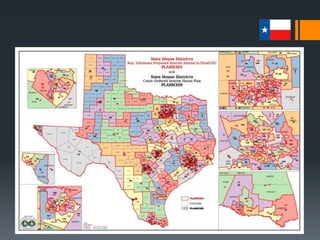
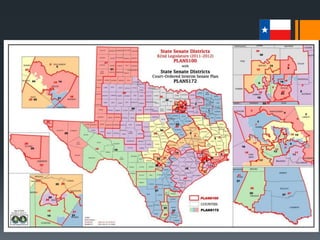
 State Legislative Districts
 The Texas Constitution stipulates, “the legislature shall, at its first
session after the publication of each United States decennial census,
apportion the State into Senatorial and Representative districts.”
 Federal courts applied the “one man, one vote” principle to Texas, but
every redistricting has been followed by complaints about
gerrymandering.
 If the legislature fails to redistrict, then the Legislative Redistricting
Board does the necessary redistricting.
 All members of the Texas Legislature are elected in single-member
districts.
 Area that elects only 1 representative to serve on a policymaking body
 Texas enacted this in 1971
Check my SlideShare page
(rfair07) for more lectures
Lectures posted for:
 United States History before 1877
 United States History after 1877
 Texas History
 United States (Federal) Government
 Texas Government
 To download a copy of this PowerPoint presentation, please
go to: https://gumroad.com/l/uqZPJ 
 If you would like a copy of all the Texas Government lectures
posted in PDF format, please check out
at:https://gumroad.com/l/GXhg 
Legislative Framework
 Districting
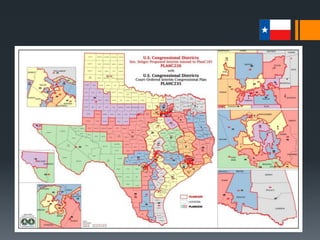
 U.S. Congressional Districts
 In the year after a federal census, the Texas Legislature is supposed to
draw new district lines for its U.S. congressional districts (from which
representatives to the U.S. House of Representatives are elected).
 Per the 2000 census, Texas’ 32 congressional districts should have an ideal
population of 651,619
 After the 2010 census, Texas will have 36 congressional districts with an
average of 698,488 per district
 This process is not as simple as it seems and often presents political
challenges to lawmakers.
 2003 redistricting plan by Tom DeLay
Legislators
 Members of the Texas Legislature may not hold another
government office and must meet specific constitutional
requirements.
 However, the biographical data for members of recent Texas
legislatures suggest informal qualifications that restrict
opportunities for election to either of the two chambers.
Legislators
 Qualifications and Characteristics
 Except for state residency and age, the qualifications are the same
for both chambers.
 Citizenship, qualified voting status, and district residency of one year
apply to both chambers.
 To be elected to the House, one must have lived in Texas for at least 2 years
and be at least 21 years of age.
 Election to the Senate requires one to have lived in Texas for 5 years and to
be at least 26 years old.
 The minimum age requirements are usually well below the actual age of
most first-time members.
 Legislators tend to be Anglo, Protestant, male, between 35 and 50
years of age, native born, attorneys or businesspersons, with limited
prior legislative service.
Legislators
 Gender and Ethnic Classifications
 Ethnic and racial minorities may be underrepresented, but their
numbers continue to increase.
 Women are also underrepresented.
 Political Party Affiliation
 Though most legislators were still Democrats in 1999, by 2003
both chambers had gone under Republican control for the first
time since Reconstruction.
 Since that year, each chamber has produced more “party-line”
votes
 Democrats voting one way on an issue and Republicans voting the
other way.
Legislators
 Education and Occupation
 In government, as in business, most positions of leadership call for
college credentials.
 Nearly all members of the Texas Legislature claim at least some time
in college and most have at least one degree.
 Members of the legal profession have a dominant influence because
they are more available to be candidates for office.
 Lawyer-legislators often face conflict-of-interest charges.
 Lesser numbers of real estate and insurance people, and some
farmers, ranchers, and teachers have also served.
 Medical personnel, engineers, and accountants have held few
legislative seats.
 Laborers have held almost none.
Legislators
 Religious Affiliation
 The religious affiliation of each legislator is not a matter of record,
but it appears that Catholic senators and representatives are
most numerous, followed (in order) by Baptists, Methodists, and
Episcopalians.
 Religious affiliation has some significance because many top
issues today relate to spiritual or moral values.
Legislators
 Legislative Experience
 Experience is measured in terms of turnover
 (first-termers replacing experienced members who have retired or lost
an election) and tenure (years served in a legislative chamber).
 For the ten recent Texas legislatures (72nd–81st), the average
turnover in the House was 26 or about 17 percent of the
membership every 2 years.
 In the Senate, it was 4.4 or about 14 percent.
 Turnover tends to be higher for the first legislature following
redistricting.
 To date, all efforts to adopt term limits have been unsuccessful.
Compensation
 Texas’s legislators receive low pay, reasonable allowances,
and a relatively generous retirement pension after a minimum
period of service.
 Pay and Per Diem Allowance
 Legislative salaries are relatively low because voters must
approve any increase.
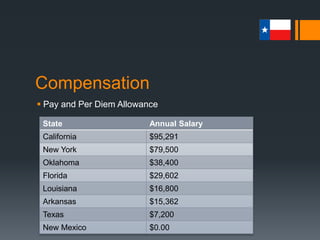
 A legislator’s salary is current $7,200 per year plus a per diem,
currently set at $168.00 for every day spent in actual service on
legislative business.
 The $7,200 annual salary has not been increased since 1975.
Check my SlideShare page
(rfair07) for more lectures
Lectures posted for:
 United States History before 1877 / after 1877
 Texas History
 United States (Federal) Government / Texas Government
 Slide 20 of 56
 To download a full copy of this PowerPoint presentation,
please go to: https://gumroad.com/l/uqZPJ 
 If you would like a copy of all the Texas Government lectures
posted in PDF format, please check out
at:https://gumroad.com/l/GXhg 

Govt 2306 ch_7

  • 1.
  • 2.
    Legislative Framework  Texas,like 48 other states, uses a bicameral lawmaking body to enact bills and adopt resolutions.  The smaller chamber in Texas is called the Senate (with 31 members); the lower chamber is called the House (with 150 members).  Election and Terms of Office  Representatives serve 2-year terms and senators serve 4-year terms—each beginning in January of odd-numbered years.  There is no limit on the number of terms a member may serve.  If a member of the legislature dies, resigns, or is expelled (removed) from office, the vacancy is filled by special election.
  • 3.
    Legislative Framework  Sessions A regular session of the legislature is held every odd-numbered year and lasts for a maximum of 140 days  Special sessions, which can be called only by the governor, can last up to 30 days.  During a special session, the legislature may consider only those matters placed before it by the governor.  There is no limit as to how many special sessions can be called.  Limits on the length of sessions reflect the distrust that people have in their legislative body and a general fear of change  Gov. Clements – “all kinds of bad things can happen when the legislature is in session.”
  • 4.
    Legislative Framework  Districting Redistricting, reflective of population changes, is supposed to be done immediately following the decennial (10 yr.) census.  Redrawing of boundaries after the federal census to create districts with approximately equal population  Conducted the first odd-numbered year after the decennial census  In Texas, the first legislative and congressional elections in districts based on the 2010 census will be conducted in November 2012 for offices filled in January 2013.  Redistricting was completed in November 2011, but was halted in March 2012 by the U.S. District Court of West Texas  An interim plan was announced in March 2012
  • 5.
    Legislative Framework  Districting Issues with redistricting  Can take away areas of constituent who has provided strong voter support to a particular legislator  May add an area of constituents who produce little support and much opposition for a legislator  May produce a new district that includes the residences of two or more representatives or senators  Only one of whom can be reelected to represent the district  Can be used for gerrymandering purposes  Drawing the boundaries of a district to include or exclude certain groups of voters and thus affect election outcomes
  • 6.
    Legislative Framework  Districting Ideal District Plans (2011)  Texas Census Population (2010) – 25,145,561  Texas Congressional Districts – 36  Ideal Population – 698,488  Texas State Senate Districts – 31  Ideal Population – 811,147  Texas State House Districts – 150  Ideal Population – 167,637  Texas State Board of Education – 15  Ideal Population – 1,676, 371
  • 7.
    Legislative Framework  Districting State Legislative Districts  The Texas Constitution stipulates, “the legislature shall, at its first session after the publication of each United States decennial census, apportion the State into Senatorial and Representative districts.”  Federal courts applied the “one man, one vote” principle to Texas, but every redistricting has been followed by complaints about gerrymandering.  If the legislature fails to redistrict, then the Legislative Redistricting Board does the necessary redistricting.  All members of the Texas Legislature are elected in single-member districts.  Area that elects only 1 representative to serve on a policymaking body  Texas enacted this in 1971
  • 10.
    Check my SlideSharepage (rfair07) for more lectures Lectures posted for:  United States History before 1877  United States History after 1877  Texas History  United States (Federal) Government  Texas Government  To download a copy of this PowerPoint presentation, please go to: https://gumroad.com/l/uqZPJ   If you would like a copy of all the Texas Government lectures posted in PDF format, please check out at:https://gumroad.com/l/GXhg 
  • 11.
    Legislative Framework  Districting U.S. Congressional Districts  In the year after a federal census, the Texas Legislature is supposed to draw new district lines for its U.S. congressional districts (from which representatives to the U.S. House of Representatives are elected).  Per the 2000 census, Texas’ 32 congressional districts should have an ideal population of 651,619  After the 2010 census, Texas will have 36 congressional districts with an average of 698,488 per district  This process is not as simple as it seems and often presents political challenges to lawmakers.  2003 redistricting plan by Tom DeLay
  • 13.
    Legislators  Members ofthe Texas Legislature may not hold another government office and must meet specific constitutional requirements.  However, the biographical data for members of recent Texas legislatures suggest informal qualifications that restrict opportunities for election to either of the two chambers.
  • 14.
    Legislators  Qualifications andCharacteristics  Except for state residency and age, the qualifications are the same for both chambers.  Citizenship, qualified voting status, and district residency of one year apply to both chambers.  To be elected to the House, one must have lived in Texas for at least 2 years and be at least 21 years of age.  Election to the Senate requires one to have lived in Texas for 5 years and to be at least 26 years old.  The minimum age requirements are usually well below the actual age of most first-time members.  Legislators tend to be Anglo, Protestant, male, between 35 and 50 years of age, native born, attorneys or businesspersons, with limited prior legislative service.
  • 15.
    Legislators  Gender andEthnic Classifications  Ethnic and racial minorities may be underrepresented, but their numbers continue to increase.  Women are also underrepresented.  Political Party Affiliation  Though most legislators were still Democrats in 1999, by 2003 both chambers had gone under Republican control for the first time since Reconstruction.  Since that year, each chamber has produced more “party-line” votes  Democrats voting one way on an issue and Republicans voting the other way.
  • 16.
    Legislators  Education andOccupation  In government, as in business, most positions of leadership call for college credentials.  Nearly all members of the Texas Legislature claim at least some time in college and most have at least one degree.  Members of the legal profession have a dominant influence because they are more available to be candidates for office.  Lawyer-legislators often face conflict-of-interest charges.  Lesser numbers of real estate and insurance people, and some farmers, ranchers, and teachers have also served.  Medical personnel, engineers, and accountants have held few legislative seats.  Laborers have held almost none.
  • 17.
    Legislators  Religious Affiliation The religious affiliation of each legislator is not a matter of record, but it appears that Catholic senators and representatives are most numerous, followed (in order) by Baptists, Methodists, and Episcopalians.  Religious affiliation has some significance because many top issues today relate to spiritual or moral values.
  • 18.
    Legislators  Legislative Experience Experience is measured in terms of turnover  (first-termers replacing experienced members who have retired or lost an election) and tenure (years served in a legislative chamber).  For the ten recent Texas legislatures (72nd–81st), the average turnover in the House was 26 or about 17 percent of the membership every 2 years.  In the Senate, it was 4.4 or about 14 percent.  Turnover tends to be higher for the first legislature following redistricting.  To date, all efforts to adopt term limits have been unsuccessful.
  • 19.
    Compensation  Texas’s legislatorsreceive low pay, reasonable allowances, and a relatively generous retirement pension after a minimum period of service.  Pay and Per Diem Allowance  Legislative salaries are relatively low because voters must approve any increase.  A legislator’s salary is current $7,200 per year plus a per diem, currently set at $168.00 for every day spent in actual service on legislative business.  The $7,200 annual salary has not been increased since 1975.
  • 20.
    Check my SlideSharepage (rfair07) for more lectures Lectures posted for:  United States History before 1877 / after 1877  Texas History  United States (Federal) Government / Texas Government  Slide 20 of 56  To download a full copy of this PowerPoint presentation, please go to: https://gumroad.com/l/uqZPJ   If you would like a copy of all the Texas Government lectures posted in PDF format, please check out at:https://gumroad.com/l/GXhg 