The House of
Representatives
Membership
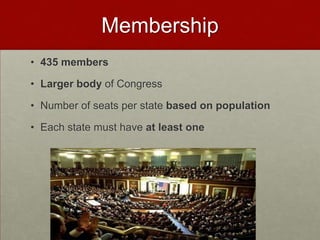
• 435 members

• Larger body of Congress

• Number of seats per state based on population

• Each state must have at least one
Qualifications
• To be elected to the House
  of Representatives, you
  must be:
  • At least 25 years old
  • A citizen of the U.S. for at
    least 7 years
  • A legal resident of the
    state you are representing

It is a tradition to live in the
   district you represent,
   although it is technically not
   required
• Your rep is Cliff Stearns-
  District 6
Term of office

• 2 year terms
• Elections in November of even-numbered
  years
• Term begins on Jan. 3rd
• Every 2 years, all 435 members must run
  for re-election
• Over 90% of all representatives are re-
  elected each year
Representation and
 reapportionment
     • Census (population count) every
       ten years
      • First census was taken in 1790
      • Most recent was 2010
      • Next will be 2020

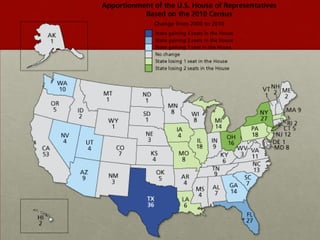
     • Reapportionment- pop. of each
       state (based on census)
       determines new number of
       representatives
      • Some states lose reps
      • Some states gain reps
      • Total number always remain 435-
Congressional redistricting

• After number of representatives is decided, states
  must draw up districts

• One district per representative

• Redistricting-setting up new district lines after
  reapportionment has been completed

• Problems
  • Unequal population between districts
  • Gerrymandering
Gerrymandering
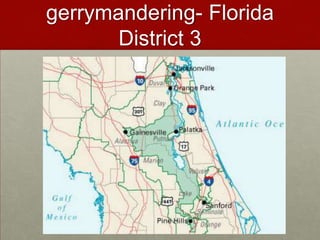
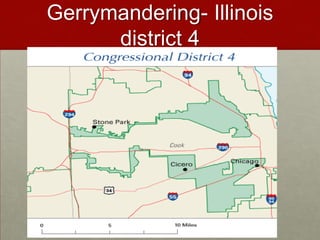
• District boundaries drawn in an
  irregular way, where one
  particular political party gains
  advantage
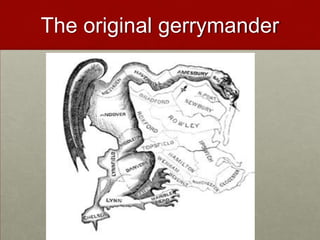
• Named after Elbridge Gerry-
  drew a salamander shaped
  district in Massachusetts to help
  his party gain advantage-a
  cartoonists added a head,
  wings, and claws to the district
  map and called it
  gerrymandering
• Gerry + Salamander =
  Gerrymander!
The original gerrymander
gerrymandering- Florida
       District 3
Gerrymandering- Illinois
      district 4
gerrymandering
• 2 types- “Packing” and “Cracking”
  • Packing
     • Crowding the other party’s voters into one
       district ensures that your party of choice will win
       all the other districts
  • Cracking
     • Dividing the other party’s voters into small
       groups within each district weakens their voter
       base


• Supreme Court has ruled that districts must be
  compact and physically adjoining, but
  gerrymandering still exists today.

Houseofreps

  • 1.
  • 2.
    Membership • 435 members •Larger body of Congress • Number of seats per state based on population • Each state must have at least one
  • 3.
    Qualifications • To beelected to the House of Representatives, you must be: • At least 25 years old • A citizen of the U.S. for at least 7 years • A legal resident of the state you are representing It is a tradition to live in the district you represent, although it is technically not required • Your rep is Cliff Stearns- District 6
  • 4.
    Term of office •2 year terms • Elections in November of even-numbered years • Term begins on Jan. 3rd • Every 2 years, all 435 members must run for re-election • Over 90% of all representatives are re- elected each year
  • 5.
    Representation and reapportionment • Census (population count) every ten years • First census was taken in 1790 • Most recent was 2010 • Next will be 2020 • Reapportionment- pop. of each state (based on census) determines new number of representatives • Some states lose reps • Some states gain reps • Total number always remain 435-
  • 7.
    Congressional redistricting • Afternumber of representatives is decided, states must draw up districts • One district per representative • Redistricting-setting up new district lines after reapportionment has been completed • Problems • Unequal population between districts • Gerrymandering
  • 8.
    Gerrymandering • District boundariesdrawn in an irregular way, where one particular political party gains advantage • Named after Elbridge Gerry- drew a salamander shaped district in Massachusetts to help his party gain advantage-a cartoonists added a head, wings, and claws to the district map and called it gerrymandering • Gerry + Salamander = Gerrymander!
  • 9.
  • 10.
  • 11.
  • 12.
    gerrymandering • 2 types-“Packing” and “Cracking” • Packing • Crowding the other party’s voters into one district ensures that your party of choice will win all the other districts • Cracking • Dividing the other party’s voters into small groups within each district weakens their voter base • Supreme Court has ruled that districts must be compact and physically adjoining, but gerrymandering still exists today.