Unit 3: The Legislative Branch
National Legislature How does the Constitution provide power for a bicameral Congress? How long is a term of Congress? How have Congressional sessions changed over time? What is the size and elective terms of members of the House? How are seats reapportioned among the States after each census? What is a typical congressional election and district? What are the qualifications for a member of the house? What is the size of the Senate? How do States elect senators? Why is a senator’s term different from a representatives? What are the qualifications to be a U.S. senator? What are the personal and political backgrounds of current members? What are the duties of a member? What privileges do members receive?
Bicameral Congress Historical- British Parliament had consisted of two houses since 1300s. Americans knew this system well and adopted it. Practical- Framers created two chambered body to settle conflict between VA and NJ Plans. Theoretical- One house might act as a check on the other.
Terms Term  - 2 or 6 year term. 20th Amendment as “noon of the 3d day of January” of every odd-numbered year. Session  - regular period of time during which Congress conducts business.
Sessions of Congress Congress meets yearly. It adjourns until each regular session, unless an emergency happens.  Session usually lasts most of the year. Pres. has power to prorogue a session, or suspend it. Special Sessions- meet to deal with emergencies. Only 26 have ever been held. Can only be called by the President.
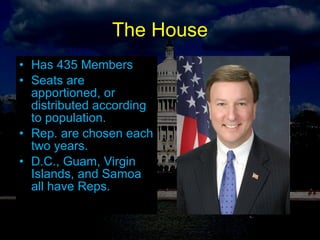
The House Has 435 Members Seats are apportioned, or distributed according to population. Rep. are chosen each two years. D.C., Guam, Virgin Islands, and Samoa all have Reps.
Qualifications for Members Must be at least 25 years of age. Must have been a citizen of the U.S. for at least seven years. Must be an inhabitant of the State from which he or she is elected.
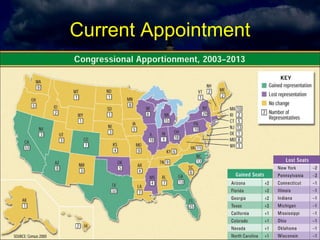
Reapportionment Seats are redistributed after every ten year census. Reapportionment act of 1929 set the final number at 435 members. Although there have been recent movements to limit terms, there are no limits set on the number of terms a representative may serve.
Current Appointment
Congressional Elections Held on the first Tuesday in November of each even numbered year. When elections are held between presidential elections, they are known as off-year, or mid-term elections. The trend is that the party in power loses seats during mid-term elections.
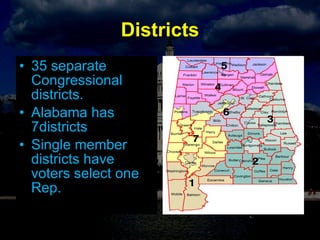
Districts 35 separate Congressional districts. Alabama has 7districts Single member districts have voters select one Rep.
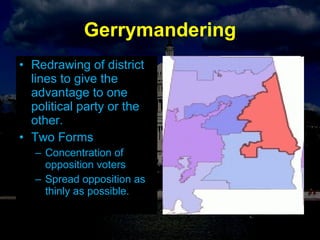
Gerrymandering Redrawing of district lines to give the advantage to one political party or the other. Two Forms Concentration of opposition voters Spread opposition as thinly as possible.
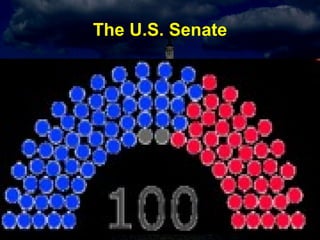
The U.S. Senate
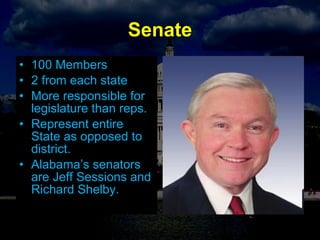
Senate 100 Members  2 from each state More responsible for legislature than reps. Represent entire State as opposed to district. Alabama’s senators are Jeff Sessions and Richard Shelby.
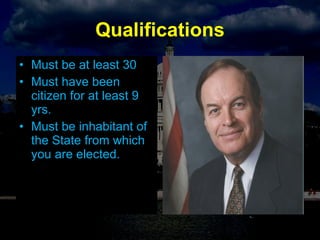
Qualifications Must be at least 30  Must have been citizen for at least 9 yrs. Must be inhabitant of the State from which you are elected.
Election and Terms Senators were originally selected by state legislatures. 17 th  Amendment changed it so the public could vote them in office. Elections are held every two years for senators, although their terms last six years. Only a third of them expire every two years. Term was designed to keep senators from become subject to public opinion and pressure.
The Job Play 5 major roles  Legislators  Representatives of their constituents Committee members Public servants Politicians
Representatives of the People Trustees Believe that each question they face must be decided on merit. Delegates Serve as agents of the people who elected them. Partisans Lawmakers who show 1 st  allegiance to the party. Politicos Combine elements of the other roles.
Salary Today, senators and reps. are paid $174,000 Speaker of the House makes $223,000 Party leaders make $193,400. Receive generous retirement packages. Longtime members can retire making $150k/yr. in benefits. Members have franking privileges where they don’t have to pay for postage. Free printing costs. Receive special tax incentives and heath care. Congress sets own salary.
Privileges the Speech and Debate Clause (Article I, Section 6, Clause 1) protects representatives & senators from suits for libel or slander arising from their official conduct. Members are immune from arrest for noncriminal offenses / engaged in congressional business.
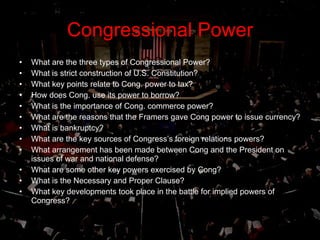
Congressional Power What are the three types of Congressional Power? What is strict construction of U.S. Constitution?  What key points relate to Cong. power to tax? How does Cong. use its power to borrow? What is the importance of Cong. commerce power? What are the reasons that the Framers gave Cong power to issue currency? What is bankruptcy? What are the key sources of Congress’s foreign relations powers? What arrangement has been made between Cong and the President on issues of war and national defense? What are some other key powers exercised by Cong? What is the Necessary and Proper Clause? What key developments took place in the battle for implied powers of Congress?
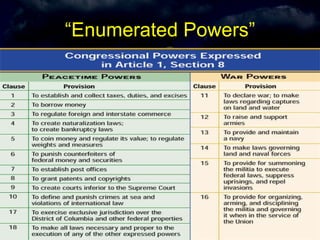
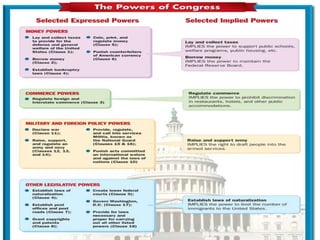
“ Enumerated Powers”
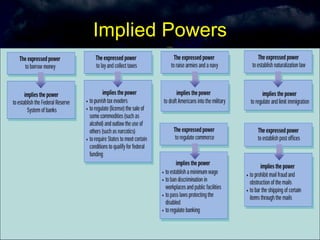
Implied Powers
 
Strict versus Liberal Construction Strict construction were led by Jefferson. Argued an Anti-Federalist position. Insisted that Cong. have expressed powers implied powers only necessary to carry out expressed powers. Liberal construction was led by Hamilton. Favored liberal interpretation of Const. This allows for Cong. powers and nat’l govt. to grow and expand.
Power to Tax The Power The Constitution give Congress the power: “ To lay and collect Taxes, Duties, Imposts and Excises, to pay the Debts and provide for the common Defense and general Welfare of the United States.…” — Article I, Section 8, Clause 1 Limitations may only tax for public purposes. May not tax exports. Direct taxes must be apportioned among the states. Taxes must be fair and equal around the country.
Commerce Power and Limits Cong has power to regulate interstate and foreign trade. Gibbons v. Ogden- clash over regulation of steamboats in N.Y. There are 4 major limits to the Commerce Power. Cannot tax exports Cannot favor the ports of one State over any other in regulation of trade Cannot require that “Vessels be bound to, or from, one State, be obliged to enter, clear or pay duties in another.  Could not interfere with the slave trade, at least not until 1808
Foreign Relations and War Cong shares this power with the President. 2 sources on Foreign Relations Various expressed powers (commerce, War) U.S. is sovereign state Only Cong has power to declare war. Has power to raise and support military forces and make rules on governing of land. War Powers Resolution of 1973 allows Cong to restrict use of combat forces in an area where war is not present.
Other Expressed Powers Naturalization Naturalization  is the process by which citizens of one country become citizens of another.  The Postal Power Article I, Section 8, Clause 7 says that Congress has the power “[t]o establish Post Offices and post Roads.” Copyrights & Patents A  copyright  is the exclusive right of an author to reproduce, publish, and sell his or her creative work. A  patent  grants a person the sole right to manufacture, use, or sell “any new and useful art, machine, manufacture, or composition of matter.”
Weights and Measures Congress has the power to “fix the Standard of Weights and Measures” throughout the United States.  Judicial Powers create all of the federal courts below the Supreme Court & structure the federal judiciary. define federal crimes & set punishment for violators of federal law. Power Over Territories and Other Areas Congress has the power to acquire, manage, & dispose of various federal areas.  One way of acquiring property is through  eminent domain,  the inherent power to take private property for public use.
Impeachment the power of removing the Pres., V.P., or other civil officers from their office through impeachment. House has the sole power to  impeach , or bring charges against the individual. There is then a trial in the Senate. 2/3 vote of the senators present is needed for conviction. penalty for conviction is removal from office. Only two presidents have been impeached (Andrew Johnson and Bill Clinton)
Executive Powers Treaties President makes treaties “by & with the Advice & Consent of the Senate,... provided 2/3 of the Senators present concur.” Presently, the President often consults members of the Senate Foreign Relations Committee.   Appointments All major appointments made by the President must be confirmed by the Senate by majority vote. Only 12 of 600 Cabinet appointments to date have been declined. “ Senatorial courtesy” is the practice in which the Senate will turn down an appointment if it is opposed by a senator of the President’s party from the State involved.
Congress In Action! How and when does Congress convene? What roles do the presiding officers in the Senate and House possess? What are the duties of party officers? How are committee chairmen chosen and what are their roles in the legislative process? How do standing committees function? What are the duties and responsibilities of the House Rules Committee? What are the functions of the joint and conference committees? What are the first steps in the introduction of a bill to the House? What happens to a bill once it is referred to a committee? How do House leaders schedule a debate on a bill? What happens to a bill on the House floor? What is the final step in the passage of a bill in the House? How is a bill introduced in the Senate? What are the Senate’s rules for debate on a bill? What is the role of conference committees in the legislative process? What actions can the President take after both houses have passed a bill?
Congress Convenes Convenes every two years on the 3 rd  of Jan. on odd numbered years. The House has formal organizational meetings at the beginning of each term. The Senate, because it is a continuous body, has fewer organizational issues to address at the start of each term. When Congress is organized, the President presents a State of the Union message to a joint session of Congress. This message, in which the President reports on the state of the nation as he sees it, is given annually.
Presiding Officers Speaker of House The  Speaker of the House  is the presiding officer of the House of Representatives and the acknowledged leader of the majority party. The Speaker’s main duties revolve around presiding over and keeping order in the House. The Speaker names the members of all select and conference committees, and signs all bills and resolutions passed by the House. President of the Senate The job of  president of the Senate  is assigned by the Constitution to the Vice President. The president of the Senate has many of the same duties as the Speaker of the House, but cannot cast votes on legislation. The  president  pro tempore ,   the leader of the majority party, is elected from the Senate and serves in the Vice President’s absence.
Party Officers Party Caucus Closed meeting of the members of each party of the house. Deals mostly with matters of party organization. Floor Leaders Most important officers in Congress Legislative strategists. Picked by peers. Whips Assist floor leaders Liaison between leadership and rank and file members.
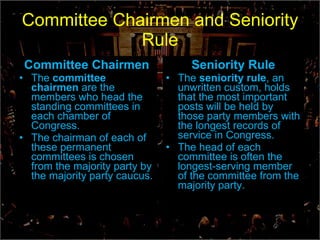
Committee Chairmen and Seniority Rule Committee Chairmen The  committee chairmen  are the members who head the standing committees in each chamber of Congress. The chairman of each of these permanent committees is chosen from the majority party by the majority party caucus. Seniority Rule The  seniority rule , an unwritten custom, holds that the most important posts will be held by those party members with the longest records of service in Congress. The head of each committee is often the longest-serving member of the committee from the majority party.
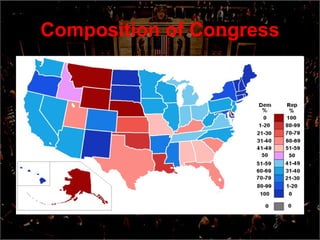
Composition of Congress
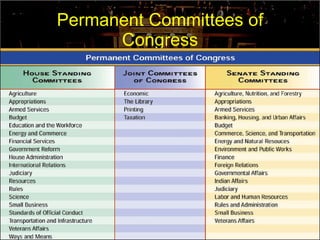
Permanent Committees of Congress
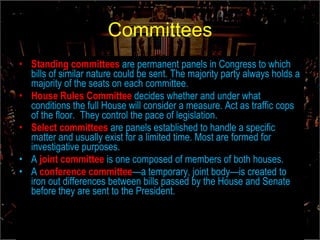
Committees Standing committees   are permanent panels in Congress to which bills of similar nature could be sent. The majority party always holds a majority of the seats on each committee. House Rules Committee  decides whether and under what conditions the full House will consider a measure. Act as traffic cops of the floor.  They control the pace of legislation. Select committees  are panels established to handle a specific matter and usually exist for a limited time. Most are formed for investigative purposes. A  joint committee   is one composed of members of both houses. A  conference committee —a temporary, joint body—is created to iron out differences between bills passed by the House and Senate before they are sent to the President.
Cm 12.4
 
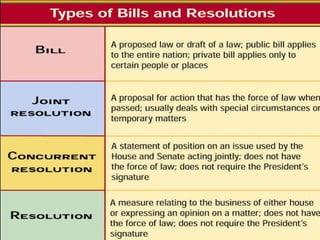
The First Steps A  bill  is a proposed law presented to the House or Senate for consideration. Most bills are born in the executive branch. Two types of bills Public bills are measures applying to the nation as a whole. (tax issue or health care) Private bills apply to certain persons or places (funding state parks or allocating money to organization) Sometimes a  rider  dealing with an unrelated matter is included.
The Bill in Committee Discharge Petitions Most bills die in committee, pigeonholed, or put away, never to be acted upon. If a committee pigeonholes a bill that a majority of the House wishes to consider, it can be brought out of committee via a  discharge petition . Gathering Information committees do their work through several  subcommittees — divisions of existing committees formed to address specific issues. Committees and subcommittees often hold public hearings or make a junket (trip) to gather information relating to a measure.
Committees in Action Report the bill favorably (do pass) Refuse to report the bill (pigeonhole it) Report the bill in amended form  Report with unfavorable recommendation Report a committee bill (entirely new bill that committee has substituted for the original)
The Bill on the Floor The  Committee of the Whole  includes all members of the House, however, they sit as one large committee and not as the House itself. Debate Severe limits are placed on floor debate due to the House’s large size.  Majority /minority floor leaders generally decide in advance how they will split the time to be spent on a bill.   Floor debate is unrestrained in the Senate. Senators may speak on a bill as long as they wish. This freedom is intended to encourage the fullest possible discussion on a piece of legislature.
The Vote Four Methods for voting on legislation Voice votes (ayes, nos) Standing vote happens when member thinks the Speaker has erred in judging voice vote. 1/5 of a quorum can demand a teller vote or an electronic vote. Roll call vote is also known as a record vote. Once a bill has been approved at the second reading, it is engrossed and printed in its final form.  Then it is read a third time.  If it is approved, the Speaker signs it.
Filibusters and Clotures Filibuster A  filibuster  is an attempt to “talk a bill to death.” A senator may exercise his or her right of holding the floor as long as necessary, and in essence talk until a measure is dropped. The Cloture Rule Rule XXII in the Standing Rules of the Senate deals with  cloture ,   or limiting debate If at least 60 senators vote for cloture, no more than another 30 hours may be spent on debate, forcing a vote on a bill.
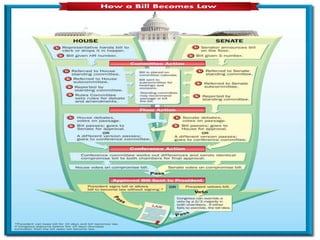
Conference Committees and Presidential Action Any measure enacted by Congress  must  have been passed by both houses in identical form. If one of the houses will not accept the other’s version of a bill, a conference committee is formed to iron out the differences. Once a conference committee completes work on a bill, it is returned to both houses for final approval. It must be accepted or rejected without amendment. The President has the final act on passed legislature Sign the bill into law Veto, or refuse to sign it, sending it back to the house in which it originated. (Can be overturned by 2/3 vote) May allow it to become law without signing it by not acting on it within 10 days of Cong. approval. Pocket Veto. If Cong. adjourns it session within 10 days of submitting a bill and  the  President does not act, the bill dies.

The legislative branch

  • 1.
    Unit 3: TheLegislative Branch
  • 2.
    National Legislature Howdoes the Constitution provide power for a bicameral Congress? How long is a term of Congress? How have Congressional sessions changed over time? What is the size and elective terms of members of the House? How are seats reapportioned among the States after each census? What is a typical congressional election and district? What are the qualifications for a member of the house? What is the size of the Senate? How do States elect senators? Why is a senator’s term different from a representatives? What are the qualifications to be a U.S. senator? What are the personal and political backgrounds of current members? What are the duties of a member? What privileges do members receive?
  • 3.
    Bicameral Congress Historical-British Parliament had consisted of two houses since 1300s. Americans knew this system well and adopted it. Practical- Framers created two chambered body to settle conflict between VA and NJ Plans. Theoretical- One house might act as a check on the other.
  • 4.
    Terms Term - 2 or 6 year term. 20th Amendment as “noon of the 3d day of January” of every odd-numbered year. Session - regular period of time during which Congress conducts business.
  • 5.
    Sessions of CongressCongress meets yearly. It adjourns until each regular session, unless an emergency happens. Session usually lasts most of the year. Pres. has power to prorogue a session, or suspend it. Special Sessions- meet to deal with emergencies. Only 26 have ever been held. Can only be called by the President.
  • 6.
    The House Has435 Members Seats are apportioned, or distributed according to population. Rep. are chosen each two years. D.C., Guam, Virgin Islands, and Samoa all have Reps.
  • 7.
    Qualifications for MembersMust be at least 25 years of age. Must have been a citizen of the U.S. for at least seven years. Must be an inhabitant of the State from which he or she is elected.
  • 8.
    Reapportionment Seats areredistributed after every ten year census. Reapportionment act of 1929 set the final number at 435 members. Although there have been recent movements to limit terms, there are no limits set on the number of terms a representative may serve.
  • 9.
  • 10.
    Congressional Elections Heldon the first Tuesday in November of each even numbered year. When elections are held between presidential elections, they are known as off-year, or mid-term elections. The trend is that the party in power loses seats during mid-term elections.
  • 11.
    Districts 35 separateCongressional districts. Alabama has 7districts Single member districts have voters select one Rep.
  • 12.
    Gerrymandering Redrawing ofdistrict lines to give the advantage to one political party or the other. Two Forms Concentration of opposition voters Spread opposition as thinly as possible.
  • 13.
  • 14.
    Senate 100 Members 2 from each state More responsible for legislature than reps. Represent entire State as opposed to district. Alabama’s senators are Jeff Sessions and Richard Shelby.
  • 15.
    Qualifications Must beat least 30 Must have been citizen for at least 9 yrs. Must be inhabitant of the State from which you are elected.
  • 16.
    Election and TermsSenators were originally selected by state legislatures. 17 th Amendment changed it so the public could vote them in office. Elections are held every two years for senators, although their terms last six years. Only a third of them expire every two years. Term was designed to keep senators from become subject to public opinion and pressure.
  • 17.
    The Job Play5 major roles Legislators Representatives of their constituents Committee members Public servants Politicians
  • 18.
    Representatives of thePeople Trustees Believe that each question they face must be decided on merit. Delegates Serve as agents of the people who elected them. Partisans Lawmakers who show 1 st allegiance to the party. Politicos Combine elements of the other roles.
  • 19.
    Salary Today, senatorsand reps. are paid $174,000 Speaker of the House makes $223,000 Party leaders make $193,400. Receive generous retirement packages. Longtime members can retire making $150k/yr. in benefits. Members have franking privileges where they don’t have to pay for postage. Free printing costs. Receive special tax incentives and heath care. Congress sets own salary.
  • 20.
    Privileges the Speechand Debate Clause (Article I, Section 6, Clause 1) protects representatives & senators from suits for libel or slander arising from their official conduct. Members are immune from arrest for noncriminal offenses / engaged in congressional business.
  • 21.
    Congressional Power Whatare the three types of Congressional Power? What is strict construction of U.S. Constitution? What key points relate to Cong. power to tax? How does Cong. use its power to borrow? What is the importance of Cong. commerce power? What are the reasons that the Framers gave Cong power to issue currency? What is bankruptcy? What are the key sources of Congress’s foreign relations powers? What arrangement has been made between Cong and the President on issues of war and national defense? What are some other key powers exercised by Cong? What is the Necessary and Proper Clause? What key developments took place in the battle for implied powers of Congress?
  • 22.
  • 23.
  • 24.
  • 25.
    Strict versus LiberalConstruction Strict construction were led by Jefferson. Argued an Anti-Federalist position. Insisted that Cong. have expressed powers implied powers only necessary to carry out expressed powers. Liberal construction was led by Hamilton. Favored liberal interpretation of Const. This allows for Cong. powers and nat’l govt. to grow and expand.
  • 26.
    Power to TaxThe Power The Constitution give Congress the power: “ To lay and collect Taxes, Duties, Imposts and Excises, to pay the Debts and provide for the common Defense and general Welfare of the United States.…” — Article I, Section 8, Clause 1 Limitations may only tax for public purposes. May not tax exports. Direct taxes must be apportioned among the states. Taxes must be fair and equal around the country.
  • 27.
    Commerce Power andLimits Cong has power to regulate interstate and foreign trade. Gibbons v. Ogden- clash over regulation of steamboats in N.Y. There are 4 major limits to the Commerce Power. Cannot tax exports Cannot favor the ports of one State over any other in regulation of trade Cannot require that “Vessels be bound to, or from, one State, be obliged to enter, clear or pay duties in another. Could not interfere with the slave trade, at least not until 1808
  • 28.
    Foreign Relations andWar Cong shares this power with the President. 2 sources on Foreign Relations Various expressed powers (commerce, War) U.S. is sovereign state Only Cong has power to declare war. Has power to raise and support military forces and make rules on governing of land. War Powers Resolution of 1973 allows Cong to restrict use of combat forces in an area where war is not present.
  • 29.
    Other Expressed PowersNaturalization Naturalization is the process by which citizens of one country become citizens of another. The Postal Power Article I, Section 8, Clause 7 says that Congress has the power “[t]o establish Post Offices and post Roads.” Copyrights & Patents A copyright is the exclusive right of an author to reproduce, publish, and sell his or her creative work. A patent grants a person the sole right to manufacture, use, or sell “any new and useful art, machine, manufacture, or composition of matter.”
  • 30.
    Weights and MeasuresCongress has the power to “fix the Standard of Weights and Measures” throughout the United States. Judicial Powers create all of the federal courts below the Supreme Court & structure the federal judiciary. define federal crimes & set punishment for violators of federal law. Power Over Territories and Other Areas Congress has the power to acquire, manage, & dispose of various federal areas. One way of acquiring property is through eminent domain, the inherent power to take private property for public use.
  • 31.
    Impeachment the powerof removing the Pres., V.P., or other civil officers from their office through impeachment. House has the sole power to impeach , or bring charges against the individual. There is then a trial in the Senate. 2/3 vote of the senators present is needed for conviction. penalty for conviction is removal from office. Only two presidents have been impeached (Andrew Johnson and Bill Clinton)
  • 32.
    Executive Powers TreatiesPresident makes treaties “by & with the Advice & Consent of the Senate,... provided 2/3 of the Senators present concur.” Presently, the President often consults members of the Senate Foreign Relations Committee. Appointments All major appointments made by the President must be confirmed by the Senate by majority vote. Only 12 of 600 Cabinet appointments to date have been declined. “ Senatorial courtesy” is the practice in which the Senate will turn down an appointment if it is opposed by a senator of the President’s party from the State involved.
  • 33.
    Congress In Action!How and when does Congress convene? What roles do the presiding officers in the Senate and House possess? What are the duties of party officers? How are committee chairmen chosen and what are their roles in the legislative process? How do standing committees function? What are the duties and responsibilities of the House Rules Committee? What are the functions of the joint and conference committees? What are the first steps in the introduction of a bill to the House? What happens to a bill once it is referred to a committee? How do House leaders schedule a debate on a bill? What happens to a bill on the House floor? What is the final step in the passage of a bill in the House? How is a bill introduced in the Senate? What are the Senate’s rules for debate on a bill? What is the role of conference committees in the legislative process? What actions can the President take after both houses have passed a bill?
  • 34.
    Congress Convenes Convenesevery two years on the 3 rd of Jan. on odd numbered years. The House has formal organizational meetings at the beginning of each term. The Senate, because it is a continuous body, has fewer organizational issues to address at the start of each term. When Congress is organized, the President presents a State of the Union message to a joint session of Congress. This message, in which the President reports on the state of the nation as he sees it, is given annually.
  • 35.
    Presiding Officers Speakerof House The Speaker of the House is the presiding officer of the House of Representatives and the acknowledged leader of the majority party. The Speaker’s main duties revolve around presiding over and keeping order in the House. The Speaker names the members of all select and conference committees, and signs all bills and resolutions passed by the House. President of the Senate The job of president of the Senate is assigned by the Constitution to the Vice President. The president of the Senate has many of the same duties as the Speaker of the House, but cannot cast votes on legislation. The president pro tempore , the leader of the majority party, is elected from the Senate and serves in the Vice President’s absence.
  • 36.
    Party Officers PartyCaucus Closed meeting of the members of each party of the house. Deals mostly with matters of party organization. Floor Leaders Most important officers in Congress Legislative strategists. Picked by peers. Whips Assist floor leaders Liaison between leadership and rank and file members.
  • 37.
    Committee Chairmen andSeniority Rule Committee Chairmen The committee chairmen are the members who head the standing committees in each chamber of Congress. The chairman of each of these permanent committees is chosen from the majority party by the majority party caucus. Seniority Rule The seniority rule , an unwritten custom, holds that the most important posts will be held by those party members with the longest records of service in Congress. The head of each committee is often the longest-serving member of the committee from the majority party.
  • 38.
  • 39.
  • 40.
    Committees Standing committees are permanent panels in Congress to which bills of similar nature could be sent. The majority party always holds a majority of the seats on each committee. House Rules Committee decides whether and under what conditions the full House will consider a measure. Act as traffic cops of the floor. They control the pace of legislation. Select committees are panels established to handle a specific matter and usually exist for a limited time. Most are formed for investigative purposes. A joint committee is one composed of members of both houses. A conference committee —a temporary, joint body—is created to iron out differences between bills passed by the House and Senate before they are sent to the President.
  • 41.
  • 42.
  • 43.
    The First StepsA bill is a proposed law presented to the House or Senate for consideration. Most bills are born in the executive branch. Two types of bills Public bills are measures applying to the nation as a whole. (tax issue or health care) Private bills apply to certain persons or places (funding state parks or allocating money to organization) Sometimes a rider dealing with an unrelated matter is included.
  • 44.
    The Bill inCommittee Discharge Petitions Most bills die in committee, pigeonholed, or put away, never to be acted upon. If a committee pigeonholes a bill that a majority of the House wishes to consider, it can be brought out of committee via a discharge petition . Gathering Information committees do their work through several subcommittees — divisions of existing committees formed to address specific issues. Committees and subcommittees often hold public hearings or make a junket (trip) to gather information relating to a measure.
  • 45.
    Committees in ActionReport the bill favorably (do pass) Refuse to report the bill (pigeonhole it) Report the bill in amended form Report with unfavorable recommendation Report a committee bill (entirely new bill that committee has substituted for the original)
  • 46.
    The Bill onthe Floor The Committee of the Whole includes all members of the House, however, they sit as one large committee and not as the House itself. Debate Severe limits are placed on floor debate due to the House’s large size. Majority /minority floor leaders generally decide in advance how they will split the time to be spent on a bill. Floor debate is unrestrained in the Senate. Senators may speak on a bill as long as they wish. This freedom is intended to encourage the fullest possible discussion on a piece of legislature.
  • 47.
    The Vote FourMethods for voting on legislation Voice votes (ayes, nos) Standing vote happens when member thinks the Speaker has erred in judging voice vote. 1/5 of a quorum can demand a teller vote or an electronic vote. Roll call vote is also known as a record vote. Once a bill has been approved at the second reading, it is engrossed and printed in its final form. Then it is read a third time. If it is approved, the Speaker signs it.
  • 48.
    Filibusters and CloturesFilibuster A filibuster is an attempt to “talk a bill to death.” A senator may exercise his or her right of holding the floor as long as necessary, and in essence talk until a measure is dropped. The Cloture Rule Rule XXII in the Standing Rules of the Senate deals with cloture , or limiting debate If at least 60 senators vote for cloture, no more than another 30 hours may be spent on debate, forcing a vote on a bill.
  • 49.
    Conference Committees andPresidential Action Any measure enacted by Congress must have been passed by both houses in identical form. If one of the houses will not accept the other’s version of a bill, a conference committee is formed to iron out the differences. Once a conference committee completes work on a bill, it is returned to both houses for final approval. It must be accepted or rejected without amendment. The President has the final act on passed legislature Sign the bill into law Veto, or refuse to sign it, sending it back to the house in which it originated. (Can be overturned by 2/3 vote) May allow it to become law without signing it by not acting on it within 10 days of Cong. approval. Pocket Veto. If Cong. adjourns it session within 10 days of submitting a bill and the President does not act, the bill dies.