Finance and Fiscal Policy
GOVT 2306
Chapter 11
Fiscal Policy
 Legislators attempted to balance what Texans expect of their
government with what they are willing to pay.
 Taxing, public spending, and governmental policy priorities will have
significant impacts on 21st century Texans.
 During the 81st legislative session in 2009, Texas’s traditional, low-tax
approach to fiscal policy (public policy that concerns taxes, government
spending, public debt, and management of government money) faced
key challenges.
 Yet, even with declining revenue and increased demands for government
services, Texans remained committed to pay-as-you-go government spending.
 The Lone Star State’s fiscal policy has not deviated from its 19th century
origins.
 Today, the notion of a balanced budget, achieved by low tax rates and
low-to-moderate government spending levels, continues to dominate
state fiscal policy.
Fiscal Policy
 Taxing Policy
 Texans have traditionally opposed mandatory assessments for
public purposes, or taxes.
 Residents have pressured their state government to maintain low
taxes.
 When additional revenues have been needed, Texans have
indicated in poll after poll their preference for regressive taxes
that favor the rich and fall most heavily on the poor.
Fig. 11-1, p. 440
Fiscal Policy
 Budget Policy
 Hostility to public debt is demonstrated in constitutional and
statutory provisions designed to force the state to operate on a
pay-as-you-go balanced budget.
 The Texas Constitution prohibits the state government from
borrowing money “except to supply casual deficiencies of
revenue, repel invasion, suppress insurrection, and to defend the
state in war.”
 Nevertheless, casual deficits (unplanned shortages) occur
periodically.
 These deficits usually arise in the General Revenue Fund (the fund
available to the legislature for general appropriations).
Fiscal Policy
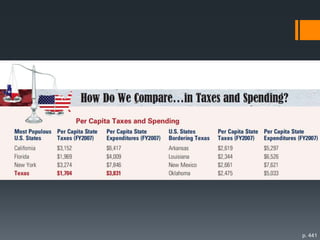
 Spending Policy
 Historically, Texans have shown little enthusiasm for state
spending.
 Consequently, public expenditures have remained low relative to those
of other state governments.
 Texas has consistently ranked 49th or 50th in state spending per
capita.
 Further, the state’s voters have indicated their willingness to
spend for highways, roads, and other public improvements; but
they have demonstrated much less support for welfare programs,
recreational facilities, and similar social services.
p. 441
Revenue Sources
 Funding for government services primarily comes from those
who pay taxes.
 In addition, the state derives revenue from fees for licenses,
sales of assets, investment income, gambling, borrowing,
and federal grants.
Revenue Sources
 The Politics of Taxation
 According to generally accepted standards, each tax levied and
the total tax structure should be just and equitable.
 Of course, notions vary widely about what kinds of taxes and
what types of structures meet these standards.
 Sales Taxes
 By far the most important single source of tax revenue in Texas is sales
taxation. (6.25%)
 Altogether, sales taxes accounted for more than 52 percent of state tax
revenue and 26 percent of all revenue in fiscal years 2008–2009.
 For almost 50 years, the state has levied and collected two kinds of
sales taxes: a general sales tax and several selective sales taxes.
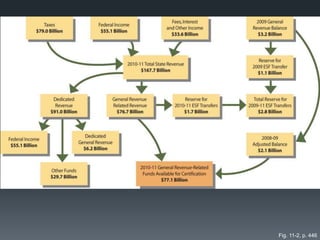
Fig. 11-2, p. 446
Revenue Sources
 The Politics of Taxation
 Sales Taxes
 General Sales Tax
 First imposed in 1961 and has become the foundation of the Texas tax system
 6.25% (current base) is the 12th highest rate among the 45 states that impose a
general sales tax
 Highest – California (7.25% base)
 Lowest – Hawaii (4.7% base)
 Local governments in Texas have the option of levying additional sales taxes
for a total of 8.25% (state and local combined)
Revenue Sources
 The Politics of Taxation
 Sales Taxes
 General Sales Tax
 The base of the tax is the sale price of “all tangible personal property” and “the
storage, use, or other consumption of tangible personal property purchased,
leased, or rented”
 Exemptions: receipts from water, telephone, and telegraph services
 sales of goods otherwise taxed (autos and fuel)
 food and food products (excluding restaurant meals)
 medical supplies sold by prescription and nonprescription drugs
 Animals and supplies used in agricultural production
 Sales by university and college clubs/organizations (as long as they do
not have more than 1 fundraiser p/month)
Revenue Sources
 The Politics of Taxation
 Sales Taxes
 General Sales Tax
 Exemptions: Internet sales
 As businesses collecting tax across state lines interferes with interstate
commerce (ICC of 1877 per the Supreme Court), 23 states are working
toward the Streamlined Sales Tax Project
 This project would simplify collection and administration procedures of
sales tax for sellers that conduct business via the Internet
 Exemption: Professional and Business Services
 As professional services groups represent some of the most powerful
and well-organized interests in the state, proposals requiring a sales tax
for these groups have traditionally face strong resistance
Revenue Sources
 The Politics of Taxation
 Sales Taxes
 Selective Sales Tax
 Quantity-based consumption taxes on specific products
 Sin Tax
 Select sales tax on items such as cigarettes, other forms of tobacco, and
alcoholic beverages, and admissions fees to “gentlemen’s clubs”
 Cigarettes were the first to be taxed in 1931
 Highway User Taxes
 Include taxes on fuels for motor vehicles that use public roads and
registration fees for the privilege of operating a vehicle in Texas (MVR)
 Miscellaneous Sales Taxes
 Hotel and motel room rentals and retail sales of boats and boat motors
Revenue Sources
 The Politics of Taxation
 Business Taxes
 As with sales taxes, Texas imposes both general and selective
business taxes.
 A general business tax is assessed against a wide range of business
operations.
 Selective business taxes are those levied on businesses engaged in
specific or selected types of commercial activities.
 Oil and gas production
 Insurance company gross premiums
 Public utilities gross receipts
 Additional business taxes include franchise, payroll, and severance.
Revenue Sources
 The Politics of Taxation
 Business Taxes
 Historical General Business Taxes
 Sales Tax (as businesses are consumers)
 Franchise Taxes
 Levied on annual receipts of businesses organized to limit the personal
liability of owners (i.e. corporations, LLCs, and similar structures)
 Sole proprietorships, general partnerships, passive investment entities, and
businesses that make $600,000 or less or owe less than $1,000 in franchise
taxes are exempt
 Unemployment compensation payroll taxes
 As most businesses are employers
Revenue Sources
 The Politics of Taxation
 Death Tax
 Because of changes to federal law, no death tax is due on the estates of
individuals dying on or after January 1, 2005.
 However, they will possibly return in 2013 as a result of provisions of the Taxpayer Relief Act
of 2010 sun setting on 12 Dec. 2012
 Tax Burden
 The U.S. Census Bureau places Texas well below the national average for the tax
burden imposed on its residents.
 When state taxes alone are considered, the Lone Star State ranked 47th among
the 50 states.
 Tax Collection
 As Texas’s chief tax collector, the comptroller of public accounts collects more
than 90 percent of state taxes, including those on motor fuel sales, oil and gas
production, cigarette and tobacco sales, and franchises.
 Gas/Diesel – 20 cents p/gallon
 Cigarettes - $1.41 p/20 pack // $1.7625 p/25 pack
 Beer - $0.20 p/gallon // Wine - $0.204 p/gallon // Liquor - $2.40 p/gallon
Revenue Sources
 Revenues from Gambling
 Racing
 Pari-mutuel wagers on horse races and dog races are taxed.
 This levy has never brought Texas significant revenue.
 Lottery
 Texas operates one of forty-one state-run lotteries.
 Major competitors for lottery players’ money are the multistate lotteries,
Mega Millions and Powerball.
 Texas is one of twelve states participating in Mega Millions.
 The Texas Lottery Commission administers the state’s lottery.
 Over 14 years, roughly $14 billion has been contributed to the Texas
Foundation School Fund
 Bingo
 State law allows bingo games to benefit charities (for example, churches,
veterans’ organizations, and service clubs).
Check my SlideShare page
(rfair07) for more lectures
Lectures posted for:
 United States History before 1877 / after 1877
 Texas History
 United States (Federal) Government / Texas Government
 Slide 19 of 38
 To download a copy of this PowerPoint presentation, please
go to: https://gumroad.com/l/NUBma 
 If you would like a copy of all the Texas Government lectures
posted in PDF format, please check out
at:https://gumroad.com/l/GXhg 

Govt 2306 ch_11

  • 1.
    Finance and FiscalPolicy GOVT 2306 Chapter 11
  • 2.
    Fiscal Policy  Legislatorsattempted to balance what Texans expect of their government with what they are willing to pay.  Taxing, public spending, and governmental policy priorities will have significant impacts on 21st century Texans.  During the 81st legislative session in 2009, Texas’s traditional, low-tax approach to fiscal policy (public policy that concerns taxes, government spending, public debt, and management of government money) faced key challenges.  Yet, even with declining revenue and increased demands for government services, Texans remained committed to pay-as-you-go government spending.  The Lone Star State’s fiscal policy has not deviated from its 19th century origins.  Today, the notion of a balanced budget, achieved by low tax rates and low-to-moderate government spending levels, continues to dominate state fiscal policy.
  • 3.
    Fiscal Policy  TaxingPolicy  Texans have traditionally opposed mandatory assessments for public purposes, or taxes.  Residents have pressured their state government to maintain low taxes.  When additional revenues have been needed, Texans have indicated in poll after poll their preference for regressive taxes that favor the rich and fall most heavily on the poor.
  • 4.
  • 5.
    Fiscal Policy  BudgetPolicy  Hostility to public debt is demonstrated in constitutional and statutory provisions designed to force the state to operate on a pay-as-you-go balanced budget.  The Texas Constitution prohibits the state government from borrowing money “except to supply casual deficiencies of revenue, repel invasion, suppress insurrection, and to defend the state in war.”  Nevertheless, casual deficits (unplanned shortages) occur periodically.  These deficits usually arise in the General Revenue Fund (the fund available to the legislature for general appropriations).
  • 6.
    Fiscal Policy  SpendingPolicy  Historically, Texans have shown little enthusiasm for state spending.  Consequently, public expenditures have remained low relative to those of other state governments.  Texas has consistently ranked 49th or 50th in state spending per capita.  Further, the state’s voters have indicated their willingness to spend for highways, roads, and other public improvements; but they have demonstrated much less support for welfare programs, recreational facilities, and similar social services.
  • 7.
  • 8.
    Revenue Sources  Fundingfor government services primarily comes from those who pay taxes.  In addition, the state derives revenue from fees for licenses, sales of assets, investment income, gambling, borrowing, and federal grants.
  • 9.
    Revenue Sources  ThePolitics of Taxation  According to generally accepted standards, each tax levied and the total tax structure should be just and equitable.  Of course, notions vary widely about what kinds of taxes and what types of structures meet these standards.  Sales Taxes  By far the most important single source of tax revenue in Texas is sales taxation. (6.25%)  Altogether, sales taxes accounted for more than 52 percent of state tax revenue and 26 percent of all revenue in fiscal years 2008–2009.  For almost 50 years, the state has levied and collected two kinds of sales taxes: a general sales tax and several selective sales taxes.
  • 10.
  • 11.
    Revenue Sources  ThePolitics of Taxation  Sales Taxes  General Sales Tax  First imposed in 1961 and has become the foundation of the Texas tax system  6.25% (current base) is the 12th highest rate among the 45 states that impose a general sales tax  Highest – California (7.25% base)  Lowest – Hawaii (4.7% base)  Local governments in Texas have the option of levying additional sales taxes for a total of 8.25% (state and local combined)
  • 12.
    Revenue Sources  ThePolitics of Taxation  Sales Taxes  General Sales Tax  The base of the tax is the sale price of “all tangible personal property” and “the storage, use, or other consumption of tangible personal property purchased, leased, or rented”  Exemptions: receipts from water, telephone, and telegraph services  sales of goods otherwise taxed (autos and fuel)  food and food products (excluding restaurant meals)  medical supplies sold by prescription and nonprescription drugs  Animals and supplies used in agricultural production  Sales by university and college clubs/organizations (as long as they do not have more than 1 fundraiser p/month)
  • 13.
    Revenue Sources  ThePolitics of Taxation  Sales Taxes  General Sales Tax  Exemptions: Internet sales  As businesses collecting tax across state lines interferes with interstate commerce (ICC of 1877 per the Supreme Court), 23 states are working toward the Streamlined Sales Tax Project  This project would simplify collection and administration procedures of sales tax for sellers that conduct business via the Internet  Exemption: Professional and Business Services  As professional services groups represent some of the most powerful and well-organized interests in the state, proposals requiring a sales tax for these groups have traditionally face strong resistance
  • 14.
    Revenue Sources  ThePolitics of Taxation  Sales Taxes  Selective Sales Tax  Quantity-based consumption taxes on specific products  Sin Tax  Select sales tax on items such as cigarettes, other forms of tobacco, and alcoholic beverages, and admissions fees to “gentlemen’s clubs”  Cigarettes were the first to be taxed in 1931  Highway User Taxes  Include taxes on fuels for motor vehicles that use public roads and registration fees for the privilege of operating a vehicle in Texas (MVR)  Miscellaneous Sales Taxes  Hotel and motel room rentals and retail sales of boats and boat motors
  • 15.
    Revenue Sources  ThePolitics of Taxation  Business Taxes  As with sales taxes, Texas imposes both general and selective business taxes.  A general business tax is assessed against a wide range of business operations.  Selective business taxes are those levied on businesses engaged in specific or selected types of commercial activities.  Oil and gas production  Insurance company gross premiums  Public utilities gross receipts  Additional business taxes include franchise, payroll, and severance.
  • 16.
    Revenue Sources  ThePolitics of Taxation  Business Taxes  Historical General Business Taxes  Sales Tax (as businesses are consumers)  Franchise Taxes  Levied on annual receipts of businesses organized to limit the personal liability of owners (i.e. corporations, LLCs, and similar structures)  Sole proprietorships, general partnerships, passive investment entities, and businesses that make $600,000 or less or owe less than $1,000 in franchise taxes are exempt  Unemployment compensation payroll taxes  As most businesses are employers
  • 17.
    Revenue Sources  ThePolitics of Taxation  Death Tax  Because of changes to federal law, no death tax is due on the estates of individuals dying on or after January 1, 2005.  However, they will possibly return in 2013 as a result of provisions of the Taxpayer Relief Act of 2010 sun setting on 12 Dec. 2012  Tax Burden  The U.S. Census Bureau places Texas well below the national average for the tax burden imposed on its residents.  When state taxes alone are considered, the Lone Star State ranked 47th among the 50 states.  Tax Collection  As Texas’s chief tax collector, the comptroller of public accounts collects more than 90 percent of state taxes, including those on motor fuel sales, oil and gas production, cigarette and tobacco sales, and franchises.  Gas/Diesel – 20 cents p/gallon  Cigarettes - $1.41 p/20 pack // $1.7625 p/25 pack  Beer - $0.20 p/gallon // Wine - $0.204 p/gallon // Liquor - $2.40 p/gallon
  • 18.
    Revenue Sources  Revenuesfrom Gambling  Racing  Pari-mutuel wagers on horse races and dog races are taxed.  This levy has never brought Texas significant revenue.  Lottery  Texas operates one of forty-one state-run lotteries.  Major competitors for lottery players’ money are the multistate lotteries, Mega Millions and Powerball.  Texas is one of twelve states participating in Mega Millions.  The Texas Lottery Commission administers the state’s lottery.  Over 14 years, roughly $14 billion has been contributed to the Texas Foundation School Fund  Bingo  State law allows bingo games to benefit charities (for example, churches, veterans’ organizations, and service clubs).
  • 19.
    Check my SlideSharepage (rfair07) for more lectures Lectures posted for:  United States History before 1877 / after 1877  Texas History  United States (Federal) Government / Texas Government  Slide 19 of 38  To download a copy of this PowerPoint presentation, please go to: https://gumroad.com/l/NUBma   If you would like a copy of all the Texas Government lectures posted in PDF format, please check out at:https://gumroad.com/l/GXhg 