Political Parties
GOVT 2306
Chapter 4
Party Structure
 Political Parties – a combination of people and interests
whose primary purpose is to gain control of government by
winning elections
 Organization
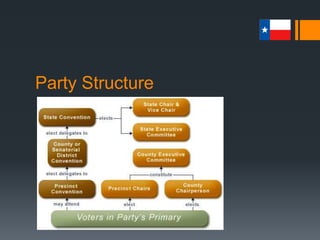
 The major two parties are organized at the: national, state,
county, and precinct levels
 Each majority party is loosely organized
 Gives the states and local party organizations opportunity to decide
their positions on party issues
 The Texas Election Code mandates that the two major parties are
similar in structure
Party Structure
Party Structure
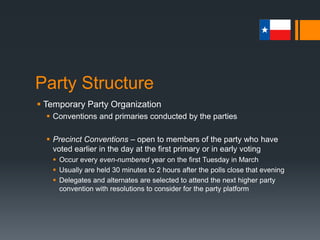
 Temporary Party Organization
 Conventions and primaries conducted by the parties
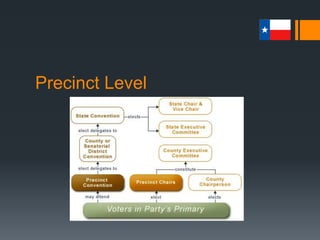
 Precinct Conventions – open to members of the party who have
voted earlier in the day at the first primary or in early voting
 Occur every even-numbered year on the first Tuesday in March
 Usually are held 30 minutes to 2 hours after the polls close that evening
 Delegates and alternates are selected to attend the next higher party
convention with resolutions to consider for the party platform
Precinct Level
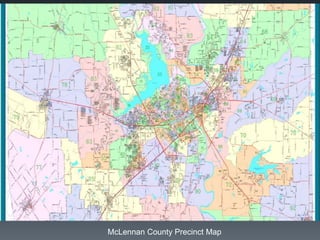
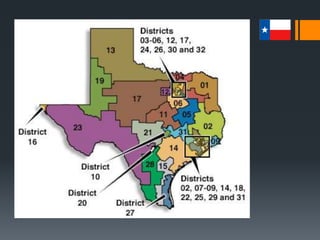
McLennan County Precinct Map
Party Structure
 Temporary Party Organization
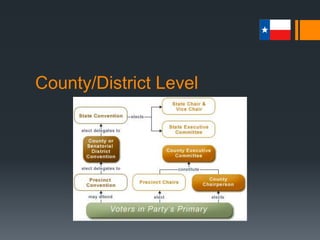
 County and District Conventions
 Delegates and alternates selected at the precinct level meet at the
county or district convention
 (If there is more than one senatorial district in the county, there will be a
separate convention for each district)
 Counties such as Harris, Dallas, and Bexar are good examples
 State law requires that both conventions occur the 3rd Saturday after
the precinct conventions
 Typically, 11 days after the primary election
 At this convention, delegates and alternates are selected to attend the
state convention, taking the approved resolutions with them
County/District Level
Party Structure
 Temporary Party Organization
 State Conventions
 In June of even-numbered years, each Texas political party must hold a
biennial state convention
 At the convention, delegates: select the state party chair, vice chair, and
members of the state executive committee
 They also draft a party platform and recognize nominees selected in the primary
elections
 If it is a presidential year, state convention delegates also select delegates
and alternates to attend the national convention and potential members of
the Electoral College
 In the 2008 election, Texas was allowed 34 electoral votes (equal to the number of
members in U.S. Congress – 2 Senators and 32 Reps.)
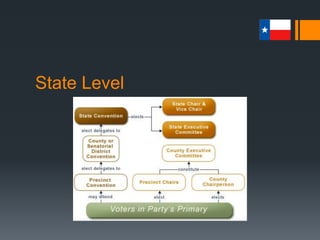
State Level
Party Structure
 Temporary Party Organization
 Selection of National Convention Delegates
 Selection depends on their support for particular candidates for the
party’s presidential nomination
 Candidate selection is done either by primary or caucus
 In a primary, rank-and-file party members can vote directly for the presidential
candidates of their choice
 Primary voting is done at the precinct level
 In a caucus, party members choose national convention delegates who either
pledge to support a particular presidential candidate or remain uncommitted
 Caucus – selection of candidates by an informal committee of party leaders
Party Structure
 Temporary Party Organization
 Democratic Selection
 Texas Democrats combine the two delegate-selection plans in
a primary-caucus in a process known as the “Texas Two-Step”
 Presidential candidates are awarded delegates to local and state
conventions in proportion to the number of their supporters in
attendance
 National delegates include those selected by state senatorial district,
those selected on an at-large basis, and superdelegates
 Superdelegate - Unpledged party official or elected official who
serves as a delegate to a party’s national convention
Party Structure
 Temporary Party Organization
 Democratic Selection
 In 2008, Texas sent 192 pledged delegates and 34 unpledged
“superdelegates”
 98 for Obama, 94 for Clinton
 The “Texas Two-Step” has become rather controversial in recent years
 Essentially, Democrats have to “vote twice” for their candidates
 Once at the primary and once again at the caucus
 2008 - Roughly 2.9 million voted at the primary level; less than 1/3 (roughly
1 million) voted at the caucus
Check my SlideShare page
(rfair07) for more lectures
Lectures posted for:
 United States History before 1877 / after 1877
 Texas History
 United States (Federal) Government / Texas Government
 Slide 14 of 32
 To download a full copy of this PowerPoint presentation,
please go to: https://gumroad.com/l/sxBUy 
 If you would like a copy of all the Texas Government lectures
posted in PDF format, please check out
at:https://gumroad.com/l/GXhg 

Govt 2306 ch_4

  • 1.
  • 2.
    Party Structure  PoliticalParties – a combination of people and interests whose primary purpose is to gain control of government by winning elections  Organization  The major two parties are organized at the: national, state, county, and precinct levels  Each majority party is loosely organized  Gives the states and local party organizations opportunity to decide their positions on party issues  The Texas Election Code mandates that the two major parties are similar in structure
  • 3.
  • 4.
    Party Structure  TemporaryParty Organization  Conventions and primaries conducted by the parties  Precinct Conventions – open to members of the party who have voted earlier in the day at the first primary or in early voting  Occur every even-numbered year on the first Tuesday in March  Usually are held 30 minutes to 2 hours after the polls close that evening  Delegates and alternates are selected to attend the next higher party convention with resolutions to consider for the party platform
  • 5.
  • 6.
  • 7.
    Party Structure  TemporaryParty Organization  County and District Conventions  Delegates and alternates selected at the precinct level meet at the county or district convention  (If there is more than one senatorial district in the county, there will be a separate convention for each district)  Counties such as Harris, Dallas, and Bexar are good examples  State law requires that both conventions occur the 3rd Saturday after the precinct conventions  Typically, 11 days after the primary election  At this convention, delegates and alternates are selected to attend the state convention, taking the approved resolutions with them
  • 8.
  • 10.
    Party Structure  TemporaryParty Organization  State Conventions  In June of even-numbered years, each Texas political party must hold a biennial state convention  At the convention, delegates: select the state party chair, vice chair, and members of the state executive committee  They also draft a party platform and recognize nominees selected in the primary elections  If it is a presidential year, state convention delegates also select delegates and alternates to attend the national convention and potential members of the Electoral College  In the 2008 election, Texas was allowed 34 electoral votes (equal to the number of members in U.S. Congress – 2 Senators and 32 Reps.)
  • 11.
  • 12.
    Party Structure  TemporaryParty Organization  Selection of National Convention Delegates  Selection depends on their support for particular candidates for the party’s presidential nomination  Candidate selection is done either by primary or caucus  In a primary, rank-and-file party members can vote directly for the presidential candidates of their choice  Primary voting is done at the precinct level  In a caucus, party members choose national convention delegates who either pledge to support a particular presidential candidate or remain uncommitted  Caucus – selection of candidates by an informal committee of party leaders
  • 13.
    Party Structure  TemporaryParty Organization  Democratic Selection  Texas Democrats combine the two delegate-selection plans in a primary-caucus in a process known as the “Texas Two-Step”  Presidential candidates are awarded delegates to local and state conventions in proportion to the number of their supporters in attendance  National delegates include those selected by state senatorial district, those selected on an at-large basis, and superdelegates  Superdelegate - Unpledged party official or elected official who serves as a delegate to a party’s national convention
  • 14.
    Party Structure  TemporaryParty Organization  Democratic Selection  In 2008, Texas sent 192 pledged delegates and 34 unpledged “superdelegates”  98 for Obama, 94 for Clinton  The “Texas Two-Step” has become rather controversial in recent years  Essentially, Democrats have to “vote twice” for their candidates  Once at the primary and once again at the caucus  2008 - Roughly 2.9 million voted at the primary level; less than 1/3 (roughly 1 million) voted at the caucus
  • 15.
    Check my SlideSharepage (rfair07) for more lectures Lectures posted for:  United States History before 1877 / after 1877  Texas History  United States (Federal) Government / Texas Government  Slide 14 of 32  To download a full copy of this PowerPoint presentation, please go to: https://gumroad.com/l/sxBUy   If you would like a copy of all the Texas Government lectures posted in PDF format, please check out at:https://gumroad.com/l/GXhg 