CHAPTER 2: FEDERALISM
AND THE TEXAS
CONSTITUTION
Brandi Dickey
Breanna Desbien
Mackenzie Daniels
Period 3
FEDERALISM
IN A NUT SHELL
 Federalism is a dual system where the national and state
governments share power and authority over citizens. Because of
this, states have their own executive, judicial, and legislative branches.
Federalism allows the national level of government to give power to

states but does not allow it to be taken away that easily.
 Different Types of Federalism:
• Cooperative Federalism- National power increased.
• New Federalism- Categorical grants decreased and block grants
became less restrictive.
Federalism: Shared Powers

Constitutions

 Taxes are collected by both

 We live in a “constitutional

the national and state

republic”. This means that we,

governments due to Federalism.

as a country, follow the

Likewise, both work together to

constitutional law. Because of

implement programs involving
social services and other things.

this, the use of judicial review
decides whether decisions made
by Texas (or any other state)
legislature is constitutional.
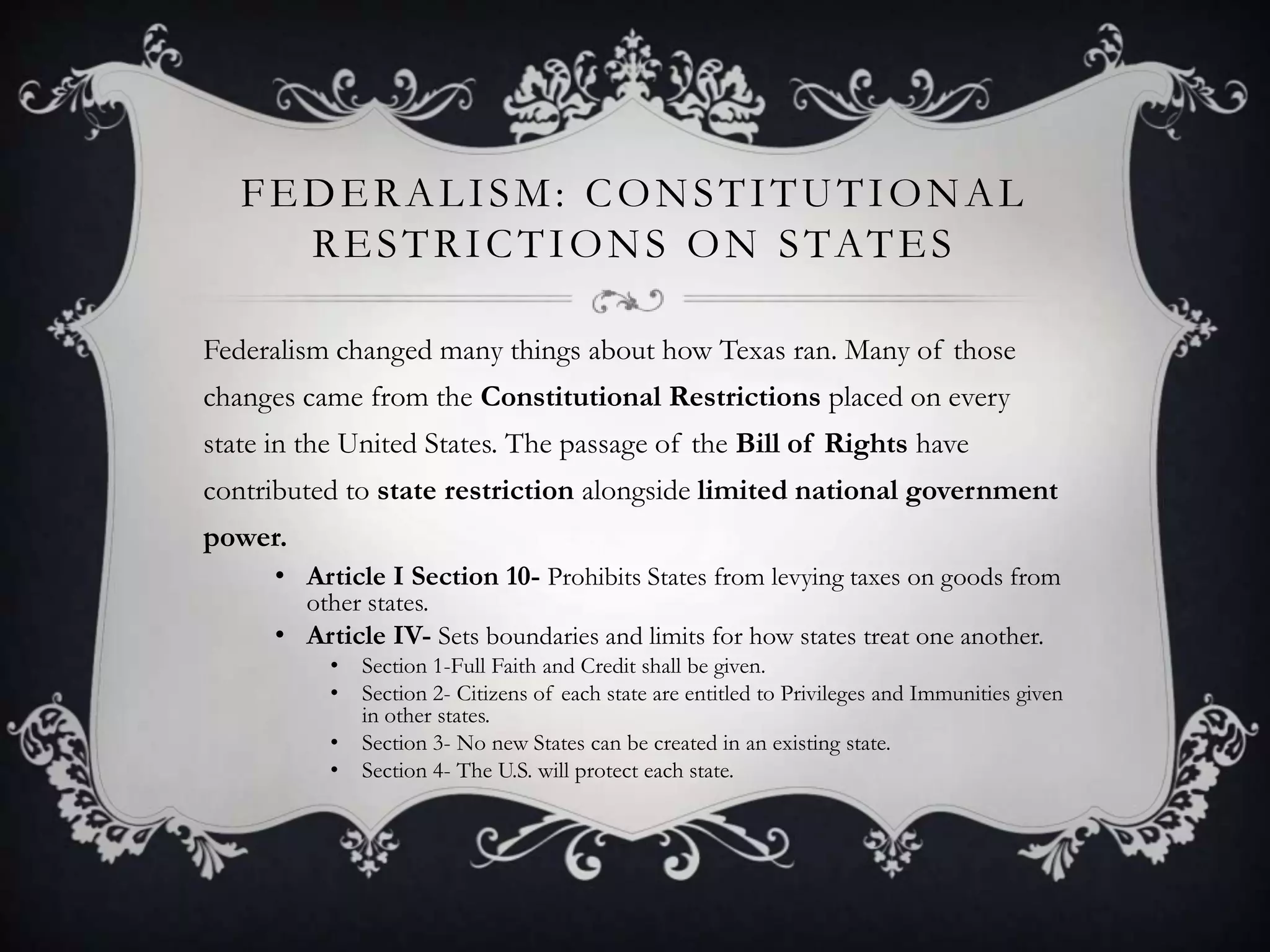
FEDERALISM: CONSTITUTIONAL
R E S T R I C T I O N S O N S TAT E S
Federalism changed many things about how Texas ran. Many of those
changes came from the Constitutional Restrictions placed on every
state in the United States. The passage of the Bill of Rights have
contributed to state restriction alongside limited national government

power.
• Article I Section 10- Prohibits States from levying taxes on goods from
other states.

• Article IV- Sets boundaries and limits for how states treat one another.
•
•
•
•

Section 1-Full Faith and Credit shall be given.
Section 2- Citizens of each state are entitled to Privileges and Immunities given
in other states.
Section 3- No new States can be created in an existing state.
Section 4- The U.S. will protect each state.
NATIONAL GAINS
 The balance of power has shifted more in the favor of the national
government.
 Taxing and Spending Policies cause the national government to
have more power over the states.

 The Supreme Court began to use the 14th amendment (due process
and equal protection under the law) to apply the Bill of Rights to state
governments.
• Example: Texas couldn’t prosecute Gregory Lee Johnson for burning the
American Flag because of the 1st amendment.

 Federal Courts have jurisdiction over areas previously under state
control.
THE “NEW” NEW
FEDERALISM
 1995- Republican members of the House and Senate promised a
smaller scope of government. However, it didn’t reduce by much.
• Devolution- The transfer of programs from the national level to the
state level.

 Federal grants started to come with fewer conditions but as a
consequence, states started to have larger shares of many social service
programs.
 National Government Mandates (regulations for states set by
Congress) frustrated states to a large extent.
STATE CONSTITUTIONS IN
GENERAL
 Most state constitutions are similar in design and concept. They
typically answer the question “Who does what?”
 Even though the U.S. typically follows constitutional law (found in

the Constitution; who knew?), many states have a mix of
constitutional law with legislative law (bills passed by legislature).
Texas is a prime example of this.
TEXAS CONSTITUTIONS
OVER THE YEARS
Texas has had seven constitutions so far.
 1827- The first was created when Texas was still a part of the Mexican
Federation. In fact, Texas was joined in part with Coahuila as one state.
 1836- Between the fall of the Alamo and the victory at San Jacinto, the
constitution of the Republic of Texas was created (modeled by that of the U.S.)
 1846- Because Texas was annexed by the U.S. a new constitution was created.
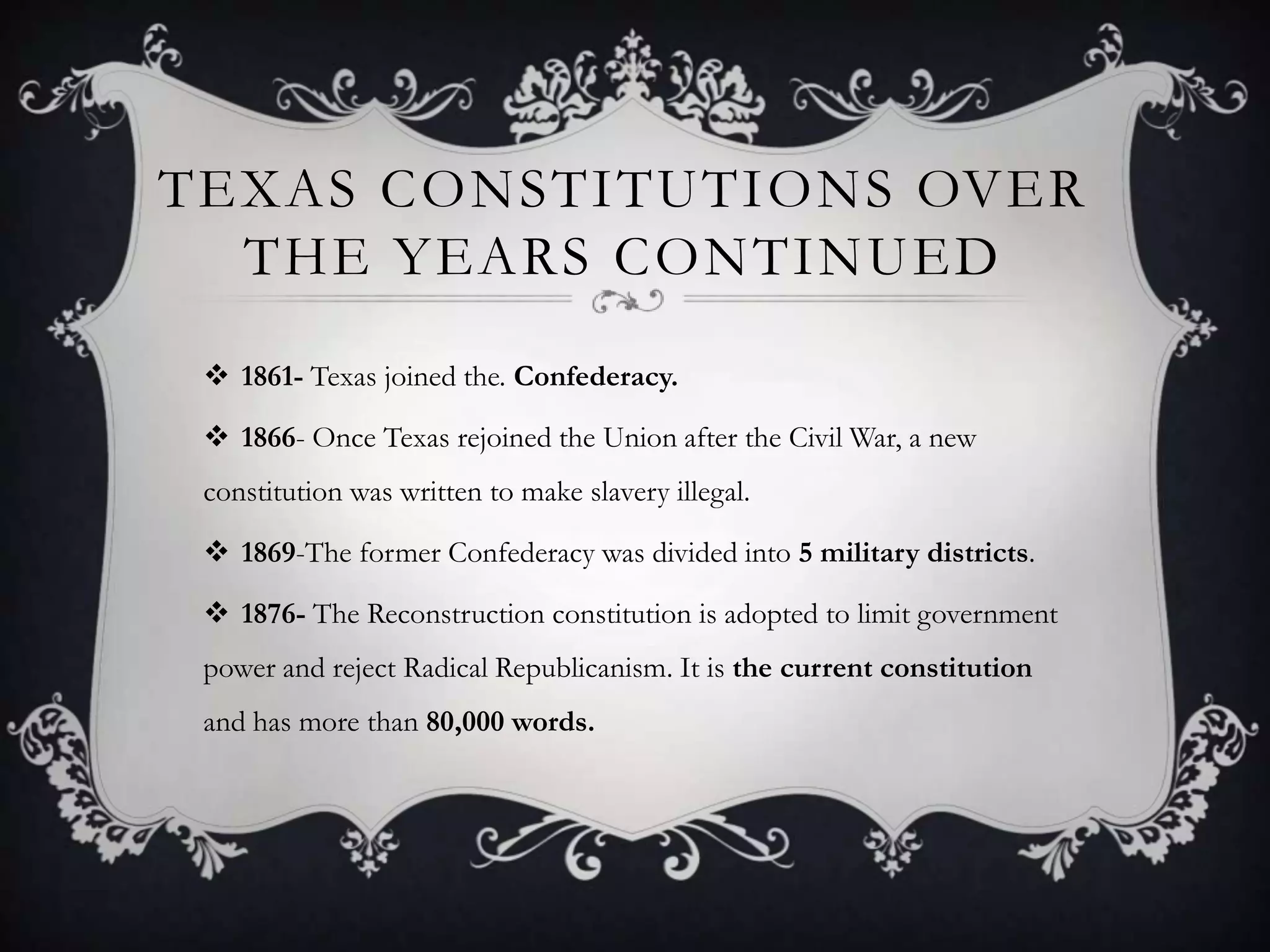
TEXAS CONSTITUTIONS OVER
THE YEARS CONTINUED
 1861- Texas joined the. Confederacy.
 1866- Once Texas rejoined the Union after the Civil War, a new
constitution was written to make slavery illegal.

 1869-The former Confederacy was divided into 5 military districts.
 1876- The Reconstruction constitution is adopted to limit government
power and reject Radical Republicanism. It is the current constitution
and has more than 80,000 words.
L I M I T S O N G OV E R N M E N T P OW E R
IN TEXAS’ 1876 CONSTITUTION
 The Balanced Budget Provision- Limited the state’s ability to
fall into debt
 Biennial Sessions Returned- This was simply because the less

time legislature is in session, the less opportunities there are for laws
to be passed.
 Judicial Branches, district courts, and the terms of judges
decreased.
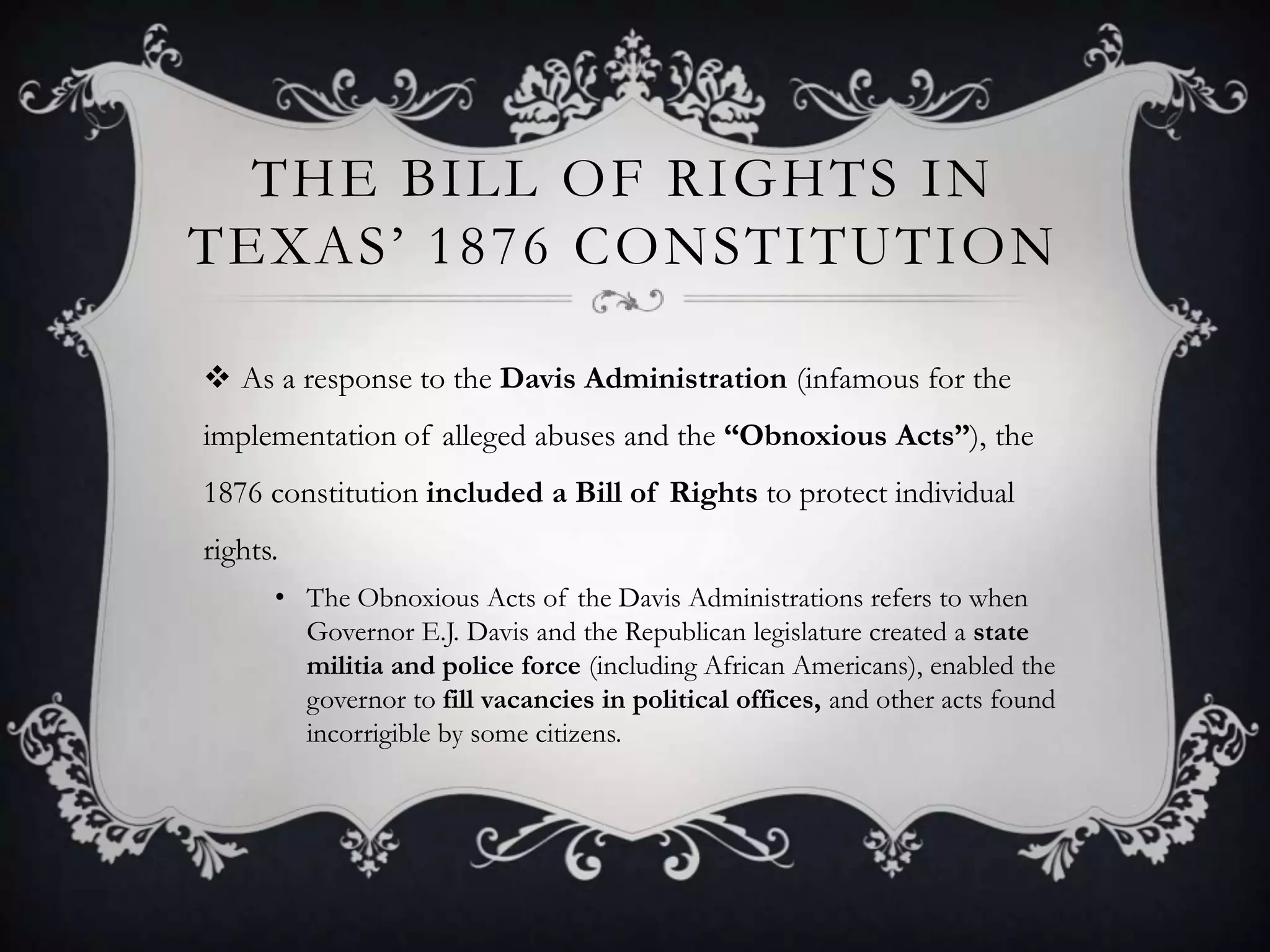
THE BILL OF RIGHTS IN
TEXAS’ 1876 CONSTITUTION
 As a response to the Davis Administration (infamous for the
implementation of alleged abuses and the “Obnoxious Acts”), the
1876 constitution included a Bill of Rights to protect individual

rights.
• The Obnoxious Acts of the Davis Administrations refers to when
Governor E.J. Davis and the Republican legislature created a state
militia and police force (including African Americans), enabled the
governor to fill vacancies in political offices, and other acts found
incorrigible by some citizens.
REASONS WHY TEXAS’ BILL OF
R I G H T S W E R E I M P O RTA N T
 The United State’s Bill of Rights did not go into very much detail
about the relationship between a state and its citizens. In fact, the U.S.
Bill of Rights did not apply to state and local governments until

around 1946 (70 years after the Texas Bill of Rights)
 The Texas Bill of Rights allowed Texas to give its citizens more
protection than the U.S. constitution stated in its Bill of Rights.
D I F F E R E N C E B E T W E E N T H E U. S.
AND THE TEXAS BILL OF RIGHTS
 Texas’ Bill of Rights is wordier than that of the U.S. Likewise, the
Texan Bill of rights has 30 provisions while the U.S.’ Bill of Rights
only has 10.

 Texas’ Bill of Rights oppose monopolies and states that
citizens will not be imprisoned for debts.
HOW TO: AMEND THE
CONSTITUTION
 To amend the Texas Constitution requires both the House and
Senate to approve the proposition by two-thirds. In addition to this
approval, it is required for the amendment to be ratified by legislature

with a majority of approval from voters.

 Fun Fact: As of 2010, the Texas Constitution has been amended
467 times.
PROSPECTS FOR REVISION
OF THE CONSTITUTION
 There has been no serious attempt to revise the current Constitution for
Texas. This is, in part, because of the obstacles that must be overcome before
the constitution can be revised. These obstacles include, but are not limited to:
• Opposition from other groups- If the current way benefits a group, then that
group will fight to keep things the way they are..
• Loss of Benefits outweigh gain of benefits- Since there is no guarantee for
the future, many people find it more worthwhile to leave things alone.
• Uncomfortable conversation- Most people don’t like change, so to talk about
something so drastic and concrete scares the average citizen.
IN CONCLUSION
 Since the integration of Texas into the United States, Texas has
become a lot more restricted than it had been previously. Federalism has
caused the state to lose the freedom it had as a Republic but has given it

security and protection in return. Due to its history within the U.S. Texas
has had to revise/compose its constitution a total of seven times. The
current constitution has been around since 1876 and even though it has
been amended frequently, it has not been rewritten since then.

Chapter 2 federalism and the texas constitution

  • 1.
    CHAPTER 2: FEDERALISM ANDTHE TEXAS CONSTITUTION Brandi Dickey Breanna Desbien Mackenzie Daniels Period 3
  • 2.
    FEDERALISM IN A NUTSHELL  Federalism is a dual system where the national and state governments share power and authority over citizens. Because of this, states have their own executive, judicial, and legislative branches. Federalism allows the national level of government to give power to states but does not allow it to be taken away that easily.  Different Types of Federalism: • Cooperative Federalism- National power increased. • New Federalism- Categorical grants decreased and block grants became less restrictive.
  • 3.
    Federalism: Shared Powers Constitutions Taxes are collected by both  We live in a “constitutional the national and state republic”. This means that we, governments due to Federalism. as a country, follow the Likewise, both work together to constitutional law. Because of implement programs involving social services and other things. this, the use of judicial review decides whether decisions made by Texas (or any other state) legislature is constitutional.
  • 4.
    FEDERALISM: CONSTITUTIONAL R ES T R I C T I O N S O N S TAT E S Federalism changed many things about how Texas ran. Many of those changes came from the Constitutional Restrictions placed on every state in the United States. The passage of the Bill of Rights have contributed to state restriction alongside limited national government power. • Article I Section 10- Prohibits States from levying taxes on goods from other states. • Article IV- Sets boundaries and limits for how states treat one another. • • • • Section 1-Full Faith and Credit shall be given. Section 2- Citizens of each state are entitled to Privileges and Immunities given in other states. Section 3- No new States can be created in an existing state. Section 4- The U.S. will protect each state.
  • 5.
    NATIONAL GAINS  Thebalance of power has shifted more in the favor of the national government.  Taxing and Spending Policies cause the national government to have more power over the states.  The Supreme Court began to use the 14th amendment (due process and equal protection under the law) to apply the Bill of Rights to state governments. • Example: Texas couldn’t prosecute Gregory Lee Johnson for burning the American Flag because of the 1st amendment.  Federal Courts have jurisdiction over areas previously under state control.
  • 6.
    THE “NEW” NEW FEDERALISM 1995- Republican members of the House and Senate promised a smaller scope of government. However, it didn’t reduce by much. • Devolution- The transfer of programs from the national level to the state level.  Federal grants started to come with fewer conditions but as a consequence, states started to have larger shares of many social service programs.  National Government Mandates (regulations for states set by Congress) frustrated states to a large extent.
  • 7.
    STATE CONSTITUTIONS IN GENERAL Most state constitutions are similar in design and concept. They typically answer the question “Who does what?”  Even though the U.S. typically follows constitutional law (found in the Constitution; who knew?), many states have a mix of constitutional law with legislative law (bills passed by legislature). Texas is a prime example of this.
  • 8.
    TEXAS CONSTITUTIONS OVER THEYEARS Texas has had seven constitutions so far.  1827- The first was created when Texas was still a part of the Mexican Federation. In fact, Texas was joined in part with Coahuila as one state.  1836- Between the fall of the Alamo and the victory at San Jacinto, the constitution of the Republic of Texas was created (modeled by that of the U.S.)  1846- Because Texas was annexed by the U.S. a new constitution was created.
  • 9.
    TEXAS CONSTITUTIONS OVER THEYEARS CONTINUED  1861- Texas joined the. Confederacy.  1866- Once Texas rejoined the Union after the Civil War, a new constitution was written to make slavery illegal.  1869-The former Confederacy was divided into 5 military districts.  1876- The Reconstruction constitution is adopted to limit government power and reject Radical Republicanism. It is the current constitution and has more than 80,000 words.
  • 10.
    L I MI T S O N G OV E R N M E N T P OW E R IN TEXAS’ 1876 CONSTITUTION  The Balanced Budget Provision- Limited the state’s ability to fall into debt  Biennial Sessions Returned- This was simply because the less time legislature is in session, the less opportunities there are for laws to be passed.  Judicial Branches, district courts, and the terms of judges decreased.
  • 11.
    THE BILL OFRIGHTS IN TEXAS’ 1876 CONSTITUTION  As a response to the Davis Administration (infamous for the implementation of alleged abuses and the “Obnoxious Acts”), the 1876 constitution included a Bill of Rights to protect individual rights. • The Obnoxious Acts of the Davis Administrations refers to when Governor E.J. Davis and the Republican legislature created a state militia and police force (including African Americans), enabled the governor to fill vacancies in political offices, and other acts found incorrigible by some citizens.
  • 12.
    REASONS WHY TEXAS’BILL OF R I G H T S W E R E I M P O RTA N T  The United State’s Bill of Rights did not go into very much detail about the relationship between a state and its citizens. In fact, the U.S. Bill of Rights did not apply to state and local governments until around 1946 (70 years after the Texas Bill of Rights)  The Texas Bill of Rights allowed Texas to give its citizens more protection than the U.S. constitution stated in its Bill of Rights.
  • 13.
    D I FF E R E N C E B E T W E E N T H E U. S. AND THE TEXAS BILL OF RIGHTS  Texas’ Bill of Rights is wordier than that of the U.S. Likewise, the Texan Bill of rights has 30 provisions while the U.S.’ Bill of Rights only has 10.  Texas’ Bill of Rights oppose monopolies and states that citizens will not be imprisoned for debts.
  • 14.
    HOW TO: AMENDTHE CONSTITUTION  To amend the Texas Constitution requires both the House and Senate to approve the proposition by two-thirds. In addition to this approval, it is required for the amendment to be ratified by legislature with a majority of approval from voters.  Fun Fact: As of 2010, the Texas Constitution has been amended 467 times.
  • 15.
    PROSPECTS FOR REVISION OFTHE CONSTITUTION  There has been no serious attempt to revise the current Constitution for Texas. This is, in part, because of the obstacles that must be overcome before the constitution can be revised. These obstacles include, but are not limited to: • Opposition from other groups- If the current way benefits a group, then that group will fight to keep things the way they are.. • Loss of Benefits outweigh gain of benefits- Since there is no guarantee for the future, many people find it more worthwhile to leave things alone. • Uncomfortable conversation- Most people don’t like change, so to talk about something so drastic and concrete scares the average citizen.
  • 16.
    IN CONCLUSION  Sincethe integration of Texas into the United States, Texas has become a lot more restricted than it had been previously. Federalism has caused the state to lose the freedom it had as a Republic but has given it security and protection in return. Due to its history within the U.S. Texas has had to revise/compose its constitution a total of seven times. The current constitution has been around since 1876 and even though it has been amended frequently, it has not been rewritten since then.