The 1990sChapter 27
George H. W. Bush
George H. W. BushA New World OrderBush calls for a “new world order” as the Soviet Union begins its declineMalta ConferenceBush and Gorbechev discuss superpower cooperationReduction of troop deploymentsReduction of armsSettling regional disputesStimulating East/West tradeGerman reunification was seen as a part of this new world orderSTART I treaty (Strategic Arms Reduction Treaty)Marked the beginning of an era of cooperation between the U.S. and Soviets
George H. W. BushDomestic IssuesTax reform:  “Read my lips, no new taxes!”Sounded good in principle, but his administration struggled with the enormous deficit from the Reagan yearsBush gives in to Democrats and raises taxesRuins his credibility and his approval ratingOther domestic reformAmericans with Disabilities ACT of 1990 (ADA)Clean Air ActBoth were fairly progressive for a conservative president
George H. W. BushThe Persian Gulf War (Gulf War I)Bush intervenes when Iraqi dictator Saddam Hussein invades Kuwait in 1990First international crisis since the end of the Cold WarBush identifies the Gulf War as the first step to create a world based on democracy and global free tradeManifest Destiny continuing into another centuryBush launches 4,000 bombing runs and a successful ground offensiveHis ratings skyrocket as a resultThe 1992 election looked promising for him
William “Bill” Jefferson Clinton
The Clinton YearsElection of 1992Initially, the election looked promising for incumbent George H. W. BushSuccessful offensive in the Gulf WarEconomy was relatively stableHowever, the economy began to recess as the election season startedClinton wins the election with 43 %Texas billionaire (and independent populist) Ross Perot split some of the vote between Clinton and Bush
The Clinton YearsDomestic PoliciesFLMA Act (Family and Medical Leave Act)Brady BillFive day waiting period on handgun purchasesAssault weapons banFirst White House website launched in 1994Gays’ rights in the militaryClinton argued for this in his campaignThe public was hostile to the issueSettled on the “don’t ask, don’t tell” policy
The Clinton YearsNAFTA (North Atlantic Free Trade Agreement)Agreement that would greatly reduce and/or eliminate the majority of tariffs for products traded between the United States, Canada, and MexicoEssentially a free-trade zone for the United States, Mexico, and CanadaDemocrats charge it caused the loss of jobs (no labor provisions)Some say our deficit has ballooned 11 times over what it was before NAFTAHowever, the American economy has grown 54% since its inceptionOverall, more time is needed to judge its successes and failures
The Family Unit in the 1990sDecline of the traditional familyAfter 1970, fewer American families had a father who was the sole breadwinnerCohabitation without marriage became commonDivorce rates doubledMore unmarried women (especially teenagers) having childrenQuality of public education declines after the 1980sMovement to return to “traditional family values” beganNostalgic return to the 1950s begins as a result of the Christian Right movementOthers gravitate toward alternative lifestyles
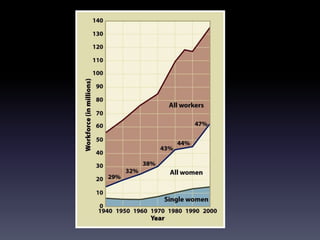
Women in the 1990sMore married women entered the workplaceSome achieved remarkable successMost were relegated to low paying jobs or “female” jobsWomen on average made around 75% of men’s salaries throughout the 1990sNOW (National Organization for Women) push for another Equal Rights Amendment for women, but ultimately fail
Election of 1996Clinton easily defeated Republican Bob DoleBecomes the first Democrat elected to two terms since FDRRoss Perot runs again as a Reform IndependentOnly garners 8.4% of the popular voteClinton embraced the most popular Republican policies like welfare reformLeft Dole with extreme positions that were unpopular among suburban middle-class votersHostility to abortion rights and environmental protection
The Computer RevolutionThe rise of the computer industry and the Internet produced a new economySteve Jobs (Apple) and Bill Gates (Microsoft) quickly became guiding forces for the future of computer-based technologyThe Internet expanded the flow of information and communications more radically than any invention since the printing press
GlobalizationGlobalization became the new concept of the 1990sThe process by which economies, cultures, and societies are linked through a global network of communication, transportation, and tradeTerm is typically used to refer to economic globalizationIntegration of national economies through trade, foreign investment, capital flow, technological integration, and migration
The Clinton ScandalsIn the 1980s and 1990s scrutiny of politicians’ private lives became far more intense than in the pastWhitewater ScandalReal estate controversy involving Bill and Hillary ClintonThe Clintons partnered with James and Susan McDougal to purchase 220 acres of land in Arkansas to become the Whitewater Development Corp.The venture failed, the McDougals entered the banking industry, and began another real estate investment that caught the attention of federal regulatorsAfter Clinton took the presidency, an independent investigation found that Clinton pressured a supporter, David Hale, into making a loan that benefitted Clinton and the McDougal’s Savings and Loan
The Clinton ScandalsWhitewater ScandalInitially, the Clintons were cleared of wrongdoing, but Kenneth Starr (President of Baylor U.) took over and used David Hale as a key witness against the ClintonsAlleged that Clinton pressured Hale  to illegally loan $300,000 of federally-backed money to Susan McDougalHale was convicted of numerous felonies and the allegation lost its credibilityHowever, Starr’s investigation led to the numerous sex scandals involving Bill ClintonPaula Jones (former government employee in Arkansas)Monica Lewinsky (White House intern)
Clinton’s ImpeachmentAfter Whitewater, Independent Counsel Kenneth Starr conducted an investigation of Clinton that included abuses of:Improper firing of White House travel agentsAlleged misuse of FBI filesSexual harassment claims from Paula JonesPerjury statements dealing with his sexual relationship with Monica LewinskyOverall, Starr’s report indicated that impeachment proceedings should proceedClinton was charged with perjury and obstruction of justice
Clinton’s ImpeachmentAfter a month of deliberation, the Senate acquitted Clinton of both chargesIn April 1999, Clinton was cited for contempt of court regarding his “willful failure” to tell the truth in the Paula Jones lawsuitHe was assessed a $90,000 fine, had his Arkansas law license suspended for 5 years, and resigned from the United States Supreme Court barOut of court, he settled with Paula Jones for $850,000 in damages
Clinton’s ImpeachmentPublically, 50% of Americans supported Clinton’s impeachment and 42% disapproved of Clinton’s acquittalClinton’s job approval rating rose during the impeachment scandal, but his poll numbers regarding honesty, integrity, and moral character sharply declinedAs a result, “moral character” was a significant issue in the 2000 electionPost-election results from the 2000 election indicated that the single most significant reason people voted for George W. Bush was for his moral character and his image as a “compassionate conservative”The association between Clinton and Al Gore (Clinton’s Vice President) greatly impacted Gore’s campaign
The 2000 Presidential ElectionAl Gore (D)George W. Bush (R)
The 2000 Presidential ElectionThis election proved to be one of the closest in the nation’s historySecond to the election of 1877The election was notable because of the controversial voting recount in FloridaGore requested hand recounts in 4 countiesResults indicated Bush won Florida and Gore appealed to the Florida Supreme CourtThe Florida Supreme Court ordered a total state recount
The 2000 Presidential ElectionThe U.S. Supreme Court immediately struck down the Florida Supreme Court’s recountIn December 2000, the U.S. Supreme Court ruled:7 to 2 that the Florida Supreme Court’s ruling for a complete recount was unconstitutional5 to 4 that the Florida recounts could not be done before a “safe harbor” deadline and should ceaseSubsequently, the previously certified total (that indicated Bush won Florida) should hold.Overall, like in 1877, the U.S. Supreme Court had to decide the outcome of the presidential election
Results of the ElectionOne of the more remarkable things about the election was not so much its controversial ending, but the even division of the country it revealedDemocrats blamed the Supreme Court, Ralph Nader, and sheer bad luck for Bush’s narrow victoryThe election also revealed a broad disengagement from public lifePrimarily, low voter turn-outRoughly 100 million show up to voteOver 280 million people in the U.S. (2000 Census)
Ch 27 the 1990s

Ch 27 the 1990s

  • 1.
  • 2.
  • 3.
    George H. W.BushA New World OrderBush calls for a “new world order” as the Soviet Union begins its declineMalta ConferenceBush and Gorbechev discuss superpower cooperationReduction of troop deploymentsReduction of armsSettling regional disputesStimulating East/West tradeGerman reunification was seen as a part of this new world orderSTART I treaty (Strategic Arms Reduction Treaty)Marked the beginning of an era of cooperation between the U.S. and Soviets
  • 4.
    George H. W.BushDomestic IssuesTax reform: “Read my lips, no new taxes!”Sounded good in principle, but his administration struggled with the enormous deficit from the Reagan yearsBush gives in to Democrats and raises taxesRuins his credibility and his approval ratingOther domestic reformAmericans with Disabilities ACT of 1990 (ADA)Clean Air ActBoth were fairly progressive for a conservative president
  • 6.
    George H. W.BushThe Persian Gulf War (Gulf War I)Bush intervenes when Iraqi dictator Saddam Hussein invades Kuwait in 1990First international crisis since the end of the Cold WarBush identifies the Gulf War as the first step to create a world based on democracy and global free tradeManifest Destiny continuing into another centuryBush launches 4,000 bombing runs and a successful ground offensiveHis ratings skyrocket as a resultThe 1992 election looked promising for him
  • 7.
  • 8.
    The Clinton YearsElectionof 1992Initially, the election looked promising for incumbent George H. W. BushSuccessful offensive in the Gulf WarEconomy was relatively stableHowever, the economy began to recess as the election season startedClinton wins the election with 43 %Texas billionaire (and independent populist) Ross Perot split some of the vote between Clinton and Bush
  • 10.
    The Clinton YearsDomesticPoliciesFLMA Act (Family and Medical Leave Act)Brady BillFive day waiting period on handgun purchasesAssault weapons banFirst White House website launched in 1994Gays’ rights in the militaryClinton argued for this in his campaignThe public was hostile to the issueSettled on the “don’t ask, don’t tell” policy
  • 11.
    The Clinton YearsNAFTA(North Atlantic Free Trade Agreement)Agreement that would greatly reduce and/or eliminate the majority of tariffs for products traded between the United States, Canada, and MexicoEssentially a free-trade zone for the United States, Mexico, and CanadaDemocrats charge it caused the loss of jobs (no labor provisions)Some say our deficit has ballooned 11 times over what it was before NAFTAHowever, the American economy has grown 54% since its inceptionOverall, more time is needed to judge its successes and failures
  • 13.
    The Family Unitin the 1990sDecline of the traditional familyAfter 1970, fewer American families had a father who was the sole breadwinnerCohabitation without marriage became commonDivorce rates doubledMore unmarried women (especially teenagers) having childrenQuality of public education declines after the 1980sMovement to return to “traditional family values” beganNostalgic return to the 1950s begins as a result of the Christian Right movementOthers gravitate toward alternative lifestyles
  • 15.
    Women in the1990sMore married women entered the workplaceSome achieved remarkable successMost were relegated to low paying jobs or “female” jobsWomen on average made around 75% of men’s salaries throughout the 1990sNOW (National Organization for Women) push for another Equal Rights Amendment for women, but ultimately fail
  • 17.
    Election of 1996Clintoneasily defeated Republican Bob DoleBecomes the first Democrat elected to two terms since FDRRoss Perot runs again as a Reform IndependentOnly garners 8.4% of the popular voteClinton embraced the most popular Republican policies like welfare reformLeft Dole with extreme positions that were unpopular among suburban middle-class votersHostility to abortion rights and environmental protection
  • 19.
    The Computer RevolutionTherise of the computer industry and the Internet produced a new economySteve Jobs (Apple) and Bill Gates (Microsoft) quickly became guiding forces for the future of computer-based technologyThe Internet expanded the flow of information and communications more radically than any invention since the printing press
  • 22.
    GlobalizationGlobalization became thenew concept of the 1990sThe process by which economies, cultures, and societies are linked through a global network of communication, transportation, and tradeTerm is typically used to refer to economic globalizationIntegration of national economies through trade, foreign investment, capital flow, technological integration, and migration
  • 24.
    The Clinton ScandalsInthe 1980s and 1990s scrutiny of politicians’ private lives became far more intense than in the pastWhitewater ScandalReal estate controversy involving Bill and Hillary ClintonThe Clintons partnered with James and Susan McDougal to purchase 220 acres of land in Arkansas to become the Whitewater Development Corp.The venture failed, the McDougals entered the banking industry, and began another real estate investment that caught the attention of federal regulatorsAfter Clinton took the presidency, an independent investigation found that Clinton pressured a supporter, David Hale, into making a loan that benefitted Clinton and the McDougal’s Savings and Loan
  • 25.
    The Clinton ScandalsWhitewaterScandalInitially, the Clintons were cleared of wrongdoing, but Kenneth Starr (President of Baylor U.) took over and used David Hale as a key witness against the ClintonsAlleged that Clinton pressured Hale to illegally loan $300,000 of federally-backed money to Susan McDougalHale was convicted of numerous felonies and the allegation lost its credibilityHowever, Starr’s investigation led to the numerous sex scandals involving Bill ClintonPaula Jones (former government employee in Arkansas)Monica Lewinsky (White House intern)
  • 27.
    Clinton’s ImpeachmentAfter Whitewater,Independent Counsel Kenneth Starr conducted an investigation of Clinton that included abuses of:Improper firing of White House travel agentsAlleged misuse of FBI filesSexual harassment claims from Paula JonesPerjury statements dealing with his sexual relationship with Monica LewinskyOverall, Starr’s report indicated that impeachment proceedings should proceedClinton was charged with perjury and obstruction of justice
  • 28.
    Clinton’s ImpeachmentAfter amonth of deliberation, the Senate acquitted Clinton of both chargesIn April 1999, Clinton was cited for contempt of court regarding his “willful failure” to tell the truth in the Paula Jones lawsuitHe was assessed a $90,000 fine, had his Arkansas law license suspended for 5 years, and resigned from the United States Supreme Court barOut of court, he settled with Paula Jones for $850,000 in damages
  • 29.
    Clinton’s ImpeachmentPublically, 50%of Americans supported Clinton’s impeachment and 42% disapproved of Clinton’s acquittalClinton’s job approval rating rose during the impeachment scandal, but his poll numbers regarding honesty, integrity, and moral character sharply declinedAs a result, “moral character” was a significant issue in the 2000 electionPost-election results from the 2000 election indicated that the single most significant reason people voted for George W. Bush was for his moral character and his image as a “compassionate conservative”The association between Clinton and Al Gore (Clinton’s Vice President) greatly impacted Gore’s campaign
  • 30.
    The 2000 PresidentialElectionAl Gore (D)George W. Bush (R)
  • 31.
    The 2000 PresidentialElectionThis election proved to be one of the closest in the nation’s historySecond to the election of 1877The election was notable because of the controversial voting recount in FloridaGore requested hand recounts in 4 countiesResults indicated Bush won Florida and Gore appealed to the Florida Supreme CourtThe Florida Supreme Court ordered a total state recount
  • 33.
    The 2000 PresidentialElectionThe U.S. Supreme Court immediately struck down the Florida Supreme Court’s recountIn December 2000, the U.S. Supreme Court ruled:7 to 2 that the Florida Supreme Court’s ruling for a complete recount was unconstitutional5 to 4 that the Florida recounts could not be done before a “safe harbor” deadline and should ceaseSubsequently, the previously certified total (that indicated Bush won Florida) should hold.Overall, like in 1877, the U.S. Supreme Court had to decide the outcome of the presidential election
  • 34.
    Results of theElectionOne of the more remarkable things about the election was not so much its controversial ending, but the even division of the country it revealedDemocrats blamed the Supreme Court, Ralph Nader, and sheer bad luck for Bush’s narrow victoryThe election also revealed a broad disengagement from public lifePrimarily, low voter turn-outRoughly 100 million show up to voteOver 280 million people in the U.S. (2000 Census)