In this presentation we will discuss about:
 Origin of Good Governance;
 Meaning & Concept of Governance;
 Meaning and Definition of Good Governance;
 Good Governance Indicators;
 Importance of Good Governance ;
 Challenges of Good Governance;
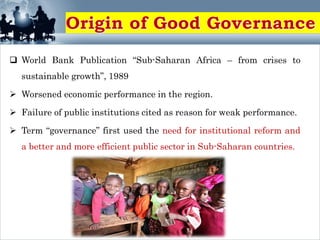
 World Bank Publication “Sub-Saharan Africa – from crises to
sustainable growth”, 1989
 Worsened economic performance in the region.
 Failure of public institutions cited as reason for weak performance.
 Term “governance” first used the need for institutional reform and
a better and more efficient public sector in Sub-Saharan countries.
 World Bank Report “Governance and Development” 1992.
 Further developed the concept of Governance;
 Defines Good Governance:
 Synonymous to sound development management;
 Central to creating and sustaining an environment which fosters
strong and equitable development;
 Essential component of sound economic policies;
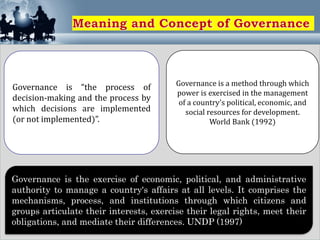
Governance is the exercise of economic, political, and administrative
authority to manage a country's affairs at all levels. It comprises the
mechanisms, process, and institutions through which citizens and
groups articulate their interests, exercise their legal rights, meet their
obligations, and mediate their differences. UNDP (1997)
Governance is “the process of
decision-making and the process by
which decisions are implemented
(or not implemented)”.
Governance is a method through which
power is exercised in the management
of a country's political, economic, and
social resources for development.
World Bank (1992)
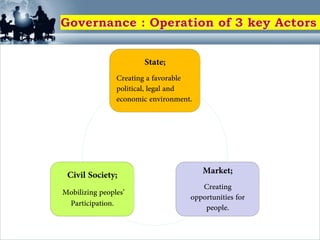
State;
Creating a favorable
political, legal and
economic environment.
Market;
Creating
opportunities for
people.
Civil Society;
Mobilizing peoples’
Participation.
According to World Bank Good Governance
entails:
o Sound public sector management;
o Accountability
o Exchange and free flow of information;
o And a legal framework for development
(Justice, respect for human rights, and
liberties).
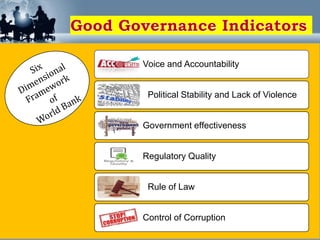
Voice and Accountability
Political Stability and Lack of Violence
Government effectiveness
Regulatory Quality
Rule of Law
Control of Corruption
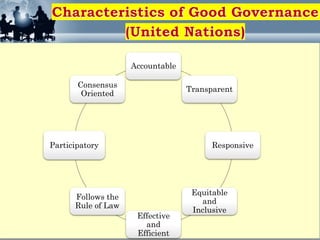
Accountable
Transparent
Responsive
Equitable
and
Inclusive
Effective
and
Efficient
Follows the
Rule of Law
Participatory
Consensus
Oriented
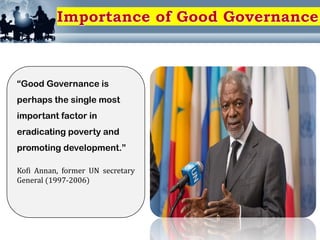
“Good Governance is
perhaps the single most
important factor in
eradicating poverty and
promoting development.”
Kofi Annan, former UN secretary
General (1997-2006)
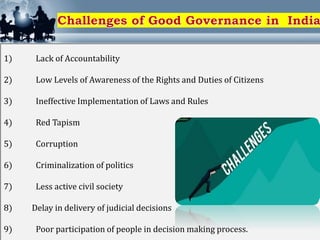
1) Lack of Accountability
2) Low Levels of Awareness of the Rights and Duties of Citizens
3) Ineffective Implementation of Laws and Rules
4) Red Tapism
5) Corruption
6) Criminalization of politics
7) Less active civil society
8) Delay in delivery of judicial decisions
9) Poor participation of people in decision making process.
‫مدیریت‬
‫علمی‬
‫است‬
‫که‬
‫یک‬
‫گروه‬
‫بدون‬
‫هدف‬
‫را‬
‫به‬
‫یک‬
‫گروه‬
‫هدف‬
‫دار‬
‫و‬
‫مؤثر‬
‫تبدیل‬
‫مینماید‬
.
‫به‬
‫عبارت‬
‫دیگر‬
‫مدیریت‬
‫با‬
‫اعمال‬
‫تغییر‬
‫در‬
‫گروه‬
‫های‬
،‫انسانی‬
‫عامل‬
‫تحول‬
‫و‬
‫ابداع‬
‫اجتماعی‬
‫است‬
( .
‫پیتر‬
‫اف‬
.
‫دراکر‬
)
Thank You!!!

Good Governance concepts and applications .pdf