QUIC

Quick UDP Internet Connections
Aluno: Felipe Rayel
Professores: Christian Esteve Rothenbeg, Maurício Ferreira
Magalhães

IA368- Tópicos em Engenharia de Computação V
Faculdade de Engenharia Elétrica e de Computação UNICAMP
Nov/2013
AGENDA
•
•
•
•
•
•

Overview
Motivations
Goals
Specification
Adoption
Conclusion
OVERVIEW
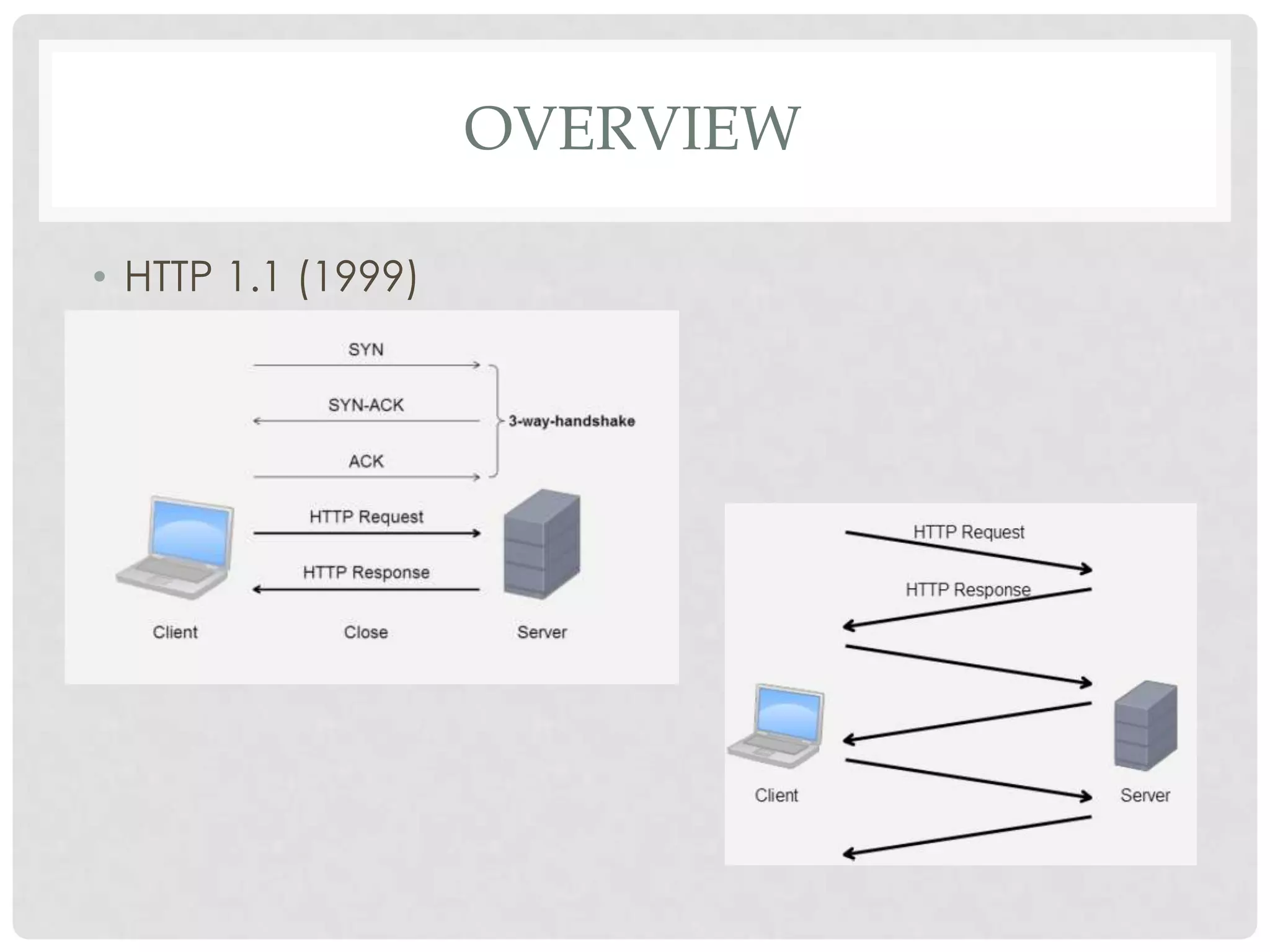
• HTTP 1.1 (1999)
OVERVIEW
•
•
•
•
•

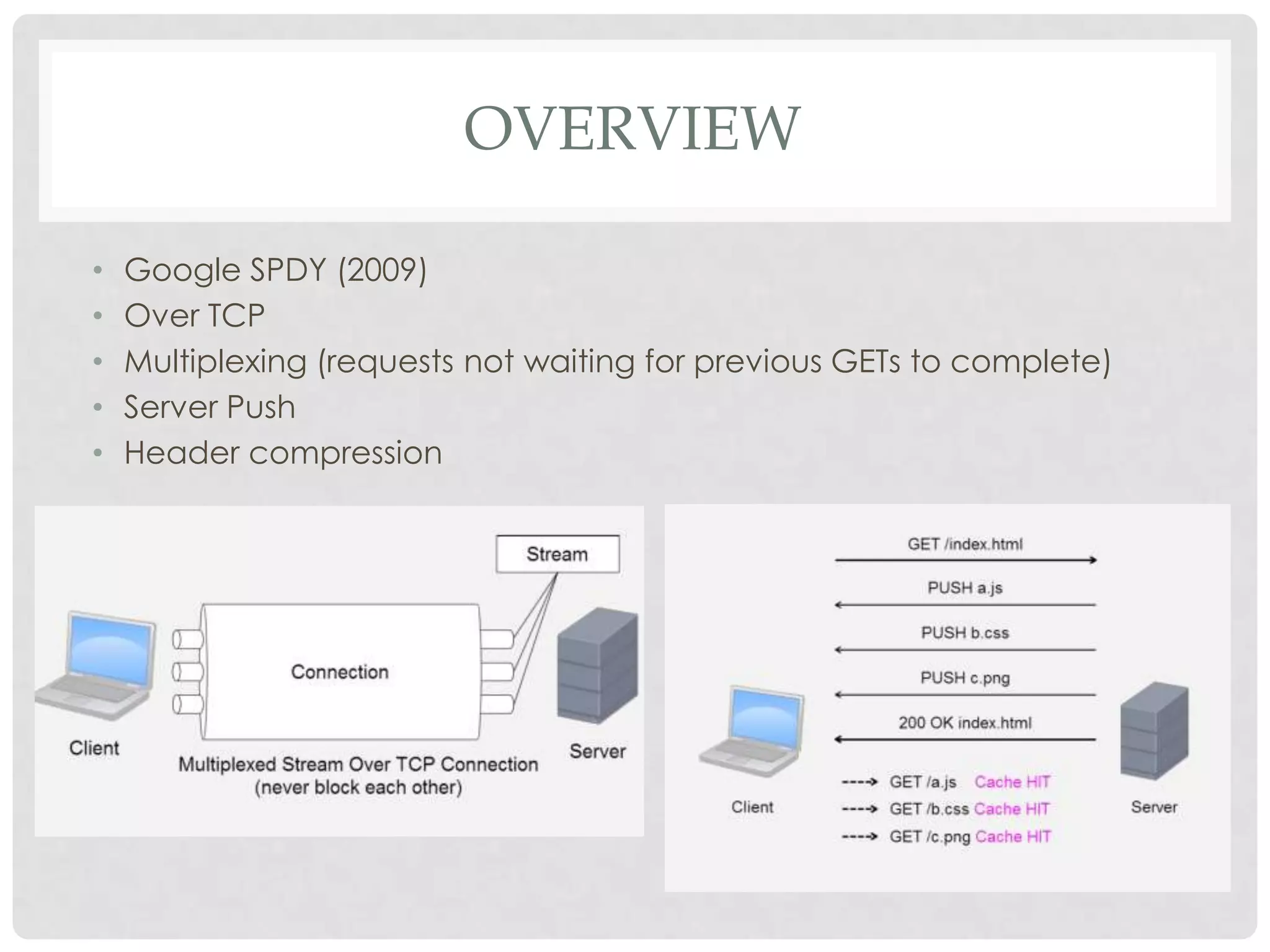
Google SPDY (2009)
Over TCP
Multiplexing (requests not waiting for previous GETs to complete)
Server Push
Header compression
MOTIVATIONS
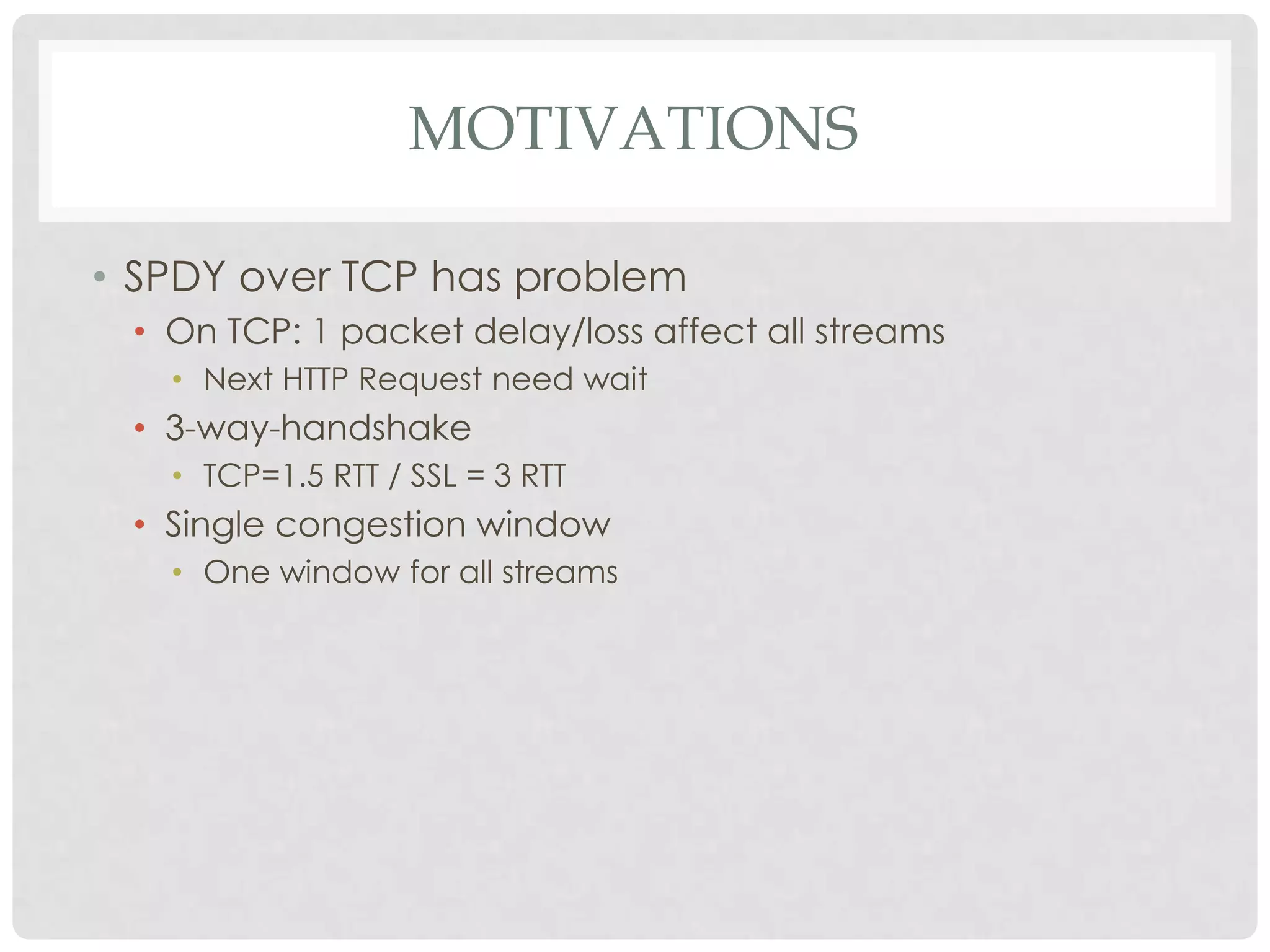
• SPDY over TCP has problem
• On TCP: 1 packet delay/loss affect all streams
• Next HTTP Request need wait

• 3-way-handshake
• TCP=1.5 RTT / SSL = 3 RTT

• Single congestion window
• One window for all streams
GOALS
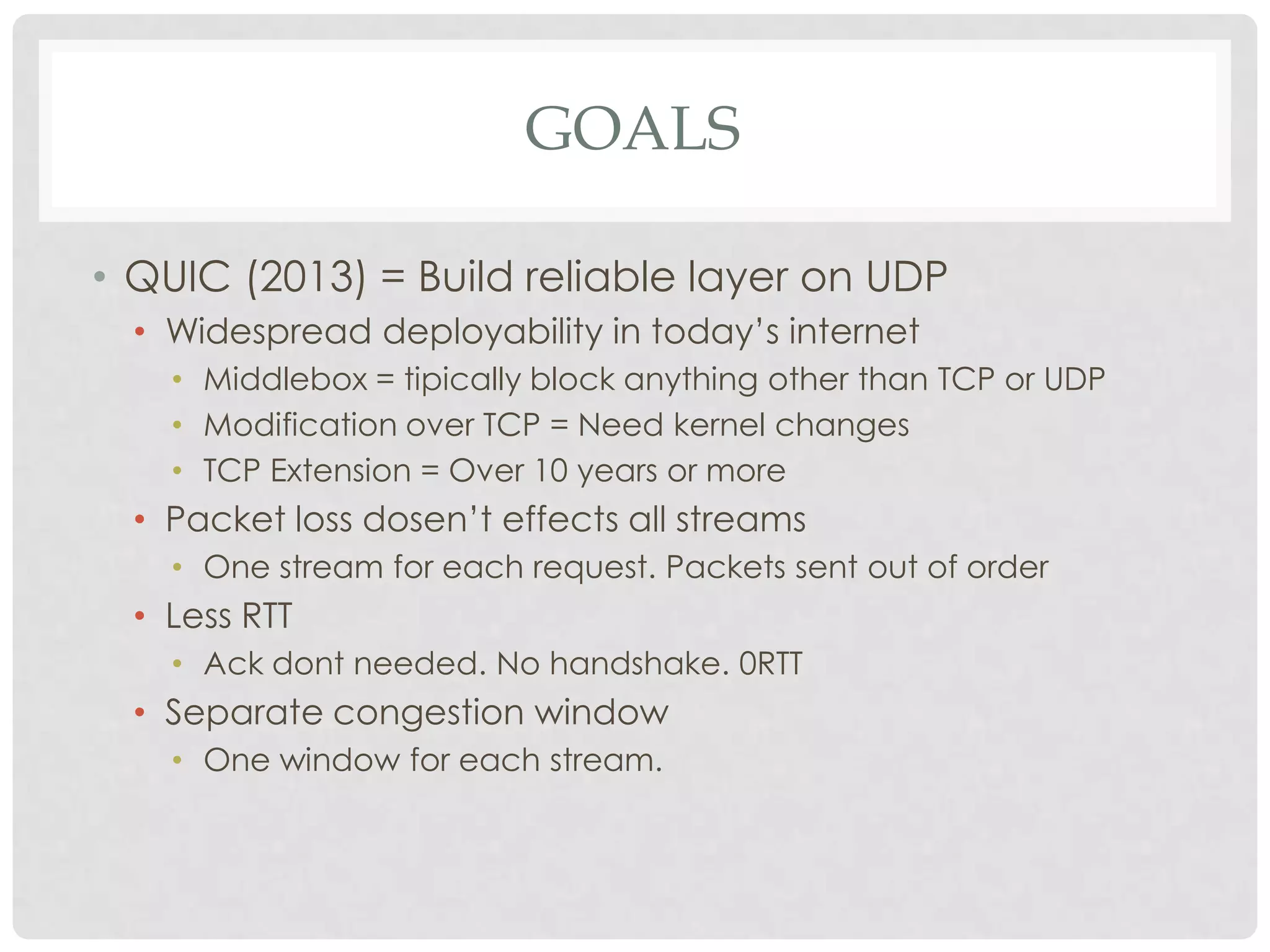
• QUIC (2013) = Build reliable layer on UDP
• Widespread deployability in today’s internet
• Middlebox = tipically block anything other than TCP or UDP
• Modification over TCP = Need kernel changes
• TCP Extension = Over 10 years or more

• Packet loss dosen’t effects all streams
• One stream for each request. Packets sent out of order

• Less RTT
• Ack dont needed. No handshake. 0RTT

• Separate congestion window
• One window for each stream.
GOALS
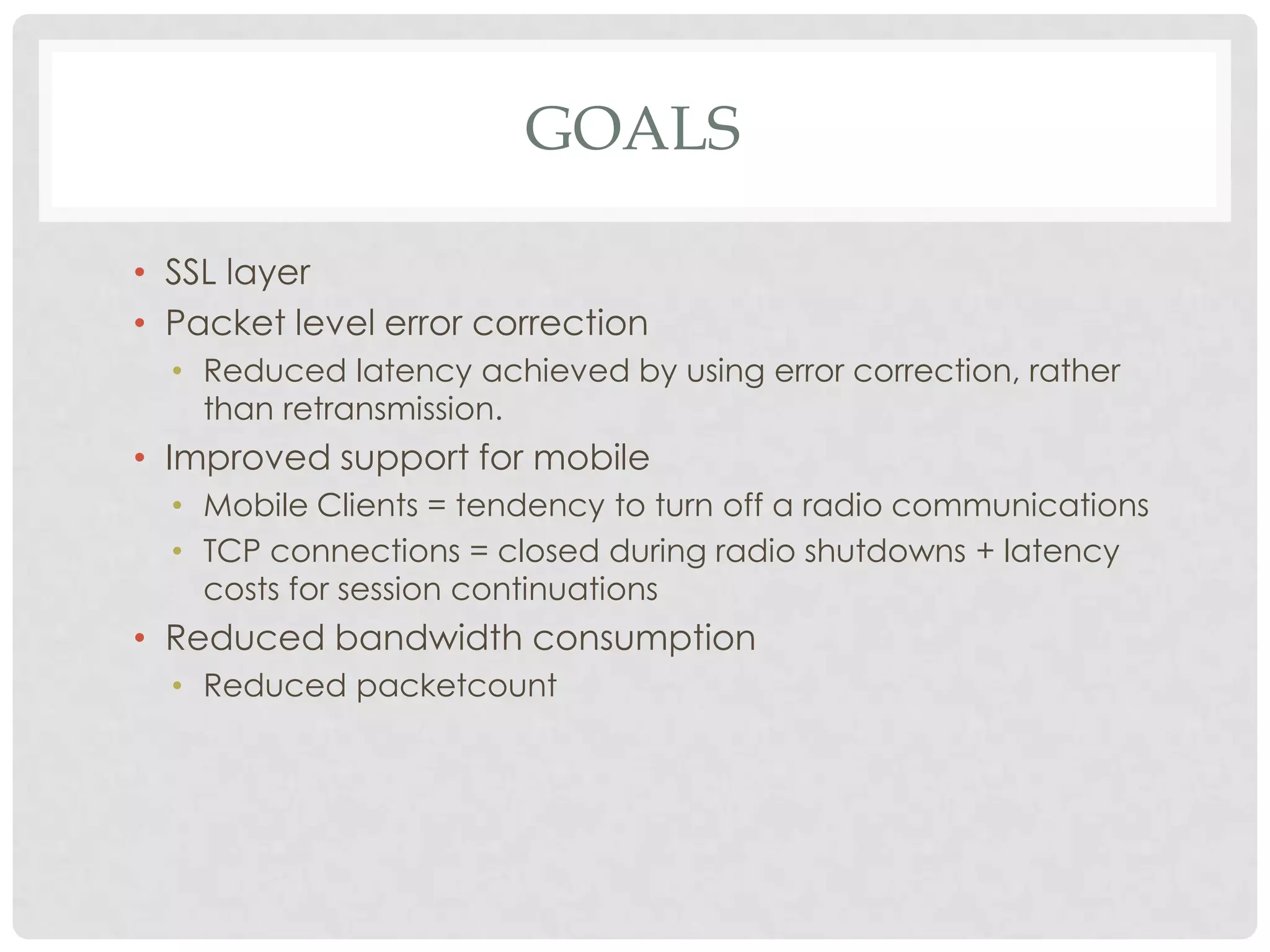
• SSL layer
• Packet level error correction
• Reduced latency achieved by using error correction, rather
than retransmission.

• Improved support for mobile
• Mobile Clients = tendency to turn off a radio communications
• TCP connections = closed during radio shutdowns + latency
costs for session continuations

• Reduced bandwidth consumption
• Reduced packetcount
SPECIFICATION
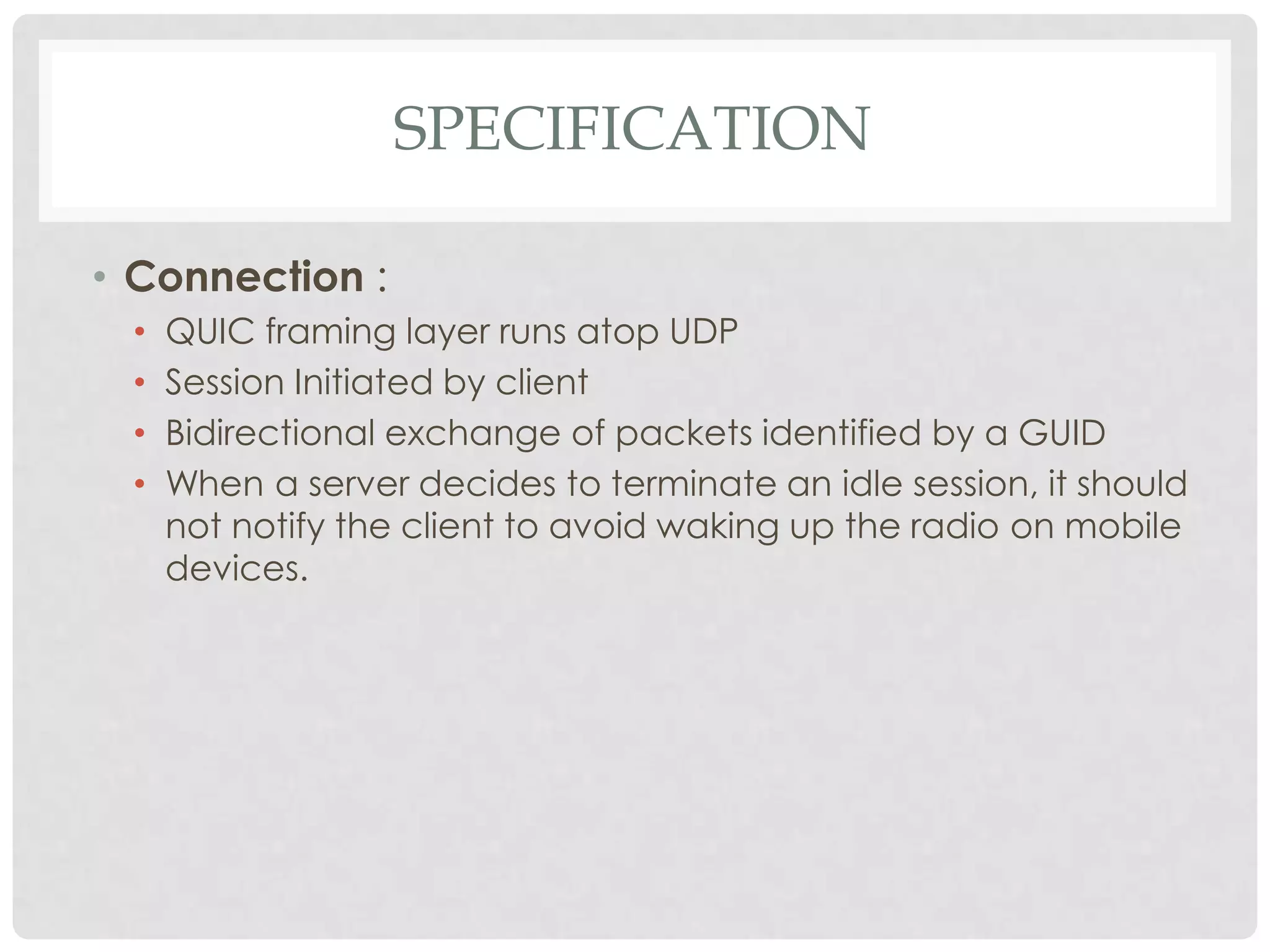
• Connection :
•
•
•
•

QUIC framing layer runs atop UDP
Session Initiated by client
Bidirectional exchange of packets identified by a GUID
When a server decides to terminate an idle session, it should
not notify the client to avoid waking up the radio on mobile
devices.
SPECIFICATION
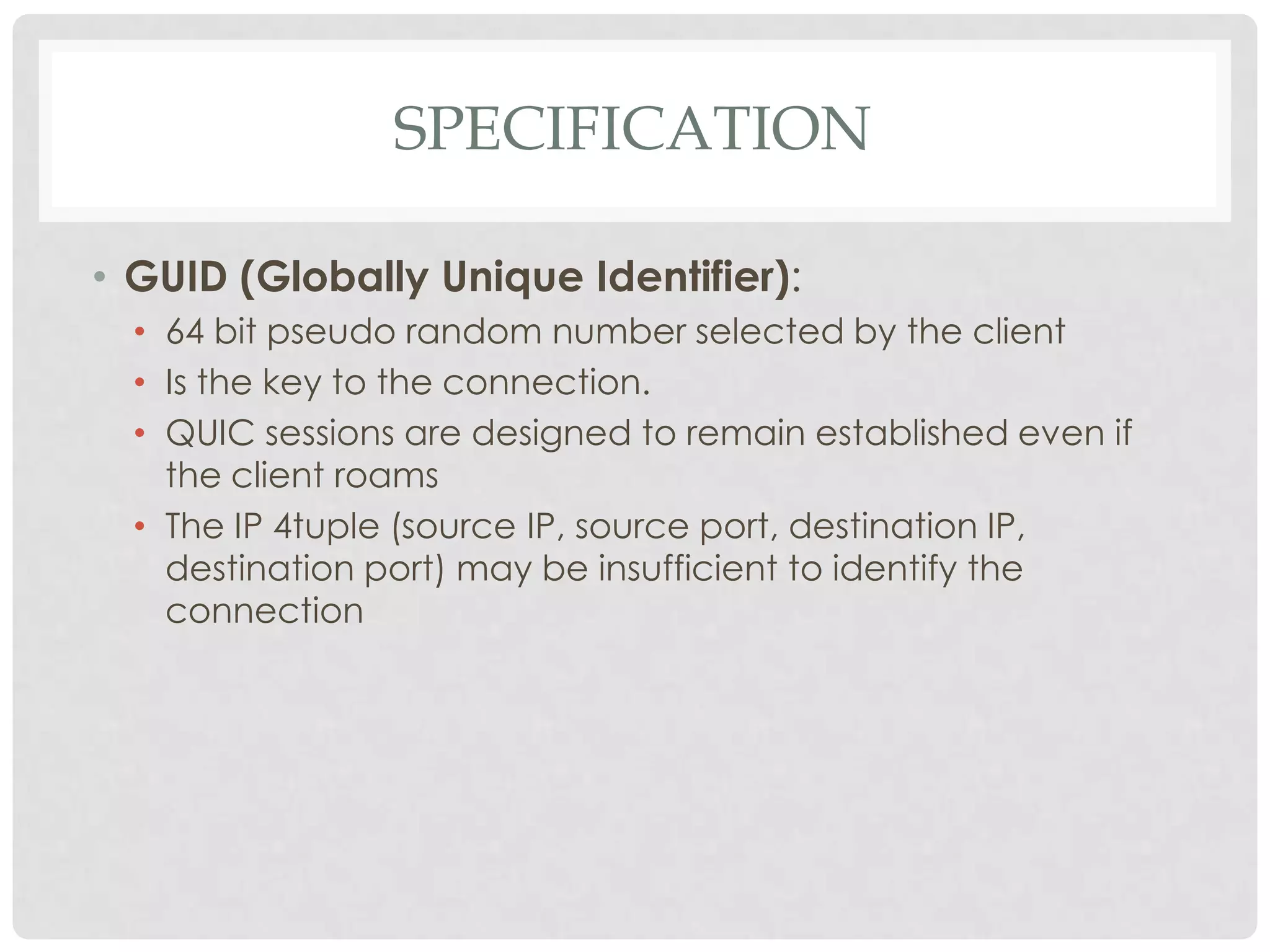
• GUID (Globally Unique Identifier):
• 64 bit pseudo random number selected by the client
• Is the key to the connection.
• QUIC sessions are designed to remain established even if
the client roams
• The IP 4tuple (source IP, source port, destination IP,
destination port) may be insufficient to identify the
connection
SPECIFICATION
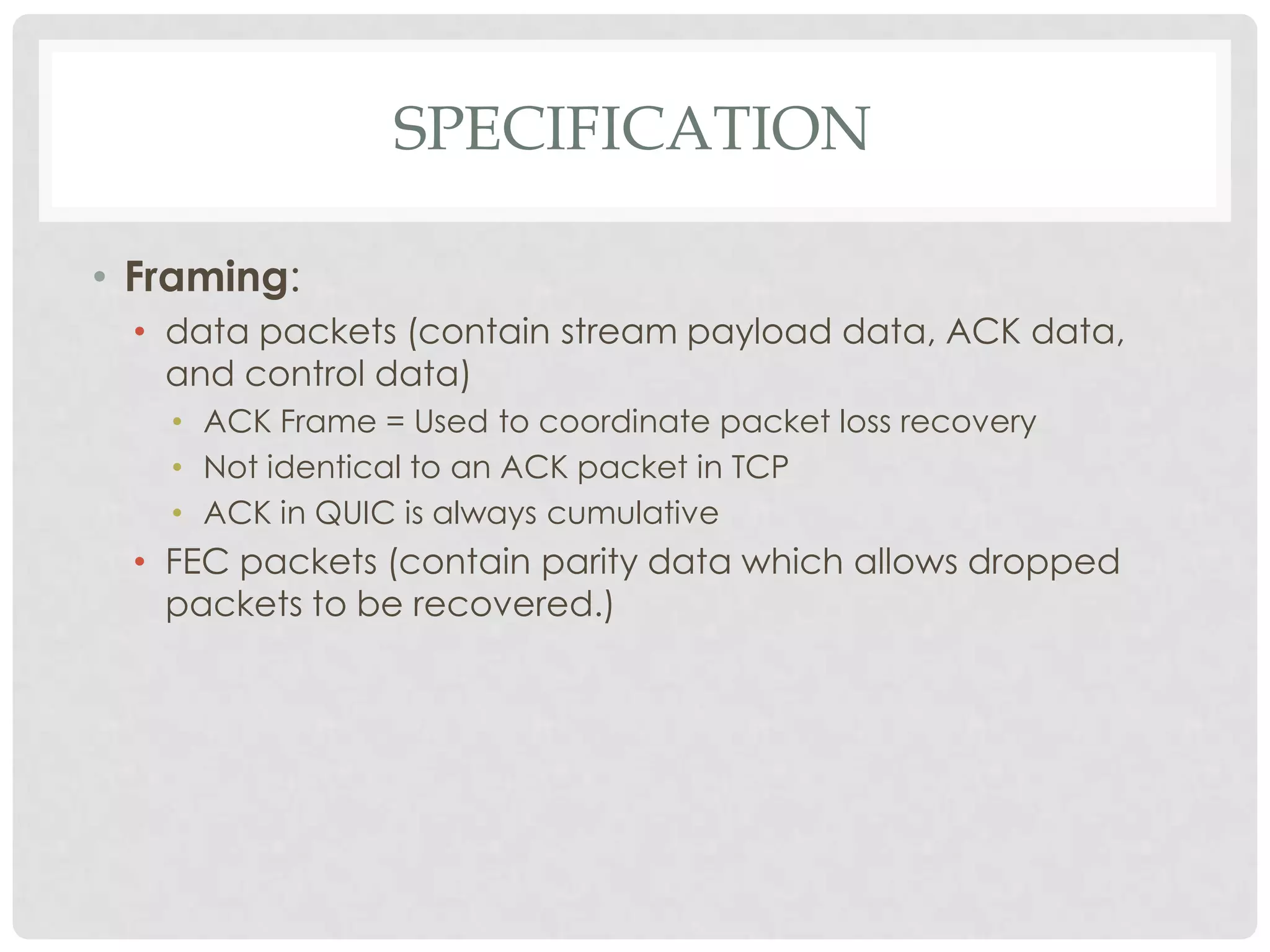
• Framing:
• data packets (contain stream payload data, ACK data,
and control data)
• ACK Frame = Used to coordinate packet loss recovery
• Not identical to an ACK packet in TCP
• ACK in QUIC is always cumulative

• FEC packets (contain parity data which allows dropped
packets to be recovered.)
SPECIFICATION
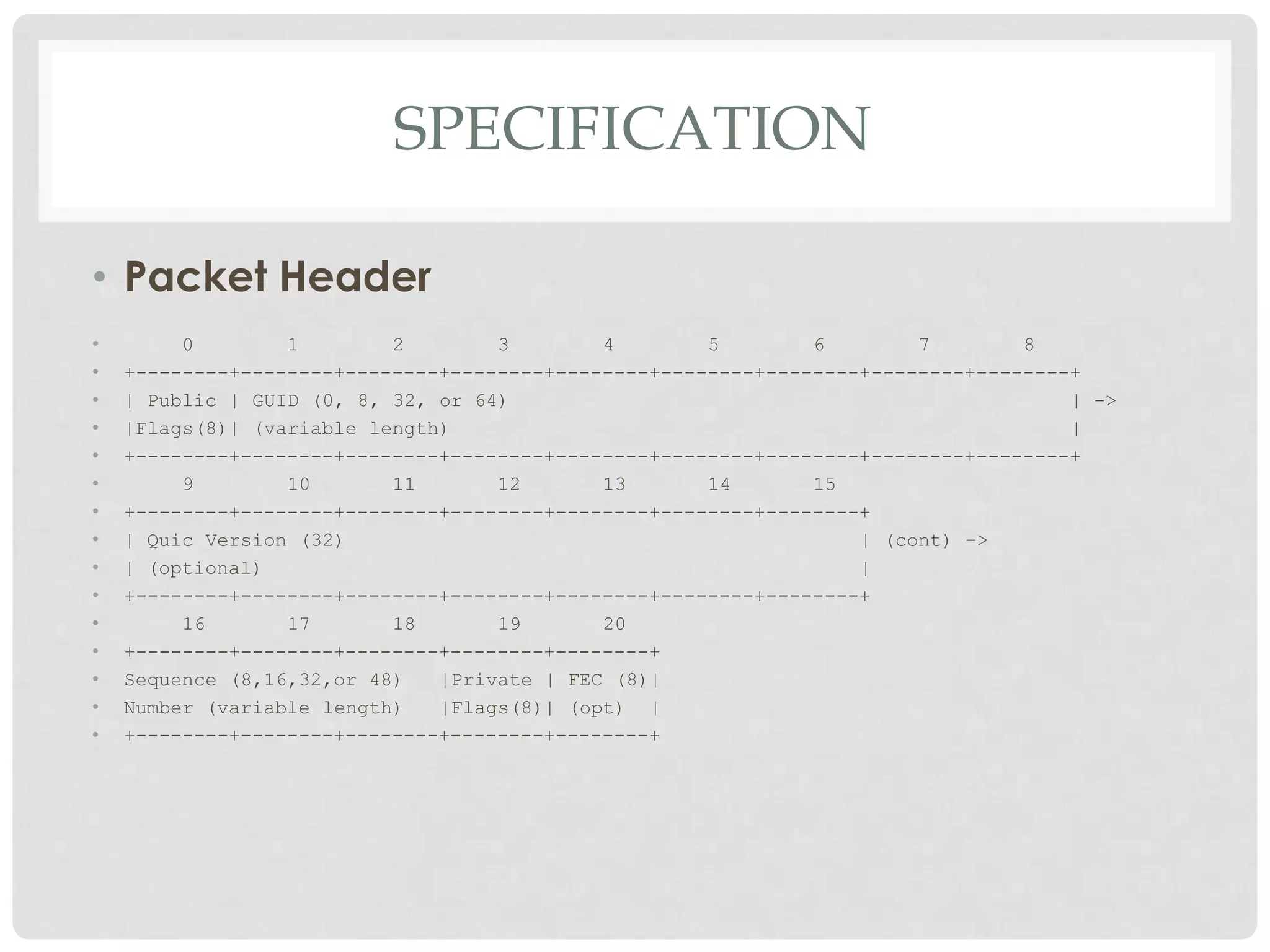
• Packet Header
•
•
•
•
•
•
•
•
•
•
•
•
•
•
•

0
1
2
3
4
5
6
7
8
+--------+--------+--------+--------+--------+--------+--------+--------+--------+
| Public | GUID (0, 8, 32, or 64)
| ->
|Flags(8)| (variable length)
|
+--------+--------+--------+--------+--------+--------+--------+--------+--------+
9
10
11
12
13
14
15
+--------+--------+--------+--------+--------+--------+--------+
| Quic Version (32)
| (cont) ->
| (optional)
|
+--------+--------+--------+--------+--------+--------+--------+
16
17
18
19
20
+--------+--------+--------+--------+--------+
Sequence (8,16,32,or 48)
|Private | FEC (8)|
Number (variable length)
|Flags(8)| (opt) |
+--------+--------+--------+--------+--------+
SPECIFICATION
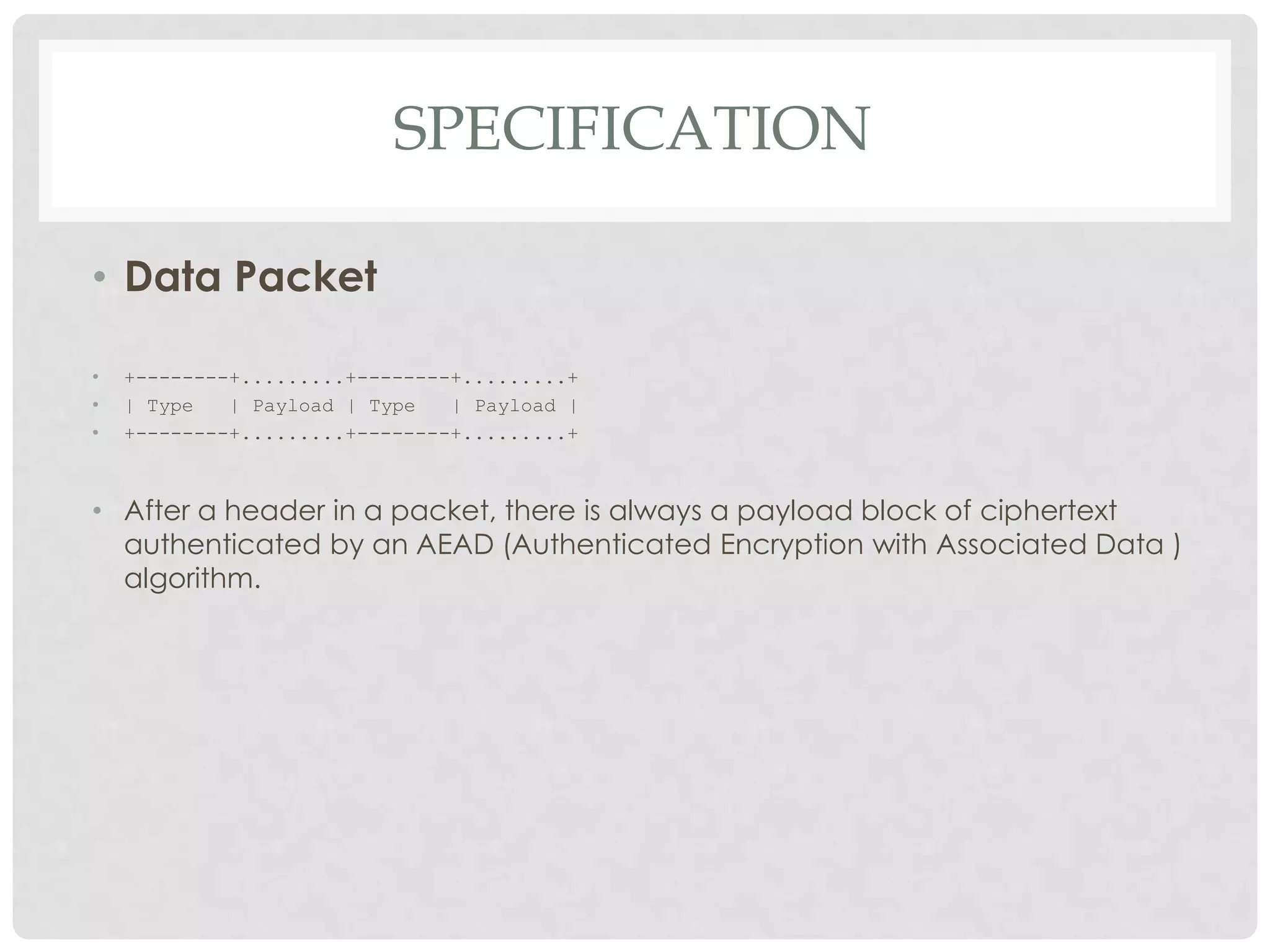
• Data Packet
•
•
•

+--------+.........+--------+.........+
| Type
| Payload | Type
| Payload |
+--------+.........+--------+.........+

• After a header in a packet, there is always a payload block of ciphertext
authenticated by an AEAD (Authenticated Encryption with Associated Data )
algorithm.
SPECIFICATION
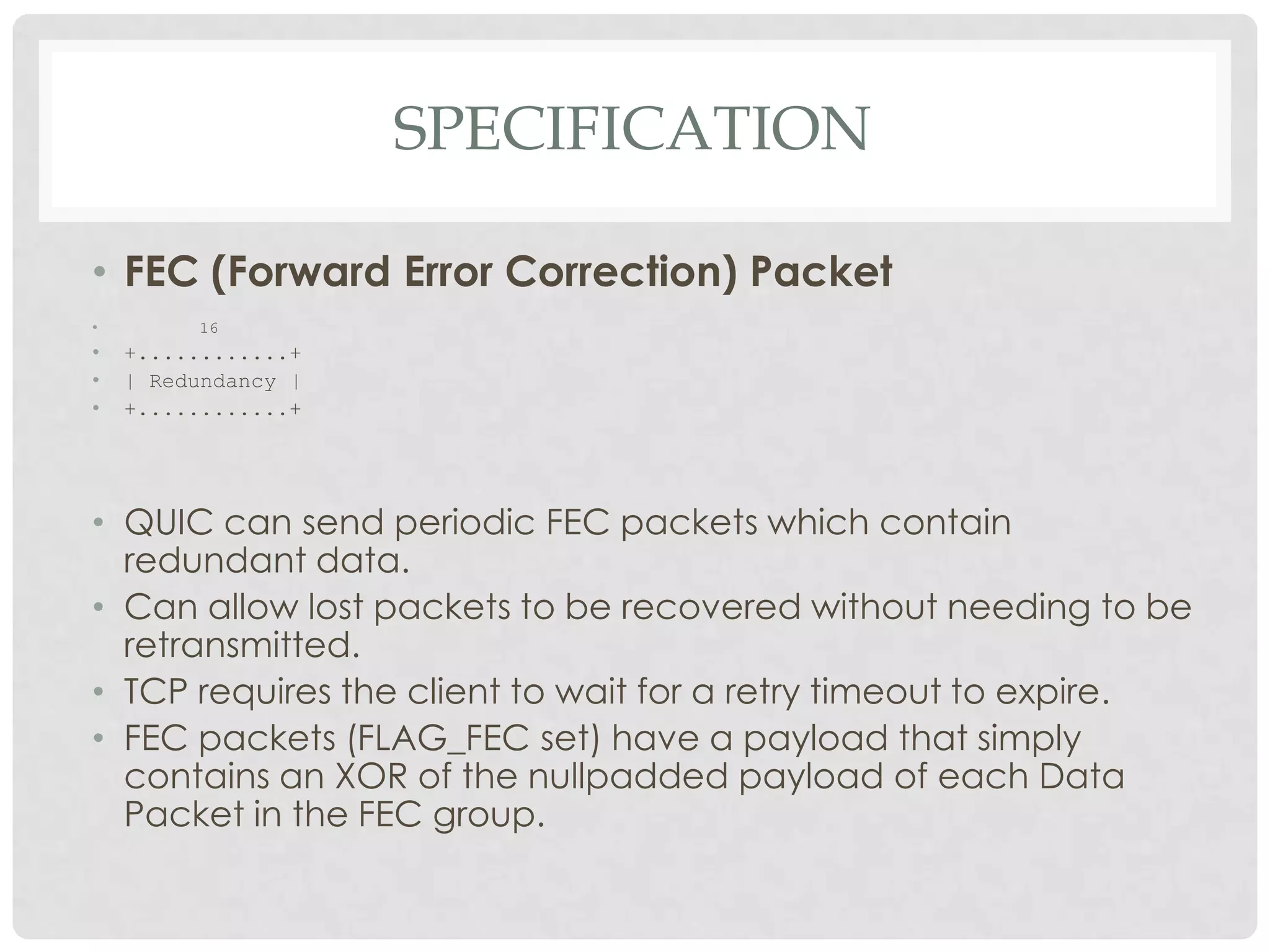
• FEC (Forward Error Correction) Packet
•

16

•
•
•

+............+
| Redundancy |
+............+

• QUIC can send periodic FEC packets which contain
redundant data.
• Can allow lost packets to be recovered without needing to be
retransmitted.
• TCP requires the client to wait for a retry timeout to expire.
• FEC packets (FLAG_FEC set) have a payload that simply
contains an XOR of the nullpadded payload of each Data
Packet in the FEC group.
SPECIFICATION
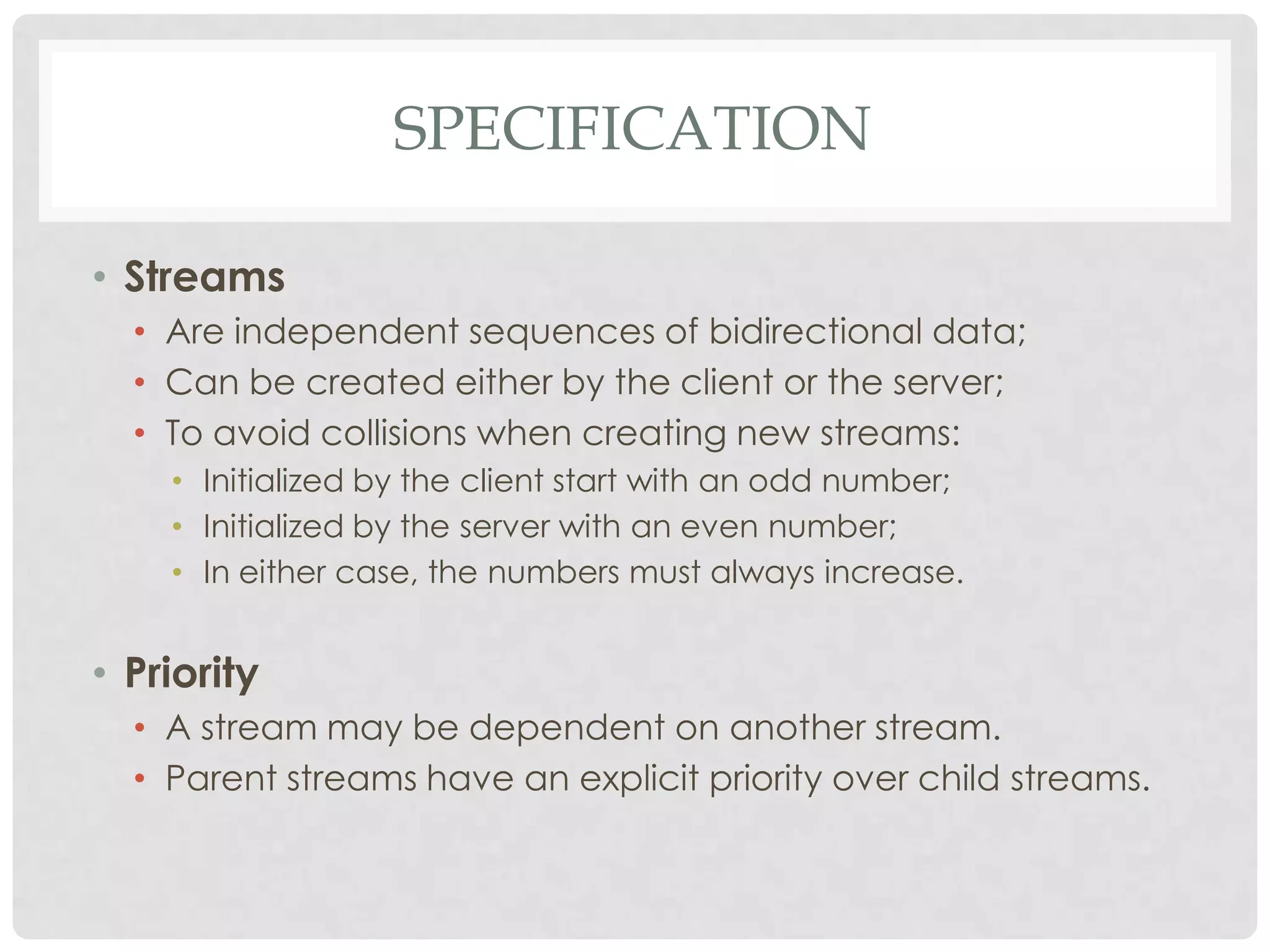
• Streams
• Are independent sequences of bidirectional data;
• Can be created either by the client or the server;
• To avoid collisions when creating new streams:
• Initialized by the client start with an odd number;
• Initialized by the server with an even number;
• In either case, the numbers must always increase.

• Priority
• A stream may be dependent on another stream.
• Parent streams have an explicit priority over child streams.
DEPLOYMENT
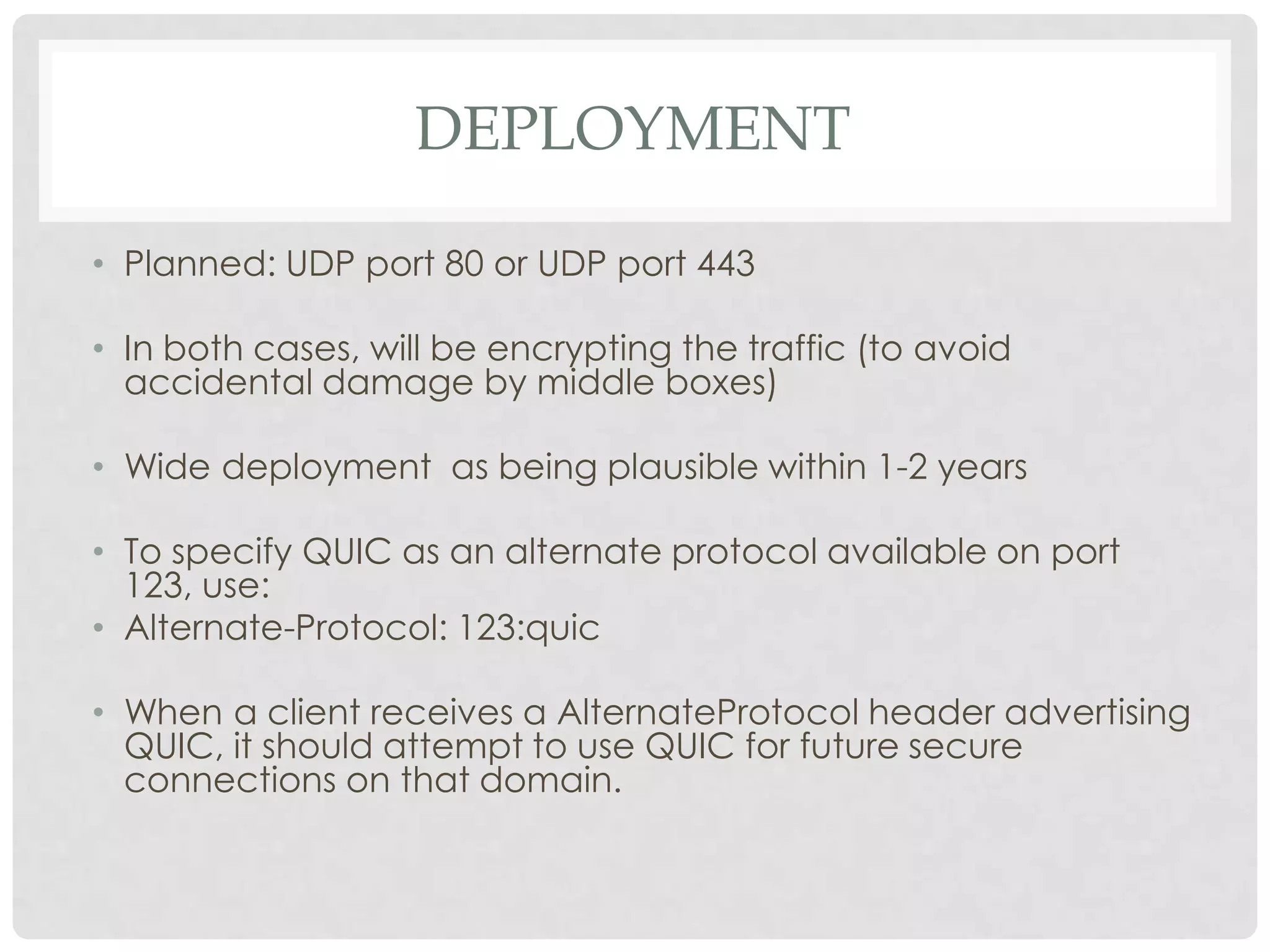
• Planned: UDP port 80 or UDP port 443
• In both cases, will be encrypting the traffic (to avoid
accidental damage by middle boxes)
• Wide deployment as being plausible within 1-2 years

• To specify QUIC as an alternate protocol available on port
123, use:
• Alternate-Protocol: 123:quic
• When a client receives a AlternateProtocol header advertising
QUIC, it should attempt to use QUIC for future secure
connections on that domain.
ADOPTION
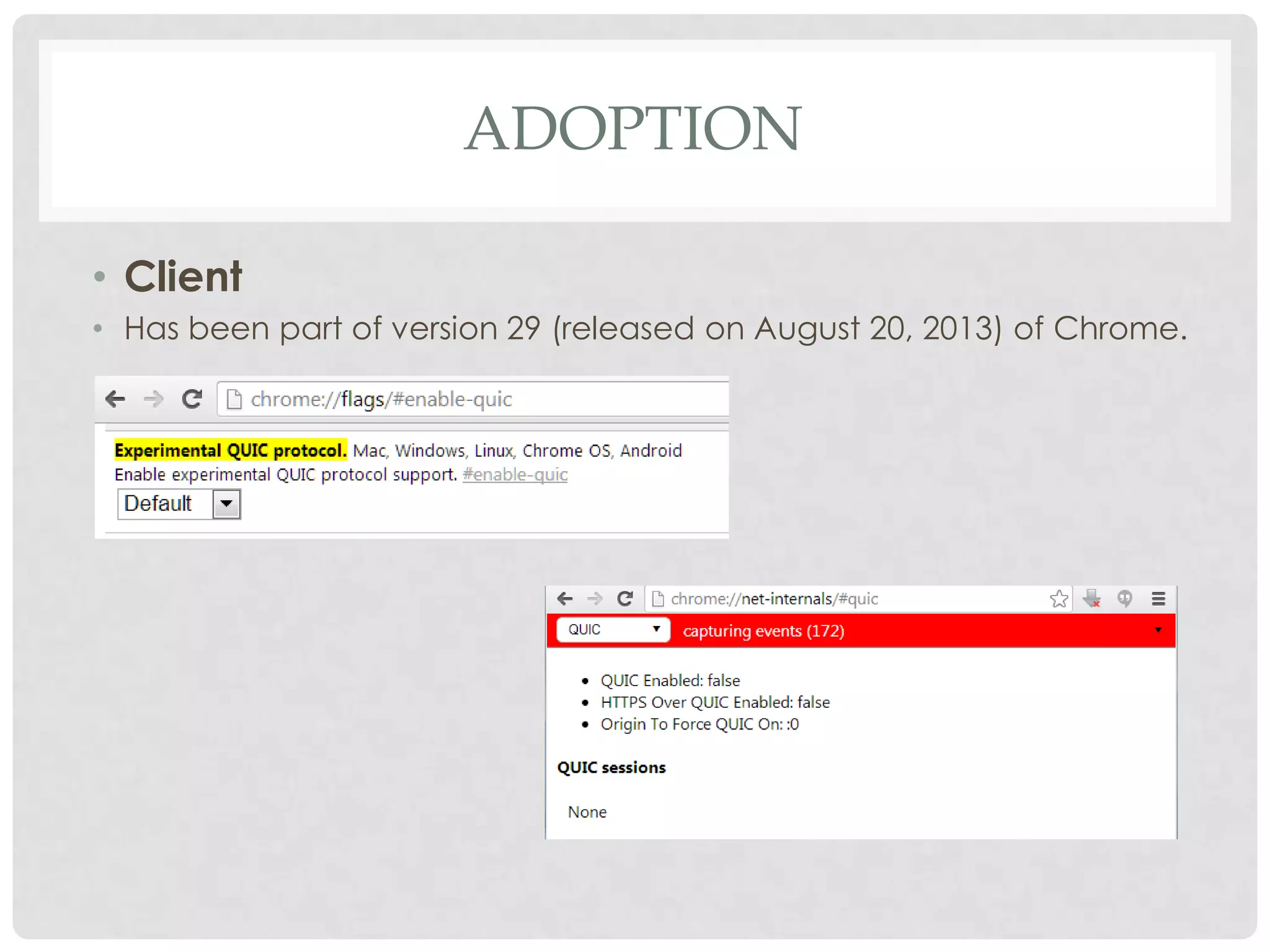
• Client
• Has been part of version 29 (released on August 20, 2013) of Chrome.
ADOPTION
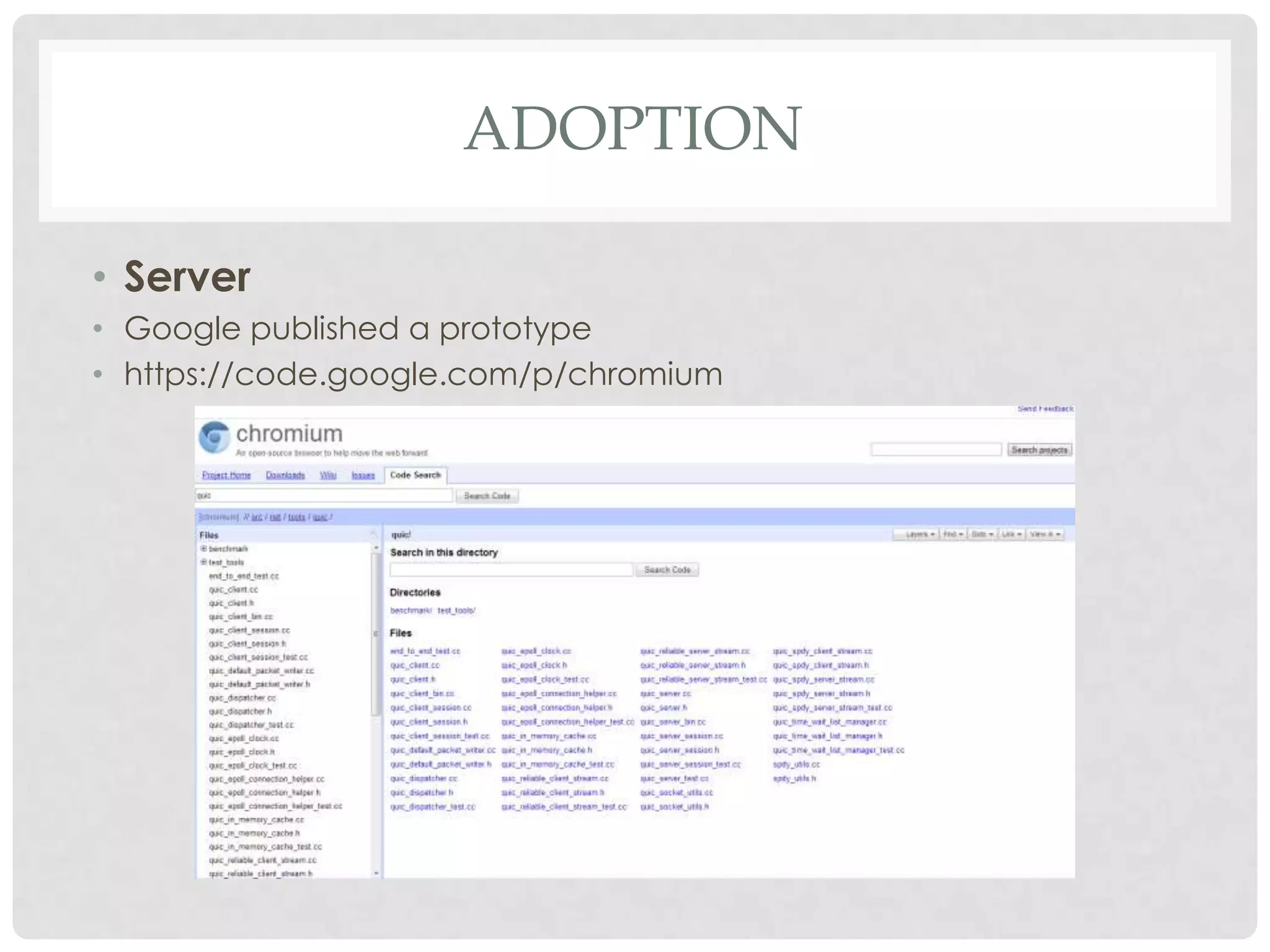
• Server
• Google published a prototype
• https://code.google.com/p/chromium
CONCLUSIONS
• Latency Reduction

• SPDY is good, QUIC is better

• Fast adoption

• In 2012, SPDY supported in Chrome, Firefox, and Opera,
• Many large web destinations (e.g., Google, Twitter, Facebook) were offering SPDY to
compatible clients.

• Patent

• SPDY is not patented
• FAST TCP is Patented, nobody uses

• HTTP 2.0

• HTTP Working Group (HTTP-WG) kicked off the new HTTP 2.0 effort in early 2012 to take
the lessons learned from SPDY and apply them to the official standard.

• Lost FEC Packet

• What Happens?

Google QUIC

  • 1.
    QUIC Quick UDP InternetConnections Aluno: Felipe Rayel Professores: Christian Esteve Rothenbeg, Maurício Ferreira Magalhães IA368- Tópicos em Engenharia de Computação V Faculdade de Engenharia Elétrica e de Computação UNICAMP Nov/2013
  • 2.
  • 3.
  • 4.
    OVERVIEW • • • • • Google SPDY (2009) OverTCP Multiplexing (requests not waiting for previous GETs to complete) Server Push Header compression
  • 5.
    MOTIVATIONS • SPDY overTCP has problem • On TCP: 1 packet delay/loss affect all streams • Next HTTP Request need wait • 3-way-handshake • TCP=1.5 RTT / SSL = 3 RTT • Single congestion window • One window for all streams
  • 6.
    GOALS • QUIC (2013)= Build reliable layer on UDP • Widespread deployability in today’s internet • Middlebox = tipically block anything other than TCP or UDP • Modification over TCP = Need kernel changes • TCP Extension = Over 10 years or more • Packet loss dosen’t effects all streams • One stream for each request. Packets sent out of order • Less RTT • Ack dont needed. No handshake. 0RTT • Separate congestion window • One window for each stream.
  • 7.
    GOALS • SSL layer •Packet level error correction • Reduced latency achieved by using error correction, rather than retransmission. • Improved support for mobile • Mobile Clients = tendency to turn off a radio communications • TCP connections = closed during radio shutdowns + latency costs for session continuations • Reduced bandwidth consumption • Reduced packetcount
  • 8.
    SPECIFICATION • Connection : • • • • QUICframing layer runs atop UDP Session Initiated by client Bidirectional exchange of packets identified by a GUID When a server decides to terminate an idle session, it should not notify the client to avoid waking up the radio on mobile devices.
  • 9.
    SPECIFICATION • GUID (GloballyUnique Identifier): • 64 bit pseudo random number selected by the client • Is the key to the connection. • QUIC sessions are designed to remain established even if the client roams • The IP 4tuple (source IP, source port, destination IP, destination port) may be insufficient to identify the connection
  • 10.
    SPECIFICATION • Framing: • datapackets (contain stream payload data, ACK data, and control data) • ACK Frame = Used to coordinate packet loss recovery • Not identical to an ACK packet in TCP • ACK in QUIC is always cumulative • FEC packets (contain parity data which allows dropped packets to be recovered.)
  • 11.
    SPECIFICATION • Packet Header • • • • • • • • • • • • • • • 0 1 2 3 4 5 6 7 8 +--------+--------+--------+--------+--------+--------+--------+--------+--------+ |Public | GUID (0, 8, 32, or 64) | -> |Flags(8)| (variable length) | +--------+--------+--------+--------+--------+--------+--------+--------+--------+ 9 10 11 12 13 14 15 +--------+--------+--------+--------+--------+--------+--------+ | Quic Version (32) | (cont) -> | (optional) | +--------+--------+--------+--------+--------+--------+--------+ 16 17 18 19 20 +--------+--------+--------+--------+--------+ Sequence (8,16,32,or 48) |Private | FEC (8)| Number (variable length) |Flags(8)| (opt) | +--------+--------+--------+--------+--------+
  • 12.
    SPECIFICATION • Data Packet • • • +--------+.........+--------+.........+ |Type | Payload | Type | Payload | +--------+.........+--------+.........+ • After a header in a packet, there is always a payload block of ciphertext authenticated by an AEAD (Authenticated Encryption with Associated Data ) algorithm.
  • 13.
    SPECIFICATION • FEC (ForwardError Correction) Packet • 16 • • • +............+ | Redundancy | +............+ • QUIC can send periodic FEC packets which contain redundant data. • Can allow lost packets to be recovered without needing to be retransmitted. • TCP requires the client to wait for a retry timeout to expire. • FEC packets (FLAG_FEC set) have a payload that simply contains an XOR of the nullpadded payload of each Data Packet in the FEC group.
  • 14.
    SPECIFICATION • Streams • Areindependent sequences of bidirectional data; • Can be created either by the client or the server; • To avoid collisions when creating new streams: • Initialized by the client start with an odd number; • Initialized by the server with an even number; • In either case, the numbers must always increase. • Priority • A stream may be dependent on another stream. • Parent streams have an explicit priority over child streams.
  • 15.
    DEPLOYMENT • Planned: UDPport 80 or UDP port 443 • In both cases, will be encrypting the traffic (to avoid accidental damage by middle boxes) • Wide deployment as being plausible within 1-2 years • To specify QUIC as an alternate protocol available on port 123, use: • Alternate-Protocol: 123:quic • When a client receives a AlternateProtocol header advertising QUIC, it should attempt to use QUIC for future secure connections on that domain.
  • 16.
    ADOPTION • Client • Hasbeen part of version 29 (released on August 20, 2013) of Chrome.
  • 17.
    ADOPTION • Server • Googlepublished a prototype • https://code.google.com/p/chromium
  • 18.
    CONCLUSIONS • Latency Reduction •SPDY is good, QUIC is better • Fast adoption • In 2012, SPDY supported in Chrome, Firefox, and Opera, • Many large web destinations (e.g., Google, Twitter, Facebook) were offering SPDY to compatible clients. • Patent • SPDY is not patented • FAST TCP is Patented, nobody uses • HTTP 2.0 • HTTP Working Group (HTTP-WG) kicked off the new HTTP 2.0 effort in early 2012 to take the lessons learned from SPDY and apply them to the official standard. • Lost FEC Packet • What Happens?