 2013 Aspire Consulting, Inc.
Leading in a VUCA World
SPQA, September 16, 2014
 2013 Aspire Consulting, Inc.
“May you live in interesting times.”
寧為太平犬,不做亂世人
~ Ancient Chinese curse ~
2
 2013 Aspire Consulting, Inc.
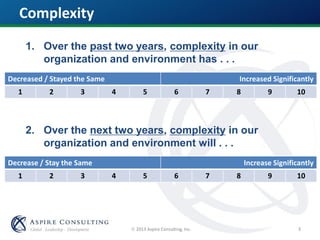
Complexity
3
1. Over the past two years, complexity in our
organization and environment has . . .
Decreased / Stayed the Same Increased Significantly
1 2 3 4 5 6 7 8 9 10
2. Over the next two years, complexity in our
organization and environment will . . .
Decrease / Stay the Same Increase Significantly
1 2 3 4 5 6 7 8 9 10
 2013 Aspire Consulting, Inc.
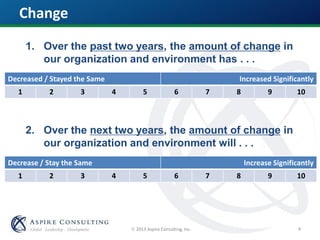
Change
4
1. Over the past two years, the amount of change in
our organization and environment has . . .
Decreased / Stayed the Same Increased Significantly
1 2 3 4 5 6 7 8 9 10
2. Over the next two years, the amount of change in
our organization and environment will . . .
Decrease / Stay the Same Increase Significantly
1 2 3 4 5 6 7 8 9 10
 2013 Aspire Consulting, Inc.
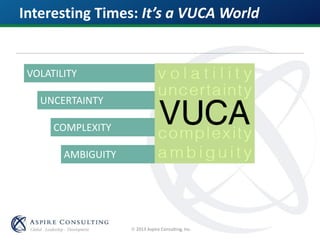
VOLATILITY
UNCERTAINTY
COMPLEXITY
AMBIGUITY
Interesting Times: It’s a VUCA World
 2013 Aspire Consulting, Inc.
Leading in a VUCA World
What do leaders need to do to successfully
and effectively lead in this VUCA world?
6
 2013 Aspire Consulting, Inc.
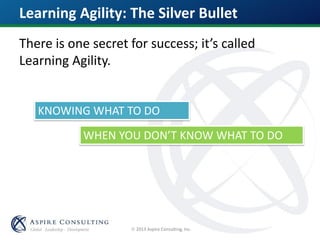
Learning Agility: The Silver Bullet
There is one secret for success; it’s called
Learning Agility.
KNOWING WHAT TO DO
WHEN YOU DON’T KNOW WHAT TO DO
 2013 Aspire Consulting, Inc.
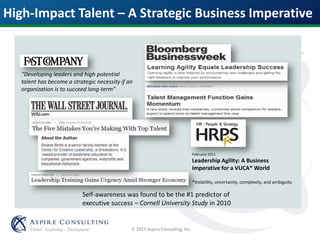
High-Impact Talent – A Strategic Business Imperative
“Developing leaders and high potential
talent has become a strategic necessity if an
organization is to succeed long-term”
February 2011
Leadership Agility: A Business
Imperative for a VUCA* World
*Volatility, uncertainty, complexity, and ambiguity
Self-awareness was found to be the #1 predictor of
executive success – Cornell University Study in 2010
 2013 Aspire Consulting, Inc.
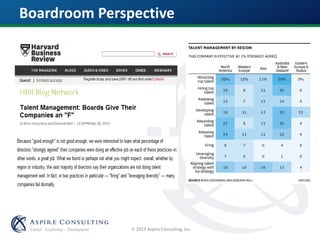
Boardroom Perspective
 2013 Aspire Consulting, Inc.
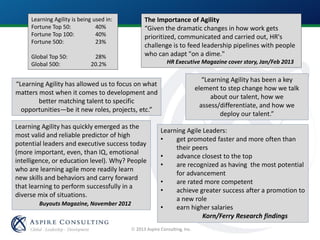
“Learning Agility has been a key
element to step change how we talk
about our talent, how we
assess/differentiate, and how we
deploy our talent.”
“Learning Agility has allowed us to focus on what
matters most when it comes to development and
better matching talent to specific
opportunities—be it new roles, projects, etc.”
Learning Agility is being used in:
Fortune Top 50: 40%
Fortune Top 100: 40%
Fortune 500: 23%
Global Top 50: 28%
Global 500: 20.2%
Learning Agility has quickly emerged as the
most valid and reliable predictor of high
potential leaders and executive success today
(more important, even, than IQ, emotional
intelligence, or education level). Why? People
who are learning agile more readily learn
new skills and behaviors and carry forward
that learning to perform successfully in a
diverse mix of situations.
Buyouts Magazine, November 2012
The Importance of Agility
“Given the dramatic changes in how work gets
prioritized, communicated and carried out, HR's
challenge is to feed leadership pipelines with people
who can adapt "on a dime."
HR Executive Magazine cover story, Jan/Feb 2013
Learning Agile Leaders:
• get promoted faster and more often than
their peers
• advance closest to the top
• are recognized as having the most potential
for advancement
• are rated more competent
• achieve greater success after a promotion to
a new role
• earn higher salaries
Korn/Ferry Research findings
 2013 Aspire Consulting, Inc.
In a VUCA world, the race doesn’t go to the
swift, strong, or smart . . .
. . . the race goes to the most adaptable,
who learn from experience and co-evolve
with the complex adaptive systems within
which they work and live.
11
 2013 Aspire Consulting, Inc.
RESEARCH ON LEARNING AGILITY
 2013 Aspire Consulting, Inc.
?
What behaviors are most
important for executive
success?
Why do executives derail?
Primary Research
Two major research streams from seminal work at
the Center for Creative Leadership and ongoing
Korn/Ferry studies.
 2013 Aspire Consulting, Inc.
Supporting Research
14
– Lombardo & Eichinger (2000) indicated that learning
how to deal effectively with first-time or changing situations is
more predictive of long-term potential or performance than is raw
intelligence.
– Sternberg et. al. (2003) identified street smarts (or
learning from experience) as far more correlated with level
attained in organizations than IQ… and reported that a revised
college admissions test that measures practical and creative
problem solving skills did better at predicting college success
than current SAT and GPAs.
– Bennis & Thomas (2002) describe the signature skill of
leaders as the ability to process new experiences… and to
integrate them into their life.
 2013 Aspire Consulting, Inc.
Have You Seen Agile Learners?
• Keen observers of themselves,
others & situations
• They compare things, search
for parallels, look at history
• Have resilience and optimism
regarding change
• Resourceful under tough
conditions, inspiring others to
perform beyond normal
• They make sense through “rules
of thumb”
• Open to the ideas and opinions
of others
• Willing to learn from
feedback, and willing to admit
to weaknesses
• Think “more” in comparison to
others: more ways to handle
situations, more things to learn,
more ways to achieve it, etc.
The Leadership Machine
 2013 Aspire Consulting, Inc.
Have You Seen Agile Learners?
Eventually, as Sternberg’s research
indicates, they pile up at the top of
organizations.
They accumulate more diverse
experiences, spend far more time making
sense of them, and as a result develop
more skills and perform better.
CCL studies were similar.
 2013 Aspire Consulting, Inc.
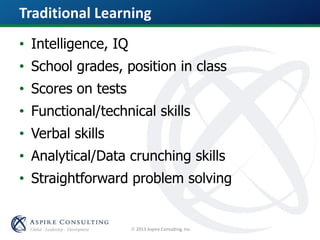
Traditional Learning
• Intelligence, IQ
• School grades, position in class
• Scores on tests
• Functional/technical skills
• Verbal skills
• Analytical/Data crunching skills
• Straightforward problem solving
 2013 Aspire Consulting, Inc.
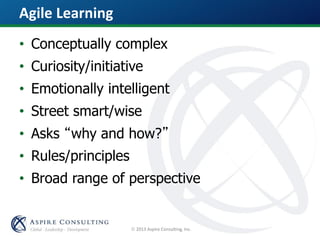
Agile Learning
• Conceptually complex
• Curiosity/initiative
• Emotionally intelligent
• Street smart/wise
• Asks “why and how?”
• Rules/principles
• Broad range of perspective
 2013 Aspire Consulting, Inc.
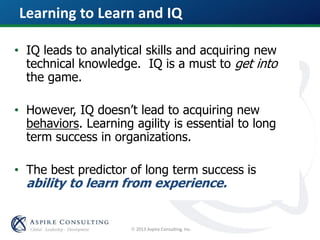
Learning to Learn and IQ
• IQ leads to analytical skills and acquiring new
technical knowledge. IQ is a must to get into
the game.
• However, IQ doesn’t lead to acquiring new
behaviors. Learning agility is essential to long
term success in organizations.
• The best predictor of long term success is
ability to learn from experience.
 2013 Aspire Consulting, Inc.
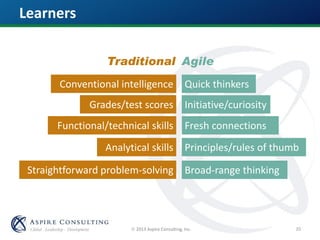
Learners
20
Conventional intelligence
Grades/test scores
Functional/technical skills
Analytical skills
Straightforward problem-solving
Quick thinkers
Initiative/curiosity
Fresh connections
Principles/rules of thumb
Broad-range thinking
Traditional Agile
 2013 Aspire Consulting, Inc.
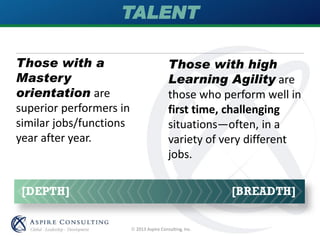
Those with a
Mastery
orientation are
superior performers in
similar jobs/functions
year after year.
Those with high
Learning Agility are
those who perform well in
first time, challenging
situations—often, in a
variety of very different
jobs.
TALENT
 2013 Aspire Consulting, Inc.
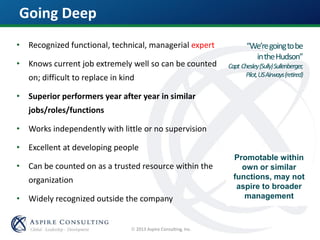
Promotable within
own or similar
functions, may not
aspire to broader
management
“We’regoingtobe
intheHudson”
Capt Chesley(Sully)Sullenberger,
Pilot,USAirways(retired)
Going Deep
• Recognized functional, technical, managerial expert
• Knows current job extremely well so can be counted
on; difficult to replace in kind
• Superior performers year after year in similar
jobs/roles/functions
• Works independently with little or no supervision
• Excellent at developing people
• Can be counted on as a trusted resource within the
organization
• Widely recognized outside the company
 2013 Aspire Consulting, Inc.
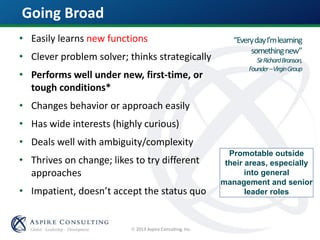
Promotable outside
their areas, especially
into general
management and senior
leader roles
“EverydayI’mlearning
somethingnew”
SirRichardBranson,
Founder–VirginGroup
Going Broad
• Easily learns new functions
• Clever problem solver; thinks strategically
• Performs well under new, first-time, or
tough conditions*
• Changes behavior or approach easily
• Has wide interests (highly curious)
• Deals well with ambiguity/complexity
• Thrives on change; likes to try different
approaches
• Impatient, doesn’t accept the status quo
 2013 Aspire Consulting, Inc.
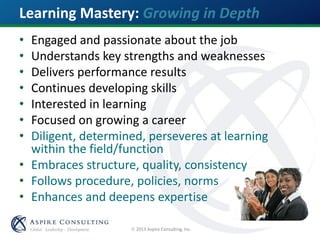
Learning Mastery: Growing in Depth
• Engaged and passionate about the job
• Understands key strengths and weaknesses
• Delivers performance results
• Continues developing skills
• Interested in learning
• Focused on growing a career
• Diligent, determined, perseveres at learning
within the field/function
• Embraces structure, quality, consistency
• Follows procedure, policies, norms
• Enhances and deepens expertise
 2013 Aspire Consulting, Inc.
Learning Agility: Growing in Breadth
• Engaged and passionate about the job
• Understands key strengths and weaknesses
• Delivers performance results
• Continues developing skills
• Interested in learning
• Focused on growing a career
• Embraces uncertainty, complexity, ambiguity
• Resourceful, risk taking, bored with routine
• Views the big picture
 2013 Aspire Consulting, Inc.
Depth Breadth
• Diligent,
determined,
perseveres at
learning w/in the
field/function
• Embraces
structure, quality,
consistency
• Follows
procedure,
policies, norms
• Enhances and
deepens
expertise
• Embraces
uncertainty,
complexity,
ambiguity
• Resourceful, risk
taking, bored
with routine
• Views the big
picture
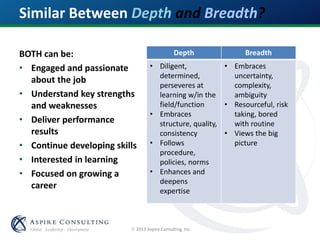
Similar Between Depth and Breadth?
BOTH can be:
• Engaged and passionate
about the job
• Understand key strengths
and weaknesses
• Deliver performance
results
• Continue developing skills
• Interested in learning
• Focused on growing a
career
 2013 Aspire Consulting, Inc.
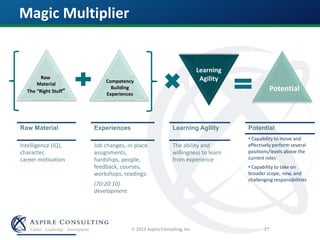
Magic Multiplier
27
Potential
Learning
AgilityRaw
Material
The “Right Stuff”
Competency
Building
Experiences
Raw Material
Intelligence (IQ),
character,
career motivation
Learning Agility
The ability and
willingness to learn
from experience
Experiences
Job changes, in-place
assignments,
hardships, people,
feedback, courses,
workshops, readings:
(70:20:10)
development
Potential
• Capability to move and
effectively perform several
positions/levels above the
current roles
• Capability to take on
broader scope, new, and
challenging responsibilities
 2013 Aspire Consulting, Inc.
Learning Agility
Is related to…
Potential.
Performance once promoted
outside their area.
The ability to handle
tough, new assignments.
 2013 Aspire Consulting, Inc.
29
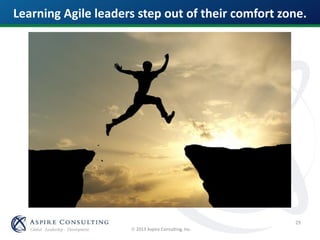
Learning Agile leaders step out of their comfort zone.
 2013 Aspire Consulting, Inc.
©2011 Korn/Ferry International
ALL RIGHTS RESERVED3
0
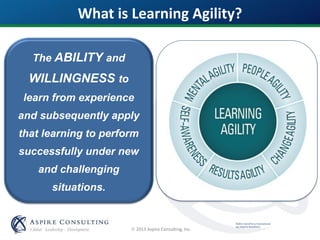
The ABILITY and
WILLINGNESS to
learn from experience
and subsequently apply
that learning to perform
successfully under new
and challenging
situations.
What is Learning Agility?
 2013 Aspire Consulting, Inc.
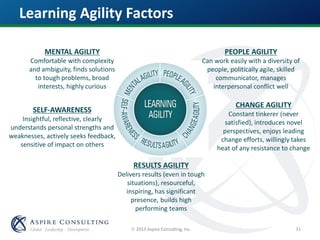
Learning Agility Factors
31
SELF-AWARENESS
Insightful, reflective, clearly
understands personal strengths and
weaknesses, actively seeks feedback,
sensitive of impact on others
RESULTS AGILITY
Delivers results (even in tough
situations), resourceful,
inspiring, has significant
presence, builds high
performing teams
PEOPLE AGILITY
Can work easily with a diversity of
people, politically agile, skilled
communicator, manages
interpersonal conflict well
MENTAL AGILITY
Comfortable with complexity
and ambiguity, finds solutions
to tough problems, broad
interests, highly curious
CHANGE AGILITY
Constant tinkerer (never
satisfied), introduces novel
perspectives, enjoys leading
change efforts, willingly takes
heat of any resistance to change
 2013 Aspire Consulting, Inc.
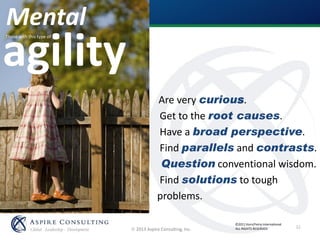
Mental
Are very curious.
Get to the root causes.
Have a broad perspective.
Find parallels and contrasts.
Question conventional wisdom.
Find solutions to tough
problems.
agility
Those with this type of
©2011 Korn/Ferry International
ALL RIGHTS RESERVED
3
2 32
 2013 Aspire Consulting, Inc.
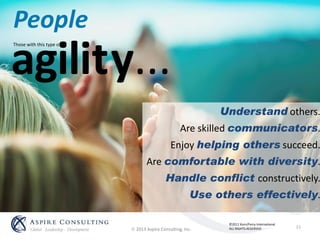
People
Understand others.
Are skilled communicators.
Enjoy helping others succeed.
Are comfortable with diversity.
Handle conflict constructively.
Use others effectively.
agility...
Those with this type of
©2011 Korn/Ferry International
ALL RIGHTS RESERVED
3
3 33
 2013 Aspire Consulting, Inc.
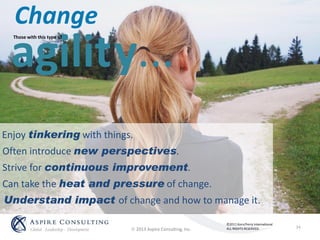
Change
Enjoy tinkering with things.
Often introduce new perspectives.
Strive for continuous improvement.
Can take the heat and pressure of change.
Understand impact of change and how to manage it.
agility...
Those with this type of
©2011 Korn/Ferry International
ALL RIGHTS RESERVED
3
4 34
 2013 Aspire Consulting, Inc.
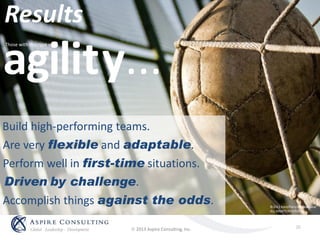
Results
Build high-performing teams.
Are very flexible and adaptable.
Perform well in first-time situations.
Driven by challenge.
Accomplish things against the odds.
agility...
Those with this type of
©2011 Korn/Ferry International
ALL RIGHTS RESERVED
3
5 35
 2013 Aspire Consulting, Inc.
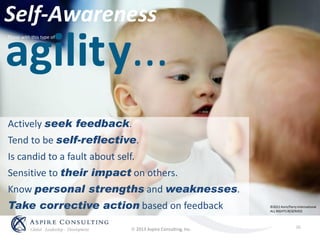
Self-Awareness
Actively seek feedback.
Tend to be self-reflective.
Is candid to a fault about self.
Sensitive to their impact on others.
Know personal strengths and weaknesses.
Take corrective action based on feedback
agility...
Those with this type of
©2011 Korn/Ferry International
ALL RIGHTS RESERVED
3
6 36
 2013 Aspire Consulting, Inc.
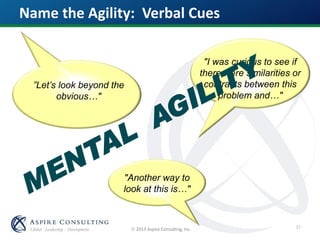
”Let’s look beyond the
obvious…"
"I was curious to see if
there were similarities or
contrasts between this
problem and…"
"Another way to
look at this is…"
Name the Agility: Verbal Cues
37
 2013 Aspire Consulting, Inc.
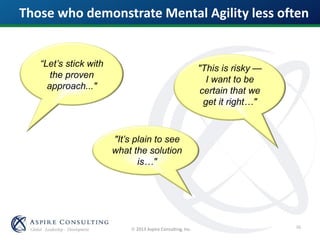
“Let’s stick with
the proven
approach..."
"This is risky —
I want to be
certain that we
get it right…"
"It’s plain to see
what the solution
is…"
Those who demonstrate Mental Agility less often
38
 2013 Aspire Consulting, Inc.
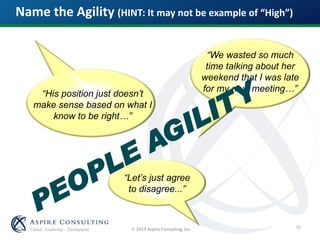
Name the Agility (HINT: It may not be example of “High”)
“His position just doesn’t
make sense based on what I
know to be right…”
“We wasted so much
time talking about her
weekend that I was late
for my next meeting…”
“Let’s just agree
to disagree...”
39
 2013 Aspire Consulting, Inc.
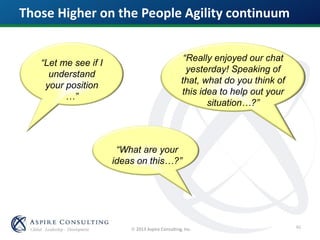
“Let me see if I
understand
your position
…”
“Really enjoyed our chat
yesterday! Speaking of
that, what do you think of
this idea to help out your
situation…?”
“What are your
ideas on this…?”
Those Higher on the People Agility continuum
40
 2013 Aspire Consulting, Inc.
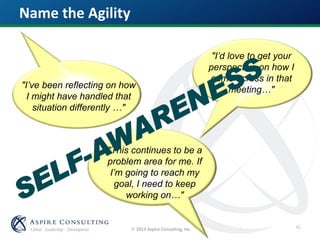
"I’ve been reflecting on how
I might have handled that
situation differently …"
"I’d love to get your
perspective on how I
came across in that
meeting…"
"This continues to be a
problem area for me. If
I’m going to reach my
goal, I need to keep
working on…"
Name the Agility
41
 2013 Aspire Consulting, Inc.
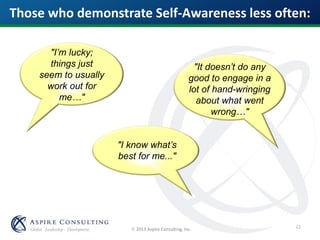
"I’m lucky;
things just
seem to usually
work out for
me…"
"It doesn’t do any
good to engage in a
lot of hand-wringing
about what went
wrong…"
"I know what’s
best for me..."
Those who demonstrate Self-Awareness less often:
42
 2013 Aspire Consulting, Inc.
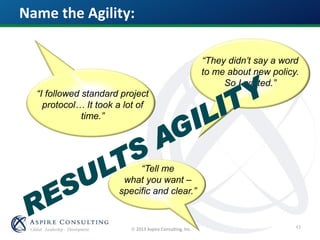
“I followed standard project
protocol… It took a lot of
time.”
“They didn’t say a word
to me about new policy.
So I waited.”
“Tell me
what you want –
specific and clear.”
Name the Agility:
43
 2013 Aspire Consulting, Inc.
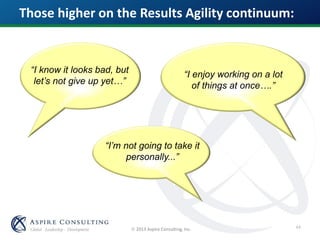
“I know it looks bad, but
let’s not give up yet…”
“I enjoy working on a lot
of things at once….”
“I’m not going to take it
personally...”
Those higher on the Results Agility continuum:
44
 2013 Aspire Consulting, Inc.
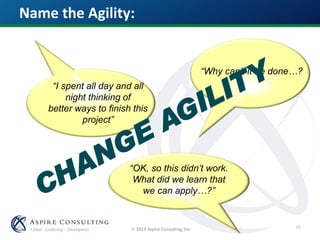
“I spent all day and all
night thinking of
better ways to finish this
project”
“Why can’t it be done…?
“OK, so this didn’t work.
What did we learn that
we can apply…?”
Name the Agility:
45
 2013 Aspire Consulting, Inc.
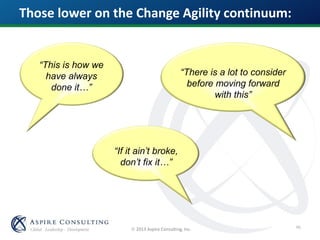
“This is how we
have always
done it…”
“There is a lot to consider
before moving forward
with this”
“If it ain’t broke,
don’t fix it…”
Those lower on the Change Agility continuum:
46
 2013 Aspire Consulting, Inc.
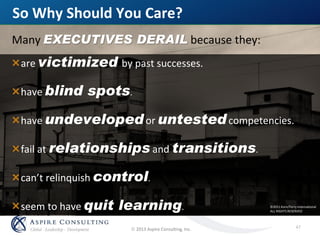
So Why Should You Care?
are victimized by past successes.
have blind spots.
have undevelopedor untestedcompetencies.
fail at relationships and transitions.
can’t relinquish control.
seem to have quit learning.
Many EXECUTIVES DERAIL because they:
©2011 Korn/Ferry International
ALL RIGHTS RESERVED
4
7 47
 2013 Aspire Consulting, Inc.
DO ALL JOBS REQUIRE
LEARNING AGILITY?
48
 2013 Aspire Consulting, Inc.
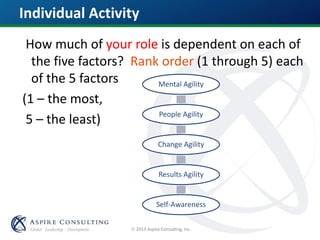
Individual Activity
How much of your role is dependent on each of
the five factors? Rank order (1 through 5) each
of the 5 factors
(1 – the most,
5 – the least)
Mental Agility
People Agility
Change Agility
Results Agility
Self-Awareness
 2013 Aspire Consulting, Inc.
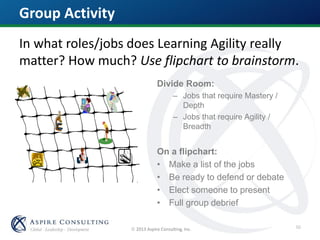
Group Activity
In what roles/jobs does Learning Agility really
matter? How much? Use flipchart to brainstorm.
Divide Room:
– Jobs that require Mastery /
Depth
– Jobs that require Agility /
Breadth
On a flipchart:
• Make a list of the jobs
• Be ready to defend or debate
• Elect someone to present
• Full group debrief
50
 2013 Aspire Consulting, Inc.
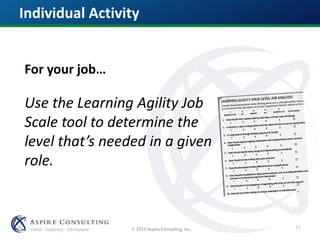
Individual Activity
For your job…
Use the Learning Agility Job
Scale tool to determine the
level that’s needed in a given
role.
51
 2013 Aspire Consulting, Inc.
• It is NOT about high versus low, good versus bad
• It is about your preference for breadth vs. depth
• It is HOW you learn from experience, not WHETHER
you learn at all
• It is about what adds VALUE in your role and
organization
• It is about what career GOALS you have and what
motivates you to get there
KEY MESSAGES:
 2013 Aspire Consulting, Inc.
LEARNING MORE ABOUT LEARNING
AGILITY
53
 2013 Aspire Consulting, Inc.
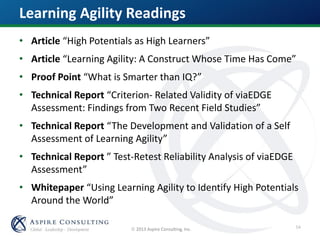
• Article “High Potentials as High Learners”
• Article “Learning Agility: A Construct Whose Time Has Come”
• Proof Point “What is Smarter than IQ?”
• Technical Report “Criterion- Related Validity of viaEDGE
Assessment: Findings from Two Recent Field Studies”
• Technical Report “The Development and Validation of a Self
Assessment of Learning Agility”
• Technical Report ” Test-Retest Reliability Analysis of viaEDGE
Assessment”
• Whitepaper “Using Learning Agility to Identify High Potentials
Around the World”
Learning Agility Readings
54
 2013 Aspire Consulting, Inc.
Developing Learning Agility
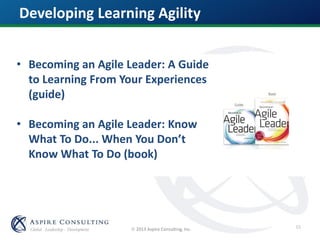
• Becoming an Agile Leader: A Guide
to Learning From Your Experiences
(guide)
• Becoming an Agile Leader: Know
What To Do... When You Don’t
Know What To Do (book)
55
 2013 Aspire Consulting, Inc.
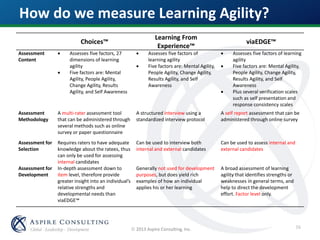
How do we measure Learning Agility?
Choices™
Learning From
Experience™
viaEDGE™
Assessment
Content
 Assesses five factors, 27
dimensions of learning
agility
 Five factors are: Mental
Agility, People Agility,
Change Agility, Results
Agility, and Self Awareness
 Assesses five factors of
learning agility
 Five factors are: Mental Agility,
People Agility, Change Agility,
Results Agility, and Self
Awareness
 Assesses five factors of learning
agility
 Five factors are: Mental Agility,
People Agility, Change Agility,
Results Agility, and Self
Awareness
 Plus several verification scales
such as self presentation and
response consistency scales
Assessment
Methodology
A multi-rater assessment tool
that can be administered through
several methods such as online
survey or paper questionnaire
A structured interview using a
standardized interview protocol
A self report assessment that can be
administered through online survey
Assessment for
Selection
Requires raters to have adequate
knowledge about the ratees, thus
can only be used for assessing
internal candidates
Can be used to interview both
internal and external candidates
Can be used to assess internal and
external candidates
Assessment for
Development
In-depth assessment down to
item level, therefore provide
greater insight into an individual’s
relative strengths and
developmental needs than
viaEDGE™
Generally not used for development
purposes, but does yield rich
examples of how an individual
applies his or her learning
A broad assessment of learning
agility that identifies strengths or
weaknesses in general terms, and
help to direct the development
effort. Factor level only.
56
 2013 Aspire Consulting, Inc.
Thank You!
steve@aspireconsulting.net
757-647-2571
57

Leading in a vuca world terrell

  • 1.
     2013 AspireConsulting, Inc. Leading in a VUCA World SPQA, September 16, 2014
  • 2.
     2013 AspireConsulting, Inc. “May you live in interesting times.” 寧為太平犬,不做亂世人 ~ Ancient Chinese curse ~ 2
  • 3.
     2013 AspireConsulting, Inc. Complexity 3 1. Over the past two years, complexity in our organization and environment has . . . Decreased / Stayed the Same Increased Significantly 1 2 3 4 5 6 7 8 9 10 2. Over the next two years, complexity in our organization and environment will . . . Decrease / Stay the Same Increase Significantly 1 2 3 4 5 6 7 8 9 10
  • 4.
     2013 AspireConsulting, Inc. Change 4 1. Over the past two years, the amount of change in our organization and environment has . . . Decreased / Stayed the Same Increased Significantly 1 2 3 4 5 6 7 8 9 10 2. Over the next two years, the amount of change in our organization and environment will . . . Decrease / Stay the Same Increase Significantly 1 2 3 4 5 6 7 8 9 10
  • 5.
     2013 AspireConsulting, Inc. VOLATILITY UNCERTAINTY COMPLEXITY AMBIGUITY Interesting Times: It’s a VUCA World
  • 6.
     2013 AspireConsulting, Inc. Leading in a VUCA World What do leaders need to do to successfully and effectively lead in this VUCA world? 6
  • 7.
     2013 AspireConsulting, Inc. Learning Agility: The Silver Bullet There is one secret for success; it’s called Learning Agility. KNOWING WHAT TO DO WHEN YOU DON’T KNOW WHAT TO DO
  • 8.
     2013 AspireConsulting, Inc. High-Impact Talent – A Strategic Business Imperative “Developing leaders and high potential talent has become a strategic necessity if an organization is to succeed long-term” February 2011 Leadership Agility: A Business Imperative for a VUCA* World *Volatility, uncertainty, complexity, and ambiguity Self-awareness was found to be the #1 predictor of executive success – Cornell University Study in 2010
  • 9.
     2013 AspireConsulting, Inc. Boardroom Perspective
  • 10.
     2013 AspireConsulting, Inc. “Learning Agility has been a key element to step change how we talk about our talent, how we assess/differentiate, and how we deploy our talent.” “Learning Agility has allowed us to focus on what matters most when it comes to development and better matching talent to specific opportunities—be it new roles, projects, etc.” Learning Agility is being used in: Fortune Top 50: 40% Fortune Top 100: 40% Fortune 500: 23% Global Top 50: 28% Global 500: 20.2% Learning Agility has quickly emerged as the most valid and reliable predictor of high potential leaders and executive success today (more important, even, than IQ, emotional intelligence, or education level). Why? People who are learning agile more readily learn new skills and behaviors and carry forward that learning to perform successfully in a diverse mix of situations. Buyouts Magazine, November 2012 The Importance of Agility “Given the dramatic changes in how work gets prioritized, communicated and carried out, HR's challenge is to feed leadership pipelines with people who can adapt "on a dime." HR Executive Magazine cover story, Jan/Feb 2013 Learning Agile Leaders: • get promoted faster and more often than their peers • advance closest to the top • are recognized as having the most potential for advancement • are rated more competent • achieve greater success after a promotion to a new role • earn higher salaries Korn/Ferry Research findings
  • 11.
     2013 AspireConsulting, Inc. In a VUCA world, the race doesn’t go to the swift, strong, or smart . . . . . . the race goes to the most adaptable, who learn from experience and co-evolve with the complex adaptive systems within which they work and live. 11
  • 12.
     2013 AspireConsulting, Inc. RESEARCH ON LEARNING AGILITY
  • 13.
     2013 AspireConsulting, Inc. ? What behaviors are most important for executive success? Why do executives derail? Primary Research Two major research streams from seminal work at the Center for Creative Leadership and ongoing Korn/Ferry studies.
  • 14.
     2013 AspireConsulting, Inc. Supporting Research 14 – Lombardo & Eichinger (2000) indicated that learning how to deal effectively with first-time or changing situations is more predictive of long-term potential or performance than is raw intelligence. – Sternberg et. al. (2003) identified street smarts (or learning from experience) as far more correlated with level attained in organizations than IQ… and reported that a revised college admissions test that measures practical and creative problem solving skills did better at predicting college success than current SAT and GPAs. – Bennis & Thomas (2002) describe the signature skill of leaders as the ability to process new experiences… and to integrate them into their life.
  • 15.
     2013 AspireConsulting, Inc. Have You Seen Agile Learners? • Keen observers of themselves, others & situations • They compare things, search for parallels, look at history • Have resilience and optimism regarding change • Resourceful under tough conditions, inspiring others to perform beyond normal • They make sense through “rules of thumb” • Open to the ideas and opinions of others • Willing to learn from feedback, and willing to admit to weaknesses • Think “more” in comparison to others: more ways to handle situations, more things to learn, more ways to achieve it, etc. The Leadership Machine
  • 16.
     2013 AspireConsulting, Inc. Have You Seen Agile Learners? Eventually, as Sternberg’s research indicates, they pile up at the top of organizations. They accumulate more diverse experiences, spend far more time making sense of them, and as a result develop more skills and perform better. CCL studies were similar.
  • 17.
     2013 AspireConsulting, Inc. Traditional Learning • Intelligence, IQ • School grades, position in class • Scores on tests • Functional/technical skills • Verbal skills • Analytical/Data crunching skills • Straightforward problem solving
  • 18.
     2013 AspireConsulting, Inc. Agile Learning • Conceptually complex • Curiosity/initiative • Emotionally intelligent • Street smart/wise • Asks “why and how?” • Rules/principles • Broad range of perspective
  • 19.
     2013 AspireConsulting, Inc. Learning to Learn and IQ • IQ leads to analytical skills and acquiring new technical knowledge. IQ is a must to get into the game. • However, IQ doesn’t lead to acquiring new behaviors. Learning agility is essential to long term success in organizations. • The best predictor of long term success is ability to learn from experience.
  • 20.
     2013 AspireConsulting, Inc. Learners 20 Conventional intelligence Grades/test scores Functional/technical skills Analytical skills Straightforward problem-solving Quick thinkers Initiative/curiosity Fresh connections Principles/rules of thumb Broad-range thinking Traditional Agile
  • 21.
     2013 AspireConsulting, Inc. Those with a Mastery orientation are superior performers in similar jobs/functions year after year. Those with high Learning Agility are those who perform well in first time, challenging situations—often, in a variety of very different jobs. TALENT
  • 22.
     2013 AspireConsulting, Inc. Promotable within own or similar functions, may not aspire to broader management “We’regoingtobe intheHudson” Capt Chesley(Sully)Sullenberger, Pilot,USAirways(retired) Going Deep • Recognized functional, technical, managerial expert • Knows current job extremely well so can be counted on; difficult to replace in kind • Superior performers year after year in similar jobs/roles/functions • Works independently with little or no supervision • Excellent at developing people • Can be counted on as a trusted resource within the organization • Widely recognized outside the company
  • 23.
     2013 AspireConsulting, Inc. Promotable outside their areas, especially into general management and senior leader roles “EverydayI’mlearning somethingnew” SirRichardBranson, Founder–VirginGroup Going Broad • Easily learns new functions • Clever problem solver; thinks strategically • Performs well under new, first-time, or tough conditions* • Changes behavior or approach easily • Has wide interests (highly curious) • Deals well with ambiguity/complexity • Thrives on change; likes to try different approaches • Impatient, doesn’t accept the status quo
  • 24.
     2013 AspireConsulting, Inc. Learning Mastery: Growing in Depth • Engaged and passionate about the job • Understands key strengths and weaknesses • Delivers performance results • Continues developing skills • Interested in learning • Focused on growing a career • Diligent, determined, perseveres at learning within the field/function • Embraces structure, quality, consistency • Follows procedure, policies, norms • Enhances and deepens expertise
  • 25.
     2013 AspireConsulting, Inc. Learning Agility: Growing in Breadth • Engaged and passionate about the job • Understands key strengths and weaknesses • Delivers performance results • Continues developing skills • Interested in learning • Focused on growing a career • Embraces uncertainty, complexity, ambiguity • Resourceful, risk taking, bored with routine • Views the big picture
  • 26.
     2013 AspireConsulting, Inc. Depth Breadth • Diligent, determined, perseveres at learning w/in the field/function • Embraces structure, quality, consistency • Follows procedure, policies, norms • Enhances and deepens expertise • Embraces uncertainty, complexity, ambiguity • Resourceful, risk taking, bored with routine • Views the big picture Similar Between Depth and Breadth? BOTH can be: • Engaged and passionate about the job • Understand key strengths and weaknesses • Deliver performance results • Continue developing skills • Interested in learning • Focused on growing a career
  • 27.
     2013 AspireConsulting, Inc. Magic Multiplier 27 Potential Learning AgilityRaw Material The “Right Stuff” Competency Building Experiences Raw Material Intelligence (IQ), character, career motivation Learning Agility The ability and willingness to learn from experience Experiences Job changes, in-place assignments, hardships, people, feedback, courses, workshops, readings: (70:20:10) development Potential • Capability to move and effectively perform several positions/levels above the current roles • Capability to take on broader scope, new, and challenging responsibilities
  • 28.
     2013 AspireConsulting, Inc. Learning Agility Is related to… Potential. Performance once promoted outside their area. The ability to handle tough, new assignments.
  • 29.
     2013 AspireConsulting, Inc. 29 Learning Agile leaders step out of their comfort zone.
  • 30.
     2013 AspireConsulting, Inc. ©2011 Korn/Ferry International ALL RIGHTS RESERVED3 0 The ABILITY and WILLINGNESS to learn from experience and subsequently apply that learning to perform successfully under new and challenging situations. What is Learning Agility?
  • 31.
     2013 AspireConsulting, Inc. Learning Agility Factors 31 SELF-AWARENESS Insightful, reflective, clearly understands personal strengths and weaknesses, actively seeks feedback, sensitive of impact on others RESULTS AGILITY Delivers results (even in tough situations), resourceful, inspiring, has significant presence, builds high performing teams PEOPLE AGILITY Can work easily with a diversity of people, politically agile, skilled communicator, manages interpersonal conflict well MENTAL AGILITY Comfortable with complexity and ambiguity, finds solutions to tough problems, broad interests, highly curious CHANGE AGILITY Constant tinkerer (never satisfied), introduces novel perspectives, enjoys leading change efforts, willingly takes heat of any resistance to change
  • 32.
     2013 AspireConsulting, Inc. Mental Are very curious. Get to the root causes. Have a broad perspective. Find parallels and contrasts. Question conventional wisdom. Find solutions to tough problems. agility Those with this type of ©2011 Korn/Ferry International ALL RIGHTS RESERVED 3 2 32
  • 33.
     2013 AspireConsulting, Inc. People Understand others. Are skilled communicators. Enjoy helping others succeed. Are comfortable with diversity. Handle conflict constructively. Use others effectively. agility... Those with this type of ©2011 Korn/Ferry International ALL RIGHTS RESERVED 3 3 33
  • 34.
     2013 AspireConsulting, Inc. Change Enjoy tinkering with things. Often introduce new perspectives. Strive for continuous improvement. Can take the heat and pressure of change. Understand impact of change and how to manage it. agility... Those with this type of ©2011 Korn/Ferry International ALL RIGHTS RESERVED 3 4 34
  • 35.
     2013 AspireConsulting, Inc. Results Build high-performing teams. Are very flexible and adaptable. Perform well in first-time situations. Driven by challenge. Accomplish things against the odds. agility... Those with this type of ©2011 Korn/Ferry International ALL RIGHTS RESERVED 3 5 35
  • 36.
     2013 AspireConsulting, Inc. Self-Awareness Actively seek feedback. Tend to be self-reflective. Is candid to a fault about self. Sensitive to their impact on others. Know personal strengths and weaknesses. Take corrective action based on feedback agility... Those with this type of ©2011 Korn/Ferry International ALL RIGHTS RESERVED 3 6 36
  • 37.
     2013 AspireConsulting, Inc. ”Let’s look beyond the obvious…" "I was curious to see if there were similarities or contrasts between this problem and…" "Another way to look at this is…" Name the Agility: Verbal Cues 37
  • 38.
     2013 AspireConsulting, Inc. “Let’s stick with the proven approach..." "This is risky — I want to be certain that we get it right…" "It’s plain to see what the solution is…" Those who demonstrate Mental Agility less often 38
  • 39.
     2013 AspireConsulting, Inc. Name the Agility (HINT: It may not be example of “High”) “His position just doesn’t make sense based on what I know to be right…” “We wasted so much time talking about her weekend that I was late for my next meeting…” “Let’s just agree to disagree...” 39
  • 40.
     2013 AspireConsulting, Inc. “Let me see if I understand your position …” “Really enjoyed our chat yesterday! Speaking of that, what do you think of this idea to help out your situation…?” “What are your ideas on this…?” Those Higher on the People Agility continuum 40
  • 41.
     2013 AspireConsulting, Inc. "I’ve been reflecting on how I might have handled that situation differently …" "I’d love to get your perspective on how I came across in that meeting…" "This continues to be a problem area for me. If I’m going to reach my goal, I need to keep working on…" Name the Agility 41
  • 42.
     2013 AspireConsulting, Inc. "I’m lucky; things just seem to usually work out for me…" "It doesn’t do any good to engage in a lot of hand-wringing about what went wrong…" "I know what’s best for me..." Those who demonstrate Self-Awareness less often: 42
  • 43.
     2013 AspireConsulting, Inc. “I followed standard project protocol… It took a lot of time.” “They didn’t say a word to me about new policy. So I waited.” “Tell me what you want – specific and clear.” Name the Agility: 43
  • 44.
     2013 AspireConsulting, Inc. “I know it looks bad, but let’s not give up yet…” “I enjoy working on a lot of things at once….” “I’m not going to take it personally...” Those higher on the Results Agility continuum: 44
  • 45.
     2013 AspireConsulting, Inc. “I spent all day and all night thinking of better ways to finish this project” “Why can’t it be done…? “OK, so this didn’t work. What did we learn that we can apply…?” Name the Agility: 45
  • 46.
     2013 AspireConsulting, Inc. “This is how we have always done it…” “There is a lot to consider before moving forward with this” “If it ain’t broke, don’t fix it…” Those lower on the Change Agility continuum: 46
  • 47.
     2013 AspireConsulting, Inc. So Why Should You Care? are victimized by past successes. have blind spots. have undevelopedor untestedcompetencies. fail at relationships and transitions. can’t relinquish control. seem to have quit learning. Many EXECUTIVES DERAIL because they: ©2011 Korn/Ferry International ALL RIGHTS RESERVED 4 7 47
  • 48.
     2013 AspireConsulting, Inc. DO ALL JOBS REQUIRE LEARNING AGILITY? 48
  • 49.
     2013 AspireConsulting, Inc. Individual Activity How much of your role is dependent on each of the five factors? Rank order (1 through 5) each of the 5 factors (1 – the most, 5 – the least) Mental Agility People Agility Change Agility Results Agility Self-Awareness
  • 50.
     2013 AspireConsulting, Inc. Group Activity In what roles/jobs does Learning Agility really matter? How much? Use flipchart to brainstorm. Divide Room: – Jobs that require Mastery / Depth – Jobs that require Agility / Breadth On a flipchart: • Make a list of the jobs • Be ready to defend or debate • Elect someone to present • Full group debrief 50
  • 51.
     2013 AspireConsulting, Inc. Individual Activity For your job… Use the Learning Agility Job Scale tool to determine the level that’s needed in a given role. 51
  • 52.
     2013 AspireConsulting, Inc. • It is NOT about high versus low, good versus bad • It is about your preference for breadth vs. depth • It is HOW you learn from experience, not WHETHER you learn at all • It is about what adds VALUE in your role and organization • It is about what career GOALS you have and what motivates you to get there KEY MESSAGES:
  • 53.
     2013 AspireConsulting, Inc. LEARNING MORE ABOUT LEARNING AGILITY 53
  • 54.
     2013 AspireConsulting, Inc. • Article “High Potentials as High Learners” • Article “Learning Agility: A Construct Whose Time Has Come” • Proof Point “What is Smarter than IQ?” • Technical Report “Criterion- Related Validity of viaEDGE Assessment: Findings from Two Recent Field Studies” • Technical Report “The Development and Validation of a Self Assessment of Learning Agility” • Technical Report ” Test-Retest Reliability Analysis of viaEDGE Assessment” • Whitepaper “Using Learning Agility to Identify High Potentials Around the World” Learning Agility Readings 54
  • 55.
     2013 AspireConsulting, Inc. Developing Learning Agility • Becoming an Agile Leader: A Guide to Learning From Your Experiences (guide) • Becoming an Agile Leader: Know What To Do... When You Don’t Know What To Do (book) 55
  • 56.
     2013 AspireConsulting, Inc. How do we measure Learning Agility? Choices™ Learning From Experience™ viaEDGE™ Assessment Content  Assesses five factors, 27 dimensions of learning agility  Five factors are: Mental Agility, People Agility, Change Agility, Results Agility, and Self Awareness  Assesses five factors of learning agility  Five factors are: Mental Agility, People Agility, Change Agility, Results Agility, and Self Awareness  Assesses five factors of learning agility  Five factors are: Mental Agility, People Agility, Change Agility, Results Agility, and Self Awareness  Plus several verification scales such as self presentation and response consistency scales Assessment Methodology A multi-rater assessment tool that can be administered through several methods such as online survey or paper questionnaire A structured interview using a standardized interview protocol A self report assessment that can be administered through online survey Assessment for Selection Requires raters to have adequate knowledge about the ratees, thus can only be used for assessing internal candidates Can be used to interview both internal and external candidates Can be used to assess internal and external candidates Assessment for Development In-depth assessment down to item level, therefore provide greater insight into an individual’s relative strengths and developmental needs than viaEDGE™ Generally not used for development purposes, but does yield rich examples of how an individual applies his or her learning A broad assessment of learning agility that identifies strengths or weaknesses in general terms, and help to direct the development effort. Factor level only. 56
  • 57.
     2013 AspireConsulting, Inc. Thank You! steve@aspireconsulting.net 757-647-2571 57