GMP- Good Manufacturing Practices
Past, Present and Future
Presented By-
Mohd Ehsan
M.Pharm(Ay.) Ist Year
What is GMP ?
GMP- Good Manufacturing Practices
A set of principles and procedures which, when followed by
manufacturers for therapeutic good, helps ensure that the products
manufacture will have the required quality.
2
Faculty of Ayurveda,IMS,RGSC,BHU
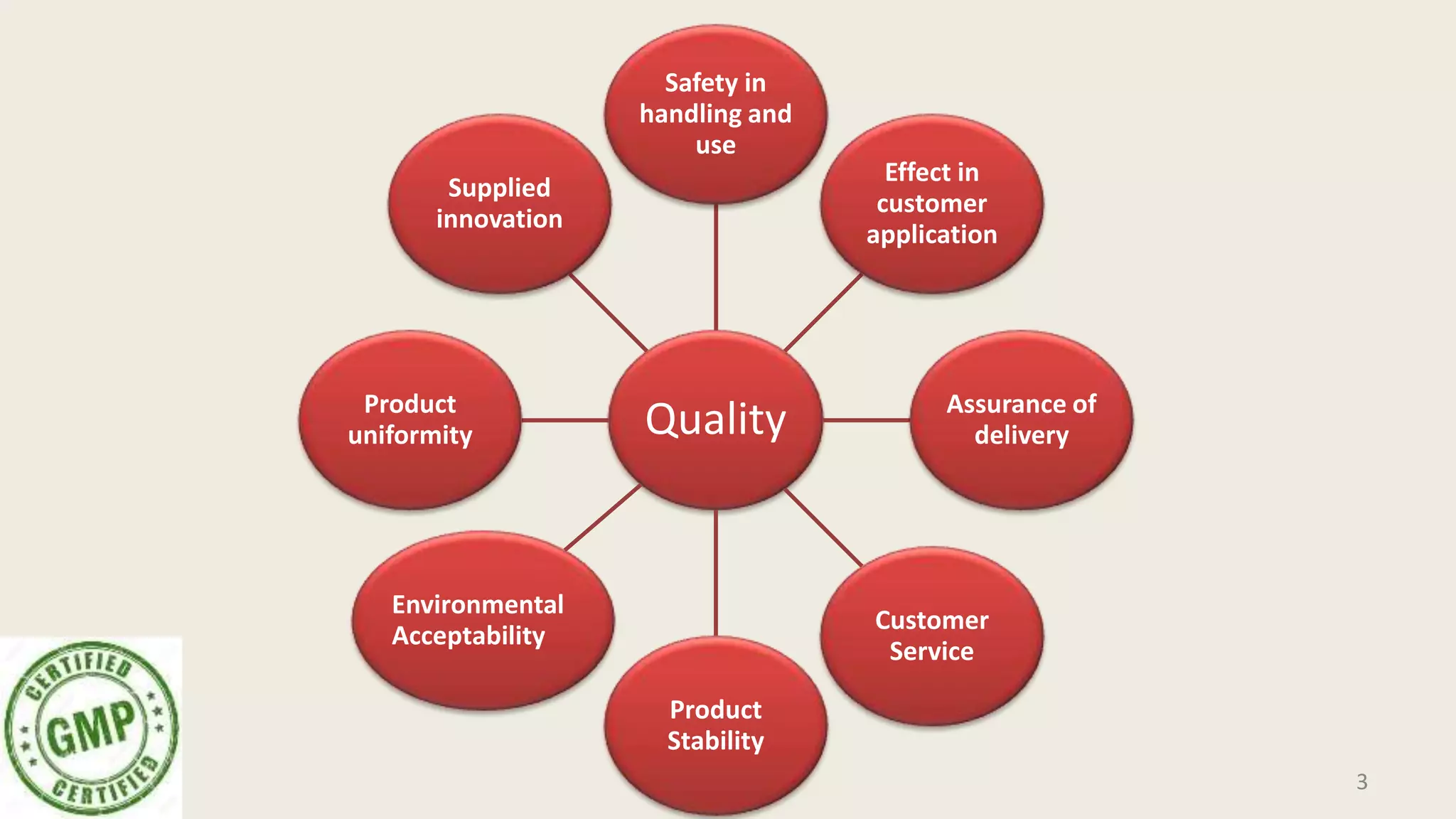
Quality
Safety in
handling and
use
Effect in
customer
application
Assurance of
delivery
Customer
Service
Product
Stability
Environmental
Acceptability
Product
uniformity
Supplied
innovation
3
Why is GMP ?
Unexpected contamination of products, causing damage to health
or even death.
Incorrect labels on containers, which could mean that patients
receive the wrong medicine.
Insufficient or too much active ingredients, resulting in ineffective
treatment or adverse effects.
4
Faculty of Ayurveda,IMS,RGSC,BHU
Where is GMP ?
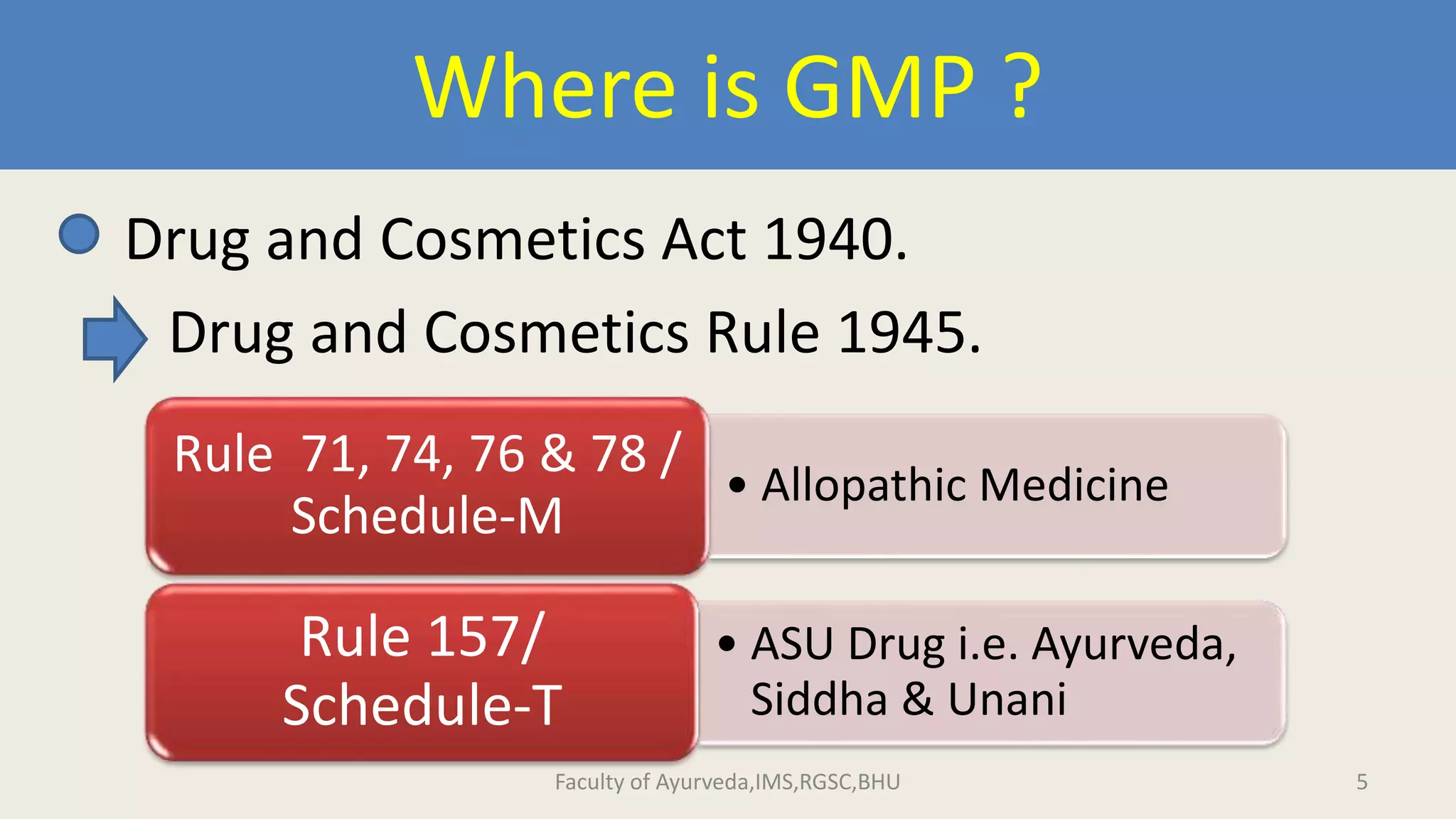
Drug and Cosmetics Act 1940.
Drug and Cosmetics Rule 1945.
• Allopathic Medicine
Rule 71, 74, 76 & 78 /
Schedule-M
• ASU Drug i.e. Ayurveda,
Siddha & Unani
Rule 157/
Schedule-T
5
Faculty of Ayurveda,IMS,RGSC,BHU
Objectives of GMP
1. Raw material are authentic, prescribed quality and contamination free.
2. The manufacturing process is performed, as prescribed in standard (SOPs).
3. Adequate QC measures are adopted.
4. The Finished Goods released for sale is of acceptable quality.
5. To achieve the objectives listed above, each licensee should evolve the
procedure of manufacturing of drugs, should be document it and kept it for
future reference and inspections.
6
Faculty of Ayurveda,IMS,RGSC,BHU
GMP in Past
Govt. of India notified Schedule T vide GSR No. 560(E) on
23rd June 2000 under Rule 157 of Drug and Cosmetic Rules.
Become mandatory for all new ASU Drug manufacturing
companies from this day.
For existing ASU units, 2 years grace period was given to
obtain GMP certification.
7
Faculty of Ayurveda,IMS,RGSC,BHU
GMP in Present
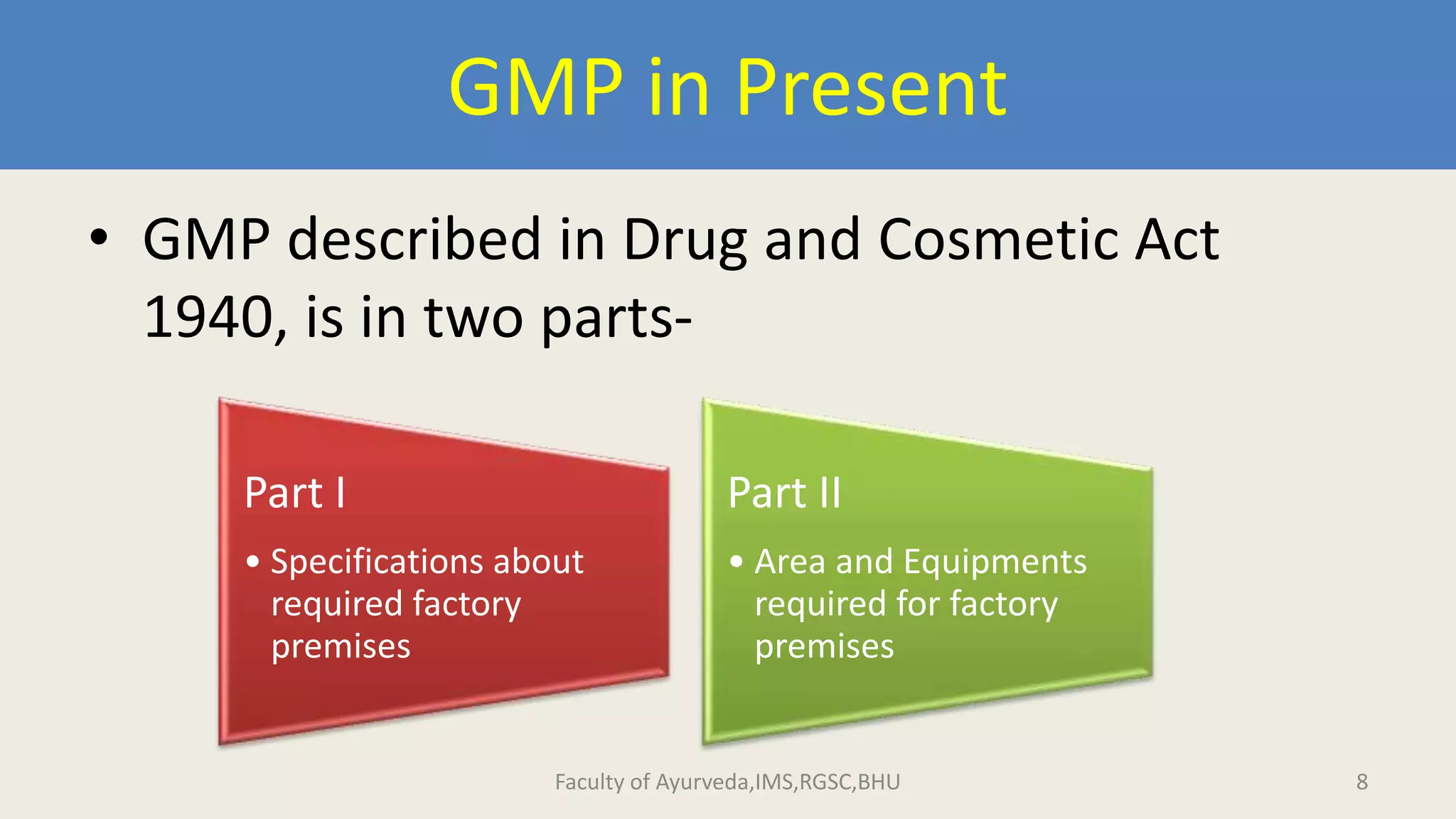
• GMP described in Drug and Cosmetic Act
1940, is in two parts-
Part I
• Specifications about
required factory
premises
Part II
• Area and Equipments
required for factory
premises
8
Faculty of Ayurveda,IMS,RGSC,BHU
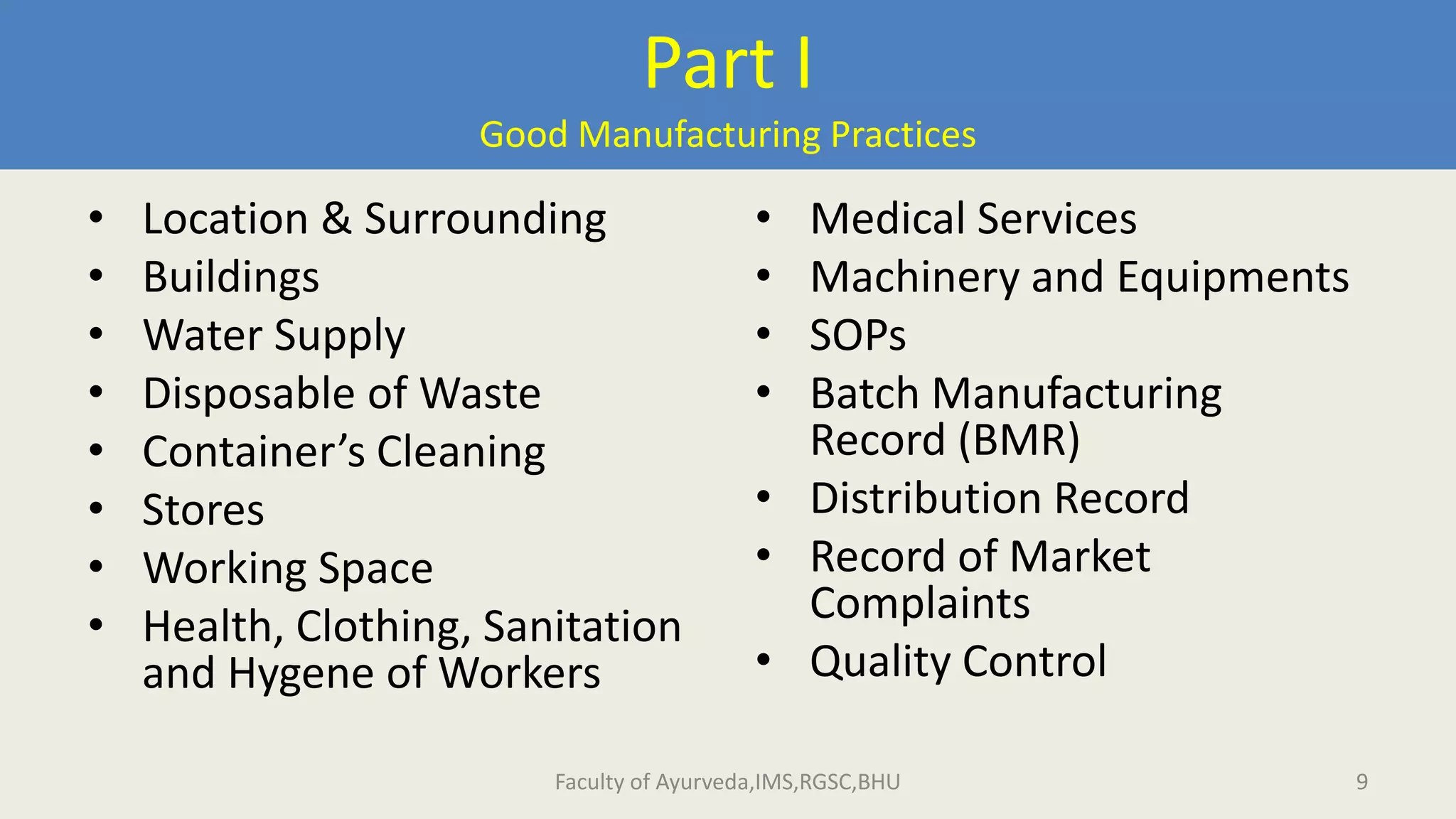
Part I
Good Manufacturing Practices
• Location & Surrounding
• Buildings
• Water Supply
• Disposable of Waste
• Container’s Cleaning
• Stores
• Working Space
• Health, Clothing, Sanitation
and Hygene of Workers
• Medical Services
• Machinery and Equipments
• SOPs
• Batch Manufacturing
Record (BMR)
• Distribution Record
• Record of Market
Complaints
• Quality Control
9
Faculty of Ayurveda,IMS,RGSC,BHU
10
11
Faculty of Ayurveda,IMS,RGSC,BHU
12
Faculty of Ayurveda,IMS,RGSC,BHU
13
Faculty of Ayurveda,IMS,RGSC,BHU
Cont…
• Requirements for sterile products.
Manufacturing Area (Air lock system with HEPA
filters)
Precautions Against Contaminations and Mix (UV-
lamps, environmental factors monitoring by
experts)
14
Faculty of Ayurveda,IMS,RGSC,BHU
Part II
Good Manufacturing Procedure
Ex-
15
Category of Medicine Min Manufacturing
Space
Machinery
recommended
Capsules 100sq. feet Air Conditioner,
Hygrometer,
thermometer, Capsule
filling machine and
balance.
A. List of recommended machinery and minimum space for
manufacturing premises (Ayurveda & Siddha System of Med.).
Faculty of Ayurveda,IMS,RGSC,BHU
Part II
Good Manufacturing Procedure
Category of Medicine Min Manufacturing
Space
Machinery recommended
Shifaf, Surma, Kajal 100sq. feet End runner, mixing S.S.
vessel.
16
B. List of machinery and minimum manufacturing space in premises
(Unani System of Medicines) .
Ex-
Faculty of Ayurveda,IMS,RGSC,BHU
Part II
Good Manufacturing Procedure
Chemistry Section Pharmacognosy Section
Refractrometer,
Moisture meter, pH
meter etc.
Microscope Binoculor, Chemical,
Galssware etc.
17
C. List of equipment recommended for in-house quality control section
D. Supplementary guidelines for manufacturing of herb-mineral-metallic
compound of Ayurveda, Siddha and Unani.
Faculty of Ayurveda,IMS,RGSC,BHU
Amendments
The List of Books [ First
schedule of DC Act
1940]
Shelf life of ASU Drugs
[Part XVII-Rule 161-B]
Poisionous Substances
under ASU Systems of
Med. [Schedule E(1)]
Permissible excipients
for manufacturing of
ASU formulation [Rule
169]
Guidelines for
evaluation of ASU
Drugs & Other
Traditional Med.
Requirements and Guidelines for
permission to manufacture of ASU
Drugs for sale or to undertake
clinical trials [(Proposed )Schedule
Z]
Categorization of Ayurveda
drugs into Ayu. Supplements,
Ayu. Cosmetics and Ayu.
Extracts under Rule 158-B
18
Faculty of Ayurveda,IMS,RGSC,BHU
Different Regulatory Agencies
CDSCO Central Drugs Standard
Control Organization
(Indian FDA), Sch- M,
Schedule-T
USFDA United States Food And Drug
Administration
CFR- Code of Federal
Regulations Title 21 Part
210&211
MHRA Medicines and Healthcare
Product Regulatory Agency
Regulatory Body of UK
TGA Therapeutic Goods
Administration
Regulatory Body of
Australia
WHO World Health Organization Agency of United Nations
MCC Medicines Control Council Regulatory Body of South
Aftrica
ANVISA The National Health
Surveillance Agency
Regulatory Body of Brazil
19
GMP in Future
20
 Introduction of cGMP
 Design of guidelines which fulfils the current
specifications and approvals from international
regulatory agencies.
In cGMP the “c” stands for “current”, reminding manufacturers that they must employ
technologies and the systems which is up to date in order to comply this regulation.
Faculty of Ayurveda,IMS,RGSC,BHU
Some amendments which should done be in
ScheduleT/ GMP for ASU Drugs
Description and Importance of Quality
Assurance.
Details about Validation, Calibration of
Equipments and Processes.
GDP (Good Documentation Practices)
including Data Integrity.
21
Faculty of Ayurveda,IMS,RGSC,BHU
Cont…
Grade of S.S. (Stainless Steel) to be used in
Manufacturing and Packing.
Personell trainings according to their
department.
Self Inspections, internal and External Audits.
22
Faculty of Ayurveda,IMS,RGSC,BHU
23
Faculty of Ayurveda,IMS,RGSC,BHU
References
 The Drug and Cosmetic Act 1940 and The Drug and Cosmetic Rules
1945.
 Guidelines For Insection of GMP Compliance by Ayurveda, Siddha
and Unani Industry, Department of AYUSH India.
 Dr. Galib Ruknuddin, Recent Advancements in D & C Act with
Reference to Ayurvedic Drug Industry.
 WHO GMP for pharmaceutical products, Annex 4 to WHO Technical
Report Series, No 908,2003.
 K.T. Patel, Torrent Pharmaceuticals Ltd, R & D Centre, Bhat,
Gandhinagar.
24
Faculty of Ayurveda,IMS,RGSC,BHU
25
Faculty of Ayurveda,IMS,RGSC,BHU

Good Manufacturing Practices in Ayurveda Pharmaceutics (Past, Present & Future)

  • 1.
    GMP- Good ManufacturingPractices Past, Present and Future Presented By- Mohd Ehsan M.Pharm(Ay.) Ist Year
  • 2.
    What is GMP? GMP- Good Manufacturing Practices A set of principles and procedures which, when followed by manufacturers for therapeutic good, helps ensure that the products manufacture will have the required quality. 2 Faculty of Ayurveda,IMS,RGSC,BHU
  • 3.
    Quality Safety in handling and use Effectin customer application Assurance of delivery Customer Service Product Stability Environmental Acceptability Product uniformity Supplied innovation 3
  • 4.
    Why is GMP? Unexpected contamination of products, causing damage to health or even death. Incorrect labels on containers, which could mean that patients receive the wrong medicine. Insufficient or too much active ingredients, resulting in ineffective treatment or adverse effects. 4 Faculty of Ayurveda,IMS,RGSC,BHU
  • 5.
    Where is GMP? Drug and Cosmetics Act 1940. Drug and Cosmetics Rule 1945. • Allopathic Medicine Rule 71, 74, 76 & 78 / Schedule-M • ASU Drug i.e. Ayurveda, Siddha & Unani Rule 157/ Schedule-T 5 Faculty of Ayurveda,IMS,RGSC,BHU
  • 6.
    Objectives of GMP 1.Raw material are authentic, prescribed quality and contamination free. 2. The manufacturing process is performed, as prescribed in standard (SOPs). 3. Adequate QC measures are adopted. 4. The Finished Goods released for sale is of acceptable quality. 5. To achieve the objectives listed above, each licensee should evolve the procedure of manufacturing of drugs, should be document it and kept it for future reference and inspections. 6 Faculty of Ayurveda,IMS,RGSC,BHU
  • 7.
    GMP in Past Govt.of India notified Schedule T vide GSR No. 560(E) on 23rd June 2000 under Rule 157 of Drug and Cosmetic Rules. Become mandatory for all new ASU Drug manufacturing companies from this day. For existing ASU units, 2 years grace period was given to obtain GMP certification. 7 Faculty of Ayurveda,IMS,RGSC,BHU
  • 8.
    GMP in Present •GMP described in Drug and Cosmetic Act 1940, is in two parts- Part I • Specifications about required factory premises Part II • Area and Equipments required for factory premises 8 Faculty of Ayurveda,IMS,RGSC,BHU
  • 9.
    Part I Good ManufacturingPractices • Location & Surrounding • Buildings • Water Supply • Disposable of Waste • Container’s Cleaning • Stores • Working Space • Health, Clothing, Sanitation and Hygene of Workers • Medical Services • Machinery and Equipments • SOPs • Batch Manufacturing Record (BMR) • Distribution Record • Record of Market Complaints • Quality Control 9 Faculty of Ayurveda,IMS,RGSC,BHU
  • 10.
  • 11.
  • 12.
  • 13.
  • 14.
    Cont… • Requirements forsterile products. Manufacturing Area (Air lock system with HEPA filters) Precautions Against Contaminations and Mix (UV- lamps, environmental factors monitoring by experts) 14 Faculty of Ayurveda,IMS,RGSC,BHU
  • 15.
    Part II Good ManufacturingProcedure Ex- 15 Category of Medicine Min Manufacturing Space Machinery recommended Capsules 100sq. feet Air Conditioner, Hygrometer, thermometer, Capsule filling machine and balance. A. List of recommended machinery and minimum space for manufacturing premises (Ayurveda & Siddha System of Med.). Faculty of Ayurveda,IMS,RGSC,BHU
  • 16.
    Part II Good ManufacturingProcedure Category of Medicine Min Manufacturing Space Machinery recommended Shifaf, Surma, Kajal 100sq. feet End runner, mixing S.S. vessel. 16 B. List of machinery and minimum manufacturing space in premises (Unani System of Medicines) . Ex- Faculty of Ayurveda,IMS,RGSC,BHU
  • 17.
    Part II Good ManufacturingProcedure Chemistry Section Pharmacognosy Section Refractrometer, Moisture meter, pH meter etc. Microscope Binoculor, Chemical, Galssware etc. 17 C. List of equipment recommended for in-house quality control section D. Supplementary guidelines for manufacturing of herb-mineral-metallic compound of Ayurveda, Siddha and Unani. Faculty of Ayurveda,IMS,RGSC,BHU
  • 18.
    Amendments The List ofBooks [ First schedule of DC Act 1940] Shelf life of ASU Drugs [Part XVII-Rule 161-B] Poisionous Substances under ASU Systems of Med. [Schedule E(1)] Permissible excipients for manufacturing of ASU formulation [Rule 169] Guidelines for evaluation of ASU Drugs & Other Traditional Med. Requirements and Guidelines for permission to manufacture of ASU Drugs for sale or to undertake clinical trials [(Proposed )Schedule Z] Categorization of Ayurveda drugs into Ayu. Supplements, Ayu. Cosmetics and Ayu. Extracts under Rule 158-B 18 Faculty of Ayurveda,IMS,RGSC,BHU
  • 19.
    Different Regulatory Agencies CDSCOCentral Drugs Standard Control Organization (Indian FDA), Sch- M, Schedule-T USFDA United States Food And Drug Administration CFR- Code of Federal Regulations Title 21 Part 210&211 MHRA Medicines and Healthcare Product Regulatory Agency Regulatory Body of UK TGA Therapeutic Goods Administration Regulatory Body of Australia WHO World Health Organization Agency of United Nations MCC Medicines Control Council Regulatory Body of South Aftrica ANVISA The National Health Surveillance Agency Regulatory Body of Brazil 19
  • 20.
    GMP in Future 20 Introduction of cGMP  Design of guidelines which fulfils the current specifications and approvals from international regulatory agencies. In cGMP the “c” stands for “current”, reminding manufacturers that they must employ technologies and the systems which is up to date in order to comply this regulation. Faculty of Ayurveda,IMS,RGSC,BHU
  • 21.
    Some amendments whichshould done be in ScheduleT/ GMP for ASU Drugs Description and Importance of Quality Assurance. Details about Validation, Calibration of Equipments and Processes. GDP (Good Documentation Practices) including Data Integrity. 21 Faculty of Ayurveda,IMS,RGSC,BHU
  • 22.
    Cont… Grade of S.S.(Stainless Steel) to be used in Manufacturing and Packing. Personell trainings according to their department. Self Inspections, internal and External Audits. 22 Faculty of Ayurveda,IMS,RGSC,BHU
  • 23.
  • 24.
    References  The Drugand Cosmetic Act 1940 and The Drug and Cosmetic Rules 1945.  Guidelines For Insection of GMP Compliance by Ayurveda, Siddha and Unani Industry, Department of AYUSH India.  Dr. Galib Ruknuddin, Recent Advancements in D & C Act with Reference to Ayurvedic Drug Industry.  WHO GMP for pharmaceutical products, Annex 4 to WHO Technical Report Series, No 908,2003.  K.T. Patel, Torrent Pharmaceuticals Ltd, R & D Centre, Bhat, Gandhinagar. 24 Faculty of Ayurveda,IMS,RGSC,BHU
  • 25.