Good Clinical
Practice
Presented by: Dr Nilamjyoti Medhi
PGT, Dept of Pharmacology
Moderator: Dr Rituparna P Ray
Associate Professor
Objectives
What is GCP
The history of Good Clinical Practices
Guidelines for GCP
Basic principles
Definition
 A standard for the
Design Auditing
Recording Conduct
Analyses Performance
Reporting Monitoring
of clinical trials that provide assurance that the data and the
reported results are CREDIBLE, ACCURATE and that the
RIGHTS, INTEGRITY and CONFIDENTIALITY of trial
subjects are protected.
The history…
– Public disasters, serious fraud and abuse of human rights.
– Trials of War criminals --Nuremberg code 1949
– Thalidomide -- Declaration of Helsinki 1964
– Belmont report 1978
– ICH 1990
How ICH started..
– 1st conf. in 1990 in Brussels
– 3 regions participated  EU / United States / Japan
– Representatives from  Industry/ Academia/ Ministry of
health.
– WHO, EFTA and Canada observers
– Reduce duplication
– Efficiency , registration for new pharmaceuticals
ICH resulted in...
Many guidelines made
– Most important- ICH GCP guidelines
– Evolved in several steps
– Consolidated guideline ICH E6 Sept 1997
Role of ICH
– Safeguard public health
– Assure consumer protection standards
– Facilitate availability of safe and effective products
– Eliminate inconsistent standards internationally
– Facilitate mutual acceptance of data from clinical trials
ICH GCP guideline..
8 sections
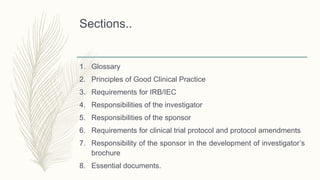
Sections..
1. Glossary
2. Principles of Good Clinical Practice
3. Requirements for IRB/IEC
4. Responsibilities of the investigator
5. Responsibilities of the sponsor
6. Requirements for clinical trial protocol and protocol amendments
7. Responsibility of the sponsor in the development of investigator’s
brochure
8. Essential documents.
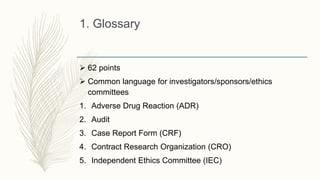
1. Glossary
 62 points
 Common language for investigators/sponsors/ethics
committees
1. Adverse Drug Reaction (ADR)
2. Audit
3. Case Report Form (CRF)
4. Contract Research Organization (CRO)
5. Independent Ethics Committee (IEC)
2. GCP Principles…
1. The ethical principles
2. Risk and benefits.
3. The rights, safety, and well-being
4. Supportive data
5. Protocol
6. Ethical clearance.
7. Subject care
8. Qualified staff
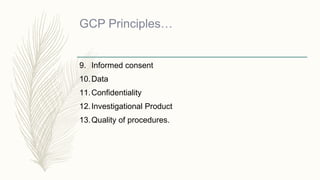
GCP Principles…
9. Informed consent
10.Data
11.Confidentiality
12.Investigational Product
13.Quality of procedures.
3. Requirements for IRB/IEC
– Responsibilities
– Composition, Functions and Operations
– Procedures
– Records
4. Responsibilities of the investigator
 Investigator's Qualifications and Agreements
 Adequate Resources
 Medical Care of Trial Subjects
 Communication with IRB/IEC
 Compliance with Protocol
 Investigational Product(s)
 Randomization Procedures and Unblinding
 Informed Consent of Trial Subjects
5. Responsibilities of the sponsor
 Quality Assurance and Quality Control
 Contract Research Organization (CRO)
 Medical Expertise
 Trial Design
 Trial Management, Data Handling, and Record Keeping
 Investigator Selection
 Allocation of Responsibilities
6. Clinical trial protocol and protocol
amendment(s)
 General Information
 Background Information
 Trial Objectives and Purpose
 Trial Design
 Selection and Withdrawal of Subjects
 Treatment of Subjects
 Assessment of Efficacy
 Assessment of Safety
7. Investigator’s brochure
 Introduction
 General Considerations
 Contents of the Investigator’s Brochure
8. Essential documents..
 Before the Clinical Phase of the Trial Commences
 During the Clinical Conduct of the Trial
 After Completion or Termination of the Trial
Indian GCP guidelines..
– Released in Dec 2001(Developed by CDSCO and endorsed
by DCGI)
– Has Revised Schedule Y (Jan 2005) addressed
discrepancies?
Issues in Developing Countries
– The informed consent process
– Economic Vulnerability
– Patient doctor relationship
– Education level
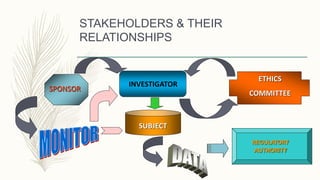
STAKEHOLDERS & THEIR
RELATIONSHIPS
SUBJECT
REGULATORY
AUTHORITY
SPONSOR
ETHICS
COMMITTEE
INVESTIGATOR
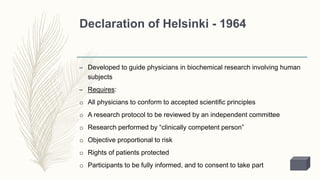
Declaration of Helsinki - 1964
– Developed to guide physicians in biochemical research involving human
subjects
– Requires:
o All physicians to conform to accepted scientific principles
o A research protocol to be reviewed by an independent committee
o Research performed by “clinically competent person”
o Objective proportional to risk
o Rights of patients protected
o Participants to be fully informed, and to consent to take part
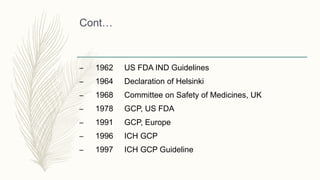
Cont…
– 1962 US FDA IND Guidelines
– 1964 Declaration of Helsinki
– 1968 Committee on Safety of Medicines, UK
– 1978 GCP, US FDA
– 1991 GCP, Europe
– 1996 ICH GCP
– 1997 ICH GCP Guideline
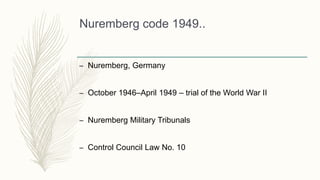
Nuremberg code 1949..
– Nuremberg, Germany
– October 1946–April 1949 – trial of the World War II
– Nuremberg Military Tribunals
– Control Council Law No. 10
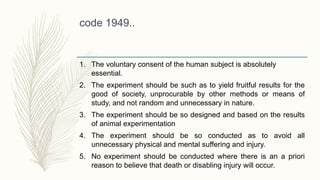
code 1949..
1. The voluntary consent of the human subject is absolutely
essential.
2. The experiment should be such as to yield fruitful results for the
good of society, unprocurable by other methods or means of
study, and not random and unnecessary in nature.
3. The experiment should be so designed and based on the results
of animal experimentation
4. The experiment should be so conducted as to avoid all
unnecessary physical and mental suffering and injury.
5. No experiment should be conducted where there is an a priori
reason to believe that death or disabling injury will occur.
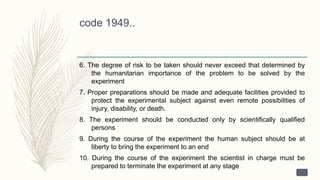
code 1949..
6. The degree of risk to be taken should never exceed that determined by
the humanitarian importance of the problem to be solved by the
experiment
7. Proper preparations should be made and adequate facilities provided to
protect the experimental subject against even remote possibilities of
injury, disability, or death.
8. The experiment should be conducted only by scientifically qualified
persons
9. During the course of the experiment the human subject should be at
liberty to bring the experiment to an end
10. During the course of the experiment the scientist in charge must be
prepared to terminate the experiment at any stage
Belmont report 1978...
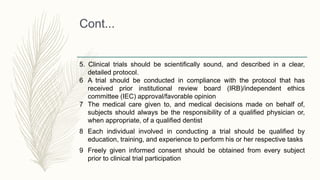
Cont...
5. Clinical trials should be scientifically sound, and described in a clear,
detailed protocol.
6 A trial should be conducted in compliance with the protocol that has
received prior institutional review board (IRB)/independent ethics
committee (IEC) approval/favorable opinion
7 The medical care given to, and medical decisions made on behalf of,
subjects should always be the responsibility of a qualified physician or,
when appropriate, of a qualified dentist
8 Each individual involved in conducting a trial should be qualified by
education, training, and experience to perform his or her respective tasks
9 Freely given informed consent should be obtained from every subject
prior to clinical trial participation
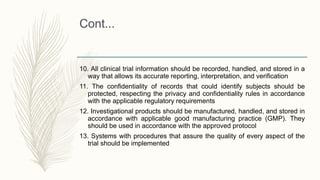
Cont...
10. All clinical trial information should be recorded, handled, and stored in a
way that allows its accurate reporting, interpretation, and verification
11. The confidentiality of records that could identify subjects should be
protected, respecting the privacy and confidentiality rules in accordance
with the applicable regulatory requirements
12. Investigational products should be manufactured, handled, and stored in
accordance with applicable good manufacturing practice (GMP). They
should be used in accordance with the approved protocol
13. Systems with procedures that assure the quality of every aspect of the
trial should be implemented
Role of GCP
– Good clinical practice (GCP) is an international ethical &
scientific standard for conducting clinical trials that involve
the participation of human subjects
– Compliance with this standard provides public assurance
that the rights, safety & well-being of trial subjects are
protected, which is consistent with the principles outlined in
the declaration of Helsinki
– GCP also ensures the credibility of clinical trial data.

Good clinical practice

Good clinical practice

  • 1.
    Good Clinical Practice Presented by:Dr Nilamjyoti Medhi PGT, Dept of Pharmacology Moderator: Dr Rituparna P Ray Associate Professor
  • 2.
    Objectives What is GCP Thehistory of Good Clinical Practices Guidelines for GCP Basic principles
  • 3.
    Definition  A standardfor the Design Auditing Recording Conduct Analyses Performance Reporting Monitoring of clinical trials that provide assurance that the data and the reported results are CREDIBLE, ACCURATE and that the RIGHTS, INTEGRITY and CONFIDENTIALITY of trial subjects are protected.
  • 4.
    The history… – Publicdisasters, serious fraud and abuse of human rights. – Trials of War criminals --Nuremberg code 1949 – Thalidomide -- Declaration of Helsinki 1964 – Belmont report 1978 – ICH 1990
  • 5.
    How ICH started.. –1st conf. in 1990 in Brussels – 3 regions participated  EU / United States / Japan – Representatives from  Industry/ Academia/ Ministry of health. – WHO, EFTA and Canada observers – Reduce duplication – Efficiency , registration for new pharmaceuticals
  • 6.
    ICH resulted in... Manyguidelines made – Most important- ICH GCP guidelines – Evolved in several steps – Consolidated guideline ICH E6 Sept 1997
  • 7.
    Role of ICH –Safeguard public health – Assure consumer protection standards – Facilitate availability of safe and effective products – Eliminate inconsistent standards internationally – Facilitate mutual acceptance of data from clinical trials
  • 8.
  • 9.
    Sections.. 1. Glossary 2. Principlesof Good Clinical Practice 3. Requirements for IRB/IEC 4. Responsibilities of the investigator 5. Responsibilities of the sponsor 6. Requirements for clinical trial protocol and protocol amendments 7. Responsibility of the sponsor in the development of investigator’s brochure 8. Essential documents.
  • 10.
    1. Glossary  62points  Common language for investigators/sponsors/ethics committees 1. Adverse Drug Reaction (ADR) 2. Audit 3. Case Report Form (CRF) 4. Contract Research Organization (CRO) 5. Independent Ethics Committee (IEC)
  • 11.
    2. GCP Principles… 1.The ethical principles 2. Risk and benefits. 3. The rights, safety, and well-being 4. Supportive data 5. Protocol 6. Ethical clearance. 7. Subject care 8. Qualified staff
  • 12.
    GCP Principles… 9. Informedconsent 10.Data 11.Confidentiality 12.Investigational Product 13.Quality of procedures.
  • 13.
    3. Requirements forIRB/IEC – Responsibilities – Composition, Functions and Operations – Procedures – Records
  • 14.
    4. Responsibilities ofthe investigator  Investigator's Qualifications and Agreements  Adequate Resources  Medical Care of Trial Subjects  Communication with IRB/IEC  Compliance with Protocol  Investigational Product(s)  Randomization Procedures and Unblinding  Informed Consent of Trial Subjects
  • 15.
    5. Responsibilities ofthe sponsor  Quality Assurance and Quality Control  Contract Research Organization (CRO)  Medical Expertise  Trial Design  Trial Management, Data Handling, and Record Keeping  Investigator Selection  Allocation of Responsibilities
  • 16.
    6. Clinical trialprotocol and protocol amendment(s)  General Information  Background Information  Trial Objectives and Purpose  Trial Design  Selection and Withdrawal of Subjects  Treatment of Subjects  Assessment of Efficacy  Assessment of Safety
  • 17.
    7. Investigator’s brochure Introduction  General Considerations  Contents of the Investigator’s Brochure
  • 18.
    8. Essential documents.. Before the Clinical Phase of the Trial Commences  During the Clinical Conduct of the Trial  After Completion or Termination of the Trial
  • 19.
    Indian GCP guidelines.. –Released in Dec 2001(Developed by CDSCO and endorsed by DCGI) – Has Revised Schedule Y (Jan 2005) addressed discrepancies?
  • 20.
    Issues in DevelopingCountries – The informed consent process – Economic Vulnerability – Patient doctor relationship – Education level
  • 21.
  • 23.
    Declaration of Helsinki- 1964 – Developed to guide physicians in biochemical research involving human subjects – Requires: o All physicians to conform to accepted scientific principles o A research protocol to be reviewed by an independent committee o Research performed by “clinically competent person” o Objective proportional to risk o Rights of patients protected o Participants to be fully informed, and to consent to take part
  • 24.
    Cont… – 1962 USFDA IND Guidelines – 1964 Declaration of Helsinki – 1968 Committee on Safety of Medicines, UK – 1978 GCP, US FDA – 1991 GCP, Europe – 1996 ICH GCP – 1997 ICH GCP Guideline
  • 25.
    Nuremberg code 1949.. –Nuremberg, Germany – October 1946–April 1949 – trial of the World War II – Nuremberg Military Tribunals – Control Council Law No. 10
  • 26.
    code 1949.. 1. Thevoluntary consent of the human subject is absolutely essential. 2. The experiment should be such as to yield fruitful results for the good of society, unprocurable by other methods or means of study, and not random and unnecessary in nature. 3. The experiment should be so designed and based on the results of animal experimentation 4. The experiment should be so conducted as to avoid all unnecessary physical and mental suffering and injury. 5. No experiment should be conducted where there is an a priori reason to believe that death or disabling injury will occur.
  • 27.
    code 1949.. 6. Thedegree of risk to be taken should never exceed that determined by the humanitarian importance of the problem to be solved by the experiment 7. Proper preparations should be made and adequate facilities provided to protect the experimental subject against even remote possibilities of injury, disability, or death. 8. The experiment should be conducted only by scientifically qualified persons 9. During the course of the experiment the human subject should be at liberty to bring the experiment to an end 10. During the course of the experiment the scientist in charge must be prepared to terminate the experiment at any stage
  • 28.
  • 29.
    Cont... 5. Clinical trialsshould be scientifically sound, and described in a clear, detailed protocol. 6 A trial should be conducted in compliance with the protocol that has received prior institutional review board (IRB)/independent ethics committee (IEC) approval/favorable opinion 7 The medical care given to, and medical decisions made on behalf of, subjects should always be the responsibility of a qualified physician or, when appropriate, of a qualified dentist 8 Each individual involved in conducting a trial should be qualified by education, training, and experience to perform his or her respective tasks 9 Freely given informed consent should be obtained from every subject prior to clinical trial participation
  • 30.
    Cont... 10. All clinicaltrial information should be recorded, handled, and stored in a way that allows its accurate reporting, interpretation, and verification 11. The confidentiality of records that could identify subjects should be protected, respecting the privacy and confidentiality rules in accordance with the applicable regulatory requirements 12. Investigational products should be manufactured, handled, and stored in accordance with applicable good manufacturing practice (GMP). They should be used in accordance with the approved protocol 13. Systems with procedures that assure the quality of every aspect of the trial should be implemented
  • 31.
    Role of GCP –Good clinical practice (GCP) is an international ethical & scientific standard for conducting clinical trials that involve the participation of human subjects – Compliance with this standard provides public assurance that the rights, safety & well-being of trial subjects are protected, which is consistent with the principles outlined in the declaration of Helsinki – GCP also ensures the credibility of clinical trial data.