Antiadrenergic drugs
Dr. Karun Kumar
Senior Lecturer
Dept. of Pharmacology
General Effects of α blockers
Blockade of vasoconstrictor α1 receptors
↓
↓ TPR
↓
Pooling of blood in capacitance vessels
↓
↓ venous return and CO
↓
Fall in BP
Interference in postural reflex
↓
Hypotension
↓
Dizziness and syncope
• Patients receiving an α blocker should not suddenly
stand up after being supine on the dental chair
• Reflex tachycardia occurs (↓ mean arterial pressure
and ↑ NA due to blockade of presyn α2 receptors)
• Nasal stuffiness and miosis
Hypotension ↓ renal blood flow
↓
↓ GFR & ↑ reabs. of Na+ and water
↓
Na+ retention & expansion of blood volume
(accentuated by reflex ↑ in renin)
Tone of smooth muscle in bladder trigone, sphincter
and prostate ↓ by blockade of α1 receptors
↓
Urine flow in patients with benign hypertrophy of
prostate (BHP) is improved
• Contractions of vas deferens and related organs
which result in ejaculation are coordinated through
α rec. (α blockers can inhibit ejaculation 
impotence)
Side Effects
Uses of α blockers
1. Pheochromocytoma  Phenoxybenzamine
definitive therapy for inoperable and malignant
tumors.
• Employed before and during surgical removal of the
tumor
• Alternatively, Phentolamine drip can be instituted
during the operation.
2. Hypertension  Prazosin and other slective α1
blockers are useful antihypertensive drugs.
• Phentolamine helps to control episodes of ↑ BP
during Clonidine withdrawal and cheese reaction in
patients on MAO inhibitors
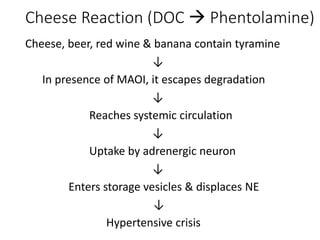
Cheese Reaction (DOC  Phentolamine)
Cheese, beer, red wine & banana contain tyramine
↓
In presence of MAOI, it escapes degradation
↓
Reaches systemic circulation
↓
Uptake by adrenergic neuron
↓
Enters storage vesicles & displaces NE
↓
Hypertensive crisis
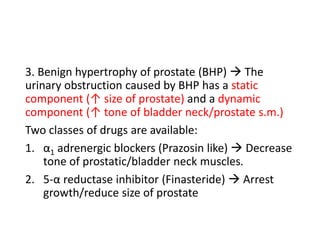
3. Benign hypertrophy of prostate (BHP)  The
urinary obstruction caused by BHP has a static
component (↑ size of prostate) and a dynamic
component (↑ tone of bladder neck/prostate s.m.)
Two classes of drugs are available:
1. α1 adrenergic blockers (Prazosin like)  Decrease
tone of prostatic/bladder neck muscles.
2. 5-α reductase inhibitor (Finasteride)  Arrest
growth/reduce size of prostate
Classification
Uses of β blockers (THAPPAD)
1. Thyrotoxicosis & Tremors
2. HTN & Hypertrophic cardiomyopathy
3. Angina & Acute MI
4. Prophylaxis of migraine
5. Phaeochromocytoma (along with alpha blockers)
6. Anxiety & Arrhythmias
7. Dissecting aortic aneurysm
8. Digitalis toxicity
Adverse effects of beta blockers
(BBC Loses Viewers in Rochedale)
• Bradycardia
• Bronchoconstriction
• Claudication
• Lipids (profile altered)
• Vivid dreams & nightmares
• Negative inotropic action
• Reduced sensitivity to hypoglycemia
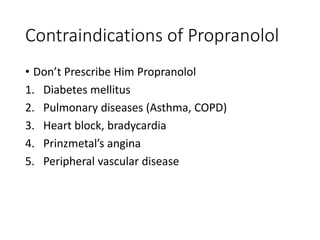
Contraindications of Propranolol
• Don’t Prescribe Him Propranolol
1. Diabetes mellitus
2. Pulmonary diseases (Asthma, COPD)
3. Heart block, bradycardia
4. Prinzmetal’s angina
5. Peripheral vascular disease
Drug Interactions
1. Additive depression of SAN & A-V conduction
with Digitalis and Verapamil  Cardiac arrest
2. Propranolol delays recovery from hypoglycaemia
due to insulin and oral antidiabetics. Warning
signs of hypoglycaemia (tachycardia, tremor) are
suppressed
3. Phenylephrine, Ephedrine and other α agonists
present in cold remedies can cause marked rise in
BP in β blocked subjects
4. Though only low concentrations of Adr are added
to lidocaine for dental anesthesia, it may produce
some pressor action in patients receiving
nonselective β blockers
5. Indomethacin and other NSAIDs attenuate the
antihypertensive action of β blockers
6. Propranolol retards lidocaine metabolism by
reducing hepatic blood flow
Other β Blockers
• Cardioselective (Metoprolol, Atenolol, Acebutolol,
Bisoprolol, Nebivolol)
1. Lower propensity to cause bronchoconstriction
2. Less interference with carbohydrate metabolism
3. Lower incidence of cold hands and feet
4. No/less deleterious effect on blood lipid profile
5. Ineffective in suppressing essential tremor
6. Less liable to impair exercise capacity
Partial agonistic (intrinsic
sympathomimetic) (Pindolol, Acebutolol)
• Activate β1 and/or β2 receptors submaximally
1. Bradycardia and depression of contractility at rest
are not prominent
2. Withdrawal is less likely to exacerbate
hypertension or angina
3. Not effective in migraine prophylaxis— dilate
cerebral vessels
4. Less suitable for secondary prophylaxis of MI
α + β Adrenergic blockers
• Labetalol  5 times more potent in blocking β than
α receptors
• Causes ↓ BP & no/slight ↓ in HR
• Orally effective but undergoes considerable first
pass metabolism
• Moderately potent hypotensive & is specially useful
in pheochromocytoma, clonidine withdrawal; can
also be used in essential hypertension
• S/E  Postural hypotension
• Carvedilol  β1 + β2 + α1 blocker; produces
vasodilatation due to
1. α1 blockade
2. Calcium channel blockade
• Has antioxidant property
• Use  Hypertension & CHF

Autonomic nervous system-III

  • 1.
    Antiadrenergic drugs Dr. KarunKumar Senior Lecturer Dept. of Pharmacology
  • 3.
    General Effects ofα blockers Blockade of vasoconstrictor α1 receptors ↓ ↓ TPR ↓ Pooling of blood in capacitance vessels ↓ ↓ venous return and CO ↓ Fall in BP
  • 4.
    Interference in posturalreflex ↓ Hypotension ↓ Dizziness and syncope • Patients receiving an α blocker should not suddenly stand up after being supine on the dental chair • Reflex tachycardia occurs (↓ mean arterial pressure and ↑ NA due to blockade of presyn α2 receptors)
  • 5.
    • Nasal stuffinessand miosis Hypotension ↓ renal blood flow ↓ ↓ GFR & ↑ reabs. of Na+ and water ↓ Na+ retention & expansion of blood volume (accentuated by reflex ↑ in renin)
  • 6.
    Tone of smoothmuscle in bladder trigone, sphincter and prostate ↓ by blockade of α1 receptors ↓ Urine flow in patients with benign hypertrophy of prostate (BHP) is improved • Contractions of vas deferens and related organs which result in ejaculation are coordinated through α rec. (α blockers can inhibit ejaculation  impotence)
  • 7.
  • 10.
    Uses of αblockers 1. Pheochromocytoma  Phenoxybenzamine definitive therapy for inoperable and malignant tumors. • Employed before and during surgical removal of the tumor • Alternatively, Phentolamine drip can be instituted during the operation.
  • 11.
    2. Hypertension Prazosin and other slective α1 blockers are useful antihypertensive drugs. • Phentolamine helps to control episodes of ↑ BP during Clonidine withdrawal and cheese reaction in patients on MAO inhibitors
  • 12.
    Cheese Reaction (DOC Phentolamine) Cheese, beer, red wine & banana contain tyramine ↓ In presence of MAOI, it escapes degradation ↓ Reaches systemic circulation ↓ Uptake by adrenergic neuron ↓ Enters storage vesicles & displaces NE ↓ Hypertensive crisis
  • 13.
    3. Benign hypertrophyof prostate (BHP)  The urinary obstruction caused by BHP has a static component (↑ size of prostate) and a dynamic component (↑ tone of bladder neck/prostate s.m.) Two classes of drugs are available: 1. α1 adrenergic blockers (Prazosin like)  Decrease tone of prostatic/bladder neck muscles. 2. 5-α reductase inhibitor (Finasteride)  Arrest growth/reduce size of prostate
  • 15.
  • 17.
    Uses of βblockers (THAPPAD) 1. Thyrotoxicosis & Tremors 2. HTN & Hypertrophic cardiomyopathy 3. Angina & Acute MI 4. Prophylaxis of migraine 5. Phaeochromocytoma (along with alpha blockers) 6. Anxiety & Arrhythmias 7. Dissecting aortic aneurysm 8. Digitalis toxicity
  • 18.
    Adverse effects ofbeta blockers (BBC Loses Viewers in Rochedale) • Bradycardia • Bronchoconstriction • Claudication • Lipids (profile altered) • Vivid dreams & nightmares • Negative inotropic action • Reduced sensitivity to hypoglycemia
  • 19.
    Contraindications of Propranolol •Don’t Prescribe Him Propranolol 1. Diabetes mellitus 2. Pulmonary diseases (Asthma, COPD) 3. Heart block, bradycardia 4. Prinzmetal’s angina 5. Peripheral vascular disease
  • 21.
    Drug Interactions 1. Additivedepression of SAN & A-V conduction with Digitalis and Verapamil  Cardiac arrest 2. Propranolol delays recovery from hypoglycaemia due to insulin and oral antidiabetics. Warning signs of hypoglycaemia (tachycardia, tremor) are suppressed 3. Phenylephrine, Ephedrine and other α agonists present in cold remedies can cause marked rise in BP in β blocked subjects
  • 22.
    4. Though onlylow concentrations of Adr are added to lidocaine for dental anesthesia, it may produce some pressor action in patients receiving nonselective β blockers 5. Indomethacin and other NSAIDs attenuate the antihypertensive action of β blockers 6. Propranolol retards lidocaine metabolism by reducing hepatic blood flow
  • 23.
    Other β Blockers •Cardioselective (Metoprolol, Atenolol, Acebutolol, Bisoprolol, Nebivolol) 1. Lower propensity to cause bronchoconstriction 2. Less interference with carbohydrate metabolism 3. Lower incidence of cold hands and feet 4. No/less deleterious effect on blood lipid profile 5. Ineffective in suppressing essential tremor 6. Less liable to impair exercise capacity
  • 24.
    Partial agonistic (intrinsic sympathomimetic)(Pindolol, Acebutolol) • Activate β1 and/or β2 receptors submaximally 1. Bradycardia and depression of contractility at rest are not prominent 2. Withdrawal is less likely to exacerbate hypertension or angina 3. Not effective in migraine prophylaxis— dilate cerebral vessels 4. Less suitable for secondary prophylaxis of MI
  • 25.
    α + βAdrenergic blockers • Labetalol  5 times more potent in blocking β than α receptors • Causes ↓ BP & no/slight ↓ in HR • Orally effective but undergoes considerable first pass metabolism • Moderately potent hypotensive & is specially useful in pheochromocytoma, clonidine withdrawal; can also be used in essential hypertension • S/E  Postural hypotension
  • 26.
    • Carvedilol β1 + β2 + α1 blocker; produces vasodilatation due to 1. α1 blockade 2. Calcium channel blockade • Has antioxidant property • Use  Hypertension & CHF

Editor's Notes

  • #4 temporary loss of consciousness caused by a fall in blood pressure.
  • #5 There are three types of postural reflexes: righting reactions, placing reactions, and equilibrium reactions. Syncope (pronounced “sin ko pea”) is the medical term for fainting or passing out. It is caused by a temporary drop in the amount of blood that flows to the brain. Syncope can happen if you have a sudden drop in blood pressure, a drop in heart rate, or changes in the amount of blood in areas of your body. Fainting or a sudden temporary loss of consciousness.
  • #8 Orthostatic hypotension is a sudden drop in blood pressure when you stand from a seated or prone (lying down) position. You may feel dizzy or even faint. Orthostatic means an upright posture. Hypotension is low blood pressure. The condition is also called postural hypotension
  • #9 Phenoxybenzamine [fen-ox-ee-BEN-za-meen] is nonselective, linking covalently to both α1 and α2 receptors . The block is irreversible and noncompetitive, and the only way the body can overcome the block is to synthesize new adrenoceptors, which requires a day or longer. Therefore, the actions of phenoxybenzamine last about 24 hours. After the drug is injected, a delay of a few hours occurs before a blockade develops.
  • #19 Claudication is pain caused by too little blood flow to your legs or arms. This is usually a symptom of peripheral artery disease, in which the arteries that supply blood to your limbs are narrowed, usually because of atherosclerosis.
  • #20 A condition in which some areas of the body feel numb and cool in certain circumstances. In Raynaud's phenomenon, smaller arteries that supply blood to the skin constrict excessively in response to cold, limiting blood supply to the affected area. The fingers, toes, ears and tip of the nose are commonly involved and feel numb and cool in response to cold temperatures or stress. It's often accompanied by changes in the colour of the skin. Treatment beyond self-care, such as dressing warmer, usually isn't required.