GONIOSCOPY
RIMS
Dr Marianus Deepak
Lakra
Associate professor
RIO, RIMS ,Ranchi
GONIOSCOPY
Biomicroscopic technique to visualize the angle of anterior chamber
of the eye
GONIOSCOPY
Biomicroscopic technique to visualize the angle of anterior chamber
of the eye
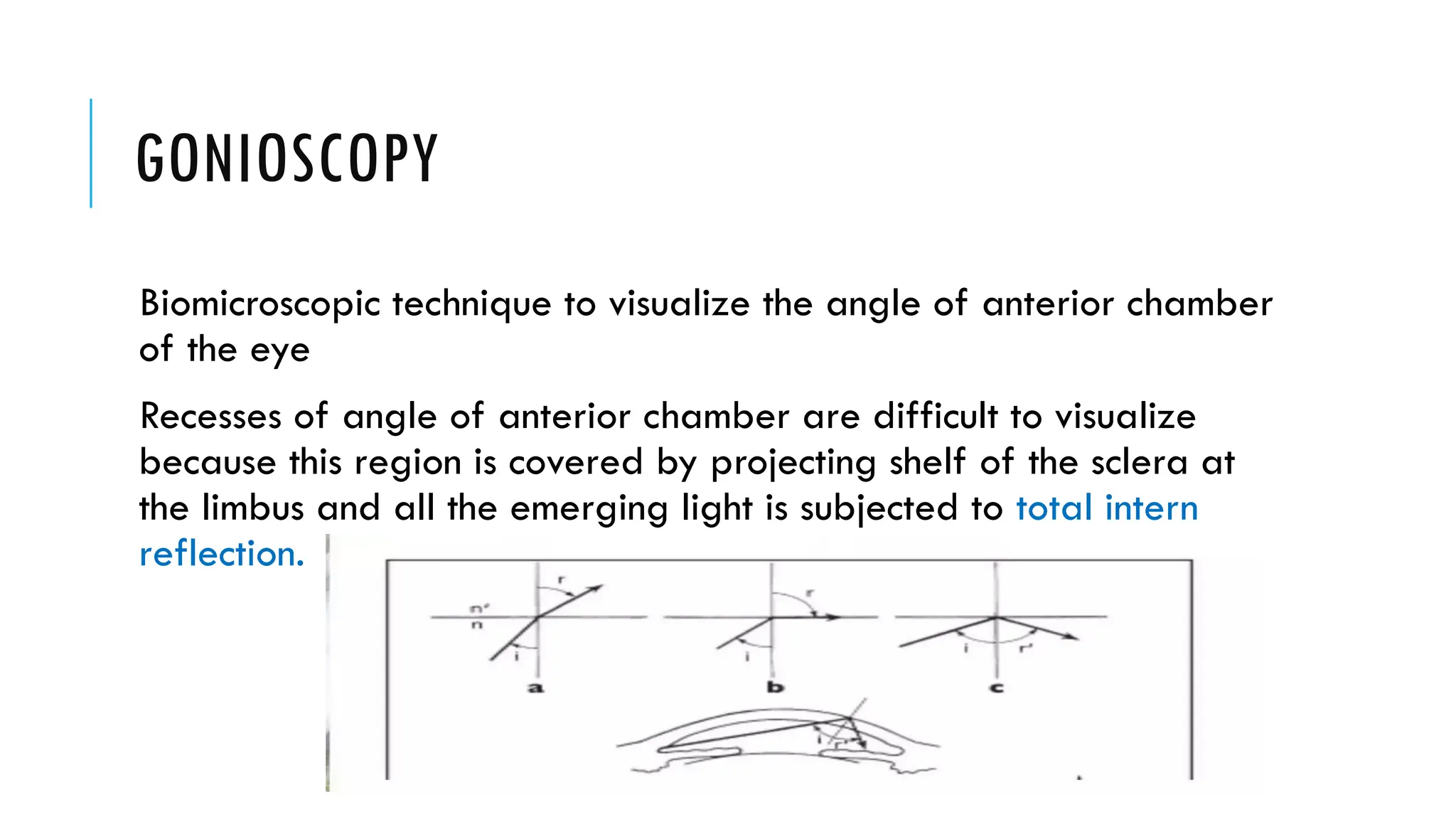
Recesses of angle of anterior chamber are difficult to visualize
because this region is covered by projecting shelf of the sclera at
the limbus and all the emerging light is subjected to total intern
reflection.
GONIOSCOPY
Biomicroscopic technique to visualize the angle of anterior chamber
of the eye
Recesses of the angle of anterior chamber are difficult to visualize
because this region is covered by projecting shelf of the sclera at
the limbus and all the emerging light is subjected to total internal
reflection.
Total internal reflection is an optical phenomenon that occur when
rays of light strike a medium boundary at the angle larger than a
particular critical angle with respect to the normal surface
GONIOSCOPY
Biomicroscopic technique to visualize the angle of anterior chamber of the eye
Recesses of the angle of anterior chamber are difficult to visualize because
this region is covered by projecting shelf of the sclera at the limbus and all the
emerging light is subjected to total internal reflection.
Total internal reflection is an optical phenomenon that occur when rays of light
strike a medium boundary at the angle larger than a particular critical angle
with respect to the normal surface
Critical angle is the angle of incidence above which total internal reflection
occurs
GONIOSCOPY
Biomicroscopic technique to visualize the angle of anterior chamber of the eye
Recesses of the angle of anterior chamber are difficult to visualize because this
region is covered by projecting shelf of the sclera at the limbus and all the emerging
light is subjected to total internal reflection.
Total internal reflection is an optical phenomenon that occur when raised of light strike
a medium boundary at the angle larger than a particular critical angle with respect
to the normal surface
Critical angle is the angle of incidence above which total internal reflection occurs
In the eye critical angle is 46 Degree at the Air Cornea interface
GONIOSCOPY
Rare exceptions of this rule:
Very steep cornea
Deep anterior chamber like Keratoglobus and Keratoconus angle
In above condition angle structure is directly visualized
GONIOSCOPY - INDICATION
SUSPECTED ANGLE CLOSURE
ANY SIGN OF ANGLE CLOSURE DISEASE
HISTORY OF ANGLE CLOSURE IN FAMILY
POSITIVE VAN HERRICK
ANY HISTORY GLAUCOMA,FIELD LOSS AND DISC DAMAGE
ELEVATED IOP
PIGMENTED DISPERSION SYNDROME
OCULAR BLUNT TRAUMA AND HISTORY OF FORIGN BODY
PSEUDOEXFOLIATION SYNDROME
 RETINAL VASCULAR
DISEASE
 HISTORY OF OCULAR
TRAUMA WITH
HYPOTONY
 UNEXPLAIND HYPOTONY
TO LOOK FOR A
CYCLODIALYSIS CLEFT
GONIOSCOPY-CONTRAINDICATION
RECURRENT CORNEAL EROSION
CORNEAL ABRASION
KERATOPATHY (Bullous ,Band ,Punctate etc)
PERFORATING EYE INJURIES
TYPE OF GONIOSCOPY
DIRECT GONIOSCOPY
Koeppe - Prototype diagnostic Gonio
lens (R.I -1.4)
-Surface is quit larger, Saline is used as
coupling agent
Richarson Shaffer -Small Koeppe lens
used in infant
Laymen- for Gonioscopic examination of
premature infant
Barkan – Prototype surgical Gonio lens
Thorpe-Surgical and Diagnostic lens for
operating room
Swan Jacob-Surgical Gonio lens used for
children
INDIRECT GONIOSCOPY
GOLDMAN LENS- Surface is slightly larger than cornea
Goldman single mirror- Mirror inclination at
62 degree
Goldman three mirror- One mirror for Gonioscopy
Two mirror for Retina
Central area – Posterior pole
73 degree - Equator
67 degree -Orra Serata
59 degree – Iridocorneal angle
Coated front surface available for laser
use
Zeiss Four mirror lens-
Prism is used in placed of mirror
-Surface is smaller than the Cornea
so use of patient tear film as coupling
agent
- All four mirror inclined at 64 Degree
- Required holder
-Fluid bridge not required
Posner four mirror- Modified Zeiss
four mirror gonio prism attach
with handle Posner
Zeiss
INDIRECT GONIOSCOPY
INDIRECT GONIOSCOPY
oThorpe four mirror – Inclination at 62 degree
Required fluid bridge
oRitch Trabeculoplasty – Four mirror Gonioscopy lens,
Two inclined at 50 degree and
Two at 62 Degree with convex lens
oLatina Trabeculoplasty lens-One mirror for trabeculoplasty
Thorpe
Ritch
Latina
POSNER
ZEISS
GOLDMAN
SINGLE
thorpe
Swan Jacob
GONIOSCOPY
DIRECT GONIOSCOPY - Clinically
oUseful but impractical for routine
used
oTo compare the angle of two eye
Simultaneously
oFor examination of the children
under anesthesia
oSurgical procedure like Goniotomy
GONIOSCOPY
oUseful but impractical for routine
used
oTo compare the angle of two eye
Simultaneously
oFor examination of the children
under anesthesia
oSurgical procedure like Goniotomy
INDIRECT GONIOSCOPY
The light rays reflected by a prism /
mirror in contact lens leave the Lens-Air
interface
DIRECT GONIOSCOPY
GONIOSCOPY
Goldman type of lens- Advantage
Easy learning technique
Less expensive
Greater visibility of detail
Stability of the lens over the cornea is better
Disadvantage:
Cannot perform Dynamic or Indentation
Gonioscopy
Used of OVD coupling agents
GONIOSCOPY
Goldman type of lens- Advantage
Easy in learning technique
Less expensive
Greater visibility of detail
Stability of the lens over the cornea is
better
Disadvantage:
Cannot perform Dynamic or Indentation
Gonioscopy
Used of OVD coupling agents
Zeiss Four Mirror Gonio lens
Allows quick evaluation of the angle
No coupling solution is needed
Enables differentiation between Appositional and
Synechial angle closure ( Indentation gonioscopy )
Disadvantages:
 Long learning curve
To avoid tendency to underestimate the narrowness
inadvertently applying pressure to the central cornea
thus artificially widening the angle
COMPARISON BETWEEN GOLDMAN AND ZEISS GONIOSCOPY
GOLDMAN SINGLE MIRROR GOLDMAN THREE MIRROR ZEISS FOUR MIRROR
Diameter of the corneal
contact
12 mm 12mm 9mm
Overall diameter 15mm 18mm 9mm
Size of the RIM 1.5mm 3mm none
Mirror Angulation 62 Degree 59 mm 64mm
Mirror Height 17mm 12mm 12mm
Distance from the Central
Cornea
3mm 7mm 5 mm
Radius of curvature 7.4mm 7.4mm 7.85mm
Coupling fluid Required Required None
Gonioscopy Manipulation Manipulation Indentation
SLIT LAMP TECHNIQUE - GENERAL GUIDELINES
Do an external examination first
Perform Tonometry before Gonioscopy
Use Anesthesia
Pay attention to the patient comfort
Pay Attention to alignment
Use magnification of 10-15 x
Use Fairly short and narrow beam ( 2-3 mm)
Use dark room
( In light Pupillary constriction makes a narrow angle more
open)
GONIOSCOPY - TECHNIQUE
Patient is seated upright on the slit lamp
Cornea anesthetized with 0.5% Proparacaine or 4 % Xylocaine
One drop of methylcellulose is placed on the concavity of the gonio Lense with patient
looking up and one edge of the lens is placed on the lower fornix while Upper lid everted
and patient is instructed to look straight after placement of gonio lens
Lens is rotated into the position against the eye
Lens is sterilized with 2% Glutaraldehyde,1:10 Sodium hypochlorite or can be rinse with
soap/ water and allowed to dry
GONIOSCOPY
THE IMAGE IS INVERTED BUT
NOT LATERALY REVERSED
GONIOSCOPY – FOR DIAGNOSTIC PURPOSE
Post traumatic increased IOP - Angle recession
Rule out the Foreign body in the angle after open globe injury
Neoplastic invasion into the angle - (Ciliary body tumor)
Epithelial growth at angle
Vitreous strand incarcerated in the surgical wound
To visualize the orientation of haptics of ACIOL
COMPARATION BETWEEN THE INDIRECT AND
DIRECT GONIOSCOPY
DIRECT GONIOSCOPY-ADVANTAGE
 Provide straight view
 The angle of visualization can be change
by altering the hight of observer which
enable to evaluate over the curvature of
the iris eg, IRIS BOMBE or NARROW
ANGLE
 Less distortion of the anterior chamber
 The view is more PANAROMIC
INDIRECT GONIOSCOPY
 Convenient
 Patient need not to lie down
 Slit lamp examination provide better details
compare to direct Gonioscopy
 Required less instruments
COMPARATION BETWEEN THE INDIRECT AND
DIRECT GONIOSCOPY
DIRECT GONIOSCOPY-ADVANTAGE
 Simultaneously Comparation of the
both eye easier
 Fundus examination through small pupil is
possible
 No coupling agent is needed
 Direct view for the Surgery eg.
GONIOTOMY, MIGS
INDIRECT GONIOSCOPY: Advantage
 LESS time consuming
 Dynamic Gonioscopy is possible
 Indentation can be done
GONIOSCOPY – DISADVANTAGE
INDIRECT GONIOSCOPY
DIRECT GONIOSCOPY
 Inconvenient procedure with the patient
because having to lie in supine
position
 Inability to performed indentation
 Low magnification
 Mirror image is formed
 Inadvertent pressure can open or closed the angle
 Depth of the narrow angle cannot be seen
 Segmental view
 One eye at a time
 Viscous is required
THERAPEUTIC USED FOR GONIOSCOPY
 LASER TRABECULOPLASTY/TRABECULOTOMY
 GONIOTOMY/GONIOPLASTY
 LASER GONIO PHOTOCOAGULATION
 REOPENING OF A BLOCKED TRABECULECTOMY
 INDENTATION GONIOSCOPY TO BREAK AN ACUTE ATTACK OF PACG
 MINIMAL INVASIVE GLAUCOMA SURGERY ( MIGS )
GONIOSCOPY
MANIPULATION GONIOSCOPY
Tangential view of the angle
help in identification of the
angle obscured by convex iris
Ask the patient to look
towards the mirror
Moving the mirror towards the
angle being viewed
GONIOSCOPY
INDENTENTION GONIOSCOPY
Also known as pressure or Dynamic
gonioscopy
Done with Corneal type ( Zeiss four mirror ,
Posner , Sussman) of Gonio lens which have
smaller contact diameter
It help in distinguishing appositional closure
from synechial closure
Lens is centrally placed on the cornea and
pushed posteriorly so that aqueous is pushed
into the angle which open the appositional
closure angle
GONIOSCOPY - ANATOMY

For identification of the angle , the scleral spur and
Schwalbe’s line are the most consistent land marks:

Starting From the Root of iris following structure
are present normal angle:

1.Root of the iris

2.Ciliary body band

3.Scleral spur

4.Pigmented trabecular meshwork (Post.)
Non pigmented trabecular meshwork (ant.)

5.Schwalbe’s line
GONIOSCOPY - ANATOMY
IRIS PROCESSES :
Present in one third of the normal eye
Non indicative of any disease process
Grey or brown lacy finger like
extensions of the periphery iris and
follow the angle concavity
Frequently seen nasally
Never interfere with the aqueous flow
GONIOSCOPY – IRIS CONFIGURATION
Myopes-Concave
Hyperopes- Convex
Abnormal Convexity – Pupillary block
Abnormal Concavity- Pigment dispersion
Abnormal last roll- Plateau iris ( S curve configuration)
DIFFERENCE BETWEEN IRIS PROCESSES AND
SYNECHIA PROCESSES
IRIS PROCESSES
FINE
Extend into the scleral spur
Follow the concavity of the recess
Under line structure seen
Iris move with indentation
Broken with the angle recession
SYNECHIA
BROAD
Extend beyond the scleral spur
Bridge the concavity of the recesses
Obscure Underline Structure
Resist the movement
 Intact
GONIOSCOPY- SCLERAL SPUR
It is the posterior lip of scleral
sulcus seen as while line between
ciliary body band and
trabecular meshwork
GONIOSCOPY – TRABECULAR MESHWORK
IT IS PIGMENTED BAND ANTERIOR TO
SCLRAL SPUR
TWO PART :
A. Anterior
lie between the Schwalbe’s
line and Anterior edge of the
Schlemm’s canal
Involved in less degree of
aqueous out flow
B. Posterior
It is the functional part.
Primary site for aqueous out
flow
Appearance of functional
trabecular meshwork depend on
amount of the pigment
deposition
GONIOSCOPY – TRABECULAR MESHWORK
IF SUPERIOR QUADRANT MORE PIGMENTED THAN INFERIOR
PSEUDO EXFOLIATION SYNDROME
• PIGMENT DISPERSON SYNDROME
• PREVIOUS INFLAMATION
PSEUDO
EXFOLIATION
PIGMENT
DISPERSION
GONIOSCOPY – TRABECULAR MESHWORK
Physiological
Senility
PATHOLOGICAL
Pigment dispersion syndrome
Pseudo exfoliation syndrome
Anterior Uveitis
Following acute angle closure
Following YAG laser Iridotomy
Iris melanoma
CAUSE OF TRABECULAR
PIGMENTATION
GONIOSCOPY – SCHLEMM’S CANAL
GENERALY NOT SEEN
LIES DEEP WITHIN POSTERIOR TRABECULAT MESHWORK AND
ANTERIOR TO SCERAL SPUR
IMPOSTANCE- BLOOD IN THE SCHLEMM’S CANAL SEEN AS RED
STREAK IN THE POSTERIOR TRABECULAR MESHWORK
GONIOSCOPY- SCHWALBE’S LINE
Junction between the anterior
chamber structure and cornea
where Descemet’s membrane
terminates
Fine ridge anterior to
trabecular meshwork identified
by a small built up of pigment
GONIOSCOPY - SCHWALBE’S LINE
HOW TO IDENTIFY
When thin slit of light hits the
iridocorneal angle at the angle
of 10 -15 degrees, two light
reflections are seen from the
external and internal corneal
surface which pipe down at the
Schwalbe’s line , marking the
anterior border of trabecular
meshwork
Corneal wedge is the useful
technique to identify the
trabecular meshwork in the eye
GONIOSCOPY- OCLUDABLE ANGLE
 If the posterior part of the trabecular meshwork
is not visible in more than 180 degree without
indentension or manipulation
GONIOSCOPY- BLOOD VESSEL AT ANGLE
Present in 50 to 80 % in blue eye and 10 to 16 % in
brown eye.
Three type:
a-Circular ciliary band vessels ( Most common )
b-Radical ciliary blood band vessel
c- Radial iris root vessels
ORIGIN OF TRABECULAR BLOOD VESSEL IS UNCERTAIN
GONIOSCOPY- BLOOD VESSEL AT ANGLE
NORMAL BLOOD VESSEL
RADIAL ORIENTATION
THICK
NON BRANCHING
DO NOT CROSS THE SCLERAL SPUR
NEOVASCULAR BLOOD VESSEL
FINE
ARBORISING
CROSSES SCLERAL SPUR
GONIOSCOPY- BLOOD VESSEL AT ANGLE
GRADING OF CHAMBER ANGLE
Van Herick
GRADE 4 Angle is widely open PAC > CT
GRADE 3 Angle is narrow PAC= ¼ -1/2 CT
GRADE 2 Angle is dangerously narrow PAC=1/4 CT
GRADE 1 Angle is dangerously narrow or closed PAC < ¼ CT
GONIOSCOPY- GRADING SYSTEM FOR THE ANGLE
OF ANTERIOR CHAMBER
1. SHAFFER GRADING
2. SCHEIE’S GRADING
3. SPEATH GONIOSCOPIC GRADING
4. R P CENTRE GONIOSCOPIC GRADING
SHAFFER GRADING
GRADE 4 ( 35-40 DEGREE)- CILIARY BODY EASILY VISIBLE
GRADE 3 ( 25-35 DEGREE ) – SCLERAL SPUR IS VISIBLE
GRADE 2 (20 DEGREE ) – ONLY TRABECULUM IS VISIBLE
ANGLE CLOSURE IS POSSIBLE BUT UNLIKELY
GRADE 1 (1O DERREE) – ONLY SCHWALBE’S LINE PERHAP
TOP OF THE TRABECULUM IS VISIBLE
HIGH RISK OF ANGLE CLOSURE
GRADE 0 (0 DEGREE) – IRIDOCORNEAL CONTACT IS PRESENT
APEX OF THE CORNEAL EDGE NOT VISIBLE
USED INDENTATION GONIOSCOPY
GRADING OF THE ANGLE WIDTH:SHAFFER’S
GRADE 0 GRADE 1 GRADE 2 GRADE 3 GRADE 4
DEGREE CLOSE 10 20 30 40
ANGLE
STUCTURE
CLOSE SWALBE’S
LINE
VISIBLE
ANTERIOR
TM IS
VISIBLE
SCLERALS
SPUR IS
VISIBLE
CILIARY BODY
VISIBLE
SCHEIE’S CLASSIFICATION – BASED ON THE MOST
POSTERIOR STRUCTURE IS IDENTIFIABLE IN ANGLE
WIDE OPEN – ALL THE ARE VISIBLE
GRADE 1 : HARDLY IRIS ROOT IS
VISIBLE
GRADE 2 : CILIARY BODY OBSCURED
GRADE 3 : POSTERIOR TRACECULUM IS
OBSCURED
GRADE 4: ONLY SCHWALBE’S LINE
VISIBLE (Closed)
SPEATH METHOD
THE NEWER SYSTEM DISCRIBE FOR IRIS
COFIGURATION:
Indicated by first letter of descriptions:
B-Bowing anteriorly (1 to 4+)
P-plateau Iris
F- Flat ,Commonest Iris configuration
(Comparable to the older ‘r’ designation)
C-Concave (Comparable to old ‘q’
designation)
SPEATH GRADING:
E40q/4+TMP
E40q/4+TMP
An Extremely deeply inserting iris root
40 degree angle recess
Posterior bowing of the peripheral iris
Extremely pigmented trabecular meshwork
C20r/2+TMP
R P CENTRE GRADING
N-No Dipping of the beam
D-Dipping of the beam
SL- Schwalbe's line and Anterior 1/3 of the trabecular
meshwork
TM-Middle 1/3 of the trabecular meshwork is visible
SC- Posterior 1/3 of the trabecular meshwork
(Location of the Schlemm’s canal visualized)
SS- Scleral Spur is visualized
CB- Ciliary body band is visualized
CLINICAL PRESENTATION OF GONIOSCOPY
COMMON ERROR WHILE DOING PERFORMING GONIOSCOPY
o Bright room light
o Air bubble
o Inadequate coupling agent
o Excessive pressure on the lens
o Light of slit passing thought the pupil
goniosc64tgy3dcde ew2tggdsexseopy-1.pptx

goniosc64tgy3dcde ew2tggdsexseopy-1.pptx

  • 1.
  • 2.
    GONIOSCOPY Biomicroscopic technique tovisualize the angle of anterior chamber of the eye
  • 3.
    GONIOSCOPY Biomicroscopic technique tovisualize the angle of anterior chamber of the eye Recesses of angle of anterior chamber are difficult to visualize because this region is covered by projecting shelf of the sclera at the limbus and all the emerging light is subjected to total intern reflection.
  • 5.
    GONIOSCOPY Biomicroscopic technique tovisualize the angle of anterior chamber of the eye Recesses of the angle of anterior chamber are difficult to visualize because this region is covered by projecting shelf of the sclera at the limbus and all the emerging light is subjected to total internal reflection. Total internal reflection is an optical phenomenon that occur when rays of light strike a medium boundary at the angle larger than a particular critical angle with respect to the normal surface
  • 6.
    GONIOSCOPY Biomicroscopic technique tovisualize the angle of anterior chamber of the eye Recesses of the angle of anterior chamber are difficult to visualize because this region is covered by projecting shelf of the sclera at the limbus and all the emerging light is subjected to total internal reflection. Total internal reflection is an optical phenomenon that occur when rays of light strike a medium boundary at the angle larger than a particular critical angle with respect to the normal surface Critical angle is the angle of incidence above which total internal reflection occurs
  • 7.
    GONIOSCOPY Biomicroscopic technique tovisualize the angle of anterior chamber of the eye Recesses of the angle of anterior chamber are difficult to visualize because this region is covered by projecting shelf of the sclera at the limbus and all the emerging light is subjected to total internal reflection. Total internal reflection is an optical phenomenon that occur when raised of light strike a medium boundary at the angle larger than a particular critical angle with respect to the normal surface Critical angle is the angle of incidence above which total internal reflection occurs In the eye critical angle is 46 Degree at the Air Cornea interface
  • 8.
    GONIOSCOPY Rare exceptions ofthis rule: Very steep cornea Deep anterior chamber like Keratoglobus and Keratoconus angle In above condition angle structure is directly visualized
  • 9.
    GONIOSCOPY - INDICATION SUSPECTEDANGLE CLOSURE ANY SIGN OF ANGLE CLOSURE DISEASE HISTORY OF ANGLE CLOSURE IN FAMILY POSITIVE VAN HERRICK ANY HISTORY GLAUCOMA,FIELD LOSS AND DISC DAMAGE ELEVATED IOP PIGMENTED DISPERSION SYNDROME OCULAR BLUNT TRAUMA AND HISTORY OF FORIGN BODY PSEUDOEXFOLIATION SYNDROME  RETINAL VASCULAR DISEASE  HISTORY OF OCULAR TRAUMA WITH HYPOTONY  UNEXPLAIND HYPOTONY TO LOOK FOR A CYCLODIALYSIS CLEFT
  • 10.
    GONIOSCOPY-CONTRAINDICATION RECURRENT CORNEAL EROSION CORNEALABRASION KERATOPATHY (Bullous ,Band ,Punctate etc) PERFORATING EYE INJURIES
  • 11.
    TYPE OF GONIOSCOPY DIRECTGONIOSCOPY Koeppe - Prototype diagnostic Gonio lens (R.I -1.4) -Surface is quit larger, Saline is used as coupling agent Richarson Shaffer -Small Koeppe lens used in infant Laymen- for Gonioscopic examination of premature infant Barkan – Prototype surgical Gonio lens Thorpe-Surgical and Diagnostic lens for operating room Swan Jacob-Surgical Gonio lens used for children INDIRECT GONIOSCOPY GOLDMAN LENS- Surface is slightly larger than cornea Goldman single mirror- Mirror inclination at 62 degree Goldman three mirror- One mirror for Gonioscopy Two mirror for Retina Central area – Posterior pole 73 degree - Equator 67 degree -Orra Serata 59 degree – Iridocorneal angle Coated front surface available for laser use
  • 12.
    Zeiss Four mirrorlens- Prism is used in placed of mirror -Surface is smaller than the Cornea so use of patient tear film as coupling agent - All four mirror inclined at 64 Degree - Required holder -Fluid bridge not required Posner four mirror- Modified Zeiss four mirror gonio prism attach with handle Posner Zeiss
  • 13.
    INDIRECT GONIOSCOPY INDIRECT GONIOSCOPY oThorpefour mirror – Inclination at 62 degree Required fluid bridge oRitch Trabeculoplasty – Four mirror Gonioscopy lens, Two inclined at 50 degree and Two at 62 Degree with convex lens oLatina Trabeculoplasty lens-One mirror for trabeculoplasty Thorpe Ritch Latina
  • 15.
  • 16.
    GONIOSCOPY DIRECT GONIOSCOPY -Clinically oUseful but impractical for routine used oTo compare the angle of two eye Simultaneously oFor examination of the children under anesthesia oSurgical procedure like Goniotomy
  • 17.
    GONIOSCOPY oUseful but impracticalfor routine used oTo compare the angle of two eye Simultaneously oFor examination of the children under anesthesia oSurgical procedure like Goniotomy INDIRECT GONIOSCOPY The light rays reflected by a prism / mirror in contact lens leave the Lens-Air interface DIRECT GONIOSCOPY
  • 18.
    GONIOSCOPY Goldman type oflens- Advantage Easy learning technique Less expensive Greater visibility of detail Stability of the lens over the cornea is better Disadvantage: Cannot perform Dynamic or Indentation Gonioscopy Used of OVD coupling agents
  • 19.
    GONIOSCOPY Goldman type oflens- Advantage Easy in learning technique Less expensive Greater visibility of detail Stability of the lens over the cornea is better Disadvantage: Cannot perform Dynamic or Indentation Gonioscopy Used of OVD coupling agents Zeiss Four Mirror Gonio lens Allows quick evaluation of the angle No coupling solution is needed Enables differentiation between Appositional and Synechial angle closure ( Indentation gonioscopy ) Disadvantages:  Long learning curve To avoid tendency to underestimate the narrowness inadvertently applying pressure to the central cornea thus artificially widening the angle
  • 20.
    COMPARISON BETWEEN GOLDMANAND ZEISS GONIOSCOPY GOLDMAN SINGLE MIRROR GOLDMAN THREE MIRROR ZEISS FOUR MIRROR Diameter of the corneal contact 12 mm 12mm 9mm Overall diameter 15mm 18mm 9mm Size of the RIM 1.5mm 3mm none Mirror Angulation 62 Degree 59 mm 64mm Mirror Height 17mm 12mm 12mm Distance from the Central Cornea 3mm 7mm 5 mm Radius of curvature 7.4mm 7.4mm 7.85mm Coupling fluid Required Required None Gonioscopy Manipulation Manipulation Indentation
  • 21.
    SLIT LAMP TECHNIQUE- GENERAL GUIDELINES Do an external examination first Perform Tonometry before Gonioscopy Use Anesthesia Pay attention to the patient comfort Pay Attention to alignment Use magnification of 10-15 x Use Fairly short and narrow beam ( 2-3 mm) Use dark room ( In light Pupillary constriction makes a narrow angle more open)
  • 22.
    GONIOSCOPY - TECHNIQUE Patientis seated upright on the slit lamp Cornea anesthetized with 0.5% Proparacaine or 4 % Xylocaine One drop of methylcellulose is placed on the concavity of the gonio Lense with patient looking up and one edge of the lens is placed on the lower fornix while Upper lid everted and patient is instructed to look straight after placement of gonio lens Lens is rotated into the position against the eye Lens is sterilized with 2% Glutaraldehyde,1:10 Sodium hypochlorite or can be rinse with soap/ water and allowed to dry
  • 23.
    GONIOSCOPY THE IMAGE ISINVERTED BUT NOT LATERALY REVERSED
  • 24.
    GONIOSCOPY – FORDIAGNOSTIC PURPOSE Post traumatic increased IOP - Angle recession Rule out the Foreign body in the angle after open globe injury Neoplastic invasion into the angle - (Ciliary body tumor) Epithelial growth at angle Vitreous strand incarcerated in the surgical wound To visualize the orientation of haptics of ACIOL
  • 25.
    COMPARATION BETWEEN THEINDIRECT AND DIRECT GONIOSCOPY DIRECT GONIOSCOPY-ADVANTAGE  Provide straight view  The angle of visualization can be change by altering the hight of observer which enable to evaluate over the curvature of the iris eg, IRIS BOMBE or NARROW ANGLE  Less distortion of the anterior chamber  The view is more PANAROMIC INDIRECT GONIOSCOPY  Convenient  Patient need not to lie down  Slit lamp examination provide better details compare to direct Gonioscopy  Required less instruments
  • 26.
    COMPARATION BETWEEN THEINDIRECT AND DIRECT GONIOSCOPY DIRECT GONIOSCOPY-ADVANTAGE  Simultaneously Comparation of the both eye easier  Fundus examination through small pupil is possible  No coupling agent is needed  Direct view for the Surgery eg. GONIOTOMY, MIGS INDIRECT GONIOSCOPY: Advantage  LESS time consuming  Dynamic Gonioscopy is possible  Indentation can be done
  • 27.
    GONIOSCOPY – DISADVANTAGE INDIRECTGONIOSCOPY DIRECT GONIOSCOPY  Inconvenient procedure with the patient because having to lie in supine position  Inability to performed indentation  Low magnification  Mirror image is formed  Inadvertent pressure can open or closed the angle  Depth of the narrow angle cannot be seen  Segmental view  One eye at a time  Viscous is required
  • 28.
    THERAPEUTIC USED FORGONIOSCOPY  LASER TRABECULOPLASTY/TRABECULOTOMY  GONIOTOMY/GONIOPLASTY  LASER GONIO PHOTOCOAGULATION  REOPENING OF A BLOCKED TRABECULECTOMY  INDENTATION GONIOSCOPY TO BREAK AN ACUTE ATTACK OF PACG  MINIMAL INVASIVE GLAUCOMA SURGERY ( MIGS )
  • 29.
    GONIOSCOPY MANIPULATION GONIOSCOPY Tangential viewof the angle help in identification of the angle obscured by convex iris Ask the patient to look towards the mirror Moving the mirror towards the angle being viewed
  • 30.
    GONIOSCOPY INDENTENTION GONIOSCOPY Also knownas pressure or Dynamic gonioscopy Done with Corneal type ( Zeiss four mirror , Posner , Sussman) of Gonio lens which have smaller contact diameter It help in distinguishing appositional closure from synechial closure Lens is centrally placed on the cornea and pushed posteriorly so that aqueous is pushed into the angle which open the appositional closure angle
  • 31.
    GONIOSCOPY - ANATOMY  Foridentification of the angle , the scleral spur and Schwalbe’s line are the most consistent land marks:  Starting From the Root of iris following structure are present normal angle:  1.Root of the iris  2.Ciliary body band  3.Scleral spur  4.Pigmented trabecular meshwork (Post.) Non pigmented trabecular meshwork (ant.)  5.Schwalbe’s line
  • 32.
    GONIOSCOPY - ANATOMY IRISPROCESSES : Present in one third of the normal eye Non indicative of any disease process Grey or brown lacy finger like extensions of the periphery iris and follow the angle concavity Frequently seen nasally Never interfere with the aqueous flow
  • 33.
    GONIOSCOPY – IRISCONFIGURATION Myopes-Concave Hyperopes- Convex Abnormal Convexity – Pupillary block Abnormal Concavity- Pigment dispersion Abnormal last roll- Plateau iris ( S curve configuration)
  • 34.
    DIFFERENCE BETWEEN IRISPROCESSES AND SYNECHIA PROCESSES IRIS PROCESSES FINE Extend into the scleral spur Follow the concavity of the recess Under line structure seen Iris move with indentation Broken with the angle recession SYNECHIA BROAD Extend beyond the scleral spur Bridge the concavity of the recesses Obscure Underline Structure Resist the movement  Intact
  • 36.
    GONIOSCOPY- SCLERAL SPUR Itis the posterior lip of scleral sulcus seen as while line between ciliary body band and trabecular meshwork
  • 37.
    GONIOSCOPY – TRABECULARMESHWORK IT IS PIGMENTED BAND ANTERIOR TO SCLRAL SPUR TWO PART : A. Anterior lie between the Schwalbe’s line and Anterior edge of the Schlemm’s canal Involved in less degree of aqueous out flow B. Posterior It is the functional part. Primary site for aqueous out flow Appearance of functional trabecular meshwork depend on amount of the pigment deposition
  • 38.
    GONIOSCOPY – TRABECULARMESHWORK IF SUPERIOR QUADRANT MORE PIGMENTED THAN INFERIOR PSEUDO EXFOLIATION SYNDROME • PIGMENT DISPERSON SYNDROME • PREVIOUS INFLAMATION PSEUDO EXFOLIATION PIGMENT DISPERSION
  • 39.
    GONIOSCOPY – TRABECULARMESHWORK Physiological Senility PATHOLOGICAL Pigment dispersion syndrome Pseudo exfoliation syndrome Anterior Uveitis Following acute angle closure Following YAG laser Iridotomy Iris melanoma CAUSE OF TRABECULAR PIGMENTATION
  • 40.
    GONIOSCOPY – SCHLEMM’SCANAL GENERALY NOT SEEN LIES DEEP WITHIN POSTERIOR TRABECULAT MESHWORK AND ANTERIOR TO SCERAL SPUR IMPOSTANCE- BLOOD IN THE SCHLEMM’S CANAL SEEN AS RED STREAK IN THE POSTERIOR TRABECULAR MESHWORK
  • 41.
    GONIOSCOPY- SCHWALBE’S LINE Junctionbetween the anterior chamber structure and cornea where Descemet’s membrane terminates Fine ridge anterior to trabecular meshwork identified by a small built up of pigment
  • 42.
    GONIOSCOPY - SCHWALBE’SLINE HOW TO IDENTIFY When thin slit of light hits the iridocorneal angle at the angle of 10 -15 degrees, two light reflections are seen from the external and internal corneal surface which pipe down at the Schwalbe’s line , marking the anterior border of trabecular meshwork Corneal wedge is the useful technique to identify the trabecular meshwork in the eye
  • 43.
    GONIOSCOPY- OCLUDABLE ANGLE If the posterior part of the trabecular meshwork is not visible in more than 180 degree without indentension or manipulation
  • 44.
    GONIOSCOPY- BLOOD VESSELAT ANGLE Present in 50 to 80 % in blue eye and 10 to 16 % in brown eye. Three type: a-Circular ciliary band vessels ( Most common ) b-Radical ciliary blood band vessel c- Radial iris root vessels ORIGIN OF TRABECULAR BLOOD VESSEL IS UNCERTAIN
  • 45.
    GONIOSCOPY- BLOOD VESSELAT ANGLE NORMAL BLOOD VESSEL RADIAL ORIENTATION THICK NON BRANCHING DO NOT CROSS THE SCLERAL SPUR NEOVASCULAR BLOOD VESSEL FINE ARBORISING CROSSES SCLERAL SPUR
  • 46.
  • 47.
    GRADING OF CHAMBERANGLE Van Herick GRADE 4 Angle is widely open PAC > CT GRADE 3 Angle is narrow PAC= ¼ -1/2 CT GRADE 2 Angle is dangerously narrow PAC=1/4 CT GRADE 1 Angle is dangerously narrow or closed PAC < ¼ CT
  • 48.
    GONIOSCOPY- GRADING SYSTEMFOR THE ANGLE OF ANTERIOR CHAMBER 1. SHAFFER GRADING 2. SCHEIE’S GRADING 3. SPEATH GONIOSCOPIC GRADING 4. R P CENTRE GONIOSCOPIC GRADING
  • 49.
    SHAFFER GRADING GRADE 4( 35-40 DEGREE)- CILIARY BODY EASILY VISIBLE GRADE 3 ( 25-35 DEGREE ) – SCLERAL SPUR IS VISIBLE GRADE 2 (20 DEGREE ) – ONLY TRABECULUM IS VISIBLE ANGLE CLOSURE IS POSSIBLE BUT UNLIKELY GRADE 1 (1O DERREE) – ONLY SCHWALBE’S LINE PERHAP TOP OF THE TRABECULUM IS VISIBLE HIGH RISK OF ANGLE CLOSURE GRADE 0 (0 DEGREE) – IRIDOCORNEAL CONTACT IS PRESENT APEX OF THE CORNEAL EDGE NOT VISIBLE USED INDENTATION GONIOSCOPY
  • 50.
    GRADING OF THEANGLE WIDTH:SHAFFER’S GRADE 0 GRADE 1 GRADE 2 GRADE 3 GRADE 4 DEGREE CLOSE 10 20 30 40 ANGLE STUCTURE CLOSE SWALBE’S LINE VISIBLE ANTERIOR TM IS VISIBLE SCLERALS SPUR IS VISIBLE CILIARY BODY VISIBLE
  • 51.
    SCHEIE’S CLASSIFICATION –BASED ON THE MOST POSTERIOR STRUCTURE IS IDENTIFIABLE IN ANGLE WIDE OPEN – ALL THE ARE VISIBLE GRADE 1 : HARDLY IRIS ROOT IS VISIBLE GRADE 2 : CILIARY BODY OBSCURED GRADE 3 : POSTERIOR TRACECULUM IS OBSCURED GRADE 4: ONLY SCHWALBE’S LINE VISIBLE (Closed)
  • 52.
    SPEATH METHOD THE NEWERSYSTEM DISCRIBE FOR IRIS COFIGURATION: Indicated by first letter of descriptions: B-Bowing anteriorly (1 to 4+) P-plateau Iris F- Flat ,Commonest Iris configuration (Comparable to the older ‘r’ designation) C-Concave (Comparable to old ‘q’ designation)
  • 53.
  • 54.
  • 55.
    E40q/4+TMP An Extremely deeplyinserting iris root 40 degree angle recess Posterior bowing of the peripheral iris Extremely pigmented trabecular meshwork
  • 56.
  • 57.
    R P CENTREGRADING N-No Dipping of the beam D-Dipping of the beam SL- Schwalbe's line and Anterior 1/3 of the trabecular meshwork TM-Middle 1/3 of the trabecular meshwork is visible SC- Posterior 1/3 of the trabecular meshwork (Location of the Schlemm’s canal visualized) SS- Scleral Spur is visualized CB- Ciliary body band is visualized
  • 58.
  • 59.
    COMMON ERROR WHILEDOING PERFORMING GONIOSCOPY o Bright room light o Air bubble o Inadequate coupling agent o Excessive pressure on the lens o Light of slit passing thought the pupil