RUTHERFORD
  THEORY


Albert C. X10/1 | Julius C. X10/13 | Nicholas S.W. X10/17 | Sinclair K. X10/19
Lenard’s Experiment

Lenard’s experiment was meant to proof that if Thomson’s
atomic model is right, electrons that go through the
aluminum plate should’ve experienced energy loss, so the
electrons should be easily refracted.

In Lenard’s experiment, he shows that Thomson’s atomic
model is wrong because he found that most of the electrons
were not refracted. This shows that electrons are not spread
evenly.
Continuation of Lenard’s Experiment

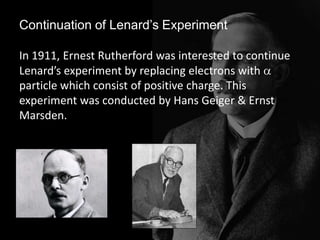
In 1911, Ernest Rutherford was interested to continue
Lenard’s experiment by replacing electrons with
particle which consist of positive charge. This
experiment was conducted by Hans Geiger & Ernst
Marsden.
Who is Ernest Rutherford?
He is a New Zealand-born, British chemist and
physicist. In 1914, he was knighted and two
years later, he was awarded the Hector
Memorial Medal. Under him, Nobel Prizes were
awarded to James Chadwick for discovering
neutron. Rutherford remains the only science
Nobel Prize winner to have performed his most
famous work after receiving the prize.
Rutherford’s research

• “rays” / particles
• Theory of protons
• Detector for electromagnetic waves
What are          rays / particles?
• High speed particles
• Made up of two protons and two neutrons
• Is a nucleus, same as the nucleus of a
  common atom of helium
• Don’t have electrons around it
• Type of ionizing radiation
• will loose all their energy in just a couple
  inches of travel in air
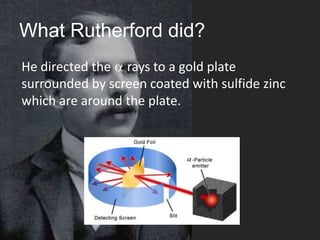
What Rutherford did?
He directed the rays to a gold plate
surrounded by screen coated with sulfide zinc
which are around the plate.
What happened?
1. Some of the   particles pass the empty space
  go trough
                                  Nucleus


 Particles                     Atoms of Gold
                               foil
2. Some of the particles that approach the
  nucleus are deflected

                               Nucleus
 Particles


                               Atoms of Gold
                               foil
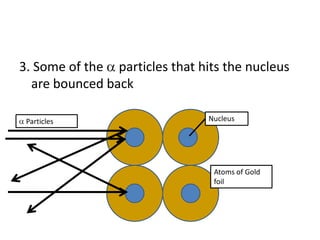
3. Some of the particles that hits the nucleus
  are bounced back

 Particles                      Nucleus


                                 Atoms of Gold
                                 foil
Conclusion of Rutherford’s Theory

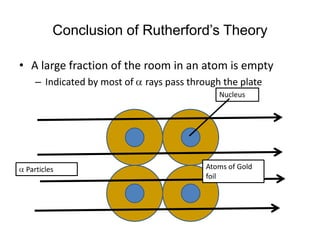
• A large fraction of the room in an atom is empty
    – Indicated by most of   rays pass through the plate
                                              Nucleus


 Particles                                 Atoms of Gold
                                           foil
• Nucleus is tiny yet very dense core of atom
   – Indicated by little amount of refracted   rays


       Particles                                  Nucleus


                                                      Atoms of Gold
                                                      foil
• Electrons go circle the nucleus with high speed
   – Indicated by the electrons that are not attracted by
     protons inside the nucleus
• The charge of the nucleus is the same as             particle’s,
  which is positive
   – Indicated by the deflected rays that deflected due to
     repulsion forces of similar charge.

                                             Nucleus
   Particles


                                             Atoms of Gold
                                             foil
Rutherford’s Theory Weakness

Based on Rutherford’s theory that
states electrons go around the
nucleus will stay on its path is
unproved. Based on physics
classical mechanic law, that objects
that going around on circular path
will release its energy in the form of
radiation, so the electron will be
going closer to the nucleus. But
then, Rutherford’s theory is
supported by Bohr’s theorem.

Rutherford theory

  • 1.
    RUTHERFORD THEORY AlbertC. X10/1 | Julius C. X10/13 | Nicholas S.W. X10/17 | Sinclair K. X10/19
  • 2.
    Lenard’s Experiment Lenard’s experimentwas meant to proof that if Thomson’s atomic model is right, electrons that go through the aluminum plate should’ve experienced energy loss, so the electrons should be easily refracted. In Lenard’s experiment, he shows that Thomson’s atomic model is wrong because he found that most of the electrons were not refracted. This shows that electrons are not spread evenly.
  • 3.
    Continuation of Lenard’sExperiment In 1911, Ernest Rutherford was interested to continue Lenard’s experiment by replacing electrons with particle which consist of positive charge. This experiment was conducted by Hans Geiger & Ernst Marsden.
  • 4.
    Who is ErnestRutherford? He is a New Zealand-born, British chemist and physicist. In 1914, he was knighted and two years later, he was awarded the Hector Memorial Medal. Under him, Nobel Prizes were awarded to James Chadwick for discovering neutron. Rutherford remains the only science Nobel Prize winner to have performed his most famous work after receiving the prize.
  • 5.
    Rutherford’s research • “rays”/ particles • Theory of protons • Detector for electromagnetic waves
  • 6.
    What are rays / particles? • High speed particles • Made up of two protons and two neutrons • Is a nucleus, same as the nucleus of a common atom of helium • Don’t have electrons around it • Type of ionizing radiation • will loose all their energy in just a couple inches of travel in air
  • 8.
    What Rutherford did? Hedirected the rays to a gold plate surrounded by screen coated with sulfide zinc which are around the plate.
  • 9.
    What happened? 1. Someof the particles pass the empty space go trough Nucleus Particles Atoms of Gold foil
  • 10.
    2. Some ofthe particles that approach the nucleus are deflected Nucleus Particles Atoms of Gold foil
  • 11.
    3. Some ofthe particles that hits the nucleus are bounced back Particles Nucleus Atoms of Gold foil
  • 12.
    Conclusion of Rutherford’sTheory • A large fraction of the room in an atom is empty – Indicated by most of rays pass through the plate Nucleus Particles Atoms of Gold foil
  • 13.
    • Nucleus istiny yet very dense core of atom – Indicated by little amount of refracted rays Particles Nucleus Atoms of Gold foil
  • 14.
    • Electrons gocircle the nucleus with high speed – Indicated by the electrons that are not attracted by protons inside the nucleus
  • 15.
    • The chargeof the nucleus is the same as particle’s, which is positive – Indicated by the deflected rays that deflected due to repulsion forces of similar charge. Nucleus Particles Atoms of Gold foil
  • 16.
    Rutherford’s Theory Weakness Basedon Rutherford’s theory that states electrons go around the nucleus will stay on its path is unproved. Based on physics classical mechanic law, that objects that going around on circular path will release its energy in the form of radiation, so the electron will be going closer to the nucleus. But then, Rutherford’s theory is supported by Bohr’s theorem.