Going with xAPI
Aaron E. Silvers, Partner
MakingBetter
xAPI Camp - Amazon
July 21, 2015
USE THE TWITTER!!!!!
@aaronesilvers #xAPIcamp
(Batman?)
Makin’ BAQON since 2008
What exactly is xAPI?
The Experience API is a standard way of
talking about our experiences, using data.
The Experience API (xAPI)
• Can track many different types of experiences — including
things that people do on the web, in mobile applications, with
wearables, in classrooms and in workplace environments
• Moves beyond a web-based, didactic model
• Promotes better design and technology practices
• Makes integration with other systems and practices easier
• Provides a way to gather and use more useful information.
It answers a lot of ‘How’ type questions…
• How can I inform better business decisions?
• How do I avoid locking us into a solution?
• How can I make investments in learning development last longer
and more future-proof?
• How can I make sure what I evaluate today is useful in the future?
• How will I connect a learner’s activities across multiple
applications?
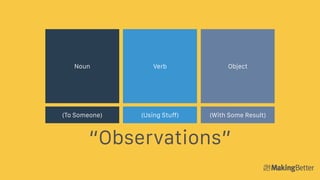
Someone Did Something
“Observations”
Noun Verb Object
(To Someone) (Using Stuff) (With Some Result)
How Does Experience API Work?
• People interact with “stuff” 

(i.e. content, apps, business systems, etc.)
• These interactions are observed and described as
statements.
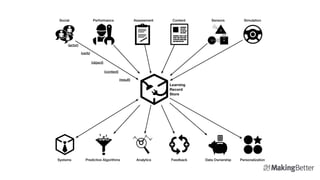
• The “stuff” sends the statements to a Learning Record Store.
What is a Learning Record Store, or LRS?
• It’s a database that stores activity statements - the “data”
• LRSs can be software (even hardware) that stands on its
own.
• LRSs can be a part of data appliances, enterprise
applications and learning management system (LMS)
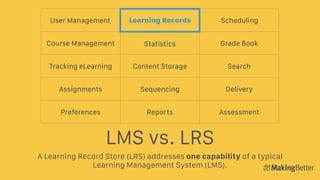
LMS vs. LRS
A Learning Record Store (LRS) addresses one capability of a typical 

Learning Management System (LMS).
User Management Learning Records Scheduling
Course Management Statistics Grade Book
Tracking eLearning Content Storage Search
Assignments Sequencing Delivery
Preferences Reports Assessment
How do I work with xAPI?
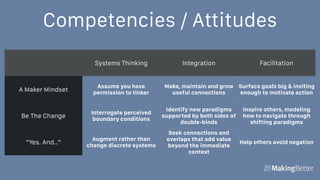
Competencies / Attitudes
Systems Thinking Integration Facilitation
A Maker Mindset
Assume you have
permission to tinker
Make, maintain and grow
useful connections
Surface goals big & inviting
enough to motivate action
Be The Change
Interrogate perceived
boundary conditions
Identify new paradigms
supported by both sides of
double-binds
Inspire others, modeling
how to navigate through
shifting paradigms
“Yes. And..”
Augment rather than
change discrete systems
Seek connections and
overlaps that add value
beyond the immediate
context
Help others avoid negation
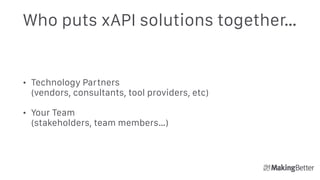
Who puts xAPI solutions together…
• Technology Partners 

(vendors, consultants, tool providers, etc)
• Your Team 

(stakeholders, team members…)
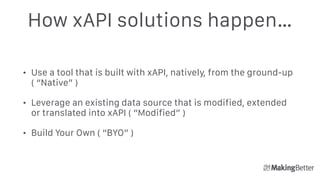
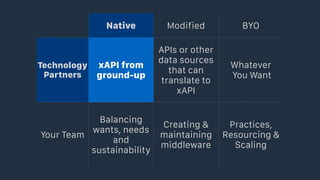
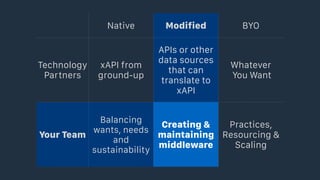
How xAPI solutions happen…
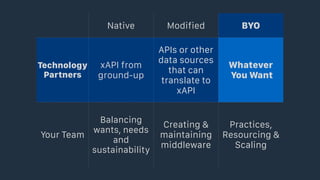
• Use a tool that is built with xAPI, natively, from the ground-up
( “Native” )
• Leverage an existing data source that is modified, extended
or translated into xAPI ( “Modified” )
• Build Your Own ( “BYO” )
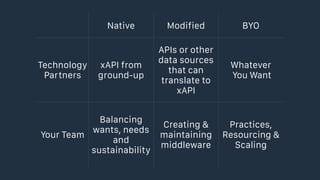
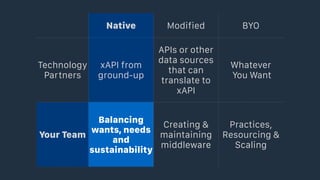
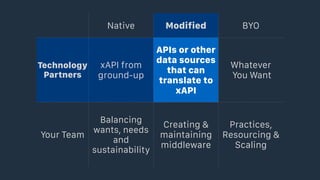
Native Modified BYO
Technology
Partners
xAPI from
ground-up
APIs or other
data sources
that can
translate to
xAPI
Whatever

You Want
Your Team
Balancing
wants, needs
and
sustainability
Creating &
maintaining
middleware
Practices,
Resourcing &
Scaling
Native Modified BYO
Technology
Partners
xAPI from
ground-up
APIs or other
data sources
that can
translate to
xAPI
Whatever

You Want
Your Team
Balancing
wants, needs
and
sustainability
Creating &
maintaining
middleware
Practices,
Resourcing &
Scaling
Questions for technology partners
If there’s support for xAPI from the ground-up…
• What activities are designed?


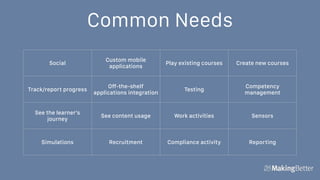
Common Needs
Social
Custom mobile
applications
Play existing courses Create new courses
Track/report progress
Off-the-shelf
applications integration
Testing
Competency
management
See the learner’s
journey
See content usage Work activities Sensors
Simulations Recruitment Compliance activity Reporting
Questions for technology partners
If there’s support for xAPI from the ground-up…
• What activities are designed?
• How are activities tracked?


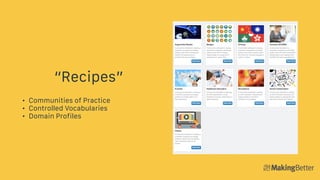
“Recipes”
• Communities of Practice
• Controlled Vocabularies
• Domain Profiles
Questions for technology partners
If there’s support for xAPI from the ground-up…
• What activities are designed?
• How are activities tracked?
• What data points are in each statement?


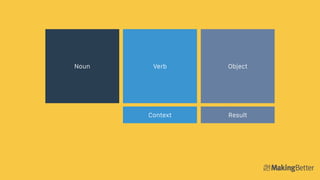
Someone Did Something
Noun Verb Object
Context Result
Questions for technology partners
If there’s support for xAPI from the ground-up…
• What activities are designed?
• How are activities tracked?
• What data points are in each statement?
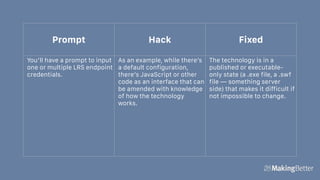
• How do I input or change endpoint credentials?


Prompt Hack Fixed
You’ll have a prompt to input
one or multiple LRS endpoint
credentials.
As an example, while there’s
a default configuration,
there’s JavaScript or other
code as an interface that can
be amended with knowledge
of how the technology
works.
The technology is in a
published or executable-
only state (a .exe file, a .swf
file — something server
side) that makes it difficult if
not impossible to change.
Questions for technology partners
If there’s support for xAPI from the ground-up…
• What activities are designed?
• How are activities tracked?
• What data points are in each statement?
• How do I input or change endpoint credentials?
• How does it rely on the LMS or other software applications?
Native Modified BYO
Technology
Partners
xAPI from
ground-up
APIs or other
data sources
that can
translate to
xAPI
Whatever

You Want
Your Team
Balancing
wants, needs
and
sustainability
Creating &
maintaining
middleware
Practices,
Resourcing &
Scaling
Questions for your team
If considering a tool built with xAPI from the ground-up…
• Is what’s baked-in going to be enough?
• Does the right data align across tools?
• If not… 

can we support our own unbiased reporting, 

knowing the caveats?
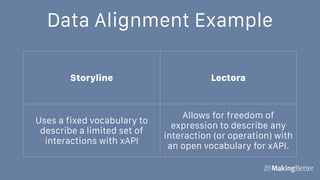
Data Alignment Example
Storyline Lectora
Uses a fixed vocabulary to
describe a limited set of
interactions with xAPI
Allows for freedom of
expression to describe any
interaction (or operation) with
an open vocabulary for xAPI.
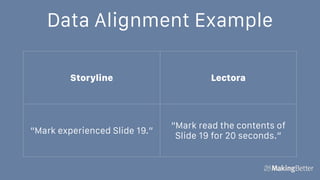
Data Alignment Example
Storyline Lectora
“Mark experienced Slide 19.”
“Mark read the contents of
Slide 19 for 20 seconds.”
Native Modified BYO
Technology
Partners
xAPI from
ground-up
APIs or other
data sources
that can
translate to
xAPI
Whatever

You Want
Your Team
Balancing
wants, needs
and
sustainability
Creating &
maintaining
middleware
Practices,
Resourcing &
Scaling
Questions for technology partners
If there’s support for APIs or other data sources that can
translate to xAPI…
• What APIs does the technology offer?
• Of these…

Can we capture the right activities?
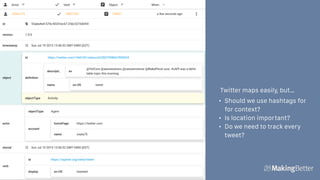
Twitter maps easily, but…
• Should we use hashtags for

for context?
• Is location important?
• Do we need to track every

tweet?
Questions for technology partners
If there’s support for APIs or other data sources that can
translate to xAPI…
• What APIs does the technology offer?
• Of these…

Can we capture the right activities?
• What data will fill in the gaps in information we need?
Native Modified BYO
Technology
Partners
xAPI from
ground-up
APIs or other
data sources
that can
translate to
xAPI
Whatever

You Want
Your Team
Balancing
wants, needs
and
sustainability
Creating &
maintaining
middleware
Practices,
Resourcing &
Scaling
Questions for your team
If considering a tool built for APIs or other data sources that can
translate to xAPI…
• Can we get enough from this/these APIs?
• How much value will we get from this system?
• What resources will we have…
• to do custom API development?
• to keep up our code with the different specs, ongoing?
• to build the translation layer?
Native Modified BYO
Technology
Partners
xAPI from
ground-up
APIs or other
data sources
that can
translate to
xAPI
Whatever

You Want
Your Team
Balancing
wants, needs
and
sustainability
Creating &
maintaining
middleware
Practices,
Resourcing &
Scaling
Questions for technology partners
If your technology partner will build whatever you want…
• What learning experience are you designing?
• What interactions are needed to support the learning
experience design?
Native Modified BYO
Technology
Partners
xAPI from
ground-up
APIs or other
data sources
that can
translate to
xAPI
Whatever

You Want
Your Team
Balancing
wants, needs
and
sustainability
Creating &
maintaining
middleware
Practices,
Resourcing &
Scaling
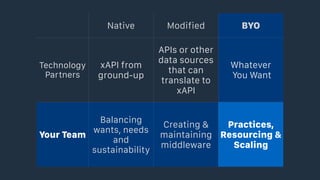
Questions for your team
If you can build whatever you want…
• What learning experience are you designing?
• What interactions are needed to support the learning experience design?
• What interactions are needed but don’t evidence or disprove the learning
experience?
• What recipes exist?
• What is the data model and information architecture it should conform with?
• What is our ability to support this at scale?
How do I vet technology
partners for xAPI projects?
When considering technology partners…
• Consider the know-how and investment of those who
contribute to the actual spec

(example: https://github.com/adlnet/xAPI-Spec/graphs/contributors)
When considering technology partners…
• Consider the know-how and investment of those who
contribute to the actual spec

(example: https://github.com/adlnet/xAPI-Spec/graphs/contributors)
• Consider who can demonstrate xAPI interoperability

(example: http://tincanapi.com/2015/04/16/tale-three-lrss/)
When considering technology partners…
• Consider the know-how and investment of those who
contribute to the actual spec

(example: https://github.com/adlnet/xAPI-Spec/graphs/contributors)
• Consider those who can demonstrate xAPI interoperability

(example: http://tincanapi.com/2015/04/16/tale-three-lrss/)
• Consider those who stay current with the spec

(example: https://github.com/aaronesilvers/IEEE/blob/master/
2014_State_of_xAPI_Tools_Survey_Responses.csv)
When considering technology partners…
• Consider the know-how and investment of those who
contribute to the actual spec

(example: https://github.com/adlnet/xAPI-Spec/graphs/contributors)
• Consider those who can demonstrate xAPI interoperability

(example: http://tincanapi.com/2015/04/16/tale-three-lrss/)
• Consider those who stay current with the spec

(example: https://github.com/aaronesilvers/IEEE/blob/master/
2014_State_of_xAPI_Tools_Survey_Responses.csv)
• Consider those who won’t lock you into one size fits all

(example: http://connectionsforum.com/case-studies/)
What’s My Roadmap to Work
With xAPI?
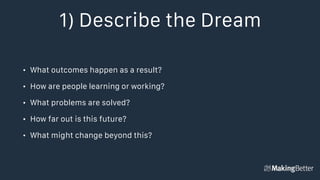
1) Describe the Dream
• What outcomes happen as a result?
• How are people learning or working?
• What problems are solved?
• How far out is this future?
• What might change beyond this?
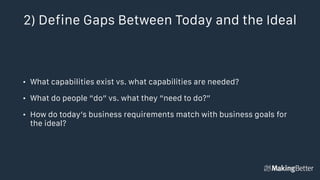
2) Define Gaps Between Today and the Ideal
• What capabilities exist vs. what capabilities are needed?
• What do people “do” vs. what they “need to do?”
• How do today’s business requirements match with business goals for
the ideal?
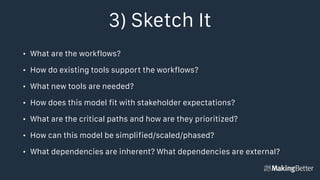
3) Sketch It
• What are the workflows?
• How do existing tools support the workflows?
• What new tools are needed?
• How does this model fit with stakeholder expectations?
• What are the critical paths and how are they prioritized?
• How can this model be simplified/scaled/phased?
• What dependencies are inherent? What dependencies are external?
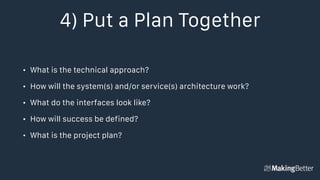
4) Put a Plan Together
• What is the technical approach?
• How will the system(s) and/or service(s) architecture work?
• What do the interfaces look like?
• How will success be defined?
• What is the project plan?
5) Reach Out
#xAPIcamp
@aaronesilvers
aaron@makingbetter.us
http://makingbetter.us/

Going with xAPI

  • 1.
    Going with xAPI AaronE. Silvers, Partner MakingBetter xAPI Camp - Amazon July 21, 2015 USE THE TWITTER!!!!! @aaronesilvers #xAPIcamp
  • 2.
  • 3.
  • 4.
    The Experience APIis a standard way of talking about our experiences, using data.
  • 6.
    The Experience API(xAPI) • Can track many different types of experiences — including things that people do on the web, in mobile applications, with wearables, in classrooms and in workplace environments • Moves beyond a web-based, didactic model • Promotes better design and technology practices • Makes integration with other systems and practices easier • Provides a way to gather and use more useful information.
  • 7.
    It answers alot of ‘How’ type questions… • How can I inform better business decisions? • How do I avoid locking us into a solution? • How can I make investments in learning development last longer and more future-proof? • How can I make sure what I evaluate today is useful in the future? • How will I connect a learner’s activities across multiple applications?
  • 8.
    Someone Did Something “Observations” NounVerb Object (To Someone) (Using Stuff) (With Some Result)
  • 9.
    How Does ExperienceAPI Work? • People interact with “stuff” 
 (i.e. content, apps, business systems, etc.) • These interactions are observed and described as statements. • The “stuff” sends the statements to a Learning Record Store.
  • 10.
    What is aLearning Record Store, or LRS? • It’s a database that stores activity statements - the “data” • LRSs can be software (even hardware) that stands on its own. • LRSs can be a part of data appliances, enterprise applications and learning management system (LMS)
  • 11.
    LMS vs. LRS ALearning Record Store (LRS) addresses one capability of a typical 
 Learning Management System (LMS). User Management Learning Records Scheduling Course Management Statistics Grade Book Tracking eLearning Content Storage Search Assignments Sequencing Delivery Preferences Reports Assessment
  • 12.
    How do Iwork with xAPI?
  • 13.
    Competencies / Attitudes SystemsThinking Integration Facilitation A Maker Mindset Assume you have permission to tinker Make, maintain and grow useful connections Surface goals big & inviting enough to motivate action Be The Change Interrogate perceived boundary conditions Identify new paradigms supported by both sides of double-binds Inspire others, modeling how to navigate through shifting paradigms “Yes. And..” Augment rather than change discrete systems Seek connections and overlaps that add value beyond the immediate context Help others avoid negation
  • 14.
    Who puts xAPIsolutions together… • Technology Partners 
 (vendors, consultants, tool providers, etc) • Your Team 
 (stakeholders, team members…)
  • 15.
    How xAPI solutionshappen… • Use a tool that is built with xAPI, natively, from the ground-up ( “Native” ) • Leverage an existing data source that is modified, extended or translated into xAPI ( “Modified” ) • Build Your Own ( “BYO” )
  • 16.
    Native Modified BYO Technology Partners xAPIfrom ground-up APIs or other data sources that can translate to xAPI Whatever
 You Want Your Team Balancing wants, needs and sustainability Creating & maintaining middleware Practices, Resourcing & Scaling
  • 17.
    Native Modified BYO Technology Partners xAPIfrom ground-up APIs or other data sources that can translate to xAPI Whatever
 You Want Your Team Balancing wants, needs and sustainability Creating & maintaining middleware Practices, Resourcing & Scaling
  • 18.
    Questions for technologypartners If there’s support for xAPI from the ground-up… • What activities are designed?


  • 19.
    Common Needs Social Custom mobile applications Playexisting courses Create new courses Track/report progress Off-the-shelf applications integration Testing Competency management See the learner’s journey See content usage Work activities Sensors Simulations Recruitment Compliance activity Reporting
  • 20.
    Questions for technologypartners If there’s support for xAPI from the ground-up… • What activities are designed? • How are activities tracked?


  • 21.
    “Recipes” • Communities ofPractice • Controlled Vocabularies • Domain Profiles
  • 22.
    Questions for technologypartners If there’s support for xAPI from the ground-up… • What activities are designed? • How are activities tracked? • What data points are in each statement?


  • 23.
    Someone Did Something NounVerb Object Context Result
  • 24.
    Questions for technologypartners If there’s support for xAPI from the ground-up… • What activities are designed? • How are activities tracked? • What data points are in each statement? • How do I input or change endpoint credentials?
 

  • 25.
    Prompt Hack Fixed You’llhave a prompt to input one or multiple LRS endpoint credentials. As an example, while there’s a default configuration, there’s JavaScript or other code as an interface that can be amended with knowledge of how the technology works. The technology is in a published or executable- only state (a .exe file, a .swf file — something server side) that makes it difficult if not impossible to change.
  • 26.
    Questions for technologypartners If there’s support for xAPI from the ground-up… • What activities are designed? • How are activities tracked? • What data points are in each statement? • How do I input or change endpoint credentials? • How does it rely on the LMS or other software applications?
  • 27.
    Native Modified BYO Technology Partners xAPIfrom ground-up APIs or other data sources that can translate to xAPI Whatever
 You Want Your Team Balancing wants, needs and sustainability Creating & maintaining middleware Practices, Resourcing & Scaling
  • 28.
    Questions for yourteam If considering a tool built with xAPI from the ground-up… • Is what’s baked-in going to be enough? • Does the right data align across tools? • If not… 
 can we support our own unbiased reporting, 
 knowing the caveats?
  • 29.
    Data Alignment Example StorylineLectora Uses a fixed vocabulary to describe a limited set of interactions with xAPI Allows for freedom of expression to describe any interaction (or operation) with an open vocabulary for xAPI.
  • 30.
    Data Alignment Example StorylineLectora “Mark experienced Slide 19.” “Mark read the contents of Slide 19 for 20 seconds.”
  • 31.
    Native Modified BYO Technology Partners xAPIfrom ground-up APIs or other data sources that can translate to xAPI Whatever
 You Want Your Team Balancing wants, needs and sustainability Creating & maintaining middleware Practices, Resourcing & Scaling
  • 32.
    Questions for technologypartners If there’s support for APIs or other data sources that can translate to xAPI… • What APIs does the technology offer? • Of these…
 Can we capture the right activities?
  • 33.
    Twitter maps easily,but… • Should we use hashtags for
 for context? • Is location important? • Do we need to track every
 tweet?
  • 34.
    Questions for technologypartners If there’s support for APIs or other data sources that can translate to xAPI… • What APIs does the technology offer? • Of these…
 Can we capture the right activities? • What data will fill in the gaps in information we need?
  • 35.
    Native Modified BYO Technology Partners xAPIfrom ground-up APIs or other data sources that can translate to xAPI Whatever
 You Want Your Team Balancing wants, needs and sustainability Creating & maintaining middleware Practices, Resourcing & Scaling
  • 36.
    Questions for yourteam If considering a tool built for APIs or other data sources that can translate to xAPI… • Can we get enough from this/these APIs? • How much value will we get from this system? • What resources will we have… • to do custom API development? • to keep up our code with the different specs, ongoing? • to build the translation layer?
  • 38.
    Native Modified BYO Technology Partners xAPIfrom ground-up APIs or other data sources that can translate to xAPI Whatever
 You Want Your Team Balancing wants, needs and sustainability Creating & maintaining middleware Practices, Resourcing & Scaling
  • 39.
    Questions for technologypartners If your technology partner will build whatever you want… • What learning experience are you designing? • What interactions are needed to support the learning experience design?
  • 40.
    Native Modified BYO Technology Partners xAPIfrom ground-up APIs or other data sources that can translate to xAPI Whatever
 You Want Your Team Balancing wants, needs and sustainability Creating & maintaining middleware Practices, Resourcing & Scaling
  • 41.
    Questions for yourteam If you can build whatever you want… • What learning experience are you designing? • What interactions are needed to support the learning experience design? • What interactions are needed but don’t evidence or disprove the learning experience? • What recipes exist? • What is the data model and information architecture it should conform with? • What is our ability to support this at scale?
  • 43.
    How do Ivet technology partners for xAPI projects?
  • 44.
    When considering technologypartners… • Consider the know-how and investment of those who contribute to the actual spec
 (example: https://github.com/adlnet/xAPI-Spec/graphs/contributors)
  • 45.
    When considering technologypartners… • Consider the know-how and investment of those who contribute to the actual spec
 (example: https://github.com/adlnet/xAPI-Spec/graphs/contributors) • Consider who can demonstrate xAPI interoperability
 (example: http://tincanapi.com/2015/04/16/tale-three-lrss/)
  • 46.
    When considering technologypartners… • Consider the know-how and investment of those who contribute to the actual spec
 (example: https://github.com/adlnet/xAPI-Spec/graphs/contributors) • Consider those who can demonstrate xAPI interoperability
 (example: http://tincanapi.com/2015/04/16/tale-three-lrss/) • Consider those who stay current with the spec
 (example: https://github.com/aaronesilvers/IEEE/blob/master/ 2014_State_of_xAPI_Tools_Survey_Responses.csv)
  • 47.
    When considering technologypartners… • Consider the know-how and investment of those who contribute to the actual spec
 (example: https://github.com/adlnet/xAPI-Spec/graphs/contributors) • Consider those who can demonstrate xAPI interoperability
 (example: http://tincanapi.com/2015/04/16/tale-three-lrss/) • Consider those who stay current with the spec
 (example: https://github.com/aaronesilvers/IEEE/blob/master/ 2014_State_of_xAPI_Tools_Survey_Responses.csv) • Consider those who won’t lock you into one size fits all
 (example: http://connectionsforum.com/case-studies/)
  • 48.
    What’s My Roadmapto Work With xAPI?
  • 49.
    1) Describe theDream • What outcomes happen as a result? • How are people learning or working? • What problems are solved? • How far out is this future? • What might change beyond this?
  • 50.
    2) Define GapsBetween Today and the Ideal • What capabilities exist vs. what capabilities are needed? • What do people “do” vs. what they “need to do?” • How do today’s business requirements match with business goals for the ideal?
  • 51.
    3) Sketch It •What are the workflows? • How do existing tools support the workflows? • What new tools are needed? • How does this model fit with stakeholder expectations? • What are the critical paths and how are they prioritized? • How can this model be simplified/scaled/phased? • What dependencies are inherent? What dependencies are external?
  • 52.
    4) Put aPlan Together • What is the technical approach? • How will the system(s) and/or service(s) architecture work? • What do the interfaces look like? • How will success be defined? • What is the project plan?
  • 53.