Connections Forum
xAPI Camp - Learning Solutions
March 15, 2016
xAPI Camp - Learning Solutions is 

Made Possible By Partnering Organizations
With Generous Support From
How xAPI Camp Works
• The Conversations You Need to Have
• Structured and Emergent
• “Yes-And”
• The Law of Two Feet
The Schedule
• 8:30-9:15am Opening Remarks (Aaron Silvers)
• 9:15-10:00am Campfires (Rob Houck, Janet Laane Effron)
• 10:00-10:15am Break
• 10:15-noon Breakout Sessions
• Noon-1:00pm Lunch
• 1-1:45pm State of the State: Authoring Tools (Sean Putman)
• 1:45-2:30pm Campfires (Robert Gadd, Nick Washburn)
• 2:30-2:45pm Break
• 2:45-4pm Breakouts
• 4-4:30pm Wrap Up and Closing
The Vocabulary
Matthew McConaughey
“I have my own vocabulary.
I love linguistics. That
surprises people.”
What exactly is xAPI?
The Experience API is a standard way of
talking about our experiences, using data.
The Experience API (xAPI)
• Can track many different types of experiences — including things that
people do on the web, in mobile applications, with wearables, in
classrooms and in workplace environments
• Moves beyond a web-based, didactic model
• Promotes better design and technology practices
• Makes integration with other systems and practices easier
• Provides a way to gather and use more useful information.
It answers a lot of ‘How’ type questions…
• How can I inform better business decisions?
• How do I avoid locking us into a solution?
• How can I make investments in learning development last longer and
more future-proof?
• How can I make sure what I evaluate today is useful in the future?
• How will I connect a learner’s activities across multiple applications?
How Does Experience API Work?
• People interact with “stuff” 

(i.e. content, apps, business systems, etc.)
• These interactions are observed and described in JSON.
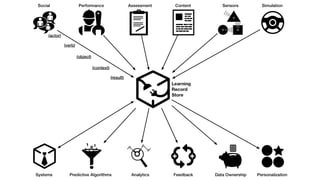
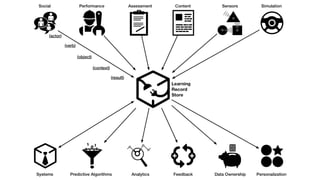
• The “stuff” sends the statements to a Learning Record Store.
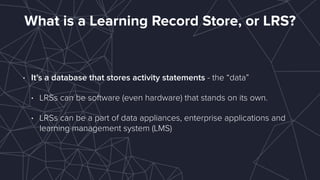
What is a Learning Record Store, or LRS?
• It’s a database that stores activity statements - the “data”
• LRSs can be software (even hardware) that stands on its own.
• LRSs can be a part of data appliances, enterprise applications and
learning management system (LMS)
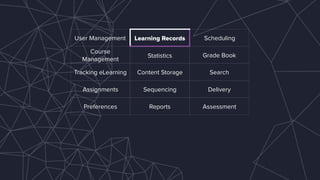
User Management Learning Records Scheduling
Course
Management
Statistics Grade Book
Tracking eLearning Content Storage Search
Assignments Sequencing Delivery
Preferences Reports Assessment
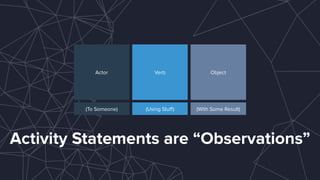
Someone Did Something
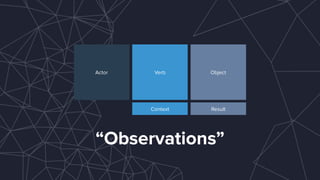
Activity Statements are “Observations”
Actor Verb Object
(To Someone) (Using Stuff) (With Some Result)
{
"actor": {
"mbox": "mailto:n3ed8rw7r39@adlnet.gov",
"name": "n3ed8rw7r39@adlnet.gov",
"objectType": "Agent"
},
"verb": {
"id": "http://adlnet.gov/expapi/verbs/passed",
"display": {
"en-US": "passed"
}
},
"object": {
"id": "http://z2.vc/xapi/activities/passed",
"objectType": "Activity",
"definition": {
"name": {
"en-US": "HTML5 data attribute prototype"
},
"description": {
"en-US": "Example generation of a passed activity using an HTML5 data attribute with unobtrusive js"
}
}
},
"id": "d3574611-8092-4616-bfdc-4f48933a0d42"
}
What are other terms we might
hear?
Adaptive Learning assesses someone’s current
knowledge state and recommends a sequence of
activity that moves that knowledge state toward a
defined learning outcome.
CMI5 is a profile of xAPI that defines
“plug-and-play” interoperability between
learning content activities and LMSs.
A profile is a set of rules that govern
how to use xAPI in specific ways for
specific experiences.
Sometimes a profile is called a recipe. When
followed, it ensures consistent data to describe
similar activities can be generated by different
activity providers.
Interoperability is the expectation that what works
in one system will work in a set of other systems by
default with no configuration necessary.
For xAPI, interoperability means that data created
in one system can be shared with appropriate
security and used by other systems with complete
integrity and authority.
An experience is a set of
activities.
An activity provider is some form of content,
software application or other media that creates
activity statements that can be sent to an LRS.
The Landscape
What does someone who works
with xAPI do?
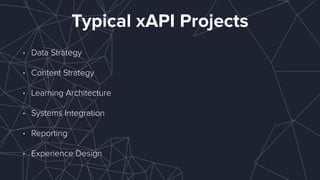
Typical xAPI Projects
• Data Strategy
• Content Strategy
• Learning Architecture
• Systems Integration
• Reporting
• Experience Design
How do I work with xAPI?
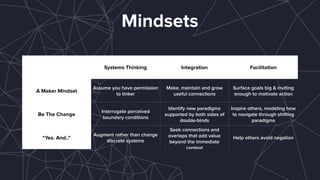
Mindsets
Systems Thinking Integration Facilitation
A Maker Mindset
Assume you have permission
to tinker
Make, maintain and grow
useful connections
Surface goals big & inviting
enough to motivate action
Be The Change
Interrogate perceived
boundary conditions
Identify new paradigms
supported by both sides of
double-binds
Inspire others, modeling how
to navigate through shifting
paradigms
“Yes. And..”
Augment rather than change
discrete systems
Seek connections and
overlaps that add value
beyond the immediate
context
Help others avoid negation
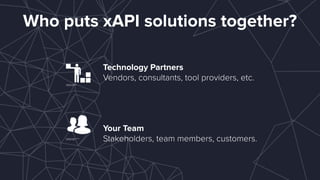
Who puts xAPI solutions together?
Technology Partners 

Vendors, consultants, tool providers, etc.


Your Team 

Stakeholders, team members, customers.
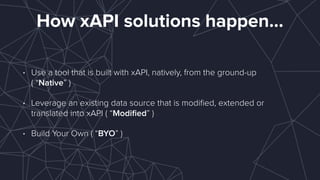
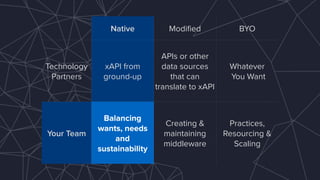
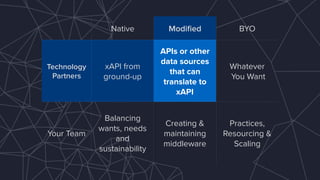
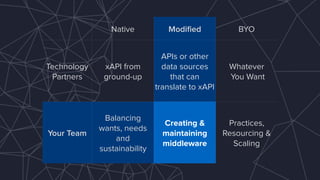
How xAPI solutions happen…
• Use a tool that is built with xAPI, natively, from the ground-up
( “Native” )
• Leverage an existing data source that is modified, extended or
translated into xAPI ( “Modified” )
• Build Your Own ( “BYO” )
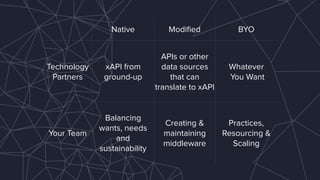
Native Modified BYO
Technology
Partners
xAPI from
ground-up
APIs or other
data sources
that can
translate to xAPI
Whatever

You Want
Your Team
Balancing
wants, needs
and
sustainability
Creating &
maintaining
middleware
Practices,
Resourcing &
Scaling
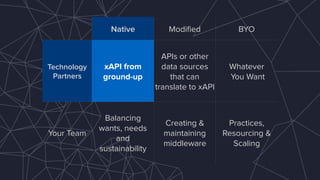
Native Modified BYO
Technology
Partners
xAPI from
ground-up
APIs or other
data sources
that can
translate to xAPI
Whatever

You Want
Your Team
Balancing
wants, needs
and
sustainability
Creating &
maintaining
middleware
Practices,
Resourcing &
Scaling
Questions for technology partners
If there’s support for xAPI from the ground-up…
• What activities are designed?


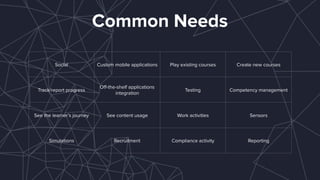
Common Needs
Social Custom mobile applications Play existing courses Create new courses
Track/report progress
Off-the-shelf applications
integration
Testing Competency management
See the learner’s journey See content usage Work activities Sensors
Simulations Recruitment Compliance activity Reporting
Questions for technology partners
If there’s support for xAPI from the ground-up…
• What activities are designed?
• How are activities tracked?


Recipes and Profiles
• Communities of Practice
• Controlled Vocabularies
• Domain Profiles
Questions for technology partners
If there’s support for xAPI from the ground-up…
• What activities are designed?
• How are activities tracked?
• What data points are in each statement?


“Observations”
Someone Did SomethingActor Verb Object
Context Result
Questions for technology partners
If there’s support for xAPI from the ground-up…
• What activities are designed?
• How are activities tracked?
• What data points are in each statement?
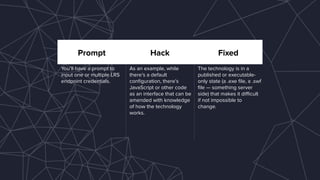
• How do I input or change endpoint credentials?


Prompt Hack Fixed
You’ll have a prompt to
input one or multiple LRS
endpoint credentials.
As an example, while
there’s a default
configuration, there’s
JavaScript or other code
as an interface that can be
amended with knowledge
of how the technology
works.
The technology is in a
published or executable-
only state (a .exe file, a .swf
file — something server
side) that makes it difficult
if not impossible to
change.
Questions for technology partners
If there’s support for xAPI from the ground-up…
• What activities are designed?
• How are activities tracked?
• What data points are in each statement?
• How do I input or change endpoint credentials?
• How does it rely on the LMS or other software applications?
Native Modified BYO
Technology
Partners
xAPI from
ground-up
APIs or other
data sources
that can
translate to xAPI
Whatever

You Want
Your Team
Balancing
wants, needs
and
sustainability
Creating &
maintaining
middleware
Practices,
Resourcing &
Scaling
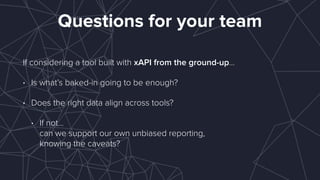
Questions for your team
If considering a tool built with xAPI from the ground-up…
• Is what’s baked-in going to be enough?
• Does the right data align across tools?
• If not… 

can we support our own unbiased reporting, 

knowing the caveats?
Native Modified BYO
Technology
Partners
xAPI from
ground-up
APIs or other
data sources
that can
translate to
xAPI
Whatever

You Want
Your Team
Balancing
wants, needs
and
sustainability
Creating &
maintaining
middleware
Practices,
Resourcing &
Scaling
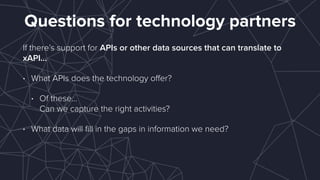
Questions for technology partners
If there’s support for APIs or other data sources that can translate to
xAPI…
• What APIs does the technology offer?
• Of these…

Can we capture the right activities?
• What data will fill in the gaps in information we need?
Native Modified BYO
Technology
Partners
xAPI from
ground-up
APIs or other
data sources
that can
translate to xAPI
Whatever

You Want
Your Team
Balancing
wants, needs
and
sustainability
Creating &
maintaining
middleware
Practices,
Resourcing &
Scaling
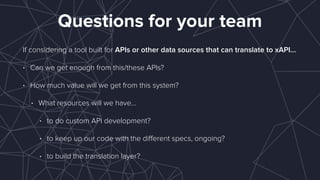
Questions for your team
If considering a tool built for APIs or other data sources that can translate to xAPI…
• Can we get enough from this/these APIs?
• How much value will we get from this system?
• What resources will we have…
• to do custom API development?
• to keep up our code with the different specs, ongoing?
• to build the translation layer?
Native Modified BYO
Technology
Partners
xAPI from
ground-up
APIs or other
data sources
that can
translate to xAPI
Whatever

You Want
Your Team
Balancing
wants, needs
and
sustainability
Creating &
maintaining
middleware
Practices,
Resourcing &
Scaling
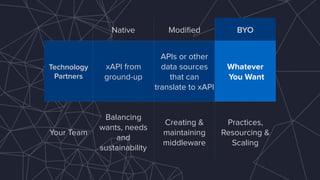
Questions for technology partners
If your technology partner will build whatever you want…
• What learning experience are you designing?
• What interactions are needed to support the learning experience
design?
Native Modified BYO
Technology
Partners
xAPI from
ground-up
APIs or other
data sources
that can
translate to
xAPI
Whatever

You Want
Your Team
Balancing
wants, needs
and
sustainability
Creating &
maintaining
middleware
Practices,
Resourcing &
Scaling
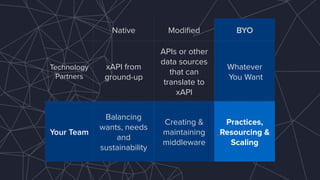
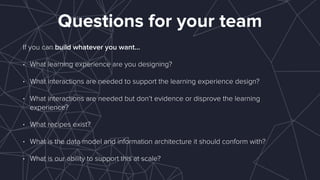
Questions for your team
If you can build whatever you want…
• What learning experience are you designing?
• What interactions are needed to support the learning experience design?
• What interactions are needed but don’t evidence or disprove the learning
experience?
• What recipes exist?
• What is the data model and information architecture it should conform with?
• What is our ability to support this at scale?
How do I vet technology
partners for xAPI projects?
When considering technology partners…
• Consider the know-how and investment of those who contribute to the
actual spec

(example: https://github.com/adlnet/xAPI-Spec/graphs/contributors)
• Consider those who can demonstrate xAPI interoperability

(example: http://tincanapi.com/2015/04/16/tale-three-lrss/)
• Consider those who stay current with the spec

(example: https://github.com/aaronesilvers/IEEE/blob/master/
2014_State_of_xAPI_Tools_Survey_Responses.csv)
• Consider those who won’t lock you into one size fits all

(example: http://connectionsforum.com/case-studies/)
This seems like a lot… right?
How do we address all that?
The Data Interoperability Standards Consortium
(Data Interoperability) is the international, nonprofit organization that
will handle the operations and maintenance of xAPI into perpetuity.
Board of Directors
Megan
Bowe
Kirsty

Kitto
Eric

Nehrlich
Brenda

Sanderson
Aaron

Silvers
Robert

Todd
MakingBetter
Queensland

Univeristy
Google IxDA MakingBetter
Learning

Invention
Stewardship > Evolution > Standardization
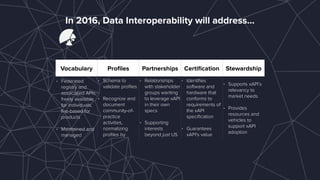
In 2016, Data Interoperability will address...
Vocabulary Profiles Partnerships Certification Stewardship
• Federated
registry and
associated APIs,
freely available
for individuals;
fee-based for
products
• Maintained and
managed
• Schema to
validate profiles
• Recognize and
document
community-of-
practice
activities,
normalizing
profiles by
domain (vs
• Relationships
with stakeholder
groups wanting
to leverage xAPI
in their own
specs
• Supporting
interests
beyond just US
DoD
• Identifies
software and
hardware that
conforms to
requirements of
the xAPI
specification
• Guarantees
xAPI’s value
proposition
• Supports xAPI’s
relevancy to
market needs
• Provides
resources and
vehicles to
support xAPI
adoption
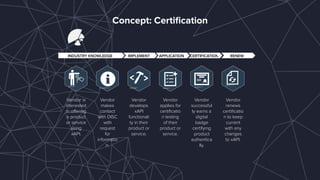
RENEWCERTIFICATION
Concept: Certification
APPLICATIONIMPLEMENTINDUSTRY KNOWLEDGE
Vendor is
interested
in offering
a product
or service
using
xAPI.
Vendor
makes
contact
with DISC
with
request
for
informatio
n.
Vendor
develops
xAPI
functionali
ty in their
product or
service.
Vendor
applies for
certificatio
n testing
of their
product or
service.
Vendor
successful
ly earns a
digital
badge
certifying
product
authentica
lly.
Vendor
renews
certificatio
n to keep
current
with any
changes
to xAPI.
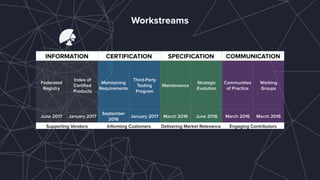
Workstreams
INFORMATION CERTIFICATION SPECIFICATION COMMUNICATION
Federated
Registry
Index of
Certified
Products
Maintaining
Requirements
Third-Party
Testing
Program
Maintenance
Strategic
Evolution
Communities
of Practice
Working
Groups
June 2017 January 2017
September
2016
January 2017 March 2016 June 2016 March 2016 March 2016
Supporting Vendors Informing Customers Delivering Market Relevance Engaging Contributors
5) Reach Out
contact@makingbetter.us
http://makingbetter.us/
Campfires
Janet Laane Effron
• Data Scientist, HT2
• Lessons Learned

DATA RULES: UNMEASURED
LEARNING’S DAY OFF
• http://investigating-
performance-0.launchrock.com
Rob Houck
• CTO, Learnshare
• Case Study

A Path from Training to Proficiency
Break
Breakout & Lunch
State of the State:
Authoring Tools
Sean Putman
• Vice President of Learning
Development, Altair Engineering
• Best Practices

State of the State: Authoring Tools
Campfires
Robert Gadd
• President, OnPoint Digital
• Lessons Learned:

Simple but Powerful Use Cases for
xAPI
Nick Washburn
• Director, Learning Division, Riptide
• Big Idea

The Enterprise Learning Ecosystem
Breakout
Questions & Answers

xAPI Camp - Learning Solutions

  • 1.
    Connections Forum xAPI Camp- Learning Solutions March 15, 2016
  • 2.
    xAPI Camp -Learning Solutions is 
 Made Possible By Partnering Organizations With Generous Support From
  • 3.
    How xAPI CampWorks • The Conversations You Need to Have • Structured and Emergent • “Yes-And” • The Law of Two Feet
  • 4.
    The Schedule • 8:30-9:15amOpening Remarks (Aaron Silvers) • 9:15-10:00am Campfires (Rob Houck, Janet Laane Effron) • 10:00-10:15am Break • 10:15-noon Breakout Sessions • Noon-1:00pm Lunch • 1-1:45pm State of the State: Authoring Tools (Sean Putman) • 1:45-2:30pm Campfires (Robert Gadd, Nick Washburn) • 2:30-2:45pm Break • 2:45-4pm Breakouts • 4-4:30pm Wrap Up and Closing
  • 5.
  • 6.
    Matthew McConaughey “I havemy own vocabulary. I love linguistics. That surprises people.”
  • 7.
  • 8.
    The Experience APIis a standard way of talking about our experiences, using data.
  • 10.
    The Experience API(xAPI) • Can track many different types of experiences — including things that people do on the web, in mobile applications, with wearables, in classrooms and in workplace environments • Moves beyond a web-based, didactic model • Promotes better design and technology practices • Makes integration with other systems and practices easier • Provides a way to gather and use more useful information.
  • 11.
    It answers alot of ‘How’ type questions… • How can I inform better business decisions? • How do I avoid locking us into a solution? • How can I make investments in learning development last longer and more future-proof? • How can I make sure what I evaluate today is useful in the future? • How will I connect a learner’s activities across multiple applications?
  • 12.
    How Does ExperienceAPI Work? • People interact with “stuff” 
 (i.e. content, apps, business systems, etc.) • These interactions are observed and described in JSON. • The “stuff” sends the statements to a Learning Record Store.
  • 13.
    What is aLearning Record Store, or LRS? • It’s a database that stores activity statements - the “data” • LRSs can be software (even hardware) that stands on its own. • LRSs can be a part of data appliances, enterprise applications and learning management system (LMS)
  • 14.
    User Management LearningRecords Scheduling Course Management Statistics Grade Book Tracking eLearning Content Storage Search Assignments Sequencing Delivery Preferences Reports Assessment
  • 15.
    Someone Did Something ActivityStatements are “Observations” Actor Verb Object (To Someone) (Using Stuff) (With Some Result)
  • 16.
    { "actor": { "mbox": "mailto:n3ed8rw7r39@adlnet.gov", "name":"n3ed8rw7r39@adlnet.gov", "objectType": "Agent" }, "verb": { "id": "http://adlnet.gov/expapi/verbs/passed", "display": { "en-US": "passed" } }, "object": { "id": "http://z2.vc/xapi/activities/passed", "objectType": "Activity", "definition": { "name": { "en-US": "HTML5 data attribute prototype" }, "description": { "en-US": "Example generation of a passed activity using an HTML5 data attribute with unobtrusive js" } } }, "id": "d3574611-8092-4616-bfdc-4f48933a0d42" }
  • 18.
    What are otherterms we might hear?
  • 19.
    Adaptive Learning assessessomeone’s current knowledge state and recommends a sequence of activity that moves that knowledge state toward a defined learning outcome.
  • 20.
    CMI5 is aprofile of xAPI that defines “plug-and-play” interoperability between learning content activities and LMSs.
  • 21.
    A profile isa set of rules that govern how to use xAPI in specific ways for specific experiences.
  • 22.
    Sometimes a profileis called a recipe. When followed, it ensures consistent data to describe similar activities can be generated by different activity providers.
  • 23.
    Interoperability is theexpectation that what works in one system will work in a set of other systems by default with no configuration necessary.
  • 24.
    For xAPI, interoperabilitymeans that data created in one system can be shared with appropriate security and used by other systems with complete integrity and authority.
  • 25.
    An experience isa set of activities.
  • 26.
    An activity provideris some form of content, software application or other media that creates activity statements that can be sent to an LRS.
  • 27.
  • 28.
    What does someonewho works with xAPI do?
  • 29.
    Typical xAPI Projects •Data Strategy • Content Strategy • Learning Architecture • Systems Integration • Reporting • Experience Design
  • 30.
    How do Iwork with xAPI?
  • 31.
    Mindsets Systems Thinking IntegrationFacilitation A Maker Mindset Assume you have permission to tinker Make, maintain and grow useful connections Surface goals big & inviting enough to motivate action Be The Change Interrogate perceived boundary conditions Identify new paradigms supported by both sides of double-binds Inspire others, modeling how to navigate through shifting paradigms “Yes. And..” Augment rather than change discrete systems Seek connections and overlaps that add value beyond the immediate context Help others avoid negation
  • 32.
    Who puts xAPIsolutions together? Technology Partners 
 Vendors, consultants, tool providers, etc. 
 Your Team 
 Stakeholders, team members, customers.
  • 33.
    How xAPI solutionshappen… • Use a tool that is built with xAPI, natively, from the ground-up ( “Native” ) • Leverage an existing data source that is modified, extended or translated into xAPI ( “Modified” ) • Build Your Own ( “BYO” )
  • 34.
    Native Modified BYO Technology Partners xAPIfrom ground-up APIs or other data sources that can translate to xAPI Whatever
 You Want Your Team Balancing wants, needs and sustainability Creating & maintaining middleware Practices, Resourcing & Scaling
  • 35.
    Native Modified BYO Technology Partners xAPIfrom ground-up APIs or other data sources that can translate to xAPI Whatever
 You Want Your Team Balancing wants, needs and sustainability Creating & maintaining middleware Practices, Resourcing & Scaling
  • 36.
    Questions for technologypartners If there’s support for xAPI from the ground-up… • What activities are designed?


  • 37.
    Common Needs Social Custommobile applications Play existing courses Create new courses Track/report progress Off-the-shelf applications integration Testing Competency management See the learner’s journey See content usage Work activities Sensors Simulations Recruitment Compliance activity Reporting
  • 38.
    Questions for technologypartners If there’s support for xAPI from the ground-up… • What activities are designed? • How are activities tracked?


  • 39.
    Recipes and Profiles •Communities of Practice • Controlled Vocabularies • Domain Profiles
  • 40.
    Questions for technologypartners If there’s support for xAPI from the ground-up… • What activities are designed? • How are activities tracked? • What data points are in each statement?


  • 41.
  • 42.
    Questions for technologypartners If there’s support for xAPI from the ground-up… • What activities are designed? • How are activities tracked? • What data points are in each statement? • How do I input or change endpoint credentials?
 

  • 43.
    Prompt Hack Fixed You’llhave a prompt to input one or multiple LRS endpoint credentials. As an example, while there’s a default configuration, there’s JavaScript or other code as an interface that can be amended with knowledge of how the technology works. The technology is in a published or executable- only state (a .exe file, a .swf file — something server side) that makes it difficult if not impossible to change.
  • 44.
    Questions for technologypartners If there’s support for xAPI from the ground-up… • What activities are designed? • How are activities tracked? • What data points are in each statement? • How do I input or change endpoint credentials? • How does it rely on the LMS or other software applications?
  • 45.
    Native Modified BYO Technology Partners xAPIfrom ground-up APIs or other data sources that can translate to xAPI Whatever
 You Want Your Team Balancing wants, needs and sustainability Creating & maintaining middleware Practices, Resourcing & Scaling
  • 46.
    Questions for yourteam If considering a tool built with xAPI from the ground-up… • Is what’s baked-in going to be enough? • Does the right data align across tools? • If not… 
 can we support our own unbiased reporting, 
 knowing the caveats?
  • 47.
    Native Modified BYO Technology Partners xAPIfrom ground-up APIs or other data sources that can translate to xAPI Whatever
 You Want Your Team Balancing wants, needs and sustainability Creating & maintaining middleware Practices, Resourcing & Scaling
  • 48.
    Questions for technologypartners If there’s support for APIs or other data sources that can translate to xAPI… • What APIs does the technology offer? • Of these…
 Can we capture the right activities? • What data will fill in the gaps in information we need?
  • 49.
    Native Modified BYO Technology Partners xAPIfrom ground-up APIs or other data sources that can translate to xAPI Whatever
 You Want Your Team Balancing wants, needs and sustainability Creating & maintaining middleware Practices, Resourcing & Scaling
  • 50.
    Questions for yourteam If considering a tool built for APIs or other data sources that can translate to xAPI… • Can we get enough from this/these APIs? • How much value will we get from this system? • What resources will we have… • to do custom API development? • to keep up our code with the different specs, ongoing? • to build the translation layer?
  • 51.
    Native Modified BYO Technology Partners xAPIfrom ground-up APIs or other data sources that can translate to xAPI Whatever
 You Want Your Team Balancing wants, needs and sustainability Creating & maintaining middleware Practices, Resourcing & Scaling
  • 52.
    Questions for technologypartners If your technology partner will build whatever you want… • What learning experience are you designing? • What interactions are needed to support the learning experience design?
  • 53.
    Native Modified BYO Technology Partners xAPIfrom ground-up APIs or other data sources that can translate to xAPI Whatever
 You Want Your Team Balancing wants, needs and sustainability Creating & maintaining middleware Practices, Resourcing & Scaling
  • 54.
    Questions for yourteam If you can build whatever you want… • What learning experience are you designing? • What interactions are needed to support the learning experience design? • What interactions are needed but don’t evidence or disprove the learning experience? • What recipes exist? • What is the data model and information architecture it should conform with? • What is our ability to support this at scale?
  • 55.
    How do Ivet technology partners for xAPI projects?
  • 56.
    When considering technologypartners… • Consider the know-how and investment of those who contribute to the actual spec
 (example: https://github.com/adlnet/xAPI-Spec/graphs/contributors) • Consider those who can demonstrate xAPI interoperability
 (example: http://tincanapi.com/2015/04/16/tale-three-lrss/) • Consider those who stay current with the spec
 (example: https://github.com/aaronesilvers/IEEE/blob/master/ 2014_State_of_xAPI_Tools_Survey_Responses.csv) • Consider those who won’t lock you into one size fits all
 (example: http://connectionsforum.com/case-studies/)
  • 57.
    This seems likea lot… right?
  • 58.
    How do weaddress all that?
  • 59.
    The Data InteroperabilityStandards Consortium (Data Interoperability) is the international, nonprofit organization that will handle the operations and maintenance of xAPI into perpetuity.
  • 60.
  • 61.
    Stewardship > Evolution> Standardization
  • 62.
    In 2016, DataInteroperability will address... Vocabulary Profiles Partnerships Certification Stewardship • Federated registry and associated APIs, freely available for individuals; fee-based for products • Maintained and managed • Schema to validate profiles • Recognize and document community-of- practice activities, normalizing profiles by domain (vs • Relationships with stakeholder groups wanting to leverage xAPI in their own specs • Supporting interests beyond just US DoD • Identifies software and hardware that conforms to requirements of the xAPI specification • Guarantees xAPI’s value proposition • Supports xAPI’s relevancy to market needs • Provides resources and vehicles to support xAPI adoption
  • 63.
    RENEWCERTIFICATION Concept: Certification APPLICATIONIMPLEMENTINDUSTRY KNOWLEDGE Vendoris interested in offering a product or service using xAPI. Vendor makes contact with DISC with request for informatio n. Vendor develops xAPI functionali ty in their product or service. Vendor applies for certificatio n testing of their product or service. Vendor successful ly earns a digital badge certifying product authentica lly. Vendor renews certificatio n to keep current with any changes to xAPI.
  • 64.
    Workstreams INFORMATION CERTIFICATION SPECIFICATIONCOMMUNICATION Federated Registry Index of Certified Products Maintaining Requirements Third-Party Testing Program Maintenance Strategic Evolution Communities of Practice Working Groups June 2017 January 2017 September 2016 January 2017 March 2016 June 2016 March 2016 March 2016 Supporting Vendors Informing Customers Delivering Market Relevance Engaging Contributors
  • 65.
  • 66.
  • 67.
    Janet Laane Effron •Data Scientist, HT2 • Lessons Learned
 DATA RULES: UNMEASURED LEARNING’S DAY OFF • http://investigating- performance-0.launchrock.com
  • 68.
    Rob Houck • CTO,Learnshare • Case Study
 A Path from Training to Proficiency
  • 69.
  • 70.
  • 71.
    State of theState: Authoring Tools
  • 72.
    Sean Putman • VicePresident of Learning Development, Altair Engineering • Best Practices
 State of the State: Authoring Tools
  • 73.
  • 74.
    Robert Gadd • President,OnPoint Digital • Lessons Learned:
 Simple but Powerful Use Cases for xAPI
  • 75.
    Nick Washburn • Director,Learning Division, Riptide • Big Idea
 The Enterprise Learning Ecosystem
  • 76.
  • 77.