1
© 2003 Thomson
© 2003 Thomson

/South-Western
/South-Western Slide
Goal Programming
Goal Programming
2
© 2003 Thomson
© 2003 Thomson

/South-Western
/South-Western Slide
Goal Programming
Goal Programming
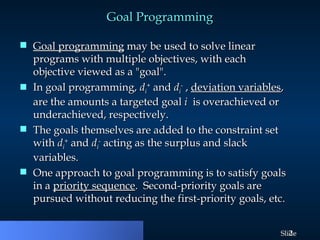
 Goal programming
Goal programming may be used to solve linear
may be used to solve linear
programs with multiple objectives, with each
objective viewed as a "goal".
 In goal programming,
In goal programming, d
di
i
+
+
and
and d
di
i
-
-
,
, deviation variables
deviation variables,
,
are the amounts a targeted goal
are the amounts a targeted goal i
i is overachieved or
is overachieved or
underachieved, respectively.
 The goals themselves are added to the constraint set
The goals themselves are added to the constraint set
with
with d
di
i
+
+
and
and d
di
i
-
-
acting as the surplus and slack
variables.
variables.
 One approach to goal programming is to satisfy goals
One approach to goal programming is to satisfy goals
in a
in a priority sequence
priority sequence. Second-priority goals are
. Second-priority goals are
pursued without reducing the first-priority goals, etc.
3
© 2003 Thomson
© 2003 Thomson

/South-Western
/South-Western Slide
Goal Programming
Goal Programming
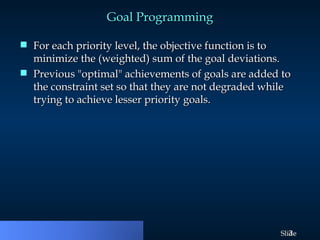
 For each priority level, the objective function is to
For each priority level, the objective function is to
minimize the (weighted) sum of the goal deviations.
 Previous "optimal" achievements of goals are added to
Previous "optimal" achievements of goals are added to
the constraint set so that they are not degraded while
trying to achieve lesser priority goals.
4
© 2003 Thomson
© 2003 Thomson

/South-Western
/South-Western Slide
Goal Programming Approach
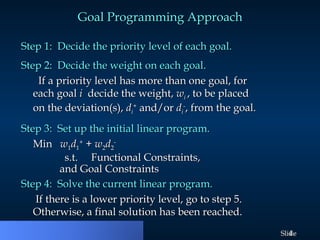
Step 1: Decide the priority level of each goal.
Step 2: Decide the weight on each goal.
If a priority level has more than one goal, for
each goal
each goal i
i decide the weight,
decide the weight, w
wi
i , to be placed
, to be placed
on the deviation(s),
on the deviation(s), d
di
i
+
+
and/or
and/or d
di
i
-
-
, from the goal.
, from the goal.
Step 3: Set up the initial linear program.
Min
Min w
w1
1d
d1
1
+
+
+
+ w
w2
2d
d2
2
-
-
s.t. Functional Constraints,
and Goal Constraints
Step 4: Solve the current linear program.
If there is a lower priority level, go to step 5.
Otherwise, a final solution has been reached.
5
© 2003 Thomson
© 2003 Thomson

/South-Western
/South-Western Slide
Goal Programming Approach
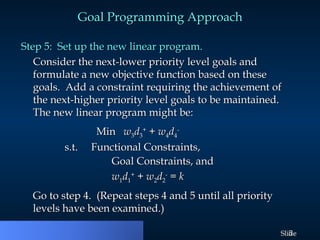
Step 5: Set up the new linear program.
Consider the next-lower priority level goals and
formulate a new objective function based on these
goals. Add a constraint requiring the achievement of
the next-higher priority level goals to be maintained.
The new linear program might be:
Min
Min w
w3
3d
d3
3
+
+
+
+ w
w4
4d
d4
4
-
-
s.t. Functional Constraints,
Goal Constraints, and
w
w1
1d
d1
1
+
+
+
+ w
w2
2d
d2
2
-
-
=
= k
k
Go to step 4. (Repeat steps 4 and 5 until all priority
levels have been examined.)
6
© 2003 Thomson
© 2003 Thomson

/South-Western
/South-Western Slide
Example: Innex Corporation
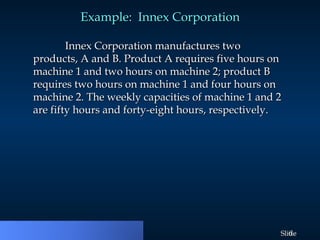
Innex Corporation manufactures two
products, A and B. Product A requires five hours on
machine 1 and two hours on machine 2; product B
requires two hours on machine 1 and four hours on
machine 2. The weekly capacities of machine 1 and 2
are fifty hours and forty-eight hours, respectively.
7
© 2003 Thomson
© 2003 Thomson

/South-Western
/South-Western Slide
Example: Innex Corporation
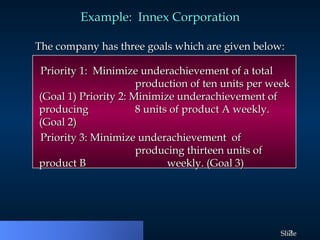
The company has three goals which are given below:
Priority 1: Minimize underachievement of a total
production of ten units per week
(Goal 1) Priority 2: Minimize underachievement of
producing
producing 8 units of product A weekly.
8 units of product A weekly.
(Goal 2)
(Goal 2)
Priority 3: Minimize underachievement of
producing thirteen units of
product B
product B weekly. (Goal 3)
weekly. (Goal 3)
8
© 2003 Thomson
© 2003 Thomson

/South-Western
/South-Western Slide
Example: Innex Corporation
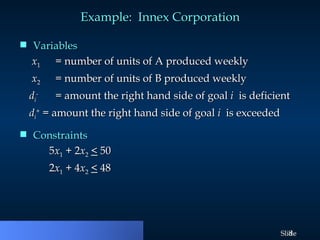
 Variables
Variables
x
x1
1 = number of units of A produced weekly
= number of units of A produced weekly
x
x2
2 = number of units of B produced weekly
= number of units of B produced weekly
d
di
i
-
-
= amount the right hand side of goal
= amount the right hand side of goal i
i is deficient
is deficient
d
di
i
+
+
= amount the right hand side of goal
= amount the right hand side of goal i
i is exceeded
is exceeded
 Constraints
Constraints
5
5x
x1
1 + 2
+ 2x
x2
2 <
< 50
50
2
2x
x1
1 + 4
+ 4x
x2
2 <
< 48
48
9
© 2003 Thomson
© 2003 Thomson

/South-Western
/South-Western Slide
Example: Innex Corporation
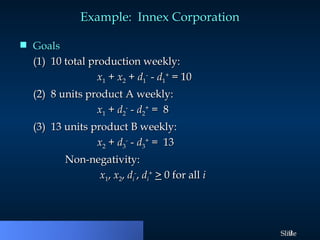
 Goals
Goals
(1) 10 total production weekly:
x
x1
1 +
+ x
x2
2 +
+ d
d1
1
-
-
-
- d
d1
1
+
+
= 10
= 10
(2) 8 units product A weekly:
x
x1
1 +
+ d
d2
2
-
-
-
- d
d2
2
+
+
= 8
= 8
(3) 13 units product B weekly:
x
x2
2 +
+ d
d3
3
-
-
-
- d
d3
3
+
+
= 13
= 13
Non-negativity:
Non-negativity:
x
x1
1,
, x
x2
2,
, d
di
i
-
-
,
, d
di
i
+
+
>
> 0 for all
0 for all i
i
10
© 2003 Thomson
© 2003 Thomson

/South-Western
/South-Western Slide
Example: Innex Corporation
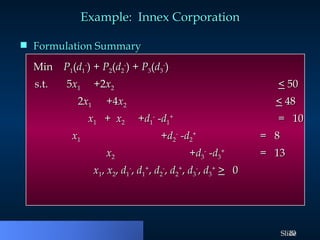
 Formulation Summary
Formulation Summary
Min
Min P
P1
1(
(d
d1
1
-
-
) +
) + P
P2
2(
(d
d2
2
-
-
) +
) + P
P3
3(
(d
d3
3
-
-
)
)
s.t. 5
s.t. 5x
x1
1 +2
+2x
x2
2 <
< 50
50
2
2x
x1
1 +4
+4x
x2
2 <
< 48
48
x
x1
1 +
+ x
x2
2 +
+d
d1
1
-
-
-
-d
d1
1
+
+
= 10
= 10
x
x1
1 +
+d
d2
2
-
-
-
-d
d2
2
+
+
= 8
= 8
x
x2
2 +
+d
d3
3
-
-
-
-d
d3
3
+
+
= 13
= 13
x
x1
1,
, x
x2
2,
, d
d1
1
-
-
,
, d
d1
1
+
+
,
, d
d2
2
-
-
,
, d
d2
2
+
+
,
, d
d3
3
-
-
,
, d
d3
3
+
+
>
> 0
0
11
© 2003 Thomson
© 2003 Thomson

/South-Western
/South-Western Slide
Example: Innex Corporation
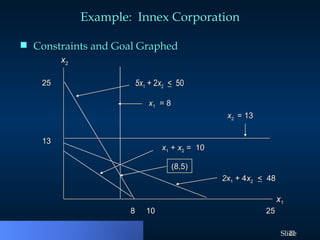
 Constraints and Goal Graphed
Constraints and Goal Graphed
25
25
13
13
8 10
8 10 25
25
5x
5x1
1 + 2
+ 2x
x2
2 <
< 50
50
x
x1
1 = 8
= 8
2x
2x1
1 + 4
+ 4x
x2
2 <
< 48
48
x
x2
2 = 13
= 13
x
x1
1
x
x2
2
x
x1
1 +
+ x
x2
2 = 10
= 10
(8,5)
(8,5)
12
© 2003 Thomson
© 2003 Thomson

/South-Western
/South-Western Slide
Example: Conceptual Products
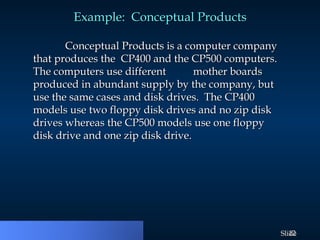
Conceptual Products is a computer company
that produces the CP400 and the CP500 computers.
The computers use different
The computers use different mother boards
mother boards
produced in abundant supply by the company, but
use the same cases and disk drives. The CP400
models use two floppy disk drives and no zip disk
drives whereas the CP500 models use one floppy
disk drive and one zip disk drive.
13
© 2003 Thomson
© 2003 Thomson

/South-Western
/South-Western Slide
Example: Conceptual Products
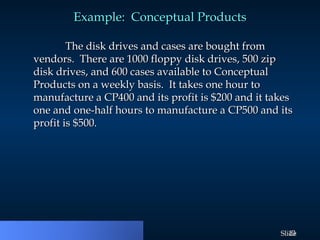
The disk drives and cases are bought from
vendors. There are 1000 floppy disk drives, 500 zip
disk drives, and 600 cases available to Conceptual
Products on a weekly basis. It takes one hour to
manufacture a CP400 and its profit is $200 and it takes
one and one-half hours to manufacture a CP500 and its
profit is $500.
profit is $500.
14
© 2003 Thomson
© 2003 Thomson

/South-Western
/South-Western Slide
Example: Conceptual Products
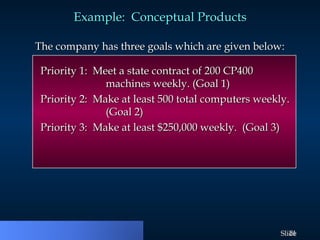
The company has three goals which are given below:
Priority 1: Meet a state contract of 200 CP400
machines weekly. (Goal 1)
Priority 2: Make at least 500 total computers weekly.
(Goal 2)
(Goal 2)
Priority 3: Make at least $250,000 weekly. (Goal 3)
15
© 2003 Thomson
© 2003 Thomson

/South-Western
/South-Western Slide
Example: Conceptual Products
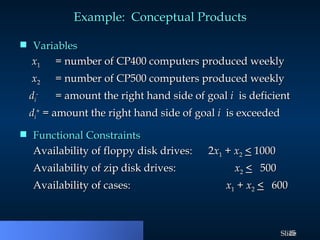
 Variables
Variables
x
x1
1 = number of CP400 computers produced weekly
= number of CP400 computers produced weekly
x
x2
2 = number of CP500 computers produced weekly
= number of CP500 computers produced weekly
d
di
i
-
-
= amount the right hand side of goal
= amount the right hand side of goal i
i is deficient
is deficient
d
di
i
+
+
= amount the right hand side of goal
= amount the right hand side of goal i
i is exceeded
is exceeded
 Functional Constraints
Functional Constraints
Availability of floppy disk drives: 2
Availability of floppy disk drives: 2x
x1
1 +
+ x
x2
2 <
< 1000
1000
Availability of zip disk drives:
Availability of zip disk drives: x
x2
2 <
< 500
500
Availability of cases:
Availability of cases: x
x1
1 +
+ x
x2
2 <
< 600
600
16
© 2003 Thomson
© 2003 Thomson

/South-Western
/South-Western Slide
Example: Conceptual Products
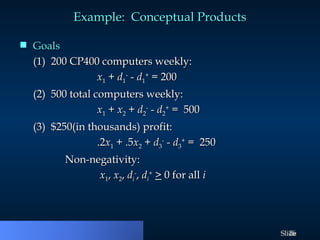
 Goals
Goals
(1) 200 CP400 computers weekly:
x
x1
1 +
+ d
d1
1
-
-
-
- d
d1
1
+
+
= 200
= 200
(2) 500 total computers weekly:
x
x1
1 +
+ x
x2
2 +
+ d
d2
2
-
-
-
- d
d2
2
+
+
= 500
= 500
(3) $250(in thousands) profit:
.2
.2x
x1
1 + .5
+ .5x
x2
2 +
+ d
d3
3
-
-
-
- d
d3
3
+
+
= 250
= 250
Non-negativity:
Non-negativity:
x
x1
1,
, x
x2
2,
, d
di
i
-
-
,
, d
di
i
+
+
>
> 0 for all
0 for all i
i
17
© 2003 Thomson
© 2003 Thomson

/South-Western
/South-Western Slide
Example: Conceptual Products
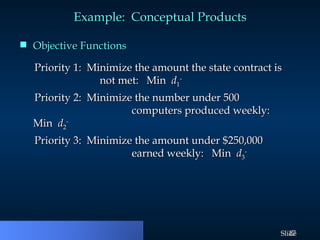
 Objective Functions
Objective Functions
Priority 1: Minimize the amount the state contract is
not met: Min
not met: Min d
d1
1
-
-
Priority 2: Minimize the number under 500
computers produced weekly:
Min
Min d
d2
2
-
-
Priority 3: Minimize the amount under $250,000
earned weekly: Min
earned weekly: Min d
d3
3
-
-
18
© 2003 Thomson
© 2003 Thomson

/South-Western
/South-Western Slide
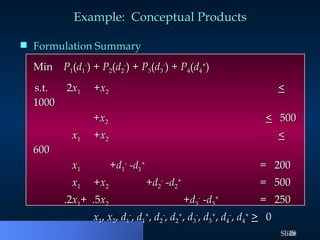
Example: Conceptual Products
 Formulation Summary
Formulation Summary
Min
Min P
P1
1(
(d
d1
1
-
-
) +
) + P
P2
2(
(d
d2
2
-
-
) +
) + P
P3
3(
(d
d3
3
-
-
) +
) + P
P4
4(
(d
d4
4
+
+
)
)
s.t. 2
s.t. 2x
x1
1 +
+x
x2
2 <
<
1000
1000
+
+x
x2
2 <
< 500
500
x
x1
1 +
+x
x2
2 <
<
600
600
x
x1
1 +
+d
d1
1
-
-
-
-d
d1
1
+
+
= 200
= 200
x
x1
1 +
+x
x2
2 +
+d
d2
2
-
-
-
-d
d2
2
+
+
= 500
= 500
.2
.2x
x1
1+ .5
+ .5x
x2
2 +
+d
d3
3
-
-
-
-d
d3
3
+
+
= 250
= 250
x
x1
1,
, x
x2
2,
, d
d1
1
-
-
,
, d
d1
1
+
+
,
, d
d2
2
-
-
,
, d
d2
2
+
+
,
, d
d3
3
-
-
,
, d
d3
3
+
+
,
, d
d4
4
-
-
,
, d
d4
4
+
+
>
> 0
0
19
© 2003 Thomson
© 2003 Thomson

/South-Western
/South-Western Slide
Example: Conceptual Products
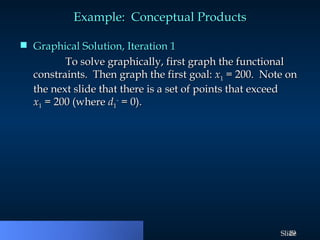
 Graphical Solution, Iteration 1
Graphical Solution, Iteration 1
To solve graphically, first graph the functional
constraints. Then graph the first goal:
constraints. Then graph the first goal: x
x1
1 = 200. Note on
= 200. Note on
the next slide that there is a set of points that exceed
x
x1
1 = 200 (where
= 200 (where d
d1
1
-
-
= 0).
= 0).
20
© 2003 Thomson
© 2003 Thomson

/South-Western
/South-Western Slide
Example: Conceptual Products
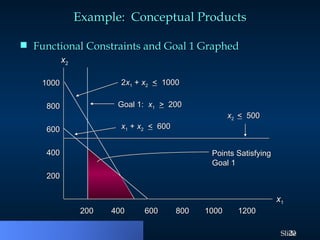
 Functional Constraints and Goal 1 Graphed
Functional Constraints and Goal 1 Graphed
1000
1000
800
800
600
600
400
400
200
200
200 400 600 800 1000 1200
200 400 600 800 1000 1200
2
2x
x1
1 +
+ x
x2
2 <
< 1000
1000
Goal 1:
Goal 1: x
x1
1 >
> 200
200
x
x1
1 +
+ x
x2
2 <
< 600
600
x
x2
2 <
< 500
500
Points Satisfying
Points Satisfying
Goal 1
Goal 1
x
x1
1
x
x2
2
21
© 2003 Thomson
© 2003 Thomson

/South-Western
/South-Western Slide
Example: Conceptual Products
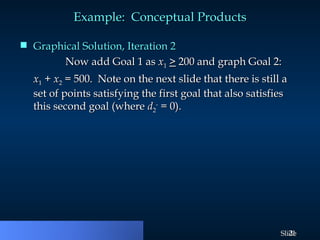
 Graphical Solution, Iteration 2
Graphical Solution, Iteration 2
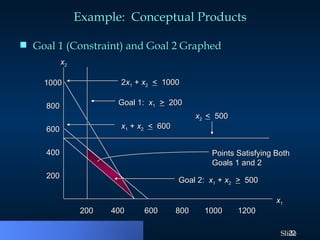
Now add Goal 1 as
Now add Goal 1 as x
x1
1 >
> 200 and graph Goal 2:
200 and graph Goal 2:
x
x1
1 +
+ x
x2
2 = 500. Note on the next slide that there is still a
= 500. Note on the next slide that there is still a
set of points satisfying the first goal that also satisfies
this second goal (where
this second goal (where d
d2
2
-
-
= 0).
= 0).
22
© 2003 Thomson
© 2003 Thomson

/South-Western
/South-Western Slide
Example: Conceptual Products
 Goal 1 (Constraint) and Goal 2 Graphed
Goal 1 (Constraint) and Goal 2 Graphed
1000
1000
800
800
600
600
400
400
200
200
200 400 600 800 1000 1200
200 400 600 800 1000 1200
2
2x
x1
1 +
+ x
x2
2 <
< 1000
1000
Goal 1:
Goal 1: x
x1
1 >
> 200
200
x
x1
1 +
+ x
x2
2 <
< 600
600
x
x2
2 <
< 500
500
Points Satisfying Both
Goals 1 and 2
Goals 1 and 2
x
x1
1
x
x2
2
Goal 2:
Goal 2: x
x1
1 +
+ x
x2
2 >
> 500
500
23
© 2003 Thomson
© 2003 Thomson

/South-Western
/South-Western Slide
Example: Conceptual Products
 Graphical Solution, Iteration 3
Graphical Solution, Iteration 3
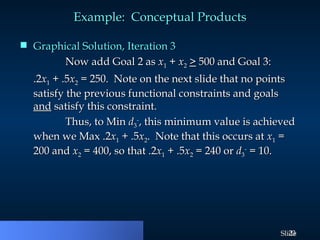
Now add Goal 2 as
Now add Goal 2 as x
x1
1 +
+ x
x2
2 >
> 500 and Goal 3:
500 and Goal 3:
.2
.2x
x1
1 + .5
+ .5x
x2
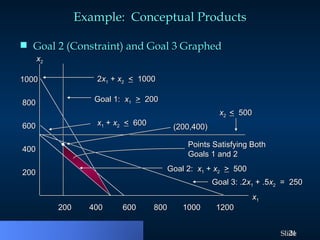
2 = 250. Note on the next slide that no points
= 250. Note on the next slide that no points
satisfy the previous functional constraints and goals
and
and satisfy this constraint.
satisfy this constraint.
Thus, to Min
Thus, to Min d
d3
3
-
-
, this minimum value is achieved
when we Max .2
when we Max .2x
x1
1 + .5
+ .5x
x2
2. Note that this occurs at
. Note that this occurs at x
x1
1 =
=
200 and
200 and x
x2
2 = 400, so that .2
= 400, so that .2x
x1
1 + .5
+ .5x
x2
2 = 240 or
= 240 or d
d3
3
-
-
= 10.
= 10.
24
© 2003 Thomson
© 2003 Thomson

/South-Western
/South-Western Slide
Example: Conceptual Products
 Goal 2 (Constraint) and Goal 3 Graphed
Goal 2 (Constraint) and Goal 3 Graphed
1000
1000
800
800
600
600
400
400
200
200
200 400 600 800 1000 1200
200 400 600 800 1000 1200
2
2x
x1
1 +
+ x
x2
2 <
< 1000
1000
Goal 1:
Goal 1: x
x1
1 >
> 200
200
x
x1
1 +
+ x
x2
2 <
< 600
600
x
x2
2 <
< 500
500
Points Satisfying Both
Goals 1 and 2
Goals 1 and 2
x
x1
1
x
x2
2
Goal 2:
Goal 2: x
x1
1 +
+ x
x2
2 >
> 500
500
Goal 3: .2
Goal 3: .2x
x1
1 + .5
+ .5x
x2
2 = 250
= 250
(200,400)
(200,400)
25
© 2003 Thomson
© 2003 Thomson

/South-Western
/South-Western Slide
A Scoring Model for Job Selection
 A graduating college student with a double major in
A graduating college student with a double major in
Finance and Accounting has received the following
three job offers:
three job offers:
•financial analyst for an investment firm in Chicago
financial analyst for an investment firm in Chicago
•accountant for a manufacturing firm in Denver
accountant for a manufacturing firm in Denver
•auditor for a CPA firm in Houston
auditor for a CPA firm in Houston
26
© 2003 Thomson
© 2003 Thomson

/South-Western
/South-Western Slide
A Scoring Model for Job Selection
 The student made the following comments:
The student made the following comments:
•“
“The financial analyst position provides the best
The financial analyst position provides the best
opportunity for my long-run career advancement.”
•“
“I would prefer living in Denver rather than in
I would prefer living in Denver rather than in
Chicago or Houston.”
•“
“I like the management style and philosophy at the
I like the management style and philosophy at the
Houston CPA firm the best.”
 Clearly, this is a multicriteria decision problem.
Clearly, this is a multicriteria decision problem.
27
© 2003 Thomson
© 2003 Thomson

/South-Western
/South-Western Slide
A Scoring Model for Job Selection
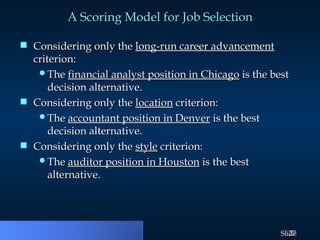
 Considering only the
Considering only the long-run career advancement
long-run career advancement
criterion:
criterion:
•The
The financial analyst position in Chicago
financial analyst position in Chicago is the best
is the best
decision alternative.
 Considering only the
Considering only the location
location criterion:
criterion:
•The
The accountant position in Denver
accountant position in Denver is the best
is the best
decision alternative.
 Considering only the
Considering only the style
style criterion:
criterion:
•The
The auditor position in Houston
auditor position in Houston is the best
is the best
alternative.
alternative.
28
© 2003 Thomson
© 2003 Thomson

/South-Western
/South-Western Slide
A Scoring Model for Job Selection
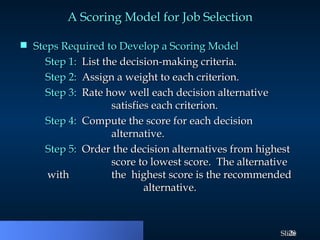
 Steps Required to Develop a Scoring Model
Steps Required to Develop a Scoring Model
Step 1:
Step 1: List the decision-making criteria.
List the decision-making criteria.
Step 2:
Step 2: Assign a weight to each criterion.
Assign a weight to each criterion.
Step 3:
Step 3: Rate how well each decision alternative
Rate how well each decision alternative
satisfies each criterion.
Step 4:
Step 4: Compute the score for each decision
Compute the score for each decision
alternative.
alternative.
Step 5:
Step 5: Order the decision alternatives from highest
Order the decision alternatives from highest
score to lowest score. The alternative
with
with the highest score is the recommended
the highest score is the recommended
alternative.
alternative.
29
© 2003 Thomson
© 2003 Thomson

/South-Western
/South-Western Slide
A Scoring Model for Job Selection
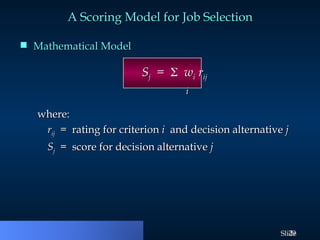
 Mathematical Model
Mathematical Model
S
Sj
j =
= 
w
wi
i r
rij
ij
i
i
where:
where:
r
rij
ij = rating for criterion
= rating for criterion i
i and decision alternative
and decision alternative j
j
S
Sj
j =
= score for decision alternative
score for decision alternative j
j
30
© 2003 Thomson
© 2003 Thomson

/South-Western
/South-Western Slide
A Scoring Model for Job Selection
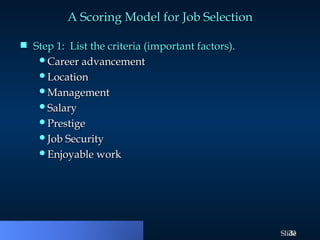
 Step 1: List the criteria (important factors).
Step 1: List the criteria (important factors).
•Career advancement
Career advancement
•Location
Location
•Management
Management
•Salary
Salary
•Prestige
Prestige
•Job Security
Job Security
•Enjoyable work
Enjoyable work
31
© 2003 Thomson
© 2003 Thomson

/South-Western
/South-Western Slide
A Scoring Model for Job Selection
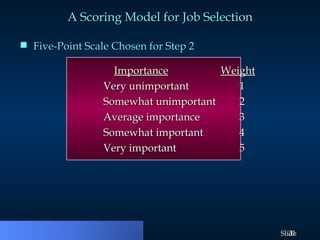
 Five-Point Scale Chosen for Step 2
Five-Point Scale Chosen for Step 2
Importance
Importance Weight
Weight
Very unimportant
Very unimportant 1
1
Somewhat unimportant
Somewhat unimportant 2
2
Average importance
Average importance 3
3
Somewhat important
Somewhat important 4
4
Very important
Very important 5
5
32
© 2003 Thomson
© 2003 Thomson

/South-Western
/South-Western Slide
A Scoring Model for Job Selection
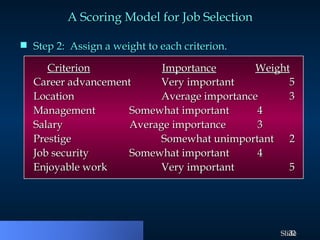
 Step 2: Assign a weight to each criterion.
Step 2: Assign a weight to each criterion.
Criterion
Criterion Importance
Importance Weight
Weight
Career advancement
Career advancement Very important
Very important 5
5
Location
Location Average importance
Average importance 3
3
Management
Management Somewhat important
Somewhat important 4
4
Salary
Salary Average importance
Average importance 3
3
Prestige
Prestige Somewhat unimportant
Somewhat unimportant 2
2
Job security
Job security Somewhat important
Somewhat important 4
4
Enjoyable work
Enjoyable work Very important
Very important 5
5
33
© 2003 Thomson
© 2003 Thomson

/South-Western
/South-Western Slide
A Scoring Model for Job Selection
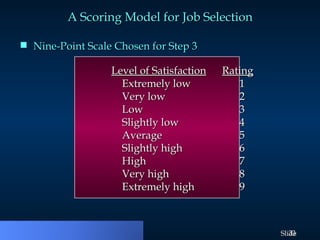
 Nine-Point Scale Chosen for Step 3
Nine-Point Scale Chosen for Step 3
Level of Satisfaction
Level of Satisfaction Rating
Rating
Extremely low
Extremely low 1
1
Very low
Very low 2
2
Low
Low 3
3
Slightly low
Slightly low 4
4
Average
Average 5
5
Slightly high
Slightly high 6
6
High
High 7
7
Very high
Very high 8
8
Extremely high
Extremely high 9
9
34
© 2003 Thomson
© 2003 Thomson

/South-Western
/South-Western Slide
A Scoring Model for Job Selection
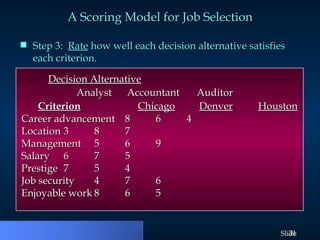
 Step 3:
Step 3: Rate
Rate how well each decision alternative satisfies
how well each decision alternative satisfies
each criterion.
each criterion.
Decision Alternative
Analyst Accountant
Analyst Accountant Auditor
Auditor
Criterion
Criterion Chicago
Chicago Denver
Denver Houston
Houston
Career advancement
Career advancement 8
8 6
6 4
4
Location
Location 3
3 8
8 7
7
Management
Management 5
5 6
6 9
9
Salary
Salary 6
6 7
7 5
5
Prestige
Prestige 7
7 5
5 4
4
Job security
Job security 4
4 7
7 6
6
Enjoyable work
Enjoyable work 8
8 6
6 5
5
35
© 2003 Thomson
© 2003 Thomson

/South-Western
/South-Western Slide
A Scoring Model for Job Selection
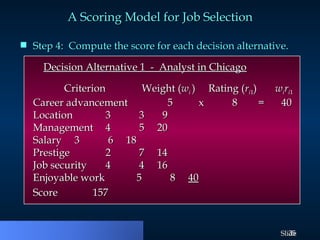
 Step 4: Compute the score for each decision alternative.
Step 4: Compute the score for each decision alternative.
Decision Alternative 1 - Analyst in Chicago
Criterion
Criterion Weight (
Weight (w
wi
i ) Rating (
) Rating (r
ri
i1
1)
) w
wi
ir
ri
i1
1
Career advancement
Career advancement 5
5 x
x 8
8 =
= 40
40
Location
Location 3
3 3
3 9
9
Management
Management 4
4 5
5 20
20
Salary
Salary 3
3 6
6 18
18
Prestige
Prestige 2
2 7
7 14
14
Job security
Job security 4
4 4
4 16
16
Enjoyable work
Enjoyable work 5
5 8
8 40
40
Score
Score 157
157
36
© 2003 Thomson
© 2003 Thomson

/South-Western
/South-Western Slide
A Scoring Model for Job Selection
 Step 4: Compute the score for each decision alternative.
Step 4: Compute the score for each decision alternative.
S
Sj
j =
= 

w
wi
i r
rij
ij
i
i
S
S1
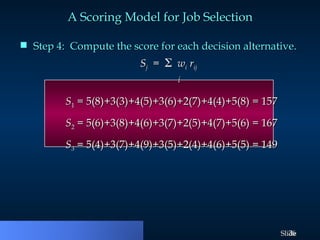
1 = 5(8)+3(3)+4(5)+3(6)+2(7)+4(4)+5(8) = 157
= 5(8)+3(3)+4(5)+3(6)+2(7)+4(4)+5(8) = 157
S
S2
2 = 5(6)+3(8)+4(6)+3(7)+2(5)+4(7)+5(6) = 167
= 5(6)+3(8)+4(6)+3(7)+2(5)+4(7)+5(6) = 167
S
S3
3 = 5(4)+3(7)+4(9)+3(5)+2(4)+4(6)+5(5) = 149
= 5(4)+3(7)+4(9)+3(5)+2(4)+4(6)+5(5) = 149
37
© 2003 Thomson
© 2003 Thomson

/South-Western
/South-Western Slide
A Scoring Model for Job Selection
 Step 4: Compute the
Step 4: Compute the score
score for each decision alternative.
for each decision alternative.
Decision Alternative
Analyst Accountant
Analyst Accountant Auditor
Auditor
Criterion
Criterion Chicago
Chicago Denver
Denver Houston
Houston
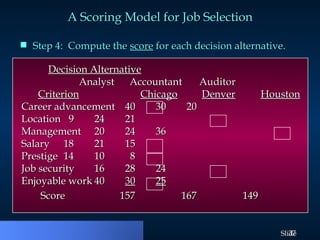
Career advancement
Career advancement 40
40 30
30 20
20
Location
Location 9
9 24
24 21
21
Management
Management 20
20 24
24 36
36
Salary
Salary 18
18 21
21 15
15
Prestige
Prestige 14
14 10
10 8
8
Job security
Job security 16
16 28
28 24
24
Enjoyable work
Enjoyable work 40
40 30
30 25
25
Score
Score 157
157 167
167 149
149
38
© 2003 Thomson
© 2003 Thomson

/South-Western
/South-Western Slide
A Scoring Model for Job Selection
 Step 5: Order the decision alternatives from highest
Step 5: Order the decision alternatives from highest
score to lowest score. The alternative with the
highest score is the recommended alternative.
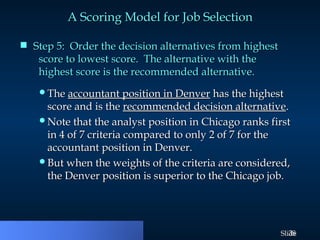
•The
The accountant position in Denver
accountant position in Denver has the highest
has the highest
score and is the
score and is the recommended decision alternative
recommended decision alternative.
.
•Note that the analyst position in Chicago ranks first
Note that the analyst position in Chicago ranks first
in 4 of 7 criteria compared to only 2 of 7 for the
accountant position in Denver.
•But when the weights of the criteria are considered,
But when the weights of the criteria are considered,
the Denver position is superior to the Chicago job.
39
© 2003 Thomson
© 2003 Thomson

/South-Western
/South-Western Slide
End of Goal Programming
40
© 2003 Thomson
© 2003 Thomson

/South-Western
/South-Western Slide
Markov Process
Markov Process
41
© 2003 Thomson
© 2003 Thomson

/South-Western
/South-Western Slide
Markov Processes
Markov Processes
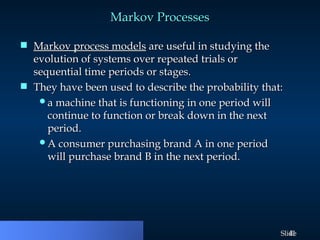
 Markov process models
Markov process models are useful in studying the
are useful in studying the
evolution of systems over repeated trials or
sequential time periods or stages.
 They have been used to describe the probability that:
They have been used to describe the probability that:
•a machine that is functioning in one period will
a machine that is functioning in one period will
continue to function or break down in the next
period.
period.
•A consumer purchasing brand A in one period
A consumer purchasing brand A in one period
will purchase brand B in the next period.
42
© 2003 Thomson
© 2003 Thomson

/South-Western
/South-Western Slide
Transition Probabilities
 Transition probabilities
Transition probabilities govern the manner in which
govern the manner in which
the state of the system changes from one stage to the
next. These are often represented in a
next. These are often represented in a transition
transition
matrix
matrix.
.
43
© 2003 Thomson
© 2003 Thomson

/South-Western
/South-Western Slide
Transition Probabilities
 A system has a
A system has a finite Markov chain
finite Markov chain with
with stationary
stationary
transition probabilities
transition probabilities if:
if:
•there are a finite number of states,
there are a finite number of states,
•the transition probabilities remain constant from
the transition probabilities remain constant from
stage to stage, and
stage to stage, and
•the probability of the process being in a particular
the probability of the process being in a particular
state at stage
state at stage n+
n+1 is completely determined by the
1 is completely determined by the
state of the process at stage
state of the process at stage n
n (and not the state at
(and not the state at
stage
stage n-
n-1). This is referred to as the
1). This is referred to as the memory-less
memory-less
property
property.
.
44
© 2003 Thomson
© 2003 Thomson

/South-Western
/South-Western Slide
Steady-State Probabilities
 The
The state probabilities
state probabilities at any stage of the process can
at any stage of the process can
be recursively calculated by multiplying the initial
state probabilities by the state of the process at stage
n
n.
.
 The probability of the system being in a particular
The probability of the system being in a particular
state after a large number of stages is called a
state after a large number of stages is called a steady-
steady-
state probability
state probability.
.
45
© 2003 Thomson
© 2003 Thomson

/South-Western
/South-Western Slide
Steady-State Probabilities
 Steady state probabilities
Steady state probabilities can be found by solving the
can be found by solving the
system of equations
system of equations 
P
P =
= 
 together with the condition
together with the condition
for probabilities that
for probabilities that 
i
i = 1.
= 1.
•Matrix
Matrix P
P is the transition probability matrix
is the transition probability matrix
•Vector
Vector 
 is the vector of steady state probabilities.
is the vector of steady state probabilities.
46
© 2003 Thomson
© 2003 Thomson

/South-Western
/South-Western Slide
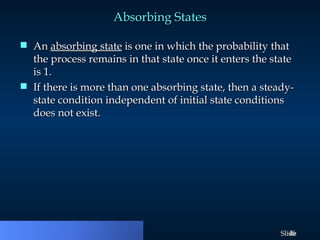
Absorbing States
Absorbing States
 An
An absorbing state
absorbing state is one in which the probability that
is one in which the probability that
the process remains in that state once it enters the state
is 1.
is 1.
 If there is more than one absorbing state, then a steady-
If there is more than one absorbing state, then a steady-
state condition independent of initial state conditions
does not exist.
does not exist.
47
© 2003 Thomson
© 2003 Thomson

/South-Western
/South-Western Slide
Transition Matrix with Submatrices
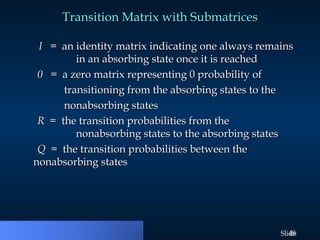
 If a Markov chain has both absorbing and
If a Markov chain has both absorbing and
nonabsorbing states, the states may be rearranged so
that the transition matrix can be written as the
following composition of four submatrices:
following composition of four submatrices: I
I,
, 0
0,
, R
R,
,
and
and Q
Q:
:
I
I 0
0
R
R Q
Q
48
© 2003 Thomson
© 2003 Thomson

/South-Western
/South-Western Slide
Transition Matrix with Submatrices
I
I = an identity matrix indicating one always remains
= an identity matrix indicating one always remains
in an absorbing state once it is reached
0
0 = a zero matrix representing 0 probability of
= a zero matrix representing 0 probability of
transitioning from the absorbing states to the
nonabsorbing states
nonabsorbing states
R
R = the transition probabilities from the
= the transition probabilities from the
nonabsorbing states to the absorbing states
Q
Q = the transition probabilities between the
= the transition probabilities between the
nonabsorbing states
nonabsorbing states
49
© 2003 Thomson
© 2003 Thomson

/South-Western
/South-Western Slide
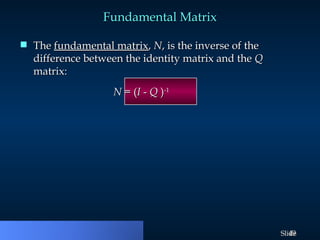
Fundamental Matrix
Fundamental Matrix
 The
The fundamental matrix
fundamental matrix,
, N
N, is the inverse of the
, is the inverse of the
difference between the identity matrix and the
difference between the identity matrix and the Q
Q
matrix:
matrix:
N
N = (
= (I
I -
- Q
Q )
)-1
-1
50
© 2003 Thomson
© 2003 Thomson

/South-Western
/South-Western Slide
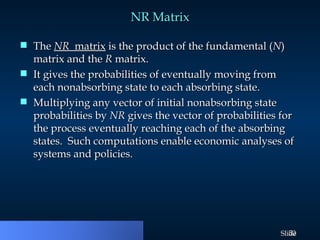
NR Matrix
NR Matrix
 The
The NR
NR matrix
matrix is the product of the fundamental (
is the product of the fundamental (N
N)
)
matrix and the
matrix and the R
R matrix.
matrix.
 It gives the probabilities of eventually moving from
It gives the probabilities of eventually moving from
each nonabsorbing state to each absorbing state.
 Multiplying any vector of initial nonabsorbing state
Multiplying any vector of initial nonabsorbing state
probabilities by
probabilities by NR
NR gives the vector of probabilities for
gives the vector of probabilities for
the process eventually reaching each of the absorbing
states. Such computations enable economic analyses of
systems and policies.
51
© 2003 Thomson
© 2003 Thomson

/South-Western
/South-Western Slide
Example: North’s Hardware
Henry, a persistent salesman, calls North's
Hardware Store once a week hoping to speak with
the store's buying agent, Shirley. If Shirley does not
accept Henry's call this week, the probability she will
do the same next week is .35. On the other hand, if
she accepts Henry's call this week, the probability she
will not do so next week is .20.
52
© 2003 Thomson
© 2003 Thomson

/South-Western
/South-Western Slide
Example: North’s Hardware
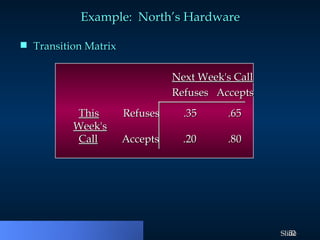
 Transition Matrix
Transition Matrix
Next Week's Call
Next Week's Call
Refuses Accepts
Refuses Accepts
This
This Refuses .35
Refuses .35 .65
.65
Week's
Week's
Call
Call Accepts .20
Accepts .20 .80
.80
53
© 2003 Thomson
© 2003 Thomson

/South-Western
/South-Western Slide
Example: North’s Hardware
 Steady-State Probabilities
Steady-State Probabilities
Question
Question
How many times per year can Henry expect to
talk to Shirley?
talk to Shirley?
Answer
Answer
To find the expected number of accepted calls per
year, find the long-run proportion (probability) of
a call being accepted and multiply it by 52 weeks.
continued
continued
. . .
. . .
54
© 2003 Thomson
© 2003 Thomson

/South-Western
/South-Western Slide
Example: North’s Hardware
 Steady-State Probabilities
Steady-State Probabilities
Answer
Answer (continued)
(continued)
Let
Let 
1
1 = long run proportion of refused calls
= long run proportion of refused calls

2
2 = long run proportion of accepted calls
= long run proportion of accepted calls
Then,
Then,
.35 .65
.35 .65
[
[

 

] = [
] = [

 

]
]
.20 .80
.20 .80
continued . . .
continued . . .
55
© 2003 Thomson
© 2003 Thomson

/South-Western
/South-Western Slide
Example: North’s Hardware
 Steady-State Probabilities
Steady-State Probabilities
Answer (continued)
Answer (continued)


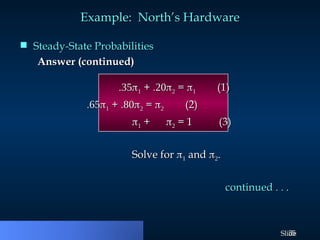
 +
+ 

 =
= 

 (1)
(1)


 +
+ 

 =
= 

 (2)
(2)


 +
+ 

 = 1 (3)
= 1 (3)
Solve for
Solve for 

 and
and 



continued . . .
continued . . .
56
© 2003 Thomson
© 2003 Thomson

/South-Western
/South-Western Slide
Example: North’s Hardware
 Steady-State Probabilities
Steady-State Probabilities
Answer (continued)
Answer (continued)
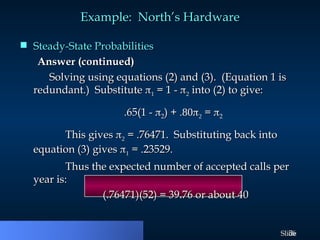
Solving using equations (2) and (3). (Equation 1 is
redundant.) Substitute
redundant.) Substitute 

 = 1 -
= 1 - 

 into (2) to give:
into (2) to give:
.65(1 -
.65(1 - 
2
2) +
) + 

 =
= 
2
2
This gives
This gives 

 = .76471. Substituting back into
= .76471. Substituting back into
equation (3) gives
equation (3) gives 

 = .23529.
= .23529.
Thus the expected number of accepted calls per
year is:
year is:
(.76471)(52) = 39.76 or about 40
57
© 2003 Thomson
© 2003 Thomson

/South-Western
/South-Western Slide
Example: North’s Hardware
 State Probability
State Probability
Question
Question
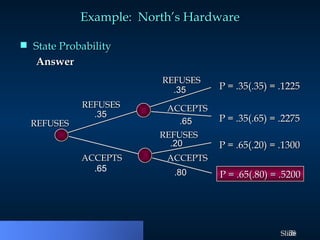
What is the probability Shirley will accept
Henry's next two calls if she does not accept his call
this week?
this week?
58
© 2003 Thomson
© 2003 Thomson

/South-Western
/South-Western Slide
Example: North’s Hardware
 State Probability
State Probability
Answer
Answer
P = .35(.35) = .1225
P = .35(.65) = .2275
P = .65(.20) = .1300
REFUSES
REFUSES
REFUSES
REFUSES
REFUSES
REFUSES
REFUSES
REFUSES
ACCEPTS
ACCEPTS
ACCEPTS
ACCEPTS
ACCEPTS
ACCEPTS
.35
.35
.35
.35
.65
.65
.20
.20
.80
.80
.65
P = .65(.80) = .5200
59
© 2003 Thomson
© 2003 Thomson

/South-Western
/South-Western Slide
Example: North’s Hardware
 State Probability
State Probability
Question
Question
What is the probability of Shirley accepting
exactly
exactly one of Henry's next two calls if she accepts
one of Henry's next two calls if she accepts
his call
his call this week?
this week?
60
© 2003 Thomson
© 2003 Thomson

/South-Western
/South-Western Slide
Example: North’s Hardware
 State Probability
State Probability
Answer
Answer
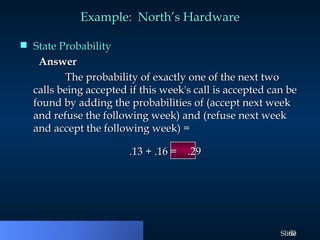
The probability of exactly one of the next two
calls being accepted if this week's call is accepted can be
found by adding the probabilities of (accept next week
and refuse the following week) and (refuse next week
and accept the following week) =
.13 + .16 = .29
.13 + .16 = .29
61
© 2003 Thomson
© 2003 Thomson

/South-Western
/South-Western Slide
Example: Jetair Aerospace
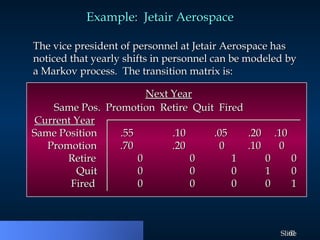
The vice president of personnel at Jetair Aerospace has
noticed that yearly shifts in personnel can be modeled by
a Markov process. The transition matrix is:
Next Year
Next Year
Same Pos. Promotion Retire Quit Fired
Current Year
Current Year
Same Position .55 .10 .05 .20 .10
Promotion .70 .20 0 .10 0
Retire
Retire 0 0 1 0 0
0 0 1 0 0
Quit
Quit 0 0 0 1 0
0 0 0 1 0
Fired
Fired 0 0 0 0 1
0 0 0 0 1
62
© 2003 Thomson
© 2003 Thomson

/South-Western
/South-Western Slide
Example: Jetair Aerospace
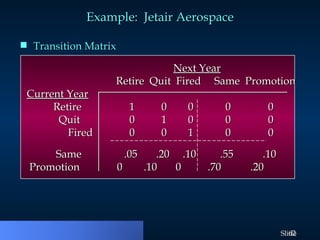
 Transition Matrix
Transition Matrix
Next Year
Next Year
Retire Quit Fired Same Promotion
Current Year
Current Year
Retire
Retire 1 0 0 0 0
1 0 0 0 0
Quit
Quit 0 1 0 0 0
0 1 0 0 0
Fired
Fired 0 0 1 0 0
0 0 1 0 0
Same
Same .05 .20 .10 .55 .10
.05 .20 .10 .55 .10
Promotion 0 .10 0 .70 .20
63
© 2003 Thomson
© 2003 Thomson

/South-Western
/South-Western Slide
Example: Jetair Aerospace
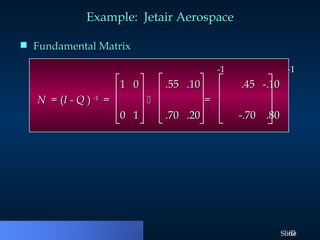
 Fundamental Matrix
Fundamental Matrix
-1 -1
-1 -1
1 0 .55 .10
1 0 .55 .10 .45 -.10
.45 -.10
N
N = (
= (I
I -
- Q
Q )
) -1
-1
=
= 
 =
=
0 1 .70 .20
0 1 .70 .20 -.70 .80
-.70 .80
64
© 2003 Thomson
© 2003 Thomson

/South-Western
/South-Western Slide
Example: Jetair Aerospace
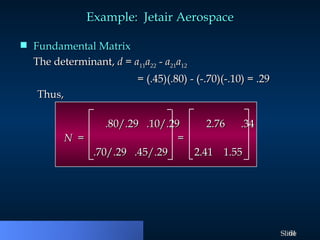
 Fundamental Matrix
Fundamental Matrix
The determinant,
The determinant, d
d =
= a
a
a
a
 -
- a
a
a
a

= (.45)(.80) - (-.70)(-.10) = .29
= (.45)(.80) - (-.70)(-.10) = .29
Thus,
Thus,
.80/.29 .10/.29 2.76 .34
.80/.29 .10/.29 2.76 .34
N
N = =
= =
.70/.29 .45/.29 2.41 1.55
.70/.29 .45/.29 2.41 1.55
65
© 2003 Thomson
© 2003 Thomson

/South-Western
/South-Western Slide
Example: Jetair Aerospace
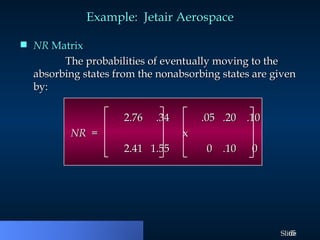
 NR
NR Matrix
Matrix
The probabilities of eventually moving to the
absorbing states from the nonabsorbing states are given
by:
by:
2.76 .34
2.76 .34 .05 .20 .10
.05 .20 .10
NR
NR =
= x
x
2.41 1.55 0 .10 0
2.41 1.55 0 .10 0
66
© 2003 Thomson
© 2003 Thomson

/South-Western
/South-Western Slide
Example: Jetair Aerospace
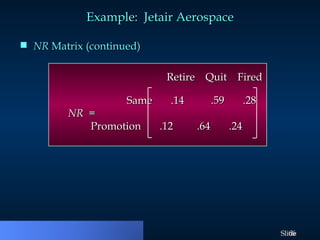
 NR
NR Matrix (continued)
Matrix (continued)
Retire Quit Fired
Retire Quit Fired
Same .14 .59 .28
Same .14 .59 .28
NR
NR =
=
Promotion .12 .64 .24
67
© 2003 Thomson
© 2003 Thomson

/South-Western
/South-Western Slide
Example: Jetair Aerospace
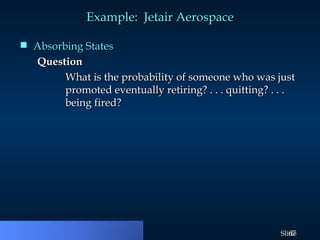
 Absorbing States
Absorbing States
Question
Question
What is the probability of someone who was just
promoted eventually retiring? . . . quitting? . . .
being fired?
being fired?
68
© 2003 Thomson
© 2003 Thomson

/South-Western
/South-Western Slide
Example: Jetair Aerospace
 Absorbing States (continued)
Absorbing States (continued)
Answer
Answer
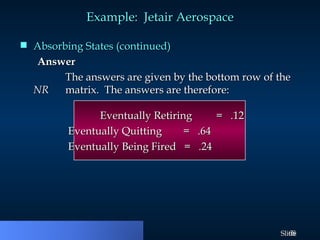
The answers are given by the bottom row of the
NR
NR matrix. The answers are therefore:
matrix. The answers are therefore:
Eventually Retiring = .12
Eventually Quitting = .64
Eventually Being Fired = .24
69
© 2003 Thomson
© 2003 Thomson

/South-Western
/South-Western Slide
End of Chapter 17
End of Chapter 17

introduction of the Goal Programming.ppt

  • 1.
    1 © 2003 Thomson ©2003 Thomson  /South-Western /South-Western Slide Goal Programming Goal Programming
  • 2.
    2 © 2003 Thomson ©2003 Thomson  /South-Western /South-Western Slide Goal Programming Goal Programming  Goal programming Goal programming may be used to solve linear may be used to solve linear programs with multiple objectives, with each programs with multiple objectives, with each objective viewed as a "goal". objective viewed as a "goal".  In goal programming, In goal programming, d di i + + and and d di i - - , , deviation variables deviation variables, , are the amounts a targeted goal are the amounts a targeted goal i i is overachieved or is overachieved or underachieved, respectively. underachieved, respectively.  The goals themselves are added to the constraint set The goals themselves are added to the constraint set with with d di i + + and and d di i - - acting as the surplus and slack acting as the surplus and slack variables. variables.  One approach to goal programming is to satisfy goals One approach to goal programming is to satisfy goals in a in a priority sequence priority sequence. Second-priority goals are . Second-priority goals are pursued without reducing the first-priority goals, etc. pursued without reducing the first-priority goals, etc.
  • 3.
    3 © 2003 Thomson ©2003 Thomson  /South-Western /South-Western Slide Goal Programming Goal Programming  For each priority level, the objective function is to For each priority level, the objective function is to minimize the (weighted) sum of the goal deviations. minimize the (weighted) sum of the goal deviations.  Previous "optimal" achievements of goals are added to Previous "optimal" achievements of goals are added to the constraint set so that they are not degraded while the constraint set so that they are not degraded while trying to achieve lesser priority goals. trying to achieve lesser priority goals.
  • 4.
    4 © 2003 Thomson ©2003 Thomson  /South-Western /South-Western Slide Goal Programming Approach Goal Programming Approach Step 1: Decide the priority level of each goal. Step 1: Decide the priority level of each goal. Step 2: Decide the weight on each goal. Step 2: Decide the weight on each goal. If a priority level has more than one goal, for If a priority level has more than one goal, for each goal each goal i i decide the weight, decide the weight, w wi i , to be placed , to be placed on the deviation(s), on the deviation(s), d di i + + and/or and/or d di i - - , from the goal. , from the goal. Step 3: Set up the initial linear program. Step 3: Set up the initial linear program. Min Min w w1 1d d1 1 + + + + w w2 2d d2 2 - - s.t. Functional Constraints, s.t. Functional Constraints, and Goal Constraints and Goal Constraints Step 4: Solve the current linear program. Step 4: Solve the current linear program. If there is a lower priority level, go to step 5. If there is a lower priority level, go to step 5. Otherwise, a final solution has been reached. Otherwise, a final solution has been reached.
  • 5.
    5 © 2003 Thomson ©2003 Thomson  /South-Western /South-Western Slide Goal Programming Approach Goal Programming Approach Step 5: Set up the new linear program. Step 5: Set up the new linear program. Consider the next-lower priority level goals and Consider the next-lower priority level goals and formulate a new objective function based on these formulate a new objective function based on these goals. Add a constraint requiring the achievement of goals. Add a constraint requiring the achievement of the next-higher priority level goals to be maintained. the next-higher priority level goals to be maintained. The new linear program might be: The new linear program might be: Min Min w w3 3d d3 3 + + + + w w4 4d d4 4 - - s.t. Functional Constraints, s.t. Functional Constraints, Goal Constraints, and Goal Constraints, and w w1 1d d1 1 + + + + w w2 2d d2 2 - - = = k k Go to step 4. (Repeat steps 4 and 5 until all priority Go to step 4. (Repeat steps 4 and 5 until all priority levels have been examined.) levels have been examined.)
  • 6.
    6 © 2003 Thomson ©2003 Thomson  /South-Western /South-Western Slide Example: Innex Corporation Example: Innex Corporation Innex Corporation manufactures two Innex Corporation manufactures two products, A and B. Product A requires five hours on products, A and B. Product A requires five hours on machine 1 and two hours on machine 2; product B machine 1 and two hours on machine 2; product B requires two hours on machine 1 and four hours on requires two hours on machine 1 and four hours on machine 2. The weekly capacities of machine 1 and 2 machine 2. The weekly capacities of machine 1 and 2 are fifty hours and forty-eight hours, respectively. are fifty hours and forty-eight hours, respectively.
  • 7.
    7 © 2003 Thomson ©2003 Thomson  /South-Western /South-Western Slide Example: Innex Corporation Example: Innex Corporation The company has three goals which are given below: The company has three goals which are given below: Priority 1: Minimize underachievement of a total Priority 1: Minimize underachievement of a total production of ten units per week production of ten units per week (Goal 1) Priority 2: Minimize underachievement of (Goal 1) Priority 2: Minimize underachievement of producing producing 8 units of product A weekly. 8 units of product A weekly. (Goal 2) (Goal 2) Priority 3: Minimize underachievement of Priority 3: Minimize underachievement of producing thirteen units of producing thirteen units of product B product B weekly. (Goal 3) weekly. (Goal 3)
  • 8.
    8 © 2003 Thomson ©2003 Thomson  /South-Western /South-Western Slide Example: Innex Corporation Example: Innex Corporation  Variables Variables x x1 1 = number of units of A produced weekly = number of units of A produced weekly x x2 2 = number of units of B produced weekly = number of units of B produced weekly d di i - - = amount the right hand side of goal = amount the right hand side of goal i i is deficient is deficient d di i + + = amount the right hand side of goal = amount the right hand side of goal i i is exceeded is exceeded  Constraints Constraints 5 5x x1 1 + 2 + 2x x2 2 < < 50 50 2 2x x1 1 + 4 + 4x x2 2 < < 48 48
  • 9.
    9 © 2003 Thomson ©2003 Thomson  /South-Western /South-Western Slide Example: Innex Corporation Example: Innex Corporation  Goals Goals (1) 10 total production weekly: (1) 10 total production weekly: x x1 1 + + x x2 2 + + d d1 1 - - - - d d1 1 + + = 10 = 10 (2) 8 units product A weekly: (2) 8 units product A weekly: x x1 1 + + d d2 2 - - - - d d2 2 + + = 8 = 8 (3) 13 units product B weekly: (3) 13 units product B weekly: x x2 2 + + d d3 3 - - - - d d3 3 + + = 13 = 13 Non-negativity: Non-negativity: x x1 1, , x x2 2, , d di i - - , , d di i + + > > 0 for all 0 for all i i
  • 10.
    10 © 2003 Thomson ©2003 Thomson  /South-Western /South-Western Slide Example: Innex Corporation Example: Innex Corporation  Formulation Summary Formulation Summary Min Min P P1 1( (d d1 1 - - ) + ) + P P2 2( (d d2 2 - - ) + ) + P P3 3( (d d3 3 - - ) ) s.t. 5 s.t. 5x x1 1 +2 +2x x2 2 < < 50 50 2 2x x1 1 +4 +4x x2 2 < < 48 48 x x1 1 + + x x2 2 + +d d1 1 - - - -d d1 1 + + = 10 = 10 x x1 1 + +d d2 2 - - - -d d2 2 + + = 8 = 8 x x2 2 + +d d3 3 - - - -d d3 3 + + = 13 = 13 x x1 1, , x x2 2, , d d1 1 - - , , d d1 1 + + , , d d2 2 - - , , d d2 2 + + , , d d3 3 - - , , d d3 3 + + > > 0 0
  • 11.
    11 © 2003 Thomson ©2003 Thomson  /South-Western /South-Western Slide Example: Innex Corporation Example: Innex Corporation  Constraints and Goal Graphed Constraints and Goal Graphed 25 25 13 13 8 10 8 10 25 25 5x 5x1 1 + 2 + 2x x2 2 < < 50 50 x x1 1 = 8 = 8 2x 2x1 1 + 4 + 4x x2 2 < < 48 48 x x2 2 = 13 = 13 x x1 1 x x2 2 x x1 1 + + x x2 2 = 10 = 10 (8,5) (8,5)
  • 12.
    12 © 2003 Thomson ©2003 Thomson  /South-Western /South-Western Slide Example: Conceptual Products Example: Conceptual Products Conceptual Products is a computer company Conceptual Products is a computer company that produces the CP400 and the CP500 computers. that produces the CP400 and the CP500 computers. The computers use different The computers use different mother boards mother boards produced in abundant supply by the company, but produced in abundant supply by the company, but use the same cases and disk drives. The CP400 use the same cases and disk drives. The CP400 models use two floppy disk drives and no zip disk models use two floppy disk drives and no zip disk drives whereas the CP500 models use one floppy drives whereas the CP500 models use one floppy disk drive and one zip disk drive. disk drive and one zip disk drive.
  • 13.
    13 © 2003 Thomson ©2003 Thomson  /South-Western /South-Western Slide Example: Conceptual Products Example: Conceptual Products The disk drives and cases are bought from The disk drives and cases are bought from vendors. There are 1000 floppy disk drives, 500 zip vendors. There are 1000 floppy disk drives, 500 zip disk drives, and 600 cases available to Conceptual disk drives, and 600 cases available to Conceptual Products on a weekly basis. It takes one hour to Products on a weekly basis. It takes one hour to manufacture a CP400 and its profit is $200 and it takes manufacture a CP400 and its profit is $200 and it takes one and one-half hours to manufacture a CP500 and its one and one-half hours to manufacture a CP500 and its profit is $500. profit is $500.
  • 14.
    14 © 2003 Thomson ©2003 Thomson  /South-Western /South-Western Slide Example: Conceptual Products Example: Conceptual Products The company has three goals which are given below: The company has three goals which are given below: Priority 1: Meet a state contract of 200 CP400 Priority 1: Meet a state contract of 200 CP400 machines weekly. (Goal 1) machines weekly. (Goal 1) Priority 2: Make at least 500 total computers weekly. Priority 2: Make at least 500 total computers weekly. (Goal 2) (Goal 2) Priority 3: Make at least $250,000 weekly. (Goal 3) Priority 3: Make at least $250,000 weekly. (Goal 3)
  • 15.
    15 © 2003 Thomson ©2003 Thomson  /South-Western /South-Western Slide Example: Conceptual Products Example: Conceptual Products  Variables Variables x x1 1 = number of CP400 computers produced weekly = number of CP400 computers produced weekly x x2 2 = number of CP500 computers produced weekly = number of CP500 computers produced weekly d di i - - = amount the right hand side of goal = amount the right hand side of goal i i is deficient is deficient d di i + + = amount the right hand side of goal = amount the right hand side of goal i i is exceeded is exceeded  Functional Constraints Functional Constraints Availability of floppy disk drives: 2 Availability of floppy disk drives: 2x x1 1 + + x x2 2 < < 1000 1000 Availability of zip disk drives: Availability of zip disk drives: x x2 2 < < 500 500 Availability of cases: Availability of cases: x x1 1 + + x x2 2 < < 600 600
  • 16.
    16 © 2003 Thomson ©2003 Thomson  /South-Western /South-Western Slide Example: Conceptual Products Example: Conceptual Products  Goals Goals (1) 200 CP400 computers weekly: (1) 200 CP400 computers weekly: x x1 1 + + d d1 1 - - - - d d1 1 + + = 200 = 200 (2) 500 total computers weekly: (2) 500 total computers weekly: x x1 1 + + x x2 2 + + d d2 2 - - - - d d2 2 + + = 500 = 500 (3) $250(in thousands) profit: (3) $250(in thousands) profit: .2 .2x x1 1 + .5 + .5x x2 2 + + d d3 3 - - - - d d3 3 + + = 250 = 250 Non-negativity: Non-negativity: x x1 1, , x x2 2, , d di i - - , , d di i + + > > 0 for all 0 for all i i
  • 17.
    17 © 2003 Thomson ©2003 Thomson  /South-Western /South-Western Slide Example: Conceptual Products Example: Conceptual Products  Objective Functions Objective Functions Priority 1: Minimize the amount the state contract is Priority 1: Minimize the amount the state contract is not met: Min not met: Min d d1 1 - - Priority 2: Minimize the number under 500 Priority 2: Minimize the number under 500 computers produced weekly: computers produced weekly: Min Min d d2 2 - - Priority 3: Minimize the amount under $250,000 Priority 3: Minimize the amount under $250,000 earned weekly: Min earned weekly: Min d d3 3 - -
  • 18.
    18 © 2003 Thomson ©2003 Thomson  /South-Western /South-Western Slide Example: Conceptual Products Example: Conceptual Products  Formulation Summary Formulation Summary Min Min P P1 1( (d d1 1 - - ) + ) + P P2 2( (d d2 2 - - ) + ) + P P3 3( (d d3 3 - - ) + ) + P P4 4( (d d4 4 + + ) ) s.t. 2 s.t. 2x x1 1 + +x x2 2 < < 1000 1000 + +x x2 2 < < 500 500 x x1 1 + +x x2 2 < < 600 600 x x1 1 + +d d1 1 - - - -d d1 1 + + = 200 = 200 x x1 1 + +x x2 2 + +d d2 2 - - - -d d2 2 + + = 500 = 500 .2 .2x x1 1+ .5 + .5x x2 2 + +d d3 3 - - - -d d3 3 + + = 250 = 250 x x1 1, , x x2 2, , d d1 1 - - , , d d1 1 + + , , d d2 2 - - , , d d2 2 + + , , d d3 3 - - , , d d3 3 + + , , d d4 4 - - , , d d4 4 + + > > 0 0
  • 19.
    19 © 2003 Thomson ©2003 Thomson  /South-Western /South-Western Slide Example: Conceptual Products Example: Conceptual Products  Graphical Solution, Iteration 1 Graphical Solution, Iteration 1 To solve graphically, first graph the functional To solve graphically, first graph the functional constraints. Then graph the first goal: constraints. Then graph the first goal: x x1 1 = 200. Note on = 200. Note on the next slide that there is a set of points that exceed the next slide that there is a set of points that exceed x x1 1 = 200 (where = 200 (where d d1 1 - - = 0). = 0).
  • 20.
    20 © 2003 Thomson ©2003 Thomson  /South-Western /South-Western Slide Example: Conceptual Products Example: Conceptual Products  Functional Constraints and Goal 1 Graphed Functional Constraints and Goal 1 Graphed 1000 1000 800 800 600 600 400 400 200 200 200 400 600 800 1000 1200 200 400 600 800 1000 1200 2 2x x1 1 + + x x2 2 < < 1000 1000 Goal 1: Goal 1: x x1 1 > > 200 200 x x1 1 + + x x2 2 < < 600 600 x x2 2 < < 500 500 Points Satisfying Points Satisfying Goal 1 Goal 1 x x1 1 x x2 2
  • 21.
    21 © 2003 Thomson ©2003 Thomson  /South-Western /South-Western Slide Example: Conceptual Products Example: Conceptual Products  Graphical Solution, Iteration 2 Graphical Solution, Iteration 2 Now add Goal 1 as Now add Goal 1 as x x1 1 > > 200 and graph Goal 2: 200 and graph Goal 2: x x1 1 + + x x2 2 = 500. Note on the next slide that there is still a = 500. Note on the next slide that there is still a set of points satisfying the first goal that also satisfies set of points satisfying the first goal that also satisfies this second goal (where this second goal (where d d2 2 - - = 0). = 0).
  • 22.
    22 © 2003 Thomson ©2003 Thomson  /South-Western /South-Western Slide Example: Conceptual Products Example: Conceptual Products  Goal 1 (Constraint) and Goal 2 Graphed Goal 1 (Constraint) and Goal 2 Graphed 1000 1000 800 800 600 600 400 400 200 200 200 400 600 800 1000 1200 200 400 600 800 1000 1200 2 2x x1 1 + + x x2 2 < < 1000 1000 Goal 1: Goal 1: x x1 1 > > 200 200 x x1 1 + + x x2 2 < < 600 600 x x2 2 < < 500 500 Points Satisfying Both Points Satisfying Both Goals 1 and 2 Goals 1 and 2 x x1 1 x x2 2 Goal 2: Goal 2: x x1 1 + + x x2 2 > > 500 500
  • 23.
    23 © 2003 Thomson ©2003 Thomson  /South-Western /South-Western Slide Example: Conceptual Products Example: Conceptual Products  Graphical Solution, Iteration 3 Graphical Solution, Iteration 3 Now add Goal 2 as Now add Goal 2 as x x1 1 + + x x2 2 > > 500 and Goal 3: 500 and Goal 3: .2 .2x x1 1 + .5 + .5x x2 2 = 250. Note on the next slide that no points = 250. Note on the next slide that no points satisfy the previous functional constraints and goals satisfy the previous functional constraints and goals and and satisfy this constraint. satisfy this constraint. Thus, to Min Thus, to Min d d3 3 - - , this minimum value is achieved , this minimum value is achieved when we Max .2 when we Max .2x x1 1 + .5 + .5x x2 2. Note that this occurs at . Note that this occurs at x x1 1 = = 200 and 200 and x x2 2 = 400, so that .2 = 400, so that .2x x1 1 + .5 + .5x x2 2 = 240 or = 240 or d d3 3 - - = 10. = 10.
  • 24.
    24 © 2003 Thomson ©2003 Thomson  /South-Western /South-Western Slide Example: Conceptual Products Example: Conceptual Products  Goal 2 (Constraint) and Goal 3 Graphed Goal 2 (Constraint) and Goal 3 Graphed 1000 1000 800 800 600 600 400 400 200 200 200 400 600 800 1000 1200 200 400 600 800 1000 1200 2 2x x1 1 + + x x2 2 < < 1000 1000 Goal 1: Goal 1: x x1 1 > > 200 200 x x1 1 + + x x2 2 < < 600 600 x x2 2 < < 500 500 Points Satisfying Both Points Satisfying Both Goals 1 and 2 Goals 1 and 2 x x1 1 x x2 2 Goal 2: Goal 2: x x1 1 + + x x2 2 > > 500 500 Goal 3: .2 Goal 3: .2x x1 1 + .5 + .5x x2 2 = 250 = 250 (200,400) (200,400)
  • 25.
    25 © 2003 Thomson ©2003 Thomson  /South-Western /South-Western Slide A Scoring Model for Job Selection A Scoring Model for Job Selection  A graduating college student with a double major in A graduating college student with a double major in Finance and Accounting has received the following Finance and Accounting has received the following three job offers: three job offers: •financial analyst for an investment firm in Chicago financial analyst for an investment firm in Chicago •accountant for a manufacturing firm in Denver accountant for a manufacturing firm in Denver •auditor for a CPA firm in Houston auditor for a CPA firm in Houston
  • 26.
    26 © 2003 Thomson ©2003 Thomson  /South-Western /South-Western Slide A Scoring Model for Job Selection A Scoring Model for Job Selection  The student made the following comments: The student made the following comments: •“ “The financial analyst position provides the best The financial analyst position provides the best opportunity for my long-run career advancement.” opportunity for my long-run career advancement.” •“ “I would prefer living in Denver rather than in I would prefer living in Denver rather than in Chicago or Houston.” Chicago or Houston.” •“ “I like the management style and philosophy at the I like the management style and philosophy at the Houston CPA firm the best.” Houston CPA firm the best.”  Clearly, this is a multicriteria decision problem. Clearly, this is a multicriteria decision problem.
  • 27.
    27 © 2003 Thomson ©2003 Thomson  /South-Western /South-Western Slide A Scoring Model for Job Selection A Scoring Model for Job Selection  Considering only the Considering only the long-run career advancement long-run career advancement criterion: criterion: •The The financial analyst position in Chicago financial analyst position in Chicago is the best is the best decision alternative. decision alternative.  Considering only the Considering only the location location criterion: criterion: •The The accountant position in Denver accountant position in Denver is the best is the best decision alternative. decision alternative.  Considering only the Considering only the style style criterion: criterion: •The The auditor position in Houston auditor position in Houston is the best is the best alternative. alternative.
  • 28.
    28 © 2003 Thomson ©2003 Thomson  /South-Western /South-Western Slide A Scoring Model for Job Selection A Scoring Model for Job Selection  Steps Required to Develop a Scoring Model Steps Required to Develop a Scoring Model Step 1: Step 1: List the decision-making criteria. List the decision-making criteria. Step 2: Step 2: Assign a weight to each criterion. Assign a weight to each criterion. Step 3: Step 3: Rate how well each decision alternative Rate how well each decision alternative satisfies each criterion. satisfies each criterion. Step 4: Step 4: Compute the score for each decision Compute the score for each decision alternative. alternative. Step 5: Step 5: Order the decision alternatives from highest Order the decision alternatives from highest score to lowest score. The alternative score to lowest score. The alternative with with the highest score is the recommended the highest score is the recommended alternative. alternative.
  • 29.
    29 © 2003 Thomson ©2003 Thomson  /South-Western /South-Western Slide A Scoring Model for Job Selection A Scoring Model for Job Selection  Mathematical Model Mathematical Model S Sj j = =  w wi i r rij ij i i where: where: r rij ij = rating for criterion = rating for criterion i i and decision alternative and decision alternative j j S Sj j = = score for decision alternative score for decision alternative j j
  • 30.
    30 © 2003 Thomson ©2003 Thomson  /South-Western /South-Western Slide A Scoring Model for Job Selection A Scoring Model for Job Selection  Step 1: List the criteria (important factors). Step 1: List the criteria (important factors). •Career advancement Career advancement •Location Location •Management Management •Salary Salary •Prestige Prestige •Job Security Job Security •Enjoyable work Enjoyable work
  • 31.
    31 © 2003 Thomson ©2003 Thomson  /South-Western /South-Western Slide A Scoring Model for Job Selection A Scoring Model for Job Selection  Five-Point Scale Chosen for Step 2 Five-Point Scale Chosen for Step 2 Importance Importance Weight Weight Very unimportant Very unimportant 1 1 Somewhat unimportant Somewhat unimportant 2 2 Average importance Average importance 3 3 Somewhat important Somewhat important 4 4 Very important Very important 5 5
  • 32.
    32 © 2003 Thomson ©2003 Thomson  /South-Western /South-Western Slide A Scoring Model for Job Selection A Scoring Model for Job Selection  Step 2: Assign a weight to each criterion. Step 2: Assign a weight to each criterion. Criterion Criterion Importance Importance Weight Weight Career advancement Career advancement Very important Very important 5 5 Location Location Average importance Average importance 3 3 Management Management Somewhat important Somewhat important 4 4 Salary Salary Average importance Average importance 3 3 Prestige Prestige Somewhat unimportant Somewhat unimportant 2 2 Job security Job security Somewhat important Somewhat important 4 4 Enjoyable work Enjoyable work Very important Very important 5 5
  • 33.
    33 © 2003 Thomson ©2003 Thomson  /South-Western /South-Western Slide A Scoring Model for Job Selection A Scoring Model for Job Selection  Nine-Point Scale Chosen for Step 3 Nine-Point Scale Chosen for Step 3 Level of Satisfaction Level of Satisfaction Rating Rating Extremely low Extremely low 1 1 Very low Very low 2 2 Low Low 3 3 Slightly low Slightly low 4 4 Average Average 5 5 Slightly high Slightly high 6 6 High High 7 7 Very high Very high 8 8 Extremely high Extremely high 9 9
  • 34.
    34 © 2003 Thomson ©2003 Thomson  /South-Western /South-Western Slide A Scoring Model for Job Selection A Scoring Model for Job Selection  Step 3: Step 3: Rate Rate how well each decision alternative satisfies how well each decision alternative satisfies each criterion. each criterion. Decision Alternative Decision Alternative Analyst Accountant Analyst Accountant Auditor Auditor Criterion Criterion Chicago Chicago Denver Denver Houston Houston Career advancement Career advancement 8 8 6 6 4 4 Location Location 3 3 8 8 7 7 Management Management 5 5 6 6 9 9 Salary Salary 6 6 7 7 5 5 Prestige Prestige 7 7 5 5 4 4 Job security Job security 4 4 7 7 6 6 Enjoyable work Enjoyable work 8 8 6 6 5 5
  • 35.
    35 © 2003 Thomson ©2003 Thomson  /South-Western /South-Western Slide A Scoring Model for Job Selection A Scoring Model for Job Selection  Step 4: Compute the score for each decision alternative. Step 4: Compute the score for each decision alternative. Decision Alternative 1 - Analyst in Chicago Decision Alternative 1 - Analyst in Chicago Criterion Criterion Weight ( Weight (w wi i ) Rating ( ) Rating (r ri i1 1) ) w wi ir ri i1 1 Career advancement Career advancement 5 5 x x 8 8 = = 40 40 Location Location 3 3 3 3 9 9 Management Management 4 4 5 5 20 20 Salary Salary 3 3 6 6 18 18 Prestige Prestige 2 2 7 7 14 14 Job security Job security 4 4 4 4 16 16 Enjoyable work Enjoyable work 5 5 8 8 40 40 Score Score 157 157
  • 36.
    36 © 2003 Thomson ©2003 Thomson  /South-Western /South-Western Slide A Scoring Model for Job Selection A Scoring Model for Job Selection  Step 4: Compute the score for each decision alternative. Step 4: Compute the score for each decision alternative. S Sj j = =   w wi i r rij ij i i S S1 1 = 5(8)+3(3)+4(5)+3(6)+2(7)+4(4)+5(8) = 157 = 5(8)+3(3)+4(5)+3(6)+2(7)+4(4)+5(8) = 157 S S2 2 = 5(6)+3(8)+4(6)+3(7)+2(5)+4(7)+5(6) = 167 = 5(6)+3(8)+4(6)+3(7)+2(5)+4(7)+5(6) = 167 S S3 3 = 5(4)+3(7)+4(9)+3(5)+2(4)+4(6)+5(5) = 149 = 5(4)+3(7)+4(9)+3(5)+2(4)+4(6)+5(5) = 149
  • 37.
    37 © 2003 Thomson ©2003 Thomson  /South-Western /South-Western Slide A Scoring Model for Job Selection A Scoring Model for Job Selection  Step 4: Compute the Step 4: Compute the score score for each decision alternative. for each decision alternative. Decision Alternative Decision Alternative Analyst Accountant Analyst Accountant Auditor Auditor Criterion Criterion Chicago Chicago Denver Denver Houston Houston Career advancement Career advancement 40 40 30 30 20 20 Location Location 9 9 24 24 21 21 Management Management 20 20 24 24 36 36 Salary Salary 18 18 21 21 15 15 Prestige Prestige 14 14 10 10 8 8 Job security Job security 16 16 28 28 24 24 Enjoyable work Enjoyable work 40 40 30 30 25 25 Score Score 157 157 167 167 149 149
  • 38.
    38 © 2003 Thomson ©2003 Thomson  /South-Western /South-Western Slide A Scoring Model for Job Selection A Scoring Model for Job Selection  Step 5: Order the decision alternatives from highest Step 5: Order the decision alternatives from highest score to lowest score. The alternative with the score to lowest score. The alternative with the highest score is the recommended alternative. highest score is the recommended alternative. •The The accountant position in Denver accountant position in Denver has the highest has the highest score and is the score and is the recommended decision alternative recommended decision alternative. . •Note that the analyst position in Chicago ranks first Note that the analyst position in Chicago ranks first in 4 of 7 criteria compared to only 2 of 7 for the in 4 of 7 criteria compared to only 2 of 7 for the accountant position in Denver. accountant position in Denver. •But when the weights of the criteria are considered, But when the weights of the criteria are considered, the Denver position is superior to the Chicago job. the Denver position is superior to the Chicago job.
  • 39.
    39 © 2003 Thomson ©2003 Thomson  /South-Western /South-Western Slide End of Goal Programming End of Goal Programming
  • 40.
    40 © 2003 Thomson ©2003 Thomson  /South-Western /South-Western Slide Markov Process Markov Process
  • 41.
    41 © 2003 Thomson ©2003 Thomson  /South-Western /South-Western Slide Markov Processes Markov Processes  Markov process models Markov process models are useful in studying the are useful in studying the evolution of systems over repeated trials or evolution of systems over repeated trials or sequential time periods or stages. sequential time periods or stages.  They have been used to describe the probability that: They have been used to describe the probability that: •a machine that is functioning in one period will a machine that is functioning in one period will continue to function or break down in the next continue to function or break down in the next period. period. •A consumer purchasing brand A in one period A consumer purchasing brand A in one period will purchase brand B in the next period. will purchase brand B in the next period.
  • 42.
    42 © 2003 Thomson ©2003 Thomson  /South-Western /South-Western Slide Transition Probabilities Transition Probabilities  Transition probabilities Transition probabilities govern the manner in which govern the manner in which the state of the system changes from one stage to the the state of the system changes from one stage to the next. These are often represented in a next. These are often represented in a transition transition matrix matrix. .
  • 43.
    43 © 2003 Thomson ©2003 Thomson  /South-Western /South-Western Slide Transition Probabilities Transition Probabilities  A system has a A system has a finite Markov chain finite Markov chain with with stationary stationary transition probabilities transition probabilities if: if: •there are a finite number of states, there are a finite number of states, •the transition probabilities remain constant from the transition probabilities remain constant from stage to stage, and stage to stage, and •the probability of the process being in a particular the probability of the process being in a particular state at stage state at stage n+ n+1 is completely determined by the 1 is completely determined by the state of the process at stage state of the process at stage n n (and not the state at (and not the state at stage stage n- n-1). This is referred to as the 1). This is referred to as the memory-less memory-less property property. .
  • 44.
    44 © 2003 Thomson ©2003 Thomson  /South-Western /South-Western Slide Steady-State Probabilities Steady-State Probabilities  The The state probabilities state probabilities at any stage of the process can at any stage of the process can be recursively calculated by multiplying the initial be recursively calculated by multiplying the initial state probabilities by the state of the process at stage state probabilities by the state of the process at stage n n. .  The probability of the system being in a particular The probability of the system being in a particular state after a large number of stages is called a state after a large number of stages is called a steady- steady- state probability state probability. .
  • 45.
    45 © 2003 Thomson ©2003 Thomson  /South-Western /South-Western Slide Steady-State Probabilities Steady-State Probabilities  Steady state probabilities Steady state probabilities can be found by solving the can be found by solving the system of equations system of equations  P P = =   together with the condition together with the condition for probabilities that for probabilities that  i i = 1. = 1. •Matrix Matrix P P is the transition probability matrix is the transition probability matrix •Vector Vector   is the vector of steady state probabilities. is the vector of steady state probabilities.
  • 46.
    46 © 2003 Thomson ©2003 Thomson  /South-Western /South-Western Slide Absorbing States Absorbing States  An An absorbing state absorbing state is one in which the probability that is one in which the probability that the process remains in that state once it enters the state the process remains in that state once it enters the state is 1. is 1.  If there is more than one absorbing state, then a steady- If there is more than one absorbing state, then a steady- state condition independent of initial state conditions state condition independent of initial state conditions does not exist. does not exist.
  • 47.
    47 © 2003 Thomson ©2003 Thomson  /South-Western /South-Western Slide Transition Matrix with Submatrices Transition Matrix with Submatrices  If a Markov chain has both absorbing and If a Markov chain has both absorbing and nonabsorbing states, the states may be rearranged so nonabsorbing states, the states may be rearranged so that the transition matrix can be written as the that the transition matrix can be written as the following composition of four submatrices: following composition of four submatrices: I I, , 0 0, , R R, , and and Q Q: : I I 0 0 R R Q Q
  • 48.
    48 © 2003 Thomson ©2003 Thomson  /South-Western /South-Western Slide Transition Matrix with Submatrices Transition Matrix with Submatrices I I = an identity matrix indicating one always remains = an identity matrix indicating one always remains in an absorbing state once it is reached in an absorbing state once it is reached 0 0 = a zero matrix representing 0 probability of = a zero matrix representing 0 probability of transitioning from the absorbing states to the transitioning from the absorbing states to the nonabsorbing states nonabsorbing states R R = the transition probabilities from the = the transition probabilities from the nonabsorbing states to the absorbing states nonabsorbing states to the absorbing states Q Q = the transition probabilities between the = the transition probabilities between the nonabsorbing states nonabsorbing states
  • 49.
    49 © 2003 Thomson ©2003 Thomson  /South-Western /South-Western Slide Fundamental Matrix Fundamental Matrix  The The fundamental matrix fundamental matrix, , N N, is the inverse of the , is the inverse of the difference between the identity matrix and the difference between the identity matrix and the Q Q matrix: matrix: N N = ( = (I I - - Q Q ) )-1 -1
  • 50.
    50 © 2003 Thomson ©2003 Thomson  /South-Western /South-Western Slide NR Matrix NR Matrix  The The NR NR matrix matrix is the product of the fundamental ( is the product of the fundamental (N N) ) matrix and the matrix and the R R matrix. matrix.  It gives the probabilities of eventually moving from It gives the probabilities of eventually moving from each nonabsorbing state to each absorbing state. each nonabsorbing state to each absorbing state.  Multiplying any vector of initial nonabsorbing state Multiplying any vector of initial nonabsorbing state probabilities by probabilities by NR NR gives the vector of probabilities for gives the vector of probabilities for the process eventually reaching each of the absorbing the process eventually reaching each of the absorbing states. Such computations enable economic analyses of states. Such computations enable economic analyses of systems and policies. systems and policies.
  • 51.
    51 © 2003 Thomson ©2003 Thomson  /South-Western /South-Western Slide Example: North’s Hardware Example: North’s Hardware Henry, a persistent salesman, calls North's Henry, a persistent salesman, calls North's Hardware Store once a week hoping to speak with Hardware Store once a week hoping to speak with the store's buying agent, Shirley. If Shirley does not the store's buying agent, Shirley. If Shirley does not accept Henry's call this week, the probability she will accept Henry's call this week, the probability she will do the same next week is .35. On the other hand, if do the same next week is .35. On the other hand, if she accepts Henry's call this week, the probability she she accepts Henry's call this week, the probability she will not do so next week is .20. will not do so next week is .20.
  • 52.
    52 © 2003 Thomson ©2003 Thomson  /South-Western /South-Western Slide Example: North’s Hardware Example: North’s Hardware  Transition Matrix Transition Matrix Next Week's Call Next Week's Call Refuses Accepts Refuses Accepts This This Refuses .35 Refuses .35 .65 .65 Week's Week's Call Call Accepts .20 Accepts .20 .80 .80
  • 53.
    53 © 2003 Thomson ©2003 Thomson  /South-Western /South-Western Slide Example: North’s Hardware Example: North’s Hardware  Steady-State Probabilities Steady-State Probabilities Question Question How many times per year can Henry expect to How many times per year can Henry expect to talk to Shirley? talk to Shirley? Answer Answer To find the expected number of accepted calls per To find the expected number of accepted calls per year, find the long-run proportion (probability) of year, find the long-run proportion (probability) of a call being accepted and multiply it by 52 weeks. a call being accepted and multiply it by 52 weeks. continued continued . . . . . .
  • 54.
    54 © 2003 Thomson ©2003 Thomson  /South-Western /South-Western Slide Example: North’s Hardware Example: North’s Hardware  Steady-State Probabilities Steady-State Probabilities Answer Answer (continued) (continued) Let Let  1 1 = long run proportion of refused calls = long run proportion of refused calls  2 2 = long run proportion of accepted calls = long run proportion of accepted calls Then, Then, .35 .65 .35 .65 [ [     ] = [ ] = [     ] ] .20 .80 .20 .80 continued . . . continued . . .
  • 55.
    55 © 2003 Thomson ©2003 Thomson  /South-Western /South-Western Slide Example: North’s Hardware Example: North’s Hardware  Steady-State Probabilities Steady-State Probabilities Answer (continued) Answer (continued)    + +    = =    (1) (1)    + +    = =    (2) (2)    + +    = 1 (3) = 1 (3) Solve for Solve for    and and     continued . . . continued . . .
  • 56.
    56 © 2003 Thomson ©2003 Thomson  /South-Western /South-Western Slide Example: North’s Hardware Example: North’s Hardware  Steady-State Probabilities Steady-State Probabilities Answer (continued) Answer (continued) Solving using equations (2) and (3). (Equation 1 is Solving using equations (2) and (3). (Equation 1 is redundant.) Substitute redundant.) Substitute    = 1 - = 1 -    into (2) to give: into (2) to give: .65(1 - .65(1 -  2 2) + ) +    = =  2 2 This gives This gives    = .76471. Substituting back into = .76471. Substituting back into equation (3) gives equation (3) gives    = .23529. = .23529. Thus the expected number of accepted calls per Thus the expected number of accepted calls per year is: year is: (.76471)(52) = 39.76 or about 40 (.76471)(52) = 39.76 or about 40
  • 57.
    57 © 2003 Thomson ©2003 Thomson  /South-Western /South-Western Slide Example: North’s Hardware Example: North’s Hardware  State Probability State Probability Question Question What is the probability Shirley will accept What is the probability Shirley will accept Henry's next two calls if she does not accept his call Henry's next two calls if she does not accept his call this week? this week?
  • 58.
    58 © 2003 Thomson ©2003 Thomson  /South-Western /South-Western Slide Example: North’s Hardware Example: North’s Hardware  State Probability State Probability Answer Answer P = .35(.35) = .1225 P = .35(.35) = .1225 P = .35(.65) = .2275 P = .35(.65) = .2275 P = .65(.20) = .1300 P = .65(.20) = .1300 REFUSES REFUSES REFUSES REFUSES REFUSES REFUSES REFUSES REFUSES ACCEPTS ACCEPTS ACCEPTS ACCEPTS ACCEPTS ACCEPTS .35 .35 .35 .35 .65 .65 .20 .20 .80 .80 .65 P = .65(.80) = .5200 P = .65(.80) = .5200
  • 59.
    59 © 2003 Thomson ©2003 Thomson  /South-Western /South-Western Slide Example: North’s Hardware Example: North’s Hardware  State Probability State Probability Question Question What is the probability of Shirley accepting What is the probability of Shirley accepting exactly exactly one of Henry's next two calls if she accepts one of Henry's next two calls if she accepts his call his call this week? this week?
  • 60.
    60 © 2003 Thomson ©2003 Thomson  /South-Western /South-Western Slide Example: North’s Hardware Example: North’s Hardware  State Probability State Probability Answer Answer The probability of exactly one of the next two The probability of exactly one of the next two calls being accepted if this week's call is accepted can be calls being accepted if this week's call is accepted can be found by adding the probabilities of (accept next week found by adding the probabilities of (accept next week and refuse the following week) and (refuse next week and refuse the following week) and (refuse next week and accept the following week) = and accept the following week) = .13 + .16 = .29 .13 + .16 = .29
  • 61.
    61 © 2003 Thomson ©2003 Thomson  /South-Western /South-Western Slide Example: Jetair Aerospace Example: Jetair Aerospace The vice president of personnel at Jetair Aerospace has The vice president of personnel at Jetair Aerospace has noticed that yearly shifts in personnel can be modeled by noticed that yearly shifts in personnel can be modeled by a Markov process. The transition matrix is: a Markov process. The transition matrix is: Next Year Next Year Same Pos. Promotion Retire Quit Fired Same Pos. Promotion Retire Quit Fired Current Year Current Year Same Position .55 .10 .05 .20 .10 Same Position .55 .10 .05 .20 .10 Promotion .70 .20 0 .10 0 Promotion .70 .20 0 .10 0 Retire Retire 0 0 1 0 0 0 0 1 0 0 Quit Quit 0 0 0 1 0 0 0 0 1 0 Fired Fired 0 0 0 0 1 0 0 0 0 1
  • 62.
    62 © 2003 Thomson ©2003 Thomson  /South-Western /South-Western Slide Example: Jetair Aerospace Example: Jetair Aerospace  Transition Matrix Transition Matrix Next Year Next Year Retire Quit Fired Same Promotion Retire Quit Fired Same Promotion Current Year Current Year Retire Retire 1 0 0 0 0 1 0 0 0 0 Quit Quit 0 1 0 0 0 0 1 0 0 0 Fired Fired 0 0 1 0 0 0 0 1 0 0 Same Same .05 .20 .10 .55 .10 .05 .20 .10 .55 .10 Promotion 0 .10 0 .70 .20 Promotion 0 .10 0 .70 .20
  • 63.
    63 © 2003 Thomson ©2003 Thomson  /South-Western /South-Western Slide Example: Jetair Aerospace Example: Jetair Aerospace  Fundamental Matrix Fundamental Matrix -1 -1 -1 -1 1 0 .55 .10 1 0 .55 .10 .45 -.10 .45 -.10 N N = ( = (I I - - Q Q ) ) -1 -1 = =   = = 0 1 .70 .20 0 1 .70 .20 -.70 .80 -.70 .80
  • 64.
    64 © 2003 Thomson ©2003 Thomson  /South-Western /South-Western Slide Example: Jetair Aerospace Example: Jetair Aerospace  Fundamental Matrix Fundamental Matrix The determinant, The determinant, d d = = a a a a  - - a a a a  = (.45)(.80) - (-.70)(-.10) = .29 = (.45)(.80) - (-.70)(-.10) = .29 Thus, Thus, .80/.29 .10/.29 2.76 .34 .80/.29 .10/.29 2.76 .34 N N = = = = .70/.29 .45/.29 2.41 1.55 .70/.29 .45/.29 2.41 1.55
  • 65.
    65 © 2003 Thomson ©2003 Thomson  /South-Western /South-Western Slide Example: Jetair Aerospace Example: Jetair Aerospace  NR NR Matrix Matrix The probabilities of eventually moving to the The probabilities of eventually moving to the absorbing states from the nonabsorbing states are given absorbing states from the nonabsorbing states are given by: by: 2.76 .34 2.76 .34 .05 .20 .10 .05 .20 .10 NR NR = = x x 2.41 1.55 0 .10 0 2.41 1.55 0 .10 0
  • 66.
    66 © 2003 Thomson ©2003 Thomson  /South-Western /South-Western Slide Example: Jetair Aerospace Example: Jetair Aerospace  NR NR Matrix (continued) Matrix (continued) Retire Quit Fired Retire Quit Fired Same .14 .59 .28 Same .14 .59 .28 NR NR = = Promotion .12 .64 .24 Promotion .12 .64 .24
  • 67.
    67 © 2003 Thomson ©2003 Thomson  /South-Western /South-Western Slide Example: Jetair Aerospace Example: Jetair Aerospace  Absorbing States Absorbing States Question Question What is the probability of someone who was just What is the probability of someone who was just promoted eventually retiring? . . . quitting? . . . promoted eventually retiring? . . . quitting? . . . being fired? being fired?
  • 68.
    68 © 2003 Thomson ©2003 Thomson  /South-Western /South-Western Slide Example: Jetair Aerospace Example: Jetair Aerospace  Absorbing States (continued) Absorbing States (continued) Answer Answer The answers are given by the bottom row of the The answers are given by the bottom row of the NR NR matrix. The answers are therefore: matrix. The answers are therefore: Eventually Retiring = .12 Eventually Retiring = .12 Eventually Quitting = .64 Eventually Quitting = .64 Eventually Being Fired = .24 Eventually Being Fired = .24
  • 69.
    69 © 2003 Thomson ©2003 Thomson  /South-Western /South-Western Slide End of Chapter 17 End of Chapter 17