9-1
Copyright © 2010 Pearson Education, Inc. Publishing as Prentice Hall
Multicriteria Decision
Making
Chapter 9
9-2
■ Goal Programming
■ Graphical Interpretation of Goal Programming
■ Computer Solution of Goal Programming Problems with QM for
Windows and Excel
■ The Analytical Hierarchy Process
■ Scoring Models
Chapter Topics
Copyright © 2010 Pearson Education, Inc. Publishing as Prentice Hall
9-3
■ Study of problems with several criteria, multiple criteria, instead of a
single objective when making a decision.
■ Three techniques discussed: goal programming, the analytical hierarchy
process and scoring models.
■ Goal programming is a variation of linear programming considering
more than one objective (goals) in the objective function.
■ The analytical hierarchy process develops a score for each decision
alternative based on comparisons of each under different criteria
reflecting the decision makers preferences.
■ Scoring models are based on a relatively simple weighted scoring
technique.
Overview
Copyright © 2010 Pearson Education, Inc. Publishing as Prentice Hall
9-4
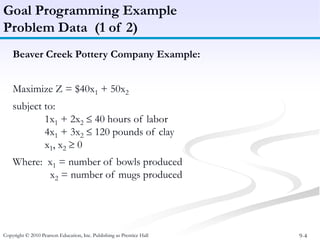
Beaver Creek Pottery Company Example:
Maximize Z = $40x1 + 50x2
subject to:
1x1 + 2x2  40 hours of labor
4x1 + 3x2  120 pounds of clay
x1, x2  0
Where: x1 = number of bowls produced
x2 = number of mugs produced
Goal Programming Example
Problem Data (1 of 2)
Copyright © 2010 Pearson Education, Inc. Publishing as Prentice Hall
9-5
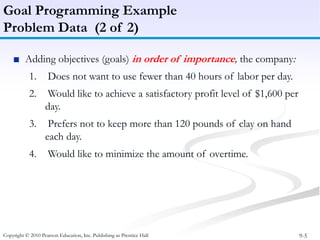
■ Adding objectives (goals) in order of importance, the company:
1. Does not want to use fewer than 40 hours of labor per day.
2. Would like to achieve a satisfactory profit level of $1,600 per
day.
3. Prefers not to keep more than 120 pounds of clay on hand
each day.
4. Would like to minimize the amount of overtime.
Goal Programming Example
Problem Data (2 of 2)
Copyright © 2010 Pearson Education, Inc. Publishing as Prentice Hall
9-6
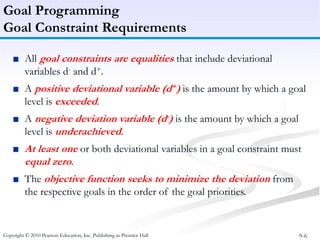
■ All goal constraints are equalities that include deviational
variables d- and d+.
■ A positive deviational variable (d+) is the amount by which a goal
level is exceeded.
■ A negative deviation variable (d-) is the amount by which a goal
level is underachieved.
■ At least one or both deviational variables in a goal constraint must
equal zero.
■ The objective function seeks to minimize the deviation from
the respective goals in the order of the goal priorities.
Goal Programming
Goal Constraint Requirements
Copyright © 2010 Pearson Education, Inc. Publishing as Prentice Hall
9-7
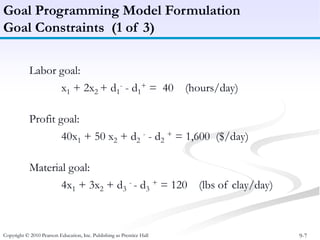
Labor goal:
x1 + 2x2 + d1
- - d1
+ = 40 (hours/day)
Profit goal:
40x1 + 50 x2 + d2
- - d2
+ = 1,600 ($/day)
Material goal:
4x1 + 3x2 + d3
- - d3
+ = 120 (lbs of clay/day)
Goal Programming Model Formulation
Goal Constraints (1 of 3)
Copyright © 2010 Pearson Education, Inc. Publishing as Prentice Hall
9-8
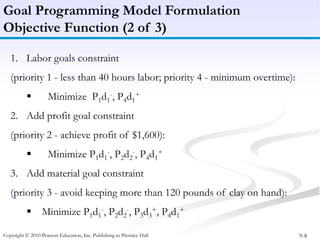
1. Labor goals constraint
(priority 1 - less than 40 hours labor; priority 4 - minimum overtime):
 Minimize P1d1
-, P4d1
+
2. Add profit goal constraint
(priority 2 - achieve profit of $1,600):
 Minimize P1d1
-, P2d2
-, P4d1
+
3. Add material goal constraint
(priority 3 - avoid keeping more than 120 pounds of clay on hand):
 Minimize P1d1
-, P2d2
-, P3d3
+, P4d1
+
Goal Programming Model Formulation
Objective Function (2 of 3)
Copyright © 2010 Pearson Education, Inc. Publishing as Prentice Hall
9-9
Complete Goal Programming Model:
Minimize P1d1
-, P2d2
-, P3d3
+, P4d1
+
subject to:
x1 + 2x2 + d1
- - d1
+ = 40 (labor)
40x1 + 50 x2 + d2
- - d2
+ = 1,600 (profit)
4x1 + 3x2 + d3
- - d3
+ = 120 (clay)
x1, x2, d1
-, d1
+, d2
-, d2
+, d3
-, d3
+  0
Goal Programming Model Formulation
Complete Model (3 of 3)
Copyright © 2010 Pearson Education, Inc. Publishing as Prentice Hall
9-10
■ Changing fourth-priority goal “limits overtime to 10 hours” instead
of minimizing overtime:
 d1
- + d4
- - d4
+ = 10
 minimize P1d1
-, P2d2
-, P3d3
+, P4d4
+
■ Addition of a fifth-priority goal- “important to achieve the goal for
mugs”:
 x1 + d5
- = 30 bowls
 x2 + d6
- = 20 mugs
 minimize P1d1
-, P2d2
-, P3d3
+, P4d4
+, 4P5d5
- + 5P5d6
-
Goal Programming
Alternative Forms of Goal Constraints (1 of 2)
Copyright © 2010 Pearson Education, Inc. Publishing as Prentice Hall
9-11
Goal Programming
Alternative Forms of Goal Constraints (2 of 2)
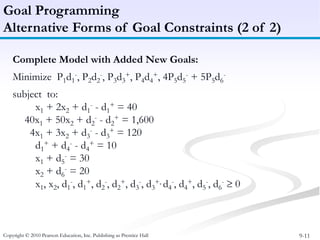
Complete Model with Added New Goals:
Minimize P1d1
-, P2d2
-, P3d3
+, P4d4
+, 4P5d5
- + 5P5d6
-
subject to:
x1 + 2x2 + d1
- - d1
+ = 40
40x1 + 50x2 + d2
- - d2
+ = 1,600
4x1 + 3x2 + d3
- - d3
+ = 120
d1
+ + d4
- - d4
+ = 10
x1 + d5
- = 30
x2 + d6
- = 20
x1, x2, d1
-, d1
+, d2
-, d2
+, d3
-, d3
+, d4
-, d4
+, d5
-, d6
-  0
Copyright © 2010 Pearson Education, Inc. Publishing as Prentice Hall
9-12
Figure 9.1 Goal Constraints
Goal Programming
Graphical Interpretation (1 of 6)
Copyright © 2010 Pearson Education, Inc. Publishing as Prentice Hall
Minimize P1d1
-, P2d2
-, P3d3
+, P4d1
+
subject to:
x1 + 2x2 + d1
- - d1
+ = 40
40x1 + 50 x2 + d2
- - d2
+ = 1,600
4x1 + 3x2 + d3
- - d3
+ = 120
x1, x2, d1
-, d1
+, d2
-, d2
+, d3
-, d3
+  0
9-13
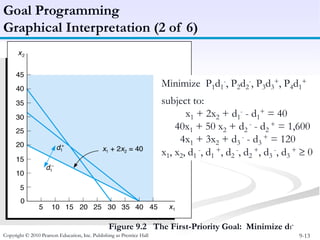
Figure 9.2 The First-Priority Goal: Minimize d1
-
Minimize P1d1
-, P2d2
-, P3d3
+, P4d1
+
subject to:
x1 + 2x2 + d1
- - d1
+ = 40
40x1 + 50 x2 + d2
- - d2
+ = 1,600
4x1 + 3x2 + d3
- - d3
+ = 120
x1, x2, d1
-, d1
+, d2
-, d2
+, d3
-, d3
+  0
Goal Programming
Graphical Interpretation (2 of 6)
Copyright © 2010 Pearson Education, Inc. Publishing as Prentice Hall
9-14
Figure 9.3 The Second-Priority Goal: Minimize d2
-
Goal Programming
Graphical Interpretation (3 of 6)
Copyright © 2010 Pearson Education, Inc. Publishing as Prentice Hall
Minimize P1d1
-, P2d2
-, P3d3
+, P4d1
+
subject to:
x1 + 2x2 + d1
- - d1
+ = 40
40x1 + 50 x2 + d2
- - d2
+ = 1,600
4x1 + 3x2 + d3
- - d3
+ = 120
x1, x2, d1
-, d1
+, d2
-, d2
+, d3
-, d3
+  0
9-15
Figure 9.4 The Third-Priority Goal: Minimize d3
+
Goal Programming
Graphical Interpretation (4 of 6)
Copyright © 2010 Pearson Education, Inc. Publishing as Prentice Hall
Minimize P1d1
-, P2d2
-, P3d3
+, P4d1
+
subject to:
x1 + 2x2 + d1
- - d1
+ = 40
40x1 + 50 x2 + d2
- - d2
+ = 1,600
4x1 + 3x2 + d3
- - d3
+ = 120
x1, x2, d1
-, d1
+, d2
-, d2
+, d3
-, d3
+  0
9-16
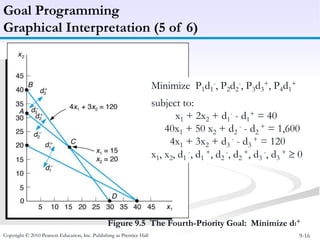
Figure 9.5 The Fourth-Priority Goal: Minimize d1
+
Goal Programming
Graphical Interpretation (5 of 6)
Copyright © 2010 Pearson Education, Inc. Publishing as Prentice Hall
Minimize P1d1
-, P2d2
-, P3d3
+, P4d1
+
subject to:
x1 + 2x2 + d1
- - d1
+ = 40
40x1 + 50 x2 + d2
- - d2
+ = 1,600
4x1 + 3x2 + d3
- - d3
+ = 120
x1, x2, d1
-, d1
+, d2
-, d2
+, d3
-, d3
+  0
9-17
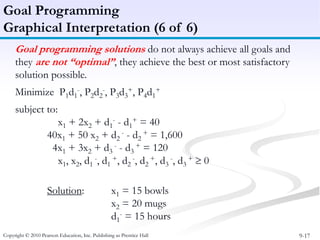
Goal programming solutions do not always achieve all goals and
they are not “optimal”, they achieve the best or most satisfactory
solution possible.
Minimize P1d1
-, P2d2
-, P3d3
+, P4d1
+
subject to:
x1 + 2x2 + d1
- - d1
+ = 40
40x1 + 50 x2 + d2
- - d2
+ = 1,600
4x1 + 3x2 + d3
- - d3
+ = 120
x1, x2, d1
-, d1
+, d2
-, d2
+, d3
-, d3
+  0
Solution: x1 = 15 bowls
x2 = 20 mugs
d1
- = 15 hours
Goal Programming
Graphical Interpretation (6 of 6)
Copyright © 2010 Pearson Education, Inc. Publishing as Prentice Hall
9-18
Exhibit 9.1
Minimize P1d1
-, P2d2
-, P3d3
+, P4d1
+
subject to:
x1 + 2x2 + d1
- - d1
+ = 40
40x1 + 50 x2 + d2
- - d2
+ = 1,600
4x1 + 3x2 + d3
- - d3
+ = 120
x1, x2, d1
-, d1
+, d2
-, d2
+, d3
-, d3
+  0
Goal Programming Computer Solution
Using QM for Windows (1 of 3)
Copyright © 2010 Pearson Education, Inc. Publishing as Prentice Hall
9-19
Exhibit 9.2
Goal Programming Computer Solution
Using QM for Windows (2 of 3)
Copyright © 2010 Pearson Education, Inc. Publishing as Prentice Hall
9-20
Exhibit 9.3
Goal Programming Computer Solution
Using QM for Windows (3 of 3)
Copyright © 2010 Pearson Education, Inc. Publishing as Prentice Hall
9-21
Exhibit 9.4
Goal Programming Computer Solution
Using Excel (1 of 3)
Copyright © 2010 Pearson Education, Inc. Publishing as Prentice Hall
9-22
Exhibit 9.5
Goal Programming
Computer Solution Using Excel (2 of 3)
Copyright © 2010 Pearson Education, Inc. Publishing as Prentice Hall
9-23
Exhibit 9.6
Goal Programming
Computer Solution Using Excel (3 of 3)
Copyright © 2010 Pearson Education, Inc. Publishing as Prentice Hall
9-24
Minimize P1d1
-, P2d2
-, P3d3
+, P4d4
+, 4P5d5
- + 5P5d6
-
subject to:
x1 + 2x2 + d1
- - d1
+ = 40
40x1 + 50x2 + d2
- - d2
+ = 1,600
4x1 + 3x2 + d3
- - d3
+ = 120
d1
+ + d4
- - d4
+ = 10
x1 + d5
- = 30
x2 + d6
- = 20
x1, x2, d1
-, d1
+, d2
-, d2
+, d3
-, d3
+, d4
-, d4
+, d5
-, d6
-  0
Goal Programming
Solution for Altered Problem Using Excel (1 of 6)
Copyright © 2010 Pearson Education, Inc. Publishing as Prentice Hall
9-25
Exhibit 9.7
Goal Programming
Solution for Altered Problem Using Excel (2 of 6)
Copyright © 2010 Pearson Education, Inc. Publishing as Prentice Hall
9-26
Copyright © 2010 Pearson Education, Inc. Publishing as Prentice Hall
Exhibit 9.8
Goal Programming
Solution for Altered Problem Using Excel (3 of 6)
9-27
Goal Programming
Solution for Altered Problem Using Excel (4 of 6)
Copyright © 2010 Pearson Education, Inc. Publishing as Prentice Hall
Exhibit 9.9
9-28
Exhibit 9.10
Goal Programming
Solution for Altered Problem Using Excel (5 of 6)
Copyright © 2010 Pearson Education, Inc. Publishing as Prentice Hall
9-29
Exhibit 9.11
Goal Programming
Solution for Altered Problem Using Excel (6 of 6)
Copyright © 2010 Pearson Education, Inc. Publishing as Prentice Hall
9-30
■ Method for ranking several decision alternatives and selecting
the best one when the decision maker has multiple objectives, or
criteria, on which to base the decision.
■ The decision maker makes a decision based on how the
alternatives compare according to several criteria.
■ The decision maker will select the alternative that best meets the
decision criteria.
■ A process for developing a numerical score to rank each
decision alternative based on how well the alternative meets the
decision maker’s criteria.
Analytical Hierarchy Process (AHP)
Overview
Copyright © 2010 Pearson Education, Inc. Publishing as Prentice Hall
9-31
Southcorp Development Company shopping mall site selection.
■ Three potential sites:
 Atlanta
 Birmingham
 Charlotte.
■ Criteria for site comparisons:
 Customer market base.
 Income level
 Infrastructure
Analytical Hierarchy Process
Example Problem Statement
Copyright © 2010 Pearson Education, Inc. Publishing as Prentice Hall
9-32
■ Top of the hierarchy: the objective (select the best site).
■ Second level: how the four criteria contribute to the objective.
■ Third level: how each of the three alternatives contributes to each
of the four criteria.
Analytical Hierarchy Process
Hierarchy Structure
Copyright © 2010 Pearson Education, Inc. Publishing as Prentice Hall
9-33
■ Mathematically determine preferences for sites with respect to
each criterion.
■ Mathematically determine preferences for criteria (rank order of
importance).
■ Combine these two sets of preferences to mathematically derive a
composite score for each site.
■ Select the site with the highest score.
Analytical Hierarchy Process
General Mathematical Process
Copyright © 2010 Pearson Education, Inc. Publishing as Prentice Hall
9-34
■ In a pairwise comparison, two alternatives are compared according
to a criterion and one is preferred.
■ A preference scale assigns numerical values to different levels of
performance.
Analytical Hierarchy Process
Pairwise Comparisons (1 of 2)
Copyright © 2010 Pearson Education, Inc. Publishing as Prentice Hall
9-35
Table 9.1 Preference Scale for Pairwise Comparisons
Analytical Hierarchy Process
Pairwise Comparisons (2 of 2)
Copyright © 2010 Pearson Education, Inc. Publishing as Prentice Hall
9-36
Income Level Infrastructure Transportation
A
B
C 















1
9
3
1/9
1
1/6
1/3
6
1
















1
1/7
1
7
1
3
1
1/3
1
















1
1/4
2
4
1
3
1/2
1/3
1
Customer Market
Site A B C
A
B
C
1
1/3
1/2
3
1
5
2
1/5
1
Analytical Hierarchy Process
Pairwise Comparison Matrix
A pairwise comparison matrix summarizes the pairwise
comparisons for a criteria.
Copyright © 2010 Pearson Education, Inc. Publishing as Prentice Hall
9-37
Customer Market
Site A B C
A
B
C
1
1/3
1/2
11/6
3
1
5
9
2
1/5
1
16/5
Customer Market
Site A B C
A
B
C
6/11
2/11
3/11
3/9
1/9
5/9
5/8
1/16
5/16
Analytical Hierarchy Process
Developing Preferences Within Criteria (1 of 3)
In synthesization, decision alternatives are prioritized within each criterion
Copyright © 2010 Pearson Education, Inc. Publishing as Prentice Hall
9-38
Table 9.2 The Normalized Matrix with Row Averages
Analytical Hierarchy Process
Developing Preferences Within Criteria (2 of 3)
The row average values represent the preference vector
Copyright © 2010 Pearson Education, Inc. Publishing as Prentice Hall
9-39
Table 9.3 Criteria Preference Matrix
Analytical Hierarchy Process
Developing Preferences Within Criteria (3 of 3)
Preference vectors for other criteria are computed similarly,
resulting in the preference matrix
Copyright © 2010 Pearson Education, Inc. Publishing as Prentice Hall
9-40
Criteria Market Income Infrastructure Transportation
Market
Income
Infrastructure
Transportation
1
5
1/3
1/4
1/5
1
1/9
1/7
3
9
1
1/2
4
7
2
1
Table 9.4 Normalized Matrix for Criteria with Row Averages
Analytical Hierarchy Process
Ranking the Criteria (1 of 2)
Pairwise Comparison Matrix:
Copyright © 2010 Pearson Education, Inc. Publishing as Prentice Hall
9-41
























0.0612
0.0860
0.6535
0.1993
Analytical Hierarchy Process
Ranking the Criteria (2 of 2)
Preference Vector for Criteria:
Market
Income
Infrastructure
Transportation
Copyright © 2010 Pearson Education, Inc. Publishing as Prentice Hall
9-42
Overall Score:
Site A score = .1993(.5012) + .6535(.2819) + .0860(.1790) +
.0612(.1561)
= .3091
Site B score = .1993(.1185) + .6535(.0598) + .0860(.6850) +
.0612(.6196) = .1595
Site C score = .1993(.3803) + .6535(.6583) + .0860(.1360) +
.0612(.2243) = .5314
Overall Ranking:
Site Score
Charlotte
Atlanta
Birmingham
0.5314
0.3091
0.1595
1.0000
Analytical Hierarchy Process
Developing an Overall Ranking
Copyright © 2010 Pearson Education, Inc. Publishing as Prentice Hall
9-43
Analytical Hierarchy Process
Summary of Mathematical Steps
1. Develop a pairwise comparison matrix for each decision alternative
for each criteria.
2. Synthesization
a. Sum each column value of the pairwise comparison matrices.
b. Divide each value in each column by its column sum.
c. Average the values in each row of the normalized matrices.
d. Combine the vectors of preferences for each criterion.
3. Develop a pairwise comparison matrix for the criteria.
4. Compute the normalized matrix.
5. Develop the preference vector.
6. Compute an overall score for each decision alternative
7. Rank the decision alternatives.
Copyright © 2010 Pearson Education, Inc. Publishing as Prentice Hall
9-44
Analytical Hierarchy Process: Consistency (1 of 3)
Consistency Index (CI): Check for consistency and validity of
multiple pairwise comparisons
Example: Southcorp’s consistency in the pairwise comparisons of the 4
site selection criteria
Copyright © 2010 Pearson Education, Inc. Publishing as Prentice Hall
Market Income Infrastructure Transportation Criteria
Market 1 1/5 3 4 0.1993
Income 5 1 9 7 0.6535
Infrastructure 1/3 1/9 1 2 0.0860
Transportation 1/4 1/7 1/2 1 0.0612
X
(1)(0.1993) + (1/5)(0.6535) + (3)(0.0860) + (4)(0.0612) = 0.8328
(5)(0.1993) + (1)(0.6535) + (9)(0.0860) + (7)(0.0612) = 2.8524
(1/3)(0.1993) + (1/9)(0.6535) + (1)(0.0860) + (2)(0.0612) = 0.3474
(¼)(0.1993) + (1/7)(0.6535) + (½)(0.0860) + (1)(0.0612) = 0.2473
9-45
Analytical Hierarchy Process: Consistency (2 of 3)
Step 2: Divide each value by the corresponding weight from the
preference vector and compute the average
0.8328/0.1993 = 4.1786
2.8524/0.6535 = 4.3648
0.3474/0.0860 = 4.0401
0.2473/0.0612 = 4.0422
16.257
Average = 16.257/4
= 4.1564
Step 3: Calculate the Consistency Index (CI)
CI = (Average – n)/(n-1), where n is no. of items compared
CI = (4.1564-4)/(4-1) = 0.0521
(CI = 0 indicates perfect consistency)
Copyright © 2010 Pearson Education, Inc. Publishing as Prentice Hall
9-46
Analytical Hierarchy Process: Consistency (3 of 3)
Step 4: Compute the Ratio CI/RI
where RI is a random index value obtained from Table 9.5
Table 9.5 Random Index Values for n Items Being Compared
CI/RI = 0.0521/0.90 = 0.0580
Note: Degree of consistency is satisfactory if CI/RI < 0.10
Copyright © 2010 Pearson Education, Inc. Publishing as Prentice Hall
n 2 3 4 5 6 7 8 9 10
RI 0 0.58 0.90 1.12 1.24 1.32 1.41 1.45 1.51
9-47
Exhibit 9.12
Analytical Hierarchy Process
Excel Spreadsheets (1 of 4)
Copyright © 2010 Pearson Education, Inc. Publishing as Prentice Hall
9-48
Exhibit 9.13
Analytical Hierarchy Process
Excel Spreadsheets (2 of 4)
Copyright © 2010 Pearson Education, Inc. Publishing as Prentice Hall
9-49
Exhibit 9.14
Analytical Hierarchy Process
Excel Spreadsheets (3 of 4)
Copyright © 2010 Pearson Education, Inc. Publishing as Prentice Hall
9-50
Exhibit 9.15
Analytical Hierarchy Process
Excel Spreadsheets (4 of 4)
Copyright © 2010 Pearson Education, Inc. Publishing as Prentice Hall
9-51
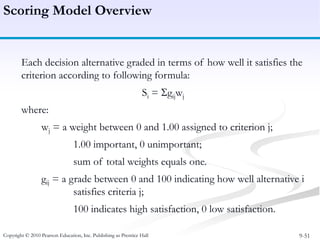
Each decision alternative graded in terms of how well it satisfies the
criterion according to following formula:
Si = gijwj
where:
wj = a weight between 0 and 1.00 assigned to criterion j;
1.00 important, 0 unimportant;
sum of total weights equals one.
gij = a grade between 0 and 100 indicating how well alternative i
satisfies criteria j;
100 indicates high satisfaction, 0 low satisfaction.
Scoring Model Overview
Copyright © 2010 Pearson Education, Inc. Publishing as Prentice Hall
9-52
Mall selection with four alternatives and five criteria:
S1 = (.30)(40) + (.25)(75) + (.25)(60) + (.10)(90) + (.10)(80) = 62.75
S2 = (.30)(60) + (.25)(80) + (.25)(90) + (.10)(100) + (.10)(30) = 73.50
S3 = (.30)(90) + (.25)(65) + (.25)(79) + (.10)(80) + (.10)(50) = 76.00
S4 = (.30)(60) + (.25)(90) + (.25)(85) + (.10)(90) + (.10)(70) = 77.75
Mall 4 preferred because of highest score, followed by malls 3, 2, 1.
Grades for Alternative (0 to 100)
Decision Criteria
Weight
(0 to 1.00) Mall 1 Mall 2 Mall 3 Mall 4
School proximity
Median income
Vehicular traffic
Mall quality, size
Other shopping
0.30
0.25
0.25
0.10
0.10
40
75
60
90
80
60
80
90
100
30
90
65
79
80
50
60
90
85
90
70
Scoring Model
Example Problem
Copyright © 2010 Pearson Education, Inc. Publishing as Prentice Hall
9-53
Exhibit 9.16
Scoring Model
Excel Solution
Copyright © 2010 Pearson Education, Inc. Publishing as Prentice Hall
9-54
Goal Programming Example Problem
Problem Statement
Public relations firm survey interviewer staffing requirements
determination.
■ One person can conduct 80 telephone interviews or 40 personal
interviews per day.
■ $50/ day for telephone interviewer; $70 for personal interviewer.
■ Goals (in priority order):
1. At least 3,000 total interviews.
2. Interviewer conducts only one type of interview each day;
maintain daily budget of $2,500.
3. At least 1,000 interviews should be by telephone.
Formulate and solve a goal programming model to determine
number of interviewers to hire in order to satisfy the goals
Copyright © 2010 Pearson Education, Inc. Publishing as Prentice Hall
9-55
Step 1: Model Formulation:
Minimize P1d1
-, P2d2
+, P3d3
-
subject to:
80x1 + 40x2 + d1
- - d1
+ = 3,000 interviews
50x1 + 70x2 + d2
- - d2
+ = $2,500 budget
80x1 + d3
- - d3
+ = 1,000 telephone interviews
where:
x1 = number of telephone interviews
x2 = number of personal interviews
Goal Programming Example Problem
Solution (1 of 2)
Copyright © 2010 Pearson Education, Inc. Publishing as Prentice Hall
9-56
Goal Programming Example Problem
Solution (2 of 2)
Step 2: QM for Windows Solution:
Copyright © 2010 Pearson Education, Inc. Publishing as Prentice Hall
9-57
Purchasing decision, three model alternatives, three decision criteria.
Pairwise comparison matrices:
Prioritized decision criteria:
Price
Bike X Y Z
X
Y
Z
1
1/3
1/6
3
1
1/2
6
2
1
Gear Action
Bike X Y Z
X
Y
Z
1
3
7
1/3
1
4
1/7
1/4
1
Weight/Durability
Bike X Y Z
X
Y
Z
1
1/3
1
3
1
2
1
1/2
1
Criteria Price Gears Weight
Price
Gears
Weight
1
1/3
1/5
3
1
1/2
5
2
1
Analytical Hierarchy Process Example Problem
Problem Statement
Copyright © 2010 Pearson Education, Inc. Publishing as Prentice Hall
9-58
Step 1: Develop normalized matrices and preference vectors for all
the pairwise comparison matrices for criteria.
Price
Bike X Y Z Row Averages
X
Y
Z
0.6667
0.2222
0.1111
0.6667
0.2222
0.1111
0.6667
0.2222
0.1111
0.6667
0.2222
0.1111
1.0000
Gear Action
Bike X Y Z Row Averages
X
Y
Z
0.0909
0.2727
0.6364
0.0625
0.1875
0.7500
0.1026
0.1795
0.7179
0.0853
0.2132
0.7014
1.0000
Analytical Hierarchy Process Example Problem
Problem Solution (1 of 4)
Copyright © 2010 Pearson Education, Inc. Publishing as Prentice Hall
9-59
Weight/Durability
Bike X Y Z Row Averages
X
Y
Z
0.4286
0.1429
0.4286
0.5000
0.1667
0.3333
0.4000
0.2000
0.4000
0.4429
0.1698
0.3873
1.0000
Criteria
Bike Price Gears Weight
X
Y
Z
0.6667
0.2222
0.1111
0.0853
0.2132
0.7014
0.4429
0.1698
0.3873
Step 1 continued: Develop normalized matrices and preference
vectors for all the pairwise comparison matrices for criteria.
Analytical Hierarchy Process Example Problem
Problem Solution (2 of 4)
Copyright © 2010 Pearson Education, Inc. Publishing as Prentice Hall
9-60
Step 2: Rank the criteria.
Price
Gears
Weight 

















0.1222
0.2299
0.6479
Criteria Price Gears Weight Row Averages
Price
Gears
Weight
0.6522
0.2174
0.1304
0.6667
0.2222
0.1111
0.6250
0.2500
0.1250
0.6479
0.2299
0.1222
1.0000
Analytical Hierarchy Process Example Problem
Problem Solution (3 of 4)
Copyright © 2010 Pearson Education, Inc. Publishing as Prentice Hall
9-61
Step 3: Develop an overall ranking.
Bike X
Bike Y
Bike Z
Bike X score = .6667(.6479) + .0853(.2299) + .4429(.1222) = .5057
Bike Y score = .2222(.6479) + .2132(.2299) + .1698(.1222) = .2138
Bike Z score = .1111(.6479) + .7014(.2299) + .3873(.1222) = .2806
Overall ranking of bikes: X first followed by Z and Y (sum of
scores equal 1.0000).









































1222
.
0
2299
.
0
6479
.
0
3837
.
0
7014
.
0
1111
.
0
1698
.
0
2132
.
0
2222
.
0
4429
.
0
0853
.
0
6667
.
0
Analytical Hierarchy Process Example Problem
Problem Solution (4 of 4)
Copyright © 2010 Pearson Education, Inc. Publishing as Prentice Hall
9-62
Copyright © 2010 Pearson Education, Inc. Publishing as Prentice Hall

Management Science - Goal Programming Procedure

  • 1.
    9-1 Copyright © 2010Pearson Education, Inc. Publishing as Prentice Hall Multicriteria Decision Making Chapter 9
  • 2.
    9-2 ■ Goal Programming ■Graphical Interpretation of Goal Programming ■ Computer Solution of Goal Programming Problems with QM for Windows and Excel ■ The Analytical Hierarchy Process ■ Scoring Models Chapter Topics Copyright © 2010 Pearson Education, Inc. Publishing as Prentice Hall
  • 3.
    9-3 ■ Study ofproblems with several criteria, multiple criteria, instead of a single objective when making a decision. ■ Three techniques discussed: goal programming, the analytical hierarchy process and scoring models. ■ Goal programming is a variation of linear programming considering more than one objective (goals) in the objective function. ■ The analytical hierarchy process develops a score for each decision alternative based on comparisons of each under different criteria reflecting the decision makers preferences. ■ Scoring models are based on a relatively simple weighted scoring technique. Overview Copyright © 2010 Pearson Education, Inc. Publishing as Prentice Hall
  • 4.
    9-4 Beaver Creek PotteryCompany Example: Maximize Z = $40x1 + 50x2 subject to: 1x1 + 2x2  40 hours of labor 4x1 + 3x2  120 pounds of clay x1, x2  0 Where: x1 = number of bowls produced x2 = number of mugs produced Goal Programming Example Problem Data (1 of 2) Copyright © 2010 Pearson Education, Inc. Publishing as Prentice Hall
  • 5.
    9-5 ■ Adding objectives(goals) in order of importance, the company: 1. Does not want to use fewer than 40 hours of labor per day. 2. Would like to achieve a satisfactory profit level of $1,600 per day. 3. Prefers not to keep more than 120 pounds of clay on hand each day. 4. Would like to minimize the amount of overtime. Goal Programming Example Problem Data (2 of 2) Copyright © 2010 Pearson Education, Inc. Publishing as Prentice Hall
  • 6.
    9-6 ■ All goalconstraints are equalities that include deviational variables d- and d+. ■ A positive deviational variable (d+) is the amount by which a goal level is exceeded. ■ A negative deviation variable (d-) is the amount by which a goal level is underachieved. ■ At least one or both deviational variables in a goal constraint must equal zero. ■ The objective function seeks to minimize the deviation from the respective goals in the order of the goal priorities. Goal Programming Goal Constraint Requirements Copyright © 2010 Pearson Education, Inc. Publishing as Prentice Hall
  • 7.
    9-7 Labor goal: x1 +2x2 + d1 - - d1 + = 40 (hours/day) Profit goal: 40x1 + 50 x2 + d2 - - d2 + = 1,600 ($/day) Material goal: 4x1 + 3x2 + d3 - - d3 + = 120 (lbs of clay/day) Goal Programming Model Formulation Goal Constraints (1 of 3) Copyright © 2010 Pearson Education, Inc. Publishing as Prentice Hall
  • 8.
    9-8 1. Labor goalsconstraint (priority 1 - less than 40 hours labor; priority 4 - minimum overtime):  Minimize P1d1 -, P4d1 + 2. Add profit goal constraint (priority 2 - achieve profit of $1,600):  Minimize P1d1 -, P2d2 -, P4d1 + 3. Add material goal constraint (priority 3 - avoid keeping more than 120 pounds of clay on hand):  Minimize P1d1 -, P2d2 -, P3d3 +, P4d1 + Goal Programming Model Formulation Objective Function (2 of 3) Copyright © 2010 Pearson Education, Inc. Publishing as Prentice Hall
  • 9.
    9-9 Complete Goal ProgrammingModel: Minimize P1d1 -, P2d2 -, P3d3 +, P4d1 + subject to: x1 + 2x2 + d1 - - d1 + = 40 (labor) 40x1 + 50 x2 + d2 - - d2 + = 1,600 (profit) 4x1 + 3x2 + d3 - - d3 + = 120 (clay) x1, x2, d1 -, d1 +, d2 -, d2 +, d3 -, d3 +  0 Goal Programming Model Formulation Complete Model (3 of 3) Copyright © 2010 Pearson Education, Inc. Publishing as Prentice Hall
  • 10.
    9-10 ■ Changing fourth-prioritygoal “limits overtime to 10 hours” instead of minimizing overtime:  d1 - + d4 - - d4 + = 10  minimize P1d1 -, P2d2 -, P3d3 +, P4d4 + ■ Addition of a fifth-priority goal- “important to achieve the goal for mugs”:  x1 + d5 - = 30 bowls  x2 + d6 - = 20 mugs  minimize P1d1 -, P2d2 -, P3d3 +, P4d4 +, 4P5d5 - + 5P5d6 - Goal Programming Alternative Forms of Goal Constraints (1 of 2) Copyright © 2010 Pearson Education, Inc. Publishing as Prentice Hall
  • 11.
    9-11 Goal Programming Alternative Formsof Goal Constraints (2 of 2) Complete Model with Added New Goals: Minimize P1d1 -, P2d2 -, P3d3 +, P4d4 +, 4P5d5 - + 5P5d6 - subject to: x1 + 2x2 + d1 - - d1 + = 40 40x1 + 50x2 + d2 - - d2 + = 1,600 4x1 + 3x2 + d3 - - d3 + = 120 d1 + + d4 - - d4 + = 10 x1 + d5 - = 30 x2 + d6 - = 20 x1, x2, d1 -, d1 +, d2 -, d2 +, d3 -, d3 +, d4 -, d4 +, d5 -, d6 -  0 Copyright © 2010 Pearson Education, Inc. Publishing as Prentice Hall
  • 12.
    9-12 Figure 9.1 GoalConstraints Goal Programming Graphical Interpretation (1 of 6) Copyright © 2010 Pearson Education, Inc. Publishing as Prentice Hall Minimize P1d1 -, P2d2 -, P3d3 +, P4d1 + subject to: x1 + 2x2 + d1 - - d1 + = 40 40x1 + 50 x2 + d2 - - d2 + = 1,600 4x1 + 3x2 + d3 - - d3 + = 120 x1, x2, d1 -, d1 +, d2 -, d2 +, d3 -, d3 +  0
  • 13.
    9-13 Figure 9.2 TheFirst-Priority Goal: Minimize d1 - Minimize P1d1 -, P2d2 -, P3d3 +, P4d1 + subject to: x1 + 2x2 + d1 - - d1 + = 40 40x1 + 50 x2 + d2 - - d2 + = 1,600 4x1 + 3x2 + d3 - - d3 + = 120 x1, x2, d1 -, d1 +, d2 -, d2 +, d3 -, d3 +  0 Goal Programming Graphical Interpretation (2 of 6) Copyright © 2010 Pearson Education, Inc. Publishing as Prentice Hall
  • 14.
    9-14 Figure 9.3 TheSecond-Priority Goal: Minimize d2 - Goal Programming Graphical Interpretation (3 of 6) Copyright © 2010 Pearson Education, Inc. Publishing as Prentice Hall Minimize P1d1 -, P2d2 -, P3d3 +, P4d1 + subject to: x1 + 2x2 + d1 - - d1 + = 40 40x1 + 50 x2 + d2 - - d2 + = 1,600 4x1 + 3x2 + d3 - - d3 + = 120 x1, x2, d1 -, d1 +, d2 -, d2 +, d3 -, d3 +  0
  • 15.
    9-15 Figure 9.4 TheThird-Priority Goal: Minimize d3 + Goal Programming Graphical Interpretation (4 of 6) Copyright © 2010 Pearson Education, Inc. Publishing as Prentice Hall Minimize P1d1 -, P2d2 -, P3d3 +, P4d1 + subject to: x1 + 2x2 + d1 - - d1 + = 40 40x1 + 50 x2 + d2 - - d2 + = 1,600 4x1 + 3x2 + d3 - - d3 + = 120 x1, x2, d1 -, d1 +, d2 -, d2 +, d3 -, d3 +  0
  • 16.
    9-16 Figure 9.5 TheFourth-Priority Goal: Minimize d1 + Goal Programming Graphical Interpretation (5 of 6) Copyright © 2010 Pearson Education, Inc. Publishing as Prentice Hall Minimize P1d1 -, P2d2 -, P3d3 +, P4d1 + subject to: x1 + 2x2 + d1 - - d1 + = 40 40x1 + 50 x2 + d2 - - d2 + = 1,600 4x1 + 3x2 + d3 - - d3 + = 120 x1, x2, d1 -, d1 +, d2 -, d2 +, d3 -, d3 +  0
  • 17.
    9-17 Goal programming solutionsdo not always achieve all goals and they are not “optimal”, they achieve the best or most satisfactory solution possible. Minimize P1d1 -, P2d2 -, P3d3 +, P4d1 + subject to: x1 + 2x2 + d1 - - d1 + = 40 40x1 + 50 x2 + d2 - - d2 + = 1,600 4x1 + 3x2 + d3 - - d3 + = 120 x1, x2, d1 -, d1 +, d2 -, d2 +, d3 -, d3 +  0 Solution: x1 = 15 bowls x2 = 20 mugs d1 - = 15 hours Goal Programming Graphical Interpretation (6 of 6) Copyright © 2010 Pearson Education, Inc. Publishing as Prentice Hall
  • 18.
    9-18 Exhibit 9.1 Minimize P1d1 -,P2d2 -, P3d3 +, P4d1 + subject to: x1 + 2x2 + d1 - - d1 + = 40 40x1 + 50 x2 + d2 - - d2 + = 1,600 4x1 + 3x2 + d3 - - d3 + = 120 x1, x2, d1 -, d1 +, d2 -, d2 +, d3 -, d3 +  0 Goal Programming Computer Solution Using QM for Windows (1 of 3) Copyright © 2010 Pearson Education, Inc. Publishing as Prentice Hall
  • 19.
    9-19 Exhibit 9.2 Goal ProgrammingComputer Solution Using QM for Windows (2 of 3) Copyright © 2010 Pearson Education, Inc. Publishing as Prentice Hall
  • 20.
    9-20 Exhibit 9.3 Goal ProgrammingComputer Solution Using QM for Windows (3 of 3) Copyright © 2010 Pearson Education, Inc. Publishing as Prentice Hall
  • 21.
    9-21 Exhibit 9.4 Goal ProgrammingComputer Solution Using Excel (1 of 3) Copyright © 2010 Pearson Education, Inc. Publishing as Prentice Hall
  • 22.
    9-22 Exhibit 9.5 Goal Programming ComputerSolution Using Excel (2 of 3) Copyright © 2010 Pearson Education, Inc. Publishing as Prentice Hall
  • 23.
    9-23 Exhibit 9.6 Goal Programming ComputerSolution Using Excel (3 of 3) Copyright © 2010 Pearson Education, Inc. Publishing as Prentice Hall
  • 24.
    9-24 Minimize P1d1 -, P2d2 -,P3d3 +, P4d4 +, 4P5d5 - + 5P5d6 - subject to: x1 + 2x2 + d1 - - d1 + = 40 40x1 + 50x2 + d2 - - d2 + = 1,600 4x1 + 3x2 + d3 - - d3 + = 120 d1 + + d4 - - d4 + = 10 x1 + d5 - = 30 x2 + d6 - = 20 x1, x2, d1 -, d1 +, d2 -, d2 +, d3 -, d3 +, d4 -, d4 +, d5 -, d6 -  0 Goal Programming Solution for Altered Problem Using Excel (1 of 6) Copyright © 2010 Pearson Education, Inc. Publishing as Prentice Hall
  • 25.
    9-25 Exhibit 9.7 Goal Programming Solutionfor Altered Problem Using Excel (2 of 6) Copyright © 2010 Pearson Education, Inc. Publishing as Prentice Hall
  • 26.
    9-26 Copyright © 2010Pearson Education, Inc. Publishing as Prentice Hall Exhibit 9.8 Goal Programming Solution for Altered Problem Using Excel (3 of 6)
  • 27.
    9-27 Goal Programming Solution forAltered Problem Using Excel (4 of 6) Copyright © 2010 Pearson Education, Inc. Publishing as Prentice Hall Exhibit 9.9
  • 28.
    9-28 Exhibit 9.10 Goal Programming Solutionfor Altered Problem Using Excel (5 of 6) Copyright © 2010 Pearson Education, Inc. Publishing as Prentice Hall
  • 29.
    9-29 Exhibit 9.11 Goal Programming Solutionfor Altered Problem Using Excel (6 of 6) Copyright © 2010 Pearson Education, Inc. Publishing as Prentice Hall
  • 30.
    9-30 ■ Method forranking several decision alternatives and selecting the best one when the decision maker has multiple objectives, or criteria, on which to base the decision. ■ The decision maker makes a decision based on how the alternatives compare according to several criteria. ■ The decision maker will select the alternative that best meets the decision criteria. ■ A process for developing a numerical score to rank each decision alternative based on how well the alternative meets the decision maker’s criteria. Analytical Hierarchy Process (AHP) Overview Copyright © 2010 Pearson Education, Inc. Publishing as Prentice Hall
  • 31.
    9-31 Southcorp Development Companyshopping mall site selection. ■ Three potential sites:  Atlanta  Birmingham  Charlotte. ■ Criteria for site comparisons:  Customer market base.  Income level  Infrastructure Analytical Hierarchy Process Example Problem Statement Copyright © 2010 Pearson Education, Inc. Publishing as Prentice Hall
  • 32.
    9-32 ■ Top ofthe hierarchy: the objective (select the best site). ■ Second level: how the four criteria contribute to the objective. ■ Third level: how each of the three alternatives contributes to each of the four criteria. Analytical Hierarchy Process Hierarchy Structure Copyright © 2010 Pearson Education, Inc. Publishing as Prentice Hall
  • 33.
    9-33 ■ Mathematically determinepreferences for sites with respect to each criterion. ■ Mathematically determine preferences for criteria (rank order of importance). ■ Combine these two sets of preferences to mathematically derive a composite score for each site. ■ Select the site with the highest score. Analytical Hierarchy Process General Mathematical Process Copyright © 2010 Pearson Education, Inc. Publishing as Prentice Hall
  • 34.
    9-34 ■ In apairwise comparison, two alternatives are compared according to a criterion and one is preferred. ■ A preference scale assigns numerical values to different levels of performance. Analytical Hierarchy Process Pairwise Comparisons (1 of 2) Copyright © 2010 Pearson Education, Inc. Publishing as Prentice Hall
  • 35.
    9-35 Table 9.1 PreferenceScale for Pairwise Comparisons Analytical Hierarchy Process Pairwise Comparisons (2 of 2) Copyright © 2010 Pearson Education, Inc. Publishing as Prentice Hall
  • 36.
    9-36 Income Level InfrastructureTransportation A B C                 1 9 3 1/9 1 1/6 1/3 6 1                 1 1/7 1 7 1 3 1 1/3 1                 1 1/4 2 4 1 3 1/2 1/3 1 Customer Market Site A B C A B C 1 1/3 1/2 3 1 5 2 1/5 1 Analytical Hierarchy Process Pairwise Comparison Matrix A pairwise comparison matrix summarizes the pairwise comparisons for a criteria. Copyright © 2010 Pearson Education, Inc. Publishing as Prentice Hall
  • 37.
    9-37 Customer Market Site AB C A B C 1 1/3 1/2 11/6 3 1 5 9 2 1/5 1 16/5 Customer Market Site A B C A B C 6/11 2/11 3/11 3/9 1/9 5/9 5/8 1/16 5/16 Analytical Hierarchy Process Developing Preferences Within Criteria (1 of 3) In synthesization, decision alternatives are prioritized within each criterion Copyright © 2010 Pearson Education, Inc. Publishing as Prentice Hall
  • 38.
    9-38 Table 9.2 TheNormalized Matrix with Row Averages Analytical Hierarchy Process Developing Preferences Within Criteria (2 of 3) The row average values represent the preference vector Copyright © 2010 Pearson Education, Inc. Publishing as Prentice Hall
  • 39.
    9-39 Table 9.3 CriteriaPreference Matrix Analytical Hierarchy Process Developing Preferences Within Criteria (3 of 3) Preference vectors for other criteria are computed similarly, resulting in the preference matrix Copyright © 2010 Pearson Education, Inc. Publishing as Prentice Hall
  • 40.
    9-40 Criteria Market IncomeInfrastructure Transportation Market Income Infrastructure Transportation 1 5 1/3 1/4 1/5 1 1/9 1/7 3 9 1 1/2 4 7 2 1 Table 9.4 Normalized Matrix for Criteria with Row Averages Analytical Hierarchy Process Ranking the Criteria (1 of 2) Pairwise Comparison Matrix: Copyright © 2010 Pearson Education, Inc. Publishing as Prentice Hall
  • 41.
    9-41                         0.0612 0.0860 0.6535 0.1993 Analytical Hierarchy Process Rankingthe Criteria (2 of 2) Preference Vector for Criteria: Market Income Infrastructure Transportation Copyright © 2010 Pearson Education, Inc. Publishing as Prentice Hall
  • 42.
    9-42 Overall Score: Site Ascore = .1993(.5012) + .6535(.2819) + .0860(.1790) + .0612(.1561) = .3091 Site B score = .1993(.1185) + .6535(.0598) + .0860(.6850) + .0612(.6196) = .1595 Site C score = .1993(.3803) + .6535(.6583) + .0860(.1360) + .0612(.2243) = .5314 Overall Ranking: Site Score Charlotte Atlanta Birmingham 0.5314 0.3091 0.1595 1.0000 Analytical Hierarchy Process Developing an Overall Ranking Copyright © 2010 Pearson Education, Inc. Publishing as Prentice Hall
  • 43.
    9-43 Analytical Hierarchy Process Summaryof Mathematical Steps 1. Develop a pairwise comparison matrix for each decision alternative for each criteria. 2. Synthesization a. Sum each column value of the pairwise comparison matrices. b. Divide each value in each column by its column sum. c. Average the values in each row of the normalized matrices. d. Combine the vectors of preferences for each criterion. 3. Develop a pairwise comparison matrix for the criteria. 4. Compute the normalized matrix. 5. Develop the preference vector. 6. Compute an overall score for each decision alternative 7. Rank the decision alternatives. Copyright © 2010 Pearson Education, Inc. Publishing as Prentice Hall
  • 44.
    9-44 Analytical Hierarchy Process:Consistency (1 of 3) Consistency Index (CI): Check for consistency and validity of multiple pairwise comparisons Example: Southcorp’s consistency in the pairwise comparisons of the 4 site selection criteria Copyright © 2010 Pearson Education, Inc. Publishing as Prentice Hall Market Income Infrastructure Transportation Criteria Market 1 1/5 3 4 0.1993 Income 5 1 9 7 0.6535 Infrastructure 1/3 1/9 1 2 0.0860 Transportation 1/4 1/7 1/2 1 0.0612 X (1)(0.1993) + (1/5)(0.6535) + (3)(0.0860) + (4)(0.0612) = 0.8328 (5)(0.1993) + (1)(0.6535) + (9)(0.0860) + (7)(0.0612) = 2.8524 (1/3)(0.1993) + (1/9)(0.6535) + (1)(0.0860) + (2)(0.0612) = 0.3474 (¼)(0.1993) + (1/7)(0.6535) + (½)(0.0860) + (1)(0.0612) = 0.2473
  • 45.
    9-45 Analytical Hierarchy Process:Consistency (2 of 3) Step 2: Divide each value by the corresponding weight from the preference vector and compute the average 0.8328/0.1993 = 4.1786 2.8524/0.6535 = 4.3648 0.3474/0.0860 = 4.0401 0.2473/0.0612 = 4.0422 16.257 Average = 16.257/4 = 4.1564 Step 3: Calculate the Consistency Index (CI) CI = (Average – n)/(n-1), where n is no. of items compared CI = (4.1564-4)/(4-1) = 0.0521 (CI = 0 indicates perfect consistency) Copyright © 2010 Pearson Education, Inc. Publishing as Prentice Hall
  • 46.
    9-46 Analytical Hierarchy Process:Consistency (3 of 3) Step 4: Compute the Ratio CI/RI where RI is a random index value obtained from Table 9.5 Table 9.5 Random Index Values for n Items Being Compared CI/RI = 0.0521/0.90 = 0.0580 Note: Degree of consistency is satisfactory if CI/RI < 0.10 Copyright © 2010 Pearson Education, Inc. Publishing as Prentice Hall n 2 3 4 5 6 7 8 9 10 RI 0 0.58 0.90 1.12 1.24 1.32 1.41 1.45 1.51
  • 47.
    9-47 Exhibit 9.12 Analytical HierarchyProcess Excel Spreadsheets (1 of 4) Copyright © 2010 Pearson Education, Inc. Publishing as Prentice Hall
  • 48.
    9-48 Exhibit 9.13 Analytical HierarchyProcess Excel Spreadsheets (2 of 4) Copyright © 2010 Pearson Education, Inc. Publishing as Prentice Hall
  • 49.
    9-49 Exhibit 9.14 Analytical HierarchyProcess Excel Spreadsheets (3 of 4) Copyright © 2010 Pearson Education, Inc. Publishing as Prentice Hall
  • 50.
    9-50 Exhibit 9.15 Analytical HierarchyProcess Excel Spreadsheets (4 of 4) Copyright © 2010 Pearson Education, Inc. Publishing as Prentice Hall
  • 51.
    9-51 Each decision alternativegraded in terms of how well it satisfies the criterion according to following formula: Si = gijwj where: wj = a weight between 0 and 1.00 assigned to criterion j; 1.00 important, 0 unimportant; sum of total weights equals one. gij = a grade between 0 and 100 indicating how well alternative i satisfies criteria j; 100 indicates high satisfaction, 0 low satisfaction. Scoring Model Overview Copyright © 2010 Pearson Education, Inc. Publishing as Prentice Hall
  • 52.
    9-52 Mall selection withfour alternatives and five criteria: S1 = (.30)(40) + (.25)(75) + (.25)(60) + (.10)(90) + (.10)(80) = 62.75 S2 = (.30)(60) + (.25)(80) + (.25)(90) + (.10)(100) + (.10)(30) = 73.50 S3 = (.30)(90) + (.25)(65) + (.25)(79) + (.10)(80) + (.10)(50) = 76.00 S4 = (.30)(60) + (.25)(90) + (.25)(85) + (.10)(90) + (.10)(70) = 77.75 Mall 4 preferred because of highest score, followed by malls 3, 2, 1. Grades for Alternative (0 to 100) Decision Criteria Weight (0 to 1.00) Mall 1 Mall 2 Mall 3 Mall 4 School proximity Median income Vehicular traffic Mall quality, size Other shopping 0.30 0.25 0.25 0.10 0.10 40 75 60 90 80 60 80 90 100 30 90 65 79 80 50 60 90 85 90 70 Scoring Model Example Problem Copyright © 2010 Pearson Education, Inc. Publishing as Prentice Hall
  • 53.
    9-53 Exhibit 9.16 Scoring Model ExcelSolution Copyright © 2010 Pearson Education, Inc. Publishing as Prentice Hall
  • 54.
    9-54 Goal Programming ExampleProblem Problem Statement Public relations firm survey interviewer staffing requirements determination. ■ One person can conduct 80 telephone interviews or 40 personal interviews per day. ■ $50/ day for telephone interviewer; $70 for personal interviewer. ■ Goals (in priority order): 1. At least 3,000 total interviews. 2. Interviewer conducts only one type of interview each day; maintain daily budget of $2,500. 3. At least 1,000 interviews should be by telephone. Formulate and solve a goal programming model to determine number of interviewers to hire in order to satisfy the goals Copyright © 2010 Pearson Education, Inc. Publishing as Prentice Hall
  • 55.
    9-55 Step 1: ModelFormulation: Minimize P1d1 -, P2d2 +, P3d3 - subject to: 80x1 + 40x2 + d1 - - d1 + = 3,000 interviews 50x1 + 70x2 + d2 - - d2 + = $2,500 budget 80x1 + d3 - - d3 + = 1,000 telephone interviews where: x1 = number of telephone interviews x2 = number of personal interviews Goal Programming Example Problem Solution (1 of 2) Copyright © 2010 Pearson Education, Inc. Publishing as Prentice Hall
  • 56.
    9-56 Goal Programming ExampleProblem Solution (2 of 2) Step 2: QM for Windows Solution: Copyright © 2010 Pearson Education, Inc. Publishing as Prentice Hall
  • 57.
    9-57 Purchasing decision, threemodel alternatives, three decision criteria. Pairwise comparison matrices: Prioritized decision criteria: Price Bike X Y Z X Y Z 1 1/3 1/6 3 1 1/2 6 2 1 Gear Action Bike X Y Z X Y Z 1 3 7 1/3 1 4 1/7 1/4 1 Weight/Durability Bike X Y Z X Y Z 1 1/3 1 3 1 2 1 1/2 1 Criteria Price Gears Weight Price Gears Weight 1 1/3 1/5 3 1 1/2 5 2 1 Analytical Hierarchy Process Example Problem Problem Statement Copyright © 2010 Pearson Education, Inc. Publishing as Prentice Hall
  • 58.
    9-58 Step 1: Developnormalized matrices and preference vectors for all the pairwise comparison matrices for criteria. Price Bike X Y Z Row Averages X Y Z 0.6667 0.2222 0.1111 0.6667 0.2222 0.1111 0.6667 0.2222 0.1111 0.6667 0.2222 0.1111 1.0000 Gear Action Bike X Y Z Row Averages X Y Z 0.0909 0.2727 0.6364 0.0625 0.1875 0.7500 0.1026 0.1795 0.7179 0.0853 0.2132 0.7014 1.0000 Analytical Hierarchy Process Example Problem Problem Solution (1 of 4) Copyright © 2010 Pearson Education, Inc. Publishing as Prentice Hall
  • 59.
    9-59 Weight/Durability Bike X YZ Row Averages X Y Z 0.4286 0.1429 0.4286 0.5000 0.1667 0.3333 0.4000 0.2000 0.4000 0.4429 0.1698 0.3873 1.0000 Criteria Bike Price Gears Weight X Y Z 0.6667 0.2222 0.1111 0.0853 0.2132 0.7014 0.4429 0.1698 0.3873 Step 1 continued: Develop normalized matrices and preference vectors for all the pairwise comparison matrices for criteria. Analytical Hierarchy Process Example Problem Problem Solution (2 of 4) Copyright © 2010 Pearson Education, Inc. Publishing as Prentice Hall
  • 60.
    9-60 Step 2: Rankthe criteria. Price Gears Weight                   0.1222 0.2299 0.6479 Criteria Price Gears Weight Row Averages Price Gears Weight 0.6522 0.2174 0.1304 0.6667 0.2222 0.1111 0.6250 0.2500 0.1250 0.6479 0.2299 0.1222 1.0000 Analytical Hierarchy Process Example Problem Problem Solution (3 of 4) Copyright © 2010 Pearson Education, Inc. Publishing as Prentice Hall
  • 61.
    9-61 Step 3: Developan overall ranking. Bike X Bike Y Bike Z Bike X score = .6667(.6479) + .0853(.2299) + .4429(.1222) = .5057 Bike Y score = .2222(.6479) + .2132(.2299) + .1698(.1222) = .2138 Bike Z score = .1111(.6479) + .7014(.2299) + .3873(.1222) = .2806 Overall ranking of bikes: X first followed by Z and Y (sum of scores equal 1.0000).                                          1222 . 0 2299 . 0 6479 . 0 3837 . 0 7014 . 0 1111 . 0 1698 . 0 2132 . 0 2222 . 0 4429 . 0 0853 . 0 6667 . 0 Analytical Hierarchy Process Example Problem Problem Solution (4 of 4) Copyright © 2010 Pearson Education, Inc. Publishing as Prentice Hall
  • 62.
    9-62 Copyright © 2010Pearson Education, Inc. Publishing as Prentice Hall