Presentation On:
GMO’s
With Their Controversies,
Advantages And
Disadvantages
Prepared By:
A Rauf Rajput
What are GMO’s?
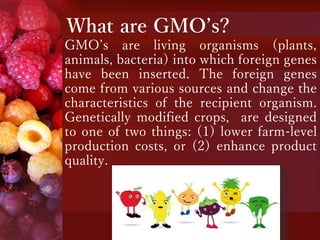
GMO’s are living organisms (plants,
animals, bacteria) into which foreign genes
have been inserted. The foreign genes
come from various sources and change the
characteristics of the recipient organism.
Genetically modified crops, are designed
to one of two things: (1) lower farm-level
production costs, or (2) enhance product
quality.
How GMO’s are Produced?
GMO’s are produced through genetic
engineering, a process in which genes that yield
desirable traits are transferred from one
organism to another. Genetic engineering
begins with the identification of 8 CHOICES
First Quarter 2000 the gene responsible for tbe
desired trait. After the gene has been identified
and isolated, it is inserted into the cell of
another organism using one of several
techniques. The most widely known technique
involves a "gene gun, " a device that uses bursts
of helium to propel microscopic particles,
coated with copies of the gene, directly into the
receptor cell.
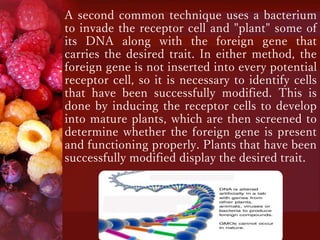
A second common technique uses a bacterium
to invade the receptor cell and "plant" some of
its DNA along with the foreign gene that
carries the desired trait. In either method, the
foreign gene is not inserted into every potential
receptor cell, so it is necessary to identify cells
that have been successfully modified. This is
done by inducing the receptor cells to develop
into mature plants, which are then screened to
determine whether the foreign gene is present
and functioning properly. Plants that have been
successfully modified display the desired trait.
Why are GMO’s so
controversial?
Genetic engineering differs from conventional
plant and animal breeding because it allows
genes to be moved across taxonomic
boundaries. With genetic engineering, genes
can be transferred not only between closely
related organisms (as from a wheat plant to a
rice plant), but also between entirely different
organisms (perhaps from a fish to a strawberry
plant).
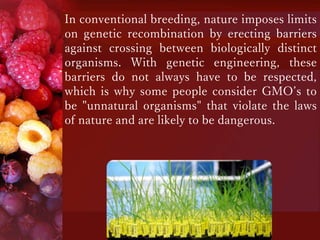
In conventional breeding, nature imposes limits
on genetic recombination by erecting barriers
against crossing between biologically distinct
organisms. With genetic engineering, these
barriers do not always have to be respected,
which is why some people consider GMO’s to
be "unnatural organisms" that violate the laws
of nature and are likely to be dangerous.
What are the advantages
of GMO’s?
Most transgenic crops currently being grown
feature traits designed to increase farm-level
productivity by raising crop yields and reducing
input use. Probably the best- known example
involves Bt, a gene from the soil-borne Bacillus
thuringiensis that induces plants to bacterium
produce a protein that is toxic to insect pests.
The resistance conferred by Bt can increase
yields and reduce the need for chemical pest
control. Based on trials conducted in the
United States, Koziel.etal., estimate yield gains
of up to 8 percent in Bt corn. Reduced use of
pesticides further increases profits, saving an
average of $2.80 to $14.50 per acre in the
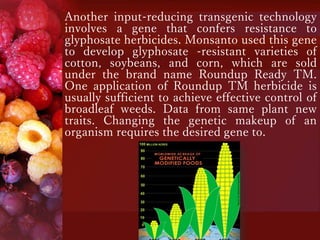
Another input-reducing transgenic technology
involves a gene that confers resistance to
glyphosate herbicides. Monsanto used this gene
to develop glyphosate -resistant varieties of
cotton, soybeans, and corn, which are sold
under the brand name Roundup Ready TM.
One application of Roundup TM herbicide is
usually sufficient to achieve effective control of
broadleaf weeds. Data from same plant new
traits. Changing the genetic makeup of an
organism requires the desired gene to.
What are the disadvantages
of GMO’s?
Human and animal health No evidence shows that
genetically modified foods are injurious to humans.
Even so, there are lingering fears that consuming
GMO’s might lead to an increase in diseases that
are resistant to several antibiotics. This As with any
new product, it is important that the potential risks
be evaluated before any GMO is approved for
commercial use. cern developed when some
genetically modified crops were found to contain
antibiotic resistance genes left over as residue from
the bioengineering process. Even though the
antibiotic resistance genes are not active, health
specialists worried that, if present in sufficiently
large numbers, they could accumulate in rhe bodies
of consumers. This concern has recently been
allayed, as researchers have devised gene-transfer
techniques that avoid the use of the antibiotic
Another potential risk posed by GMO’s is that
people with allergies could suffer reactions after
unwittingly consuming modified food
containing allergenic substances introduced
from external sources. Proponents of GMO’s
argue that since very few genes produce
harmful compounds, the likelihood of this
happening is extremely low. And even if an
inserted gene were to result in production of a
harmful compound, the chances of it reaching
consumers are negligible, because it would be
found by food safety inspection and testing.
THE END

GMO's with their Controversies

  • 1.
    Presentation On: GMO’s With TheirControversies, Advantages And Disadvantages Prepared By: A Rauf Rajput
  • 2.
    What are GMO’s? GMO’sare living organisms (plants, animals, bacteria) into which foreign genes have been inserted. The foreign genes come from various sources and change the characteristics of the recipient organism. Genetically modified crops, are designed to one of two things: (1) lower farm-level production costs, or (2) enhance product quality.
  • 3.
    How GMO’s areProduced? GMO’s are produced through genetic engineering, a process in which genes that yield desirable traits are transferred from one organism to another. Genetic engineering begins with the identification of 8 CHOICES First Quarter 2000 the gene responsible for tbe desired trait. After the gene has been identified and isolated, it is inserted into the cell of another organism using one of several techniques. The most widely known technique involves a "gene gun, " a device that uses bursts of helium to propel microscopic particles, coated with copies of the gene, directly into the receptor cell.
  • 4.
    A second commontechnique uses a bacterium to invade the receptor cell and "plant" some of its DNA along with the foreign gene that carries the desired trait. In either method, the foreign gene is not inserted into every potential receptor cell, so it is necessary to identify cells that have been successfully modified. This is done by inducing the receptor cells to develop into mature plants, which are then screened to determine whether the foreign gene is present and functioning properly. Plants that have been successfully modified display the desired trait.
  • 5.
    Why are GMO’sso controversial? Genetic engineering differs from conventional plant and animal breeding because it allows genes to be moved across taxonomic boundaries. With genetic engineering, genes can be transferred not only between closely related organisms (as from a wheat plant to a rice plant), but also between entirely different organisms (perhaps from a fish to a strawberry plant).
  • 6.
    In conventional breeding,nature imposes limits on genetic recombination by erecting barriers against crossing between biologically distinct organisms. With genetic engineering, these barriers do not always have to be respected, which is why some people consider GMO’s to be "unnatural organisms" that violate the laws of nature and are likely to be dangerous.
  • 7.
    What are theadvantages of GMO’s? Most transgenic crops currently being grown feature traits designed to increase farm-level productivity by raising crop yields and reducing input use. Probably the best- known example involves Bt, a gene from the soil-borne Bacillus thuringiensis that induces plants to bacterium produce a protein that is toxic to insect pests. The resistance conferred by Bt can increase yields and reduce the need for chemical pest control. Based on trials conducted in the United States, Koziel.etal., estimate yield gains of up to 8 percent in Bt corn. Reduced use of pesticides further increases profits, saving an average of $2.80 to $14.50 per acre in the
  • 8.
    Another input-reducing transgenictechnology involves a gene that confers resistance to glyphosate herbicides. Monsanto used this gene to develop glyphosate -resistant varieties of cotton, soybeans, and corn, which are sold under the brand name Roundup Ready TM. One application of Roundup TM herbicide is usually sufficient to achieve effective control of broadleaf weeds. Data from same plant new traits. Changing the genetic makeup of an organism requires the desired gene to.
  • 9.
    What are thedisadvantages of GMO’s? Human and animal health No evidence shows that genetically modified foods are injurious to humans. Even so, there are lingering fears that consuming GMO’s might lead to an increase in diseases that are resistant to several antibiotics. This As with any new product, it is important that the potential risks be evaluated before any GMO is approved for commercial use. cern developed when some genetically modified crops were found to contain antibiotic resistance genes left over as residue from the bioengineering process. Even though the antibiotic resistance genes are not active, health specialists worried that, if present in sufficiently large numbers, they could accumulate in rhe bodies of consumers. This concern has recently been allayed, as researchers have devised gene-transfer techniques that avoid the use of the antibiotic
  • 10.
    Another potential riskposed by GMO’s is that people with allergies could suffer reactions after unwittingly consuming modified food containing allergenic substances introduced from external sources. Proponents of GMO’s argue that since very few genes produce harmful compounds, the likelihood of this happening is extremely low. And even if an inserted gene were to result in production of a harmful compound, the chances of it reaching consumers are negligible, because it would be found by food safety inspection and testing.
  • 11.