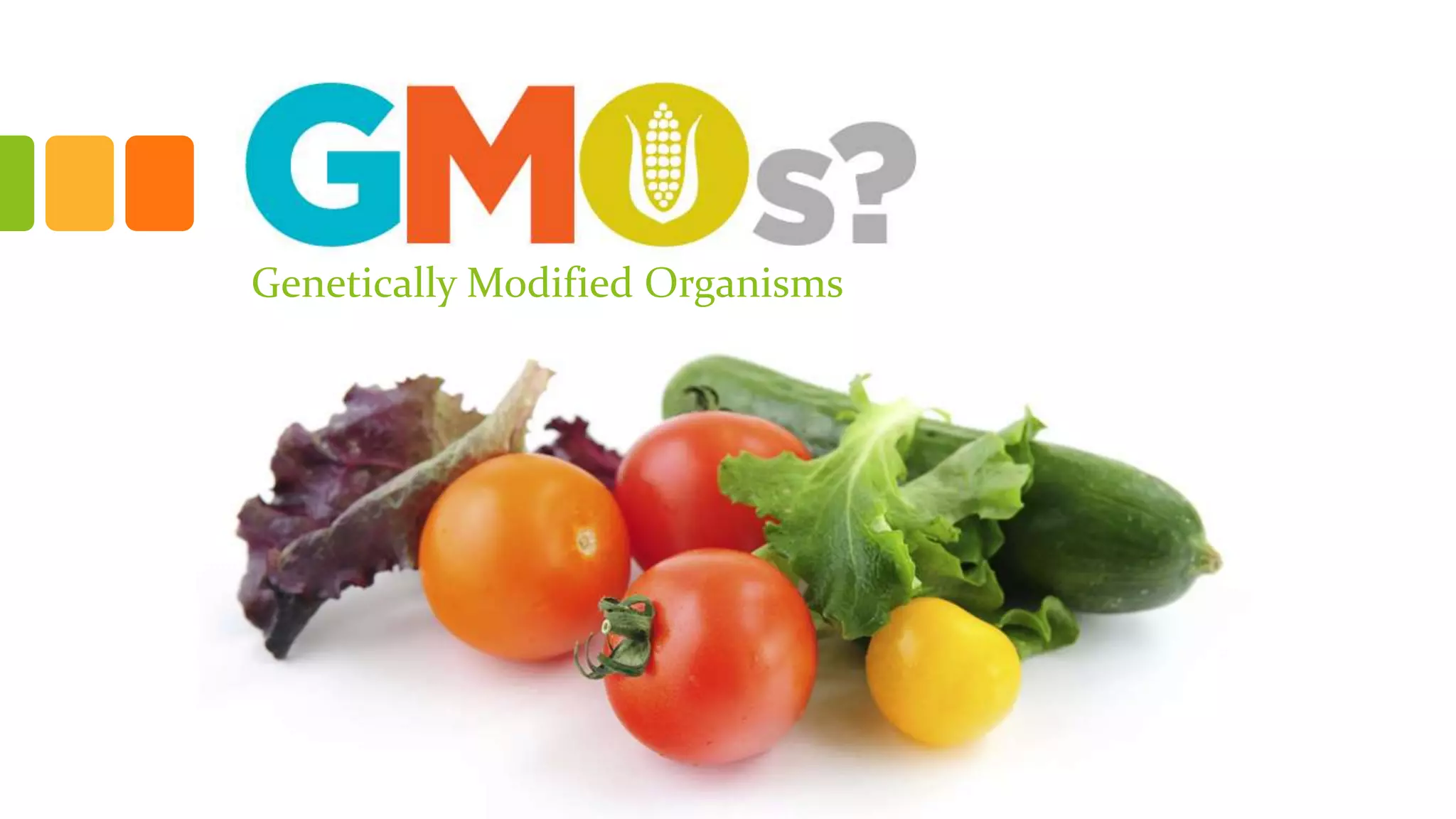
Genetically Modified Organisms
When you hear the word GMOs,
what first comes to your mind?
A. Danger/Something bad
B. Farmers
C. Monsanto
D. Good/Something helpful
E. Nothing/ I don’t really know what a GMO is….
What is a GMO?
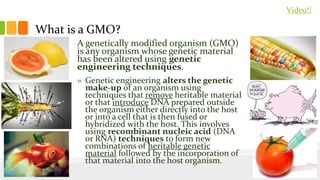
A genetically modified organism (GMO)
is any organism whose genetic material
has been altered using genetic
engineering techniques.
» Genetic engineering alters the genetic
make-up of an organism using
techniques that remove heritable material
or that introduce DNA prepared outside
the organism either directly into the host
or into a cell that is then fused or
hybridized with the host. This involves
using recombinant nucleic acid (DNA
or RNA) techniques to form new
combinations of heritable genetic
material followed by the incorporation of
that material into the host organism.
Video!!
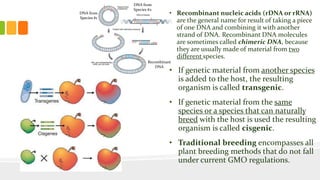
DNA from
Species #1
DNA from
Species #2
Recombinant
DNA
• Recombinant nucleic acids (rDNA or rRNA)
are the general name for result of taking a piece
of one DNA and combining it with another
strand of DNA. Recombinant DNA molecules
are sometimes called chimeric DNA, because
they are usually made of material from two
different species.
• If genetic material from another species
is added to the host, the resulting
organism is called transgenic.
• If genetic material from the same
species or a species that can naturally
breed with the host is used the resulting
organism is called cisgenic.
• Traditional breeding encompasses all
plant breeding methods that do not fall
under current GMO regulations.
GMO organisms are really not fundamentally
different from other means of plant breeding
and genetics that have been extensively used.
Do you:
A. Agree with the statement
B. Disagree with the statement
C. Not sure / No opinion on the statement
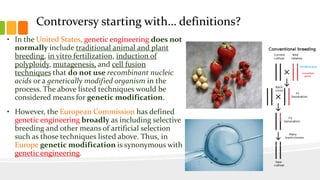
Controversy starting with… definitions?
• In the United States, genetic engineering does not
normally include traditional animal and plant
breeding, in vitro fertilization, induction of
polyploidy, mutagenesis, and cell fusion
techniques that do not use recombinant nucleic
acids or a genetically modified organism in the
process. The above listed techniques would be
considered means for genetic modification.
• However, the European Commission has defined
genetic engineering broadly as including selective
breeding and other means of artificial selection
such as those techniques listed above. Thus, in
Europe genetic modification is synonymous with
genetic engineering.
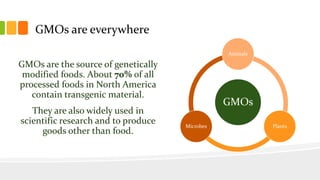
GMOs are everywhere
GMOs are the source of genetically
modified foods. About 70% of all
processed foods in North America
contain transgenic material.
They are also widely used in
scientific research and to produce
goods other than food.
GMOs
Animals
PlantsMicrobes
GMO Research
Agriculture
• Improvement of crop yields
• Herbicide resistance
• Insect resistance
• Drought, frost, and disease
resistance
• Increased tolerance to salinity,
floods, and low nutrients
• Increased nutrients produced
– Golden rice
• Vaccines transport/intake
Medicine
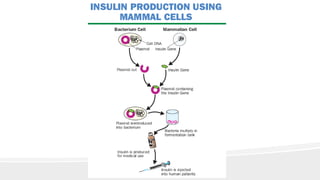
• Human insulin injections
• Human growth hormone,
HGH
• Blood clotting factor VIII
• Hepatitis B vaccine
• Diagnosing HIV infection
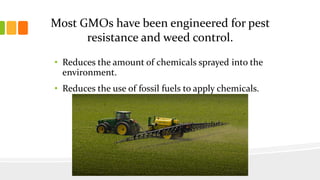
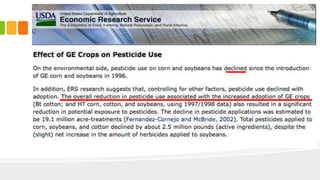
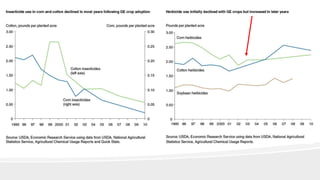
Most GMOs have been engineered for pest
resistance and weed control.
• Reduces the amount of chemicals sprayed into the
environment.
• Reduces the use of fossil fuels to apply chemicals.
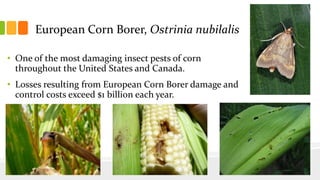
European Corn Borer, Ostrinia nubilalis
• One of the most damaging insect pests of corn
throughout the United States and Canada.
• Losses resulting from European Corn Borer damage and
control costs exceed $1 billion each year.
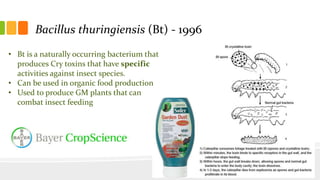
• Bt is a naturally occurring bacterium that
produces Cry toxins that have specific
activities against insect species.
• Can be used in organic food production
• Used to produce GM plants that can
combat insect feeding
Bacillus thuringiensis (Bt) - 1996
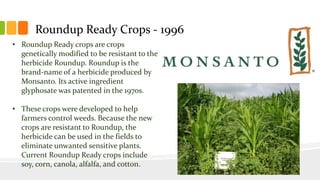
Roundup Ready Crops - 1996
• Roundup Ready crops are crops
genetically modified to be resistant to the
herbicide Roundup. Roundup is the
brand-name of a herbicide produced by
Monsanto. Its active ingredient
glyphosate was patented in the 1970s.
• These crops were developed to help
farmers control weeds. Because the new
crops are resistant to Roundup, the
herbicide can be used in the fields to
eliminate unwanted sensitive plants.
Current Roundup Ready crops include
soy, corn, canola, alfalfa, and cotton.
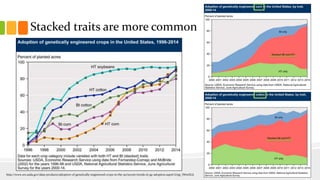
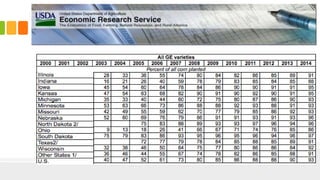
Stacked traits are more common
http://www.ers.usda.gov/data-products/adoption-of-genetically-engineered-crops-in-the-us/recent-trends-in-ge-adoption.aspx#.Uxjp_IWmXLk
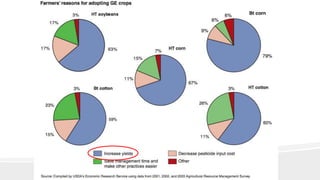
Why do you think most farmers use genetically
engineered (GE) crops?
A. Better for the environment
B. Saves time and helps farm management
C. Increases yield
D. Overall land appearance is better
E. None of these
http://www.fda.gov/ForConsumers/ConsumerUpdates/ucm143980.htm
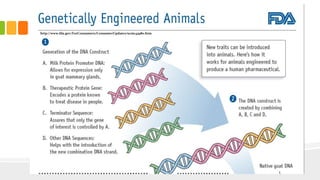
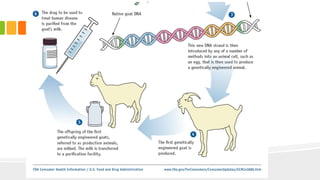
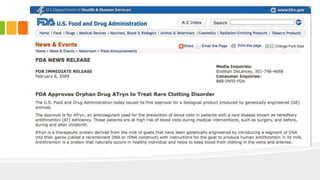
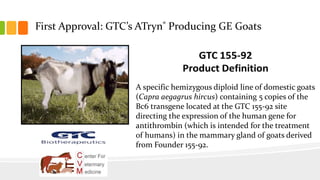
First Approval: GTC’s ATryn® Producing GE Goats
A specific hemizygous diploid line of domestic goats
(Capra aegagrus hircus) containing 5 copies of the
Bc6 transgene located at the GTC 155-92 site
directing the expression of the human gene for
antithrombin (which is intended for the treatment
of humans) in the mammary gland of goats derived
from Founder 155-92.
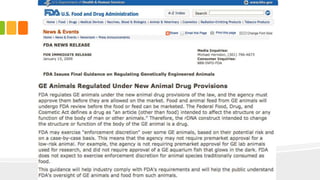
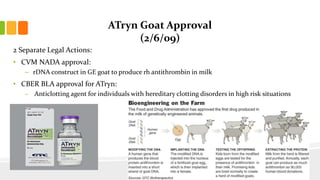
ATryn Goat Approval
(2/6/09)
2 Separate Legal Actions:
• CVM NADA approval:
– rDNA construct in GE goat to produce rh antithrombin in milk
• CBER BLA approval for ATryn:
– Anticlotting agent for individuals with hereditary clotting disorders in high risk situations
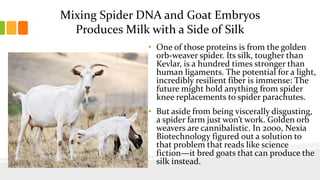
Mixing Spider DNA and Goat Embryos
Produces Milk with a Side of Silk
• One of those proteins is from the golden
orb-weaver spider. Its silk, tougher than
Kevlar, is a hundred times stronger than
human ligaments. The potential for a light,
incredibly resilient fiber is immense: The
future might hold anything from spider
knee replacements to spider parachutes.
• But aside from being viscerally disgusting,
a spider farm just won’t work. Golden orb
weavers are cannibalistic. In 2000, Nexia
Biotechnology figured out a solution to
that problem that reads like science
fiction—it bred goats that can produce the
silk instead.
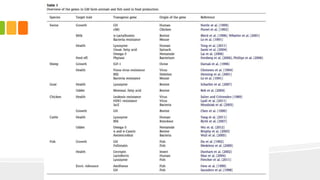
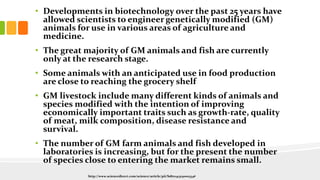
• Developments in biotechnology over the past 25 years have
allowed scientists to engineer genetically modified (GM)
animals for use in various areas of agriculture and
medicine.
• The great majority of GM animals and fish are currently
only at the research stage.
• Some animals with an anticipated use in food production
are close to reaching the grocery shelf
• GM livestock include many different kinds of animals and
species modified with the intention of improving
economically important traits such as growth-rate, quality
of meat, milk composition, disease resistance and
survival.
• The number of GM farm animals and fish developed in
laboratories is increasing, but for the present the number
of species close to entering the market remains small.
http://www.sciencedirect.com/science/article/pii/S1871141313000334#
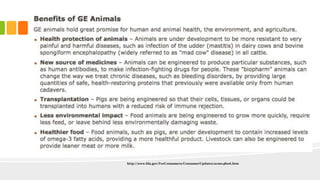
http://www.fda.gov/ForConsumers/ConsumerUpdates/ucm048106.htm
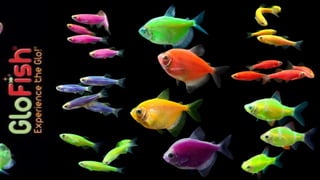
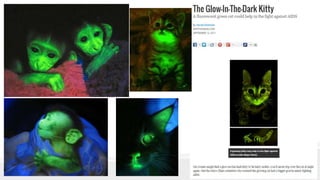
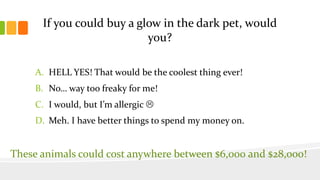
If you could buy a glow in the dark pet, would
you?
A. HELL YES! That would be the coolest thing ever!
B. No… way too freaky for me!
C. I would, but I’m allergic 
D. Meh. I have better things to spend my money on.
These animals could cost anywhere between $6,000 and $28,000!
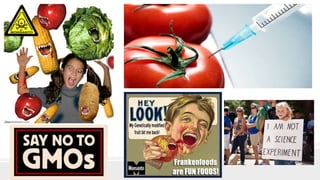
Why do you think some individuals are opposed
to GE crops?
A. They are uninformed
B. They are ignorant
C. They have valid points with regards to environmental
health
D. They have valid points with regards to human health
E. They do not like the idea of manipulating nature
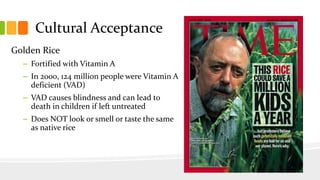
Cultural Acceptance
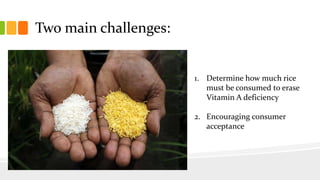
Golden Rice
– Fortified with Vitamin A
– In 2000, 124 million people were Vitamin A
deficient (VAD)
– VAD causes blindness and can lead to
death in children if left untreated
– Does NOT look or smell or taste the same
as native rice
Two main challenges:
1. Determine how much rice
must be consumed to erase
Vitamin A deficiency
2. Encouraging consumer
acceptance
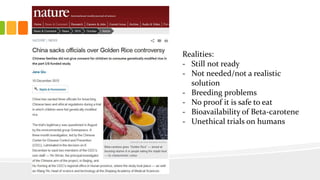
Realities:
- Still not ready
- Not needed/not a realistic
solution
- Breeding problems
- No proof it is safe to eat
- Bioavailability of Beta-carotene
- Unethical trials on humans
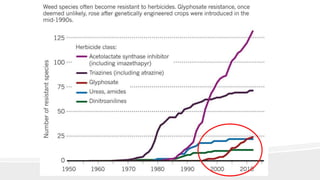
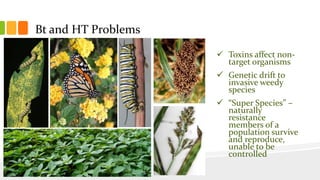
Bt and HT Problems
 Toxins affect non-
target organisms
 Genetic drift to
invasive weedy
species
 “Super Species” –
naturally
resistance
members of a
population survive
and reproduce,
unable to be
controlled
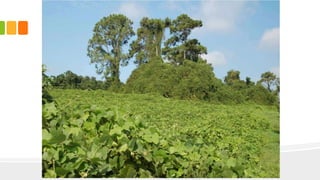
A transgene can be regarded as
having escaped from the crop if:
1. The transgene is transferred by pollination to
a wild related plant that persists in
agricultural habitats becoming a weed or
more weedy
2. The related plant in 1 occupies disturbed
habitats associated with agriculture or other
human activities i.e. roadsides, waterways,
ditches railroad beds
3. The related plant in 1 invades semi-natural
habitats i.e. River deltas, saltmarshes,
woodlands
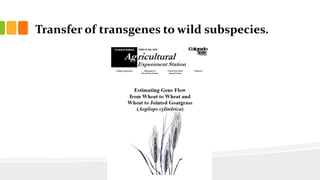
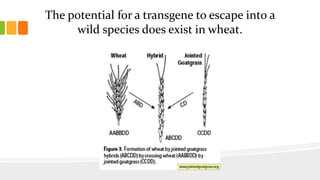
Transfer of transgenes to wild subspecies.
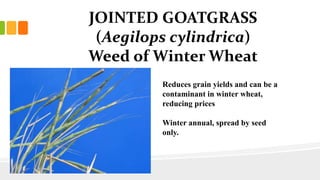
JOINTED GOATGRASS
(Aegilops cylindrica)
Weed of Winter Wheat
Reduces grain yields and can be a
contaminant in winter wheat,
reducing prices
Winter annual, spread by seed
only.
The potential for a transgene to escape into a
wild species does exist in wheat.
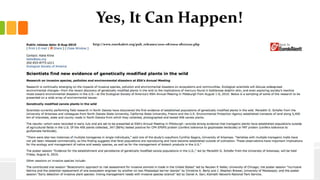
http://www.eurekalert.org/pub_releases/2010-08/esoa-sft072110.php
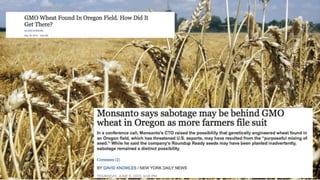
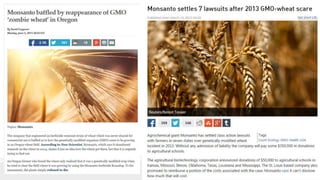
Yes, It Can Happen!
So What?
1. Genetic erosion – Centers
of diversity
2. Genetic pollution of
natural gene pools
3. Changes in invasiveness
of the species
1 & 2 are independent of the transgene, while 3 is dependent on the
nature of the transgene.
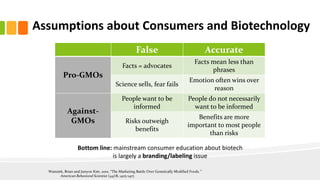
Assumptions about Consumers and Biotechnology
False Accurate
Pro-GMOs
Facts = advocates
Facts mean less than
phrases
Science sells, fear fails
Emotion often wins over
reason
Against-
GMOs
People want to be
informed
People do not necessarily
want to be informed
Risks outweigh
benefits
Benefits are more
important to most people
than risks
Bottom line: mainstream consumer education about biotech
is largely a branding/labeling issue
Wansink, Brian and Junyon Kim. 2001. “The Marketing Battle Over Genetically Modified Foods.”
American Behavioral Scientist (44):8, 1405-1417.
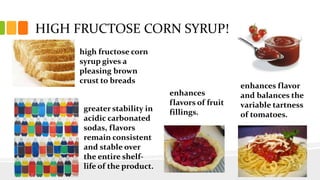
high fructose corn
syrup gives a
pleasing brown
crust to breads
enhances
flavors of fruit
fillings.
enhances flavor
and balances the
variable tartness
of tomatoes.
greater stability in
acidic carbonated
sodas, flavors
remain consistent
and stable over
the entire shelf-
life of the product.
HIGH FRUCTOSE CORN SYRUP!
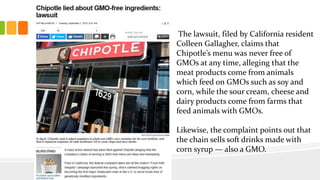
The lawsuit, filed by California resident
Colleen Gallagher, claims that
Chipotle’s menu was never free of
GMOs at any time, alleging that the
meat products come from animals
which feed on GMOs such as soy and
corn, while the sour cream, cheese and
dairy products come from farms that
feed animals with GMOs.
Likewise, the complaint points out that
the chain sells soft drinks made with
corn syrup — also a GMO.
http://www.monsanto.com/newsviews/pages/food-labeling.aspx
http://www.ecori.org/massachusetts-farming/2014/3/1/gmo-labeling-in-mass-faces-march-19-deadline.html
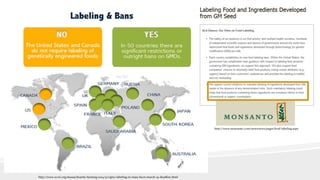
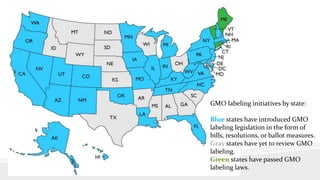
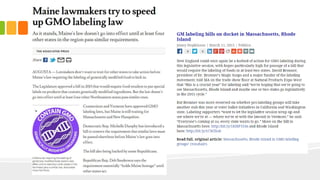
GMO labeling initiatives by state:
Blue states have introduced GMO
labeling legislation in the form of
bills, resolutions, or ballot measures.
Gray states have yet to review GMO
labeling.
Green states have passed GMO
labeling laws.
GMO lecture CPSC113
GMO lecture CPSC113
GMO lecture CPSC113

GMO lecture CPSC113

  • 1.
  • 2.
    When you hearthe word GMOs, what first comes to your mind? A. Danger/Something bad B. Farmers C. Monsanto D. Good/Something helpful E. Nothing/ I don’t really know what a GMO is….
  • 3.
    What is aGMO? A genetically modified organism (GMO) is any organism whose genetic material has been altered using genetic engineering techniques. » Genetic engineering alters the genetic make-up of an organism using techniques that remove heritable material or that introduce DNA prepared outside the organism either directly into the host or into a cell that is then fused or hybridized with the host. This involves using recombinant nucleic acid (DNA or RNA) techniques to form new combinations of heritable genetic material followed by the incorporation of that material into the host organism. Video!!
  • 4.
    DNA from Species #1 DNAfrom Species #2 Recombinant DNA • Recombinant nucleic acids (rDNA or rRNA) are the general name for result of taking a piece of one DNA and combining it with another strand of DNA. Recombinant DNA molecules are sometimes called chimeric DNA, because they are usually made of material from two different species. • If genetic material from another species is added to the host, the resulting organism is called transgenic. • If genetic material from the same species or a species that can naturally breed with the host is used the resulting organism is called cisgenic. • Traditional breeding encompasses all plant breeding methods that do not fall under current GMO regulations.
  • 5.
    GMO organisms arereally not fundamentally different from other means of plant breeding and genetics that have been extensively used. Do you: A. Agree with the statement B. Disagree with the statement C. Not sure / No opinion on the statement
  • 6.
    Controversy starting with…definitions? • In the United States, genetic engineering does not normally include traditional animal and plant breeding, in vitro fertilization, induction of polyploidy, mutagenesis, and cell fusion techniques that do not use recombinant nucleic acids or a genetically modified organism in the process. The above listed techniques would be considered means for genetic modification. • However, the European Commission has defined genetic engineering broadly as including selective breeding and other means of artificial selection such as those techniques listed above. Thus, in Europe genetic modification is synonymous with genetic engineering.
  • 7.
    GMOs are everywhere GMOsare the source of genetically modified foods. About 70% of all processed foods in North America contain transgenic material. They are also widely used in scientific research and to produce goods other than food. GMOs Animals PlantsMicrobes
  • 8.
    GMO Research Agriculture • Improvementof crop yields • Herbicide resistance • Insect resistance • Drought, frost, and disease resistance • Increased tolerance to salinity, floods, and low nutrients • Increased nutrients produced – Golden rice • Vaccines transport/intake Medicine • Human insulin injections • Human growth hormone, HGH • Blood clotting factor VIII • Hepatitis B vaccine • Diagnosing HIV infection
  • 10.
    Most GMOs havebeen engineered for pest resistance and weed control. • Reduces the amount of chemicals sprayed into the environment. • Reduces the use of fossil fuels to apply chemicals.
  • 11.
    European Corn Borer,Ostrinia nubilalis • One of the most damaging insect pests of corn throughout the United States and Canada. • Losses resulting from European Corn Borer damage and control costs exceed $1 billion each year.
  • 12.
    • Bt isa naturally occurring bacterium that produces Cry toxins that have specific activities against insect species. • Can be used in organic food production • Used to produce GM plants that can combat insect feeding Bacillus thuringiensis (Bt) - 1996
  • 13.
    Roundup Ready Crops- 1996 • Roundup Ready crops are crops genetically modified to be resistant to the herbicide Roundup. Roundup is the brand-name of a herbicide produced by Monsanto. Its active ingredient glyphosate was patented in the 1970s. • These crops were developed to help farmers control weeds. Because the new crops are resistant to Roundup, the herbicide can be used in the fields to eliminate unwanted sensitive plants. Current Roundup Ready crops include soy, corn, canola, alfalfa, and cotton.
  • 14.
    Stacked traits aremore common http://www.ers.usda.gov/data-products/adoption-of-genetically-engineered-crops-in-the-us/recent-trends-in-ge-adoption.aspx#.Uxjp_IWmXLk
  • 15.
    Why do youthink most farmers use genetically engineered (GE) crops? A. Better for the environment B. Saves time and helps farm management C. Increases yield D. Overall land appearance is better E. None of these
  • 21.
  • 25.
    First Approval: GTC’sATryn® Producing GE Goats A specific hemizygous diploid line of domestic goats (Capra aegagrus hircus) containing 5 copies of the Bc6 transgene located at the GTC 155-92 site directing the expression of the human gene for antithrombin (which is intended for the treatment of humans) in the mammary gland of goats derived from Founder 155-92.
  • 26.
    ATryn Goat Approval (2/6/09) 2Separate Legal Actions: • CVM NADA approval: – rDNA construct in GE goat to produce rh antithrombin in milk • CBER BLA approval for ATryn: – Anticlotting agent for individuals with hereditary clotting disorders in high risk situations
  • 28.
    Mixing Spider DNAand Goat Embryos Produces Milk with a Side of Silk • One of those proteins is from the golden orb-weaver spider. Its silk, tougher than Kevlar, is a hundred times stronger than human ligaments. The potential for a light, incredibly resilient fiber is immense: The future might hold anything from spider knee replacements to spider parachutes. • But aside from being viscerally disgusting, a spider farm just won’t work. Golden orb weavers are cannibalistic. In 2000, Nexia Biotechnology figured out a solution to that problem that reads like science fiction—it bred goats that can produce the silk instead.
  • 29.
    • Developments inbiotechnology over the past 25 years have allowed scientists to engineer genetically modified (GM) animals for use in various areas of agriculture and medicine. • The great majority of GM animals and fish are currently only at the research stage. • Some animals with an anticipated use in food production are close to reaching the grocery shelf • GM livestock include many different kinds of animals and species modified with the intention of improving economically important traits such as growth-rate, quality of meat, milk composition, disease resistance and survival. • The number of GM farm animals and fish developed in laboratories is increasing, but for the present the number of species close to entering the market remains small. http://www.sciencedirect.com/science/article/pii/S1871141313000334#
  • 30.
  • 33.
    If you couldbuy a glow in the dark pet, would you? A. HELL YES! That would be the coolest thing ever! B. No… way too freaky for me! C. I would, but I’m allergic  D. Meh. I have better things to spend my money on. These animals could cost anywhere between $6,000 and $28,000!
  • 35.
    Why do youthink some individuals are opposed to GE crops? A. They are uninformed B. They are ignorant C. They have valid points with regards to environmental health D. They have valid points with regards to human health E. They do not like the idea of manipulating nature
  • 37.
    Cultural Acceptance Golden Rice –Fortified with Vitamin A – In 2000, 124 million people were Vitamin A deficient (VAD) – VAD causes blindness and can lead to death in children if left untreated – Does NOT look or smell or taste the same as native rice
  • 38.
    Two main challenges: 1.Determine how much rice must be consumed to erase Vitamin A deficiency 2. Encouraging consumer acceptance
  • 39.
    Realities: - Still notready - Not needed/not a realistic solution - Breeding problems - No proof it is safe to eat - Bioavailability of Beta-carotene - Unethical trials on humans
  • 40.
    Bt and HTProblems  Toxins affect non- target organisms  Genetic drift to invasive weedy species  “Super Species” – naturally resistance members of a population survive and reproduce, unable to be controlled
  • 41.
    A transgene canbe regarded as having escaped from the crop if: 1. The transgene is transferred by pollination to a wild related plant that persists in agricultural habitats becoming a weed or more weedy 2. The related plant in 1 occupies disturbed habitats associated with agriculture or other human activities i.e. roadsides, waterways, ditches railroad beds 3. The related plant in 1 invades semi-natural habitats i.e. River deltas, saltmarshes, woodlands
  • 42.
    Transfer of transgenesto wild subspecies.
  • 43.
    JOINTED GOATGRASS (Aegilops cylindrica) Weedof Winter Wheat Reduces grain yields and can be a contaminant in winter wheat, reducing prices Winter annual, spread by seed only.
  • 44.
    The potential fora transgene to escape into a wild species does exist in wheat.
  • 45.
  • 48.
    So What? 1. Geneticerosion – Centers of diversity 2. Genetic pollution of natural gene pools 3. Changes in invasiveness of the species 1 & 2 are independent of the transgene, while 3 is dependent on the nature of the transgene.
  • 50.
    Assumptions about Consumersand Biotechnology False Accurate Pro-GMOs Facts = advocates Facts mean less than phrases Science sells, fear fails Emotion often wins over reason Against- GMOs People want to be informed People do not necessarily want to be informed Risks outweigh benefits Benefits are more important to most people than risks Bottom line: mainstream consumer education about biotech is largely a branding/labeling issue Wansink, Brian and Junyon Kim. 2001. “The Marketing Battle Over Genetically Modified Foods.” American Behavioral Scientist (44):8, 1405-1417.
  • 52.
    high fructose corn syrupgives a pleasing brown crust to breads enhances flavors of fruit fillings. enhances flavor and balances the variable tartness of tomatoes. greater stability in acidic carbonated sodas, flavors remain consistent and stable over the entire shelf- life of the product. HIGH FRUCTOSE CORN SYRUP!
  • 53.
    The lawsuit, filedby California resident Colleen Gallagher, claims that Chipotle’s menu was never free of GMOs at any time, alleging that the meat products come from animals which feed on GMOs such as soy and corn, while the sour cream, cheese and dairy products come from farms that feed animals with GMOs. Likewise, the complaint points out that the chain sells soft drinks made with corn syrup — also a GMO.
  • 55.
  • 56.
    GMO labeling initiativesby state: Blue states have introduced GMO labeling legislation in the form of bills, resolutions, or ballot measures. Gray states have yet to review GMO labeling. Green states have passed GMO labeling laws.
Editor's Notes

  • #13 orders Lepidoptera (moths and butterflies), Diptera (flies and mosquitoes), Coleoptera (beetles), and Hymenoptera (wasps, bees, ants and sawflies).