Organic Acidemias Barbara K. Burton, MD Northwestern University Feinberg  School of Medicine, Chicago, IL
Definition Group of disorders characterized by excretion of excess of non-amino organic acids in urine Defects in amino acid metabolism distal to removal of the amino group and separated from the amino acid by a non-reversible reaction Organic acids are low molecular weight substances They have at least one carboxylic group and may have keto or hydroxy-groups (so water soluble compounds) Their polar character enables rapid urinary excretion
“ Classic or typical” presentation: acute overwhelming illness; recurrent metabolic crises Developmental delay with or without seizures Static or progressive dystonia or choreoathetosis  in early childhood Abnormal odor of body or body fluids Clinical presentations of organic acidemias
What do the symptoms represent?  -  they represent a toxic encephalopathy What are the typical symptoms? Lethargy progressing to coma Poor feeding Abnormal muscle tone Respiratory distress  Vomiting Seizures “ Typical” presentations of organic acidemias
Age of onset is highly variable Severity is highly variable In the neonate, may be confused with a number of more common pediatric disorders such as sepsis, congenital heart disease, gastrointestinal disorders In the older infant and child, may be misdiagnosed  as an ingestion, gastroenteritis or CNS disorder “ Typical” presentations of organic acidemias
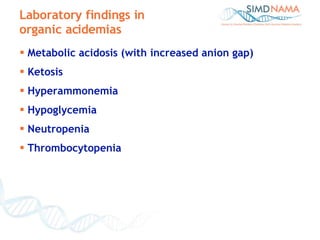
Metabolic acidosis (with increased anion gap) Ketosis Hyperammonemia Hypoglycemia Neutropenia Thrombocytopenia Laboratory findings in  organic acidemias
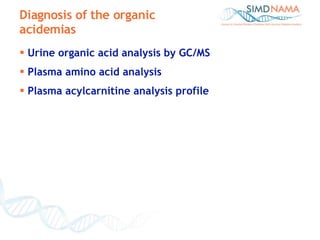
Urine organic acid analysis by GC/MS Plasma amino acid analysis Plasma acylcarnitine analysis profile Diagnosis of the organic acidemias
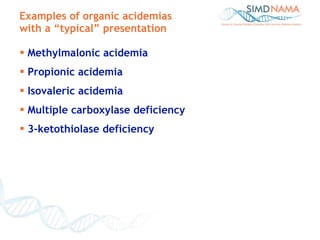
Examples of organic acidemias  with a “typical” presentation Methylmalonic acidemia Propionic acidemia Isovaleric acidemia Multiple carboxylase deficiency 3-ketothiolase deficiency
Biochemical pathway involved in methylmalonic and propionic acidemias NEXT >>
Methylmalonic acidemia NEXT >>
Methylmalonic acidemia The defect is in the enzyme methymalonyl  CoA mutase  Adenosylcobalamin, the active form of vitamin  B12 is a cofactor for the mutase enzyme There are vitamin B12 responsive and non-responsive forms of MMA which are genetically distinct IEM phenocopy: severe vitamin B12 deficiency Defects in cobalamin synthesis and transport also result in methylmalonic acidemia and aciduria
Vitamin B12 responsiveness must be  determined clinically  Renal disease is a common late complication Pancreatitis is a common complication Metabolic “stroke” producing choreoathetosis  may occur   Special clinical features of methylmalonic acidemia
Optic atrophy may be late complication  There is a “benign” form with lower level elevations of plasma and urine MMA; there is also a transient form detected by NBS which may persist for up to one year after birth Special clinical features of methylmalonic acidemia
Propionic acidemia Enzymatic block: Propionyl-CoA carboxylase (PCC) Biotin is the PCC Coenzyme
Propionic acidemia NEXT >>
Special clinical features of propionic acidemia Although biotin is a cofactor for PCC, there are no biotin-responsive patients with PA Recurrent pancreatitis is a common complication Cardiomyopathy is a common complication and a common cause of death; the etiology is unclear  Optic atrophy has been reported like in MMA in a significant number of patients  Metabolic stroke involving basal ganglia may occur (acute or progressive extrapyramidal syndrome)
Isovaleric acidemia Enzymatic defect: Isovaleryl-CoA dehydrogenase  NEXT >>
Special clinical features of isovaleric acidemia Highly variable, but in general, patients tend to have a better prognosis than do those with MMA or PA Special sweaty feet odor of urine and sweat is a very distinctive sign (also observed in glutaric aciduria  type II) There is a mild, presumably   asymptomatic form that has been frequently detected since newborn screening began with MS/MS. It is associated with lower levels of urinary metabolites and with a defined mutation
Also referred to as beta-ketothiolase deficiency Relatively common disorder Presents with acute episodes of ketoacidosis accompanying intercurrent illnesses; patients are typically normal between episodes Hypoglycemia and moderate hyperammonemia  may occur Mitochondrial acetoacetyl CoA thiolase deficiency
Developmental delay with/or without seizures Examples of organic acidemias that can present  in this way: Cobalamin synthetic defects Biotinidase deficiency Methylmalonic acidemia Propionic  acidemia Isovaleric  acidemia
Static or progressive dystonia or choreoathetosis The most important disorder presenting in this  way is glutaric aciduria type I Acute dystonia can rarely be a presenting sign  of MMA or PA  L-2-hydroxyglutaric aciduria
Clinical features of glutaric aciduria type 1 Macrocephaly at birth in about half of affected infants Acute encephalopathic crisis at 3-18 months, often but not always precipitated by intercurrent illness. Results in dystonia, choreoathetosis, significant motor disabilities, although cognitive abilities are often preserved Episodes may be recurrent but most disability is felt to be the result of a single episode of acute striatal necrosis
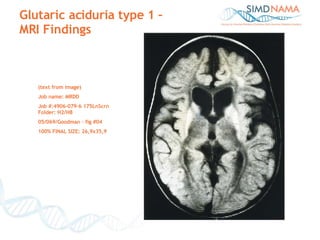
Highly suggestive brain CT scan and MRI findings: frontotemporal atrophy, delayed myelination, high signal intensities in the dentate nucleus Laboratory findings may include hypoglycemia and metabolic acidosis although they are rarely profound Clinical features of glutaric aciduria type 1
Glutaric aciduria type 1 –  MRI Findings (text from image) Job name: MRDD Job #:4906-079-6 175LnScrn Folder: H2/H8 05/069/Goodman – fig #04 100% FINAL SIZE: 26,9x35,9
Abnormal odor in organic acidemias Isovaleric acidemia (sweaty feet: isovaleric) Glutaric aciduria type II (sweaty feet: isovaleric) Trimethylaminuria (fish: trimethylamine) Dimethylglycinuria (fish: dimethylglycine) Maple syrup urine disease (maple syrup:3hydroxy ileu) Tyrosinemia type I (boiled cabbage: ketomethylthiobutyric)

Organic Acidemias Didactic Bb Day1 3 Jh

  • 1.
    Organic Acidemias BarbaraK. Burton, MD Northwestern University Feinberg School of Medicine, Chicago, IL
  • 2.
    Definition Group ofdisorders characterized by excretion of excess of non-amino organic acids in urine Defects in amino acid metabolism distal to removal of the amino group and separated from the amino acid by a non-reversible reaction Organic acids are low molecular weight substances They have at least one carboxylic group and may have keto or hydroxy-groups (so water soluble compounds) Their polar character enables rapid urinary excretion
  • 3.
    “ Classic ortypical” presentation: acute overwhelming illness; recurrent metabolic crises Developmental delay with or without seizures Static or progressive dystonia or choreoathetosis in early childhood Abnormal odor of body or body fluids Clinical presentations of organic acidemias
  • 4.
    What do thesymptoms represent? - they represent a toxic encephalopathy What are the typical symptoms? Lethargy progressing to coma Poor feeding Abnormal muscle tone Respiratory distress Vomiting Seizures “ Typical” presentations of organic acidemias
  • 5.
    Age of onsetis highly variable Severity is highly variable In the neonate, may be confused with a number of more common pediatric disorders such as sepsis, congenital heart disease, gastrointestinal disorders In the older infant and child, may be misdiagnosed as an ingestion, gastroenteritis or CNS disorder “ Typical” presentations of organic acidemias
  • 6.
    Metabolic acidosis (withincreased anion gap) Ketosis Hyperammonemia Hypoglycemia Neutropenia Thrombocytopenia Laboratory findings in organic acidemias
  • 7.
    Urine organic acidanalysis by GC/MS Plasma amino acid analysis Plasma acylcarnitine analysis profile Diagnosis of the organic acidemias
  • 8.
    Examples of organicacidemias with a “typical” presentation Methylmalonic acidemia Propionic acidemia Isovaleric acidemia Multiple carboxylase deficiency 3-ketothiolase deficiency
  • 9.
    Biochemical pathway involvedin methylmalonic and propionic acidemias NEXT >>
  • 10.
  • 11.
    Methylmalonic acidemia Thedefect is in the enzyme methymalonyl CoA mutase Adenosylcobalamin, the active form of vitamin B12 is a cofactor for the mutase enzyme There are vitamin B12 responsive and non-responsive forms of MMA which are genetically distinct IEM phenocopy: severe vitamin B12 deficiency Defects in cobalamin synthesis and transport also result in methylmalonic acidemia and aciduria
  • 12.
    Vitamin B12 responsivenessmust be determined clinically Renal disease is a common late complication Pancreatitis is a common complication Metabolic “stroke” producing choreoathetosis may occur Special clinical features of methylmalonic acidemia
  • 13.
    Optic atrophy maybe late complication There is a “benign” form with lower level elevations of plasma and urine MMA; there is also a transient form detected by NBS which may persist for up to one year after birth Special clinical features of methylmalonic acidemia
  • 14.
    Propionic acidemia Enzymaticblock: Propionyl-CoA carboxylase (PCC) Biotin is the PCC Coenzyme
  • 15.
  • 16.
    Special clinical featuresof propionic acidemia Although biotin is a cofactor for PCC, there are no biotin-responsive patients with PA Recurrent pancreatitis is a common complication Cardiomyopathy is a common complication and a common cause of death; the etiology is unclear Optic atrophy has been reported like in MMA in a significant number of patients Metabolic stroke involving basal ganglia may occur (acute or progressive extrapyramidal syndrome)
  • 17.
    Isovaleric acidemia Enzymaticdefect: Isovaleryl-CoA dehydrogenase NEXT >>
  • 18.
    Special clinical featuresof isovaleric acidemia Highly variable, but in general, patients tend to have a better prognosis than do those with MMA or PA Special sweaty feet odor of urine and sweat is a very distinctive sign (also observed in glutaric aciduria type II) There is a mild, presumably asymptomatic form that has been frequently detected since newborn screening began with MS/MS. It is associated with lower levels of urinary metabolites and with a defined mutation
  • 19.
    Also referred toas beta-ketothiolase deficiency Relatively common disorder Presents with acute episodes of ketoacidosis accompanying intercurrent illnesses; patients are typically normal between episodes Hypoglycemia and moderate hyperammonemia may occur Mitochondrial acetoacetyl CoA thiolase deficiency
  • 20.
    Developmental delay with/orwithout seizures Examples of organic acidemias that can present in this way: Cobalamin synthetic defects Biotinidase deficiency Methylmalonic acidemia Propionic acidemia Isovaleric acidemia
  • 21.
    Static or progressivedystonia or choreoathetosis The most important disorder presenting in this way is glutaric aciduria type I Acute dystonia can rarely be a presenting sign of MMA or PA L-2-hydroxyglutaric aciduria
  • 22.
    Clinical features ofglutaric aciduria type 1 Macrocephaly at birth in about half of affected infants Acute encephalopathic crisis at 3-18 months, often but not always precipitated by intercurrent illness. Results in dystonia, choreoathetosis, significant motor disabilities, although cognitive abilities are often preserved Episodes may be recurrent but most disability is felt to be the result of a single episode of acute striatal necrosis
  • 23.
    Highly suggestive brainCT scan and MRI findings: frontotemporal atrophy, delayed myelination, high signal intensities in the dentate nucleus Laboratory findings may include hypoglycemia and metabolic acidosis although they are rarely profound Clinical features of glutaric aciduria type 1
  • 24.
    Glutaric aciduria type1 – MRI Findings (text from image) Job name: MRDD Job #:4906-079-6 175LnScrn Folder: H2/H8 05/069/Goodman – fig #04 100% FINAL SIZE: 26,9x35,9
  • 25.
    Abnormal odor inorganic acidemias Isovaleric acidemia (sweaty feet: isovaleric) Glutaric aciduria type II (sweaty feet: isovaleric) Trimethylaminuria (fish: trimethylamine) Dimethylglycinuria (fish: dimethylglycine) Maple syrup urine disease (maple syrup:3hydroxy ileu) Tyrosinemia type I (boiled cabbage: ketomethylthiobutyric)