Glycogen storage
disease
By
G.Tharani
1st M.sc Biochemistry
 GSD is passed down from parents to children (is hereditary). It
is most often seen in babies or young children. But some
forms of GSD may appear in adults.
GLYCOGEN STORAGE DISEASE
Glycogen storage disease (GSD) is a rare condition that changes
the way the body uses and stores glycogen, a form of sugar or
glucose.
 GSD mostly affects the liver and the muscles. Some types cause problems
in other areas of the body as well. Types of GSD and the parts of the body
they affect the most include:
•Type VI (Hers’ disease) – Liver, blood cells.
•Type VII (Tarui’s disease) – Skeletal muscles, blood cells.
•Type IX – Liver.
•Type XI – Liver, kidneys, intestines.
Symptoms
Glycogen storage disease type VI (also known as GSDVI or Hers
disease) is an inherited disorder caused by an inability to break
down a complex sugar called glycogen in liver cells. A lack of
glycogen breakdown interferes with the normal function of the liver .
GSDTypeVI
Symptoms of GSD6 usually begin in infancy or childhood and may
include an enlarged liver (hepatomegaly), low blood sugar
(hypoglycemia) or an increase in the amount of lactic in the blood
(lactic acidosis).
GSDTYPEVII
 Muscle phosphofructokinase (PFK) deficiency (Tarui's disease), or
glycogen storage disease type 7 (GSD7), is a rare form of glycogen
storage disease characterized by fatigue and muscular exercise
intolerance. It occurs in childhood.
Glycogen storage disease type 7 (GSD7) is an inherited condition in
which the body is unable to break down glycogen (a complex
sugar) in the muscle cells .
• GSD
TYPEVIII
 An x-linked recessive hepatic glycogen storage disease resulting from lack of
expression of phosphorylase-b-kinase activity. Symptoms are relatively mild;
hepatomegaly, increased liver glycogen, and decreased leukocyte phosphorylase
are present.
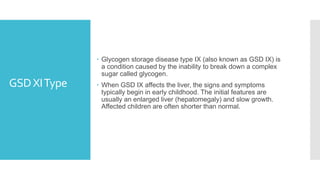
GSDXIType
 Glycogen storage disease type IX (also known as GSD IX) is
a condition caused by the inability to break down a complex
sugar called glycogen.
 When GSD IX affects the liver, the signs and symptoms
typically begin in early childhood. The initial features are
usually an enlarged liver (hepatomegaly) and slow growth.
Affected children are often shorter than normal.
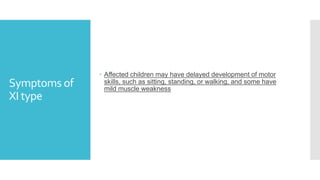
Symptoms of
XI type
 Affected children may have delayed development of motor
skills, such as sitting, standing, or walking, and some have
mild muscle weakness
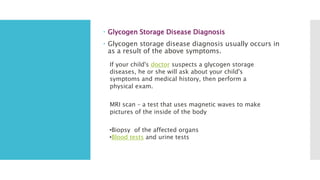
 Glycogen Storage Disease Diagnosis
 Glycogen storage disease diagnosis usually occurs in
as a result of the above symptoms.
If your child's doctor suspects a glycogen storage
diseases, he or she will ask about your child's
symptoms and medical history, then perform a
physical exam.
MRI scan – a test that uses magnetic waves to make
pictures of the inside of the body
•Biopsy of the affected organs
•Blood tests and urine tests
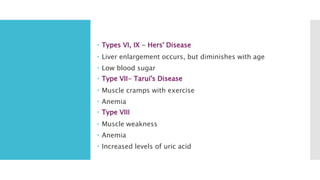
 Types VI, IX - Hers' Disease
 Liver enlargement occurs, but diminishes with age
 Low blood sugar
 Type VII- Tarui's Disease
 Muscle cramps with exercise
 Anemia
 Type VIII
 Muscle weakness
 Anemia
 Increased levels of uric acid
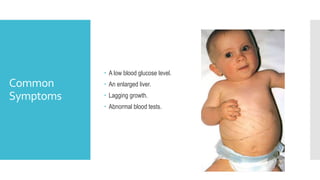
Common
Symptoms
 A low blood glucose level.
 An enlarged liver.
 Lagging growth.
 Abnormal blood tests.
 REFERENCE LINK
 https://www.hopkinsmedicine.org
 https://www.chop.edu.>glycogen-st
 https://medicineplus.gov>condition.
Glycogen storage disease pptx

Glycogen storage disease pptx

  • 1.
  • 2.
     GSD ispassed down from parents to children (is hereditary). It is most often seen in babies or young children. But some forms of GSD may appear in adults. GLYCOGEN STORAGE DISEASE Glycogen storage disease (GSD) is a rare condition that changes the way the body uses and stores glycogen, a form of sugar or glucose.
  • 3.
     GSD mostlyaffects the liver and the muscles. Some types cause problems in other areas of the body as well. Types of GSD and the parts of the body they affect the most include: •Type VI (Hers’ disease) – Liver, blood cells. •Type VII (Tarui’s disease) – Skeletal muscles, blood cells. •Type IX – Liver. •Type XI – Liver, kidneys, intestines.
  • 4.
    Symptoms Glycogen storage diseasetype VI (also known as GSDVI or Hers disease) is an inherited disorder caused by an inability to break down a complex sugar called glycogen in liver cells. A lack of glycogen breakdown interferes with the normal function of the liver . GSDTypeVI Symptoms of GSD6 usually begin in infancy or childhood and may include an enlarged liver (hepatomegaly), low blood sugar (hypoglycemia) or an increase in the amount of lactic in the blood (lactic acidosis).
  • 5.
    GSDTYPEVII  Muscle phosphofructokinase(PFK) deficiency (Tarui's disease), or glycogen storage disease type 7 (GSD7), is a rare form of glycogen storage disease characterized by fatigue and muscular exercise intolerance. It occurs in childhood. Glycogen storage disease type 7 (GSD7) is an inherited condition in which the body is unable to break down glycogen (a complex sugar) in the muscle cells .
  • 6.
    • GSD TYPEVIII  Anx-linked recessive hepatic glycogen storage disease resulting from lack of expression of phosphorylase-b-kinase activity. Symptoms are relatively mild; hepatomegaly, increased liver glycogen, and decreased leukocyte phosphorylase are present.
  • 7.
    GSDXIType  Glycogen storagedisease type IX (also known as GSD IX) is a condition caused by the inability to break down a complex sugar called glycogen.  When GSD IX affects the liver, the signs and symptoms typically begin in early childhood. The initial features are usually an enlarged liver (hepatomegaly) and slow growth. Affected children are often shorter than normal.
  • 8.
    Symptoms of XI type Affected children may have delayed development of motor skills, such as sitting, standing, or walking, and some have mild muscle weakness
  • 9.
     Glycogen StorageDisease Diagnosis  Glycogen storage disease diagnosis usually occurs in as a result of the above symptoms. If your child's doctor suspects a glycogen storage diseases, he or she will ask about your child's symptoms and medical history, then perform a physical exam. MRI scan – a test that uses magnetic waves to make pictures of the inside of the body •Biopsy of the affected organs •Blood tests and urine tests
  • 10.
     Types VI,IX - Hers' Disease  Liver enlargement occurs, but diminishes with age  Low blood sugar  Type VII- Tarui's Disease  Muscle cramps with exercise  Anemia  Type VIII  Muscle weakness  Anemia  Increased levels of uric acid
  • 11.
    Common Symptoms  A lowblood glucose level.  An enlarged liver.  Lagging growth.  Abnormal blood tests.
  • 12.
     REFERENCE LINK https://www.hopkinsmedicine.org  https://www.chop.edu.>glycogen-st  https://medicineplus.gov>condition.