MILK PROTEINS
1
2
1 • INTRODUCTION
2 • MILK PROTEIN
3 • CASEIN AND CASEINATE MANUFUCTURING
4 • APPLICATION OF CASEIN PRODUCTS IN FOOD
5 • WHEY PROTEIN AND WHEY PROTEIN PRODUCTS
6 • APPLICATION OF WHEY PROTEIN PRODUCTS IN FOOD
7 • MILK PROTEIN CONCTRATES PRODUCTION PROCESS AND APPICATION
8 • COMMERCIALLY AVAILABLE PRODUCTS
9 • CONCLUSION
10 • REFERANCES
3
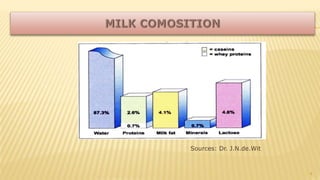
Sources: Dr. J.N.de.Wit
4
5
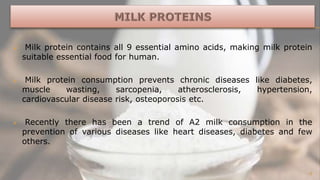
 Milk protein contains all 9 essential amino acids, making milk protein
suitable essential food for human.
 Milk protein consumption prevents chronic diseases like diabetes,
muscle wasting, sarcopenia, atherosclerosis, hypertension,
cardiovascular disease risk, osteoporosis etc.
 Recently there has been a trend of A2 milk consumption in the
prevention of various diseases like heart diseases, diabetes and few
others.
6
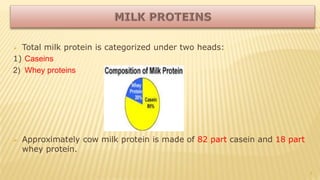
 Total milk protein is categorized under two heads:
1) Caseins
2) Whey proteins
 Approximately cow milk protein is made of 82 part casein and 18 part
whey protein.
7
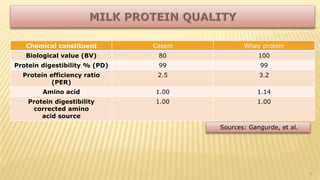
Chemical constituent Casein Whey protein
Biological value (BV) 80 100
Protein digestibility % (PD) 99 99
Protein efficiency ratio
(PER)
2.5 3.2
Amino acid 1.00 1.14
Protein digestibility
corrected amino
acid source
1.00 1.00
8
Sources: Gangurde, et al.
9
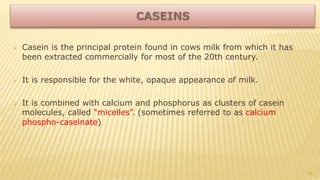
 Casein is the principal protein found in cows milk from which it has
been extracted commercially for most of the 20th century.
 It is responsible for the white, opaque appearance of milk.
 It is combined with calcium and phosphorus as clusters of casein
molecules, called “micelles”. (sometimes referred to as calcium
phospho-caseinate)
10
11
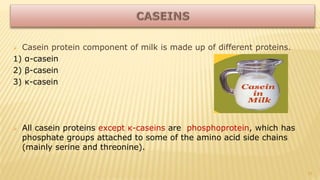
 Casein protein component of milk is made up of different proteins.
1) α-casein
2) β-casein
3) κ-casein
 All casein proteins except κ-caseins are phosphoprotein, which has
phosphate groups attached to some of the amino acid side chains
(mainly serine and threonine).
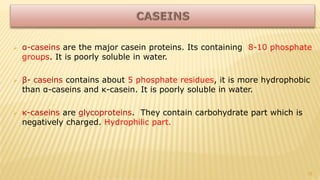
 α-caseins are the major casein proteins. Its containing 8-10 phosphate
groups. It is poorly soluble in water.
 β- caseins contains about 5 phosphate residues, it is more hydrophobic
than α-caseins and κ-casein. It is poorly soluble in water.
 κ-caseins are glycoproteins. They contain carbohydrate part which is
negatively charged. Hydrophilic part.
12
13
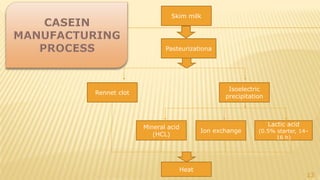
Skim milk
Pasteurizationa
Isoelectric
precipitation
Rennet clot
Mineral acid
(HCL)
Ion exchange
Lactic acid
(0.5% starter, 14–
16 h)
Heat
14
Separation of casein
curd
Tempering
Drying
(52–57
C)(F.M.C=8%.)
Dewatering
(M.C= 55–60%)
Washing
Grinding
(hammer, roller or
pin mill)
15
Grading
Bagging
Blending
Sources: Casein and Caseinate: Methods of Manufacture
1616
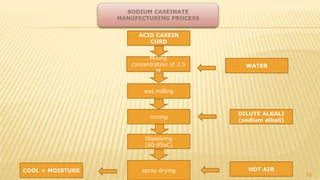
ACID CASEIN
CURD
Dissolving
(60-95oC)
mixing
wet milling
Mixing
concentration of 2.5
M
spray drying
WATER
DILUTE ALKALI
(sodium alkali)
HOT AIRCOOL + MOISTURE
17
bagging
blending
E469
FOODSUPPLEMENTS
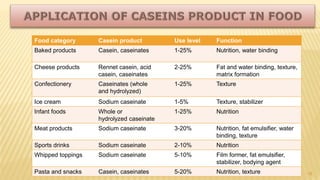
Food category Casein product Use level Function
Baked products Casein, caseinates 1-25% Nutrition, water binding
Cheese products Rennet casein, acid
casein, caseinates
2-25% Fat and water binding, texture,
matrix formation
Confectionery Caseinates (whole
and hydrolyzed)
1-25% Texture
Ice cream Sodium caseinate 1-5% Texture, stabilizer
Infant foods Whole or
hydrolyzed caseinate
1-25% Nutrition
Meat products Sodium caseinate 3-20% Nutrition, fat emulsifier, water
binding, texture
Sports drinks Sodium caseinate 2-10% Nutrition
Whipped toppings Sodium caseinate 5-10% Film former, fat emulsifier,
stabilizer, bodying agent
Pasta and snacks Casein, caseinates 5-20% Nutrition, texture 18
19
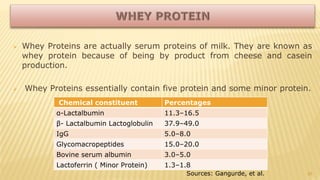
 Whey Proteins are actually serum proteins of milk. They are known as
whey protein because of being by product from cheese and casein
production.
 Whey Proteins essentially contain five protein and some minor protein.
20
Chemical constituent Percentages
α-Lactalbumin 11.3–16.5
β- Lactalbumin Lactoglobulin 37.9–49.0
IgG 5.0–8.0
Glycomacropeptides 15.0–20.0
Bovine serum albumin 3.0–5.0
Lactoferrin ( Minor Protein) 1.3–1.8
Sources: Gangurde, et al.
 Other Minor Protein present in whey
lactollin, glycoproteins, lactoperoxidase and transferrin
 Whey protein is loaded with the essential and nonessential amino acids
with few carbohydrates and little fat content.
 It contains the amino acid cysteine which can be used to make
glutathione (GSH).
21
22
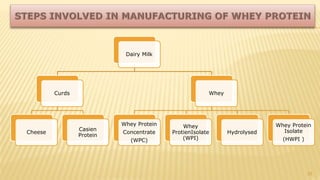
Dairy Milk
Curds
Cheese
Casien
Protein
Whey
Whey Protein
Concentrate
(WPC)
Whey
ProtienIsolate
(WPI)
Hydrolysed
Whey Protein
Isolate
(HWPI )
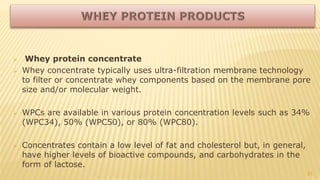
 Whey protein concentrate
 Whey concentrate typically uses ultra-filtration membrane technology
to filter or concentrate whey components based on the membrane pore
size and/or molecular weight.
 WPCs are available in various protein concentration levels such as 34%
(WPC34), 50% (WPC50), or 80% (WPC80).
 Concentrates contain a low level of fat and cholesterol but, in general,
have higher levels of bioactive compounds, and carbohydrates in the
form of lactose.
23
 Whey protein isolate
 Whey protein isolate have a protein content of 90% or greater and is
produced through a variety of processes like micro-filtration and ion-
exchange.
 Micro-filtration removes additional lactose and fat to increase protein
concentration up to 90% or higher.
24
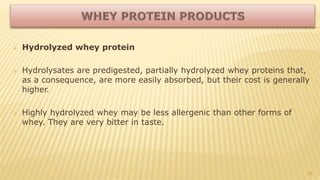
 Hydrolyzed whey protein
 Hydrolysates are predigested, partially hydrolyzed whey proteins that,
as a consequence, are more easily absorbed, but their cost is generally
higher.
 Highly hydrolyzed whey may be less allergenic than other forms of
whey. They are very bitter in taste.
25
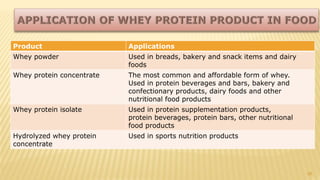
Product Applications
Whey powder Used in breads, bakery and snack items and dairy
foods
Whey protein concentrate The most common and affordable form of whey.
Used in protein beverages and bars, bakery and
confectionary products, dairy foods and other
nutritional food products
Whey protein isolate Used in protein supplementation products,
protein beverages, protein bars, other nutritional
food products
Hydrolyzed whey protein
concentrate
Used in sports nutrition products
26
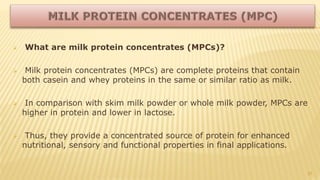
 What are milk protein concentrates (MPCs)?
 Milk protein concentrates (MPCs) are complete proteins that contain
both casein and whey proteins in the same or similar ratio as milk.
 In comparison with skim milk powder or whole milk powder, MPCs are
higher in protein and lower in lactose.
 Thus, they provide a concentrated source of protein for enhanced
nutritional, sensory and functional properties in final applications.
27
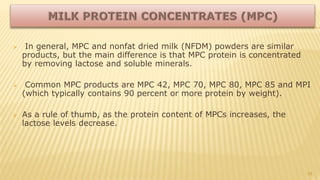
 In general, MPC and nonfat dried milk (NFDM) powders are similar
products, but the main difference is that MPC protein is concentrated
by removing lactose and soluble minerals.
 Common MPC products are MPC 42, MPC 70, MPC 80, MPC 85 and MPI
(which typically contains 90 percent or more protein by weight).
 As a rule of thumb, as the protein content of MPCs increases, the
lactose levels decrease.
28
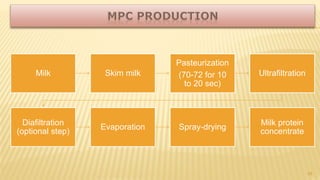
Milk Skim milk
Pasteurization
(70-72 for 10
to 20 sec)
Ultrafiltration
Diafiltration
(optional step)
Evaporation Spray-drying
Milk protein
concentrate
29
No. Functional Properties Applications
1 Water binding, thickening and
viscosity
Soups and sauces, meat products,
bakery products, confectionary,
chocolate, yogurt, cheese
2 Emulsification Soups and sauces, ice cream,
confectionary, meat products, coffee
whitener
3 Foaming and whipping Ice cream, desserts, whipped toppings
4 Gelation Cheese, yogurt, bakery, confectionary
5 Heat stability Recombined milk, soups and sauces, and
enteral and clinical nutrition
6 Color/flavor development Chocolate, confectionary
30
 Processing of milk into dairy products leaves a significant part of milk
proteins behind, which can be utilized in many way.
 In general, Proteins and especially milk proteins have several functions
in foods such as emulsification, foam formation and stability etc.
 Milk protein concentrates are high-quality proteins naturally found in
milk. These high-protein milk powders offer the global food and
beverage industry versatile food ingredients with excellent functionality
and nutrition.
31
32
33
 Soumitra Banerjee. “A2 Milk: The Unknown Story About a Milk
Protein”. Acta Scientific Nutritional Health (2018), 2: 28-31.
 AR Sarode, PD Sawale, CD Khedkar, SD Kalyankar, RD Pawshe.
Casein and Caseinate: Methods of Manufacture. The Encyclopedia of
Food and Health, (2016),1: pp. 676-682.
 Isabel Gigli. Milk Proteins - From Structure to Biological Properties
and Health Aspects. Published by InTech.(2016).
 Jihan M. Kassem. Future Challenges of Whey Proteins. International
Journal of Dairy Science.(2015) 10 (4): 139-159.
34
 Hemant H Gangurde, Mayur A Chordiya, Pooja S Patil, Nayana S
Baste. Whey protein. Scholars' Research Journal (2011) ,1: 69-77.
 Hasmukh Patel, Sonia Patel. Technical Report: Milk Protein
Concentrates: Manufacturing and Applications.
 C. R. Southward (Consumer and Applications Science Section, New
Zealand). Casein Product.
 Marjorie Geiser. The Wonders of Whey Protein. NSCA Performance
Training Journal.
35
 Dr. J.N. de Wit. Lecturer’s Handbook on Whey and Whey Products,
Published by European Whey Products Association.(2001).
36

Milk Protein ppt

  • 1.
  • 2.
    2 1 • INTRODUCTION 2• MILK PROTEIN 3 • CASEIN AND CASEINATE MANUFUCTURING 4 • APPLICATION OF CASEIN PRODUCTS IN FOOD 5 • WHEY PROTEIN AND WHEY PROTEIN PRODUCTS 6 • APPLICATION OF WHEY PROTEIN PRODUCTS IN FOOD 7 • MILK PROTEIN CONCTRATES PRODUCTION PROCESS AND APPICATION 8 • COMMERCIALLY AVAILABLE PRODUCTS 9 • CONCLUSION 10 • REFERANCES
  • 3.
  • 4.
  • 5.
  • 6.
     Milk proteincontains all 9 essential amino acids, making milk protein suitable essential food for human.  Milk protein consumption prevents chronic diseases like diabetes, muscle wasting, sarcopenia, atherosclerosis, hypertension, cardiovascular disease risk, osteoporosis etc.  Recently there has been a trend of A2 milk consumption in the prevention of various diseases like heart diseases, diabetes and few others. 6
  • 7.
     Total milkprotein is categorized under two heads: 1) Caseins 2) Whey proteins  Approximately cow milk protein is made of 82 part casein and 18 part whey protein. 7
  • 8.
    Chemical constituent CaseinWhey protein Biological value (BV) 80 100 Protein digestibility % (PD) 99 99 Protein efficiency ratio (PER) 2.5 3.2 Amino acid 1.00 1.14 Protein digestibility corrected amino acid source 1.00 1.00 8 Sources: Gangurde, et al.
  • 9.
  • 10.
     Casein isthe principal protein found in cows milk from which it has been extracted commercially for most of the 20th century.  It is responsible for the white, opaque appearance of milk.  It is combined with calcium and phosphorus as clusters of casein molecules, called “micelles”. (sometimes referred to as calcium phospho-caseinate) 10
  • 11.
    11  Casein proteincomponent of milk is made up of different proteins. 1) α-casein 2) β-casein 3) κ-casein  All casein proteins except κ-caseins are phosphoprotein, which has phosphate groups attached to some of the amino acid side chains (mainly serine and threonine).
  • 12.
     α-caseins arethe major casein proteins. Its containing 8-10 phosphate groups. It is poorly soluble in water.  β- caseins contains about 5 phosphate residues, it is more hydrophobic than α-caseins and κ-casein. It is poorly soluble in water.  κ-caseins are glycoproteins. They contain carbohydrate part which is negatively charged. Hydrophilic part. 12
  • 13.
    13 Skim milk Pasteurizationa Isoelectric precipitation Rennet clot Mineralacid (HCL) Ion exchange Lactic acid (0.5% starter, 14– 16 h) Heat
  • 14.
  • 15.
    15 Grading Bagging Blending Sources: Casein andCaseinate: Methods of Manufacture
  • 16.
    1616 ACID CASEIN CURD Dissolving (60-95oC) mixing wet milling Mixing concentrationof 2.5 M spray drying WATER DILUTE ALKALI (sodium alkali) HOT AIRCOOL + MOISTURE
  • 17.
  • 18.
    Food category Caseinproduct Use level Function Baked products Casein, caseinates 1-25% Nutrition, water binding Cheese products Rennet casein, acid casein, caseinates 2-25% Fat and water binding, texture, matrix formation Confectionery Caseinates (whole and hydrolyzed) 1-25% Texture Ice cream Sodium caseinate 1-5% Texture, stabilizer Infant foods Whole or hydrolyzed caseinate 1-25% Nutrition Meat products Sodium caseinate 3-20% Nutrition, fat emulsifier, water binding, texture Sports drinks Sodium caseinate 2-10% Nutrition Whipped toppings Sodium caseinate 5-10% Film former, fat emulsifier, stabilizer, bodying agent Pasta and snacks Casein, caseinates 5-20% Nutrition, texture 18
  • 19.
  • 20.
     Whey Proteinsare actually serum proteins of milk. They are known as whey protein because of being by product from cheese and casein production.  Whey Proteins essentially contain five protein and some minor protein. 20 Chemical constituent Percentages α-Lactalbumin 11.3–16.5 β- Lactalbumin Lactoglobulin 37.9–49.0 IgG 5.0–8.0 Glycomacropeptides 15.0–20.0 Bovine serum albumin 3.0–5.0 Lactoferrin ( Minor Protein) 1.3–1.8 Sources: Gangurde, et al.
  • 21.
     Other MinorProtein present in whey lactollin, glycoproteins, lactoperoxidase and transferrin  Whey protein is loaded with the essential and nonessential amino acids with few carbohydrates and little fat content.  It contains the amino acid cysteine which can be used to make glutathione (GSH). 21
  • 22.
  • 23.
     Whey proteinconcentrate  Whey concentrate typically uses ultra-filtration membrane technology to filter or concentrate whey components based on the membrane pore size and/or molecular weight.  WPCs are available in various protein concentration levels such as 34% (WPC34), 50% (WPC50), or 80% (WPC80).  Concentrates contain a low level of fat and cholesterol but, in general, have higher levels of bioactive compounds, and carbohydrates in the form of lactose. 23
  • 24.
     Whey proteinisolate  Whey protein isolate have a protein content of 90% or greater and is produced through a variety of processes like micro-filtration and ion- exchange.  Micro-filtration removes additional lactose and fat to increase protein concentration up to 90% or higher. 24
  • 25.
     Hydrolyzed wheyprotein  Hydrolysates are predigested, partially hydrolyzed whey proteins that, as a consequence, are more easily absorbed, but their cost is generally higher.  Highly hydrolyzed whey may be less allergenic than other forms of whey. They are very bitter in taste. 25
  • 26.
    Product Applications Whey powderUsed in breads, bakery and snack items and dairy foods Whey protein concentrate The most common and affordable form of whey. Used in protein beverages and bars, bakery and confectionary products, dairy foods and other nutritional food products Whey protein isolate Used in protein supplementation products, protein beverages, protein bars, other nutritional food products Hydrolyzed whey protein concentrate Used in sports nutrition products 26
  • 27.
     What aremilk protein concentrates (MPCs)?  Milk protein concentrates (MPCs) are complete proteins that contain both casein and whey proteins in the same or similar ratio as milk.  In comparison with skim milk powder or whole milk powder, MPCs are higher in protein and lower in lactose.  Thus, they provide a concentrated source of protein for enhanced nutritional, sensory and functional properties in final applications. 27
  • 28.
     In general,MPC and nonfat dried milk (NFDM) powders are similar products, but the main difference is that MPC protein is concentrated by removing lactose and soluble minerals.  Common MPC products are MPC 42, MPC 70, MPC 80, MPC 85 and MPI (which typically contains 90 percent or more protein by weight).  As a rule of thumb, as the protein content of MPCs increases, the lactose levels decrease. 28
  • 29.
    Milk Skim milk Pasteurization (70-72for 10 to 20 sec) Ultrafiltration Diafiltration (optional step) Evaporation Spray-drying Milk protein concentrate 29
  • 30.
    No. Functional PropertiesApplications 1 Water binding, thickening and viscosity Soups and sauces, meat products, bakery products, confectionary, chocolate, yogurt, cheese 2 Emulsification Soups and sauces, ice cream, confectionary, meat products, coffee whitener 3 Foaming and whipping Ice cream, desserts, whipped toppings 4 Gelation Cheese, yogurt, bakery, confectionary 5 Heat stability Recombined milk, soups and sauces, and enteral and clinical nutrition 6 Color/flavor development Chocolate, confectionary 30
  • 31.
     Processing ofmilk into dairy products leaves a significant part of milk proteins behind, which can be utilized in many way.  In general, Proteins and especially milk proteins have several functions in foods such as emulsification, foam formation and stability etc.  Milk protein concentrates are high-quality proteins naturally found in milk. These high-protein milk powders offer the global food and beverage industry versatile food ingredients with excellent functionality and nutrition. 31
  • 32.
  • 33.
  • 34.
     Soumitra Banerjee.“A2 Milk: The Unknown Story About a Milk Protein”. Acta Scientific Nutritional Health (2018), 2: 28-31.  AR Sarode, PD Sawale, CD Khedkar, SD Kalyankar, RD Pawshe. Casein and Caseinate: Methods of Manufacture. The Encyclopedia of Food and Health, (2016),1: pp. 676-682.  Isabel Gigli. Milk Proteins - From Structure to Biological Properties and Health Aspects. Published by InTech.(2016).  Jihan M. Kassem. Future Challenges of Whey Proteins. International Journal of Dairy Science.(2015) 10 (4): 139-159. 34
  • 35.
     Hemant HGangurde, Mayur A Chordiya, Pooja S Patil, Nayana S Baste. Whey protein. Scholars' Research Journal (2011) ,1: 69-77.  Hasmukh Patel, Sonia Patel. Technical Report: Milk Protein Concentrates: Manufacturing and Applications.  C. R. Southward (Consumer and Applications Science Section, New Zealand). Casein Product.  Marjorie Geiser. The Wonders of Whey Protein. NSCA Performance Training Journal. 35
  • 36.
     Dr. J.N.de Wit. Lecturer’s Handbook on Whey and Whey Products, Published by European Whey Products Association.(2001). 36

Editor's Notes

  • #4 Milk, as the first food for mammals, supplies all the energy and nutrients needed for the proper growth and development of the neonate. Milk is a complex biological fluid with high content of proteins, minerals, and lipids secreted by mammals to supply nutrition and to provide immunological protection to the newborn. The main function of milk is to provide essential amino acids and minerals that are vital for the development and therefore function of muscular and other tissues in new born mammals. Sources: Milk Proteins - From Structure to Biological Properties and Health Aspects Edited by Isabel Gigli
  • #7 beta-casein, conducted by National Bureau of Animal Genetic Resources, Kamal, Haryana (India), it was found that milk of Indian milch breeds, i.e. Gir, Tharparkar, Rathi, Red Sindhi, Sahiwal, Kankrej and Hariana had A2 beta casein present
  • #11 Source: Written by C. R. Southward (Consumer and Applications Science Section, New Zealand Dairy Research Institute).
  • #13 Beta Caseins: Beta-casein comes in twelve genetic variations, namely A1, A2, A3, B, C, D, E, F, H1, H2, I and G. Out of these twelve variations, A1, A2 and B forms are the commonly found genetic variations [5]. A1 and A2 beta-casein protein differs from each other in single amino acid sequencing at “67th” position. For A2 beta-casein protein, at 67th place “Proline” is present, whereas for A1 beta-casein protein in 67th place, “Histidine” is found [6,7]. This polymorphism is responsible to cause changes in digestion patterns. A1 beta-casein digestion by digestive enzymes develops bioactive seven-amino-acid peptide called as “Beta-Casomorphin-7” (BCM-7) and on the other hand A2 beta casein digestion results in minimal development and least release of BCM-7. Because α-caseins and β-caseins are highly phosphorylated, they are very sensitive to the concentration of calcium salts, that is, they will precipitate with excess Ca2+ ions. In milk, κ-casein combine with α-caseins and β- caseins to form micelle. Do not precipitate in the presence of Ca2+ ions.
  • #14 In the case of the enzymatic coagulation of casein, the pH of the milk does not change. Instead, the coagulation depends on the addition of a specific enzyme, chymosin/rennin, which cleaves a highly charged portion from the k-casein, called glycomacropeptide. The temperature of the skim milk should be held close to 35 C for hydrochloric acid curd. The pH 4.1 is adjusted by adding dilute acid slowly with continuous stirring. It produces a granular curd that is easy to drain and wash.
  • #15 Whey should be removed from contact with the curd as soon as possible. The longer the curd remains in contact with the whey, the more difficult it is to wash out acids, salts, whey protein, and lactose. Washing The washing of casein curd is one of the most important steps in casein manufacture as most quality improvement in casein is achieved through efficient washing. Three separate washes of casein curd are required with contact times of 15–20 min each. The temperature of the final wash water should be adjusted to 32–40 C The pH of the water should be around 4.6 for the first two washings to avoid the formation of a gelatinous layer over the curd particles in excessively acid water, as well as the softening and dispersion of the curd in alkaline waters. The third wash should be given with neutral water Tempering: It is the holding of casein for a period of 24 h to allow efficient cooling, hardening, and even distribution of moisture throughout the batch. The most efficient tempering consists of recirculating the dried casein by pneumatic conveyers Grinding 60- and 80-mesh casein, pin mills are much more efficient than hammer mills
  • #16 The grinding operation is followed by sieving into various mesh sizes, and then bagging. Common mesh sizes are 30–40 mesh casein, 60-mesh casein, and 90-mesh casein.
  • #17 The most common alkali used in the manufacture of spray dried sodium caseinate is sodium hydroxide. It is mixed (as an aqueous solution with a typical concentration of 2.5 M) with a slurry of the casein curd or powder in water. The usual amount of sodium hydroxide needed is about 2% (w/w) of the casein solids. The casein curd is milled (Figure 5) using one or more colloid mills to reduce the size of the individual particles so that they will dissolve rapidly, and is then mixed with the alkali using high shear. In producing solutions of sodium caseinate for spray drying, it is important to achieve the maximum possible concentration of solids for economic reasons, as the more water there is to evaporate, the higher is the energy cost. Concentrated solutions of sodium caseinate (> 15% solids), however, are very viscous, and require powerful agitators and pumps for mixing and fluid transfer. The use of high temperatures (60-95oC) during the later dissolving stages is of practical benefit, as the viscosity of sodium caseinate solutions decreases with temperature. However, there is still a delicate balance between what is mechanically achievable and what is economically practicable during the commercial production of sodium caseinate.
  • #19 Hydrolysed casein (.hydrolysates.) is derived from whole casein by reacting it in solution with a proteolytic enzyme.
  • #22 GSH is an antioxidant that defends the body against free radical damage and some toxins
  • #26 The process of hydrolysis breaks down the protein into smaller segments called peptides.
  • #29 For example, NFDM contains about 34 to 36 percent protein and 52 percent lactose, while MPC 42 contains 42 percent protein and 46 percent lactose, and MPC 80 contains 80 percent protein and 5 to 6 percent lactose, respectively.
  • #30 Ultrafiltration During the UF step, caseins, whey proteins, micellar salts and residual fat are concentrated in the retentate, whereas lactose, soluble salts and nonprotein nitrogen are removed with the permeate For high-protein MPCs such as MPC 85, UF alone is not sufficient to achieve the required protein-to-solids ratio in the retentate. Diafiltration (DF) is commonly applied to help remove additional lactose and soluble minerals. Once the desired protein-to-solids ratio has been achieved, the UF retentate is evaporated and spray-dried.