Lipid Metabolism
By
Dr. Mustafa Kahtan Al-Bayaty
Lipids
Lipids include a wide variety of chemical substances such as:
• Neutral fat (triacylglycerol or triglycerides).
• Fatty acids and their derivatives.
•Phospholipids.
• Glycolipids.
•Sterols.
• Fat soluble vitamins (A, D, E and K).
Components of dietary lipids
The major components of dietary lipids are:
1. Approximately 90 % of dietary lipid is in the form of triacylglycerols
(triglycerides).
2. Cholesterol and cholesterol esters.
3. Phospholipids.
4. Free fatty acids.
Dietary lipids
Triacylglycerols
(90 %)
Cholesterol and
cholesterol esters
Phospholipids Free fatty acids
Digestion of lipids
•The major site of lipid digestion is the small intestine.
•Little or no digestion occurs in the mouth or stomach.
In the stomach, lipids are mixed with hydrochloric acid
to form chyme.
•The lipids are digested in the intestine by pancreatic
enzymes.
Digestion in Small Intestine
•The acidic stomach contents called chyme, containing dietary
fat leaves the stomach and enters the small intestine.
•Digestion of fat occurs in the duodenum by emulsification of
fat.
•In the duodenum the dietary fat is emulsified by the action
of bile salts.
Emulsification of fat
•Emulsification is the breakdown of fat globules in the
duodenum into tiny droplets.
•Emulsification provides a larger surface area on which the
enzyme pancreatic lipase can act to digest the fats into fatty
acids and glycerol.
•Emulsification is assisted by the action of the bile salts.
Emulsification of fat
Hydrolysis of dietary triacylglycerols
• Emulsified triacylglycerols are hydrolyzed by pancreatic lipase.
Lipase hydrolyses fatty acid in the 1 and 3 positions of the
triacylglycerol, producing 2-monoacylglycerols and two molecules of
fatty acids.
Hydrolysis of dietary phospholipids
• Dietary glycerophospholipids are digested by pancreatic
phospholipase-A2. This enzyme catalyzes the hydrolysis of fatty acid
residues at the 2-position of the phospholipid, leaving
lysophospholipids and a molecule of fatty acid.
Hydrolysis of cholesterol ester
• Cholesterol esters are hydrolyzed by pancreatic cholesterol ester
hydrolase (cholesterol esterase), which produces cholesterol plus
free fatty acid.
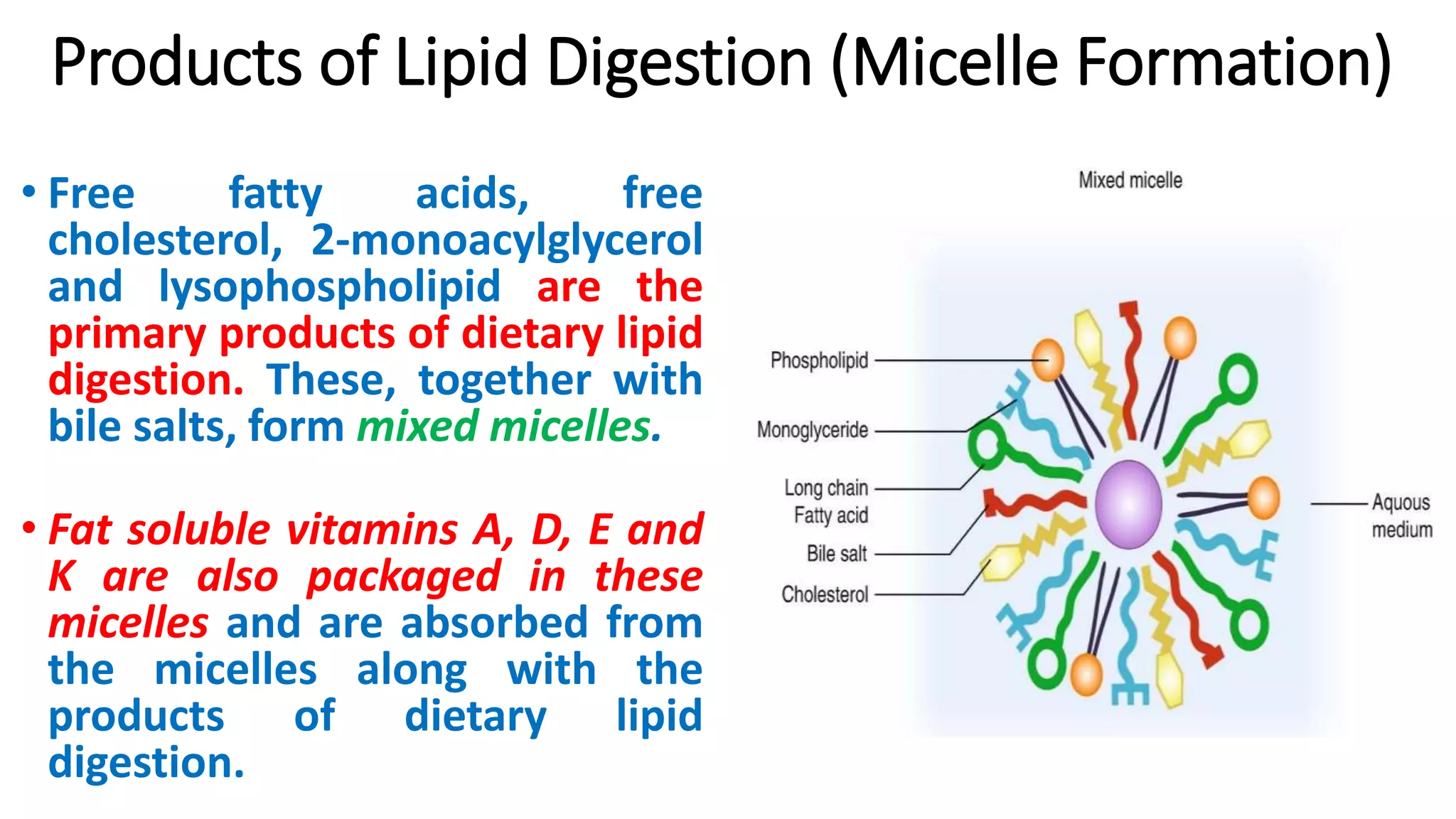
Products of Lipid Digestion (Micelle Formation)
• Free fatty acids, free
cholesterol, 2-monoacylglycerol
and lysophospholipid are the
primary products of dietary lipid
digestion. These, together with
bile salts, form mixed micelles.
• Fat soluble vitamins A, D, E and
K are also packaged in these
micelles and are absorbed from
the micelles along with the
products of dietary lipid
digestion.
Absorption of Lipids by Intestinal Mucosal Cells
• 2-monoacylglycerol, fatty acids, cholesterol, and lysophospholipid
packaged in mixed micelles are absorbed from the intestinal lumen
into the intestinal mucosal cells by diffusion.
• Inside the mucosal cells the following events occur:
1. 2-monoacylglycerols are reconverted to triacylglycerols.
2. The absorbed lysophospholipids and cholesterol are also
reconverted to phospholipids and cholesterol esters.
3. The triacylglycerol resynthesized in intestinal cells combine with
cholesterol, phospholipids and proteins to form chylomicrons.
Transport of lipids
• Triacylglycerol, phospholipid and cholesterol esters resynthesized in
the intestinal mucosa are absorbed into the lymph in the form of
lipoprotein known as chylomicrons.
• Chylomicrons are composed of:
- Triacylglycerols (85 – 90%).
- Cholesterol and cholesterol ester (5%).
- Phospholipids (7%).
- Protein (apolipoprotein, 1–2%).
• The chylomicrons pass from the lymph into the blood
through the thoracic duct.
After a fatty meal, the plasma is milky in appearance
due to the presence of chylomicrons
Fatty acid oxidation
•Fatty acids are oxidized mainly by a process called β-
oxidation.
•In β-oxidation, two carbon units are removed beginning from
the carboxyl end of the fatty acid in the form of acetyl-CoA.
•It is called β-oxidation because oxidation of fatty acids occurs
at the β-carbon atom.
• β-oxidation pathway occurs in mitochondria.
Fatty acids oxidation involves three major steps:
1.Activation of fatty acid to acyl-CoA.
2.Transfer of acyl CoA into mitochondria by
carnitine transport system.
3.Reactions of β-oxidation in mitochondria.
1. Activation of Fatty Acid
• Before being catabolized, free fatty acids are converted to an active
form called acyl-CoA.
• It occurs in the cytosol in the presence of:
1. ATP.
2. Coenzyme-A (CoA-SH).
3. The enzyme acyl-CoA synthetase also called thiokinase.
• Subsequent steps of β-oxidation occur in the mitochondria of the
liver and other tissue cells.
Activation of Fatty Acid
Transport of Acyl-CoA into Mitochondria
•The mitochondrial inner membrane is impermeable to
fatty acids. So a special transport mechanism is
needed.
•Activated long chain fatty acids are carried across the
inner mitochondrial membrane by carnitine.
The transport of fatty acids into mitochondria by carnitine involves
four steps:
1. The acyl group of acyl-CoA is transferred to the carnitine to form
acyl-carnitine by the enzyme carnitine acyltransferase-I (CAT-I).
2. Acyl-carnitine is then transported across the inner mitochondrial
membrane by the enzyme translocase.
3. The acyl group is transferred back to CoA in the mitochondrial
matrix by the enzyme carnitine acyl transferase-ll (CAT-II).
4. Acyl-CoA is reformed in the mitochondrial matrix with liberation of
carnitine which is returned to the cytosolic side by the translocase
in exchange for an incoming acyl-carnitine.
Reactions of β-oxidation of Fatty Acid
• β-oxidation involves the removal of two carbon units from the
carboxyl end of the fatty acid in the form of acetyl-CoA.
• It is called β-oxidation because oxidation of fatty acids occurs at the
β-carbon atom.
• β-oxidation pathway occurs in mitochondria.
• β-oxidation involves the removal of two carbon units from the
carboxyl end of the fatty acid in the form of acetyl-CoA.
Each cycle of β-oxidation yields:
Energy yield of β-oxidation of Fatty Acid
1 molecule of acetyl-CoA 1 acetyl-CoA = 10 ATP.
1 molecule of NADH
1 molecule of FADH2 1 FADH2 = 1.5 ATP.
1 NADH = 2.5 ATP.
Through TCA cycle
Through electron
transport chain
Through electron
transport chain
Capryloyl-CoA (8 carbons)
Fatty acyl-CoA (6 carbons) + 1 acetyl-CoA + 1 NADH + 1 FADH2
Fatty acyl-CoA (4 carbons) + 1 acetyl-CoA + 1 NADH + 1 FADH2
2 acetyl-CoA + 1 NADH + 1 FADH2
1st cycle of β-oxidation
2nd cycle of β-oxidation
3rd cycle of β-oxidation
Caprylic acid
(8 carbons)
CoA-SH
- 2 ATP
• The complete β-oxidation of caprylic acid (8 carbons fatty acid) yields:
4 molecules of acetyl-CoA 4 x 10 ATP = 40 ATP
3 molecules of NADH
3 molecules of FADH2 3 x 1.5 ATP = 4.5 ATP
3 x 2.5 ATP = 7.5 ATP
Through TCA cycle
Through electron
transport chain
Through electron
transport chain
Total ATP = 52 ATP
52 – 2 = 50 ATP molecules is the total energy yield from the
complete oxidation of caprylic acid.
Consumed in the activation of
caprylic acid to capryloyl-CoA
β-oxidation of Palmitic acid
Calculate the total energy yield
from the complete oxidation of
palmitic acid (16 carbons).
Metabolism of
Ketone Bodies
Ketone Bodies
•Acetoacetate, β-hydroxybutyrate and acetone are collectively
known as ketone bodies.
•These are water soluble energy yielding substances.
•Acetone is, however, an exception, since it cannot be
metabolized and is readily exhaled through lungs.
Ketogenesis
•Ketogenesis means the formation of ketone bodies.
•Liver is the only organ that synthesizes ketone bodies.
•The synthesis of ketone bodies occurs in mitochondrial
matrix of hepatic cells.
•Ketone bodies are synthesized in the liver from acetyl-CoA
formed by the β-oxidation of fatty acids.
Synthesis of
ketone bodies
Utilization of Ketone Bodies
• The site of production of ketone bodies is the liver. But the
liver cannot utilize ketone bodies because it lacks the
particular enzyme CoA-transferase which is required for the
activation of ketone bodies.
• Acetoacetate, β-hydroxybutyrate and acetone diffuse from
the liver mitochondria into the blood and are transported to
peripheral tissues.
Ketone bodies are
metabolized to acetyl-CoA,
which in turn enters the
TCA cycle for the production
of energy.
Significance of Ketogenesis
• Ketogenesis is a mechanism that allows the liver to oxidize
increasing quantities of fatty acids.
• During deprivation of carbohydrate as in starvation and
diabetes mellitus, acetoacetate and β-hydroxybutyrate serve
as an alternative source of energy for extrahepatic tissues
such as skeletal muscle, heart muscle, renal cortex, etc.
• In prolonged starvation 75 % of the energy needs of the brain
are supplied by ketone bodies reducing its need for glucose.
Hormonal regulation of ketogenesis
Free fatty acids, the precursors of ketone bodies arise from
lipolysis of triacylglycerol in adipose tissue. So factors
regulating lipolysis also regulate ketogenesis.
1. Glucagon stimulates lipolysis which in turn stimulates
ketogenesis.
2. Insulin inhibits lipolysis and ketogenesis.
Disorders of Ketone
Body Metabolism
Ketosis
• Ketosis is referred to the overall condition of (ketonemia and
ketonuria) and it means increased production or levels of ketone
bodies.
• Ketonemia: is a condition of increased ketone bodies concentration
in the blood.
• Ketonuria: is a condition of increased ketone bodies concentration in
the urine.
Ketonemia eventually leads to excretion of ketone bodies into the
urine resulting in ketonuria.
Ketoacidosis
•The acidosis caused by over production of the ketone bodies
acetoacetate and β-hydroxybutyrate (moderately strong
acids) which causes a decrease in the pH of the blood.
•Acetoacetate and β-hydroxybutyrate acids when present in
high concentration in blood, are buffered by HCO3
– (akali)
fraction of bicarbonate buffer. The excessive use of HCO3
–
depletes the alkali reserve causing ketoacidosis.
•Ketone bodies concentration is much higher in
ketoacidosis than in ketosis and in the absence of
ketoacidosis risk factors, ketosis is generally
considered safe.
•Ketoacidosis is seen in type I diabetes mellitus.
• ketoacidosis is relatively rare in type II diabetes.
Atherosclerosis
• High level of serum cholesterol results in atherosclerosis.
• The atherosclerosis is characterized by hardening and narrowing of
the arteries due to deposition of cholesterol and other lipids in the
inner arterial wall.
• Deposition of cholesterol and other lipids in the inner arterial wall
leads to formation of plaque (sticky deposit) and results in the
endothelial damage and narrowing of the arterial lumen.
• The hardening and narrowing of coronary arteries results in coronary
heart disease (CHD).
Plaque
Risk factors of atherosclerosis
1. Age (the risk of atherosclerosis increases with age).
2. Sex (males are more susceptible to atherosclerosis than females).
3. Genetic factors.
4. Hyperlipidemia (increased levels of total cholesterol, triglycerides and LDL are
associated with increased risk of atherosclerosis).
5. Low levels of HDL are associated with increased risk of atherosclerosis.
6. Hypertension (increased blood pressure is associated with increased risk of
atherosclerosis).
7. Diabetes mellitus.
8. Smoking.
9. Excessive alcohol consumption.
10. Obesity.
11. Lack of physical activity.

Lipid metabolism

  • 1.
  • 2.
    Lipids Lipids include awide variety of chemical substances such as: • Neutral fat (triacylglycerol or triglycerides). • Fatty acids and their derivatives. •Phospholipids. • Glycolipids. •Sterols. • Fat soluble vitamins (A, D, E and K).
  • 3.
    Components of dietarylipids The major components of dietary lipids are: 1. Approximately 90 % of dietary lipid is in the form of triacylglycerols (triglycerides). 2. Cholesterol and cholesterol esters. 3. Phospholipids. 4. Free fatty acids.
  • 4.
    Dietary lipids Triacylglycerols (90 %) Cholesteroland cholesterol esters Phospholipids Free fatty acids
  • 5.
    Digestion of lipids •Themajor site of lipid digestion is the small intestine. •Little or no digestion occurs in the mouth or stomach. In the stomach, lipids are mixed with hydrochloric acid to form chyme. •The lipids are digested in the intestine by pancreatic enzymes.
  • 6.
    Digestion in SmallIntestine •The acidic stomach contents called chyme, containing dietary fat leaves the stomach and enters the small intestine. •Digestion of fat occurs in the duodenum by emulsification of fat. •In the duodenum the dietary fat is emulsified by the action of bile salts.
  • 7.
    Emulsification of fat •Emulsificationis the breakdown of fat globules in the duodenum into tiny droplets. •Emulsification provides a larger surface area on which the enzyme pancreatic lipase can act to digest the fats into fatty acids and glycerol. •Emulsification is assisted by the action of the bile salts.
  • 8.
  • 10.
    Hydrolysis of dietarytriacylglycerols • Emulsified triacylglycerols are hydrolyzed by pancreatic lipase. Lipase hydrolyses fatty acid in the 1 and 3 positions of the triacylglycerol, producing 2-monoacylglycerols and two molecules of fatty acids.
  • 11.
    Hydrolysis of dietaryphospholipids • Dietary glycerophospholipids are digested by pancreatic phospholipase-A2. This enzyme catalyzes the hydrolysis of fatty acid residues at the 2-position of the phospholipid, leaving lysophospholipids and a molecule of fatty acid.
  • 12.
    Hydrolysis of cholesterolester • Cholesterol esters are hydrolyzed by pancreatic cholesterol ester hydrolase (cholesterol esterase), which produces cholesterol plus free fatty acid.
  • 13.
    Products of LipidDigestion (Micelle Formation) • Free fatty acids, free cholesterol, 2-monoacylglycerol and lysophospholipid are the primary products of dietary lipid digestion. These, together with bile salts, form mixed micelles. • Fat soluble vitamins A, D, E and K are also packaged in these micelles and are absorbed from the micelles along with the products of dietary lipid digestion.
  • 14.
    Absorption of Lipidsby Intestinal Mucosal Cells • 2-monoacylglycerol, fatty acids, cholesterol, and lysophospholipid packaged in mixed micelles are absorbed from the intestinal lumen into the intestinal mucosal cells by diffusion. • Inside the mucosal cells the following events occur: 1. 2-monoacylglycerols are reconverted to triacylglycerols. 2. The absorbed lysophospholipids and cholesterol are also reconverted to phospholipids and cholesterol esters. 3. The triacylglycerol resynthesized in intestinal cells combine with cholesterol, phospholipids and proteins to form chylomicrons.
  • 15.
    Transport of lipids •Triacylglycerol, phospholipid and cholesterol esters resynthesized in the intestinal mucosa are absorbed into the lymph in the form of lipoprotein known as chylomicrons. • Chylomicrons are composed of: - Triacylglycerols (85 – 90%). - Cholesterol and cholesterol ester (5%). - Phospholipids (7%). - Protein (apolipoprotein, 1–2%).
  • 16.
    • The chylomicronspass from the lymph into the blood through the thoracic duct. After a fatty meal, the plasma is milky in appearance due to the presence of chylomicrons
  • 18.
    Fatty acid oxidation •Fattyacids are oxidized mainly by a process called β- oxidation. •In β-oxidation, two carbon units are removed beginning from the carboxyl end of the fatty acid in the form of acetyl-CoA. •It is called β-oxidation because oxidation of fatty acids occurs at the β-carbon atom. • β-oxidation pathway occurs in mitochondria.
  • 19.
    Fatty acids oxidationinvolves three major steps: 1.Activation of fatty acid to acyl-CoA. 2.Transfer of acyl CoA into mitochondria by carnitine transport system. 3.Reactions of β-oxidation in mitochondria.
  • 20.
    1. Activation ofFatty Acid • Before being catabolized, free fatty acids are converted to an active form called acyl-CoA. • It occurs in the cytosol in the presence of: 1. ATP. 2. Coenzyme-A (CoA-SH). 3. The enzyme acyl-CoA synthetase also called thiokinase. • Subsequent steps of β-oxidation occur in the mitochondria of the liver and other tissue cells.
  • 21.
  • 22.
    Transport of Acyl-CoAinto Mitochondria •The mitochondrial inner membrane is impermeable to fatty acids. So a special transport mechanism is needed. •Activated long chain fatty acids are carried across the inner mitochondrial membrane by carnitine.
  • 23.
    The transport offatty acids into mitochondria by carnitine involves four steps: 1. The acyl group of acyl-CoA is transferred to the carnitine to form acyl-carnitine by the enzyme carnitine acyltransferase-I (CAT-I). 2. Acyl-carnitine is then transported across the inner mitochondrial membrane by the enzyme translocase. 3. The acyl group is transferred back to CoA in the mitochondrial matrix by the enzyme carnitine acyl transferase-ll (CAT-II). 4. Acyl-CoA is reformed in the mitochondrial matrix with liberation of carnitine which is returned to the cytosolic side by the translocase in exchange for an incoming acyl-carnitine.
  • 26.
    Reactions of β-oxidationof Fatty Acid • β-oxidation involves the removal of two carbon units from the carboxyl end of the fatty acid in the form of acetyl-CoA. • It is called β-oxidation because oxidation of fatty acids occurs at the β-carbon atom. • β-oxidation pathway occurs in mitochondria.
  • 27.
    • β-oxidation involvesthe removal of two carbon units from the carboxyl end of the fatty acid in the form of acetyl-CoA.
  • 28.
    Each cycle ofβ-oxidation yields: Energy yield of β-oxidation of Fatty Acid 1 molecule of acetyl-CoA 1 acetyl-CoA = 10 ATP. 1 molecule of NADH 1 molecule of FADH2 1 FADH2 = 1.5 ATP. 1 NADH = 2.5 ATP. Through TCA cycle Through electron transport chain Through electron transport chain
  • 29.
    Capryloyl-CoA (8 carbons) Fattyacyl-CoA (6 carbons) + 1 acetyl-CoA + 1 NADH + 1 FADH2 Fatty acyl-CoA (4 carbons) + 1 acetyl-CoA + 1 NADH + 1 FADH2 2 acetyl-CoA + 1 NADH + 1 FADH2 1st cycle of β-oxidation 2nd cycle of β-oxidation 3rd cycle of β-oxidation Caprylic acid (8 carbons) CoA-SH - 2 ATP
  • 30.
    • The completeβ-oxidation of caprylic acid (8 carbons fatty acid) yields: 4 molecules of acetyl-CoA 4 x 10 ATP = 40 ATP 3 molecules of NADH 3 molecules of FADH2 3 x 1.5 ATP = 4.5 ATP 3 x 2.5 ATP = 7.5 ATP Through TCA cycle Through electron transport chain Through electron transport chain Total ATP = 52 ATP 52 – 2 = 50 ATP molecules is the total energy yield from the complete oxidation of caprylic acid. Consumed in the activation of caprylic acid to capryloyl-CoA
  • 31.
  • 32.
    Calculate the totalenergy yield from the complete oxidation of palmitic acid (16 carbons).
  • 33.
  • 34.
    Ketone Bodies •Acetoacetate, β-hydroxybutyrateand acetone are collectively known as ketone bodies. •These are water soluble energy yielding substances. •Acetone is, however, an exception, since it cannot be metabolized and is readily exhaled through lungs.
  • 35.
    Ketogenesis •Ketogenesis means theformation of ketone bodies. •Liver is the only organ that synthesizes ketone bodies. •The synthesis of ketone bodies occurs in mitochondrial matrix of hepatic cells. •Ketone bodies are synthesized in the liver from acetyl-CoA formed by the β-oxidation of fatty acids.
  • 36.
  • 37.
    Utilization of KetoneBodies • The site of production of ketone bodies is the liver. But the liver cannot utilize ketone bodies because it lacks the particular enzyme CoA-transferase which is required for the activation of ketone bodies. • Acetoacetate, β-hydroxybutyrate and acetone diffuse from the liver mitochondria into the blood and are transported to peripheral tissues.
  • 38.
    Ketone bodies are metabolizedto acetyl-CoA, which in turn enters the TCA cycle for the production of energy.
  • 40.
    Significance of Ketogenesis •Ketogenesis is a mechanism that allows the liver to oxidize increasing quantities of fatty acids. • During deprivation of carbohydrate as in starvation and diabetes mellitus, acetoacetate and β-hydroxybutyrate serve as an alternative source of energy for extrahepatic tissues such as skeletal muscle, heart muscle, renal cortex, etc. • In prolonged starvation 75 % of the energy needs of the brain are supplied by ketone bodies reducing its need for glucose.
  • 41.
    Hormonal regulation ofketogenesis Free fatty acids, the precursors of ketone bodies arise from lipolysis of triacylglycerol in adipose tissue. So factors regulating lipolysis also regulate ketogenesis. 1. Glucagon stimulates lipolysis which in turn stimulates ketogenesis. 2. Insulin inhibits lipolysis and ketogenesis.
  • 42.
  • 43.
    Ketosis • Ketosis isreferred to the overall condition of (ketonemia and ketonuria) and it means increased production or levels of ketone bodies. • Ketonemia: is a condition of increased ketone bodies concentration in the blood. • Ketonuria: is a condition of increased ketone bodies concentration in the urine. Ketonemia eventually leads to excretion of ketone bodies into the urine resulting in ketonuria.
  • 45.
    Ketoacidosis •The acidosis causedby over production of the ketone bodies acetoacetate and β-hydroxybutyrate (moderately strong acids) which causes a decrease in the pH of the blood. •Acetoacetate and β-hydroxybutyrate acids when present in high concentration in blood, are buffered by HCO3 – (akali) fraction of bicarbonate buffer. The excessive use of HCO3 – depletes the alkali reserve causing ketoacidosis.
  • 46.
    •Ketone bodies concentrationis much higher in ketoacidosis than in ketosis and in the absence of ketoacidosis risk factors, ketosis is generally considered safe. •Ketoacidosis is seen in type I diabetes mellitus. • ketoacidosis is relatively rare in type II diabetes.
  • 47.
    Atherosclerosis • High levelof serum cholesterol results in atherosclerosis. • The atherosclerosis is characterized by hardening and narrowing of the arteries due to deposition of cholesterol and other lipids in the inner arterial wall. • Deposition of cholesterol and other lipids in the inner arterial wall leads to formation of plaque (sticky deposit) and results in the endothelial damage and narrowing of the arterial lumen. • The hardening and narrowing of coronary arteries results in coronary heart disease (CHD).
  • 48.
  • 50.
    Risk factors ofatherosclerosis 1. Age (the risk of atherosclerosis increases with age). 2. Sex (males are more susceptible to atherosclerosis than females). 3. Genetic factors. 4. Hyperlipidemia (increased levels of total cholesterol, triglycerides and LDL are associated with increased risk of atherosclerosis). 5. Low levels of HDL are associated with increased risk of atherosclerosis. 6. Hypertension (increased blood pressure is associated with increased risk of atherosclerosis). 7. Diabetes mellitus. 8. Smoking. 9. Excessive alcohol consumption. 10. Obesity. 11. Lack of physical activity.