Downloaded 19 times
![2 Gbps SerDes Design Based on IBM Cu-11 (130nm)
Standard Cell Technology
Rashed Zafar Bhatti
EE- Systems Department
University of Southern California
Marina del Rey, CA-90292, USA
bhatti@isi.edu
Monty Denneau
IBM T.J. Watson Research Center
Yorktown Heights, NY 10598
denneau@us.ibm.com
Jeff Draper
Information Sciences Institute
University of Southern California
Marina del Rey, CA-90292, USA
draper@isi.edu
ABSTRACT
This paper introduces a standard cell based design for a Serializer
and Deserializer (SerDes) communication link. The proposed
design is area, power and design time efficient as compared to
conventional SerDes Designs, making it very attractive for
modest budget multi-core and multi-processor ASICs with wide
communication buses that are difficult to accommodate within the
pin count of commonly available packaging. The design employs
a “Statistical Random Sampling Technique” to observe and adjust
the synchronization and serialization signals at start up rather than
using a resource-heavy PLL or DLL based frequency
multiplier/synthesizer and clock data recovery circuits. The
serialization and deserialization logic is based on standard cell
technology that makes the design highly portable. Multiple serial
lines are bundled with a strobe that is used as a reference signal
for deserialization. Data-to-strobe timing skew is compensated by
adjusting the launch times of strobe and data symbols at the
sender side. The edges of the strobe are set within the eye of data
symbols to have maximum timing margin, which makes the
design inherently tolerant of jitter. Power consumption of the
proposed SerDes design is 30 mW per serial link targeted to IBM
Cu-11(130 nm) Technology, nearly a 2.5x improvement over the
conventional design with a 60% less area requirement.
Categories and Subject Descriptors
B.4.3 [Input/Output and Data Communications]:
Interconnections (Subsystems) – Standard Cell based Serializer
and Deserializer circuits for high speed signaling.
General Terms
Measurement, Design and Theory.
Keywords
Duty Cycle Correction (DCC), Phase detection, SerDes, LVDS,
CML driver, PLL, DLL, CDR, jitter and skew compensation.
1. INTRODUCTION
Over the past few decades processor designers have been
exploiting mainly technology frequency scaling for performance
gain, with architectural improvements providing only modest
performance adders. However, frequency scaling is reaching its
physical limits, and architectures have matured so greatly that any
further revolutionary improvement is unlikely. To push forward
the conventional performance scaling trend computer engineers
are now moving towards a parallel processing paradigm by
putting more and more processing cores on a single chip along
with different kinds of on-chip memory architectures. DIVA’s
PIM chips[3], Intel’s Pentium D, AMD’s Dual Opteron, Sun’s
Niagara and IBM’s Cell are just a few of the many examples of
such architectures. Multiple cores on a single chip essentially
demand wider interfacing buses that produce a considerable mass
of interconnection wires on the chip and require a high number of
package pins to connect the silicon die with the rest of the board
level circuit. This problem is often tackled by serializing multiple
signals to a high-speed data channel at the source side and
deserializing them at the target side. A dedicated pair of a
Serializer and Deserializer (SerDes) is used for this purpose.
SerDes technology has existed for some time, but, until recently,
has had little visibility as a true interface in commonly fabricated
ASIC’s. The reasons that SerDes has not enjoyed widespread
adoption are (1) design time inefficiency, (2) high power
requirements, (3) channel bit error rate (BER) and (4) silicon area
cost. The recent surge in low voltage differential signaling
(LVDS) technology and its common-mode versatility has partially
solved the problem of channel bandwidth and BER problem [11],
but still all known state-of-the-art SerDes designs like IBM High
Speed SerDes (HSS)[10] are complex, area-intensive and power
hungry which make them not suitable for medium and low-budget
projects.
In this paper we introduce a SerDes design that does not
employ resource heavy components like conventional SerDes
designs. The main emphasis is to speed up the design time and
portability of the design across technologies while keeping the
overall costs as low as possible. The rest of the paper is organized
as following: section 2 is a brief survey of the conventional
SerDes designs; Section 3 explains the ideological and theoretical
basis of the proposed design. Section 4 shows implementation
details of the design. Section 5 briefly analyzes the proposed
design and section 6 concludes the paper.
Permission to make digital or hard copies of all or part of this work for
personal or classroom use is granted without fee provided that copies are
not made or distributed for profit or commercial advantage and that
copies bear this notice and the full citation on the first page. To copy
otherwise, or republish, to post on servers or to redistribute to lists,
requires prior specific permission and/or a fee.
GLSVLSI'06, April 30–May 2, 2006, Philadelphia, Pennsylvania, USA.
Copyright 2006 ACM 1-59593-347-6/06/0004...$5.00.
198](https://image.slidesharecdn.com/glsvlsi06-140704132935-phpapp02/75/serdes-1-2048.jpg)
![2. CONVENTIONAL SERDES DESIGNS
Figure 1 illustrates the main components of conventional SerDes
systems [4]. The serializer on the sender side includes a clock
multiplier or frequency synthesizer and a parallel-to-serial
multiplexer circuit with an I/O driver at the output, whereas a
clock recovery and serial-to-parallel conversion circuits with
receiver are the main components of the deserializer at the
receiving end. A clock multiplier is one of the very important
components of SerDes system. In conventional high-speed SerDes
systems like [8], [10], 0 and [5], to achieve maximum bandwidth
and pack large number of parallel data lines to one serial link,
low-jitter fast-locking PLL based clock multipliers/frequency
synthesizers are used to drive the parallel to serial converters.
Similarly a clock recovery circuit, on the receiver side, employs
sophisticated PLLs or DLLs to recover the clock on the receiver
end to capture and deserialize data back to a parallel form. I/O
drivers and receivers are used to provide a high bandwidth
communication channel between the sender and receiver.
Different types of driver and receiver pairs are used depending
upon the desired operating parameters. The two most commonly
used kinds are low voltage differential signaling (LVDS) and
current mode logic (CML) drivers. LVDS drivers generally
operate at 100-450 mV swing with DC-coupled signal and
provide a speed between 155 Mb/s and 2 Gb/s. CML drivers
operate at a higher voltage swing with DC or AC coupled signals
and typically provide bandwidth above 2.5 Gb/s[11]. To further
enhance the communication channel performance advanced
techniques like feed forward equalization (FFE) and pre-emphasis
are used on the transmitter side where as on the receiver side
equalization is achieved through either passive equalizers,
receiver peaking pre-amplifiers or decision feedback equalizers
(DFE) [8]. IBM’s state-of-the-art 6.4GB/s CMOS SerDes core
[10] employs CML drivers and receivers with a 4-tap FFE and 5-
tap DFE for channel equalization. Given that frequent usage of
LVDS and CML drivers, component libraries for VLSI
technologies (e.g. IBM Cu-11, Cu-08 etc) typically provide a
reasonable choice of LVDS and CML drivers and receivers.
3. SUBSTRATUM OF THE DESIGN
Many well characterized high-performance IP cores of SerDes
systems that are commercially available employ sophisticated
components like low-jitter, fast-locking PLLs or DLLs for clock
multiplication or frequency synthesis and clock recovery circuits
to achieve high-quality communication. However, these
characteristics make the overall design extremely resource heavy
in terms of silicon area and power consumption. Moreover these
IP’s are still way too expensive for medium budget projects. On
the other hand custom designing a SerDes system with a
conventional approach is not design time efficient, especially for
systems where SerDes itself is not a primary component of the
system. The primary motivation of the proposed work is to come
up with a SerDes design approach that can avoid the resource
heavy analog components like PLLs and clock data recovery
(CDR) circuits.
In the proposed design we use a system clock and its phases to
multiplex the data to the serial link to avoid the requirement of
PLL-based high-frequency clock generation to serialize the
parallel data. On the transmitter side the two main challenges
involved in this approach are (1) generating a clean 50% duty
cycle clock from the system clock and (2) producing its exact
phase that can be used to multiplex the parallel data lines to
serialized symbols of fairly equal duration. We introduce a
statistical random sampling technique for both correcting the duty
cycle [1] and generating multiple phases of the clock [2]. To
avoid complex CDR circuits, multiple serial lines are grouped
with a strobe that acts as a reference signal and is used for
clocking on the receiver side.
On the receiver side the two main challenges are (1)
compensation of the relative skew of the multiple serial links that
belong to the same strobe group and (2) de-skewing and aligning
the strobe with respect to serial data so that the data capturing
edges occur in the eye of that data symbols to have maximum
timing margin. We use programmable delay lines at the
transmitter side through which the launch time of the serial data
and strobe can be controlled.
3.1 Theoretical Basis
Statistical random sampling has long been used to quantitatively
estimate a particular attribute of a given population through
sampling some correlated observable phenomenon randomly. We
applied this technique over high-speed on-chip signals in two
manners: (1) to measure the duty cycle of a signal and (2) to
measure relative phase of two periodic signals of same frequency
and duty cycle. In this technique a random clock [7] is used,
which may be generated by a digitally controlled ring oscillator
fed with pseudo random numbers generated from a Linear
Feedback Shift Register (LFSR). The capricious behavioral
characteristics of a ring oscillator together with pseudo-random
numbers generated by a LFSR produce a fine random clock for
random observation of on-chip signals. Since the speed (average
frequency) of the random clock has no direct bearing on the
accuracy of the measurement results, this gives another dimension
of flexibility in random clock oscillator design.
3.1.1 Duty Cycle measurement
To measure the duty cycle of a signal, its state is repeatedly
observed and recorded at random instants of time with the help of
a random clock. The duty cycle of the signal is directly related to
the probability of capturing a logic high (one) in a particular
random observation. A large data sample of premeditated size is
gathered and the ratio of the number of ones observed to the totalFigure 1. A Conventional SerDes System.
199](https://image.slidesharecdn.com/glsvlsi06-140704132935-phpapp02/75/serdes-2-2048.jpg)
![observation provides the measurement results. The accuracy and
confidence level can easily be controlled with the size of the
sampled observation[1].
3.1.2 Relative Phase measurement
The measurement of the relative phase of two periodic signals
with the statistical random sampling technique requires
simultaneous observations of the two signals at random instants of
time. For this, the states of the two signals are captured with a
random clock and if the leading signal is captured as high and
lagging signal is captured as low the observation is counted. If the
cycle time of the two signals under observation is Tcycle and tA is
the time for which two signals overlap such that the leading signal
is high and the lagging signal is low, then for a large enough
sample size the ratio of number of counted observations to the
total observations becomes quite equal to the ratio tA/Tcycle. This is
due to the fact that the joint probability of capturing the two
signals in the particular state (when first is high and second is
low) is equal to the ratio tA/Tcycle. The observed ratio can be
mapped to relative phase using the equation: phase φ = 2π
tA/Tcycle. Similar to the duty cycle measurement the accuracy and
confidence level of the relative phase measurement can easily be
controlled with the size of the sampled observation[2]. In the
subsequent section we preset an implementation instance of a
Random Sampling Unit used in the proposed SerDes design
approach.
4. IMPLEMENTATION
The SerDes Design presented in this paper has been targeted to
IBM Cu-11 standard cell library and is designed for a massive
parallel computing architecture with a system clock of 500MHz.
Both transmitter and receiver sides are accessible to a common
host through which initial configurations, measurements and
adjustments can be done at start up before the high speed serial
channels are activated. The high speed communication is done
through LVDS driver (OLVDS) and receiver (ILVDS) cells,
provided in the IO library of IBM Cu-11 technology. The SerDes
design is based on 4-to-1 multiplexing serializers (Tx-bit units)
and 1-to-4 de-multiplexing deserializers (Rx-bit units) thus having
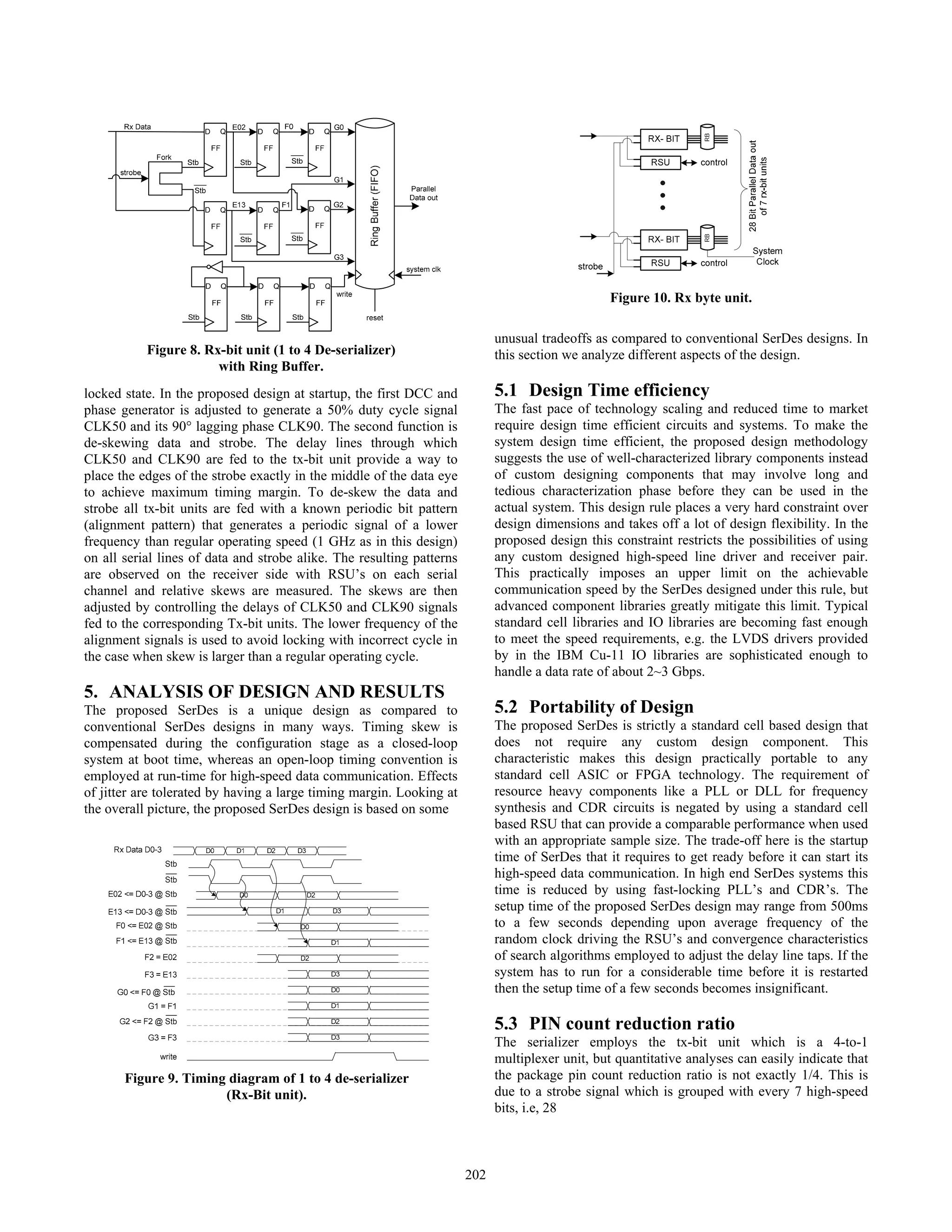
a 2 Gbps link at each serial channel. Seven high-speed bits are
grouped with a strobe signal to form a Tx-byte unit. A Tx-byte
unit takes a 28 bit packet and transmits it over 8 serial channels
including a channel for strobe. The strobe is generated by
applying a bit pattern of alternating ones and zeros like 0101 to a
tx-bit unit which is the same as used for serialization of data bits.
On the receiver side the 8 serial channels are received at a Rx-
byte unit which includes 7 Rx-bit units. Rx-bit unit is a 1-to-4
deserializer that uses the edges of the strobe to capture and
deserialize the data back to parallel bits. An implementation detail
of various components of the proposed SerDes system is provided
in the following subsections.
4.1 Transmitter Side (Serializer)
4.1.1 Tx-Bit Unit
Figure 2 shows the standard cell based tx-bit unit circuit. All four
input data bits D0~D3 are captured at the edge of the clock; bits
D2 and D3 are recaptured at negative edge of the clock. Three
balanced multiplexers are used to multiplex the data to a single
serial output. The timing diagram of the Tx-bit unit is shown in
Figure 3. It takes a symmetric (50% duty cycle) clock (CLK50)
and its 90° lagging phase (CLK90) to multiplex and serialize four
parallel data bits. In the proposed design these two signals are
generated from the system clock. On large chips, the system clock
is distributed through large clock distribution trees made up of
clock buffers and interconnects of appropriate sizes to minimize
skew and end-to-end delay. A noticeable degradation in duty
cycle can occur at the terminal ends of the signal distribution
network. This is due to the slight mismatch in the drive strengths
of pull-up and pull-down networks of the CMOS gates/buffers
and non-uniformity in the distribution of wiring capacitance. To
conserve the portability of the design across different
technologies a standard cell based duty cycle corrector (DCC)
circuit is designed to fix the problem of duty cycle degradation.
4.1.2 Duty Cycle Corrector (DCC)
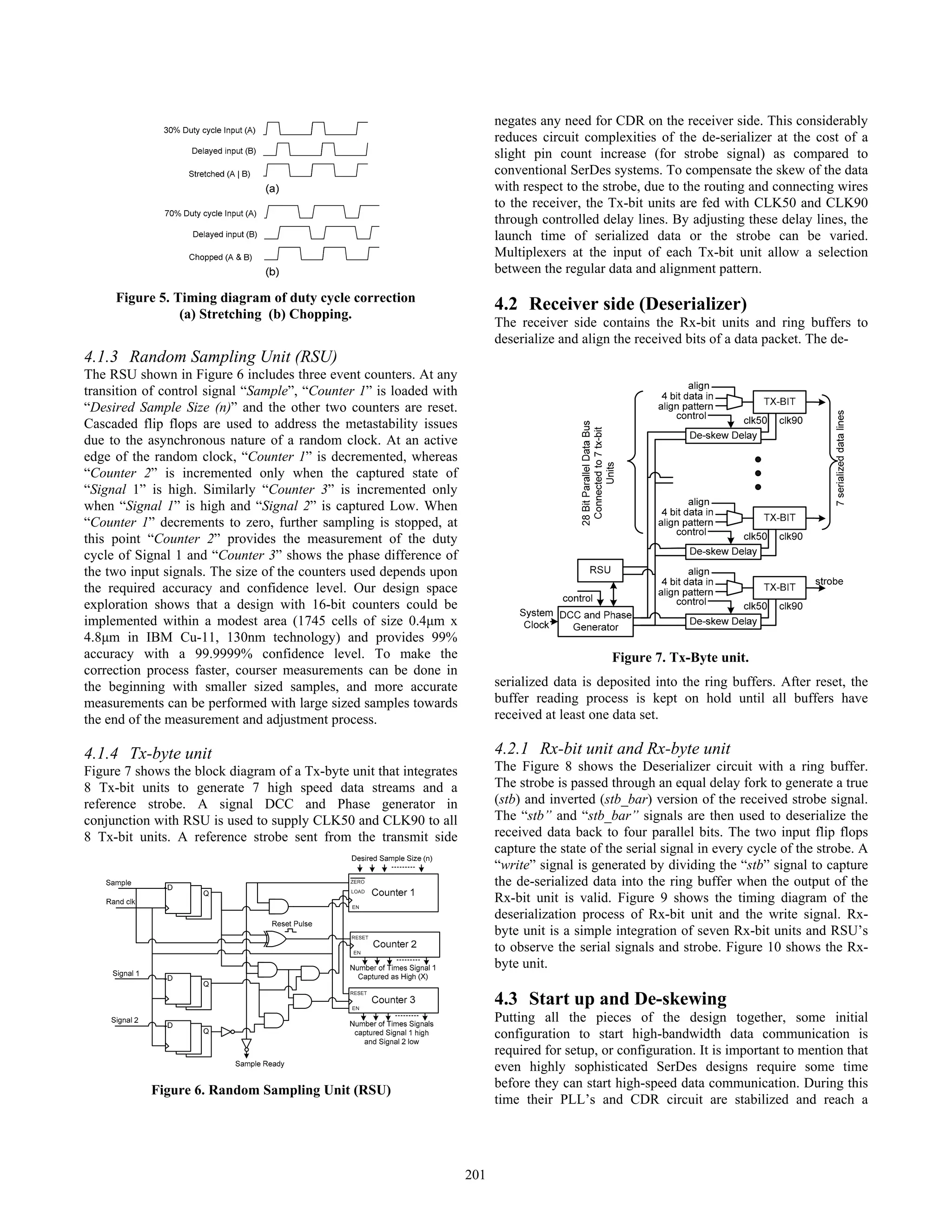
The proposed DCC circuit is shown in Figure 4. It employs a
statistical random sampling technique to measure and correct the
duty cycle of the clock. The circuit uses a small programmable
delay line that provides a delayed version of the input signal. The
delayed signal is ORed with the original input to stretch and
ANDed with the input to chop the input signal as illustrated in
Figure 5. This DCC can adjust an input signal with input duty
cycle of 30% to 70% to wide achievable values within this range.
The duty cycle corrected symmetric clock is then passed through
a digitally controlled delay line to produce its 90° lagging phase
that can be fed to Tx-bit unit as CLK50 and CLK90. The relative
phase between CLK50 and CLK90 is adjusted with the help of a
random sampling unit (RSU).
Figure 3. Timing diagram of Tx-bit unit.
D0
D1
D2
D3
r-D0
r-D1
r-D2
r-D3
rt-D2
rt-D3
MB0
MB1
Ser-Out
CLK50 (50% Duty
Cycle Clock)
CLK90 (90º Phase Clock)
Figure 2. Tx-bit unit: A 4 to 1 serializer circuit module.
Asymmetric
Input Signal
Delay Line
CLK50
(50% Duty Cycle)
Control
Taps
Stretched
Chopped
Original
Random Sampling Unit
Control Unit
sel
Random
clock
Delay LineCLK50
CLK90
(90° Phase)
Figure 4. Duty Cycle Corrector (DCC) and Phase Generator.
200](https://image.slidesharecdn.com/glsvlsi06-140704132935-phpapp02/75/serdes-3-2048.jpg)
![parallel bits are communicated over 8 high-speed channels, thus
the actual pin count reduction ratio of this design is 2/7 instead of
1/4.
5.4 Area and Power Efficiency
From an area and power perspective, in general the most resource
heavy components of a conventional SerDes system are a
frequency multiplier or frequency synthesizer, Driver/Receiver
pair and CDR circuit. The proposed design does not use these
components, resulting in an overall design that is area and power
efficient. The tx-byte unit occupies an area of 3257 cells
excluding and 148409 cells including the LVDS drivers (where
one cell is 0.4μm x 4.8μm in IBM Cu-11, 130nm technology).
The rx-byte unit requires 31535 cells excluding and 176687
including LVDS receivers. The result is 46442 cells (89168.64
μm2
) per high speed bit (2 Gbps channel). The power required to
drive a single high-speed channel at 2Gpbs is around 30 mW. For
a quick comparison to a highly sophisticated SerDes design e.g.
IBM High Speed SerDes (HSS)[10], the proposed design is 60%
smaller in area and requires 62% less power.
5.5 Results
The proposed SerDes design targeted to IBM Cu-11 is laid out for
a 1600 ball grid array (BGA) pin package using area pad drivers
(OLVDS) and receivers (ILVDS) of IBM IO libraries. The design
is then tested through HSPICE simulations for lossy transmission
lines connecting wire models of 50Ω co-axial cable, wires on FR4
and NELCO13 boards of un-equal lengths for data and strobe
lines. Lengths of the wires are set such that the delay lines to
compensate the strobe-data skew should emulate the worst case
scenario. Figure 11 shows an eye diagram of the data signal
received at the pads of an LVDS receiver with respect to edges of
the strobe signal for an FR-4 board wires. The simulations include
full loss, crosstalk, power supply reflections, and jitter. In spite of
the jitter in the strobe the wide opening of the eye shows a timing
margin that corresponds to a jitter tolerance of around ±200ps to
other sources of noise like crosstalk etc.
6. CONCLUSION
The increasing trend of multi core processors and embedded
systems demands large signal count. SerDes are a direct solution
to reduce package pin count by practically time multiplexing
multiple signals on to the same pin. However the conventional
designs of SerDes systems come with large die area, operating
power and financial cost. The proposed SerDes uses a unique
design technique to avoid resource heavy components used in
conventional SerDes designs. The design is based on Standard
cell technology and is portable to any other technology. The
power consumption of the proposed SerDes design is 30 mW per
serial link targeted to IBM Cu-11(130 nm) Technology, nearly a
2.5x improvement over the conventional design within 60% less
area.
7. REFERENCES
[1] R. Bhatti, et al, “Duty cycle measurement and correction
using a random sampling technique”, IEEE International
Midwest Symposium on Circuits and Systems 2005.
[2] R. Bhatti, et al, “Phase Measurement and Adjustment of
Digital Signals Using Random Sampling Technique”, IEEE
International Symposium on Circuits and Systems 2006.
[3] Jeff Draper, et al, The Architecture of the DIVA Processing-
In-Memory Chip, Proceedings of the International
Conference on Supercomputing, June 2002
[4] C. Dryden, “Survey of design and process failure modes for
high-speed SerDes in nanometer CMOS”, 23rd Proceedings
of IEEE VLSI Test Symposium 2005.
[5] T. Geurts et al, “A 2.5 Gbps - 3.125 Gbps multi-core serial-
link transceiver in 0.13 /spl mu/m CMOS”, Proceeding of the
30th European Solid-State Circuits Conference 2004.
Page(s):487 – 490.
[6] K. Iniewski et al, “SerDes technology for gigabit I/O
communications in storage area networking”, 4th IEEE
International Workshop on System-on-Chip for Real-Time
Applications Proceedings 2004, Page(s):247 – 252
[7] S. Maggioni, et al, “Random sampling for on-chip
characterization of standard-cell propagation delay”, Fourth
International Symposium on Quality Electronic Design 2003.
[8] E. Matoglu et al, “Design and verification of multi-gigabit
transmission channels using equalization techniques”,
Proceedings of Electronic Components and Technology
2005.
[9] H. Partovi et al, “A 62.5 Gb/s multi-standard SerDes IC”,
Proceedings of Custom Integrated Circuits Conference 2003.
[10] M. Sorna et al, “A 6.4Gb/s CMOS SerDes core with
feedforward and decision-feedback equalization”, IEEE
International Solid-State Circuits Conference, 2005.
[11] E. Suckow, “Basics of High-Performance SerDes Design”,
http://www.analogzone.com
[12] S. Sunter, A. Roy and J. F. Cote, “An automated, complete,
structural test solution for SerDes”, Proceedings of
International Test Conference 2004.
Figure 11. Simulation results for the complete system that
includes line loss, crosstalk, reflections and jitter.
203](https://image.slidesharecdn.com/glsvlsi06-140704132935-phpapp02/75/serdes-6-2048.jpg)

This document describes a 2 Gbps serializer and deserializer (SerDes) communication link design based on standard cell technology. The proposed design aims to be more area, power, and design time efficient compared to conventional SerDes designs. It employs a statistical random sampling technique to observe and adjust synchronization and serialization signals during startup, rather than using PLL or DLL based circuits. Multiple serial lines are bundled with a strobe signal used for deserialization. Data-to-strobe timing skew is compensated by adjusting launch times of strobe and data symbols. The design is inherently tolerant of jitter. It is targeted to consume 30 mW per link in a 130nm technology, a 2.5x improvement over conventional designs with 60%


