International Journal of VLSI design & Communication Systems (VLSICS) Vol.6, No.6, December 2015
DOI : 10.5121/vlsic.2015.6603 23
DESIGN OF A LOW-POWER 1.65 GBPS DATA
CHANNEL FOR HDMI TRANSMITTER
Ajay Agrawal and R.S.Gamad
Department of Electronics and Instrumentation Engineering,
Shri Govindram Seksaria Institute of Technology and Science,
23, Park Road, Indore, M.P. 452003, India
ABSTRACT
This paper presents a design of low power data channel for application in High Definition Multimedia
Interface (HDMI) Transmitter circuit. The input is 10 bit parallel data and output is serial data at 1.65
Gbps. This circuit uses only a single frequency of serial clock input. All other timing signals are derived
within the circuit from the serial clock. This design has dedicated lines to disable and enable all its
channels within two pixel-clock periods only. A pair of disable and enable functions performed
immediately after power-on of the circuit serves as the reset function. The presented design is immune to
data-dependent switching spikes in supply current and pushes them in the range of serial frequency and its
multiples. Thus filtering requirements are relaxed. The output stage uses a bias voltage of 2.8 volts for a
receiver pull-up voltage of 3.3 volts. The reported data channel is designed using UMC 180 nm CMOS
Technology. The design is modifiable for other inter-board serial interfaces like USB and LAN with
different number of bits at the parallel input.
KEYWORDS
Gbps, HDMI, Serial Interface, Supply Current, USB
1. INTRODUCTION
Presently, a large number of computer devices under development are hand-held mobile devices
equipped with high speed serial communication ports like USB and HDMI. As these devices are
battery operated, it is highly necessary that the power consumption of their transmitting circuits is
kept as low as possible. Since the speed of transmission cannot be reduced for a standard real
time data transmitter like HDMI, it is required to design the transmitter circuit without sacrificing
the speed of transmission [1]. Some design use the feature of power harvesting from the receiver
signalling channels allowing the high power consumption of the transmitter IC. Another solution
is technology scaling for low power achievement at the desired speed. This normally results in
increased design and fabrication cost of the devices. While some other designs use reduced signal
swing of the output voltage which do not apply to the presented target interface [2-6]. This design
presents the data channel section of the HDMI transmitter circuit in 180 nm CMOS which is
input with only one frequency of serial clock coming from the PLL and eliminated the use of
multiple clock signals [7]. It is powered with the standard 1.8V supply and driver cascade stage
used a bias voltage of 2.8 V which is less than battery voltage of almost all mobile devices.
International Journal of VLSI design & Communication Systems (VLSICS) Vol.6, No.6, December 2015
24
This paper is organized as follows. In section two, the overview of proposed HDMI transmitter
data channel is discussed. Section three presents schematic of proposed data channel. The
simulation results of proposed design are presented in section four and concluded in section five.
2. HDMI TRANSMITTER DATA CHANNEL
The block diagram of proposed HDMI data channel is shown in Fig.1. The transmitter data
channel was fed with 10-bit parallel data from the video data controller. The FIFO and serializing
block do the function of holding the 10-bit data and its serialization.
Figure 1. Block Diagram of Data Channel
The even 5 bits were multiplexed into one active low ‘Even’ signal and odd 5 bits were
multiplexed into one active low ‘Odd’ signal. Similarly active low even and odd complements
were also generated. The two ‘Even’ and ‘Odd’ signals were sufficiently buffered by two
different pre-drivers with pull-up at their inputs. Two more similar pre-drivers were required for
their complements. Thus four pre-driver channels were used. This even and odd period driving
has the advantage of hiding data-dependent surges on supply nets which arise due to pre-driver
switching [2]. The pre-driver outputs were applied to the driving circuit as shown in Fig. 1 to
drive the output differential line. The driver output pins Tx+ and Tx- sink the current supplied
from the receiver supply via termination resistors on the remote side of the HDMI cable. The
receiver supply voltage is generally 3.3 Volts. Also as per the specifications[1] when the
transmitter is in standby mode, the voltage drop across the resistors should not exceed 10mV
each.
3. PROPOSED DATA CHANNEL
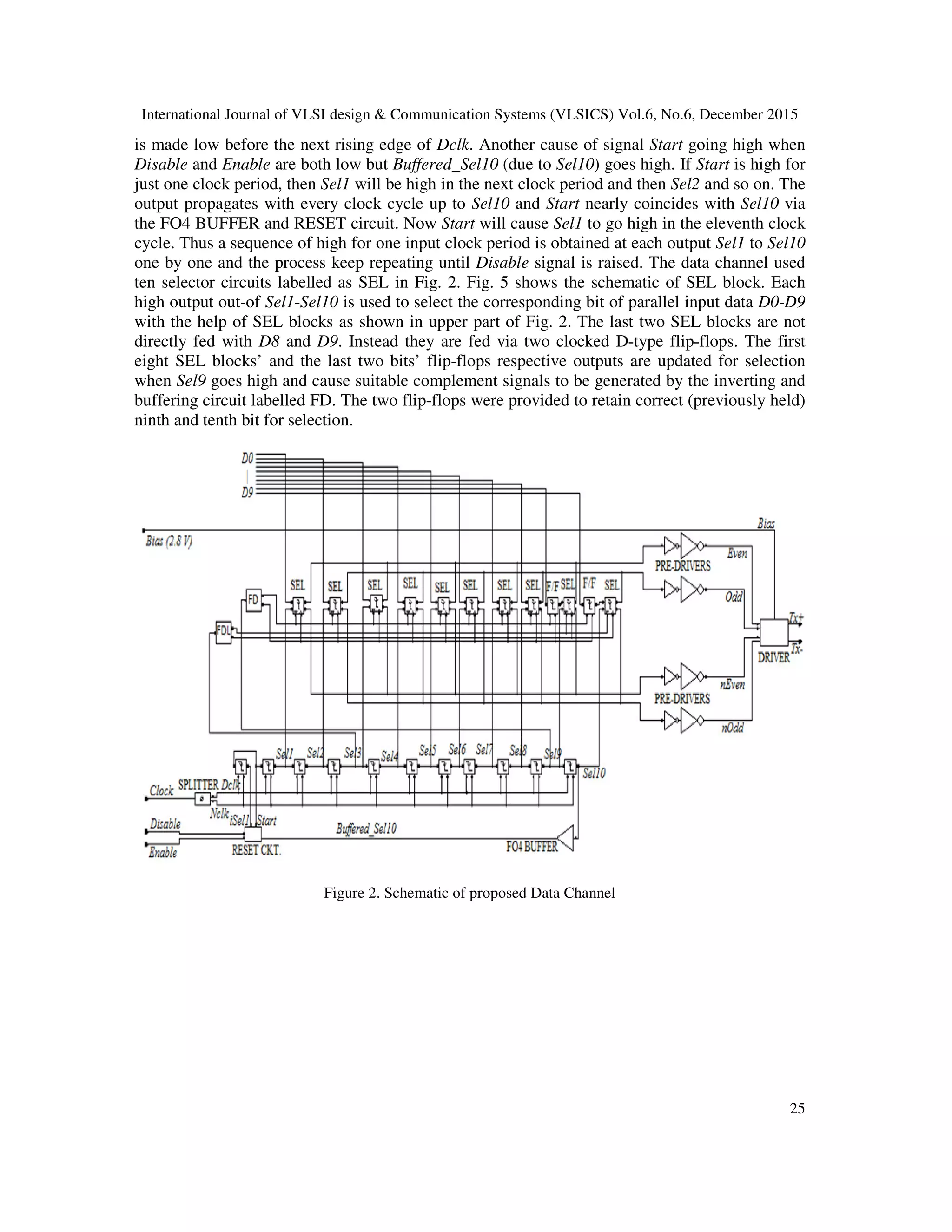
The schematic of presented Data Channel is shown in Fig. 2. It contains a tandem connected
chain of ten falling-edge triggered clocked D-type flip-flops[8]. This flip-flop chain is shown in
the lower part of Fig. 2 with outputs labelled Sel1 to Sel10. In Fig. 2, the first flip-flop has a
parallel similar flip-flop (left-most) and both their inputs are fed with the common signal Start.
The output of first flip-flop is Sel1 and that of its parallel is iSel1. These 11 flip-flops are
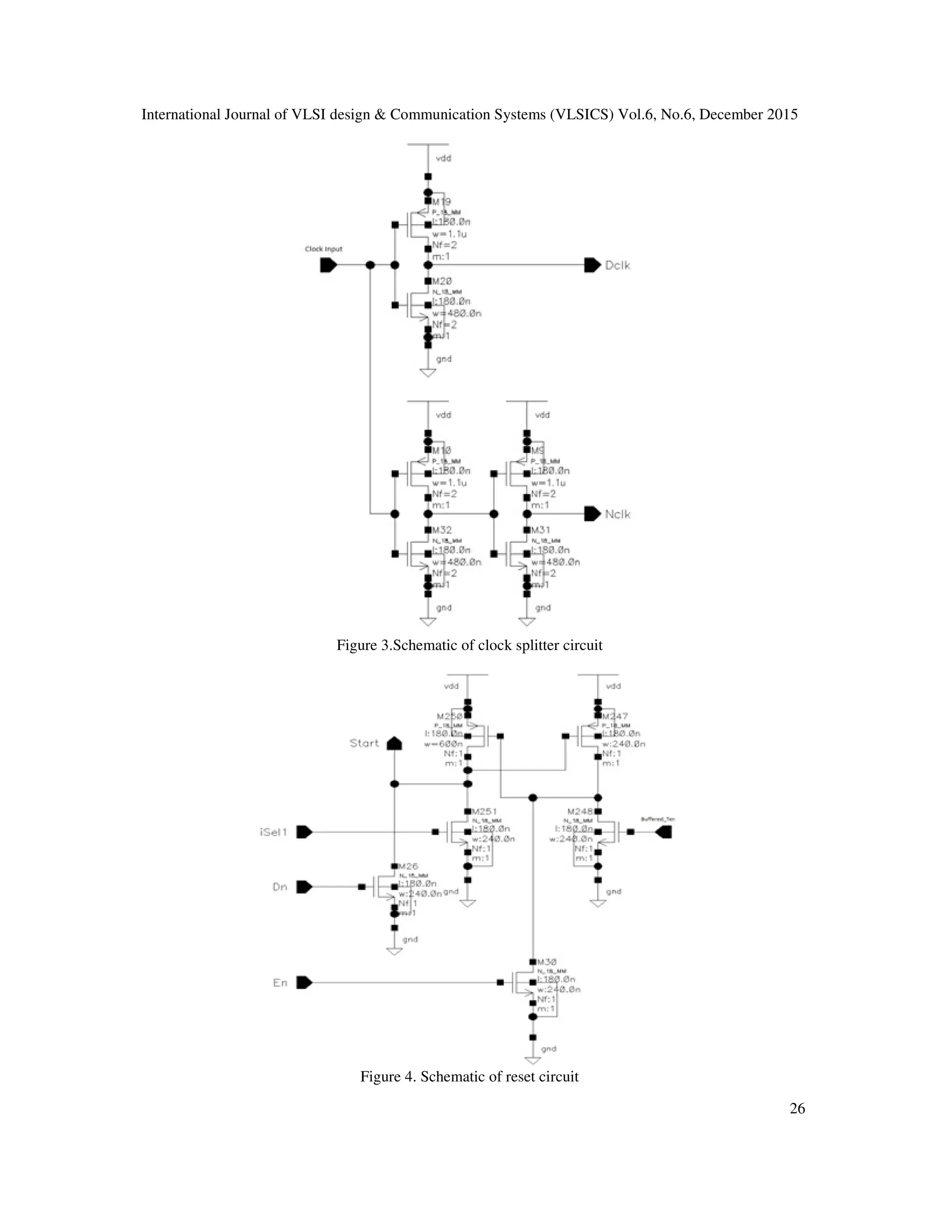
triggered with two nearly complement clock signals Dclk and Nclk obtained from the input Clock
signal by the SPLITTER circuit shown in Fig. 3.
A RESET circuit was provided for disabling and enabling the data channel. The schematic of this
RESET circuit is shown in Fig. 4. The signal Start is driven as high at falling edge of Dclk only if
Disable input was low and Enable input was high at the previous rising edge of Dclk. The Enable
International Journal of VLSI design & Communication Systems (VLSICS) Vol.6, No.6, December 2015
25
is made low before the next rising edge of Dclk. Another cause of signal Start going high when
Disable and Enable are both low but Buffered_Sel10 (due to Sel10) goes high. If Start is high for
just one clock period, then Sel1 will be high in the next clock period and then Sel2 and so on. The
output propagates with every clock cycle up to Sel10 and Start nearly coincides with Sel10 via
the FO4 BUFFER and RESET circuit. Now Start will cause Sel1 to go high in the eleventh clock
cycle. Thus a sequence of high for one input clock period is obtained at each output Sel1 to Sel10
one by one and the process keep repeating until Disable signal is raised. The data channel used
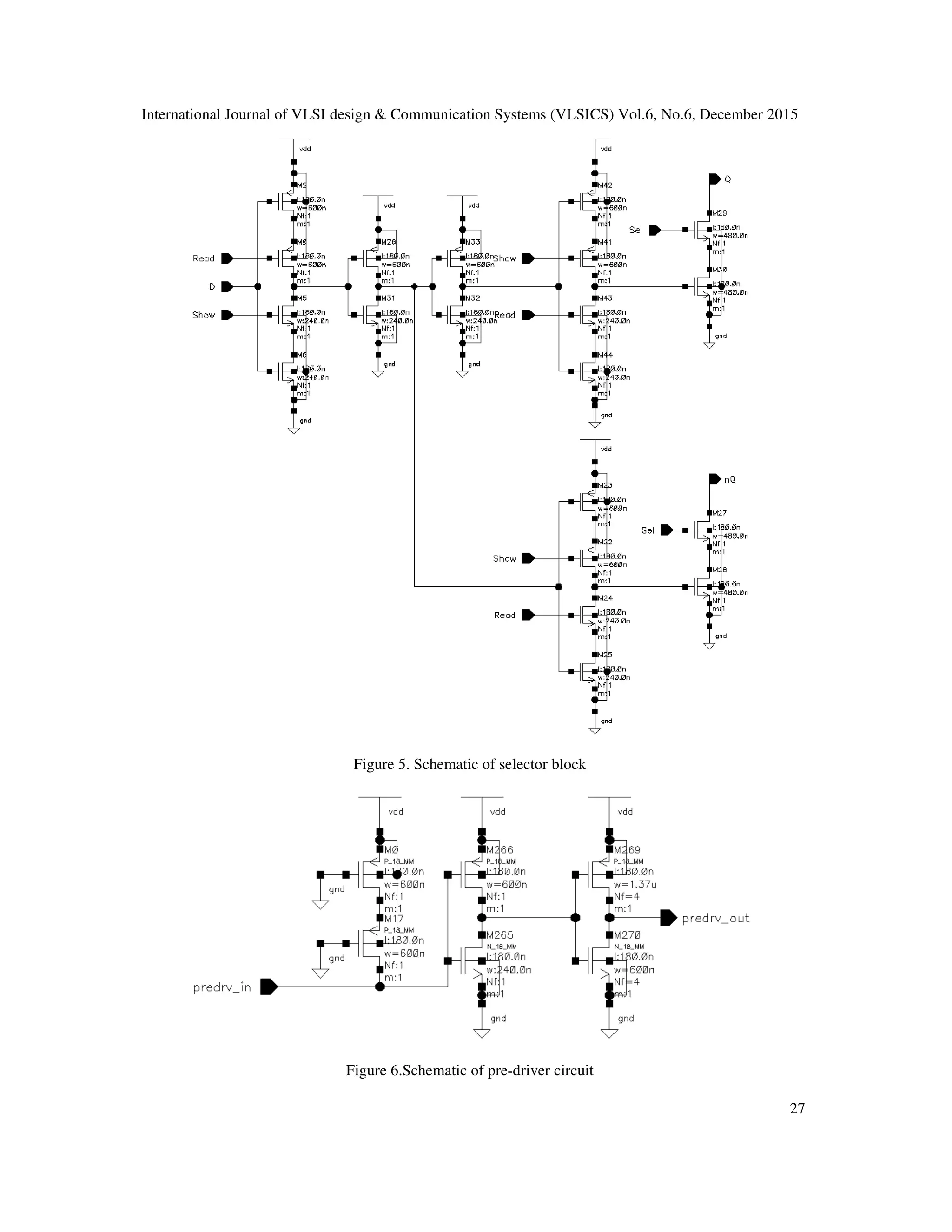
ten selector circuits labelled as SEL in Fig. 2. Fig. 5 shows the schematic of SEL block. Each
high output out-of Sel1-Sel10 is used to select the corresponding bit of parallel input data D0-D9
with the help of SEL blocks as shown in upper part of Fig. 2. The last two SEL blocks are not
directly fed with D8 and D9. Instead they are fed via two clocked D-type flip-flops. The first
eight SEL blocks’ and the last two bits’ flip-flops respective outputs are updated for selection
when Sel9 goes high and cause suitable complement signals to be generated by the inverting and
buffering circuit labelled FD. The two flip-flops were provided to retain correct (previously held)
ninth and tenth bit for selection.
Figure 2. Schematic of proposed Data Channel
International Journal of VLSI design & Communication Systems (VLSICS) Vol.6, No.6, December 2015
26
Figure 3.Schematic of clock splitter circuit
Figure 4. Schematic of reset circuit
International Journal of VLSI design & Communication Systems (VLSICS) Vol.6, No.6, December 2015
Figure 5. Schematic of selector block
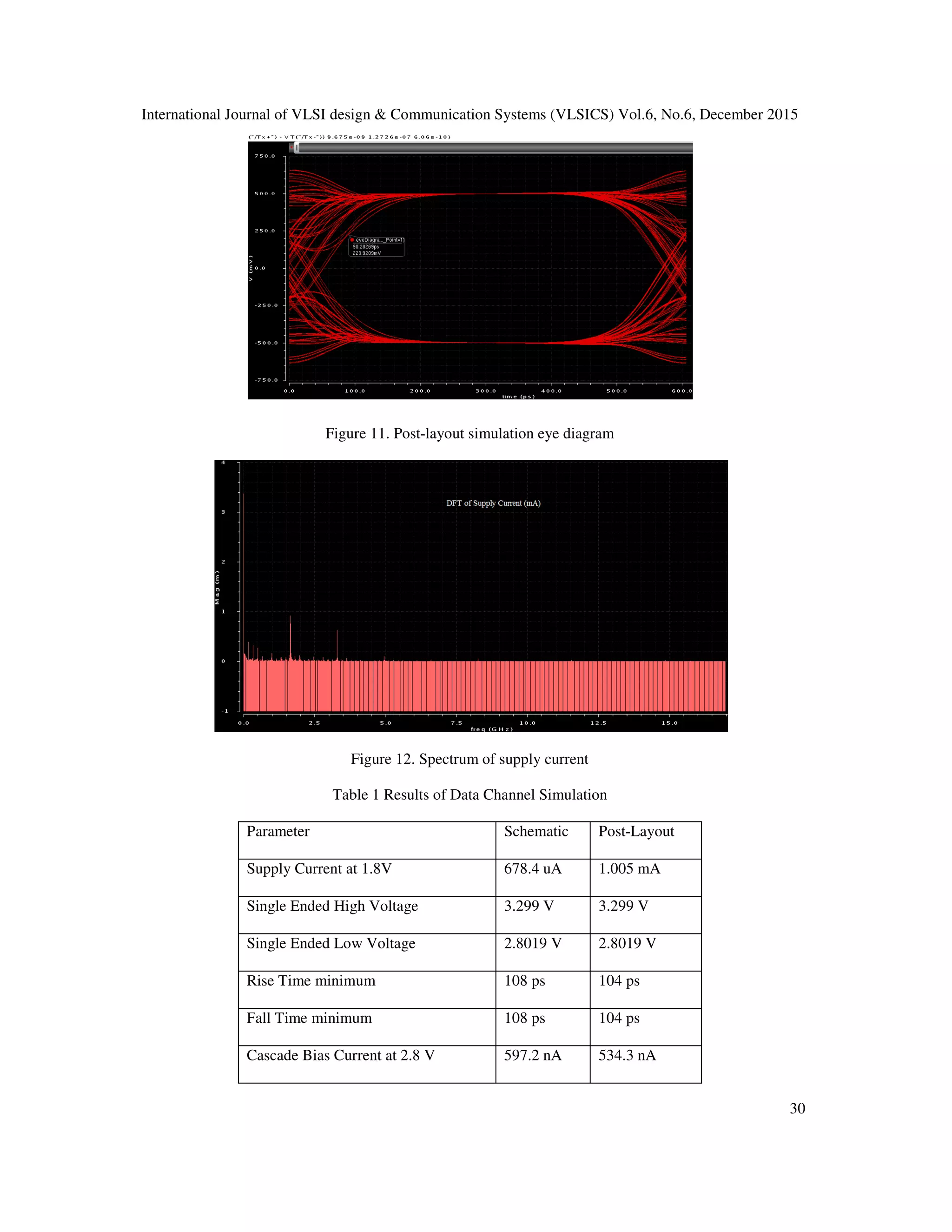
Figure 6.Schematic of pre
International Journal of VLSI design & Communication Systems (VLSICS) Vol.6, No.6, December 2015
Figure 5. Schematic of selector block
Figure 6.Schematic of pre-driver circuit
International Journal of VLSI design & Communication Systems (VLSICS) Vol.6, No.6, December 2015
27
International Journal of VLSI design & Communication Systems (VLSICS) Vol.6, No.6, December 2015
These two flip-flops update the output with the falling and rising edge respective of their own
clock (Show) and anti-clock (Read) inputs. These inputs are derived from
inverting and buffering circuit labelled as FDL. Hence parallel
first bit selected and kept in hold until all bits are serialized. Thus all correct data bits are selected
in one round of selection from Sel1
data channel.
The SELs’ complementary outputs are connected in two groups of even and odd bit periods for
the purpose of pseudo-shadow switching
has its own internal pull-up at the input as shown in
from the five connected SEL outputs. The even and odd pre
parallel pmos transistors in DRIVER circ
multiplexing was achieved. A
differential driving. Fig. 8 shows the proposed layout for the presented design.
Figure 8. Proposed layout of Data Channel
International Journal of VLSI design & Communication Systems (VLSICS) Vol.6, No.6, December 2015
flops update the output with the falling and rising edge respective of their own
clock (Read) inputs. These inputs are derived from Sel3 high level by the
inverting and buffering circuit labelled as FDL. Hence parallel 10 bit data is taken in hold before
first bit selected and kept in hold until all bits are serialized. Thus all correct data bits are selected
Sel1 to Sel10. This is the First-In First-Out (FIFO) action of the
he SELs’ complementary outputs are connected in two groups of even and odd bit periods for
shadow switching [9]. Thus four pre-drivers were used and each pre
up at the input as shown in Fig. 6 so that active low can be multiplexed
from the five connected SEL outputs. The even and odd pre-driver outputs were used to drive the
parallel pmos transistors in DRIVER circuit as shown in Fig.7. Thus 10:1 time
A complementarily active-low driving pair was required for
differential driving. Fig. 8 shows the proposed layout for the presented design.
Figure 7. Schematic of driver circuit
Figure 8. Proposed layout of Data Channel
International Journal of VLSI design & Communication Systems (VLSICS) Vol.6, No.6, December 2015
28
flops update the output with the falling and rising edge respective of their own
high level by the
10 bit data is taken in hold before
first bit selected and kept in hold until all bits are serialized. Thus all correct data bits are selected
Out (FIFO) action of the
he SELs’ complementary outputs are connected in two groups of even and odd bit periods for
drivers were used and each pre-driver
active low can be multiplexed
driver outputs were used to drive the
7. Thus 10:1 time-division
low driving pair was required for
International Journal of VLSI design & Communication Systems (VLSICS) Vol.6, No.6, December 2015
4. SIMULATION RESULTS
The presented design was simulated using Cadence Virtuoso.
bit-select signals Sel1-Sel10, iSel1
for schematic and post-layout simulation are compared in Table 1.
diagram requirements of the HDMI specification and post
10 and 11 respectively. Fig. 12 shows the spectrum of supply current drawn by three as such
presented data channels and one clock channe
within 500 MHz are less than 6% of dc component. The simulation results are compared against
HDMI specification [1] for output voltage requirements in Table 2.
Figure 9. Bit
Figure 10. Eye diagram specification
International Journal of VLSI design & Communication Systems (VLSICS) Vol.6, No.6, December 2015
ESULTS
ed design was simulated using Cadence Virtuoso. During post-layout simulation the
iSel1 and Start signals were obtained as shown in Fig. 9. The
layout simulation are compared in Table 1. The differential output eye
diagram requirements of the HDMI specification and post-layout simulation are displayed in Fig.
10 and 11 respectively. Fig. 12 shows the spectrum of supply current drawn by three as such
presented data channels and one clock channel. As shown in Fig. 12, supply current components
within 500 MHz are less than 6% of dc component. The simulation results are compared against
HDMI specification [1] for output voltage requirements in Table 2.
Figure 9. Bit-select and other signals
Figure 10. Eye diagram specification
International Journal of VLSI design & Communication Systems (VLSICS) Vol.6, No.6, December 2015
29
layout simulation the
signals were obtained as shown in Fig. 9. The results
differential output eye
layout simulation are displayed in Fig.
10 and 11 respectively. Fig. 12 shows the spectrum of supply current drawn by three as such
supply current components
within 500 MHz are less than 6% of dc component. The simulation results are compared against
International Journal of VLSI design & Communication Systems (VLSICS) Vol.6, No.6, December 2015
Figure 11. Post
Figure 12. Spectrum of supply current
Table 1 Results of Data Channel Simulation
Parameter
Supply Current at 1.8V
Single Ended High Voltage
Single Ended Low Voltage
Rise Time minimum
Fall Time minimum
Cascade Bias Current at 2.8 V
International Journal of VLSI design & Communication Systems (VLSICS) Vol.6, No.6, December 2015
Figure 11. Post-layout simulation eye diagram
Figure 12. Spectrum of supply current
Table 1 Results of Data Channel Simulation
Schematic Post-Layout
Supply Current at 1.8V 678.4 uA 1.005 mA
Ended High Voltage 3.299 V 3.299 V
Single Ended Low Voltage 2.8019 V 2.8019 V
Rise Time minimum 108 ps 104 ps
Fall Time minimum 108 ps 104 ps
Cascade Bias Current at 2.8 V 597.2 nA 534.3 nA
International Journal of VLSI design & Communication Systems (VLSICS) Vol.6, No.6, December 2015
30
International Journal of VLSI design & Communication Systems (VLSICS) Vol.6, No.6, December 2015
31
Table 2. Performance Chart
Item Desired Value [1]
Achieved
Value
Single-ended standby output voltage, Voff 3.290 V < Voff < 3.310 V 3.299 V
Single-ended output swing voltage, Vswing 400mV < Vswing < 600mV 660 mV
Single-ended high level output voltage, VH 3.3 V + 10mV 3.299 V
Single-ended low level output voltage, VL 2.7 V < VL < 2.9 V 2.8019 V
Rise time & fall time (20%-80%)
75 psec < Rise time & 75 psec
< fall time
104 psec &
104 psec
5. CONCLUSIONS
In this paper, a design was presented for data channel of 1.65 Gbps serial speed for application in
HDMI transmitter with low power consumption. The single ended output voltage swing could be
manipulated by controlling the time of over-lap and under-lap of driver’s parallel MOS
transistors by providing additional combinational logic in the serializer. The presented schematic
can also be utilized for other similar high speed serial interfaces like USB and LAN with
applicable modifications.
ACKNOWLEDGEMENTS
The authors would like to thank the Department of Electronics and Instrumentation Engineering,
S.G.S.I.T.S., Indore, India for providing the laboratory facility for performing this work.
REFERENCES
[1] HDMI Licensing, LLC, High-Definition Multimedia Interface Specification Version 1.3a,
http://www.hdmi.org
[2] N. Gupta, T. Nandy, P. S. Sahni, M. Garg, J. N. Tripathi, (2014) “Zero Power 4.95Gbps HDMI
Transmitter”, IEEE International Symposium on Circuits and Systems (ISCAS), Melbourne VIC,
page no. 1500 – 1503.
[3] N. Gupta, P. Bala, V.K. Singh, (2013) “Area and Power Efficient 3.4Gbps/Channel HDMI
Transmitter with Single-Ended Structure”, Proceedings of the 26th International Conference on VLSI
Design and 12th International Conference on Embedded Systems (VLSID), Pune, ISSN: 1063-9667,
page no. 142 – 146.
[4] N. Gupta, T. Nandy, S. Kundu, (2012) “HDMI transmitter in 32nM technology using 28Å MOS”,
IEEE International Symposium on Circuits and Systems (ISCAS), Seoul, ISSN: 0271-4302, page no.
1951 – 1954.
International Journal of VLSI design & Communication Systems (VLSICS) Vol.6, No.6, December 2015
32
[5] Y. Jeong, et al., (2012) “0.37mW/Gb/s low power SLVS transmitter for battery powered
applications”, IEEE International Symposium on Circuits and Systems (ISCAS), Seoul, ISSN: 0271-
4302, page no. 1955 – 1958.
[6] R. Inti, et al., (2011) “A highly digital 0.5 -to-4Gb/s 1.9mW/Gb/s serial-link transceiver using
current-recycling in 90nm CMOS”, IEEE International Solid-State Circuits Conference Digest of
Technical Papers (ISSCC), San Francisco, CA, ISSN: 0193-6530, page no.152 – 154.
[7] K. Kim, K. Jung, C. Park, W. Park, S. Lee and S. Cho, (2010) “A 3.4Gbps Transmitter for Multi-
Serial Data Communication using pre-emphasis method”, Proceedings of the 4th WSEAS
international conference on Circuits, systems, signal and telecommunications, pp. 153-156.
[8] Y. Suzuki , K. Odagawa and T. Abe, (1973) “Clocked CMOS calculator circuitry”, IEEE J. Solid-
State Circuits, vol. 8, pp.462 -469.
[9] N. Gupta, T. Nandy, P. Bala, (2012) "Self- -Induced Supply Noise Reduction Technique in GBPS
Rate Transmitters", Proceedings of the 25th International Conference on VLSI Design (VLSID), pp.
92, 95, 7-11.

Design of a Low-Power 1.65 GBPS Data Channel for HDMI Transmitter

  • 1.
    International Journal ofVLSI design & Communication Systems (VLSICS) Vol.6, No.6, December 2015 DOI : 10.5121/vlsic.2015.6603 23 DESIGN OF A LOW-POWER 1.65 GBPS DATA CHANNEL FOR HDMI TRANSMITTER Ajay Agrawal and R.S.Gamad Department of Electronics and Instrumentation Engineering, Shri Govindram Seksaria Institute of Technology and Science, 23, Park Road, Indore, M.P. 452003, India ABSTRACT This paper presents a design of low power data channel for application in High Definition Multimedia Interface (HDMI) Transmitter circuit. The input is 10 bit parallel data and output is serial data at 1.65 Gbps. This circuit uses only a single frequency of serial clock input. All other timing signals are derived within the circuit from the serial clock. This design has dedicated lines to disable and enable all its channels within two pixel-clock periods only. A pair of disable and enable functions performed immediately after power-on of the circuit serves as the reset function. The presented design is immune to data-dependent switching spikes in supply current and pushes them in the range of serial frequency and its multiples. Thus filtering requirements are relaxed. The output stage uses a bias voltage of 2.8 volts for a receiver pull-up voltage of 3.3 volts. The reported data channel is designed using UMC 180 nm CMOS Technology. The design is modifiable for other inter-board serial interfaces like USB and LAN with different number of bits at the parallel input. KEYWORDS Gbps, HDMI, Serial Interface, Supply Current, USB 1. INTRODUCTION Presently, a large number of computer devices under development are hand-held mobile devices equipped with high speed serial communication ports like USB and HDMI. As these devices are battery operated, it is highly necessary that the power consumption of their transmitting circuits is kept as low as possible. Since the speed of transmission cannot be reduced for a standard real time data transmitter like HDMI, it is required to design the transmitter circuit without sacrificing the speed of transmission [1]. Some design use the feature of power harvesting from the receiver signalling channels allowing the high power consumption of the transmitter IC. Another solution is technology scaling for low power achievement at the desired speed. This normally results in increased design and fabrication cost of the devices. While some other designs use reduced signal swing of the output voltage which do not apply to the presented target interface [2-6]. This design presents the data channel section of the HDMI transmitter circuit in 180 nm CMOS which is input with only one frequency of serial clock coming from the PLL and eliminated the use of multiple clock signals [7]. It is powered with the standard 1.8V supply and driver cascade stage used a bias voltage of 2.8 V which is less than battery voltage of almost all mobile devices.
  • 2.
    International Journal ofVLSI design & Communication Systems (VLSICS) Vol.6, No.6, December 2015 24 This paper is organized as follows. In section two, the overview of proposed HDMI transmitter data channel is discussed. Section three presents schematic of proposed data channel. The simulation results of proposed design are presented in section four and concluded in section five. 2. HDMI TRANSMITTER DATA CHANNEL The block diagram of proposed HDMI data channel is shown in Fig.1. The transmitter data channel was fed with 10-bit parallel data from the video data controller. The FIFO and serializing block do the function of holding the 10-bit data and its serialization. Figure 1. Block Diagram of Data Channel The even 5 bits were multiplexed into one active low ‘Even’ signal and odd 5 bits were multiplexed into one active low ‘Odd’ signal. Similarly active low even and odd complements were also generated. The two ‘Even’ and ‘Odd’ signals were sufficiently buffered by two different pre-drivers with pull-up at their inputs. Two more similar pre-drivers were required for their complements. Thus four pre-driver channels were used. This even and odd period driving has the advantage of hiding data-dependent surges on supply nets which arise due to pre-driver switching [2]. The pre-driver outputs were applied to the driving circuit as shown in Fig. 1 to drive the output differential line. The driver output pins Tx+ and Tx- sink the current supplied from the receiver supply via termination resistors on the remote side of the HDMI cable. The receiver supply voltage is generally 3.3 Volts. Also as per the specifications[1] when the transmitter is in standby mode, the voltage drop across the resistors should not exceed 10mV each. 3. PROPOSED DATA CHANNEL The schematic of presented Data Channel is shown in Fig. 2. It contains a tandem connected chain of ten falling-edge triggered clocked D-type flip-flops[8]. This flip-flop chain is shown in the lower part of Fig. 2 with outputs labelled Sel1 to Sel10. In Fig. 2, the first flip-flop has a parallel similar flip-flop (left-most) and both their inputs are fed with the common signal Start. The output of first flip-flop is Sel1 and that of its parallel is iSel1. These 11 flip-flops are triggered with two nearly complement clock signals Dclk and Nclk obtained from the input Clock signal by the SPLITTER circuit shown in Fig. 3. A RESET circuit was provided for disabling and enabling the data channel. The schematic of this RESET circuit is shown in Fig. 4. The signal Start is driven as high at falling edge of Dclk only if Disable input was low and Enable input was high at the previous rising edge of Dclk. The Enable
  • 3.
    International Journal ofVLSI design & Communication Systems (VLSICS) Vol.6, No.6, December 2015 25 is made low before the next rising edge of Dclk. Another cause of signal Start going high when Disable and Enable are both low but Buffered_Sel10 (due to Sel10) goes high. If Start is high for just one clock period, then Sel1 will be high in the next clock period and then Sel2 and so on. The output propagates with every clock cycle up to Sel10 and Start nearly coincides with Sel10 via the FO4 BUFFER and RESET circuit. Now Start will cause Sel1 to go high in the eleventh clock cycle. Thus a sequence of high for one input clock period is obtained at each output Sel1 to Sel10 one by one and the process keep repeating until Disable signal is raised. The data channel used ten selector circuits labelled as SEL in Fig. 2. Fig. 5 shows the schematic of SEL block. Each high output out-of Sel1-Sel10 is used to select the corresponding bit of parallel input data D0-D9 with the help of SEL blocks as shown in upper part of Fig. 2. The last two SEL blocks are not directly fed with D8 and D9. Instead they are fed via two clocked D-type flip-flops. The first eight SEL blocks’ and the last two bits’ flip-flops respective outputs are updated for selection when Sel9 goes high and cause suitable complement signals to be generated by the inverting and buffering circuit labelled FD. The two flip-flops were provided to retain correct (previously held) ninth and tenth bit for selection. Figure 2. Schematic of proposed Data Channel
  • 4.
    International Journal ofVLSI design & Communication Systems (VLSICS) Vol.6, No.6, December 2015 26 Figure 3.Schematic of clock splitter circuit Figure 4. Schematic of reset circuit
  • 5.
    International Journal ofVLSI design & Communication Systems (VLSICS) Vol.6, No.6, December 2015 Figure 5. Schematic of selector block Figure 6.Schematic of pre International Journal of VLSI design & Communication Systems (VLSICS) Vol.6, No.6, December 2015 Figure 5. Schematic of selector block Figure 6.Schematic of pre-driver circuit International Journal of VLSI design & Communication Systems (VLSICS) Vol.6, No.6, December 2015 27
  • 6.
    International Journal ofVLSI design & Communication Systems (VLSICS) Vol.6, No.6, December 2015 These two flip-flops update the output with the falling and rising edge respective of their own clock (Show) and anti-clock (Read) inputs. These inputs are derived from inverting and buffering circuit labelled as FDL. Hence parallel first bit selected and kept in hold until all bits are serialized. Thus all correct data bits are selected in one round of selection from Sel1 data channel. The SELs’ complementary outputs are connected in two groups of even and odd bit periods for the purpose of pseudo-shadow switching has its own internal pull-up at the input as shown in from the five connected SEL outputs. The even and odd pre parallel pmos transistors in DRIVER circ multiplexing was achieved. A differential driving. Fig. 8 shows the proposed layout for the presented design. Figure 8. Proposed layout of Data Channel International Journal of VLSI design & Communication Systems (VLSICS) Vol.6, No.6, December 2015 flops update the output with the falling and rising edge respective of their own clock (Read) inputs. These inputs are derived from Sel3 high level by the inverting and buffering circuit labelled as FDL. Hence parallel 10 bit data is taken in hold before first bit selected and kept in hold until all bits are serialized. Thus all correct data bits are selected Sel1 to Sel10. This is the First-In First-Out (FIFO) action of the he SELs’ complementary outputs are connected in two groups of even and odd bit periods for shadow switching [9]. Thus four pre-drivers were used and each pre up at the input as shown in Fig. 6 so that active low can be multiplexed from the five connected SEL outputs. The even and odd pre-driver outputs were used to drive the parallel pmos transistors in DRIVER circuit as shown in Fig.7. Thus 10:1 time A complementarily active-low driving pair was required for differential driving. Fig. 8 shows the proposed layout for the presented design. Figure 7. Schematic of driver circuit Figure 8. Proposed layout of Data Channel International Journal of VLSI design & Communication Systems (VLSICS) Vol.6, No.6, December 2015 28 flops update the output with the falling and rising edge respective of their own high level by the 10 bit data is taken in hold before first bit selected and kept in hold until all bits are serialized. Thus all correct data bits are selected Out (FIFO) action of the he SELs’ complementary outputs are connected in two groups of even and odd bit periods for drivers were used and each pre-driver active low can be multiplexed driver outputs were used to drive the 7. Thus 10:1 time-division low driving pair was required for
  • 7.
    International Journal ofVLSI design & Communication Systems (VLSICS) Vol.6, No.6, December 2015 4. SIMULATION RESULTS The presented design was simulated using Cadence Virtuoso. bit-select signals Sel1-Sel10, iSel1 for schematic and post-layout simulation are compared in Table 1. diagram requirements of the HDMI specification and post 10 and 11 respectively. Fig. 12 shows the spectrum of supply current drawn by three as such presented data channels and one clock channe within 500 MHz are less than 6% of dc component. The simulation results are compared against HDMI specification [1] for output voltage requirements in Table 2. Figure 9. Bit Figure 10. Eye diagram specification International Journal of VLSI design & Communication Systems (VLSICS) Vol.6, No.6, December 2015 ESULTS ed design was simulated using Cadence Virtuoso. During post-layout simulation the iSel1 and Start signals were obtained as shown in Fig. 9. The layout simulation are compared in Table 1. The differential output eye diagram requirements of the HDMI specification and post-layout simulation are displayed in Fig. 10 and 11 respectively. Fig. 12 shows the spectrum of supply current drawn by three as such presented data channels and one clock channel. As shown in Fig. 12, supply current components within 500 MHz are less than 6% of dc component. The simulation results are compared against HDMI specification [1] for output voltage requirements in Table 2. Figure 9. Bit-select and other signals Figure 10. Eye diagram specification International Journal of VLSI design & Communication Systems (VLSICS) Vol.6, No.6, December 2015 29 layout simulation the signals were obtained as shown in Fig. 9. The results differential output eye layout simulation are displayed in Fig. 10 and 11 respectively. Fig. 12 shows the spectrum of supply current drawn by three as such supply current components within 500 MHz are less than 6% of dc component. The simulation results are compared against
  • 8.
    International Journal ofVLSI design & Communication Systems (VLSICS) Vol.6, No.6, December 2015 Figure 11. Post Figure 12. Spectrum of supply current Table 1 Results of Data Channel Simulation Parameter Supply Current at 1.8V Single Ended High Voltage Single Ended Low Voltage Rise Time minimum Fall Time minimum Cascade Bias Current at 2.8 V International Journal of VLSI design & Communication Systems (VLSICS) Vol.6, No.6, December 2015 Figure 11. Post-layout simulation eye diagram Figure 12. Spectrum of supply current Table 1 Results of Data Channel Simulation Schematic Post-Layout Supply Current at 1.8V 678.4 uA 1.005 mA Ended High Voltage 3.299 V 3.299 V Single Ended Low Voltage 2.8019 V 2.8019 V Rise Time minimum 108 ps 104 ps Fall Time minimum 108 ps 104 ps Cascade Bias Current at 2.8 V 597.2 nA 534.3 nA International Journal of VLSI design & Communication Systems (VLSICS) Vol.6, No.6, December 2015 30
  • 9.
    International Journal ofVLSI design & Communication Systems (VLSICS) Vol.6, No.6, December 2015 31 Table 2. Performance Chart Item Desired Value [1] Achieved Value Single-ended standby output voltage, Voff 3.290 V < Voff < 3.310 V 3.299 V Single-ended output swing voltage, Vswing 400mV < Vswing < 600mV 660 mV Single-ended high level output voltage, VH 3.3 V + 10mV 3.299 V Single-ended low level output voltage, VL 2.7 V < VL < 2.9 V 2.8019 V Rise time & fall time (20%-80%) 75 psec < Rise time & 75 psec < fall time 104 psec & 104 psec 5. CONCLUSIONS In this paper, a design was presented for data channel of 1.65 Gbps serial speed for application in HDMI transmitter with low power consumption. The single ended output voltage swing could be manipulated by controlling the time of over-lap and under-lap of driver’s parallel MOS transistors by providing additional combinational logic in the serializer. The presented schematic can also be utilized for other similar high speed serial interfaces like USB and LAN with applicable modifications. ACKNOWLEDGEMENTS The authors would like to thank the Department of Electronics and Instrumentation Engineering, S.G.S.I.T.S., Indore, India for providing the laboratory facility for performing this work. REFERENCES [1] HDMI Licensing, LLC, High-Definition Multimedia Interface Specification Version 1.3a, http://www.hdmi.org [2] N. Gupta, T. Nandy, P. S. Sahni, M. Garg, J. N. Tripathi, (2014) “Zero Power 4.95Gbps HDMI Transmitter”, IEEE International Symposium on Circuits and Systems (ISCAS), Melbourne VIC, page no. 1500 – 1503. [3] N. Gupta, P. Bala, V.K. Singh, (2013) “Area and Power Efficient 3.4Gbps/Channel HDMI Transmitter with Single-Ended Structure”, Proceedings of the 26th International Conference on VLSI Design and 12th International Conference on Embedded Systems (VLSID), Pune, ISSN: 1063-9667, page no. 142 – 146. [4] N. Gupta, T. Nandy, S. Kundu, (2012) “HDMI transmitter in 32nM technology using 28Å MOS”, IEEE International Symposium on Circuits and Systems (ISCAS), Seoul, ISSN: 0271-4302, page no. 1951 – 1954.
  • 10.
    International Journal ofVLSI design & Communication Systems (VLSICS) Vol.6, No.6, December 2015 32 [5] Y. Jeong, et al., (2012) “0.37mW/Gb/s low power SLVS transmitter for battery powered applications”, IEEE International Symposium on Circuits and Systems (ISCAS), Seoul, ISSN: 0271- 4302, page no. 1955 – 1958. [6] R. Inti, et al., (2011) “A highly digital 0.5 -to-4Gb/s 1.9mW/Gb/s serial-link transceiver using current-recycling in 90nm CMOS”, IEEE International Solid-State Circuits Conference Digest of Technical Papers (ISSCC), San Francisco, CA, ISSN: 0193-6530, page no.152 – 154. [7] K. Kim, K. Jung, C. Park, W. Park, S. Lee and S. Cho, (2010) “A 3.4Gbps Transmitter for Multi- Serial Data Communication using pre-emphasis method”, Proceedings of the 4th WSEAS international conference on Circuits, systems, signal and telecommunications, pp. 153-156. [8] Y. Suzuki , K. Odagawa and T. Abe, (1973) “Clocked CMOS calculator circuitry”, IEEE J. Solid- State Circuits, vol. 8, pp.462 -469. [9] N. Gupta, T. Nandy, P. Bala, (2012) "Self- -Induced Supply Noise Reduction Technique in GBPS Rate Transmitters", Proceedings of the 25th International Conference on VLSI Design (VLSID), pp. 92, 95, 7-11.