GLSL I
Objectives
• Shader applications
• Vertex shaders
• Fragment shaders
• Programming shaders
• Cg
• GLSL
2
Vertex Shader Applications
• Moving vertices
• Morphing
• Wave motion
• Fractals
• Lighting
• More realistic models
• Cartoon shaders
3
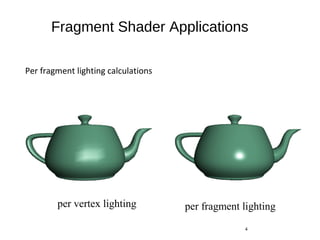
Fragment Shader Applications
Per fragment lighting calculations
4
per vertex lighting per fragment lighting
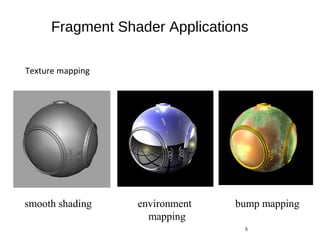
Fragment Shader Applications
Texture mapping
5
smooth shading environment
mapping
bump mapping
Writing Shaders
• First programmable shaders were programmed in an assembly-like
manner
• OpenGL extensions added for vertex and fragment shaders
• Cg (C for graphics) C-like language for programming shaders
• Works with both OpenGL and DirectX
• Interface to OpenGL complex
• OpenGL Shading Language (GLSL)
6
GLSL
• OpenGL Shading Language
• Part of OpenGL 2.0
• High level C-like language
• New data types
• Matrices
• Vectors
• Samplers
• OpenGL state available through built-in variables
7
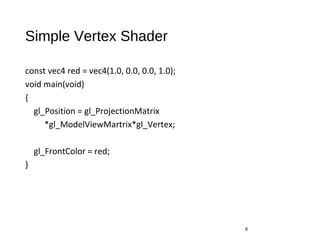
Simple Vertex Shader
const vec4 red = vec4(1.0, 0.0, 0.0, 1.0);
void main(void)
{
gl_Position = gl_ProjectionMatrix
*gl_ModelViewMartrix*gl_Vertex;
gl_FrontColor = red;
}
8
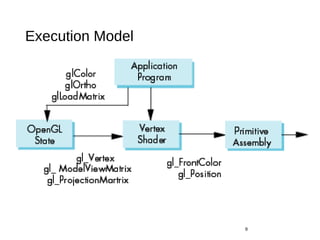
Execution Model
9
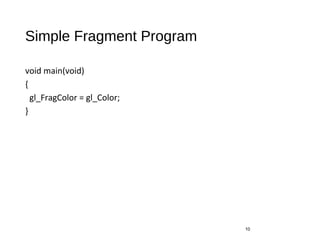
Simple Fragment Program
void main(void)
{
gl_FragColor = gl_Color;
}
10
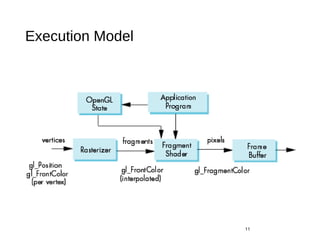
Execution Model
11
Data Types
• C types: int, float, bool
• Vectors:
• float vec2, vec 3, vec4
• Also int (ivec) and boolean (bvec)
• Matrices: mat2, mat3, mat4
• Stored by columns
• Standard referencing m[row][column]
• C++ style constructors
• vec3 a =vec3(1.0, 2.0, 3.0)
• vec2 b = vec2(a)
12
Pointers
• There are no pointers in GLSL
• We can use C structs which
can be copied back from functions
• Because matrices and vectors are basic types they can be passed into
and output from GLSL functions, e.g.
matrix3 func(matrix3 a)
13
Qualifiers
•GLSL has many of the same qualifiers such as
const as C/C++
•Need others due to the nature of the execution
model
•Variables can change
• Once per primitive
• Once per vertex
• Once per fragment
• At any time in the application
•Vertex attributes are interpolated by the rasterizer
into fragment attributes
14
Attribute Qualifier
•Attribute-qualified variables can change at
most once per vertex
•Cannot be used in fragment shaders
•Built in (OpenGL state variables)
•gl_Color
•gl_ModelViewMatrix
•User defined (in application program)
•attribute float temperature
•attribute vec3 velocity
15
Uniform Qualified
• Variables that are constant for an entire primitive
• Can be changed in application outside scope of glBegin and
glEnd
• Cannot be changed in shader
• Used to pass information to shader such as the bounding box of a
primitive
16
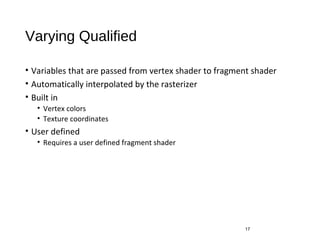
Varying Qualified
• Variables that are passed from vertex shader to fragment shader
• Automatically interpolated by the rasterizer
• Built in
• Vertex colors
• Texture coordinates
• User defined
• Requires a user defined fragment shader
17
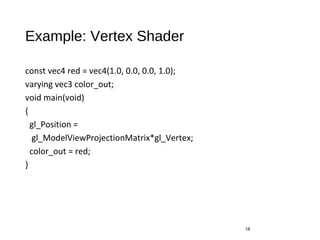
Example: Vertex Shader
const vec4 red = vec4(1.0, 0.0, 0.0, 1.0);
varying vec3 color_out;
void main(void)
{
gl_Position =
gl_ModelViewProjectionMatrix*gl_Vertex;
color_out = red;
}
18
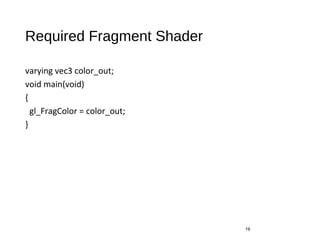
Required Fragment Shader
varying vec3 color_out;
void main(void)
{
gl_FragColor = color_out;
}
19
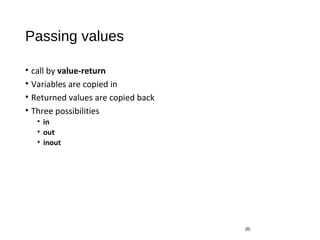
Passing values
• call by value-return
• Variables are copied in
• Returned values are copied back
• Three possibilities
• in
• out
• inout
20
Operators and Functions
• Standard C functions
• Trigonometric
• Arithmetic
• Normalize, reflect, length
• Overloading of vector and matrix types
mat4 a;
vec4 b, c, d;
c = b*a; // a column vector stored as a 1d array
d = a*b; // a row vector stored as a 1d array
21
Swizzling and Selection
• Can refer to array elements by element using [] or selection (.)
operator with
• x, y, z, w
• r, g, b, a
• s, t, p, q
• a[2], a.b, a.z, a.p are the same
• Swizzling operator lets us manipulate components
vec4 a;
a.yz = vec2(1.0, 2.0);
22

GLSL

  • 1.
  • 2.
    Objectives • Shader applications •Vertex shaders • Fragment shaders • Programming shaders • Cg • GLSL 2
  • 3.
    Vertex Shader Applications •Moving vertices • Morphing • Wave motion • Fractals • Lighting • More realistic models • Cartoon shaders 3
  • 4.
    Fragment Shader Applications Perfragment lighting calculations 4 per vertex lighting per fragment lighting
  • 5.
    Fragment Shader Applications Texturemapping 5 smooth shading environment mapping bump mapping
  • 6.
    Writing Shaders • Firstprogrammable shaders were programmed in an assembly-like manner • OpenGL extensions added for vertex and fragment shaders • Cg (C for graphics) C-like language for programming shaders • Works with both OpenGL and DirectX • Interface to OpenGL complex • OpenGL Shading Language (GLSL) 6
  • 7.
    GLSL • OpenGL ShadingLanguage • Part of OpenGL 2.0 • High level C-like language • New data types • Matrices • Vectors • Samplers • OpenGL state available through built-in variables 7
  • 8.
    Simple Vertex Shader constvec4 red = vec4(1.0, 0.0, 0.0, 1.0); void main(void) { gl_Position = gl_ProjectionMatrix *gl_ModelViewMartrix*gl_Vertex; gl_FrontColor = red; } 8
  • 9.
  • 10.
    Simple Fragment Program voidmain(void) { gl_FragColor = gl_Color; } 10
  • 11.
  • 12.
    Data Types • Ctypes: int, float, bool • Vectors: • float vec2, vec 3, vec4 • Also int (ivec) and boolean (bvec) • Matrices: mat2, mat3, mat4 • Stored by columns • Standard referencing m[row][column] • C++ style constructors • vec3 a =vec3(1.0, 2.0, 3.0) • vec2 b = vec2(a) 12
  • 13.
    Pointers • There areno pointers in GLSL • We can use C structs which can be copied back from functions • Because matrices and vectors are basic types they can be passed into and output from GLSL functions, e.g. matrix3 func(matrix3 a) 13
  • 14.
    Qualifiers •GLSL has manyof the same qualifiers such as const as C/C++ •Need others due to the nature of the execution model •Variables can change • Once per primitive • Once per vertex • Once per fragment • At any time in the application •Vertex attributes are interpolated by the rasterizer into fragment attributes 14
  • 15.
    Attribute Qualifier •Attribute-qualified variablescan change at most once per vertex •Cannot be used in fragment shaders •Built in (OpenGL state variables) •gl_Color •gl_ModelViewMatrix •User defined (in application program) •attribute float temperature •attribute vec3 velocity 15
  • 16.
    Uniform Qualified • Variablesthat are constant for an entire primitive • Can be changed in application outside scope of glBegin and glEnd • Cannot be changed in shader • Used to pass information to shader such as the bounding box of a primitive 16
  • 17.
    Varying Qualified • Variablesthat are passed from vertex shader to fragment shader • Automatically interpolated by the rasterizer • Built in • Vertex colors • Texture coordinates • User defined • Requires a user defined fragment shader 17
  • 18.
    Example: Vertex Shader constvec4 red = vec4(1.0, 0.0, 0.0, 1.0); varying vec3 color_out; void main(void) { gl_Position = gl_ModelViewProjectionMatrix*gl_Vertex; color_out = red; } 18
  • 19.
    Required Fragment Shader varyingvec3 color_out; void main(void) { gl_FragColor = color_out; } 19
  • 20.
    Passing values • callby value-return • Variables are copied in • Returned values are copied back • Three possibilities • in • out • inout 20
  • 21.
    Operators and Functions •Standard C functions • Trigonometric • Arithmetic • Normalize, reflect, length • Overloading of vector and matrix types mat4 a; vec4 b, c, d; c = b*a; // a column vector stored as a 1d array d = a*b; // a row vector stored as a 1d array 21
  • 22.
    Swizzling and Selection •Can refer to array elements by element using [] or selection (.) operator with • x, y, z, w • r, g, b, a • s, t, p, q • a[2], a.b, a.z, a.p are the same • Swizzling operator lets us manipulate components vec4 a; a.yz = vec2(1.0, 2.0); 22