1
INTRODUCTION
Good Laboratory Practice (GLP) regulations became part
of the regulatory landscape in latter part of the 1970s in
response to malpractice in research and development
(R&D) activities by pharmaceutical companies and
contract facilities used by them.


                                                             2
Overview of GLP
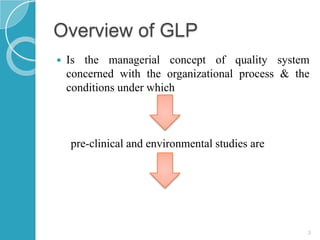
   Is the managerial concept of quality system
    concerned with the organizational process & the
    conditions under which


    pre-clinical and environmental studies are


                                                  3
Planned

    Performed

    Monitored

     Recorded

Archived        Reported

                           4
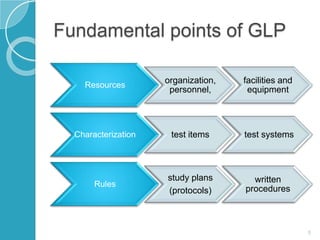
Fundamental points of GLP

                     organization,   facilities and
    Resources
                      personnel,      equipment


  Characterization    test items     test systems


                     study plans       written
       Rules
                     (protocols)     procedures


                                                      5
Resources

          Organization and personnel


   GLP regulations require that the structure of R&D
    organizations and the responsibilities of R&D
    personnel be clearly defined.
   GLP also stresses that there should be sufficient
    staff to perform the tasks required. The
    qualifications and the training of staff must also be
    defined and documented.

                                                        6
Resources

               Facilities and equipment


   The regulations emphasize the need for sufficient
    facilities and equipment to perform the studies.
   All equipment must be in working order. To ensure
    this, a strict programme of qualification, calibration
    and maintenance must be adopted.


                                                             7
Characterization
   In order to perform a study correctly, it is
    essential to know as much as possible about the
    materials used during the study. For studies that
    evaluate the properties of pharmaceutical
    compounds during non-clinical studies, it is a
    prerequisite to have details about the test item
    and the test system (often an animal or plant) to
    which the test item is to be administered.


                                                    8
Rules

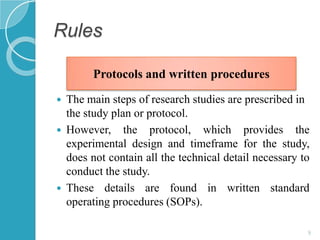
         Protocols and written procedures

   The main steps of research studies are prescribed in
    the study plan or protocol.
   However, the protocol, which provides the
    experimental design and timeframe for the study,
    does not contain all the technical detail necessary to
    conduct the study.
   These details are found in written standard
    operating procedures (SOPs).

                                                         9
Results
                        Raw data

   All studies generate raw data. These are the
    outcome of research and form the basis for
    establishing scientific interpretations and arriving at
    conclusions. The raw data must also reflect the
    procedures and conditions of the study.


                                                          10
Results

                      Final Report

   The study report contains an account of the way in
    which the study was performed, incorporates the
    study results and includes the scientific
    interpretation of the data. The report is provided to
    regulatory authorities as part of the submission for
    registration and marketing approval.


                                                        11
Results

                        Archives

   Storage of records must ensure safe keeping for
    many years and allow for prompt retrieval.


                                                      12
Quality Assurance
   Quality assurance (QA), as defined by GLP, is a
    team of persons (often called the Quality assurance
    unit – QAU) charged with assuring management
    that GLP compliance has been attained within the
    laboratory.
   QA must be independent from scientists involved in
    the operational aspects of the study being
    performed. QA functions as a witness to the hole
    non-clinical research process.


                                                      13
Studies to which GLP regulations
apply
   Study of products regulated by the drug regulatory
    bodies


                                                         14
15
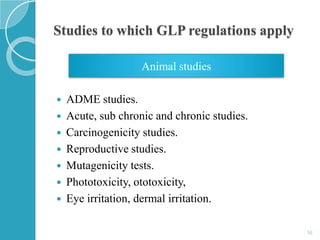
Studies to which GLP regulations apply

                    Animal studies

   ADME studies.
   Acute, sub chronic and chronic studies.
   Carcinogenicity studies.
   Reproductive studies.
   Mutagenicity tests.
   Phototoxicity, ototoxicity,
   Eye irritation, dermal irritation.

                                              16
Studies where the GLP regulations are
not mandatory but advisable
   Basic Research
   Developing new methodologies
   Dose range finding studies
   Stability studies


                                        17
SOP
   Approved by study director and principal
    investigator---SOPs should be available wherever
    applicable e.g.,
   Test and reference items
   Apparatus, materials and reagents
   Record keeping, reporting, storage and retrieval
   Test system
   Quality assurance procedure


                                                       18
Components of SOP
   Date of approval of protocol
   Descriptive title
   Name and address of the testing facility
   Experimental design and procedure
   Dosage levels
   Type and frequency of test, analysis and
    measurement
   Number, body weight range, sex, source of supply,
    species, strains and age of the test animals
   Record of results
   Statistical methods
                                                        19
20

Glp

  • 1.
  • 2.
    INTRODUCTION Good Laboratory Practice(GLP) regulations became part of the regulatory landscape in latter part of the 1970s in response to malpractice in research and development (R&D) activities by pharmaceutical companies and contract facilities used by them. 2
  • 3.
    Overview of GLP  Is the managerial concept of quality system concerned with the organizational process & the conditions under which pre-clinical and environmental studies are 3
  • 4.
    Planned Performed Monitored Recorded Archived Reported 4
  • 5.
    Fundamental points ofGLP organization, facilities and Resources personnel, equipment Characterization test items test systems study plans written Rules (protocols) procedures 5
  • 6.
    Resources Organization and personnel  GLP regulations require that the structure of R&D organizations and the responsibilities of R&D personnel be clearly defined.  GLP also stresses that there should be sufficient staff to perform the tasks required. The qualifications and the training of staff must also be defined and documented. 6
  • 7.
    Resources Facilities and equipment  The regulations emphasize the need for sufficient facilities and equipment to perform the studies.  All equipment must be in working order. To ensure this, a strict programme of qualification, calibration and maintenance must be adopted. 7
  • 8.
    Characterization  In order to perform a study correctly, it is essential to know as much as possible about the materials used during the study. For studies that evaluate the properties of pharmaceutical compounds during non-clinical studies, it is a prerequisite to have details about the test item and the test system (often an animal or plant) to which the test item is to be administered. 8
  • 9.
    Rules Protocols and written procedures  The main steps of research studies are prescribed in the study plan or protocol.  However, the protocol, which provides the experimental design and timeframe for the study, does not contain all the technical detail necessary to conduct the study.  These details are found in written standard operating procedures (SOPs). 9
  • 10.
    Results Raw data  All studies generate raw data. These are the outcome of research and form the basis for establishing scientific interpretations and arriving at conclusions. The raw data must also reflect the procedures and conditions of the study. 10
  • 11.
    Results Final Report  The study report contains an account of the way in which the study was performed, incorporates the study results and includes the scientific interpretation of the data. The report is provided to regulatory authorities as part of the submission for registration and marketing approval. 11
  • 12.
    Results Archives  Storage of records must ensure safe keeping for many years and allow for prompt retrieval. 12
  • 13.
    Quality Assurance  Quality assurance (QA), as defined by GLP, is a team of persons (often called the Quality assurance unit – QAU) charged with assuring management that GLP compliance has been attained within the laboratory.  QA must be independent from scientists involved in the operational aspects of the study being performed. QA functions as a witness to the hole non-clinical research process. 13
  • 14.
    Studies to whichGLP regulations apply  Study of products regulated by the drug regulatory bodies 14
  • 15.
  • 16.
    Studies to whichGLP regulations apply Animal studies  ADME studies.  Acute, sub chronic and chronic studies.  Carcinogenicity studies.  Reproductive studies.  Mutagenicity tests.  Phototoxicity, ototoxicity,  Eye irritation, dermal irritation. 16
  • 17.
    Studies where theGLP regulations are not mandatory but advisable  Basic Research  Developing new methodologies  Dose range finding studies  Stability studies 17
  • 18.
    SOP  Approved by study director and principal investigator---SOPs should be available wherever applicable e.g.,  Test and reference items  Apparatus, materials and reagents  Record keeping, reporting, storage and retrieval  Test system  Quality assurance procedure 18
  • 19.
    Components of SOP  Date of approval of protocol  Descriptive title  Name and address of the testing facility  Experimental design and procedure  Dosage levels  Type and frequency of test, analysis and measurement  Number, body weight range, sex, source of supply, species, strains and age of the test animals  Record of results  Statistical methods 19
  • 20.