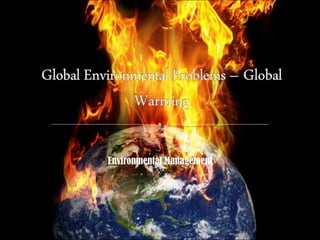
Environmental Management
What is Global Warming?
Why is Global warming so important?
Effect on Agriculture
Positive effects of Global Warming?
Global warming is the
unusually rapid
increase in Earth’s
average surface
temperature over the
past century primarily
due to the greenhouse
gases released by
people burning fossil
fuels.
•Burning of fossil fuel for electricity
•human agriculture and
 industrialization
•Methane
•carbon dioxide
•Nitrous oxide
•hydroflourocarbons
•increasing average temperature of the earth


•increasing sea level due to melting of polar
ice
•modifying the quantity and pattern of
rainfall
•higher or lower agricultural outputs, glacier
melting, lesser summer stream flows, genus
extinctions and rise in the ranges of disease
•various new diseases have emerged
How to combat Global
 Warming?
POLITICAL MEASURES
 Recycle your E-Waste


 Change your Bulbs to CFLs


 Prefer to Walk for Short Distances


 Drive Smart Cars or Bikes


 Book Eco-Friendly Hotels


 More usage of Solar Heaters
 It is an amendment to the international treaty United Nations
  Framework Convention on Climate Change(UNFCCC or FCCC).
 Initially adopted on 11 December 1997 in Kyoto, Japan and
  entered into force on 16 February 2005.
 As of July 2010, 191 states have signed and ratified the protocol.
 37 countries commit themselves to a reduction of four
  greenhouse gases (GHG) i.e. carbon dioxide, methane, nitrous
  oxide, sulphur hexafluoride and two groups of gases,
  hydrofluorocarbons and perfluorocarbons.
 Objective: Stabilization and reconstruction of greenhouse gas
  concentrations in the atmosphere at a level that would prevent
  dangerous anthropogenic interference with the climate system.
 The Protocol defines three flexibility mechanisms which are:
 International Emissions Trading (IET)
 Clean Development Mechanism (CDM)
 Joint Implementation (JI)
 Financial commitments: developed countries have to pay
  billions of dollars, and supply technology to other countries for
  climate-related studies and projects
 Enforcement : If an annex I country is not in compliance with
  its emissions limitation, then that country is required to make
  up the difference plus that country will be suspended from
  making transfers under an emissions trading program.
 Kyoto Protocol’s first commitment period would end in 2012.
Climate change affects all aspects of individual and
 social life including health, economics and poverty
 levels; it is more than a physical phenomenon
Tackling climate change from public sector to private
 sector.
 Perspective needed to deal with climate change: based on different
  frames-
    1) one looks to market solutions
    2) looking at technology as the answer
    3) of injustice, of unequal distribution of
         responsibility between the North and
         South
     4) to tackle climate change from causes that have
        arisen from aspirations to high levels of consumption
     5) alarmist-expecting a tipping point

    Many things are uncertain about global warming. Some say it will
  lead to the melting of the Greenland ice sheet; others say it will
  disrupt the Asian monsoon
Climate change is not all bad; at least it is not so for
 everyone, everywhere
 Eg. Siberia
 It generates a host of business opportunities
Carbon trading could create new jobs.
Climate change can be used to draw attention to the
 gross inequalities that exist in our world.
THANK YOU

48620803 global-warming-ppt

  • 1.
  • 2.
    What is GlobalWarming? Why is Global warming so important? Effect on Agriculture Positive effects of Global Warming?
  • 3.
    Global warming isthe unusually rapid increase in Earth’s average surface temperature over the past century primarily due to the greenhouse gases released by people burning fossil fuels.
  • 4.
    •Burning of fossilfuel for electricity •human agriculture and industrialization
  • 5.
  • 7.
    •increasing average temperatureof the earth •increasing sea level due to melting of polar ice •modifying the quantity and pattern of rainfall •higher or lower agricultural outputs, glacier melting, lesser summer stream flows, genus extinctions and rise in the ranges of disease •various new diseases have emerged
  • 8.
    How to combatGlobal Warming?
  • 9.
  • 10.
     Recycle yourE-Waste  Change your Bulbs to CFLs  Prefer to Walk for Short Distances  Drive Smart Cars or Bikes  Book Eco-Friendly Hotels  More usage of Solar Heaters
  • 11.
     It isan amendment to the international treaty United Nations Framework Convention on Climate Change(UNFCCC or FCCC).  Initially adopted on 11 December 1997 in Kyoto, Japan and entered into force on 16 February 2005.  As of July 2010, 191 states have signed and ratified the protocol.  37 countries commit themselves to a reduction of four greenhouse gases (GHG) i.e. carbon dioxide, methane, nitrous oxide, sulphur hexafluoride and two groups of gases, hydrofluorocarbons and perfluorocarbons.  Objective: Stabilization and reconstruction of greenhouse gas concentrations in the atmosphere at a level that would prevent dangerous anthropogenic interference with the climate system.
  • 12.
     The Protocoldefines three flexibility mechanisms which are:  International Emissions Trading (IET)  Clean Development Mechanism (CDM)  Joint Implementation (JI)  Financial commitments: developed countries have to pay billions of dollars, and supply technology to other countries for climate-related studies and projects  Enforcement : If an annex I country is not in compliance with its emissions limitation, then that country is required to make up the difference plus that country will be suspended from making transfers under an emissions trading program.  Kyoto Protocol’s first commitment period would end in 2012.
  • 14.
    Climate change affectsall aspects of individual and social life including health, economics and poverty levels; it is more than a physical phenomenon Tackling climate change from public sector to private sector.
  • 15.
     Perspective neededto deal with climate change: based on different frames- 1) one looks to market solutions 2) looking at technology as the answer 3) of injustice, of unequal distribution of responsibility between the North and South 4) to tackle climate change from causes that have arisen from aspirations to high levels of consumption 5) alarmist-expecting a tipping point Many things are uncertain about global warming. Some say it will lead to the melting of the Greenland ice sheet; others say it will disrupt the Asian monsoon
  • 16.
    Climate change isnot all bad; at least it is not so for everyone, everywhere Eg. Siberia  It generates a host of business opportunities Carbon trading could create new jobs. Climate change can be used to draw attention to the gross inequalities that exist in our world.
  • 17.