GLOBAL
WARMING
Nazmus Sakib
Id: 191-005-651
Dept. of Industrial Engineering
BGMEA University of Fashion and
Technology(BUFT)
1
4
Four Main
GREENHOUSE
GASES
What is Global
Warmining?
2
TABLE OF CONTENTS
ITS EFFECTS
3
5
Causes of Global
Warming
Global warming
prevention
Sustainability
Objectives
6
WHAT IS GLOBAL WARMING?
• Global warming has become the most addressed
environment problem now-a-days .
• Some gases can entrap energy and prevents radiation.
Entrapment of this energy or temperature is
commonly known as “Greenhouse effect” and these
gases are called “Greenhouse Gases”.
• The earth surface is becoming very hot day by day,
this is commonly known as “Global Warming”.
ITS EFFECTS
1. Heat waves and periods of unusual weather
2. Ocean warming and sea-level rise, glaciers melting and costal flooding
3. Unusual weather behavior
4. Human health
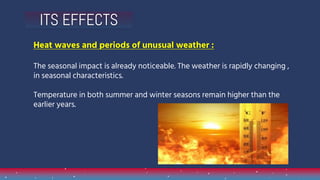
Heat waves and periods of unusual weather :
The seasonal impact is already noticeable. The weather is rapidly changing ,
in seasonal characteristics.
Temperature in both summer and winter seasons remain higher than the
earlier years.
ITS EFFECTS
Ocean warming and sea-level rise, glaciers melting and costal flooding:
The artic and Antarctic poles are becoming warmer.
The ice caps in the north pole is melting rapidly, thereby increasing the water level in
the sea. This will flood and sink the costal areas.
A large part of the globe will go under the sea permanently, changing the world map.
A large part of costal belt of Bay of Bengal, including sunderban may also drown .
ITS EFFECTS
Unusual weather behavior :
More heavy rainfalls, frequent cyclone and devastating floods are
now becoming increasing phenomenon.
On the other hand , droughts are also noticed in many areas
ITS EFFECTS
Human Health :
Diseases are spreading more alarmingly
ITS EFFECTS
Positive Effect of Global Warming:
Can stimulates plants growth in place where carbon dioxide and
temperature are the limiting factors.
Melting Artic ice may open the northwest passage in summer which will
cut 5000 miles for shipping routes between Europe and Asia.
ITS EFFECTS
Future effects
As the Earth's temperature continues to rise, the monsoon pattern will change dramatically.
Glaciers in the Himalayas will disappear by the end of the century, leading to foods and then
severe droughts.
A one-degree rise in global temperature would reduce wheat production by 15% and rice by
12.1%.
If the earth's temperature rises by two degrees, 15 to 20 percent of the spaces will be wiped out.
New disease caused by the virus will erupt and its spread and severity will prove disastrous for
mankind.
1.
ITS EFFECTS
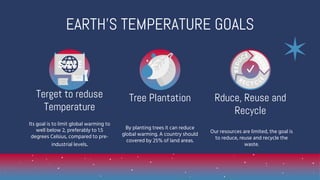
EARTH’S TEMPERATURE GOALS
Terget to reduse
Temperature
Tree Plantation Rduce, Reuse and
Recycle
Its goal is to limit global warming to
well below 2, preferably to 1.5
degrees Celsius, compared to pre-
industrial levels.
By planting trees it can reduce
global warming. A country should
covered by 25% of land areas.
Our resources are limited, the goal is
to reduce, reuse and recycle the
waste.
Greenhouse Gases Industrial waste
Toxic materials and gases are burned and
released into the atmosphere, such as
carbon dioxide and methane. Because
these gases are able to absorb radiation
from the sun, they have a direct impact on
the temperature of the planet.
The greenhouse effect is the way in which
heat is trapped close to Earth's surface by
“greenhouse gases.” These heat-trapping
gases can be thought of as a blanket
wrapped around Earth, keeping the planet
toastier than it would be without them.
WHAT IS WARMING THE PLANET UP?
1. Greenhouse gases
2. CFCs (made by only humans)
3. CO2 ,CH4 , and N2O
4. CO, nitrogen dioxide (NO2 ), Sulfur dioxide (SO2) ,
What gases are causing Global Warming
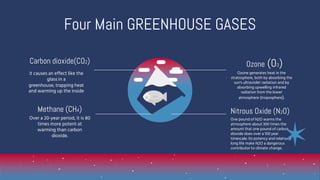
it causes an effect like the
glass in a
greenhouse, trapping heat
and warming up the inside
Over a 20-year period, it is 80
times more potent at
warming than carbon
dioxide.
Ozone generates heat in the
stratosphere, both by absorbing the
sun's ultraviolet radiation and by
absorbing upwelling infrared
radiation from the lower
atmosphere (troposphere).
One pound of N2O warms the
atmosphere about 300 times the
amount that one pound of carbon
dioxide does over a 100 year
timescale. Its potency and relatively
long life make N2O a dangerous
contributor to climate change.
Carbon dioxide(CO2) Ozone (O3)
Nitrous Oxide (N2O)
Methane (CH4)
Four Main GREENHOUSE GASES
1. Halocarbons, Perfluorocarbons and Sulfur hexafluoride : Man made chemicals that have both direct and indirect
radioactive forcing effects.
2. Carbon monoxide : CO contributes indirectly to climate change because it participates in chemical reactions in
the atmosphere that produce ozone, which is a climate change gas.
3. Nitrogen oxides : Nitrous oxide is 300 times more potent than carbon dioxide, and it also depletes the ozone
layer. Since it also has a shorter life span, reducing it could have a faster, significant impact on global warming
4. Aerosols : Aerosols are extremely small particles or liquid droplets found in atmosphere. They can be produced
by natural events such as storms and volcanic activity.
Aerosols radiative effects occurs through direct and indirect mechanisms; directly by scattering and absorbing
solar radiation; and indirectly by increasing droplet counts that modify the formation, precipitation efficiency and
radiative propertied of cloud.
Other Greenhouse Gases
Causes of Global Warming
1. FOSSIL FUELS
The massive use of fossil fuels is obviously the first
source of global warming, as burning coal, oil and gas
produces carbon dioxide - the most important greenhouse
gas in the atmosphere - as well as nitrous oxide.
2. DEFORESTATION
The exploitation of forests has a major role in climate
change. Trees help regulate the climate by absorbing
CO2 from the atmosphere. When they are cut down, this
positive effect is lost and the carbon stored in the trees
is released into the atmosphere.
Causes of Global Warming
3. INTENSIVE FARMING
Another cause of global warming is intensive farming, not only
with the ever-increasing livestock, but also with plant
protection products and fertilizers. In fact, cattle and sheep
produce large amounts of methane when digesting their food,
while fertilizers produce nitrous oxide emissions.
4. WASTE DISPOSAL
Waste management methods like landfills and incineration emit
greenhouse and toxic gases - including methane - that are
released into the atmosphere, soil and waterways, contributing
to the increase of the greenhouse effect.
Causes of Global Warming
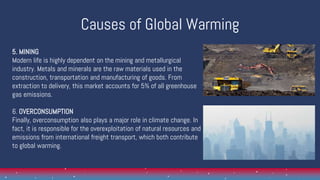
5. MINING
Modern life is highly dependent on the mining and metallurgical
industry. Metals and minerals are the raw materials used in the
construction, transportation and manufacturing of goods. From
extraction to delivery, this market accounts for 5% of all greenhouse
gas emissions.
6. OVERCONSUMPTION
Finally, overconsumption also plays a major role in climate change. In
fact, it is responsible for the overexploitation of natural resources and
emissions from international freight transport, which both contribute
to global warming.
1. Renewable energies
The first way to prevent climate change is to move away from fossil fuels. What are the
alternatives? Renewable energies like solar, wind, biomass and geothermal.
2. Energy & water efficiency
Producing clean energy is essential, but reducing our consumption of energy and water by
using more efficient devices (e.g. LED light bulbs, innovative shower systems) is less costly
and equally important.
Global warming prevention
3. Sustainable transportation
Promoting public transportation, carpooling, but also electric and hydrogen mobility,
can definitely help reduce CO2 emissions and thus fight global warming.
4. Sustainable infrastructure
In order to reduce the CO2 emissions from buildings - caused by heating, air
conditioning, hot water or lighting - it is necessary both to build new low energy
buildings, and to renovate the existing constructions
Global warming prevention
5. Sustainable agriculture & forest management
Encouraging better use of natural resources, stopping massive deforestation as well
as making agriculture greener and more efficient should also be a priority.
6. Responsible consumption & recycling
Adopting responsible consumption habits is crucial, be it regarding food (particularly
meat), clothing, cosmetics or cleaning products. Last but not least, recycling is an
absolute necessity for dealing with waste.
Global warming prevention
1. Increase energy efficiency;
2. Increase the use of renewable energy;
3. Measure, report, and reduce direct and indirect greenhouse gas emissions;
4. Conserve and protect water resources through efficiency, reuse, and stormwater
management;
5. Eliminate waste, prevent pollution, and increase recycling;
6. Evaluate climate change risks and vulnerabilities and develop mitigation and
adaptation measures to manage both the short-and long-term effects of climate
change on the mission and operations.
Sustainability Objectives
“By polluting the oceans, not
mitigating CO2 emissions and
destroying our biodiversity, we are
killing our planet. Let us face it, there
is no planet B.”
- Emmanuel Macron
Thank You
Do you have any questions?

Global Warming.pptx

  • 1.
  • 2.
    Nazmus Sakib Id: 191-005-651 Dept.of Industrial Engineering BGMEA University of Fashion and Technology(BUFT)
  • 3.
    1 4 Four Main GREENHOUSE GASES What isGlobal Warmining? 2 TABLE OF CONTENTS ITS EFFECTS 3 5 Causes of Global Warming Global warming prevention Sustainability Objectives 6
  • 4.
    WHAT IS GLOBALWARMING? • Global warming has become the most addressed environment problem now-a-days . • Some gases can entrap energy and prevents radiation. Entrapment of this energy or temperature is commonly known as “Greenhouse effect” and these gases are called “Greenhouse Gases”. • The earth surface is becoming very hot day by day, this is commonly known as “Global Warming”.
  • 5.
    ITS EFFECTS 1. Heatwaves and periods of unusual weather 2. Ocean warming and sea-level rise, glaciers melting and costal flooding 3. Unusual weather behavior 4. Human health
  • 6.
    Heat waves andperiods of unusual weather : The seasonal impact is already noticeable. The weather is rapidly changing , in seasonal characteristics. Temperature in both summer and winter seasons remain higher than the earlier years. ITS EFFECTS
  • 7.
    Ocean warming andsea-level rise, glaciers melting and costal flooding: The artic and Antarctic poles are becoming warmer. The ice caps in the north pole is melting rapidly, thereby increasing the water level in the sea. This will flood and sink the costal areas. A large part of the globe will go under the sea permanently, changing the world map. A large part of costal belt of Bay of Bengal, including sunderban may also drown . ITS EFFECTS
  • 8.
    Unusual weather behavior: More heavy rainfalls, frequent cyclone and devastating floods are now becoming increasing phenomenon. On the other hand , droughts are also noticed in many areas ITS EFFECTS
  • 9.
    Human Health : Diseasesare spreading more alarmingly ITS EFFECTS
  • 10.
    Positive Effect ofGlobal Warming: Can stimulates plants growth in place where carbon dioxide and temperature are the limiting factors. Melting Artic ice may open the northwest passage in summer which will cut 5000 miles for shipping routes between Europe and Asia. ITS EFFECTS
  • 11.
    Future effects As theEarth's temperature continues to rise, the monsoon pattern will change dramatically. Glaciers in the Himalayas will disappear by the end of the century, leading to foods and then severe droughts. A one-degree rise in global temperature would reduce wheat production by 15% and rice by 12.1%. If the earth's temperature rises by two degrees, 15 to 20 percent of the spaces will be wiped out. New disease caused by the virus will erupt and its spread and severity will prove disastrous for mankind. 1. ITS EFFECTS
  • 12.
    EARTH’S TEMPERATURE GOALS Tergetto reduse Temperature Tree Plantation Rduce, Reuse and Recycle Its goal is to limit global warming to well below 2, preferably to 1.5 degrees Celsius, compared to pre- industrial levels. By planting trees it can reduce global warming. A country should covered by 25% of land areas. Our resources are limited, the goal is to reduce, reuse and recycle the waste.
  • 13.
    Greenhouse Gases Industrialwaste Toxic materials and gases are burned and released into the atmosphere, such as carbon dioxide and methane. Because these gases are able to absorb radiation from the sun, they have a direct impact on the temperature of the planet. The greenhouse effect is the way in which heat is trapped close to Earth's surface by “greenhouse gases.” These heat-trapping gases can be thought of as a blanket wrapped around Earth, keeping the planet toastier than it would be without them. WHAT IS WARMING THE PLANET UP?
  • 14.
    1. Greenhouse gases 2.CFCs (made by only humans) 3. CO2 ,CH4 , and N2O 4. CO, nitrogen dioxide (NO2 ), Sulfur dioxide (SO2) , What gases are causing Global Warming
  • 15.
    it causes aneffect like the glass in a greenhouse, trapping heat and warming up the inside Over a 20-year period, it is 80 times more potent at warming than carbon dioxide. Ozone generates heat in the stratosphere, both by absorbing the sun's ultraviolet radiation and by absorbing upwelling infrared radiation from the lower atmosphere (troposphere). One pound of N2O warms the atmosphere about 300 times the amount that one pound of carbon dioxide does over a 100 year timescale. Its potency and relatively long life make N2O a dangerous contributor to climate change. Carbon dioxide(CO2) Ozone (O3) Nitrous Oxide (N2O) Methane (CH4) Four Main GREENHOUSE GASES
  • 16.
    1. Halocarbons, Perfluorocarbonsand Sulfur hexafluoride : Man made chemicals that have both direct and indirect radioactive forcing effects. 2. Carbon monoxide : CO contributes indirectly to climate change because it participates in chemical reactions in the atmosphere that produce ozone, which is a climate change gas. 3. Nitrogen oxides : Nitrous oxide is 300 times more potent than carbon dioxide, and it also depletes the ozone layer. Since it also has a shorter life span, reducing it could have a faster, significant impact on global warming 4. Aerosols : Aerosols are extremely small particles or liquid droplets found in atmosphere. They can be produced by natural events such as storms and volcanic activity. Aerosols radiative effects occurs through direct and indirect mechanisms; directly by scattering and absorbing solar radiation; and indirectly by increasing droplet counts that modify the formation, precipitation efficiency and radiative propertied of cloud. Other Greenhouse Gases
  • 18.
    Causes of GlobalWarming 1. FOSSIL FUELS The massive use of fossil fuels is obviously the first source of global warming, as burning coal, oil and gas produces carbon dioxide - the most important greenhouse gas in the atmosphere - as well as nitrous oxide. 2. DEFORESTATION The exploitation of forests has a major role in climate change. Trees help regulate the climate by absorbing CO2 from the atmosphere. When they are cut down, this positive effect is lost and the carbon stored in the trees is released into the atmosphere.
  • 19.
    Causes of GlobalWarming 3. INTENSIVE FARMING Another cause of global warming is intensive farming, not only with the ever-increasing livestock, but also with plant protection products and fertilizers. In fact, cattle and sheep produce large amounts of methane when digesting their food, while fertilizers produce nitrous oxide emissions. 4. WASTE DISPOSAL Waste management methods like landfills and incineration emit greenhouse and toxic gases - including methane - that are released into the atmosphere, soil and waterways, contributing to the increase of the greenhouse effect.
  • 20.
    Causes of GlobalWarming 5. MINING Modern life is highly dependent on the mining and metallurgical industry. Metals and minerals are the raw materials used in the construction, transportation and manufacturing of goods. From extraction to delivery, this market accounts for 5% of all greenhouse gas emissions. 6. OVERCONSUMPTION Finally, overconsumption also plays a major role in climate change. In fact, it is responsible for the overexploitation of natural resources and emissions from international freight transport, which both contribute to global warming.
  • 21.
    1. Renewable energies Thefirst way to prevent climate change is to move away from fossil fuels. What are the alternatives? Renewable energies like solar, wind, biomass and geothermal. 2. Energy & water efficiency Producing clean energy is essential, but reducing our consumption of energy and water by using more efficient devices (e.g. LED light bulbs, innovative shower systems) is less costly and equally important. Global warming prevention
  • 22.
    3. Sustainable transportation Promotingpublic transportation, carpooling, but also electric and hydrogen mobility, can definitely help reduce CO2 emissions and thus fight global warming. 4. Sustainable infrastructure In order to reduce the CO2 emissions from buildings - caused by heating, air conditioning, hot water or lighting - it is necessary both to build new low energy buildings, and to renovate the existing constructions Global warming prevention
  • 23.
    5. Sustainable agriculture& forest management Encouraging better use of natural resources, stopping massive deforestation as well as making agriculture greener and more efficient should also be a priority. 6. Responsible consumption & recycling Adopting responsible consumption habits is crucial, be it regarding food (particularly meat), clothing, cosmetics or cleaning products. Last but not least, recycling is an absolute necessity for dealing with waste. Global warming prevention
  • 24.
    1. Increase energyefficiency; 2. Increase the use of renewable energy; 3. Measure, report, and reduce direct and indirect greenhouse gas emissions; 4. Conserve and protect water resources through efficiency, reuse, and stormwater management; 5. Eliminate waste, prevent pollution, and increase recycling; 6. Evaluate climate change risks and vulnerabilities and develop mitigation and adaptation measures to manage both the short-and long-term effects of climate change on the mission and operations. Sustainability Objectives
  • 25.
    “By polluting theoceans, not mitigating CO2 emissions and destroying our biodiversity, we are killing our planet. Let us face it, there is no planet B.” - Emmanuel Macron
  • 26.
    Thank You Do youhave any questions?