AGRICULTURE: GLOBAL WARMING’S VICTIM CAUSE  AND SOLUTION
Agriculture:  Global Warming Victim
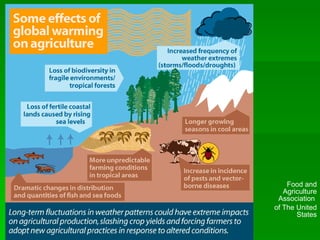
Food and Agriculture Association  of The United States
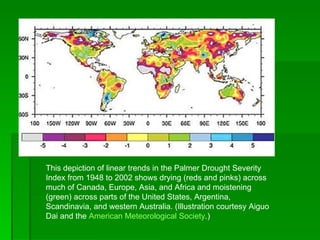
This depiction of linear trends in the Palmer Drought Severity Index from 1948 to 2002 shows drying (reds and pinks) across much of Canada, Europe, Asia, and Africa and moistening (green) across parts of the United States, Argentina, Scandinavia, and western Australia. (Illustration courtesy Aiguo Dai and the  American Meteorological Society .)
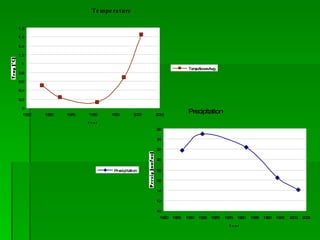
“ Global Warming Contributes to Australia’s Worst Drought” During 2002, worst drought since records began in 1910 Temperatures highest since 1950 Increased evaporation Loss of soil moisture and vegetation drying Concentrated at Murray-Darling Basin – nation’ s agriculture heartland Karoly et. al. 2003
 
Consequences Decreased production of wheat, barley, cotton, and canola Production of major winter crops was set to fall by 14.8 million tons  Gross value of farm production was forecasted to fall by 21% Australian Bureau of Ag Resource Economics Projected temperature increases in Australia between 1*C and 6*C and 45% decrease in stream flow in Murray-Darling Basin by 2070 CSIRO
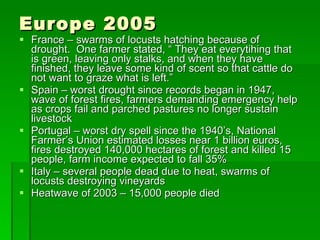
Europe 2005 France – swarms of locusts hatching because of drought.  One farmer stated, “ They eat everytihing that is green, leaving only stalks, and when they have finished, they leave some kind of scent so that cattle do not want to graze what is left.” Spain – worst drought since records began in 1947, wave of forest fires, farmers demanding emergency help as crops fail and parched pastures no longer sustain livestock Portugal – worst dry spell since the 1940’s, National Farmer’s Union estimated losses near 1 billion euros, fires destroyed 140,000 hectares of forest and killed 15 people, farm income expected to fall 35% Italy – several people dead due to heat, swarms of locusts destroying vineyards Heatwave of 2003 – 15,000 people died
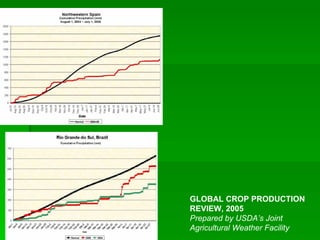
GLOBAL CROP PRODUCTION REVIEW, 2005 Prepared by USDA’s Joint Agricultural Weather Facility
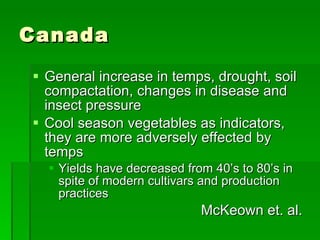
Canada General increase in temps, drought, soil compactation, changes in disease and insect pressure Cool season vegetables as indicators, they are more adversely effected by temps Yields have decreased from 40’s to 80’s in spite of modern cultivars and production practices McKeown et. al.
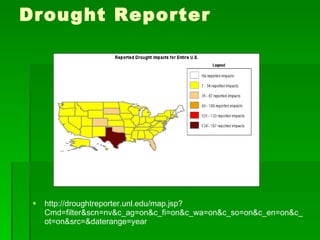
Drought Reporter http://droughtreporter.unl.edu/map.jsp?Cmd=filter&scn=nv&c_ag=on&c_fi=on&c_wa=on&c_so=on&c_en=on&c_ot=on&src=&daterange=year
United States No reliable precipitation projections More frequent floods and droughts New technologies to prepare for widespread drought and crop-pounding storms UC Berkeley team estimates that a five degree temperature rise -projected to occur in the next 30-50 years at current rates of carbon dioxide accumulation in the atmosphere - could result in $15 billion to $30 billion in annual damage to American crops.  McBroom, 2001 “ Our whole farming system really contributes to a lot of global warming and it could be made to be much more sustainable”  Francis Thicke, Fairfield Farmer Lorentzen, 2006
Agriculture:  Global Warming Cause
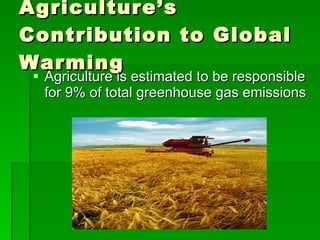
Agriculture’s Contribution to Global Warming Agriculture is estimated to be responsible for 9% of total greenhouse gas emissions
Methane (CH4) Emissions Agriculture  is the main contributor to CH4 emissions. Agriculture is responsible for 43% of methane emissions followed by waste (34%) and energy (21%).
Major Cause of Methane Emissions in Agriculture Livestock manure is mainly composed of organic matter that, in the absence of oxygen, is decomposed by bacteria and in this way produces methane. Manure management accounts for about 71% of CH4 emissions resulting from agricultural activity. The amount of methane emitted by livestock is calculated by the number of animals multiplied by an emission rate per animal.  The emission rate mainly depends on the type of digestive system of the animal and its feed intake.
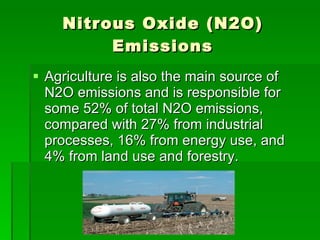
Nitrous Oxide (N2O) Emissions Agriculture is also the main source of N2O emissions and is responsible for some 52% of total N2O emissions, compared with 27% from industrial processes, 16% from energy use, and 4% from land use and forestry.
Causes of Nitrous Oxide Emissions in Agriculture N2O emissions from agriculture are cause from three sources: 1) direct emissions from agricultural soils and animal production systems 2) indirect emissions which take place after nitrogen is lost from the field or after leaching or the runoff of nitrates 3) emissions resulting from agricultural burning.
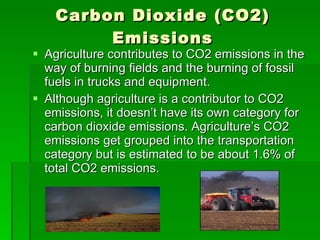
Carbon Dioxide (CO2) Emissions Agriculture contributes to CO2 emissions in the way of burning fields and the burning of fossil fuels in trucks and equipment. Although agriculture is a contributor to CO2 emissions, it doesn’t have its own category for carbon dioxide emissions. Agriculture’s CO2 emissions get grouped into the transportation category but is estimated to be about 1.6% of total CO2 emissions.
Main Agricultural Cause of Global Warming Nearly 1/5 of all global warming causing emissions come from animal agriculture, more than the cumulative impact of all the transportation in the world.  This effect occurs because animal wastes and digestion produces methane and nitrous oxide gases, which have 23 and 246 times the heat trapping of carbon dioxide. The livestock industry is also the leading cause of deforestation of the rainforest. 70% of the former Amazon Rainforest is currently devoted to animal agriculture.  Because trees and other plants remove greenhouse gasses from the atmosphere, deforestation accelerates the pace of global warming
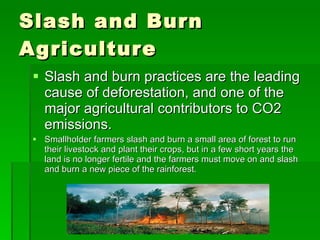
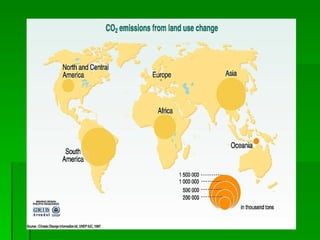
Slash and Burn Agriculture Slash and burn practices are the leading cause of deforestation, and one of the major agricultural contributors to CO2 emissions.  Smallholder farmers slash and burn a small area of forest to run their livestock and plant their crops, but in a few short years the land is no longer fertile and the farmers must move on and slash and burn a new piece of the rainforest.
 
Agriculture:  Global Warming Mitigator
Agriculture  Part of the Solution Carbon Sequestration Largest global terrestrial sequestration pool Forest Sequestration Biofuel/Ethanol Biomass Build with wood Fuel for electricity
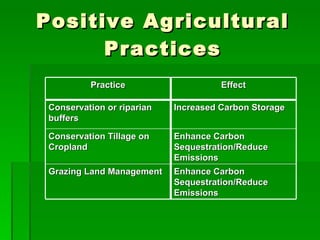
Positive Agricultural Practices Practice Effect Conservation or riparian buffers Increased Carbon Storage Conservation Tillage on Cropland Enhance Carbon Sequestration/Reduce Emissions Grazing Land Management Enhance Carbon Sequestration/Reduce Emissions
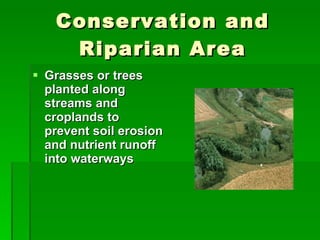
Conservation and Riparian Area Grasses or trees planted along streams and croplands to prevent soil erosion and nutrient runoff into waterways
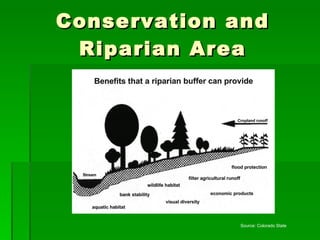
Conservation and Riparian Area Source: Colorado State
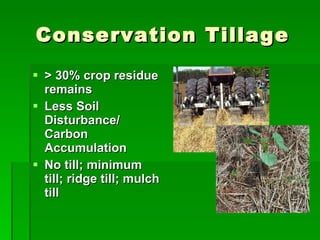
Conservation Tillage > 30% crop residue remains Less Soil Disturbance/ Carbon Accumulation No till; minimum till; ridge till; mulch till
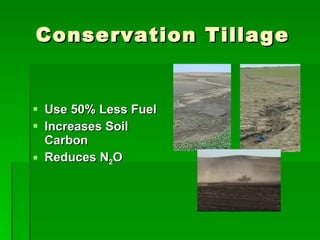
Conservation Tillage Use 50% Less Fuel Increases Soil Carbon Reduces N 2 O
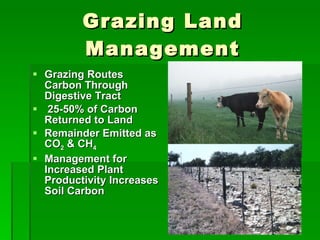
Grazing Land Management Grazing Routes Carbon Through Digestive Tract 25-50% of Carbon Returned to Land  Remainder Emitted as CO 2  & CH 4   Management for Increased Plant Productivity Increases Soil Carbon
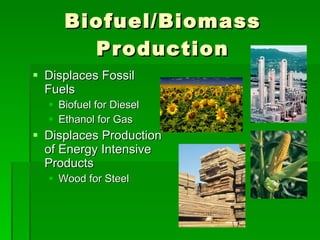
Biofuel/Biomass Production Displaces Fossil Fuels Biofuel for Diesel Ethanol for Gas Displaces Production of Energy Intensive Products Wood for Steel
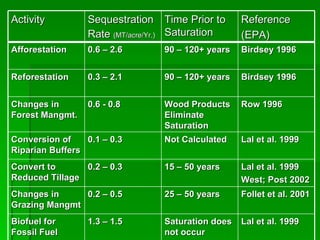
Activity Sequestration Rate  (MT/acre/Yr.) Time Prior to Saturation Reference (EPA) Afforestation 0.6 – 2.6 90 – 120+ years  Birdsey 1996 Reforestation 0.3 – 2.1 90 – 120+ years Birdsey 1996 Changes in Forest Mangmt. 0.6 - 0.8 Wood Products Eliminate Saturation Row 1996 Conversion of Riparian Buffers 0.1 – 0.3 Not Calculated Lal et al. 1999 Convert to Reduced Tillage 0.2 – 0.3 15 – 50 years Lal et al. 1999 West; Post 2002 Changes in Grazing Mangmt 0.2 – 0.5 25 – 50 years Follet et al. 2001 Biofuel for Fossil Fuel 1.3 – 1.5 Saturation does not occur Lal et al. 1999
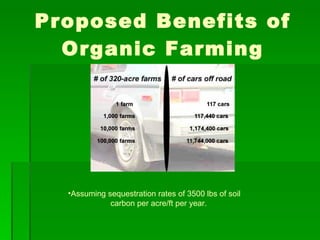
Proposed Benefits of Organic Farming Assuming sequestration rates of 3500 lbs of soil  carbon per acre/ft per year.
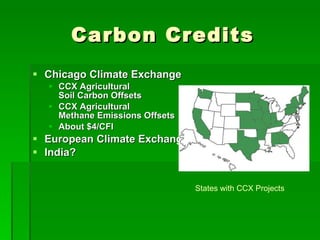
Carbon Credits Chicago Climate Exchange CCX Agricultural Soil Carbon Offsets CCX Agricultural Methane Emissions Offsets About $4/CFI European Climate Exchange India? States with CCX Projects
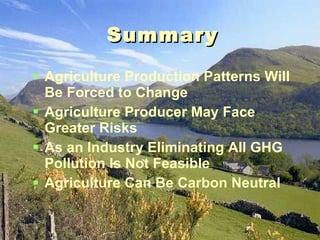
Summary Agriculture Production Patterns Will Be Forced to Change Agriculture Producer May Face Greater Risks As an Industry Eliminating All GHG Pollution Is Not Feasible Agriculture Can Be Carbon Neutral

Global Warming 2003 Style Agriculture

  • 1.
    AGRICULTURE: GLOBAL WARMING’SVICTIM CAUSE AND SOLUTION
  • 2.
    Agriculture: GlobalWarming Victim
  • 3.
    Food and AgricultureAssociation of The United States
  • 4.
    This depiction oflinear trends in the Palmer Drought Severity Index from 1948 to 2002 shows drying (reds and pinks) across much of Canada, Europe, Asia, and Africa and moistening (green) across parts of the United States, Argentina, Scandinavia, and western Australia. (Illustration courtesy Aiguo Dai and the American Meteorological Society .)
  • 5.
    “ Global WarmingContributes to Australia’s Worst Drought” During 2002, worst drought since records began in 1910 Temperatures highest since 1950 Increased evaporation Loss of soil moisture and vegetation drying Concentrated at Murray-Darling Basin – nation’ s agriculture heartland Karoly et. al. 2003
  • 6.
  • 7.
    Consequences Decreased productionof wheat, barley, cotton, and canola Production of major winter crops was set to fall by 14.8 million tons Gross value of farm production was forecasted to fall by 21% Australian Bureau of Ag Resource Economics Projected temperature increases in Australia between 1*C and 6*C and 45% decrease in stream flow in Murray-Darling Basin by 2070 CSIRO
  • 8.
    Europe 2005 France– swarms of locusts hatching because of drought. One farmer stated, “ They eat everytihing that is green, leaving only stalks, and when they have finished, they leave some kind of scent so that cattle do not want to graze what is left.” Spain – worst drought since records began in 1947, wave of forest fires, farmers demanding emergency help as crops fail and parched pastures no longer sustain livestock Portugal – worst dry spell since the 1940’s, National Farmer’s Union estimated losses near 1 billion euros, fires destroyed 140,000 hectares of forest and killed 15 people, farm income expected to fall 35% Italy – several people dead due to heat, swarms of locusts destroying vineyards Heatwave of 2003 – 15,000 people died
  • 9.
    GLOBAL CROP PRODUCTIONREVIEW, 2005 Prepared by USDA’s Joint Agricultural Weather Facility
  • 10.
    Canada General increasein temps, drought, soil compactation, changes in disease and insect pressure Cool season vegetables as indicators, they are more adversely effected by temps Yields have decreased from 40’s to 80’s in spite of modern cultivars and production practices McKeown et. al.
  • 11.
  • 12.
    United States Noreliable precipitation projections More frequent floods and droughts New technologies to prepare for widespread drought and crop-pounding storms UC Berkeley team estimates that a five degree temperature rise -projected to occur in the next 30-50 years at current rates of carbon dioxide accumulation in the atmosphere - could result in $15 billion to $30 billion in annual damage to American crops. McBroom, 2001 “ Our whole farming system really contributes to a lot of global warming and it could be made to be much more sustainable” Francis Thicke, Fairfield Farmer Lorentzen, 2006
  • 13.
    Agriculture: GlobalWarming Cause
  • 14.
    Agriculture’s Contribution toGlobal Warming Agriculture is estimated to be responsible for 9% of total greenhouse gas emissions
  • 15.
    Methane (CH4) EmissionsAgriculture is the main contributor to CH4 emissions. Agriculture is responsible for 43% of methane emissions followed by waste (34%) and energy (21%).
  • 16.
    Major Cause ofMethane Emissions in Agriculture Livestock manure is mainly composed of organic matter that, in the absence of oxygen, is decomposed by bacteria and in this way produces methane. Manure management accounts for about 71% of CH4 emissions resulting from agricultural activity. The amount of methane emitted by livestock is calculated by the number of animals multiplied by an emission rate per animal. The emission rate mainly depends on the type of digestive system of the animal and its feed intake.
  • 17.
    Nitrous Oxide (N2O)Emissions Agriculture is also the main source of N2O emissions and is responsible for some 52% of total N2O emissions, compared with 27% from industrial processes, 16% from energy use, and 4% from land use and forestry.
  • 18.
    Causes of NitrousOxide Emissions in Agriculture N2O emissions from agriculture are cause from three sources: 1) direct emissions from agricultural soils and animal production systems 2) indirect emissions which take place after nitrogen is lost from the field or after leaching or the runoff of nitrates 3) emissions resulting from agricultural burning.
  • 19.
    Carbon Dioxide (CO2)Emissions Agriculture contributes to CO2 emissions in the way of burning fields and the burning of fossil fuels in trucks and equipment. Although agriculture is a contributor to CO2 emissions, it doesn’t have its own category for carbon dioxide emissions. Agriculture’s CO2 emissions get grouped into the transportation category but is estimated to be about 1.6% of total CO2 emissions.
  • 20.
    Main Agricultural Causeof Global Warming Nearly 1/5 of all global warming causing emissions come from animal agriculture, more than the cumulative impact of all the transportation in the world. This effect occurs because animal wastes and digestion produces methane and nitrous oxide gases, which have 23 and 246 times the heat trapping of carbon dioxide. The livestock industry is also the leading cause of deforestation of the rainforest. 70% of the former Amazon Rainforest is currently devoted to animal agriculture. Because trees and other plants remove greenhouse gasses from the atmosphere, deforestation accelerates the pace of global warming
  • 21.
    Slash and BurnAgriculture Slash and burn practices are the leading cause of deforestation, and one of the major agricultural contributors to CO2 emissions. Smallholder farmers slash and burn a small area of forest to run their livestock and plant their crops, but in a few short years the land is no longer fertile and the farmers must move on and slash and burn a new piece of the rainforest.
  • 22.
  • 23.
    Agriculture: GlobalWarming Mitigator
  • 24.
    Agriculture Partof the Solution Carbon Sequestration Largest global terrestrial sequestration pool Forest Sequestration Biofuel/Ethanol Biomass Build with wood Fuel for electricity
  • 25.
    Positive Agricultural PracticesPractice Effect Conservation or riparian buffers Increased Carbon Storage Conservation Tillage on Cropland Enhance Carbon Sequestration/Reduce Emissions Grazing Land Management Enhance Carbon Sequestration/Reduce Emissions
  • 26.
    Conservation and RiparianArea Grasses or trees planted along streams and croplands to prevent soil erosion and nutrient runoff into waterways
  • 27.
    Conservation and RiparianArea Source: Colorado State
  • 28.
    Conservation Tillage >30% crop residue remains Less Soil Disturbance/ Carbon Accumulation No till; minimum till; ridge till; mulch till
  • 29.
    Conservation Tillage Use50% Less Fuel Increases Soil Carbon Reduces N 2 O
  • 30.
    Grazing Land ManagementGrazing Routes Carbon Through Digestive Tract 25-50% of Carbon Returned to Land Remainder Emitted as CO 2 & CH 4 Management for Increased Plant Productivity Increases Soil Carbon
  • 31.
    Biofuel/Biomass Production DisplacesFossil Fuels Biofuel for Diesel Ethanol for Gas Displaces Production of Energy Intensive Products Wood for Steel
  • 32.
    Activity Sequestration Rate (MT/acre/Yr.) Time Prior to Saturation Reference (EPA) Afforestation 0.6 – 2.6 90 – 120+ years Birdsey 1996 Reforestation 0.3 – 2.1 90 – 120+ years Birdsey 1996 Changes in Forest Mangmt. 0.6 - 0.8 Wood Products Eliminate Saturation Row 1996 Conversion of Riparian Buffers 0.1 – 0.3 Not Calculated Lal et al. 1999 Convert to Reduced Tillage 0.2 – 0.3 15 – 50 years Lal et al. 1999 West; Post 2002 Changes in Grazing Mangmt 0.2 – 0.5 25 – 50 years Follet et al. 2001 Biofuel for Fossil Fuel 1.3 – 1.5 Saturation does not occur Lal et al. 1999
  • 33.
    Proposed Benefits ofOrganic Farming Assuming sequestration rates of 3500 lbs of soil carbon per acre/ft per year.
  • 34.
    Carbon Credits ChicagoClimate Exchange CCX Agricultural Soil Carbon Offsets CCX Agricultural Methane Emissions Offsets About $4/CFI European Climate Exchange India? States with CCX Projects
  • 35.
    Summary Agriculture ProductionPatterns Will Be Forced to Change Agriculture Producer May Face Greater Risks As an Industry Eliminating All GHG Pollution Is Not Feasible Agriculture Can Be Carbon Neutral