Studocu is not sponsored or endorsed by any college or university
Downloaded by Kris Martinez (kris231986@gmail.com)
Contemporary World - THE Global Interstate System
College of education (Don Honorio Ventura Technological State University)
lOMoARcPSD|14695909
CONTEMPORARY WORLD
THE GLOBAL INTERSTATE SYSTEM
Interstate System
- a theoretical system of contending and cooperating states. This is generally referred to as
the international system by political scientists, and it is the primary focus of the study of
International Relations.
- responsible for the promotion of responsible, sustainable, and universally accessible
tourism.
Organization for Economic Cooperation and Development (OECD)
- the leading international organization in the field of tourism, promoting tourism as a driver
of economic growth, inclusive development, and environmental sustainability, and
providing leadership and support to the sector in advancing knowledge and tourism
policies worldwide.
it monitors the global economy
- It accomplishes these in three ways: and the economies
of member countries; it lends to countries experiencing balance-of-payments challenges ;
and it provides practical assistance to members.
However, here are the four (4) challenges that affect the globalization of governments:
1. Traditional difficulties
- include external involvement (i.e., invasion by other countries. For example, when
Saddam Hussein was the ruler of Iraq in 1990, he invaded and conquered Kuwait for its
oil fields. As a result, he was deposed by an international coalition led by the United
States.).
2. National or identity movements
- various people with separate identities can reside in
different states (e.g., Kurds live in various countries, including Iraq, Iran, and Turkey.).
3. Economics Around the World
- the global economy requires states to follow the laws of free-market (neoliberal)
capitalism.
- Neoliberal economics (also known as neoliberal capitalism) focuses on free trade and the
removal of trade barriers. It ensured that governments did not impose restrictions on
corporate presence as well as the free flow of cash and jobs. In general, neoliberal
economics is viewed as a threat since a state, especially one that is sovereign, is unable
to protect its own economic interests.
4. Global Social Movement
lOMoARcPSD|14695909
Downloaded by Kris Martinez (kris231986@gmail.com)
- spontaneous movements of people or movements that originate from massive grassroots
organization. These social movements are transnational, which means they occur across
countries and borders.
The Relevance of the State Amid Globalization:
A state is a distinct political community with its own set of norms and practices that is, to some
extent, distinct from other communities.
The Four Elements of State:
1. Permanent population - refers to the total number of people alive at a given area
within a period (over half a year).
2. Territory - an area of land under the jurisdiction of a ruler or state.
3. Government - the governing body of a nation, state, or community.
4. Sovereignty - the authority of a state to govern itself or another state.
Institutions that Govern International Relations
1. The United Nations (UN)
- Currently made up of 193 member states, the United Nations (UN) is an
international organization founded in 1945.
- remains the one place on Earth where all the world’s nations can gather together,
discuss common problems, and find shared solutions that benefit all of humanity.
- aims at maintaining international peace and security, developing friendly relations
among nations and promoting social progress, better living standards and human rights.
2. The International Court of Justice (ICJ)
- Sometimes known as the World Court. This is a court of justice where countries
can settle conflicts, as well as a location where war criminals and rulers who have done
awful things to their people can be tried for their crimes.
- a continuing and autonomous body that is permanently in session.
- Its seat is at The Hague, but sessions may be held elsewhere when the court
Downloaded by Kris Martinez (kris231986@gmail.com)
considers it desirable to do so. The official languages of the court are French and
English.
-
3. North Atlantic Treaty Organization (NATO)
a defense treaty or military alliance formed by the United Nations, Canada, and 25
European countries.
- The countries in this group effectively decided to combine their military and
announce to the world that if one of its members is messed with, the other countries will
come to their support.
4. Non-Government Organizations (NGOs)
- Organizations that are not affiliated with any country. This enables them to operate
freely all around the world. They give emergency help such as food, water, and medical
lOMoARcPSD|14695909
supplies to those whose homes or towns have been damaged by a natural disaster or
conflict.
5. Global Economics Association: The WTO and the NAFTA
a. The World Trade Organization (WTO) - a global organization comprised of
162
countries established with the objective of encouraging free trade. Countries can
thus acquire and sell goods without imposing import fees or tariffs.
b. North American Free Trade Agreement (NAFTA) - an economic treaty signed
by the United States, Canada, and Mexico that allows the three countries to
trade freely without taxation.
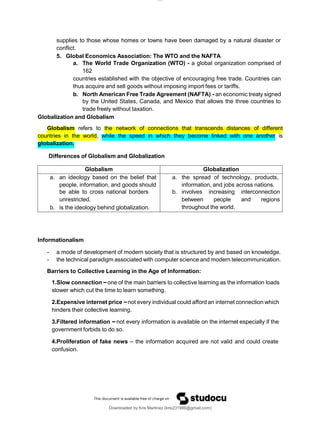
Globalization and Globalism
Globalism refers to the network of connections that transcends distances of different
countries in the world, while the speed in which they become linked with one another is
globalization.
Differences of Globalism and Globalization
Globalism Globalization
a. an ideology based on the belief that
people, information, and goods should
be able to cross national borders
unrestricted.
b. is the ideology behind globalization.
a. the spread of technology, products,
information, and jobs across nations.
b. involves increasing interconnection
between people and regions
throughout the world.
Informationalism
- a mode of development of modern society that is structured by and based on knowledge.
- the technical paradigm associated with computer science and modern telecommunication.
Barriers to Collective Learning in the Age of Information:
1.Slow connection –one of the main barriers to collective learning as the information loads
slower which cut the time to learn something.
2.Expensive internet price –not every individual could afford an internet connection which
hinders their collective learning.
3.Filtered information –not every information is available on the internet especially if the
government forbids to do so.
4.Proliferation of fake news – the information acquired are not valid and could create
confusion.
lOMoARcPSD|14695909
Downloaded by Kris Martinez (kris231986@gmail.com)
Global Citizenship
- a moral and ethical disposition that can guide the understanding of individuals or groups
of global contexts, and remind them of their relative responsibilities and various
communities (Caecilla Johanna Van Peski).
- the umbrella term for social, political, environmental, and economic actions of globally
minded individuals and communities on a worldwide scale.
- refers to the belief that individuals are members of multiple, diverse, local and non-local
networks rather than single actors affecting isolated societies. Promoting global citizenship
in sustainable development will allow individuals to embrace their social responsibility to
act for the benefit of all societies, not just their own.
lOMoARcPSD|14695909

contemporary-world-the-global-interstate-system.pptx

  • 1.
    Studocu is notsponsored or endorsed by any college or university Downloaded by Kris Martinez (kris231986@gmail.com) Contemporary World - THE Global Interstate System College of education (Don Honorio Ventura Technological State University) lOMoARcPSD|14695909
  • 2.
    CONTEMPORARY WORLD THE GLOBALINTERSTATE SYSTEM Interstate System - a theoretical system of contending and cooperating states. This is generally referred to as the international system by political scientists, and it is the primary focus of the study of International Relations. - responsible for the promotion of responsible, sustainable, and universally accessible tourism. Organization for Economic Cooperation and Development (OECD) - the leading international organization in the field of tourism, promoting tourism as a driver of economic growth, inclusive development, and environmental sustainability, and providing leadership and support to the sector in advancing knowledge and tourism policies worldwide. it monitors the global economy - It accomplishes these in three ways: and the economies of member countries; it lends to countries experiencing balance-of-payments challenges ; and it provides practical assistance to members. However, here are the four (4) challenges that affect the globalization of governments: 1. Traditional difficulties - include external involvement (i.e., invasion by other countries. For example, when Saddam Hussein was the ruler of Iraq in 1990, he invaded and conquered Kuwait for its oil fields. As a result, he was deposed by an international coalition led by the United States.). 2. National or identity movements - various people with separate identities can reside in different states (e.g., Kurds live in various countries, including Iraq, Iran, and Turkey.). 3. Economics Around the World - the global economy requires states to follow the laws of free-market (neoliberal) capitalism. - Neoliberal economics (also known as neoliberal capitalism) focuses on free trade and the removal of trade barriers. It ensured that governments did not impose restrictions on corporate presence as well as the free flow of cash and jobs. In general, neoliberal economics is viewed as a threat since a state, especially one that is sovereign, is unable to protect its own economic interests. 4. Global Social Movement lOMoARcPSD|14695909 Downloaded by Kris Martinez (kris231986@gmail.com)
  • 3.
    - spontaneous movementsof people or movements that originate from massive grassroots organization. These social movements are transnational, which means they occur across countries and borders. The Relevance of the State Amid Globalization: A state is a distinct political community with its own set of norms and practices that is, to some extent, distinct from other communities. The Four Elements of State: 1. Permanent population - refers to the total number of people alive at a given area within a period (over half a year). 2. Territory - an area of land under the jurisdiction of a ruler or state. 3. Government - the governing body of a nation, state, or community. 4. Sovereignty - the authority of a state to govern itself or another state. Institutions that Govern International Relations 1. The United Nations (UN) - Currently made up of 193 member states, the United Nations (UN) is an international organization founded in 1945. - remains the one place on Earth where all the world’s nations can gather together, discuss common problems, and find shared solutions that benefit all of humanity. - aims at maintaining international peace and security, developing friendly relations among nations and promoting social progress, better living standards and human rights. 2. The International Court of Justice (ICJ) - Sometimes known as the World Court. This is a court of justice where countries can settle conflicts, as well as a location where war criminals and rulers who have done awful things to their people can be tried for their crimes. - a continuing and autonomous body that is permanently in session. - Its seat is at The Hague, but sessions may be held elsewhere when the court Downloaded by Kris Martinez (kris231986@gmail.com) considers it desirable to do so. The official languages of the court are French and English. - 3. North Atlantic Treaty Organization (NATO) a defense treaty or military alliance formed by the United Nations, Canada, and 25 European countries. - The countries in this group effectively decided to combine their military and announce to the world that if one of its members is messed with, the other countries will come to their support. 4. Non-Government Organizations (NGOs) - Organizations that are not affiliated with any country. This enables them to operate freely all around the world. They give emergency help such as food, water, and medical lOMoARcPSD|14695909
  • 4.
    supplies to thosewhose homes or towns have been damaged by a natural disaster or conflict. 5. Global Economics Association: The WTO and the NAFTA a. The World Trade Organization (WTO) - a global organization comprised of 162 countries established with the objective of encouraging free trade. Countries can thus acquire and sell goods without imposing import fees or tariffs. b. North American Free Trade Agreement (NAFTA) - an economic treaty signed by the United States, Canada, and Mexico that allows the three countries to trade freely without taxation. Globalization and Globalism Globalism refers to the network of connections that transcends distances of different countries in the world, while the speed in which they become linked with one another is globalization. Differences of Globalism and Globalization Globalism Globalization a. an ideology based on the belief that people, information, and goods should be able to cross national borders unrestricted. b. is the ideology behind globalization. a. the spread of technology, products, information, and jobs across nations. b. involves increasing interconnection between people and regions throughout the world. Informationalism - a mode of development of modern society that is structured by and based on knowledge. - the technical paradigm associated with computer science and modern telecommunication. Barriers to Collective Learning in the Age of Information: 1.Slow connection –one of the main barriers to collective learning as the information loads slower which cut the time to learn something. 2.Expensive internet price –not every individual could afford an internet connection which hinders their collective learning. 3.Filtered information –not every information is available on the internet especially if the government forbids to do so. 4.Proliferation of fake news – the information acquired are not valid and could create confusion. lOMoARcPSD|14695909 Downloaded by Kris Martinez (kris231986@gmail.com)
  • 5.
    Downloaded by KrisMartinez (kris231986@gmail.com) Global Citizenship - a moral and ethical disposition that can guide the understanding of individuals or groups of global contexts, and remind them of their relative responsibilities and various communities (Caecilla Johanna Van Peski). - the umbrella term for social, political, environmental, and economic actions of globally minded individuals and communities on a worldwide scale. - refers to the belief that individuals are members of multiple, diverse, local and non-local networks rather than single actors affecting isolated societies. Promoting global citizenship in sustainable development will allow individuals to embrace their social responsibility to act for the benefit of all societies, not just their own. lOMoARcPSD|14695909